Happy Clients
Technologies Expertise
Projects Delivered
Awards Won
Modern agribusinesses face various challenges that require immediate urgency for upholding high business standards in the paradigm of agriculture:
IoT systems lose their effectiveness due to the hindrance in timely insights stemming from lagging internet connectivity.
How Suffescom Resolves It
✅ Develop apps that work despite network failure.
✅ Enable local data storage and real-time synchronization.
✅ Utilize cloud-based data management to make connectivity reliable and workable.
Steepening hacking techniques can trigger security lapses, leading to financial loss and hindering clients' trust.
How Suffescom Secures It
✅ Ensure strong end-to-end encryption.
✅ Adheres strictly to compliance standards.
✅ Provide robust access control.
Even the most advanced solutions fail if the clients cannot operate them. Designing intuitive and easy-to-use applications is imperative in the modern agricultural ecosystem.
How Suffescom Eliminates It
✅ Develop straightforward and intuitive UI/UX designs.
✅ Offer a simple user guide to inform them before application usage.
✅ Prioritize mobile-first designs.
Most IoT systems fail to adapt to technology scalability, leading to lagging dashboards or delayed analytics, which can inhibit operational efficiencies.
How Suffescom Scales It
✅ Rely upon cloud-native architecture to help businesses scale their systems as per their needs.
✅ Design high-performing dashboards with quantified outcomes.
✅ Providing regular real-time system updates.
IoT hardware needs to remain accurate, durable, and functional in unpredictable weather conditions. Faulty sensors = inaccurate data = poor decisions!
How Suffescom Handles It
✅ Integrate rugged, weather-proof sensors.
✅ Build remote diagnostics to help businesses fix faulty systems via app comfort in real-time.
✅ Perform app updates to ensure its relevancy in tackling complex technical issues.
The typical IoT devices, such as soil sensors and weather stations, require smoother interoperability for the farmers to make timely, data-driven decisions. In many cases, these IoT devices work in isolations, limiting timely, data-driven decisions.
How Suffescom Simplifies It
✅ Builds unified platforms that collect data across all devices.
✅ Minimize load-consuming and irrelevant functionalities.
✅ Develop high-performing APIs to form a connecting link between devices.
| Metric | Traditional Farming Methods | IoT Agriculture (Smart Farming) |
|---|---|---|
| Decision Making | Based on experience, intuition, and manual observation | Data-driven decisions using real-time sensor data and AI insights |
| Crop Monitoring | Manual field inspection (time-consuming, limited coverage) | Continuous real-time monitoring via IoT sensors, drones, and dashboards |
| Water Usage (Irrigation) | Fixed schedules, often leading to over/under watering | Smart irrigation based on soil moisture + weather data |
| Yield Prediction | Approximate estimation using past seasons | AI/ML-based predictive analytics using live farm data |
| Pest & Disease Detection | Visible symptoms noticed at a later stage | Early detection using IoT sensors + computer vision |
| Labor Dependency | High manual labor requirement | Automation of monitoring, irrigation, and alerts |
| Resource Efficiency (Fertilizer, Water, Energy) | Often overused due to lack of precision | Optimized usage based on real-time soil and crop needs |
| Farm Connectivity | Fragmented systems, little to no integration | Unified IoT platforms integrating all devices and data |
| Scalability | Difficult to scale due to manual processes | Easily scalable via cloud-based IoT architecture |
| Data Availability | No structured data collection | Continuous data collection, storage, and analysis |
| Risk Management | Reactive approach (damage after occurrence) | Predictive + preventive alerts for weather, disease, equipment failure |
| Operational Cost | Higher due to inefficiencies and wastage | Lower due to automation and precision control |
| Sustainability Impact | Higher resource wastage and environmental strain | Precision usage reduces environmental footprint |
We have established our presence across a wide range of agricultural and allied industries, stepping beyond conventional farming setups. Our IoT-based agriculture solutions are actively used in real-world scenarios to solve critical farming challenges and drive measurable outcomes:
• Soil Health Monitoring
• Precision Irrigation Management
• Crop Growth Tracking
• Fertilizer Application Optimization
• Pest and Disease Detection
• Real Time Weather Forecasting
• Frost and Drought Alert Systems
• Greenhouse Climate Control
• Air Quality and Humidity Monitoring
• Flood and Water Level Detection
• Livestock Health and Activity Tracking
• Automated Feeding Systems
• Water Usage and Conservation Monitoring
• Energy Consumption Management
• Farm Equipment and Machinery Tracking
• Crop Yield Prediction and Forecasting
• Post Harvest Quality Monitoring
• Cold Chain and Storage Management
• Farm to Market Logistics Tracking
• Regulatory Compliance and Reporting Automation
The cost of developing an IoT agriculture application depends on numerous factors, such as product/service demand, complexity levels, and geographic inflation. These factors when combined provide a comprehensive picture of the overall expenses:
| Complexity Level | Estimated Cost (USD) | What It Includes |
|---|---|---|
| Basic IoT Agriculture App (MVP) | $10,000 – $25,000 | Basic crop monitoring, limited IoT integration, simple dashboard |
| Mid-Level IoT Agriculture App | $30,000 – $90,000 | Multi-device integration, smart irrigation, real-time analytics |
| Advanced / Enterprise IoT Agriculture App | $100,000 – $300,000+ | AI/ML models, predictive analytics, large-scale automation |
| Full IoT Ecosystem (General Range) | $20,000 – $200,000+ | End-to-end system including hardware + cloud + app |
| Agriculture-Specific Moderate App | $40,000 – $120,000 | Sensors, weather tracking, predictive insights |
Smart agribusinesses are investing to transition from experience-based farming to data-backed, automated methods.
As a premier IoT agriculture app development company, we aim to integrate features backed by data-driven insights that precisely address the users’ core agricultural demands:
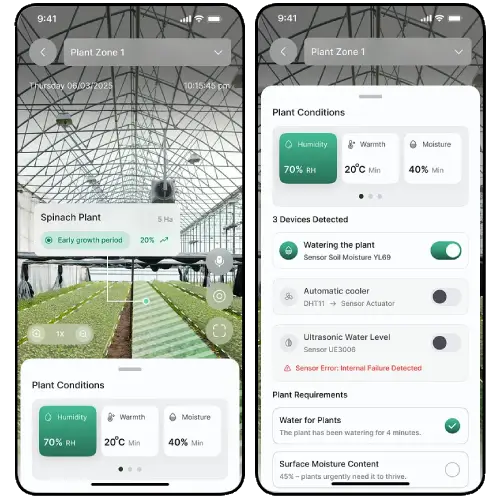
Our IoT-based agriculture solutions help farmers to assess soil conditions, plant health, irrigation needs, pest infestations, and livestock handling. This provides farmers with granular, real-time data visibility without the need to perform manual inspection.
Our advanced IoT-enabled techniques help gather data from multiple sensors and then send them to the cloud for analysis to deliver precision predictions, helping businesses to take prompt, strategic decisions.
Our state-of-the-art predictive maintenance methods help businesses to prevent device failure, mitigate downtime, and save costly breakdowns well in advance. We help minimize equipment failures during critical harvesting seasons.
Our tailored IoT-enabled solutions assist farmers in saving exorbitant bills on electricity, fuel, and water through smart farming app development. This approach significantly lowers operations costs while promoting sustainable environmental practices.
Our customized agriculture IoT-solutions instil unmatched compatibility and coordination between different devices, software, and hardware. This scalability factor aims to accommodate more devices for enhanced functionalities without impacting the system performance.
Suffescom delivers solutions that impart more than just offering businesses their tangible ROI. We address each element of agriculture ecosystems with customized and data-backed solutions.
Boost precision farming techniques with IoT-based agriculture solutions for data-driven decisions, transcending the conventional guessworks. Incorporate each aspect of data analysis to streamline critical business decisions through precision farming software.
Perform irrigation only when it truly matters by leveraging real-time soil moisture and weather sensor data for automating water delivery. Inhibit water waste and utilize that source into other loopholes, such as crop expansion and productivity optimization.
Enhance business productivity by fetching livestock-related data from IoT devices to track animal health, location, breeding cycles, and behavioral anomalies. Stand as the pioneer in curbing manual effort and unexpected losses.
Automate temperatures, humidity, CO2 levels, ventilation, and lighting control via a single device accessible at the user's comfort. Emerge as the eco-sustainable business leader!
Transform raw sensor data into actionable intelligence through AI-powered analytics and seamless IoT farming app development. Access unified dashboards with every critical parameter under one screen.
The Internet of Things (IoT) is a dynamic ecosystem that incorporates multiple tools and applications, including software, sensors, hardware, and connectivity solutions. The tech stack of IoT farming software development includes a broad array of platforms for building, deploying, and maintaining IoT applications:
We facilitate a systematic approach that caters to the needs of every farmer and agribusiness:
1
Our process begins with identifying the target audiences, determining project scope, budget, and timeline, and choosing the deployment model (cloud, hybrid, or edge).
2
We then create user personas, design wireframes, and build interactive prototypes to test the IoT in agriculture app features in replicated real-world scenarios.
3
With everything in place, we deploy cloud infrastructure by building IoT gateways, developing RESTful APIs, creating cross-platform mobile and web apps with real-time alerts, dashboards, GPS, and geofencing.
4
Later, we integrate ML models for crop yield prediction, computer vision for pest detection, blockchain for supply chain traceability, and agriculture automation app development for irrigation and greenhouse control.
5
We don’t deploy the final application straightaway! We perform unit, integration, security, and real-field pilot testing beforehand to navigate their streamlined launch.
6
Post-deployment, we monitor system uptime and device health, push OTA firmware updates, collect user feedback, scale infrastructure, upgrade AI models, and integrate emerging technologies like 5G and Digital Twins through IoT farming software development techniques.
We have a team of high-profile developers with immense farming expertise and robust technological understanding. These professionals can easily transform your vision into game-changing business results.
We holistically devise full-stack solutions that address all dimensions of business needs. Our solutions are created to target user needs and provide the transformative value they deserve.
Our verified portfolio and client recognition speaks our success story! Over a decade, we have been offering unmatched performance and continuing to set new benchmarks in excellence.
Whatever solutions we create undergo stringent security compliances to ensure your valuable data is thoroughly safeguarded and can easily accommodate scaling user frequency and data volume.
We strive for long-term client relationships. Each solution we develop has satisfaction, reliability, and performance integrated with bold innovation.
This can be performed using granular data that, when combined with Machine Learning (ML) and Artificial Intelligence (AI), converts agriculture from a reactive to a proactive process.
Yes, you can customize an IoT agriculture app for your business needs by tailoring functionality, UI, and data analytics to your distinctive workflows. These include managing greenhouse conditions, livestock, and specific crops.
Yes, IoT agriculture apps can easily integrate with existing farm systems. Rather than replacing the existing machines to match the rising business demands, they can be automated and integrated with advanced IoT functionalities, such as live tracking and automated alerts.
The key devices include soil moisture/pH sensors, weather stations, automated irrigation controllers, livestock wearables, GPS-enabled drone systems, and autonomous machinery.
Developing an IoT agriculture app at the top IoT agriculture app development company generally ranges from $10,000 to over $100,000, depending upon complexity, features, and project scale. The other factors impacting this pricing model, including regional inflation rates, service demand, and rising infrastructural needs.
Yes, IoT agriculture apps are equally suitable for small farms. While early IoT solutions were designed for large-scale operations, modern technologies, especially those utilizing low-power, long-range networks like LoRaWAN, offer affordable, easy-to-deploy options for smaller, specialized, or local farming operations.
Fret Not! We have Something to Offer.