+971-8000321216



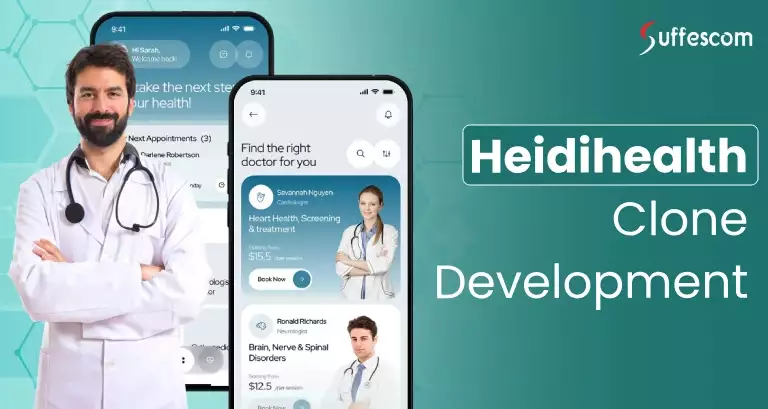
Since its launch, Heidi has reshaped how clinicians handle administrative work in the healthcare industry. This AI-powered medical scribe platform can automate core documentation tasks that consume an enormous portion of clinicians' time. Heidi's rapid growth reflects both high practical utility and strong global adoption. According to Wikipedia, it processes over 2 million patient consultations per week across more than 100 countries. Its main user base spans Australia, the US, the UK, Canada, New Zealand, France, Spain, Germany, and Singapore, indicating its strong foothold and inspirational success. This large scale of global usage also underscores the documentation burden that healthcare systems face worldwide.
If you are a business owner or entrepreneur inspired by Heidi's success and want to enter this space by building an app similar to Heidi Health, our clone development gives you an easy, fast, and affordable way to do so.
Here we are covering everything you need to know to build an app like Heidi, from key features, development timeline, to estimated costs, so you can launch your solution faster and without draining your budget.
Build Your Heidihealth Clone With Our Experts
Why Are Businesses Rushing to Create AI Tool Like Heidi Health?
In traditional clinical workflows, physicians spend a significant portion of their time on patient documentation and transcription, which reduces time available for direct patient care. AI medical scribes like Heidi Health address this challenge by leveraging advanced speech recognition, medical NLP, and large language models (LLMs) to automate clinical note generation with high accuracy and efficiency.
Following are the key validated factors that contribute to its growing trust, adoption, and popularity among healthcare startups and providers building similar solutions:
- The AI clinical documentation market is projected to cross $5.5 billion by 2030.
- The platform gained 7K organic traffic to over 100K organic traffic globally.
- Quickly to launch and automatically creates clinical notes during/after consultations.
- Helps doctors maintain better work-life balance.
- Notes can be directly added to electronic health records, preventing mistakes during manual note-taking.
- Doctors can attend to more patients than spending time on manual doc preparation.
If you're planning to build an AI solution similar to Heidi Health, current market conditions are highly favorable. AI infrastructure costs are decreasing, LLM capabilities are rapidly maturing, and healthcare organizations are actively seeking trusted automation partners to optimize clinical workflows.
Key Features in Our Heidihealth Clone
Our Heidi clone development is designed to create an enhanced, adaptive version of the Heidi app. It goes beyond a simple copy by providing additional customization, scalability, and even performance improvements.
The platform automates clinical documentation, enabling healthcare providers to save time, improve accuracy, and focus on patient care. We can enable the following key features during AI care partner development, like Heidihealth:
Real Time AI Transcription
We can build your Heidihealth clone to capture clinician-patient conversations instantly and accurately, converting speech into text for live documentation without interrupting the natural flow of consultations.
Automated Clinical Note Generation
Ability to transform recorded consultations into structured clinical notes ready for patient records, reducing hours of manual writing while ensuring accuracy and compliance.
Referral Letters Creation
Automatically generates professional referral letters for specialists or other healthcare providers, formatted according to standard clinical and institutional guidelines.
Patient Summaries
Creates concise, structured patient summaries highlighting diagnoses, treatments, and progress, simplifying information sharing between providers and improving continuity of care.
Speciality-Specific Templates
Includes pre-built templates for various medical specialties, allowing clinicians to document visits efficiently without losing critical details.
Multilingual Support
Supports over 100 languages, enabling clinicians to document consultations in multiple languages and improving accessibility for international or multicultural patient populations.
Analytics Dashboard
Provides insights into clinician workflow, consultation times, and documentation efficiency, helping healthcare organizations optimize productivity and resource allocation.
Security & Compliance
HIPAA, GDPR, and ISO-compliant storage and encryption ensure that patient data is protected and that your app meets global regulatory standards.
Cloud Storage & Backup
Automatically stores all documentation securely in the cloud, with redundant backups and easy retrieval, protecting data from loss or system failure.
Automated Billing & Coding Suggestions
Suggests ICD and CPT codes based on consultation content, streamlining billing processes and reducing errors in insurance documentation.
Voice Commands
Enables hands-free control of the app, allowing clinicians to navigate, annotate, and finalize notes using simple voice commands.
Customizable Workflow Options
Adapt the app's features, templates, and documentation flow to match your clinic or hospital's unique processes.
Integration with EHR Systems
Smoothly integrates with popular EHR platforms such as Epic, and Cerner to ensure notes and summaries are updated directly in patient records.
Multi-Device Sync
Ensures that all patient notes, summaries, and templates remain consistent and accessible across devices in real-time.
Offline Mode
Allows clinicians to continue documenting consultations without internet connectivity, with automatic synchronization when back online.
Audit & Compliance Logs
Tracks all edits, submissions, and accesses for accountability, supporting regulatory audits and clinical governance requirements.
Push Notifications & Alerts
Sends timely reminders for pending notes, upcoming consultations, or follow-ups, helping clinicians stay organized and compliant.
Data Export & Reporting
Provides options to export notes, reports, and analytics in multiple formats (PDF, CSV, Excel) for audits, research, or institutional reporting.
Secure Messaging
Built-in HIPAA-compliant messaging allows clinicians to communicate about patients securely without leaving the platform.
Customizable AI Models
Enables training the AI on your institution's style, vocabulary, and workflow preferences for improved note accuracy and efficiency.
Continuous Updates & AI Improvements
Regular platform updates enhance features, AI accuracy, and security, ensuring your app remains state-of-the-art and reliable over time.
Launch Your Own AI Medical Scribe Platform in Weeks
Solving Common Limitations in AI Medical Scribe Apps
Our AI care partner development, like Heidihealth, is not based on simply copying an AI medical scribe application. Instead, we focus on creating an enhanced and more adaptable version by identifying areas where the existing platform can be improved. By analyzing real user feedback and industry requirements, we design solutions that address limitations in usability, functionality, performance, and other important aspects.
This enables your app to deliver a more finely tuned user experience and stronger overall performance while still retaining the core value. Below are some commonly reported issues users experience with the existing AI medical scribe apps, along with the solutions we implement in our clone development to overcome them.
| Issues in Existing Platforms | Impact on Users | Our Solution in Clone Development |
| Inconsistent transcription accuracy | Medical conversations can contain complex terminology, and background noises are inevitable, which sometimes leads to inaccurate notes. | We implement advanced speech recognition trained on medical vocabulary and enable customizable AI training to improve accuracy across different clinical environments. |
| Limited workflow customization | Many clinics and hospitals follow different documentation workflows, and limited customization makes the platform harder to adapt across specialties. | Our solution supports fully customizable templates, workflows, and documentation structures, allowing organizations to tailor the app to their specific clinical processes. |
| Performance or stability issues | Users sometimes report crashes, lag, or slow processing during consultations, which can disrupt the documentation process. | We build the platform using optimized cloud infrastructure and scalable architecture to ensure stable performance and smooth real-time transcription. |
| Integration limitations with healthcare systems | Healthcare providers often rely on EHR systems and telehealth tools. Due to limited integrations, productivity is reduced | Our clone development supports broad API-based integrations with EHR systems, telehealth platforms, and hospital management software. |
| Limited offline functionality | When internet connectivity is unstable, clinicians may lose the ability to capture consultation notes efficiently. | We enable offline recording and transcription buffering, allowing consultations to continue and automatically sync once connectivity is restored. |
| Generic documentation templates | Templates do not meet the needs of specialists such as cardiologists, dermatologists, or therapists. | Our platform provides speciality-specific templates and customizable note formats designed for different medical fields. |
| User interface complexity | Busy clinicians require fast and simple tools, and complex interfaces can slow adoption | We focus on clean design with intuitive navigation, ensuring clinicians can start documenting consultations with a minimal learning curve |
| Limited branding and business customization | Many solutions offer limited ability to adapt branding or monetization models. | We allow complete branding control, white-label deployment, and flexible monetization models such as subscriptions or enterprise licensing. |
Competitive Features from Other AI Healthcare Scribe Apps We Enable
| Capability | Heidi | In Our Development |
| Ambient documentation | Available | Available |
| Bidirectional EHR integration | Missing | Available |
| Advanced coding/billing automation | Limited | Available |
| Collaborative note editing | Missing | Available |
| Dynamic specialty templates | Limited | Available |
| Practice automation tools | Missing | Available |
| Advanced analytics | Limited | Available |
As technologies evolve, several platforms have introduced advanced capabilities that go beyond basic transcription and note generation. Our Heidi clone development approach allows you to integrate these additional competitive features. Let's take a look at them:
Deep Bidirectional EHR Integration
What's missing in Heidi: It mostly supports one-way integration, where notes are generated and pushed to the EHR. It cannot automatically pull patient data, such as medications or history, into the note-generation workflow.
Our Solution: We can enable your platform to pull patient history, labs, imaging, and medication lists. Alongside, make sure the app can automatically map note sections into the EHR fields.
Advanced Medical Coding & Billing Automation
What's missing in Heidi: It only provides code suggestions (ICD-10 hints).
Our Solution: We can offer you the following in your clone app to ensure billing workflows remain automated:
- Automated CPT Coding
- Billing compliance checks
- Insurance verification
Real-Time Collaborative Documentation
What's missing in Heidi: Teams can share notes/templates, but cannot edit the same note simultaneously.
Our Solution: We can enable your platform to allow for the following:
- Multiple clinicians are editing a chart at the same time
- Attribution and timestamp tracking.
Highly Dynamic Clinical Templates
What's missing in Heidi: Templates are mostly static and not deeply customized by visit type or patient context.
Our Solution: We can build you a platform that comes with specialty-specific templates that can adapt based on diagnosis and visit type.
Popular Integrations Our Clone Supports
Many AI healthcare solutions fail to gain long-term adoption, not because the technology is weak, but because they struggle to integrate with the core systems clinicians already rely on every day. Hospitals and clinics operate within complex digital ecosystems.
When a new tool cannot work compatibly with these systems, it creates workflow friction and limits real-world usability.
That's why when developing your AI medical scribe platform, we prioritize interoperability and smooth integration from the start. Our development approach focuses on building a flexible architecture that can connect easily with existing healthcare technologies. Below are some of the popular systems and platforms our clone can compatibly work with:
Electronic Health Record (EHR) Systems
EHR integration allows consultation notes, patient summaries, and documentation generated by the AI scribe to automatically sync with patient records. Common EHR systems we support include:
- Epic
- Practice Fusion
- eClinicalWorks
- NextGen Healthcare
- Athenahealth
- Cerner
- Allscripts
We can also implement interoperability standards such as HL7 and FHIR for secure data exchange between healthcare platforms.
Telehealth Platforms
With telemedicine becoming a core part of healthcare delivery, AI scribes must support documentation during virtual consultations. Our platform can integrate with major telehealth systems to capture and structure notes automatically during remote visits.
Popular telehealth integrations include:
- Zoom for Healthcare
- Doxy.me
- Amwell
- Teladoc
- Microsoft Teams Healthcare
- Google Meet for Healthcare
Cloud Infrastructure and Storage
Cloud integration makes sure your platform remains secure and capable of handling large volumes of clinical documentation and AI processing. Supported cloud platforms include:
- Amazon Web Services (AWS)
- Microsoft Azure
- Google Cloud Platform (GCP)
Analytics and Reporting Platforms
Our platform can integrate with the following analytics tools:
- Power BI
- Tableau
- Google Analytics
- Looker
- Custom healthcare dashboards
Platform Compatibility
In today's healthcare environment, clinicians and staff need flexible access to AI-powered tools across multiple devices and platforms. Many existing solutions fail to provide true cross-device support, limiting usability and adoption. But our Heidi clone is designed for complete platform compatibility, ensuring clinicians can use it wherever and whenever they need it.
Cross-Device Functionality
Our clone ensures real-time synchronization across all devices, so notes, templates, and patient records remain consistent whether accessed via desktop, mobile, or browser.
Web Application
Accessible via any modern browser, allowing clinicians and administrators to document consultations, review notes, and manage workflows without installing additional software.
Mobile Applications (Both iOS & Android)
Full-featured apps enable clinicians to capture and generate notes on smartphones or tablets, supporting mobility and bedside care.
Desktop Applications
Robust desktop software for hospitals, clinics, and larger healthcare facilities, providing advanced functionality in a stable, high-performance environment.
Browser Extensions
Lightweight extensions for Chrome and Edge allow quick access to transcription, note generation, and EHR integration directly from the clinician's workflow.
Challenges in Heidi Health Like AI Tool Development And How to Handle Them
Anyone looking to create an AI tool like Heidi Health should know the real obstacles upfront:
- Medical speech accuracy: General speech models struggle with clinical jargon, accents, and exam room noise. Domain-specific fine-tuning on medical datasets is required.
- EHR integration complexity: Legacy systems use HL7 v2, newer ones use FHIR. Supporting multiple EHRs simultaneously requires custom middleware and adds significant time to the build.
- Compliance from Day 1: HIPAA and GDPR cannot be bolted on later. Security architecture, audit logging, and data handling must be designed into the system from the start.
- Specialty-specific accuracy: A cardiology consultation sounds very different from a psychiatric one. Generic models produce poor notes across specialties without specialty-level training data.
- Ongoing model tuning: AI accuracy degrades over time without regular retraining on new clinical language patterns. Budget for this as an ongoing operational cost, not a one-time build.
Technology Stack
| Module | Tech/Tools |
| Audio Capture | Microphones, WebRTC, Android/iOS audio APIs |
| Speech-to-Text | OpenAI Whisper, Vosk, Azure Speech, NVIDIA NeMo |
| Natural Language Understanding | GPT-4, MedPaLM, ClinicalBERT, spaCy + custom medical NER models |
| Note Generation | LLMs (GPT‑4, LLaMA), prompt templates, structured summarization logic |
| EHR Integration | FHIR/HL7 APIs, Epic Bridges, Cerner Millennium APIs |
| Backend/Orchestration | Python/Node.js microservices, FastAPI/Flask, Kubernetes, Docker |
| Cloud | AWS (EC2, Lambda), Azure, GCP, or local GPU servers |
| Privacy & Security | HIPAA-compliant storage (S3, encrypted DB), TLS, audit logging |
| Analytics | Prometheus, Grafana, ELK stack, custom dashboards |
| Frontend | React/React Native, Flutter, web dashboard UI |
Who Should Invest in Heidi Health Like AI Tool Development?
Heidi health like AI tool development is not for every business but for the right ones, the ROI is clear:
- Healthcare Startups: Enter the AI scribe market with a white-label-ready product and a clear monetization model (subscriptions or per-seat licensing).
- Hospital Chains & Clinic Groups: Stop paying per-seat SaaS fees. Owning the platform means full control over data, features, and costs at scale.
- Telemedicine Platforms: Add AI documentation to your existing telehealth product without relying on third-party scribe integrations.
- SaaS Founders: Build once, sell to hundreds of clinics. The recurring revenue model works extremely well in this space.
- Medical Software Agencies: Expand your portfolio into AI-powered clinical tools, which are currently the fastest-growing segment in health tech.
Development Timeline
Creating a Heidi-style AI medical scribe involves multiple stages, from building a minimum viable product to a full custom solution. Here's a rough guide for planning your development timeline and budget.
| Stage | Timeline |
| Strategy | 1 day |
| Core Ambient AI (Speech-to-Text + Basic NLU) | 2–3weeks |
| Note Generation & Templates | 2 weeks |
| Simple EHR Integration (1 system, basic FHIR API) | 2–4 weeks |
| Frontend | 3–4 weeks |
| Testing & Deployment | 2 weeks |
Estimated Cost to Build Heidi Health Like Platform
The cost to build heidi health like platform depends on three main variables: the AI model you use (off-the-shelf vs. custom-trained), the number of EHR systems you integrate, and whether you build for one specialty or multiple.
Here's what drives costs beyond the MVP:
| Add-On | Estimated Cost |
| Custom medical NLP model training | $10,000 – $15,000 |
| Multi-EHR integration (3+ systems) | $15,000 – $20,000 |
| HIPAA audit + compliance layer | $20,000 – $25,000 |
| Mobile apps (iOS + Android) | $15,000 – $25,000 |
| Annual maintenance & AI tuning | $8,000 – $20,000 |
You can get started with an MVP version, which starts at just $10k and goes up to $15k.
- Talk to our expert for a free consultation to:
- Define your project scope
- Discuss scalability and future expansion
- Get insights on the exact features you need, timeline to build it, and cost
Get The Exact Price To Make Your AI Medical Scribe Platform
Why Choose Our Clone Development?
Here's why our clone development services are trusted by healthcare organizations globally.
1. No Vendor Lock-In & Full IP Ownership
Take complete control of your AI platform without dependency on external vendors.
- Full ownership of source code and AI models
- No restrictive licensing or subscription obligations
- Freedom to modify, scale, or pivot your solution
2. Unlimited Customization
Adapt the platform to your practice's workflows, branding, and templates to suit every clinical and operational need.
- Customize UI/UX and clinician workflows.
- Create specialty-specific logic, and rules can be implemented.
3. End-to-End Services
We support you through every stage of development, deployment, and post-launch optimization.
- AI strategy, ambient NLP, and speech-to-text development
- Deployment and EHR integration with FHIR/HL7 systems
- Post-launch AI tuning and workflow optimization
4. Extensive Healthcare Industry Experience
Our team has deep expertise in building HIPAA-compliant AI healthcare software that integrates smoothly with clinical workflows.
- Years of experience in healthcare software development
- Knowledge of compliance, patient privacy, and EHR systems
- Focus on improving clinician efficiency and patient care
5. Recognized Achievements
We have a proven track record with global clients, certifications, and industry recognition.
- Over 13 years of experience delivering digital products
- ISO 9001 & ISO 27001 certified
- Top-rated healthcare app development on Clutch (4.9/5)
- Multiple awards for AI and healthcare innovation
Bottom Line!
There is enormous potential for innovation in developing Heidi-style AI medical scribe solutions. Healthcare organizations constantly need smarter tools to reduce clinician workload and improve patient care. With our clone app development services, you get more than a fast, cost-effective launch. You can design a platform tailored to your exact requirements, from workflows and templates to branding and specialty logic. As an experienced software development agency, we help entrepreneurs and healthcare startups build solutions without vendor lock-ins, restrictive licensing, or limited customization.
By discussing your goals, requirements, and budget with our experts, we can help you target the right market segment for your platform, define an effective revenue model, and plan the clone development to meet real-world clinician needs. Talk to our expert and get actionable guidance on building a Heidi-style clone that aligns perfectly with your vision and market strategy.
FAQs
Is the app HIPAA compliant?
We design the platform following HIPAA-compliant software development practices to ensure that protected health information is handled securely. This includes:
- Encrypted data storage
- Secure access controls
- Audit logging
- Strict authentication mechanisms
Is the audio recording encrypted?
All audio recordings and generated documentation are protected using end-to-end encryption and secure storage mechanisms.
We implement multiple layers of protection:
- TLS encryption for audio data during transmission
- Full audit logging for every access or modification
- AES-256 encryption for stored audio files and documentation
- Controlled access permissions for clinicians and administrators
- Secure cloud storage environments on platforms like Amazon Web Services or Microsoft Azure
Can it work with telehealth tools like Zoom for Healthcare or Microsoft Teams?
The platform can integrate with major telehealth and communication tools so clinicians can automatically capture and document virtual consultations.
We also support integrations with platforms such as:
- Google Meet
- Doxy.me
- Microsoft Teams
- Zoom for Healthcare
What features are included in the MVP?
The MVP focuses on the core capabilities required to launch an AI medical scribe platform quickly. The exact features included in the MVP depend on your target market, clinical workflow requirements, and integration needs. Since every healthcare startup or organization has different priorities, we typically define the MVP scope based on the specific problem you want to solve first.
During a consultation, our team will help you determine the essential features required to launch quickly while keeping development costs efficient. Book a free strategy session with our expert now!
How much does a production-ready version cost?
The best way to get an accurate estimate is to book a free consultation with our team. During this session, we will discuss your requirements, recommend a feature set, and provide a clear cost and timeline estimate for building a productive, ready Heidi Clone