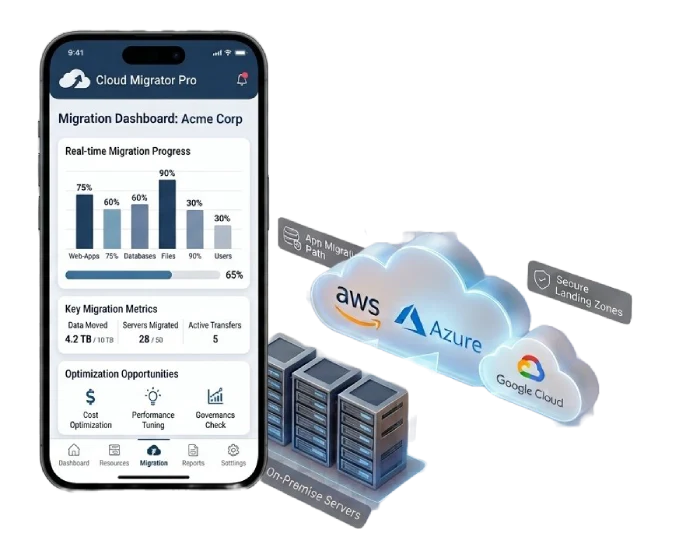
Cloud Migration Services We Offer

Our cloud migration services help businesses transition workloads into cloud environments with a proven approach.

Cloud Migration Consulting

Our cloud migration consulting starts with a complete assessment of your current IT environment. Our cloud migration consultant finds all dependencies and creates a migration plan based on priorities.

  • Cloud Consulting to check infrastructure readiness and find workloads suitable for migration.
  • Complete Migration Strategy Development to define the best migration approach for workloads.
  • Cloud Architecture Planning to design an environment completely aligned with performance and security needs.
  • Migration Roadmap Development to organize migration activities into practical phases with clear priorities.
  • Risk and Dependency Assessment to identify potential cloud migration challenges before execution.

Application Migration

Application migration requires more than moving workloads into a new environment. Our team evaluates application behavior and dependencies to select an approach that limits disruption.

  • Application Discovery and Assessment to identify technical dependencies and migration requirements.
  • On-Premise to Cloud Migration to move applications into suitable cloud infrastructure with controlled disruption.
  • Application Rehosting to transfer suitable workloads with minimal changes to the existing codebase.
  • Application Replatforming to adapt workloads for managed cloud services without complete redevelopment.
  • Application Testing and Cutover to validate functionality before production deployment.

Cloud Data Migration

Data often contains critical business information that cannot tolerate loss or corruption. Our cloud data migration services use controlled processes to protect data throughout the transition.


  • Database Migration to transfer business databases into suitable cloud database environments.
  • Data Discovery and Assessment to identify data dependencies and migration requirements.
  • Secure Data Transfer to move sensitive information through controlled migration processes.
  • Data Synchronization to keep target environments completely aligned during phased migration.
  • Data Validation and Reconciliation to verify migrated data for completeness and accuracy.

Infrastructure Migration

Infrastructure migration changes the foundation on which business applications operate. Our engineers plan each move around workload requirements to maintain reliable operations after deployment.

  • Server Migration to move physical and virtual workloads into cloud compute environments.
  • Storage Migration to transfer business files and application storage into suitable cloud platforms.
  • Network Migration to establish secure connectivity for workloads running in the cloud.
  • Infrastructure Dependency Mapping to identify relationships that could affect the migration process.
  • Post-Migration Infrastructure Validation to verify connectivity and infrastructure performance after deployment.

Cloud Migration Engineering Services

Our cloud migration engineering services turn the migration strategy into an operational cloud environment. Engineers handle implementation details and resolve technical issues that arise during execution.

  • Cloud Environment Provisioning to configure the infrastructure required for migrated workloads.
  • Migration Automation to reduce repetitive tasks through appropriate cloud migration tools.
  • Infrastructure as Code to create repeatable configurations for consistent cloud deployments.
  • Integration Engineering to connect migrated workloads with existing business systems.
  • Cloud Security Engineering to implement access controls and encryption based on workload needs.

Cloud Modernization

Legacy applications can carry architectural limitations that simple migration cannot resolve. Our modernization approach identifies areas that need improvement before workloads settle into the cloud.

  • Legacy Application Modernization to address outdated components that limit cloud adoption.
  • Application Replatforming to move suitable workloads onto managed cloud services with limited code changes.
  • Application Refactoring to restructure selected components for improved maintainability.
  • Application Containerization to package suitable workloads for consistent cloud deployment.
  • Cloud-Native Architecture to introduce modern cloud patterns where they provide technical value.

AWS Cloud Migration Services

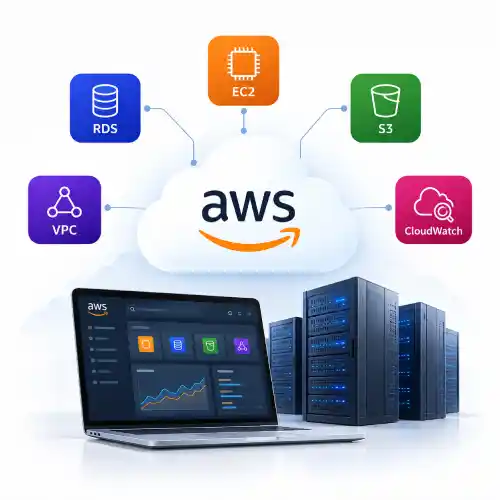
Our AWS cloud migration services support businesses moving workloads to Amazon Web Services. We align the target setup with application requirements and the existing technology landscape.

  • AWS Migration Assessment to identify workloads that are suitable for AWS adoption.
  • AWS Application Migration to move eligible applications into appropriate AWS environments.
  • AWS Database Migration to transfer supported databases using suitable AWS services.
  • AWS Infrastructure Configuration to establish the cloud resources required for migrated workloads.
  • AWS Post-Migration Optimization to improve resource utilization and operational efficiency.

Azure Cloud Migration

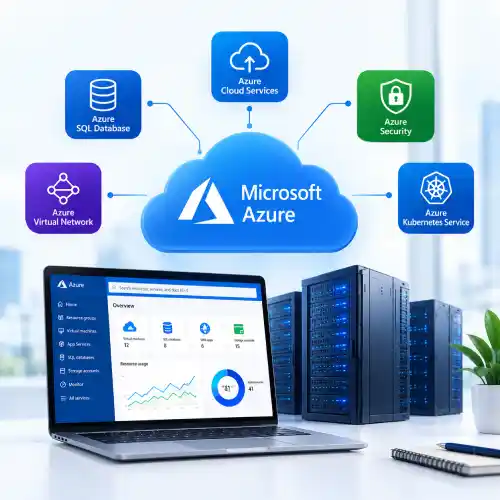
Our Azure cloud migration services support organizations adopting Microsoft Azure for their workloads. We consider existing Microsoft technologies and application dependencies before defining the migration approach.

  • Azure Migration Assessment to evaluate workloads before their transition to Azure.
  • Azure Application Migration to move suitable applications into Azure environments.
  • Azure Database Migration to transfer supported databases into appropriate Azure services.
  • Azure Infrastructure Configuration to establish the cloud resources required for workloads.
  • Azure Post-Migration Optimization to improve resource utilization after deployment.

Enterprise Cloud Migration

Large migration programs involve dependencies that can span multiple applications and teams. Our enterprise cloud migration approach uses controlled phases to keep complex transitions manageable.

  • Enterprise Application Portfolio Assessment to evaluate workloads based on technical complexity and business importance.
  • Migration Wave Planning to organize related workloads into manageable migration phases.
  • Hybrid Cloud Architecture to connect cloud workloads with existing infrastructure where required.
  • Enterprise Cloud Security to establish access controls and security measures across migrated workloads.
  • Migration Governance and Validation to maintain consistent testing and approval processes throughout the program.

Cloud Migration Support & Optimization

Migration does not end when workloads reach production. Our cloud migration managed services help teams maintain the environment and respond to changing operational requirements.

  • Post-Migration Monitoring to track workload health and infrastructure performance.
  • Cloud Cost Optimization to identify unused resources and inefficient configurations.
  • Cloud Performance Optimization to improve resource utilization based on actual workload behavior.
  • Cloud Security Reviews to identify configuration and access issues after migration.
  • Ongoing Cloud Support to resolve operational issues and support future cloud changes.

Our Portfolio of Successful Cloud Migration Projects

We help businesses migrate applications, infrastructure, and data to cloud environments through controlled migration strategies designed around workload requirements, security, performance, and business continuity.

Cloud migration for manufacturing enterprise

Cloud Migration for a Manufacturing Enterprise

Business Requirement: A manufacturing enterprise was operating important workloads on aging infrastructure. Rising maintenance requirements made the environment harder to manage. The business needed a reliable cloud migration strategy that could improve infrastructure management without affecting production operations.

Solution: Suffescom checked the current environment and mapped workload dependencies before creating a complete migration plan. We migrated applications and infrastructure into a cloud environment with controlled cutovers. Our team provided post-migration monitoring to help the team track performance and resource utilization.

Outcomes:

41% reduction in infrastructure maintenance effort

34% improvement in application availability

28% faster infrastructure provisioning

View Case Study
Cloud data migration for financial services business

Cloud Data Migration for a Financial Services Business

Business Requirement: A financial services company maintained business data in different legacy database environments. Data access was becoming very difficult as storage requirements increased. The business required a secure migration approach that could improve data availability without changing dependent applications.

Solution: Our company planned the cloud data migration around application dependencies and database workloads. We transferred chosen databases into a managed cloud environment and incorporated validation checks. Data synchronization helped maintain continuity during the transition.

Outcomes:

44% faster data access

36% reduction in database management effort

30% improvement in data availability

View Case Study
Application migration for logistics company

Application Migration for a Logistics Company

Business Requirement: A logistics company relied on applications running across aging on-premises infrastructure. Infrastructure limitations affected application deployment and made resource management more difficult. The company wanted to move its core workloads to the cloud without requiring a complete application rewrite.

Solution: Suffescom assessed application dependencies and selected a replatforming approach for suitable workloads. We migrated the applications into a cloud environment and configured the required infrastructure and integrations. Performance monitoring was added to help the operations team track application health after migration.

Outcomes:

38% faster application deployment

32% reduction in infrastructure management effort

27% improvement in application performance

View Case Study

Ready to Move Your Workloads to the Cloud?

Plan your cloud migration with the right strategy, architecture, and execution approach. Talk to our cloud migration experts to assess your environment and identify the right path forward.

Why Migrate to the Cloud?

Cloud migration can address a lot of limitations in legacy infrastructure. The value comes from choosing the best workloads and designing the target environment around actual needs.

Flexible Resource Capacity

Cloud technology makes it possible to boost capacity when workload demand rises. At the same time, it becomes possible to reduce capacity in case the workload demand declines. It helps prevent unnecessary purchase of hardware to address temporary demand.

Stronger Security Controls

Cloud platforms provide centralized controls for identity and access management. Encryption and continuous monitoring can also be applied to many workloads without relying completely on physical infrastructure controls.

Better Application Performance

The workloads that are migrated benefit from utilizing up-to-date computational and storage capabilities tailored to their needs. Teams can also adjust configurations when application behavior changes.

Lower Infrastructure Overhead

Cloud adoption reduces the need to maintain physical servers and supporting infrastructure. It can also lower maintenance requirements and make infrastructure spending easier to manage.

Quicker Infrastructure Provisioning

Cloud resources can be provisioned through automated workflows instead of waiting for physical hardware installation. Development teams can therefore prepare environments faster when new workloads or releases require additional capacity.

Stronger Disaster Recovery

Cloud architecture can replicate very important workloads in separate environments. This provides additional recovery options when an infrastructure failure affects the primary workload environment.

Easier Access to Business Data

Authorized teams can access cloud hosted data through controlled interfaces without depending on a physical location. This can simplify collaboration between teams and connected business applications.

Practical Legacy Modernization

Migration creates an opportunity to address infrastructure limitations inside older applications. Selected workloads can be migrated or re-engineered without replacing the entire set of apps.

6 R’s of Cloud Migration Strategy

Every workload has different requirements. Our cloud migration strategy evaluates application complexity, business value, and technical dependencies to select the most suitable migration approach.

6 R's of Cloud Migration Strategy

01. Rehosting

Rehosting moves applications to the cloud with minimal changes. It suits stable workloads that need faster migration without significant application redevelopment.

Key benefits:
  • Minimal Code Changes
  • Faster Workload Migration
  • Lower Migration Effort

02. Replatforming

Replatforming adapts applications to selected cloud services without major redesign. It improves efficiency and cloud compatibility without rebuilding the entire application.

Key benefits:
  • Managed Cloud Services
  • Limited Application Changes
  • Better Resource Utilization

03. Repurchasing

Repurchasing replaces existing software with a cloud based alternative. It works well when maintaining legacy applications requires significant effort or resources.

Key benefits:
  • SaaS Platform Adoption
  • Reduced Maintenance Effort
  • Faster Technology Transition

04. Refactoring

Refactoring redesigns application components around cloud native architecture. It suits workloads that require better performance, maintainability, and deeper use of cloud capabilities.

Key benefits:
  • Cloud Native Architecture
  • Improved Application Performance
  • Greater Cloud Utilization

05. Retaining

Retaining keeps selected workloads in their existing environment when migration offers limited value. These workloads can be reassessed when business requirements change.

Key considerations:
  • Workload Suitability Review
  • Existing System Management
  • Future Migration Planning

06. Retiring

Retiring removes applications that no longer provide business value. Eliminating obsolete workloads simplifies the migration scope and reduces unnecessary infrastructure requirements.

Key benefits:
  • Legacy System Identification
  • Redundant Workload Removal
  • Lower Infrastructure Costs

Industries Our Cloud Migration Company Serves

At Suffescom, we provide cloud migration services for various industries based on their requirements.

Healthcare

Cloud app modernization for healthcare

Modernize healthcare solutions and infrastructure to support better patient records and clinical workflows.

  • Patient records modernization
  • Clinical workflow modernization
  • Healthcare infrastructure modernization

Fintech

Cloud app modernization for fintech

Update financial platforms with cloud architecture to support transaction processing and secure financial data management.

  • Financial platform modernization
  • Transaction processing modernization
  • Secure financial data management

Real Estate

Cloud app modernization for real estate

Modernize real estate platforms to improve access to property data and streamline business operations.

  • Property data modernization
  • Real estate platform modernization
  • Business operations optimization

Insurance

Cloud app modernization for insurance

Transform outdated insurance software solutions to simplify administration of policies and improve claims processing processes.

  • Insurance software modernization
  • Policy administration modernization
  • Claims processing modernization

eCommerce

Cloud app modernization for ecommerce

Modernize eCommerce platforms to handle changing traffic demands and improve integration with order management systems.

  • eCommerce platform modernization
  • Traffic scalability improvements
  • Order management integration

Logistics

Cloud app modernization for logistics

Upgrade logistics platforms and infrastructure to improve visibility of shipments and connect transportation management systems.

  • Logistics platform modernization
  • Shipment visibility improvements
  • Transportation management integration

Manufacturing

Cloud app modernization for manufacturing

Modernize custom manufacturing platforms and cloud infrastructure to support connected equipment data and improve operational visibility.

  • Manufacturing platform modernization
  • Connected equipment data integration
  • Operational visibility improvements

Retail

Cloud app modernization for retail

Transform retail systems to connect inventory management and point-of-sale applications with centralized cloud platforms.

  • Retail system modernization
  • Inventory management integration
  • Point-of-sale application integration

Automotive

Cloud app modernization for automotive

Modernize automotive platforms and data platforms to support connected vehicle services and improve data exchange across systems.

  • Automotive platform modernization
  • Connected vehicle service support
  • Cross-system data exchange

Agriculture

Cloud app modernization for agriculture

Upgrade agricultural software and data infrastructure to support connected farming systems and improve access to field data.

  • Agricultural software modernization
  • Connected farming system support
  • Field data accessibility improvements

iGaming

iGaming

Support high-volume transactions and improve application performance in all cloud environments by modernizing gaming platforms.

  • High-volume transaction support
  • Gaming platform modernization
  • Cloud application performance improvements

Media & Entertainment

arrow-icon

Upgrade content management and distribution platforms to support efficient media entertainmentprocessing and reliable content delivery.

  • High-volume transaction support
  • Gaming platform modernization
  • Cloud application performance improvements
CLOUD PLATFORM EXPERTISE

Cloud Platforms We Work With

Our cloud migration services support businesses moving applications, databases, and infrastructure to suitable cloud platforms. We assess workload requirements to select the right platform for each migration.

01 Step 1

Amazon Web Services (AWS)

Our AWS cloud migration services help move applications and databases to AWS using infrastructure suited to business workloads.

02 Step 2

Microsoft Azure

Migrate applications and infrastructure to Azure with support for Microsoft-based environments, enterprise workloads, and existing business systems.

03 Step 3

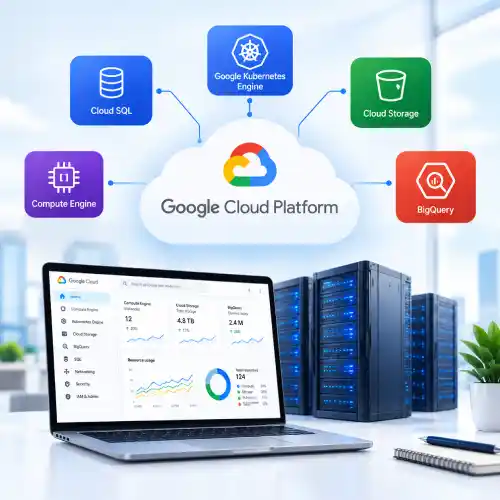
Google Cloud Platform (GCP)

Move applications and data to Google Cloud using services designed for computing, storage, analytics, and application deployment.

04 Step 4

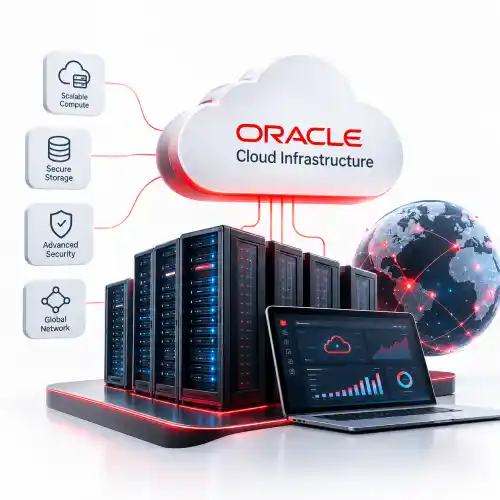
Oracle Cloud Infrastructure (OCI)

Migrate enterprise applications and databases to OCI with infrastructure suited to Oracle workloads and business-critical systems.

05 Step 5

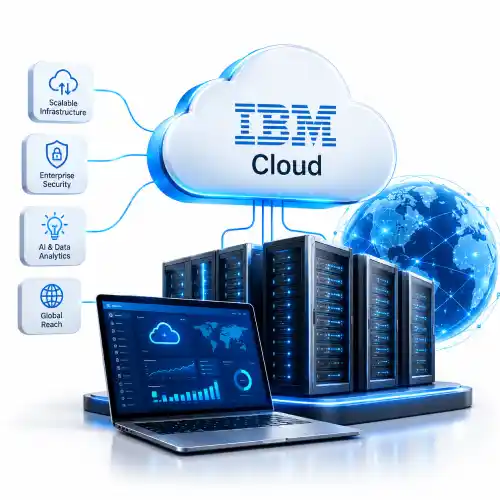
IBM Cloud

Move enterprise workloads to IBM Cloud with support for legacy system integration and existing business infrastructure.

AWS Cloud
AWS Amazon Web Services
01 AMAZON WEB SERVICES
Microsoft Azure
AZURE Microsoft Azure
02 MICROSOFT AZURE
Google Cloud Platform
GCP Google Cloud Platform
03 GOOGLE CLOUD PLATFORM
Oracle Cloud Infrastructure
OCI Oracle Cloud Infrastructure
04 ORACLE CLOUD INFRASTRUCTURE
IBM Cloud
IBM IBM Cloud
05 IBM CLOUD

Planning Your Cloud Migration?

Get expert guidance to assess your infrastructure, choose the right cloud platform, and plan your migration.

Our Transparent Cloud Migration Process

Our cloud migration process provides a structured path for moving workloads to the cloud. Each stage addresses key technical requirements before the next migration phase begins.

Discovery and Assessment

We examine the existing environment to understand workload dependencies. This stage identifies applications that can move to the cloud and highlights migration risks.

Migration Strategy

A migration roadmap defines the approach for each workload. Our cloud migration company prioritizes workloads based on business needs and the required migration timeline.

Cloud Architecture

The target cloud environment is designed around workload requirements. As a trusted cloud migration service provider, we establish the infrastructure foundation needed for security and reliable application performance.

Migration Preparation

At Suffescom, we prepare the environment before workloads move. Required cloud resources are configured and testing procedures are established to reduce issues during migration.

Migration Execution

Workloads are moved through controlled migration phases. Each migration undergoes testing and validation to confirm application functionality before production cutover.

Optimization and Support

After migration, workloads are monitored to identify improvement opportunities. Resource usage is reviewed and technical support helps maintain reliable cloud operations.

Cloud Migration Cost

The cost of cloud migration depends on workload complexity and the amount of infrastructure being moved. Application dependencies and modernization requirements also affect the overall migration investment.

Basic Cloud Migration

USD $15K – $40K

  • Workload assessment
  • Migration planning
  • Basic application migration
  • Data transfer
  • Cloud environment setup
  • Security configuration
  • Migration testing
  • Production deployment
  • Timeline: 1–3 months
  • Post-migration support: 1 Month
Get a Quote

Mid-Level Cloud Migration

USD $40K – $100K

  • Multi-workload migration
  • Application dependency mapping
  • Database migration
  • Cloud architecture
  • Data synchronization
  • Security implementation
  • Integration configuration
  • Performance optimization
  • Timeline: 3–6 months
  • Post-migration support: 2 Months
Get a Quote

Advanced Cloud Migration

USD $100K – $300K+

  • Enterprise workload migration
  • Complex application modernization
  • Large-scale data migration
  • Hybrid cloud architecture
  • Multi-cloud integration
  • Advanced security controls
  • Migration automation
  • Performance engineering
  • Timeline: 6–12+ months
  • Post-migration support: 3 Months
Get a Quote

Cloud Migration Challenges and How Suffescom Addresses Them

Cloud migration can expose hidden dependencies and infrastructure gaps. Our engineers address these issues during assessment so they do not surface during production cutover.

Legacy Application Dependencies

Challenge: Older applications may depend on outdated databases or tightly coupled services. Moving one component without understanding these links can break application workflows.

Solution: Our cloud migration consulting services map application dependencies before migration. Each workload is then assigned the right migration path.

Data Loss During Migration

Challenge: Large databases can change during migration. This creates a risk of mismatched records when the source system remains active.

Solution: Our cloud data migration services use replication and reconciliation checks to keep source and target data aligned before cutover.

Unexpected Cloud Spending

Challenge: A migrated workload can take a lot more cloud resources than planned. Oversized instances and idle resources can instantly increase monthly costs.

Solution: We review workload consumption before deployment. FinOps practices then help right-size resources and remove unnecessary capacity after migration.

Security Gaps After Migration

Challenge: Existing access rules may not translate directly to the cloud. Incorrect permissions can expose workloads or create unnecessary access.

Solution: We configure IAM roles based on actual user and application requirements. Encryption and audit logging are applied to sensitive workloads.

Performance After Cutover

Challenge: An application that performs well on-premises may behave differently after migration. Network latency or unsuitable compute resources can affect response times.

Solution: Our cloud migration engineering services include workload testing before cutover. Engineers tune infrastructure based on observed application behavior.

Hybrid Connectivity Issues

Challenge: On premise to cloud migration often leaves some systems running locally. Poor connectivity can interrupt communication between migrated workloads and retained applications.

Solution: We establish secure network paths between environments. Connectivity is tested before each migration wave reaches production.

See What Clients Say About Us

Hear from businesses that worked with Suffescom on cloud migration, infrastructure modernization, and cloud data migration projects.

CLIENT STORY Suffescom logo Cloud migration client story

Suffescom helped us move our applications to the cloud without major disruption. Their cloud migration services covered each phase, and our team could keep track of the progress. Managing our infrastructure has become much easier since then.

Andrew Bennett
Andrew Bennett Operations Director

We were struggling with rising infrastructure costs and outdated servers. Suffescom helped us migrate to the cloud and review our resource usage. There were a few adjustments after launch, but the team helped us resolve them.

Christopher Hayes
Christopher Hayes Business Operations Manager

Our old database was becoming difficult to maintain. The cloud data migration made data access easier for our team. We also have fewer infrastructure issues to deal with during daily operations.

Matthew Brooks
Matthew Brooks Finance Manager

We needed to move several business applications to the cloud but were concerned about downtime. Suffescom helped us plan the migration and test the applications before launch. The transition went well, and our team is now more comfortable managing the new environment.

Steven Parker
Steven Parker Managing Director

Take the Next Step Toward Cloud Adoption

Move critical workloads to the cloud with a migration approach designed around your existing infrastructure and application requirements.

Why Choose Suffescom for Cloud Migration Services

Suffescom brings strategy and engineering together to handle complex cloud moves. Our cloud migration services focus on reducing disruption and preparing workloads for reliable cloud operations.

Proven Migration Expertise

With over a decade of experience, our team understands application dependencies and infrastructure constraints. This experience helps uncover migration risks before they affect production workloads.

Strategy Built Around Workloads

Each workload needs a different migration path. Our cloud migration consultants identify the best approach based on application architecture and business requirements. We align migration methods with workload dependencies, performance needs, and long-term business goals.

Security Across the Move

Security checks begin before migration. We configure identity controls and encryption to protect workloads throughout the transition. Access policies and security requirements are considered during planning, migration, testing, and cloud deployment.

Better Cloud Cost Control

Cloud spending can rise after migration without proper resource planning. We review usage patterns and help rightsize infrastructure for actual workload needs. This helps businesses avoid unnecessary resources and maintain better control over ongoing cloud costs.

Support After Migration

Migration support continues after deployment. Our cloud migration engineering services help resolve technical issues and improve the new environment as workloads settle. We can also help monitor performance and address issues that emerge after go-live.

Integration With Existing Systems

We ensure migrated workloads work smoothly with existing applications and business systems. Our team manages API connections, integrations, and data flows to maintain operational continuity after migration.

Awards That Showcase Our Excellence

Technology Stack We Use for Cloud Migration

We use proven cloud technologies based on workload requirements. The technology stack can vary depending on the migration approach and target environment.

  • AWS

    AWS

  • Microsoft Azure

    Microsoft Azure

  • Google Cloud

    Google Cloud

  • Oracle Cloud

    Oracle Cloud

  • IBM Cloud

    IBM Cloud

  • AWS Migration Hub

    AWS Migration Hub

  • Azure Migrate

    Azure Migrate

  • Google Cloud Migration Center

    Google Cloud Migration Center

  • CloudEndure

    CloudEndure

  • Docker

    Docker

  • Kubernetes

    Kubernetes

  • Amazon EKS

    Amazon EKS

  • Azure AKS

    Azure AKS

  • Google GKE

    Google GKE

  • Terraform

    Terraform

  • AWS CloudFormation

    AWS CloudFormation

  • Azure Bicep

    Azure Bicep

  • Ansible

    Ansible

  • AWS Database Migration Service

    AWS DMS

  • Azure Database Migration Service

    Azure Database Migration Service

  • Google Database Migration Service

    Google Database Migration Service

  • Oracle GoldenGate

    Oracle GoldenGate

  • Jenkins

    Jenkins

  • GitHub Actions

    GitHub Actions

  • GitLab CI/CD

    GitLab CI/CD

  • Azure DevOps

    Azure DevOps

  • Amazon CloudWatch

    Amazon CloudWatch

  • Azure Monitor

    Azure Monitor

  • Google Cloud Monitoring

    Google Cloud Monitoring

  • Prometheus

    Prometheus

  • Grafana

    Grafana

  • AWS IAM

    AWS IAM

  • Microsoft Entra ID

    Microsoft Entra ID

  • Google Cloud IAM

    Google Cloud IAM

  • HashiCorp Vault

    HashiCorp Vault

Book a 30-Minute Free Cloud Migration Consultation

Discuss your current infrastructure with our cloud migration experts and identify practical next steps for moving your workloads to the cloud.

Frequently Asked Questions

Cloud migration involves moving applications, data, workloads, and infrastructure from on-premises systems to a cloud environment such as AWS or Azure.
Not necessarily. Cloud consulting services can help assess your current infrastructure, applications, costs, and growth needs to determine whether moving to the cloud is worthwhile.
Common cloud migration challenges include data loss, application compatibility, downtime, security risks, integration issues, and unexpected costs.
Applications, databases, websites, storage, virtual machines, and enterprise workloads can be migrated. A cloud migration consultant can identify which workloads are suitable.
A typical migration includes assessing applications, data, and dependencies; selecting the migration strategy and cloud platform; migrating, testing, and validating workloads; and optimizing the environment after deployment.
Cloud migration solutions can improve scalability, availability, deployment speed, disaster recovery, and infrastructure flexibility while reducing dependence on physical servers.
A cloud migration timeline can range from 1 to 12+ months. It depends on workload complexity, data volume, integrations, and business requirements. Simple projects may take weeks, while enterprise cloud migration can take several months.
After migration, workloads are tested, monitored, and optimized for performance and reliability. Ongoing cloud migration managed services can help with monitoring, troubleshooting, security, and optimization.
Cloud data migration services can use encryption, secure transfer protocols, access controls, backups, and monitoring to protect data during migration.
Businesses should address excessive user permissions, unsecured data transfers, misconfigured cloud resources, and weak authentication and monitoring before migration.
Yes. Cloud platforms provide security and compliance capabilities for frameworks such as GDPR, HIPAA, and PCI DSS, when properly configured and managed.
Both platforms offer security, identity, encryption, and compliance capabilities. AWS cloud migration services or Azure cloud migration can be selected based on workload and business requirements.
Cloud migration costs can range from $15,000 to $300,000+. The final cost depends on data volume, workloads, applications, cloud platform, migration strategy, and ongoing support. A cloud migration consulting team can provide a project-specific estimate.
Common approaches include Rehost, which moves workloads with minimal changes; Replatform, which makes limited cloud optimizations; Refactor, which redesigns applications for cloud-native performance; and Retire or Retain for workloads that are unsuitable or unnecessary to migrate.
Yes. Cloud migration managed services can provide architecture, migration, monitoring, and ongoing support without requiring a large in-house cloud team.
Not always. A phased migration can reduce risks by moving workloads gradually, testing each stage, and minimizing business disruption.

Beware of Scams

Don't Get Lost in a Crowd by Clicking X

Your App is Just a Click Away!

Fret Not! We have Something to Offer.