A scalable middleware Order Management System that seamlessly bridges Chili's Malaysia's mobile ordering application with its legacy POS system—without modifying existing infrastructure. Built with intelligent queue management, automated kitchen station assignment, real-time order synchronization, and rate-limited POS integration to improve operational efficiency across multiple restaurant outlets.
Enterprise Middleware Order Management System
Decoupled Event-Driven Middleware
Spring Boot · PostgreSQL · Redis · OAuth2 · Resilience4j · ELK Stack
Production-Ready | Supporting 12+ Restaurant Outlets
About the Client
Chili's Malaysia is one of the country's leading casual dining restaurant chains, serving thousands of customers daily through both dine-in and digital ordering channels. As mobile ordering adoption increased, the existing legacy POS system became a bottleneck, limiting scalability, operational visibility, and customer communication.
To overcome these challenges without replacing the POS, a standalone middleware Order Management System (OMS) was developed. Acting as an intelligent bridge between the mobile application and the legacy POS, the middleware introduced queue management, automated kitchen workflows, real-time order synchronization, and centralized monitoring while preserving the existing restaurant infrastructure.
Core System Modules
Order Management
FIFO Queue Management
Kitchen Station Assignment
Real-Time Status
Primary Users
The Challenge
The existing POS could process only three orders per minute before returning HTTP 429 (Too Many Requests). During peak dining hours, large order bursts overwhelmed the system, resulting in failed submissions, manual intervention, and delayed service.
Rush-hour order spikes caused the POS to print dozens of tickets simultaneously, creating long preparation queues, staff confusion, and kitchen bottlenecks. Without controlled order flow, average ticket times exceeded 25 minutes.
The legacy POS lacked support for pushing order status updates to the mobile application. Customers received an initial confirmation but had no visibility into preparation progress, leading to increased support calls, customer frustration, and order abandonment.
Orders arrived without automatic assignment to kitchen stations such as Grill, Fry, Prep, and Dessert. Staff manually distributed tickets, resulting in uneven workloads, duplicated effort, missed items, and reduced operational efficiency.
The Solution
MIDDLEWARE ARCHITECTURE
ORDER ORCHESTRATION
OBSERVABILITY & OPERATIONS
Architecture
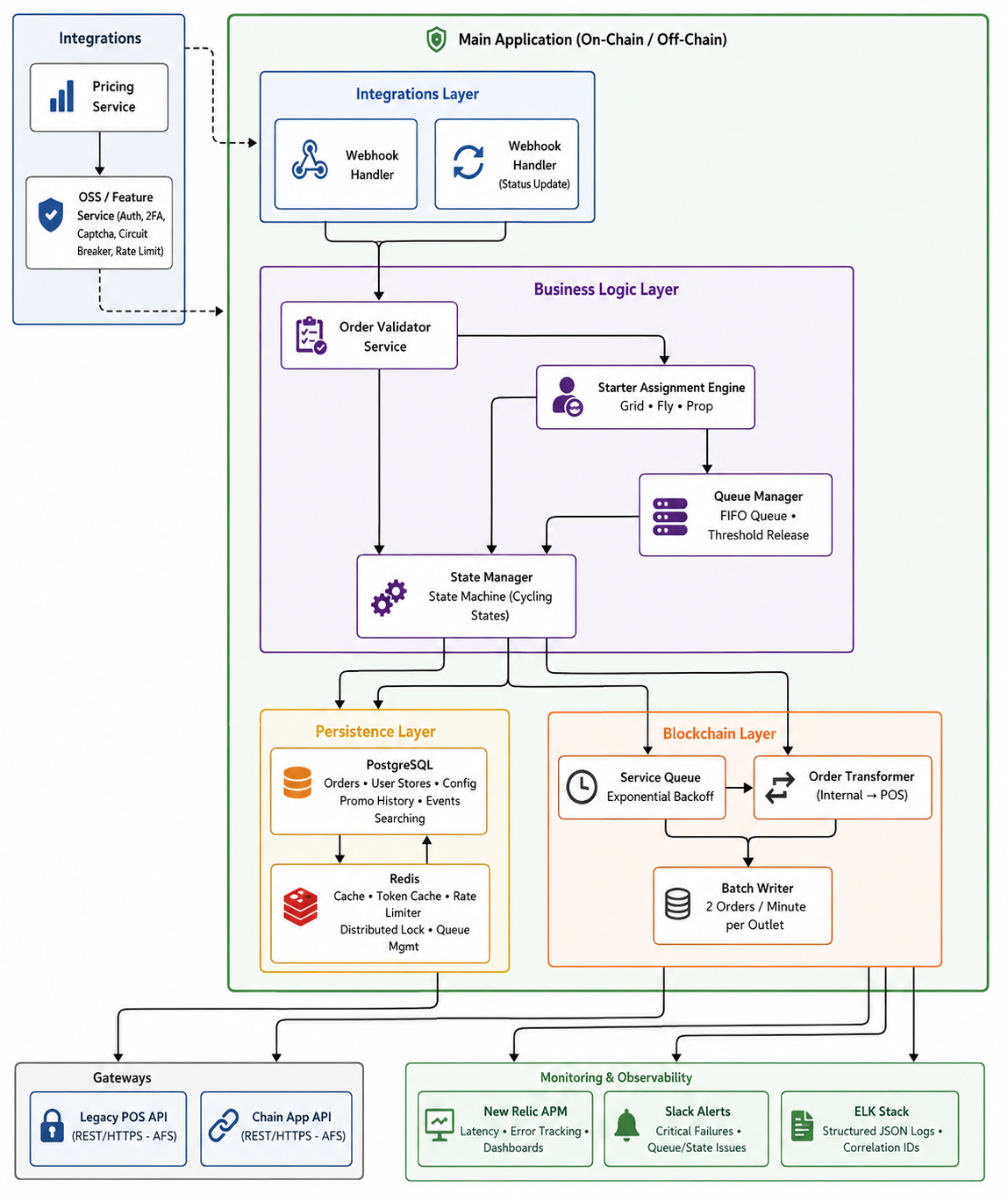
The middleware Order Management System was designed as a decoupled integration layer between Chili's Malaysia's mobile ordering application and its legacy POS system. Rather than modifying the existing POS, the solution orchestrates order processing, queue management, kitchen workflows, and real-time status synchronization while maintaining secure and reliable communication across all restaurant outlets.
The architecture focuses on scalability, resilience, and operational visibility, ensuring smooth order processing during peak hours while supporting multi-outlet deployments.
Database Architecture
The middleware OMS combines PostgreSQL for ACID-compliant transactional data with Redis for high-speed caching, queue management, distributed locking, and rate limiting. This architecture ensures consistent order processing, sub-second response times, and reliable performance during peak restaurant traffic across multiple outlets.
Performance Benchmarks
Key Outcomes & Business Value
Reduction in Kitchen Ticket Time
Average ticket preparation time decreased from 25 minutes to 16 minutes, enabling faster service and improved kitchen efficiency during peak hours.
Higher Peak Order Capacity
Restaurants successfully increased processing capacity from 20 to 30+ orders per hour without overloading the legacy POS or kitchen operations.
System Uptime
The middleware maintained high availability with reliable order synchronization and uninterrupted operations across all supported restaurant outlets.
Fewer Customer Wait Complaints
Real-time order tracking and controlled kitchen workflows significantly reduced customer inquiries and improved the overall ordering experience.
The middleware OMS automated order orchestration, kitchen station assignment, queue management, and real-time status synchronization without requiring any modifications to the legacy POS. This streamlined restaurant operations, eliminated ticket pileups during rush hours, and reduced manual coordination across kitchen teams.
The solution delivered measurable improvements in operational efficiency and customer satisfaction. Restaurants achieved 100% adoption across all outlets within two weeks, experienced a 75% reduction in order abandonment (8% to 2%), and gained real-time operational visibility through centralized dashboards, enabling better staffing decisions and continuous performance optimization.
Conclusion
The legacy POS could process only a limited number of orders per minute. Implementing token-bucket rate limiting and intelligent FIFO queue management from the beginning ensured reliable order processing and eliminated HTTP 429 errors during peak traffic.
Separating order acceptance, kitchen orchestration, and POS synchronization allowed the mobile application to respond quickly while background processes handled longer-running tasks. This improved scalability without compromising consistency or user experience.
Comprehensive monitoring through dashboards, centralized logging, and application performance monitoring enabled proactive issue detection, bottleneck analysis, and data-driven staffing decisions across all restaurant outlets.

"Suffescom helped streamline our order management process with reliable POS integration. Their solution improved kitchen workflows and supported smoother operations during peak hours."
Chief Operating Officer, Chili’s Malaysia
• SUFFESCOM SOLUTIONS
Build Smarter. Scale Faster. Grow More.
Have a Vision? Let’s Turn It Into a Digital Reality.
Get a quick response from our best experts in under 10 minutes.
Suffescom easily understood our main goal and delivered the best digital solution. Their team was very cooperative, and it was a very good experience working with them. I would highly recommend them.

Working with Suffescom was a really great experience. Their developers demonstrated technical knowledge and delivered our mobile app solution with all required functionalities on time.

Suffescom helped us build a logistics software solution that completely improved our fleet operations. Their professionalism and transparency are what make them a reliable technology partner.

Share Your Requirements. Our Experts Will Shape the Solution.
• SUFFESCOM SOLUTIONS
Build Smarter. Scale Faster. Grow More.
Have a Vision? Let’s Turn It Into a Digital Reality.
Get a quick response from our best experts in under 10 minutes.
Suffescom easily understood our main goal and delivered the best digital solution. Their team was very cooperative, and it was a very good experience working with them. I would highly recommend them.
Working with Suffescom was a really great experience. Their developers demonstrated technical knowledge and delivered our mobile app solution with all required functionalities on time.
Suffescom helped us build a logistics software solution that completely improved our fleet operations. Their professionalism and transparency are what make them a reliable technology partner.
Share Your Requirements. Our Experts Will Shape the Solution.
• SUFFESCOM SOLUTIONS
Build Smarter. Scale Faster. Grow More.
Have a Vision? Let’s Turn It Into a Digital Reality.
Get a quick response from our best experts in under 10 minutes.
Suffescom easily understood our main goal and delivered the best digital solution. Their team was very cooperative, and it was a very good experience working with them. I would highly recommend them.
Working with Suffescom was a really great experience. Their developers demonstrated technical knowledge and delivered our mobile app solution with all required functionalities on time.
Suffescom helped us build a logistics software solution that completely improved our fleet operations. Their professionalism and transparency are what make them a reliable technology partner.
Share Your Requirements. Our Experts Will Shape the Solution.
Fret Not! We have Something to Offer.