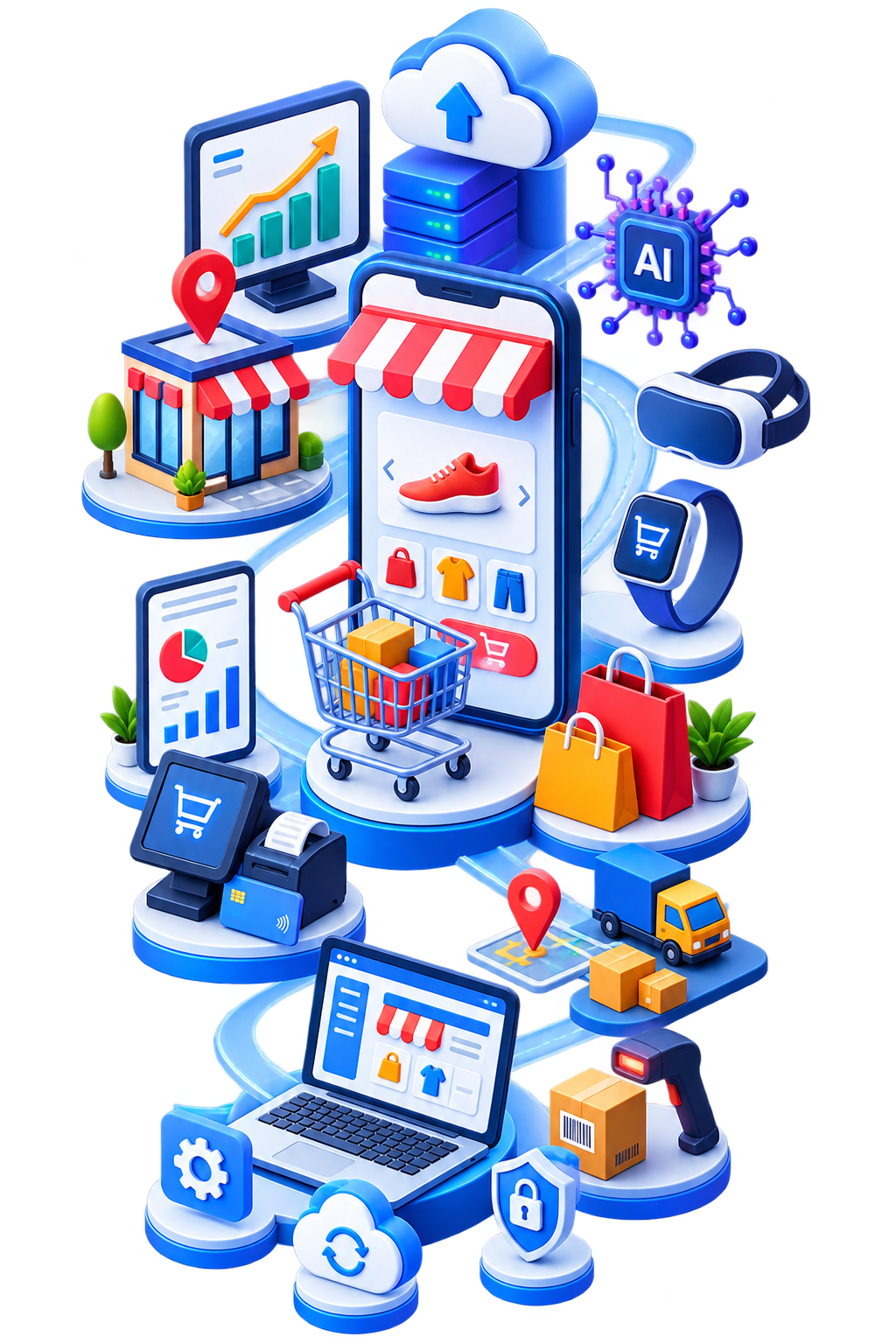
Disconnected systems, slow checkouts, and inconsistent inventories: these are not how retail companies should work. Suffescom offers custom retail solutions, including digital commerce, inventory management, point of sale, and analytics. We are a reliable retail software development company that can help you grow using the best technologies and years of development experience.
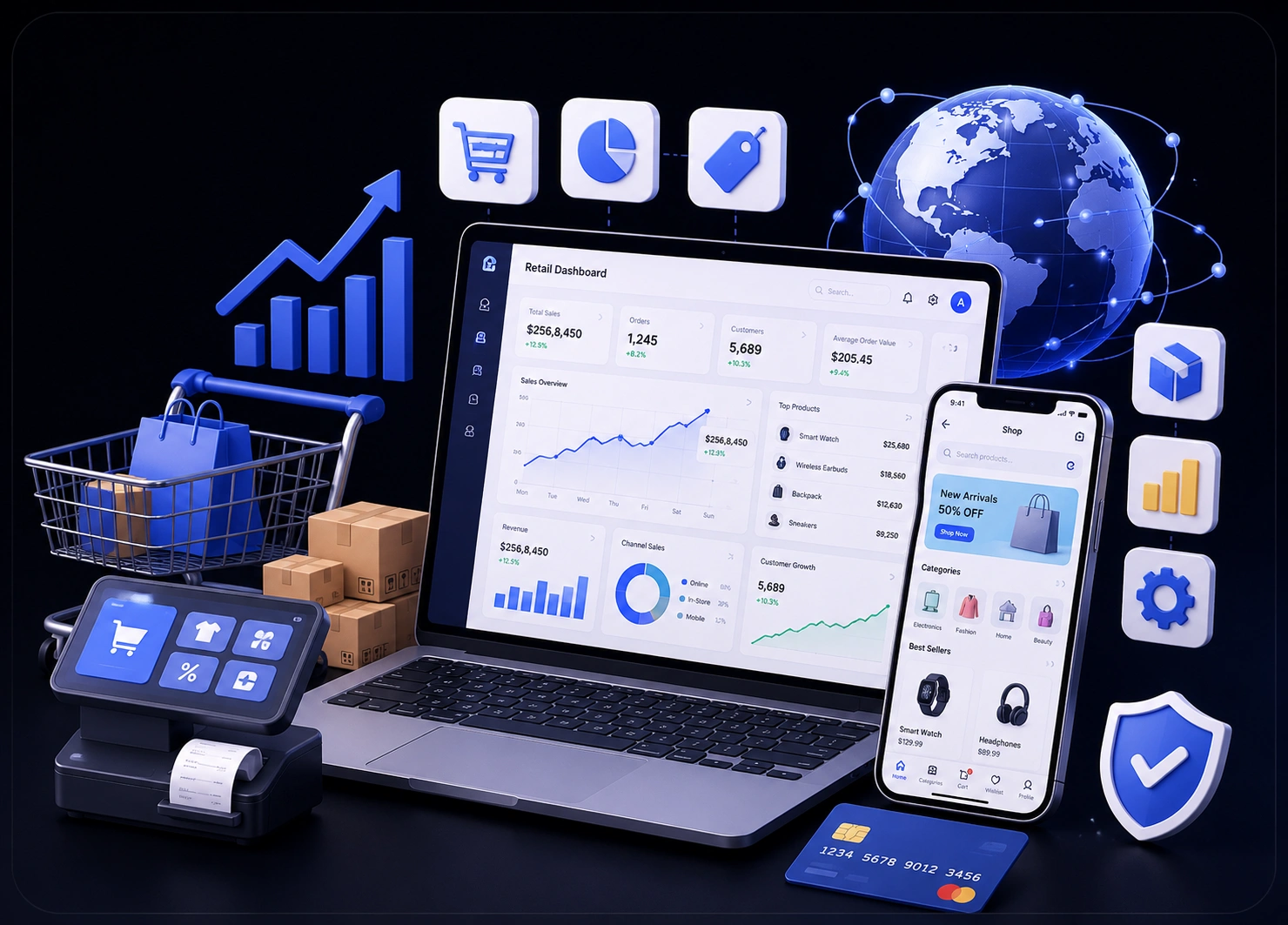
Retailers must integrate stores, eCommerce, inventory, fulfillment, payments, customer data, and supply chains in addition to transaction processing. The retail software development process harmonizes all these steps in order to achieve the smoothest experience for customers and efficient operations in the retail business.
Connect all your stores, website, mobile app, and other channels that your customers may use in a unified retail environment. With retail software development, all your products, prices, orders, information about customers, and interaction processes will remain consistent.
Gain a comprehensive understanding of your inventory status by assessing it across all your stores, within the warehouse, and throughout your online platforms. Integration helps you manage your inventory more efficiently, cut down on errors, and prevent overselling.
Automate all processes connected with order processing, purchasing, fulfillment, pricing, reporting, and store management in one solution. Retail software development saves you from manual work, helps to make fewer mistakes, and provides more time to do the important things..
To improve efficiency and decision-making, ensure that all relevant sales, customer, stock level, and operational process data is easily accessible in a single, centralized location. The retail staff will be able to identify patterns, forecast demand, and perform better due to useful insights.
Leverage the integration of POS systems, ERP systems, CRM, e-commerce platforms, payment gateways, logistics solutions, and other third-party apps. Retail software can help you break down data silos and establish seamless information exchange across your technologies.
Scale through adding more stores, sales channels, products, integrations, and functionality without having to redesign your current technology infrastructure. Retail software solutions that are scalable will enable you to change as per changes in the markets as well as the consumers.
Utilizing interconnected information regarding your customers will significantly enhance your understanding of their behavior and preferences. Retail software will convert your customers into loyal customers by offering rewards, discounts, and product recommendations.
You can use connected workflows to coordinate orders, inventory, warehouses, stores, and delivery partners. Improved visibility across fulfillment operations enables retailers to process orders more quickly and provide customers with more dependable delivery experiences.
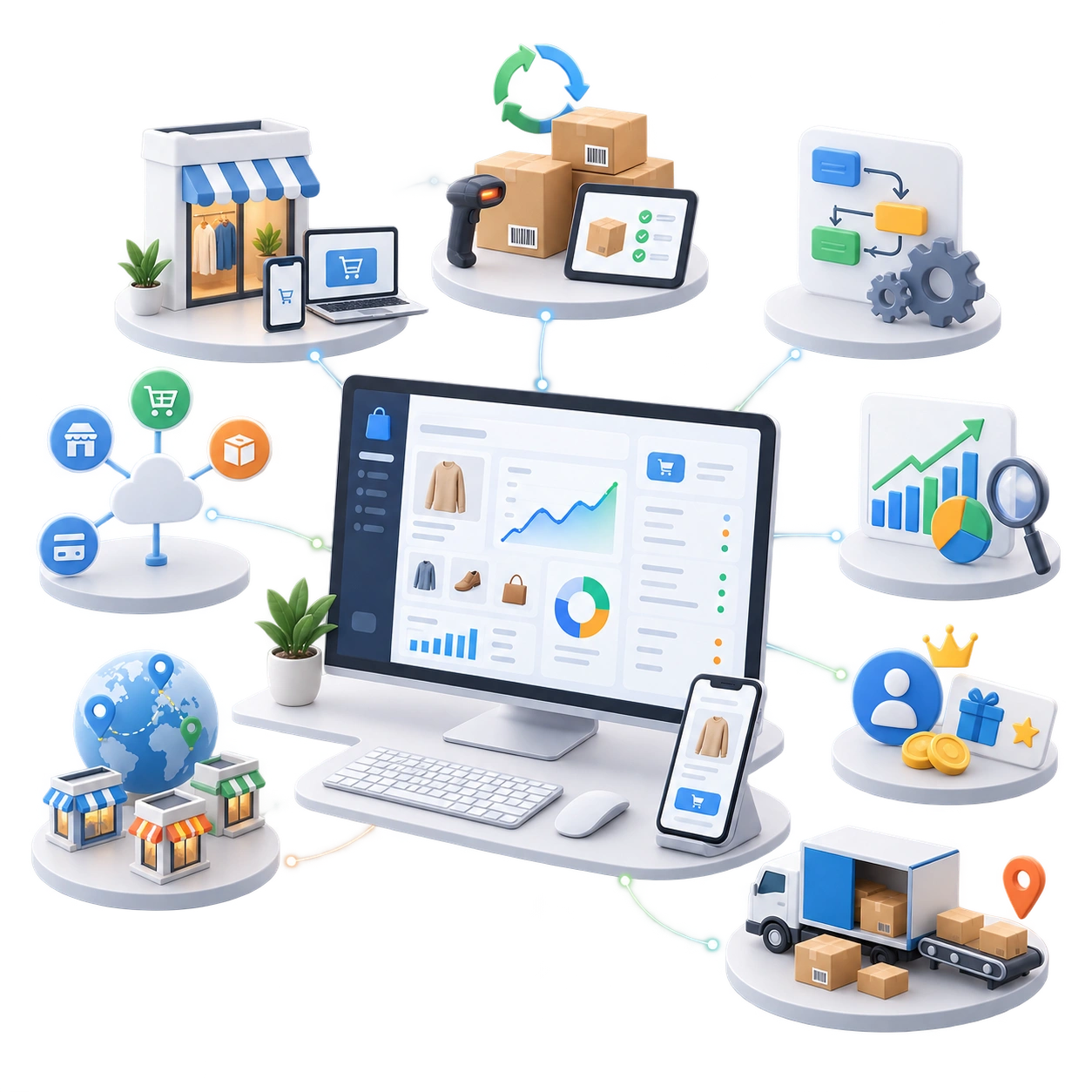
Our retail software development services encompass the entire software lifecycle process from conception and design through development, integration, and support. We assist retailers in developing and enhancing technology that suits them and integrates well with other technologies.
See how our retail software development expertise helps businesses solve complex operational and customer-facing challenges.

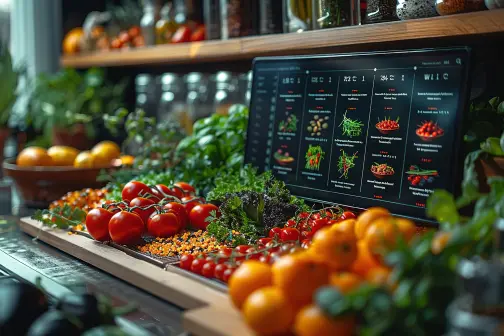
Business Requirement: A growing fashion retailer needed to connect its POS, eCommerce store, inventory system, and customer database. Disconnected data was making it difficult to maintain accurate stock information across physical and online stores.
Our Solution: We integrated the retailer’s core systems through APIs, creating a synchronized flow of product, inventory, order, and customer data across its sales channels.
Outcomes:
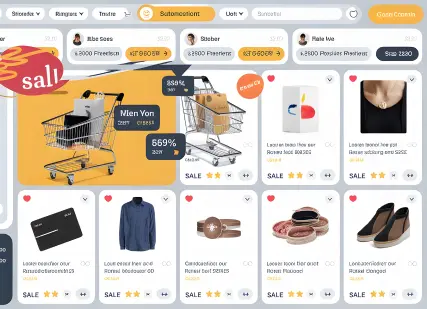
Business Requirement: A regional supermarket chain had plans to expand into new markets but first had to ascertain whether their existing technology infrastructure could handle additional stores and online ordering.
Our Solution: We evaluated the company’s current system and provided a technology roadmap that included both modernization and development considerations for the future.
Outcomes:
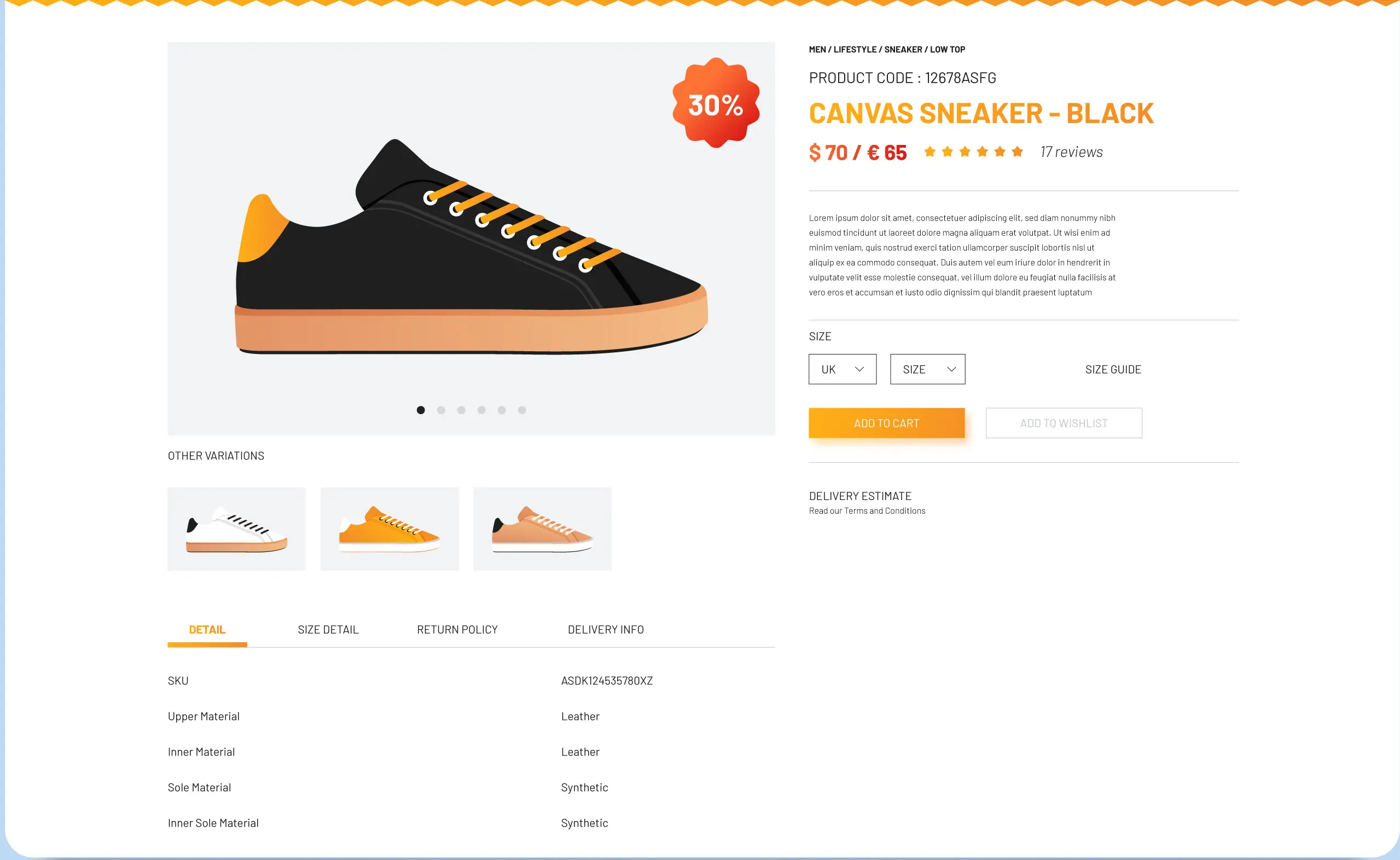
Business Requirement: The multi-brand retailer was relying on outdated legacy applications that reduced reporting efficiency, limited integration with new systems, and made it difficult to introduce innovative digital features and improve overall operations.
Our Solution: We upgraded the application architecture of the client, upgraded legacy systems, refined APIs, and migrated critical applications to a more scalable environment.
Outcomes:
Business Requirement: The specialty retail company required a tailored platform that would enable efficient management of products, orders, customers, promotions, and overall operations, all integrated into a single solution without the need for multiple separate programs.
Our Solution: Custom retail software development was provided, including UI/UX design, app development, backend development, integrations, testing, and deployment.
Outcomes:
The custom retail software development services that we offer encompass all the elements required for commerce, shops, customers, inventories, and data to be managed in digital form.

Stores, e-commerce, mobile devices, inventory, and customer interactions are all combined into one ecosystem by our integrated platforms. Our retail software development projects help businesses provide consistent experiences while operating across multiple channels.

Our eCommerce development efforts are centered on storefronts, catalogs, payments, orders, and fulfillment. We design flexible retail commerce solutions that can effectively accommodate expanding product lines, rising customer volumes, and diverse sales channels.

We provide up-to-date POS solutions and retail management systems that combine the check-out process with inventory, prices, promotions, customer information, and reports. It allows our clients to improve their in-store operations while having control over their business.

Custom retail software solutions offered by us allow businesses to manage inventory and orders for both offline stores and warehouses and online. Real-time data and automated processes improve efficiency in tracking, order processing, and fulfillment.

We create loyalty programs, personalization strategies, customer engagement initiatives, and mobile applications to help retailers communicate with customers beyond transactions and improve the shopping experience by leveraging customer insights and behavioral data.

Our product line consists of data-driven applications that integrate sales, customer, inventory, and operational information. With the aid of these tools, retailers will be able to monitor their business performance and make trend-based business decisions.
Retail technology has evolved past basic eCommerce and POS. Connected and data-driven technologies have been adopted by businesses to enhance customer experience and automate their processes to cope with changing market requirements..
The use of AI will help businesses learn more about their customers' behavior and make product recommendations and offers to customers, as well as create more relevant content. The use of AI may be used for search, segmentation, and engagement.
Customers require an easy experience in switching from one channel to another. Modern retail software development is oriented towards integration of different channels for keeping inventory, orders, prices, and customer information synchronized.
Retailers adopt connected inventory systems that allow tracking of updated information in different locations, including online channels. Improved visibility will enable better replenishment, lower stock issues, and improved fulfillment.
Automation has become a tool for automating order management, inventory management, reporting, pricing, and customer communication. This makes it possible for retail teams to respond more quickly and with less manual labor.
Companies are now collecting sales, customer, inventory, and operations data for better decision-making. Analytics can enable the detection of buying behavior, predictions of demand, optimization of products, and business performance monitoring.
Retailers can use cloud computing to scale apps, services, and distribution channels, allowing them to respond to changing market demands. This will help retailers to make quick deployments and easily access business data from anywhere.
Mobile apps are still very useful for customers, as they provide them with product discovery, shopping, payment, loyalty, and engagement. Retailers use mobile devices to create enthralling and immersive shopping experiences for customers.
Retailers are now demanding that POS, ERP, CRM, e-commerce, payment, logistics, and analytics integrate. The API-based architecture simplifies management and expansion processes, enabling integration and scalability across systems.
Self-checkout, digital kiosks, mobile check-out, and other self-service solutions are emerging as an effective way to reduce friction in physical stores. Self-service can be tied to inventory, payment, and customer management systems as well.
As retail moves more and more online, security has become an integral aspect of custom retail software development. Companies are now focused on securing their payments, identity management, data security, access control, and IT infrastructure.
Our retail software development services work across leading commerce and business platforms, helping retailers customize functionality, connect systems, and build workflows around their needs.
Flexible eCommerce, payments, inventory, promotions, and multichannel selling.
Growing retailers, D2C brands, and businesses scaling online.
Cloud-based SaaS with web, mobile, POS, and API capabilities..
Plans start at $39/month when billed monthly; Shopify Plus starts at $2,300/month on a three-year term.
Flexible commerce capabilities for complex catalogs, multiple storefronts, B2B/B2C commerce, and personalization.
Mid-sized and enterprise retailers with complex commerce requirements.
Available as Adobe Commerce as a Cloud Service (SaaS) and Adobe Commerce on Cloud (PaaS).
Pricing is customized based on business requirements and provided through Adobe.
E-commerce, personalization, order management, analysis, and customer experience connectivity.
Merchants who wish to have a connection between their commerce, CRM, marketing, and customer data.
Enterprise commerce cloud platform.
Please inquire about pricing through Salesforce.
B2B, B2C, B2B2C, and D2C commerce are enabled with product, order, pricing, and customer management capabilities.
Large retailers and enterprises with complex operations or SAP environments.
Cloud-based commerce platform with composable and cloud ERP editions.
Prices are negotiable and can be calculated on an annual purchase basis or gross merchandise volume.
Connects commerce with sales, customer management, finance, supply chain, and other business operations.
Retailers looking to unify customer, sales, inventory, and operational processes.
Microsoft cloud-based business and commerce ecosystem.
Varies by Dynamics 365 application, edition, users, and requirements; custom quotes may apply.
Modular capability in eCommerce, Sales, CRM, Inventory, Accounting, and Purchasing
Smaller retailers are searching for a modular business platform.
Could be cloud-based or self-hosted with modular applications.
Depends on the selected apps, number of users, hosting, and implementation requirements.
Retail software solutions should not only perform transaction processing but also provide integration of operations, customer data, inventory, sales channels, and empower teams with the ability to perform their tasks faster and with better results.
Provide dependable and quick transactions through both offline and digital sales channels. Create a comprehensive workflow that combines sales, payments, returns, promotions, and customer data into a single system.
Monitor inventory in multiple locations, including physical stores, warehouses, and online sales channels. Automate inventory management and eliminate stock discrepancies, over-selling, stockouts, and manual inventory control.
Use integrated workflows to integrate order management between online and offline sales channels. Provide order management options such as store pickup, returns, and exchanges across multiple channels.
Integrate customer data, including purchase history, preferences, loyalty programs, and other activities, in one place. Use customer data for personalization of offers, rewards, and more relevant customer interaction.
Transform the sales, inventory, customers, and operational data into meaningful information. The custom-built dashboard and reports may allow team members to work efficiently and make quick decisions.
Maintain information regarding products, prices, categories, variations, promotions, and availability across various sales channels. Catalog management provides consistency and accuracy in customer-facing data.
Payments can be processed securely in both online and offline retail scenarios. Various payment types, refunds, discounts, receipts, and transaction information can be supported via connected processes.
Ensure that the access provided is as per the position of the individual in the organization. Security mechanisms like authentication, authorization, auditing, and data processing aid in protecting retail and customer information..
Integrate POS, ERP, CRM, e-commerce, accounting, payment, logistics, and other applications using API integration. Good integration features allow you to create an integrated retail system without changing any of your existing systems.
Use AI and automation to forecast demand, make recommendations, segment customers, send inventory alerts, search, and automate processes. These capabilities can help retailers respond faster while reducing manual effort.
We utilize the latest technological innovations in order to create intelligent retail applications, automate difficult procedures, enhance the experience of customers, and assist firms in making better use of their data.
Retail BI combines the information on sales, inventory, customers, and operations for the purpose of providing retail firms with an overview of how well their operations are doing. It enables teams to spot trends, analyze metrics, and make timely decisions.
AI and machine learning help retailers analyze customer, sales, and operational data. They identify patterns, predict demand, and automate key decisions. These technologies also enable personalization, smarter pricing, and more efficient retail operations.
The Internet of Things (IoT) connects retail devices, sensors, and systems, allowing for real-time information exchange. IoT can help retailers gain visibility across supply chains, as well as control over inventory management and store surveillance.
Retailers can use AR and VR technologies to provide customers with a better experience when exploring and testing their products. AR and VR technologies, from virtual try-ons to immersive visualization, can reduce purchase uncertainty and boost digital engagement.
Computer vision allows retail technology to make sense out of images and video captured by cameras and other visual sensors. It could allow for automation of inventory management, product recognition, understanding of store activities, etc.
Our blockchain development technology may help retailers maintain accurate records of information in an immutable manner through the supply chain and the transaction process. Blockchain may prove valuable when authentication is essential for goods.
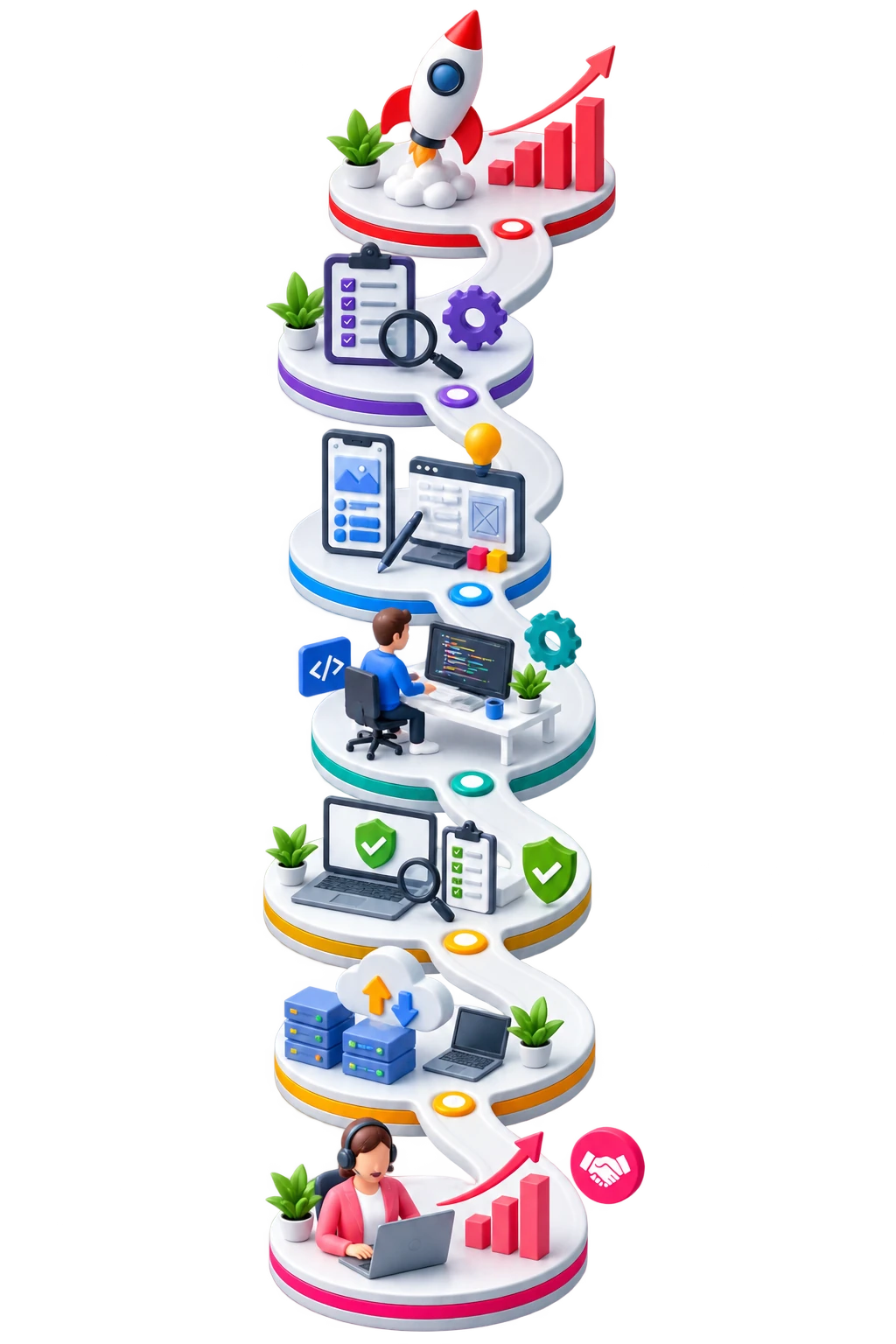
We adopt a systematic methodology to convert our retail requirements into robust software solutions. This process is done phase by phase based on the business model, current technological environment, and future growth targets.
We begin with an understanding of your retail operations, customers, current systems, and business objectives. The team gathers functional requirements, technology gaps, integration requirements, and scalability requirements.
We create a technology strategy, solution architecture, development scope, and project roadmap. This phase ensures that the software integrates seamlessly into your existing retail environment and meets future requirements.
We design interfaces that are easy to use for consumers, store employees, managers, and other end users. Before development begins, prototyping is an essential step in ensuring that every aspect of the user experience is tested and optimized.
Our retail software developers build the software in planned iterations while integrating required POS, ERP, CRM, payment, inventory, logistics, and third-party systems. Regular builds enable progress reviews at various stages of the development process.
Performance, security, usability, compatibility, integration, and functionality of our software are all assessed in relevant environments. We address any problems that come up before our software is finished and ready for production.
After final validation, we prepare the application for deployment and configure the required infrastructure and production environment. Our team actively assists with the launch process to help ensure a seamless and smooth transition for all users involved.
Post-launch, we monitor performance, address issues, and make improvements based on changing business requirements and user feedback. This keeps your custom retail software development investment useful as the business evolves.
The cost of retail software development is determined by the scope of the project, its complexity, level of integration, and technological needs. An easy retail application will require an entirely different budget compared to the enterprise-level system for many stores and warehouses.
Our custom retail software solutions may be helpful for creating integrated operations, improving customer experience, and developing a technical platform that will be able to evolve as the company grows.
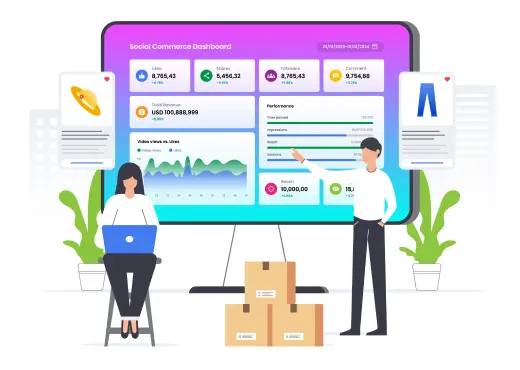
Implement automation for routine activities and integration for sales, fulfillment, inventory, and customer management processes. This will lower the amount of work needed and give employees more time to do valuable tasks.
Gain access to connected data about your inventory levels in stores, warehouses, and even online. When inventory information is integrated, you can optimize supply chain management, avoid shortages, and speed up replenishments.
Ensure customer interaction is seamless on websites, mobile applications, physical stores, and any other channels. This allows retailers to provide consistent information to their customers about products or services, promotions, and support.
Unify data from sales, customer relationships, inventories, and operations into one repository. Real-time analytics enables business units to respond quickly to changing trends and market dynamics, ensuring their competitiveness and relevance.
Integrate POS, ERP, CRM, eCommerce, payment, logistics, and other business applications through APIs and custom integrations. This creates a more connected technology ecosystem without requiring you to replace every existing system.
Build software that can support additional stores, products, users, transactions, and markets as requirements expand. A scalable architecture facilitates the gradual introduction of new features and capabilities as business needs evolve over time.
Unlike rigid off-the-shelf systems, custom retail software solutions can be adapted as workflows and business requirements change. Retailers can add functionality without being restricted by features they don't need or platforms they have outgrown.
Centralized information gives managers a clearer view of sales, inventory, orders, customers, and store performance. Teams can more efficiently coordinate operations and detect problems earlier when there is greater visibility.


We had too many systems doing different things, and keeping the data in sync was becoming a daily headache. Suffescom helped us connect everything, and now it’s much easier to keep track of what’s happening.

We knew our technology needed work, but we weren’t sure where to start. The consultation gave us a much clearer idea of what to fix now and what we could leave for later.

Our old system was holding us back, especially when we wanted to add new integrations. The modernization made the whole setup easier to work with and gave us more room to grow.

We didn’t want another off-the-shelf system that we’d have to work around. The team built it around our actual processes, which made the final product much more useful for us.

Choosing a retail software development company is about more than technical skills. We combine retail understanding, engineering expertise, and flexible engagement models to build software that fits your operations and supports long-term growth.
We understand the technology challenges that come with IT services for retail, from inventory and order management to omnichannel experiences and system integrations. Our team builds software around real business workflows rather than generic functionality.
Each retailer has their own processes, systems, and development roadmap. Based on your needs, we develop a unique solution for retail software development that could be completely new or could involve additional functionalities or updates of the current system.
A range of systems are commonly used by retail companies to perform standard business operations. We design the architecture to be integrated with different systems like POS, ERP, CRM, eCommerce, payments, logistics, and other systems.
We pick the right technologies and architectures depending on the number of your future users, transactions, locations, etc. It effectively mitigates potential technological constraints that may arise from an increasing software workload.
Security measures are considered throughout the entire software development life cycle, and not only in the end stage. We provide tailored authentication, access control, data security, API security, and other measures based on project needs.
If you need a full development team, specialized skills, or assistance with a specific phase of the project, we are very willing to participate. As their priorities change throughout the development lifecycle, this allows retailers flexibility.
We ensure effective communication about the scope, progress, technical aspects, and deliverables throughout the project's lifecycle. Collaborative effort enables early detection of changes and aligns the development process with business objectives.
The retail software solutions require continuous evolution in accordance with the shifting customer expectations, platform, and business requirements. We offer post-launch support and improvements in the solution to ensure reliability and relevance.
We select technologies based on your retail application's requirements, expected scale, integrations, and long-term maintenance needs.




























• SUFFESCOM SOLUTIONS
Build Smarter. Scale Faster. Grow More.
Have a Vision? Let’s Turn It Into a Digital Reality.
Get a quick response from our best experts in under 10 minutes.
Suffescom easily understood our main goal and delivered the best digital solution. Their team was very cooperative, and it was a very good experience working with them. I would highly recommend them.

Working with Suffescom was a really great experience. Their developers demonstrated technical knowledge and delivered our mobile app solution with all required functionalities on time.

Suffescom helped us build a logistics software solution that completely improved our fleet operations. Their professionalism and transparency are what make them a reliable technology partner.

Share Your Requirements. Our Experts Will Shape the Solution.
• SUFFESCOM SOLUTIONS
Build Smarter. Scale Faster. Grow More.
Have a Vision? Let’s Turn It Into a Digital Reality.
Get a quick response from our best experts in under 10 minutes.
Suffescom easily understood our main goal and delivered the best digital solution. Their team was very cooperative, and it was a very good experience working with them. I would highly recommend them.
Working with Suffescom was a really great experience. Their developers demonstrated technical knowledge and delivered our mobile app solution with all required functionalities on time.
Suffescom helped us build a logistics software solution that completely improved our fleet operations. Their professionalism and transparency are what make them a reliable technology partner.
Share Your Requirements. Our Experts Will Shape the Solution.
• SUFFESCOM SOLUTIONS
Build Smarter. Scale Faster. Grow More.
Have a Vision? Let’s Turn It Into a Digital Reality.
Get a quick response from our best experts in under 10 minutes.
Suffescom easily understood our main goal and delivered the best digital solution. Their team was very cooperative, and it was a very good experience working with them. I would highly recommend them.
Working with Suffescom was a really great experience. Their developers demonstrated technical knowledge and delivered our mobile app solution with all required functionalities on time.
Suffescom helped us build a logistics software solution that completely improved our fleet operations. Their professionalism and transparency are what make them a reliable technology partner.
Share Your Requirements. Our Experts Will Shape the Solution.
Fret Not! We have Something to Offer.