Suffescom provides custom accounting software development services according to actual business needs. We help businesses turn complicated financial processes into secure digital systems that improve accuracy and financial visibility.

Our software consulting services include reviewing your accounting workflows and determining the scope. We also help select the architecture and technology stack and consider reporting standards and regulatory requirements.
Purpose-built accounting platforms give businesses much better control in their financial workflows. Our accounting software development company creates systems with main accounting modules along with configurable business rules.
Migrating financial records between systems needs very careful handling to safeguard data accuracy and business continuity. We migrate historical transactions and account records from legacy platforms and also map financial details to the new accounting system.
Connected financial systems decrease data silos and manual data entry. We incorporate accounting software with required banking platforms and payment gateways along with ERP and CRM systems to support reliable data exchange.
Legacy accounting systems can become very expensive to maintain as technology requirements change frequently. Our accounting software developers modernize outdated solutions by updating architecture and removing legacy components.
After-launch maintenance keeps accounting platforms reliable as volumes of transactions and business requirements change. We provide maintenance services that cover issue resolution and feature enhancements.
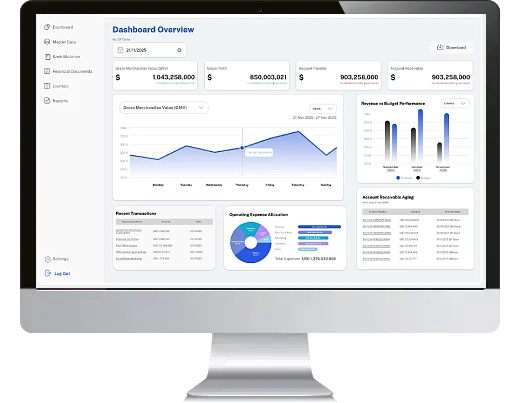
Business Requirement: A Florida-based flying academy was managing student billing and banking through manual accounting processes. These tasks took time and made it harder to get updated financial information. The academy needed to improve its existing accounting platform without replacing it.
Solution: We improved the current accounting platform with automated document capture and bank reconciliation. Our team added AI-based assistance to support financial queries, and automated invoice workflows reduced repetitive tasks.
Outcomes:
Customers supported globally
API requests processed monthly
App integrations supported
Platform uptime
Business Requirement: A U.S.-based wealth management firm was required to implement a centralized bookkeeping system that would automate receipt and expense tracking, document consolidation, synchronization of accounting records, and facilitate approval and payment workflows.
Solution: We developed an AI-powered bookkeeping platform with OCR and machine-learning-based document extraction, multi-channel document capture, automated expense categorization, accounting integrations, role-based approvals, centralized document management, and payment workflows.
Outcomes:
AI document extraction accuracy
Accounting platform integrations
Bank connections
financial documents processed annually
Business Requirement: A multi-specialty medical group based in the USA with over 50 physicians. They needed a modernized replacement for their out-of-date billing system that was not integrated with their electronic health records (EHR) and practice management system.
Solution: We developed a patient-centric financial portal integrated with the healthcare provider's existing systems, enabling pre-visit cost estimates, centralized financial information, itemized billing, online payments, payment plans, and automated claim-denial workflows.
Outcomes:
reduction in billing-related phone calls
increase in patient payments
improvement in clean claim rate
patient satisfaction with the new financial experience
At Suffescom, we develop custom accounting software solutions to your business’s particular requirements.
We develop billing systems that fit your revenue workflow and help finance teams manage invoicing with greater accuracy. Automated controls support timely billing and clearer payment visibility.
Designed around main finance controls for managing business obligations and customer dues. Our company builds accounts payable software solutions that aid finance teams in maintaining reliable records and improving payment oversight.
Payroll and employee spending can be managed through connected financial workflows. We develop systems that simplify compensation processing while giving finance teams better oversight of business expenses.
Best for organizations handling different subsidiaries or business units. Financial controls help maintain separate books while supporting consolidated oversight across the organization.
Structured to support tax operations through configurable rules and financial records. We develop this accounting software solution to help teams prepare accurate tax data and also maintain an auditable history of transactions.
We build reporting software solutions that convert accounting data into useful business intelligence. With this financial software solution , management can monitor financial performance with reports without relying on fragmented spreadsheets.
We develop accounting software around real finance workflows with configurable controls for bookkeeping and reporting.
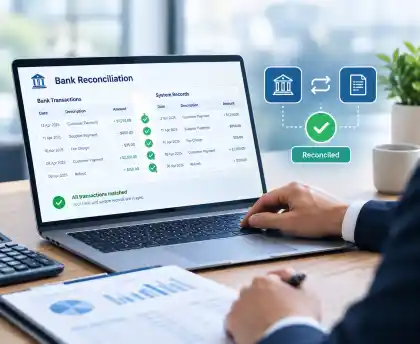
Connect bank feeds with the general ledger to compare deposits and withdrawals with recorded transactions. Matching rules will help manage recurring transactions, and any unmatched transactions are processed for manual reconciliation.
Categorize bank and credit card transactions to the chart of accounts based on user-defined rules. Accountants will be able to validate proposed categorizations and make changes to exceptions before posting to the ledger with this feature.
Match purchase orders with receiving records and vendor invoices prior to approving an AP transaction. The system can automatically identify quantity and price differences to help prevent overpayment to suppliers.
Schedule recurring accounting entries for various expenses along with accruals and other periodic adjustments. Automated posting reduces manual journal work while maintaining the appropriate accounting period.
Configure rules for approvals for journal entries and expense claims along with vendor invoices and payment requests. Routing can be based on transaction value and department or designated approval authority.
Maintain the main accounting record with automated posting from AP and AR, payroll and other sub ledgers. Debit and credit balances remain organized through a precise chart of accounts.
Capture vendor bills and check invoice information against purchase orders before payment. AP workflows can manage due dates and payment runs along with duplicate invoice detection and vendor records.
Track customer invoices from issuance through collection with old schedules for balances not paid. This functionality provides automated workflows to send payment reminders and also record partial payments and unapplied cash.
This functionality guarantees that close activities are conducted efficiently in various accounting departments. Reconciliation checklists include bank accounts with accruals and adjusting journal entries before closing.
Consolidate financial statements across subsidiaries and business units while maintaining separate books for each entity. Intercompany transactions can be eliminated before consolidated balance sheets and income statements are generated.
Control revenue schedules for contracts and subscriptions based on specific recognition criteria. Deferred revenue balances can be tracked, and recognized revenue is posted to the appropriate accounting periods.
Forecast the operating cash positions by accounts receivable and accounts payable, as well as scheduled cash disbursements and past cash flow information. The forecasting models added in accounting software solutions will help find liquidity problems.
Maintain fixed asset registers with acquisition cost and depreciation schedule. We build software solutions that will calculate depreciation according to either the straight-line or declining balance method while accounting for disposals and accumulated depreciation.
Record transactions denominated in foreign currencies while maintaining functional currency records. Foreign currency transactions will have the appropriate exchange rate while the gains and losses will be calculated separately.
Calculate sales tax based on configured jurisdictions and transaction rules. Taxable and exempt transactions can be recorded separately while tax liabilities are organized for reporting and filing preparation.
Segments We Serve
We develop accounting software around the financial workflows and reporting needs of different business segments. Each system can be configured around transaction volumes and accounting structures.
Accounting solutions designed around retail transactions, payments, inventory, and financial reporting.
Financial workflows for online businesses covering sales, payments, expenses, reconciliation, and reporting.
Accounting infrastructure supporting financial transactions, reporting, reconciliation, and compliance workflows.
Accounting systems supporting automotive sales, expenses, payments, inventory, and financial operations.
Financial management for property transactions, payments, expenses, commissions, and multi-entity accounting.
Accounting workflows for insurance businesses covering premiums, claims, payments, expenses, and reporting.
Accounting solutions for manufacturing operations, production costs, inventory, purchasing, payroll, and reporting.
Financial workflows for healthcare organizations including billing, payments, payroll, expenses, and reporting.
Accounting software supporting logistics billing, expenses, payments, payroll, reconciliation, and financial reporting.
We integrate custom accounting software with the financial and operational platforms your business already uses. Our integration services cover API integration and data synchronization along with payment connectivity and automated financial workflows.
Incorporate your accounting platform with ERP systems to exchange purchase orders and sales data with vendor records and financial transactions.
Connect CRM platforms with accounting software to automate customer data transfer and support quote-to-invoice workflows.
Integrate banking APIs to retrieve account balances and transaction feeds. Automated reconciliation workflows can match bank activity with accounting entries.
Connect Stripe and PayPal along with other payment gateways to capture payment confirmations and transaction fees while updating invoice and receivable records.
Integrate payroll systems to import salary journals and tax deductions along with employee compensation data directly into accounting workflows.
Connect expense platforms to import approved claims and receipts. Accounting rules can then assign expenses to the appropriate accounts and cost centers.
Integrate procurement systems with AP workflows to transfer purchase orders and supplier invoices while supporting three-way matching.

Connect inventory platforms to accounting modules for automated updates to stock valuation and cost of goods sold along with inventory-related journal entries.
Integrate asset management platforms to transfer acquisition and disposal records into fixed asset accounting. Depreciation schedules can be synchronized with the general ledger.
Connect Shopify and WooCommerce along with other commerce platforms to import orders and refunds and payment data for automated sales accounting.
Integrate tax platforms to exchange transaction data and support sales tax calculations along with tax reporting and filing workflows.
Connect Power BI and Tableau along with other analytics platforms to make accounting data available for financial dashboards and management reporting.
Selecting between custom accounting software and an off-the-shelf platform depends on your accounting workflows and how much control you need over financial processes.
| Parameter | Custom Accounting Software | Off-the-Shelf Accounting Software |
|---|---|---|
| Features | Custom AP, AR, GL, payroll, tax, and reconciliation workflows | Predefined AP, AR, GL, payroll, and reporting features |
| Cost | Higher upfront development investment | Lower initial subscription or licensing cost |
| Timeline | Longer due to design, development, and testing | Faster setup with ready-made modules |
| Customization | Custom rules, approvals, calculations, and reports | Limited to available settings and add-ons |
| Integrations | Custom APIs for banks, payments, ERP, CRM, and payroll | Pre-built integrations supported by the vendor |
| Reporting | Reports based on your chart of accounts and KPIs | Standard financial reports and dashboards |
| Scalability | Supports multiple entities, currencies, and higher transaction volumes | Depends on the vendor's plans and platform limits |
| Security | Custom roles, MFA, audit trails, and access controls | Security features defined by the vendor |
| Compliance | Can be configured for GAAP, tax rules, and internal controls | Compliance features depend on the vendor and plan |
| Maintenance | Updates and fixes managed by your development team | Updates and maintenance handled by the vendor |
| Best For | Complex accounting workflows and specialized requirements | Standard accounting needs and faster deployment |
Our accounting software development services begin with your finance workflows and move through architecture, development, testing, and launch.
We start by checking how your team records transactions and how the general ledger is managed. This scope helps us create a roadmap that covers invoicing and reconciliation.
Next, our accounting software developers plan the system around your chart of accounts and transaction structure. The data model and access levels are defined before accounting software development starts.
We then design screens for invoice processing and journal entries. Accountants can review transactions through custom workflows and also help managers get access to financial reports.
Our accounting software developers then build the required modules around the approved architecture. Automated journal posting and payment workflows are incorporated alongside custom reporting.
Next, our accounting software development company performs testing checks to guarantee transactions are posted to the correct accounts. We verify calculations through reconciliation tests and compare financial reports.
The accounting software solution then goes live after final data checks and deployment testing. Post-launch support covers technical fixes and enhancements as your accounting requirements change.
The cost of custom accounting software development ranges from USD $25K to $200K+. The final cost depends on the accounting modules and system complexity.
The accounting software development budget changes based on how deeply the software needs to handle accounting operations. The biggest cost drivers are usually the accounting modules, integrations, data volume, and financial controls.
Banking APIs, ACH processors, payroll platforms, ERP systems, and tax software each require separate integration work. Real-time synchronization can increase development effort.
The number of accounting modules directly affects the scope. Invoicing and bookkeeping require less work than a platform with multi-entity accounting.
Historical records may come from spreadsheets or old accounting systems. Data mapping becomes a lot more involved when account structures change between the old and new platforms.
Cloud deployment needs suitable hosting and database infrastructure. Hybrid or on-premise setups can involve additional configuration and infrastructure work.
The chosen architecture affects accounting software development effort and infrastructure costs. Third-party services can also add recurring API or licensing expenses.
A typical team may include a business analyst, accounting specialist, developers, QA engineers, solution architect, and DevOps engineer. Team size affects the project budget.
The cost does not end at deployment. Ongoing work may include security patches, accounting rule changes, integration maintenance, bug fixes, and new module development.
Custom accounting software can be built around the way your finance team works instead of forcing accounting processes into predefined workflows. It can also provide tighter control over financial data and automation.
Automated calculations and validation rules help reduce mistakes during data entry. Reconciliation and transaction checks can further improve accounting accuracy.
Automated accounting tasks can reduce the effort required during month-end and year-end closing. Finance teams can complete reconciliations and generate reports with less manual work.
A centralized view of receivables and payables helps finance teams track cash positions. Dashboards can also highlight upcoming payments and overdue invoices.
Role-based permissions can restrict access to sensitive financial data. Approval workflows and audit trails also make financial activities easier to monitor.
Custom accounting software can bring financial records into one system. Teams can access current information without switching between spreadsheets and disconnected applications.
The software can adapt as your business grows. New users and business units can be added without replacing the entire accounting system.
As an accounting software development company, we build platforms around real finance workflows rather than fixed accounting templates. Our accounting software development services cover custom modules, integrations, financial controls, and post-launch support.
Our team works with workflows such as AP, AR, general ledger, bank reconciliation, invoicing, and financial close. This gives custom accounting software development projects a stronger functional foundation.
We adapt the software to your approval rules and accounting structure. Finance teams can follow their existing processes without being restricted by predefined workflows.
We connect accounting platforms with banking APIs, payment gateways, ERP, payroll, CRM, and tax systems. Data flows are designed around your existing financial systems.
We build accounting software with applicable financial and data compliance requirements in mind. Security controls and data handling are incorporated into the software development process.
At Suffescom, we build a platform that can support higher transaction volumes and growing business structures. New entities or accounting modules can be added without replacing the core system.
Our accounting software development company continues to support the platform after deployment. We handle technical issues, integration changes, and new accounting requirements as they arise.
Our commitment to technology, product quality, and engineering excellence has earned recognition across leading industry platforms and technology organizations.
Discuss your accounting workflows, integrations, and software requirements with our experts.
It involves building software to manage core financial tasks such as bookkeeping, invoicing, expenses, payments, reconciliation, and financial reporting.
Custom software is useful when standard tools cannot handle a company's specific workflows, reporting requirements, user roles, or third-party integrations.
The time to build accounting software is between 3-9+ months. It depends on the complexity of solutions, integrations, and features.
Choose custom development when existing platforms lack essential features, require costly workarounds, or cannot integrate with your business systems.
Essential features of accounting software include:
Yes. It can automatically categorize transactions, match bank entries, process recurring transactions, and reconcile accounts to reduce manual bookkeeping.
It can use data encryption, role-based permissions, multi-factor authentication, secure APIs, audit logs, and regular backups to protect financial information.
Yes. It can manage multiple business entities, currencies, tax rules, fiscal periods, and consolidated financial reports from one platform.
The cost to develop accounting software ranges from $25K to $200K+. It depends on features, integrations, security, and development complexity.
The main factors that impact accounting software development cost are:
Yes. API integrations can connect accounting software with QuickBooks, Xero, banking systems, payment gateways, payroll platforms, CRMs, and ERPs.
Yes. Data from spreadsheets, databases, legacy systems, or existing accounting platforms can be imported after data mapping, cleaning, validation, and testing.
The process of accounting software development typically covers requirements analysis, UI/UX design, architecture, development, API integration, testing, data migration, deployment, and maintenance.
Accounting software developers implement:
Yes. A cloud-based architecture can scale databases, users, transactions, and integrations while maintaining performance as business requirements increase.
To choose the best accounting software development company, check its experience with financial applications, accounting workflows, API integrations, data security, cloud development, and post-launch support, as well as relevant project experience.
• SUFFESCOM SOLUTIONS
Build Smarter. Scale Faster. Grow More.
Have a Vision? Let’s Turn It Into a Digital Reality.
Get a quick response from our best experts in under 10 minutes.
Share Your Requirements. Our Experts Will Shape the Solution.
• SUFFESCOM SOLUTIONS
Build Smarter. Scale Faster. Grow More.
Have a Vision? Let’s Turn It Into a Digital Reality.
Get a quick response from our best experts in under 10 minutes.
Share Your Requirements. Our Experts Will Shape the Solution.
Fret Not! We have Something to Offer.