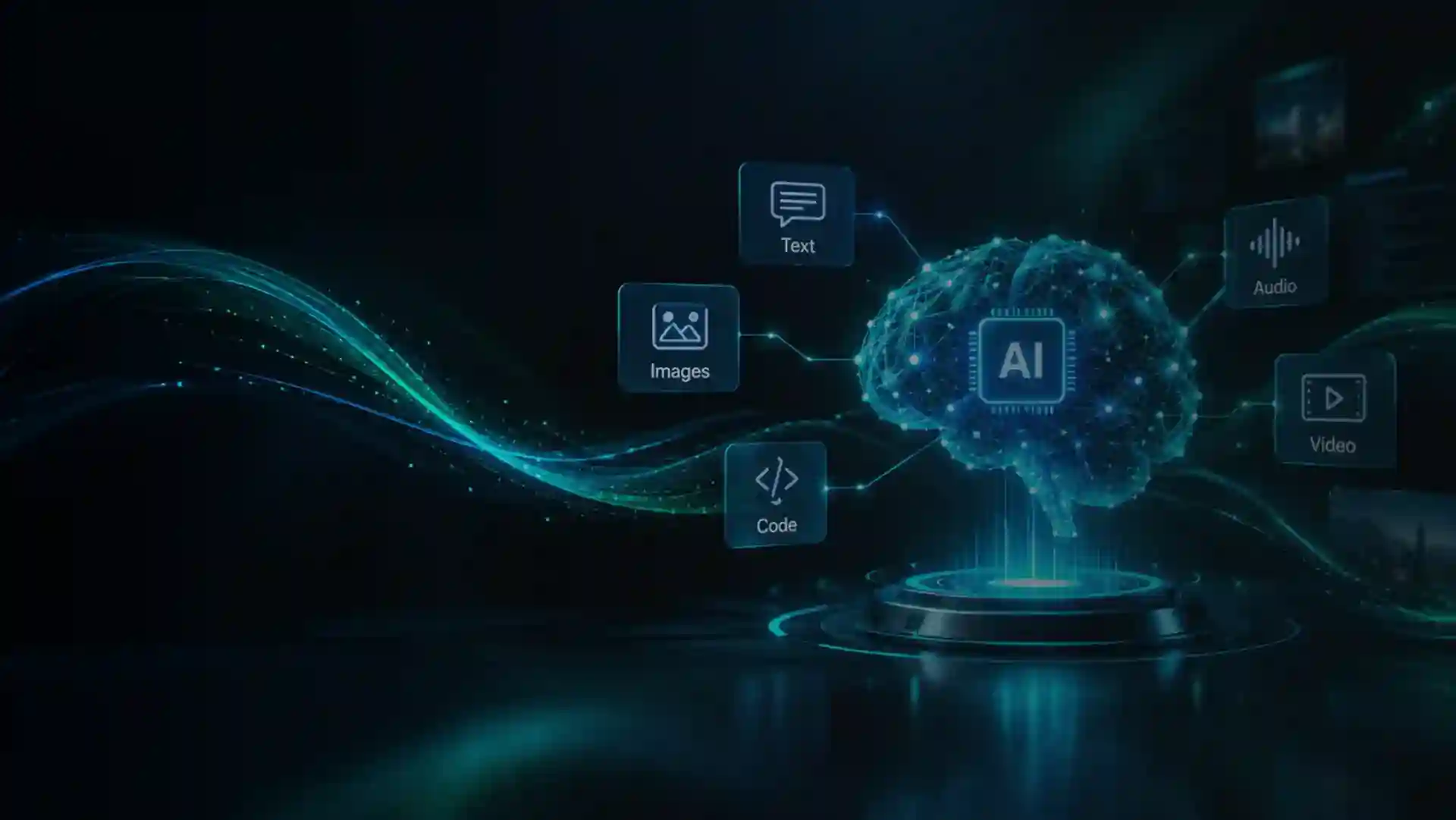
At Suffescom, we develop generative AI applications that help businesses automate tasks and deliver smarter user experiences. Our generative AI development company builds custom AI products with LLMs, RAG, AI agents, and secure integrations tailored to your business needs.
Your Reliable Partner for Generative AI Development
At Suffescom, we help businesses integrate Generative AI to solve actual operational challenges. Our team builds Generative AI applications around specific workflows instead of forcing AI into processes where it adds little value. Our genAI development services begin with your business requirements. We assess the existing workflow and identify where AI can make a practical difference. The result is an application designed around your actual users and processes.
We build AI assistants enterprise copilots, knowledge systems, and document intelligence tools. Our Generative AI development company uses technologies such as LLMs, RAG, vector databases, and AI agents based on the needs of each project. We can also connect GenAI applications with your existing business software. This allows teams to work with information from their current systems without changing the entire technology setup.
We Provide Generative AI Development Services Across Different Industry Domains
Generative AI is being adopted in many sectors where businesses handle very large volumes of information, customer interactions, and operational workflows. Our generative AI development services can be adapted to industry-specific requirements and regulatory considerations.
Use GenAI for clinical knowledge assistance, patient communication, medical documentation, and healthcare workflow support while maintaining appropriate access controls.
Support media and entertainment teams with content creation, audience assistance, knowledge management, research, summarization, and workflow automation.
Accelerate Business Operations with a Custom Generative AI solution by Suffescom.
Our Portfolio of Successful Generative AI Projects
Generative AI Knowledge Assistant for a Healthcare Provider
Business Requirements: A healthcare organization needed a faster way for staff to find information across internal policies and operational documents. Employees were spending too much time searching through large document repositories. The project required a secure AI interface that could return relevant information with supporting sources.
Solution: We developed a RAG-based knowledge assistant using an LLM with a vector search layer. Documents were processed through an ingestion pipeline before being indexed for semantic retrieval. Role-based access controls ensured users could only retrieve information permitted by their access level.
Business Requirements: A financial services company wanted to reduce the time analysts spent preparing client summaries and reviewing account information. The existing process required analysts to switch between several internal systems before preparing a report.
Solution: An AI copilot was incorporated into the current platform through APIs. The system retrieved approved account information and generated structured summaries for analyst review. Human approval remained part of the workflow before any information was shared externally.
Generative AI Customer Support Assistant for an E-commerce Platform
Business Requirements: An e-commerce business had to deal with many repetitive customer queries. Customer service agents wasted a lot of time answering questions related to orders, returns, shipment status, and product-related issues.
Solution: We built a GenAI support assistant connected to the company’s knowledge base and order management APIs. Relevant answers to the customers' inquiries were generated via retrieval-based methods. More complex issues were redirected to human agents following certain escalation criteria.
Use Cases of GenAI Development for Modern Businesses
Generative AI can support business teams in different operations. Explore the use cases that show where GenAI can fit into current processes and deliver actual value without replacing human oversight.
AI-Powered Knowledge Management
Make organizational knowledge easier to find and use. We connect GenAI with all approved information so employees can find answers without searching through many disconnected repositories. Access controls can restrict responses to information available to each user.
Intelligent Workflow Assistance
Decrease recurring tasks in everyday business processes. Generative AI can prepare task inputs, summarize activities and assist employees at different points in a workflow. Human review can remain in place for tasks that still need approval.
Decision Support Systems
Give teams a much more precise view of complicated information. Our generative AI development solutions can consolidate relevant inputs and surface information that may require more investigation. Final decisions remain with the responsible business users.
Personalized User Experiences
Adapt digital experiences to individual user needs and context. We use GenAI to personalize interactions and assistance based on permitted user and business data. Context-aware responses can make digital products a lot more relevant without exposing restricted information.
AI-Powered Productivity Systems
Help employees complete information-heavy work with less manual effort. These systems can assist with drafting, research, meeting follow-ups, information analysis, and routine knowledge tasks. At Suffescom, we tailor generative AI development solutions to specific roles and existing work practices.
Business Content Automation
Support content operations without being completely dependent on manual production. GenAI can generate and adapt business content based on predefined details, tone requirements, and approval processes. Review stages can be added before content reaches customers.
AI-Powered Reporting
Turn operational information into business ready reports and summaries. GenAI can interpret approved data sources and prepare reports for different business audiences. We implement Generative AI for structured output formats to help keep generated reports aligned with requirements.
Customer Interaction Intelligence
Help teams be aware of and respond to customer interactions effectively. Our GenAI development company builds solutions that summarize conversations and extract useful customer insights. We design these workflows with escalation paths when an interaction requires human attention.
AI-Powered Process Optimization
Find where manual steps create unnecessary effort within business operations. We integrate GenAI to analyze process information and identify repetitive activities and opportunities for workflow automation. The findings can then inform changes to current operational workflows.
Multilingual Business AI
Support organizations that operate across multiple languages and markets. GenAI can assist with translation, localization, multilingual content generation, and language-aware interactions while preserving approved business terminology.
AI-Powered Forecasting Support
Use GenAI alongside current analytical systems to make forecasts easier to interpret. The system can explain trends and present scenario information in a format business teams can understand. GenAI supports the interpretation layer rather than replacing established forecasting models.
AI-Powered Compliance Assistance
Support compliance teams with faster review of policies, records, and regulatory information. GenAI can identify relevant requirements, summarize documents, flag potential gaps, and prepare review-ready outputs. Human experts can validate findings before any compliance action is taken.
Our End-to-End GenAI Development Services
We provide GenAI development services for businesses adopting this technology in different products and workflows.
Our generative AI consulting & development services help businesses know where GenAI can deliver actual value. We provide consulting services that help examine business workflows and current infrastructure before development starts.
AI Readiness Assessment: Assess infrastructure, data and security needs to determine AI readiness.
Use Case & Roadmap Planning: Discover use cases and plan a phased roadmap of implementation with goals.
Model Selection & Strategy: Compare LLMs and other different models in terms of accuracy and implementation considerations.
Integration Strategy: Align AI components with existing applications and workflows within the organization.
AI Governance: Establish control measures around data access, privacy, and responsible AI adoption.
Generative AI Application Development
We develop GenAI applications to turn your business needs into actual working and production-ready AI apps. Our team aims to develop the application layer where users interact with models and AI-powered workflows.
AI Assistant Development: AI-powered assistants for retrieving knowledge, task assistance, and contextual conversations.
Copilot Development: Embed AI into employee workflows to assist with information discovery and other daily tasks.
AI Content Applications: Create AI applications for content creation, classification, etc.
Document Intelligence: Employ OCR (Optical Character Recognition) and NLP (Natural Language Processing) in document-intensive workflows.
Custom Generative AI Platforms: Engineer purpose built GenAI products around industry workflows and needs.
Generative AI Model Fine-Tuning
Fine-tuning helps adapt a foundation model for a specialized task. It is useful when prompt engineering or RAG does not provide the required level of task-specific performance.
Dataset Preparation: Prepare specific data for training and validation.
Model Selection: Assess available models against the required use case.
Fine-Tuning: Train the selected model with curated datasets for targeted behavior.
Model Evaluation: Test outputs against defined quality and performance benchmarks.
Performance Optimization: Adjust training parameters and datasets based on evaluation results.
GenAI-Powered Data Analytics
Generative AI can make data analytics a lot easier to access with natural language. Users can easily interact with data without depending completely on predefined reports.
Natural Language Queries: Convert users' questions into queries against approved datasets.
AI-Generated Insights: Turn relevant data into very precise explanations for business users.
Report Generation: Generate recurring reports from defined data sources.
Data Exploration: Help find trends and unusual patterns within available datasets.
Analytics Integration: Connect GenAI capabilities with existing BI tools and data pipelines.
AI Agent Development
AI agents can move beyond just simple responses by doing all the defined tasks in a workflow. Their architecture determines which decisions they can make and which actions they can execute.
Task-Based Agent Design: Define goals and establish the actions available to each agent.
Tool & API Connectivity: Connect agents with APIs and business tools required for task execution.
Multi-Step Workflows: Enable agents to complete sequential tasks while retaining relevant context.
Agent Memory: Add memory capabilities when workflows need more contextual continuity.
Guardrails & Controls: Set permissions and validation rules to keep agent actions within defined limits.
Generative AI Integration
Our generative AI integration services bring modern capabilities into existing business systems. The integration approach is based on your application architecture and the way data moves across your workflow.
API Integration: Link AI models with applications with secure API endpoints.
CRM & ERP Integration: Bring AI capabilities into customer management and operational systems.
Database Connectivity: Give AI applications controlled access to relevant structured data.
Enterprise Workflow Integration: Add GenAI to current processes without replacing the underlying software.
Third-Party AI Integration: Connect external models and AI services when they fit the project requirements.
RAG-Based Generative AI Solutions
RAG (Retrieval-Augmented Generation) allows an AI model to retrieve relevant information before generating an answer. This makes it suitable for applications that need to work with private business knowledge.
Knowledge Base Setup: Organize approved documents and information sources for retrieval.
Data Ingestion: Process source material through parsing and content preparation.
Vector Search: Generate embeddings to support semantic information retrieval.
Context Retrieval: Pass relevant information to the model during response generation.
RAG Evaluation: Test retrieval relevance and response quality against defined benchmarks.
Generative AI Model Development
Our generative AI development services include custom model engineering for different use cases. The app development lifecycle can extend from dataset preparation through production deployment.
Model Architecture Design: Select an architecture that matches the required AI capability.
Training Data Preparation: Build suitable datasets for training and model validation.
Model Training: Train models against defined objectives and project-specific data.
Model Testing: Check output quality with all required performance benchmarks.
Deployment Setup: Prepare trained models for use within the target application environment.
Generative AI Model Architecting
AI model architecture defines how the model interacts with data and supporting infrastructure. Careful planning at this stage can improve scalability and simplify future optimization.
Architecture Planning: Define the components required for the intended AI capability.
Data Pipeline Design: Plan the movement of data through preprocessing and model workflows.
Infrastructure Selection: Assess computing and storage requirements for the expected workload.
Model Workflow Design: Structure training and inference processes around project requirements.
Architecture Optimization: Review performance and resource usage before implementation.
Generative AI Model Replication
Model replication can support projects that require greater control over deployment. The implementation depends on the functionality being reproduced and the available infrastructure.
Capability Assessment: Find the model capabilities required for the target application.
Architecture Analysis: Examine the technical structure needed to reproduce those capabilities.
Environment Setup: Configure the required computing environment for development and testing.
Performance Benchmarking: Compare model behavior against established quality requirements.
Deployment Optimization: Tune the implementation for its intended production environment.
Model Integration & Deployment
A production GenAI system requires more than model access through an API. Deployment also involves application connectivity and operational controls.
Model API Setup: Expose model functionality through secure and monitored endpoints.
Application Integration: Connect inference services with application logic and user interfaces.
Cloud Deployment: Deploy models on suitable cloud or private infrastructure.
Inference Optimization: Improve response speed and resource efficiency for production workloads.
Production Testing: Validate model behavior and system reliability before release.
Generative AI Upgrade & Maintenance
GenAI applications need ongoing attention as models and business needs change. Our post-launch maintenance services aid in preserving application quality and also support future improvements.
Model Updates: Review newer models and incorporate upgrades when they suit the application.
Performance Monitoring: Track response quality and system performance after deployment.
Prompt & RAG Optimization: Refine prompts and retrieval strategies using production feedback.
Bug & Integration Fixes: Resolve issues across the AI layer and connected applications.
Feature Enhancements: Add new capabilities as user requirements develop.
AI Model Ecosystems
Models Our Generative AI Developers Use
Selecting the model depends on different aspects like the application's purpose and deployment environment. We work with leading model ecosystems and combine them with techniques like prompt engineering and tool calling to match the technical needs of each GenAI application.
OpenAI GPT Ecosystem
OpenAI's GPT models support a broad range of generative AI applications, which include conversational interfaces and AI-powered business applications. Our GenAI development company selects a model that can be aligned with the required context window.
Meta AI Llama Ecosystem
Llama provides open-weight models that can be deployed in controlled environments where businesses require a lot more flexibility over infrastructure and data handling. The ecosystem can support customization, private deployment, and domain-specific AI applications.
Google DeepMind Gemini Ecosystem
Gemini models support multimodal AI workloads involving text, images, audio, video, and documents. We use this model to develop applications that require broader context processing or interaction across different data formats.
Anthropic Claude Ecosystem
Claude models are suited to language intensive workloads like document analysis and enterprise content processing. Their large-context capabilities can support applications working with substantial amounts of business information.
Mistral AI
Mistral offers open-source and commercial models for enterprises looking for agility in cloud and self-hosted solutions. The Mistral model suite can be taken into consideration for use cases where there is a need for efficient inference, control of deployment or customizability of the model.
Microsoft Azure AI
Azure AI provides access to multiple model families alongside enterprise cloud infrastructure and security controls. It can support organizations that need GenAI capabilities within an existing Microsoft technology environment.
Cohere
Cohere focuses heavily on enterprise language applications, that includes semantic search and multilingual workloads. Its models can be used where organizations need Generative AI capabilities closely connected to enterprise knowledge and information systems.
Amazon Bedrock
Amazon Bedrock provides access to multiple foundation models through AWS infrastructure. It can support applications that require model choice, managed infrastructure, security controls, and integration with existing AWS services.
DeepSeek
DeepSeek offers reasoning and general-purpose models that can support coding and analytical workloads. Its models can be considered for applications that require reasoning capabilities and flexible deployment options.
Generative AI Integration in Business Workflows
Enterprise GenAI adoption involves more than connecting an application to an LLM API. The surrounding architecture determines how models access business data and interact with current systems.
Our Generative AI Development Process
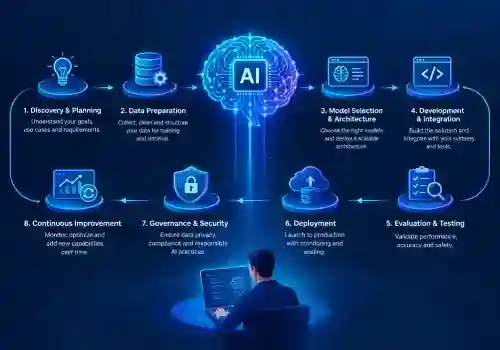
Our GenAI development services follow an engineering-led process that takes an AI concept through all stages from data preparation to ongoing governance. We define technical decisions early so the resulting system can work with real business data and existing infrastructure.
Define the AI Use Case
We first identify the task the model needs to perform and check if an LLM, RAG architecture, AI agent, or another approach suits the business requirement. Our Generative AI developers also define expected outputs and evaluation criteria.
What you get:
AI use case specification
Technical feasibility report
Defined success metrics
Prepare Business Data
Next, the source data is collected and prepared for AI processing. Documents may pass through OCR and parsing before being cleaned, chunked, enriched with metadata, and converted into embeddings for retrieval-based applications.
What you get:
AI-ready datasets
Data processing pipeline
Embedding and indexing setup
Select the AI Model
Our Generative AI development company benchmarks the required foundation models against the workload of the project. Factors like context length, reasoning performance, inference latency, hosting requirements, and token costs help determine the model strategy.
What you get:
Model comparison
LLM selection
Inference architecture
Build the AI Logic
Our GenAI application development services turn the selected model into application logic. This stage can involve prompt templates, RAG retrieval, function calling, structured outputs, memory, or agent tools depending on how the system needs to behave.
What you get:
Prompt and context design
AI workflow logic
Tool and function configuration
Connect the Application
The AI layer is connected with the software environment in which it will operate. API endpoints can link the model with databases, business applications, authentication systems, and internal services.
What you get:
API integration
Backend connectivity
Authentication and access controls
Test Model Responses
We evaluate the AI against actual prompts and known failure cases. Testing can measure groundedness, retrieval accuracy, hallucinations, instruction following, response latency, and output consistency.
What you get:
AI evaluation suite
Test and benchmark results
Guardrail configuration
Move to Production
The validated application is prepared for its production environment. Our generative AI software development services include containerized deployment, secrets management, encrypted data flows, API protection, and infrastructure configuration.
What you get:
Production deployment
Secure model endpoints
Environment configuration
Monitor AI Performance
Production telemetry helps identify changes in model and application behavior. Our Generative AI development company monitors inference latency, token consumption, failed requests, retrieval performance, and output quality to guide optimization.
What you get:
LLM observability
Performance telemetry
Cost monitoring
Maintain and Govern
GenAI applications need controlled updates as models and business requirements change. Model versioning, regression tests, evaluation gates, access reviews, and audit logs help maintain expected behavior after changes.
What you get:
Model lifecycle management
Governance framework
Ongoing evaluation
Cost to Develop a Generative AI Application
The cost of generative AI development can range from $15,000 to $400,000+. The final investment depends on factors such as model strategy, application complexity, data requirements, integrations, security, and production infrastructure.
Techniques Our Generative AI Development Company Applies
Generative AI implementation depends on the configuration and optimization of models for actual production tasks. We apply tested techniques to improve the quality of outputs.
Prompt Engineering
−
We design system instructions and prompts for a particular system based on certain business needs. Prompt templates can be version-controlled and tested against appropriate inputs to enhance instructions.
Context Engineering
+
Context engineering controls the information presented to a model for every single request. We manage conversation history and required application data to keep model inputs reliable.
Model Distillation
+
Model distillation transfers useful capabilities from a large model to train a smaller one. This may reduce the costs of inference and latencies associated with applications performing repetitive or specific tasks.
Model Quantization
+
Quantization decreases model precision to conserve memory and reduce computation. Methods like INT8 and INT4 quantization may help achieve better inference in the appropriate workloads.
Guardrails
+
AI guardrails place defined controls around inputs and outputs of a model. We include content filtering, PII detection, validation rules, and policy-based response controls if necessary, depending on the business process.
Structured Outputs
+
Structured outputs constrain results based on predetermined formats like JSON. This enables applications to check AI-generated data for validity before feeding it to databases.
Challenges and Risks of Generative AI Adoption and Mitigation
Generative AI adoption can introduce technical and operational risks that affect reliability and maintainability. Identifying these risks early helps teams design stronger AI systems and prepare practical mitigation strategies.
Model Lock-In
Challenge: Application logic built around one provider's SDK can make model migration costlier. Changes in pricing or model availability can add a lot more dependency.
Solution: We isolate provider specific APIs behind a model gateway. Standardized request and response interfaces make it a lot easier to benchmark another model without rewriting application logic.
Non-Deterministic Outputs
Challenge: Similar inputs could lead to dissimilar outputs, especially in cases where there is a change in the settings of generation or the version of the models used.
Solution: We keep track of request parameters, model IDs, prompts, context obtained and outputs in important operations. Test cases could then be used when debugging and evaluating the models.
Latency During Multi-Step Requests
Challenge: A single user request may trigger retrieval, reranking, multiple model calls, API requests, and post-processing. Sequential execution can create noticeable delays.
Solution: Independent operations can run asynchronously where appropriate. Response caching, smaller models per task, streaming, and parallel tool invocation are some of the methods that can reduce latency.
Weak Evaluation Coverage
Challenge: A demo may work reliably on some sample prompts but can fail on edge cases or adversarial requests.
Solution: We create evaluation datasets containing normal and adversarial scenarios. Automated evaluation can quantify factual correctness and task accomplishment.
Model Update Regression
Challenge: A provider can release a new model version that changes response style, tool behavior, latency, or accuracy without changes to your application code.
Solution: New versions are tested against the current evaluation suite before release. Production traffic can be gradually shifted to the new version while monitoring key quality and performance metrics.
Token Cost Spikes
Challenge: Large prompts and repeated context can result in unexpected inference cost increases due to increased usage.
Solution: We measure tokens per request and identify high consumption prompts. Token reduction via context compression and request-level token budgets can decrease unnecessary inference.
See What Clients Say About Us
See how businesses have used our generative AI solutions to improve knowledge access, support workflows, and add AI capabilities to their existing systems.
CLIENT STORY
The team at Suffescom developed a knowledge assistant around our internal documents and connected it with a secure retrieval system. It has made finding information much easier for our staff, especially when they need a specific policy or operational detail quickly.
Sarah Mitchell Operations Manager, Healthcare Organization
Suffescom helped us add an AI copilot to our existing financial platform instead of changing the systems our analysts already use. The team connected the required account data through APIs and kept human review in place, which was important for our reporting process.
James Carter Product Manager, Financial Services Company
Suffescom developed the AI support assistant and connected it with our knowledge base and order management system. It now handles many of the repetitive questions our team used to answer manually, while more complicated issues can still be passed to an agent.
Emily Roberts Customer Experience Manager, E-commerce Business
Where Could GenAI Fit Your Business?
Identify practical opportunities for GenAI across the systems and processes your teams already use.
Modern GenAI systems can do more than generate text. They can interpret mixed data, understand user intent, work with application context, and assist with tasks that previously required several software steps.
Natural-Language Commands
Users can ask questions or request actions in natural language. The AI layer can translate those requests into database queries, API calls, or application functions.
Process Mixed Data
A GenAI system can work with documents, images, audio, video, and text within the same application. This is useful when business information is spread across different formats.
Add AI to Existing Products
Businesses can introduce copilots or document intelligence inside software they already operate. The current product does not need to become a separate AI platform.
Shorten User Workflows
Instead of moving through several screens to complete an information-heavy task, users can provide their intent in one interaction. The application can gather context and prepare the required output.
Give Software Task Awareness
GenAI can interpret what a user is currently doing and provide assistance based on that context. The response can account for the active record, role, permissions, and previous interaction.
Create Dynamic Interfaces
AI can generate responses, summaries, forms, explanations, or recommendations based on the request rather than displaying the same fixed interface to every user.
Reuse Organizational Knowledge
Internal documentation can become an interactive knowledge layer. Employees can query policies and technical documentation without knowing where each source is stored.
Test AI Behavior Before Release
Generative AI applications can be checked against real prompts and expected outputs before reaching production. This makes model behavior part of the software testing process.
Automate Repetitive Knowledge Tasks
GenAI can handle repetitive tasks such as summarizing documents and classifying content. This reduces manual effort while keeping users involved in tasks that require review or approval.
Why Choose Suffescom for Generative AI Development Services?
A GenAI development partner needs to handle more than model implementation. Suffescom combines AI engineering with product development, security practices, and long-term software support.
01
Experienced Product Engineering
Suffescom has been delivering AI-integrated app & software products since 2013. We understand how to introduce GenAI into existing products without treating the AI layer as a standalone experiment.
02
Practical Agent Development
Our team has built AI agents for different business requirements. This experience helps us handle agent tools, task execution, permissions, and human approval points.
03
Cross-Industry Knowledge
Our work spans more than 30 industries. This exposure helps us understand domain-specific data, user roles, business rules, and existing software environments.
04
Security in the Architecture
Security requirements are considered during application design and development. Access controls, API protection, data handling, and audit requirements can be incorporated according to the project's needs.
05
Existing System Expertise
GenAI often needs to work with software that businesses already use. Our engineering teams can work with APIs, databases, enterprise applications, authentication systems, and legacy environments.
06
Production Support
Our involvement does not stop when the AI product goes live. We provide post-launch support for technical issues, model changes, performance tuning, and new feature requirements.
07
Reliable Infrastructure
GenAI applications require dependable infrastructure alongside the model layer. We address deployment, monitoring, application reliability, and infrastructure requirements as part of production engineering.
08
Long-Term Development Partner
AI products evolve as models, data, and business requirements change. We can continue working on the product through upgrades, new integrations, AI enhancements, and ongoing maintenance.
Bring your GenAI idea to development with engineers experienced in model integration, AI application development, data pipelines, and production deployment.
Generative AI development involves building software that can generate text, images, code, audio, or other content from user prompts. It typically combines foundation models, APIs, custom data, retrieval systems, and application logic.
Businesses use generative AI for content generation, customer support, document processing, knowledge assistants, workflow automation, and data analysis.
A custom application is useful when a business needs proprietary data, specialized workflows, deeper integrations, or greater control over security and user experience. Off-the-shelf tools are often sufficient for general-purpose tasks.
To choose a trusted generative AI development company, evaluate experience with foundation models, RAG, AI agents, API integrations, data security, deployment, and post-launch support. Ask for relevant case studies and assess how the team handles model evaluation and production monitoring.
The process of generative AI application development usually covers use-case discovery, data preparation, model selection, architecture design, prototype development, integration, evaluation, security testing, deployment, and continuous optimisation.
Common technologies used for Generative AI development solutions include OpenAI and other foundation model APIs, Python, LangChain, vector databases, RAG pipelines, cloud AI services, and frameworks for agent development. The technology stack depends on the application's requirements.
Features in a custom generative AI solution can include conversational interfaces, document analysis, semantic search, AI agents, content generation, workflow automation, human-in-the-loop review, and role-based access.
Yes. RAG, embeddings, vector databases, and controlled data pipelines can connect an AI application with private business information without requiring the foundation model to be trained from scratch on that data.
The cost of generative AI development ranges from $15,000 to $400,000+. It depends on application complexity, model usage, integrations, data requirements, security controls, and infrastructure.
Major cost drivers of Generative AI software development include model selection, token usage, data preparation, RAG implementation, AI agent complexity, third-party APIs, cloud infrastructure, UI requirements, integrations, and ongoing model monitoring.
Yes. Generative AI integration helps connect AI capabilities with CRMs, ERPs, databases, help desks, communication tools, document repositories, and internal applications through APIs, webhooks, SDKs, and secure middleware.
Yes. Applications can integrate models from providers such as OpenAI and other LLM platforms through APIs. The architecture can also support model routing or multiple providers when cost, performance, privacy, or availability requirements differ.
Security can include encryption in transit and at rest, access controls, data isolation, secrets management, audit logging, secure APIs, and controlled retrieval permissions. Data handling should also align with the application's regulatory requirements.
Risk can be reduced through data access controls, input filtering, retrieval permissions, PII detection, output validation, and strict prompt and system policies. No AI system should be treated as automatically secure without application-level controls.
RAG can ground responses in approved business data, while structured prompts, source citations, output validation, confidence checks, and human review can further reduce unsupported responses. Continuous evaluation is important after deployment.
The required standards depend on the industry, data handled, and target market. A generative AI application may need to address frameworks such as GDPR, HIPAA, SOC 2, or ISO 27001, along with requirements for data retention, access control, consent, auditability, and data processing.
🍪We use cookies
Our website requires some cookies to function properly.
•SUFFESCOM SOLUTIONS
Build Smarter. Scale Faster. Grow More.
Have a Vision? Let’s Turn It Into a Digital Reality.
Get a quick response from our best experts in under 10 minutes.
“
Suffescom easily understood our main goal and delivered the best digital solution. Their team was very cooperative, and it was a very good experience working with them. I would highly recommend them.
James AndersonFounder & CEO, FinTech Company
“
Working with Suffescom was a really great experience. Their developers demonstrated technical knowledge and delivered our mobile app solution with all required functionalities on time.
Sarah MitchellProduct Manager, Healthcare Startup
“
Suffescom helped us build a logistics software solution that completely improved our fleet operations. Their professionalism and transparency are what make them a reliable technology partner.
Michael RobertsCEO, Logistics Company
Our Customer Say:EXCELLENT★★★★½✓ Goodfirms
Have a project idea or need expert guidance? Share your requirements at sales@suffescom.com and our team will get back to you shortly.
Share Your Requirements. Our Experts Will Shape the Solution.
Expert consultation within 10 minutes.Your project details are completely secure under NDA protection.
Get Outstanding Business Outcomes With Future Ready Solutions
Get Free Consultation From Top Industry Experts
Begin A Generous Partnership Now
•SUFFESCOM SOLUTIONS
Build Smarter. Scale Faster. Grow More.
Have a Vision? Let’s Turn It Into a Digital Reality.
Get a quick response from our best experts in under 10 minutes.
“
Suffescom easily understood our main goal and delivered the best digital solution. Their team was very cooperative, and it was a very good experience working with them. I would highly recommend them.
James AndersonFounder & CEO, FinTech Company
“
Working with Suffescom was a really great experience. Their developers demonstrated technical knowledge and delivered our mobile app solution with all required functionalities on time.
Sarah MitchellProduct Manager, Healthcare Startup
“
Suffescom helped us build a logistics software solution that completely improved our fleet operations. Their professionalism and transparency are what make them a reliable technology partner.
Michael RobertsCEO, Logistics Company
Our Customer Say:EXCELLENT★★★★½✓ Goodfirms
Have a project idea or need expert guidance? Share your requirements at sales@suffescom.com and our team will get back to you shortly.
Share Your Requirements. Our Experts Will Shape the Solution.
Expert consultation within 10 minutes.Your project details are completely secure under NDA protection.
Have a Vision? Let’s Turn It Into a Digital Reality.
Get a quick response from our best experts in under 10 minutes.
“
Suffescom easily understood our main goal and delivered the best digital solution. Their team was very cooperative, and it was a very good experience working with them. I would highly recommend them.
James AndersonFounder & CEO, FinTech Company
“
Working with Suffescom was a really great experience. Their developers demonstrated technical knowledge and delivered our mobile app solution with all required functionalities on time.
Sarah MitchellProduct Manager, Healthcare Startup
“
Suffescom helped us build a logistics software solution that completely improved our fleet operations. Their professionalism and transparency are what make them a reliable technology partner.
Michael RobertsCEO, Logistics Company
Our Customer Say:EXCELLENT★★★★½✓ Goodfirms
Have a project idea or need expert guidance? Share your requirements at sales@suffescom.com and our team will get back to you shortly.
Share Your Requirements. Our Experts Will Shape the Solution.
Expert consultation within 10 minutes.Your project details are completely secure under NDA protection.
 +971-8000321216