At Suffescom, we help businesses turn fragmented data into a reliable foundation for analytics and AI. Our data analytics engineering services cover architecture design and pipeline development, along with data integration and modernization.
Our data engineers connect information across applications, databases, APIs, and cloud environments. We create pipelines that prepare data for warehouses and lakes as well as BI platforms and AI workloads. We have supported 150+ startups and enterprises in managing data from diverse sources and building enterprise data strategies. The work also includes cloud data lakes and advanced pipelines across AWS and Azure environments.
We also provide data engineering consulting services to improve current data environments. By leveraging the best approach, we help you build infrastructure that can support changing business needs.
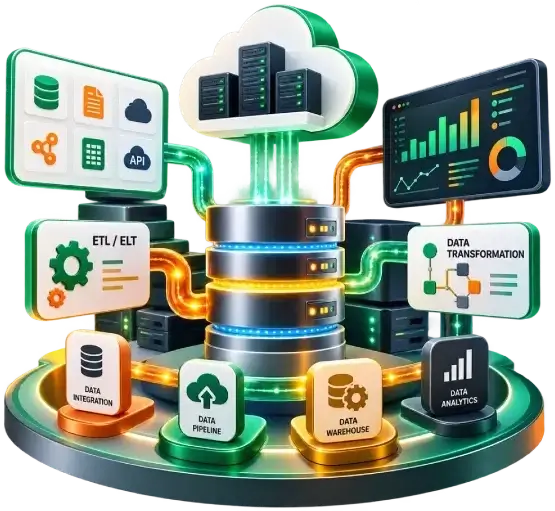
Data environments need more than basic pipelines. They require a foundation that can move information reliably and make it usable. Our data engineering services and solutions cover the complete data lifecycle. It helps businesses improve current infrastructure.
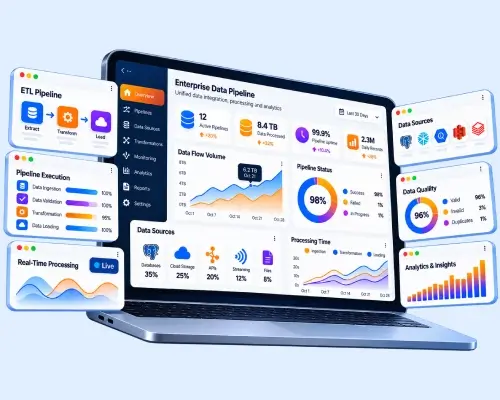
Pipelines keep data flowing between source systems. Our data engineering solutions support batch and instant processing based on workload needs. We design ingestion workflows that decrease manual data movement and establish paths for analytics.
Disconnected systems can make it very difficult to access consistent business information. We provide data integration engineering services to connect applications and databases through APIs. This helps establish consistent data flows in your existing technology environment.
A well-structured warehouse gives teams a consistent environment for reporting and analysis. We design and incorporate data warehouses that bring details from multiple systems into a format that supports BI and enterprise reporting.
Data lakes provide a flexible environment for storing very vast volumes of information. Our data engineering consultants design cloud data lakes that can support analytics and machine learning workloads. Storage architecture is planned around data volume and access needs.
Large datasets require an architecture that can handle increasing processing demands. Our big data engineering services help process high-volume information through distributed data processing environments. The engineering approach is aligned with workload requirements and downstream use cases.
Outdated data infrastructure can slow down performance and make maintenance difficult. Our data modernization services help change environments to modern architectures. We assess the current setup and create a modernization path that supports continuity.
The process of moving your data to a new system entails more than just transferring records. Our data engineering services include data migration and data validation/reconciliation. This guarantees that your data remains consistent when migrating from old systems to the new ones.
Analytics teams need data that is ready for consumption. Our data analytics engineering services prepare datasets for BI platforms and analytical applications. We build transformation workflows that make data a lot easier to query.
Data governance establishes control over how information is accessed and managed. Our team can incorporate governance practices into the data architecture to support security and compliance requirements.
Business Requirement
A retail company was collecting sales data through various applications and databases. Data teams worked on manual exports to prepare information for reporting. Slow updates made it very difficult to get a current view of sales performance.
Solution
Our team developed an automated data pipeline that pulled details from databases. Transformation workflows standardized incoming records before loading them into a centralized analytics warehouse. Incremental processing decreased unnecessary data movement.
Outcomes
52%
faster data availability41%
reduction in manual data preparation35%
improvement in reporting turnaroundBusiness Requirement
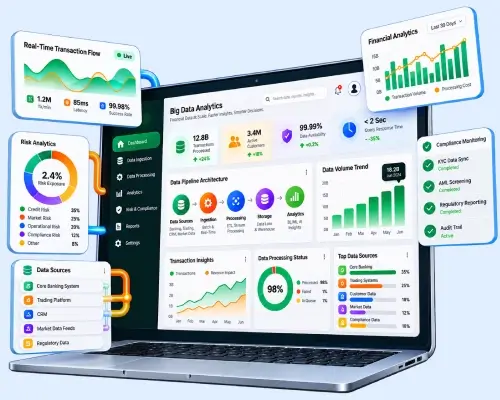
A financial services company was processing large volumes of transaction and market data through conventional infrastructure. Processing windows were increasing as data volumes grew. Analytical teams needed faster access to historical datasets.
Solution
Our data engineering services company incorporated a distributed data processing architecture for workloads. Partitioned storage improved access to old datasets and parallel processing decreased computation time. Automated ingestion workflows moved incoming data into the environment.
Outcomes
58%
faster data processing44%
reduction in processing time37%
faster access to analytical datasetsBusiness Requirement
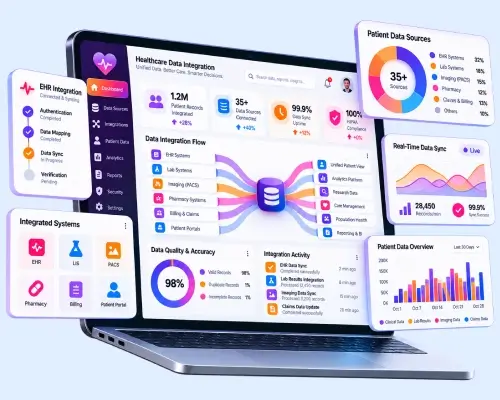
A healthcare provider stored patient and operational information across separate applications. Data teams had to extract records from multiple systems before generating reports. Differences in data formats also created additional reconciliation work.
Solution
Suffescom developed a data engineering solution that connected the current applications with a centralized data platform. API integrations and scheduled ingestion workflows moved required information into the target environment. Validation rules were added to identify inconsistent records during processing.
Outcomes
47%
faster data consolidation39%
reduction in manual reconciliation32%
faster report preparationAt Suffescom, we provide data engineering services for diverse industries. Each solution is developed based on precise needs.
Reliable data infrastructure decreases the effort needed to transfer data across different systems. Well-defined pipelines also provide much more control over the quality and processing of data as the processing workloads get complex.
Dependency mapping shows where data originates and which transformations may impact it. Our data integration engineering services include finding the source of reporting issues without checking every pipeline manually.
Reusable ingestion patterns make it very easy to connect another database or app without redesigning the complete pipeline. New sources can follow transformations and rules for validation.
Partitioned storage and distributed processing allow the management of the load that exceeds the capabilities of standard databases. Processing resources are allocated based on the workload.
Transformation workflows convert source data into datasets for BI and analytical applications. Teams can work with defined metrics instead of repeatedly preparing raw information.
Data engineering environments usually process sensitive customer and operational information. Our data engineering services incorporate security and compliance controls into data pipelines and storage layers to protect information throughout its lifecycle.
Our data engineering services company follows an nine-stage process that takes your data environment from assessment to production support. Let’s discuss each stage.
01
The process begins by checking where data is stored and how it actually moves between systems. Our data engineering consultants assess the current setup to find dependencies and processing needs.
02
The target architecture is defined around different metrics like storage and analytics requirements. Our data engineering consulting services help businesses choose the best architecture for their workloads.
03
Data pipelines are developed to move information from source systems into the required destination. ETL or ELT logic is selected according to the data workflow.
04
Applications and databases are connected with the target data environment. Our team of data engineers establishes the required connections while accounting for source-specific requirements.
05
Quality controls find problematic records before they reach downstream systems. We apply all required validation rules defined based on the structure and needs of each dataset.
06
Pipelines are then tested by our data engineers against anticipated workloads and different conditions of failure before release. We also optimize processing logic and identify issues.
07
The tested infrastructure is then moved into production with monitoring in all pipelines and processing workloads. Alerts help us identify failures and abnormal behavior in the data engineering solution.
08
Post-deployment support keeps the data environment completely aligned with changing workloads. Our data engineering services company can extend current pipelines as new requirements emerge.
09
Data environments evolve as business needs, data volumes, and technology requirements change. At Suffescom, our data engineering experts continuously review the environment for scalability and effective performance.
The cost to develop a data engineering solution ranges from $20K to $300K+. The final investment depends on data volume and pipeline complexity, along with integration requirements, cloud infrastructure, and analytics workloads.
USD $20K – $50K
USD $50K – $150K
USD $150K – $300K+
As a trusted data engineering service provider, we help you build the best foundation for data-driven processes. Our team builds efficient data pipelines that modernize platforms and increase AI adoption.
At Suffescom, we have an experienced team of data engineering consultants and developers who assess your current systems and build a solution that completely fits your workload needs.
Our team works with cloud platforms and diverse data technologies to support various workload needs of the business. This helps in selecting the best suited architecture for the current environment.
At Suffescom, we integrate databases and APIs with existing business applications. This approach to data integration engineering keeps information flowing without requiring big changes to core systems.
Address complex data challenges with practical engineering solutions. Our teams work across different data environments using suitable technologies. We design pipelines that connect siloed systems and prepare data for analytics and AI workloads.
Data needs change as businesses add new sources or workloads. Our data engineering services include ongoing improvements and integration support after the deployment of solutions.
At Suffescom, we provide different engagement models for businesses to choose from based on their precise project needs and internal capabilities. We can support a pipeline project or provide resources for ongoing needs.
We select technologies based on your data sources and current system needs. Our data engineering stack supports pipeline development, data integration, processing, storage, and analytics.
Data engineering is the practice of designing, building, and maintaining systems that collect, store, clean, and move data. It turns raw data from multiple sources into reliable, analysis-ready datasets for analytics, reporting, and machine learning.
Data engineering creates a reliable foundation for turning raw business data into usable information. It improves data accessibility, quality, scalability, and processing speed so teams can make better decisions and support analytics and AI applications.
Data engineering can handle structured, semi-structured, and unstructured data from sources like.
You may need data engineering services if your data is spread across:
Data engineering services can include:
Yes. Data integration engineering services can connect databases, APIs, cloud applications, CRM and ERP platforms, third-party systems, and other sources. The data can then be transformed and consolidated into a centralized environment for analytics.
ETL extracts, transforms, and then loads data into a target system, while ELT loads raw data first and transforms it within the destination platform. ELT is commonly used with modern cloud data warehouses and lakehouse architectures because they can scale processing efficiently.
Yes. At Suffescom, our data engineering consultants first assess legacy databases, pipelines, warehouses, and integration layers and create a modernization roadmap. Depending on business needs, our engineers build solutions.
Modern data engineering solutions may use technologies like:
A data pipeline automatically moves data between systems while applying processes such as extraction, validation, transformation, and loading. Pipelines can run in batches or process data continuously for near-real-time use cases.
Data engineering can improve quality through:
The right choice depends on your data types and use cases. A data warehouse is well suited to structured analytics and reporting, while a data lake can store large volumes of structured and unstructured data. Many organizations use a lakehouse approach to combine capabilities.
The cost to develop a data engineering solution ranges from $20K to $300K. It depends on factors like project scope, data volume, number of sources, integrations, architecture complexity, cloud infrastructure, security requirements, and ongoing support.
A small pipeline or integration can take a few weeks, while enterprise data platforms and large-scale modernization projects may take several months. The timeline ranges from 2- 12+ months, depending on data complexity, integrations, migration requirements, and the desired production scope.
Consider data engineering consultants when you need specialized expertise, faster implementation, help with complex architecture, cloud modernization, or temporary engineering capacity. An external team can also work alongside your existing engineers when additional expertise is required.
To choose the best data engineering services provider:
• SUFFESCOM SOLUTIONS
Build Smarter. Scale Faster. Grow More.
Have a Vision? Let’s Turn It Into a Digital Reality.
Get a quick response from our best experts in under 10 minutes.
Share Your Requirements. Our Experts Will Shape the Solution.
• SUFFESCOM SOLUTIONS
Build Smarter. Scale Faster. Grow More.
Have a Vision? Let’s Turn It Into a Digital Reality.
Get a quick response from our best experts in under 10 minutes.
Share Your Requirements. Our Experts Will Shape the Solution.
Fret Not! We have Something to Offer.