We build production management systems that help manufacturers coordinate activities from released orders through completion. Supervisors gain a lot better control over production status.

Inventory applications provide traceability across raw materials and finished products from receiving through dispatch. Warehouse teams can use digital controls to maintain stock accuracy across multiple facilities.

Supply chain platforms connect manufacturers with suppliers and logistics partners across the product lifecycle. Teams can identify supply risks earlier and make informed decisions around sourcing and distribution.

Quality management software embeds inspection requirements into manufacturing operations and maintains a digital trail of quality events. We develop manufacturing software that supports quicker investigation when non-conformities occur.

Keep production equipment visible throughout its operational lifecycle with dedicated asset management capabilities. Maintenance teams can use service records and maintenance schedules to plan equipment interventions.

Manufacturing workforce systems help managers assign qualified personnel to the right production activities. Employee records and scheduling capabilities provide better oversight of labor availability.

Customer service software helps manufacturers manage post sale interactions and customer issues from a centralized platform. Teams can track support cases and maintain customer communication throughout the resolution process.

Our EDI integration services automate document exchange between manufacturers and trading partners. This decreases manual transaction handling and supports standardized communication with customers and suppliers.

Manufacturing ERP platforms bring production and enterprise functions into a shared operational environment. We customize ERP workflows to connect manufacturing data with finance and procurement and inventory operations.

Manufacturing finance software connects operational transactions with accounting processes to improve financial visibility and control. Teams can manage production costs, payables, receivables, and financial reporting within connected workflows.
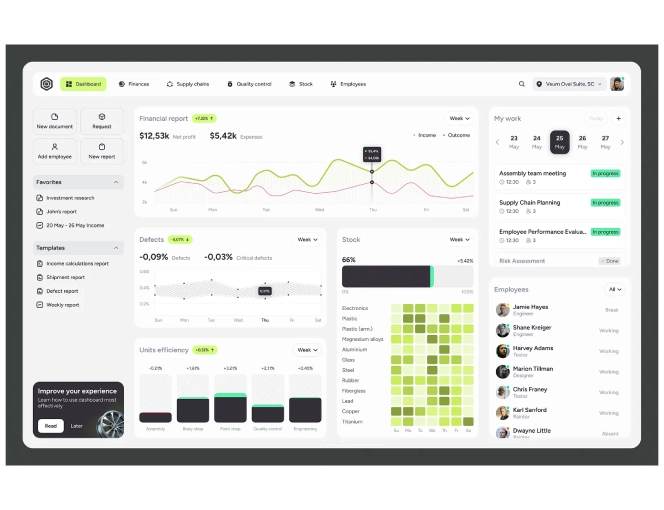
Business Requirement: An industrial equipment manufacturer required better coordination between production and inventory operations. Its current processes made it difficult to keep track of its production activities and material availability.
Our Solution: Our team developed a custom manufacturing ERP platform based on the company’s operational workflows. The system linked production planning with inventory tracking and provided a lot better visibility for management teams.
Outcomes:
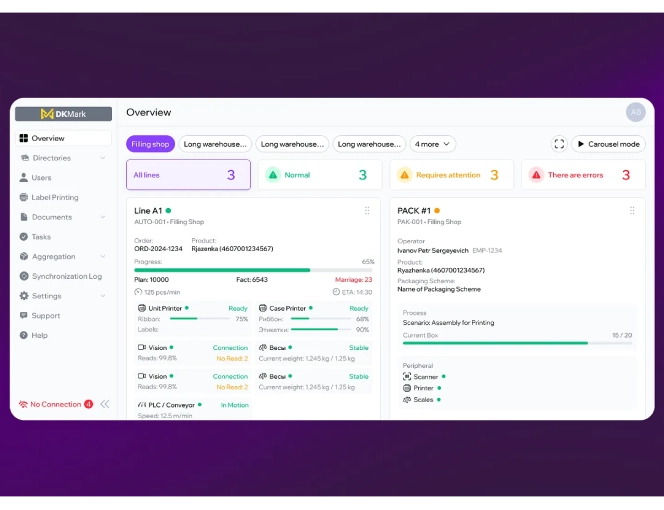
Business Requirement: A manufacturer required a digital platform to improve shop floor visibility and production tracking. Manual updates were creating a lot of delays in reporting and making it harder to identify production bottlenecks.
Our Solution: Our manufacturing software development company created custom production management software with instant tracking capabilities. The platform allowed teams to monitor work orders and machine activity and also helped maintain digital production records.
Outcomes:
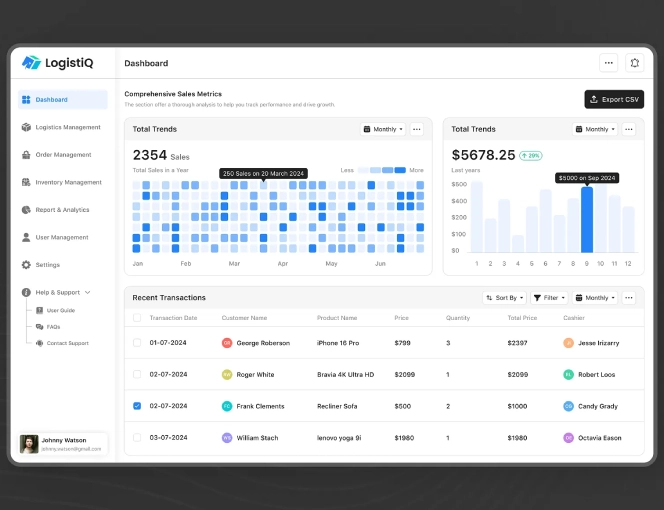
Business Requirement: An electric vehicle component manufacturer required better visibility across suppliers and material movement. Limited coordination between procurement and logistics teams was highly impacting material availability and planning of deliveries.
Our Solution: Our team built a supply chain management platform that integrated supplier data with procurement and logistics processes. This system ensured visibility into both purchase processes and material movements.
Outcomes:
We deliver manufacturing software development services for businesses looking to digitize production and improve operational control. Our expertise covers custom platforms and industrial applications along with integration and modernization.
Our consulting team evaluates your production environment before manufacturing software development starts. This helps define all required technologies and a practical roadmap for your manufacturing software project.
Our design services translate complicated manufacturing workflows into intuitive digital experiences. User flows and interfaces are structured around the needs of production teams and operational needs.
We develop custom manufacturing software solutions that are built around your specific production requirements. The platform can support planning and scheduling while improving visibility across daily manufacturing activities.
Connected systems give production teams access to the operational data they need. Our integration expertise links ERP and MES platforms with other essential business applications.
Cloud migration helps manufacturers move on-premises applications to an appropriate cloud environment. The transition can improve scalability and reduce the infrastructure burden of maintaining traditional systems.
We provide data analytics services that turn operational information into business insights. These solutions help teams know production performance and find areas for operational improvement.
Legacy software can become difficult to scale as production requirements change. Modernization updates outdated architecture while keeping essential manufacturing processes operational.
Production software needs technical support after deployment. At suffescom, we provide support services that help maintain performance and also help address security and operational needs.
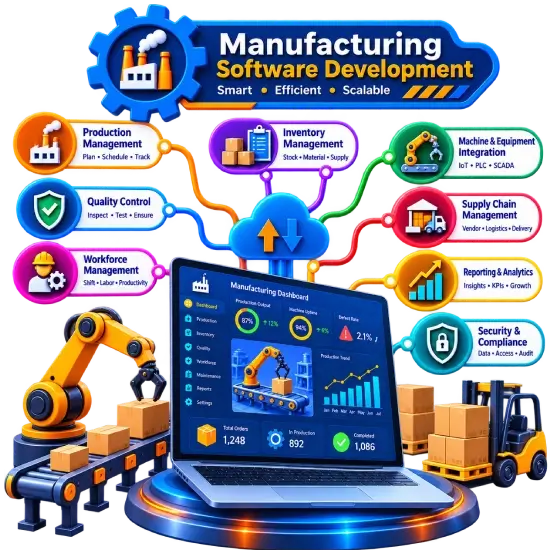
Our manufacturing software development services support industry-specific workflows across production environments with distinct operational requirements and compliance considerations.
Automotive Manufacturing
Industrial Machinery & Heavy Equipment
Electronics & Semiconductor Manufacturing
Pharmaceuticals & Life Sciences
Food & Beverage Processing
Oil & Gas Equipment Manufacturing
Solar Energy Equipment Manufacturing
Medical Device Manufacturing
Aerospace & Defense Manufacturing
Electric Vehicle Component Manufacturing
Chemicals & Specialty Materials Manufacturing
Consumer Goods Manufacturing
AI can extend custom manufacturing software with predictive capabilities and intelligent automation. Our software developers integrate these AI capabilities to help manufacturers find patterns in operational data and make quicker decisions.

AI models analyze production information to detect bottlenecks and unusual patterns in operations. This will allow manufacturers to increase production efficiency and respond to changes in performance more quickly.

Intelligent process automation is achieved through the automation of recurring manufacturing processes using AI decision making capabilities. This eliminates human involvement and allows teams to work on activities that require operational expertise.

Machine learning models evaluate historical demand and production data to improve forecasting accuracy. Better predictions help teams plan capacity and material requirements with greater confidence.

Our manufacturing software development company integrates computer vision to examine products for defects during manufacturing. This supports consistent quality checks and helps find production issues early.

AI can identify patterns that indicate potential equipment failures before they cause significant disruption. Maintenance teams can use these predictions to prioritize interventions and reduce unplanned downtime.

AI integrated into a custom manufacturing software solution helps analyze supplier and logistics data to find any disruptions and changing conditions. Manufacturers can use predictive insights to make quicker sourcing and distribution decisions.

Inventory data can be evaluated against demand patterns and production requirements. AI recommendations help maintain material availability while reducing unnecessary stock accumulation.

AI models can analyze energy consumption in all equipment and facilities to find unusual usage patterns. Manufacturers can use these insights to improve energy efficiency and control operational expenditure.

AI copilots give manufacturing teams a conversational way to access operational information and reports. We develop manufacturing software solutions integrated with Natural language interfaces to help users retrieve relevant data.
Our manufacturing software development team works with established enterprise platforms to extend current systems and build connected manufacturing environments. Platform selection of custom manufacturing software solutions depends on your requirements.

ERP and business management capabilities for production planning and supply chain operations.

Enterprise manufacturing capabilities covering production and materials management and plant operations.

Cloud ERP functionality for manufacturers handling financials and business operations.

Flexible ERP modules for production, procurement, inventory and warehouse workflows.

CRM capabilities that can connect customer operations with manufacturing and order management workflows.

Industrial software technologies supporting manufacturing execution and production engineering and industrial automation environments.

Cloud manufacturing platform capabilities for production management and connected factory operations.
We develop custom manufacturing software solutions that can be created with features that address production requirements and enterprise workflows. Each capability is selected according to your processes and the level of operational visibility your teams require.
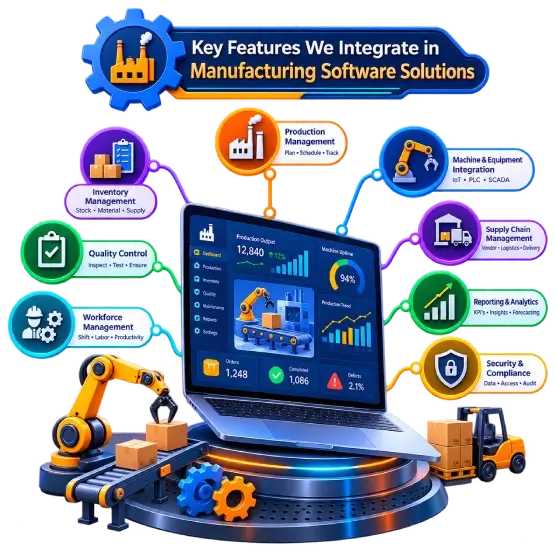

Coordinate production orders with available capacity and material requirements.

Track production activity and work center performance as operations progress.

Maintain visibility into raw materials, work in progress and finished goods.

Manage product structures and component requirements across manufacturing processes.

Capture inspection results and manage defects and non-conformance workflows.
Schedule maintenance activities and maintain detailed equipment service records.

Manage purchasing workflows and supplier interactions from requisition through delivery.

Track customer orders and fulfillment activities throughout the order lifecycle.

Turn manufacturing data into operational reports and performance dashboards.

Control access to sensitive manufacturing and business information based on user responsibilities.
The cost of build a manufacturing software depends on production complexity and the number of workflows and integrations required.
Security is considered throughout the manufacturing software development lifecycle to protect production data and connected operational systems. Our security approach combines established cybersecurity practices with controls suited to industrial environments.
Manufacturing software may be utilized by the operator, engineers, and even other parties outside the organization. The access policy will ensure that each person is given access only to what they need.
The production record and supply chain need to be protected from any unapproved access or manipulation. We include encryption and data governance controls to safeguard information in all transmission layers.
We set up SIEM solutions for providing centralization of visibility in applications and infrastructure at the manufacturing facility. This will help security teams investigate suspicious events.
We develop a custom manufacturing platform that follows secure engineering practices throughout the application lifecycle. It helps identify vulnerabilities before they can affect production environments.
Our manufacturing software development company integrates Industry 4.0 technologies based on specific production requirements rather than adding technology without a defined use case. We connect these capabilities with ERP and MES to create practical solutions.

We integrate RPA into manufacturing workflows where repeating administrative tasks consume valuable employee time. Our team develops software bots that can interact with ERP and procurement systems to execute rule based transactions with better consistency.

IoT integration connects manufacturing software with machines and industrial devices through appropriate communication protocols. This allows production software to receive equipment data without requiring changes to core machinery.
Artificial Intelligence can be integrated into the manufacturing software, which is used to analyze past and current production data. Machine learning algorithms are incorporated in solutions to provide assistance in areas where regular reporting fails.

Digital twin technology creates virtual representations of manufacturing assets and processes using operational data. Our software development company integrates these models into monitoring environments for simulation and performance analysis.

We use edge computing when manufacturing software solutions require processing close to connected equipment. Local computation can support low-latency workflows and also help decrease dependence on continuous cloud connectivity.

Computer vision can be incorporated into IT solutions for manufacturers to analyze images captured during production. Our developers can connect trained vision models with inspection workflows for automated visual assessment.


Before the ERP implementation, it was difficult for our teams to keep production and inventory information updated. The new system has made it much easier to track materials and production activities from one place.

Production reporting used to take a lot of manual effort and we often had delays in getting the latest shop floor information. The new platform gives our team much better visibility into work orders and machine activity.

We had limited visibility into supplier and material movement which affected our delivery planning. The new supply chain platform has made procurement tracking much easier and helped our teams respond faster to material availability issues.

Manufacturing software needs to work around real production environments. With 13+ years of experience in custom software development, we build solutions that solve your business challenges.

Our manufacturing software development company understands the needs behind production planning and inventory. This helps translate manufacturing workflows into practical digital capabilities.

Every manufacturing environment has its own processes and technology landscape. We build custom manufacturing software around those requirements instead of relying on one-size-fits-all functionality.

Manufacturing applications usually need to support additional facilities and integrations over time. Our manufacturing software development approach focuses on modular architecture that can change with changing business requirements.

We connect manufacturing platforms with current ERP, MES, CRM, and warehouse systems. API-based integration aids in maintaining consistent data exchange in the technology ecosystem.

Our developers can incorporate AI, IoT and other Industry 4.0 technologies where they provide practical operational value. This allows manufacturers to introduce predictive capabilities without removing their complete technology environment.

Security and compliance needs are very important and considered during each stage of industrial software development. Our engineering practices support appropriate access controls and auditability for manufacturing environments.































Partner with Suffescom for manufacturing software built around your workflows. Connect production data, automate critical operations, and create a stronger foundation for scalable growth.
Manufacturing software helps businesses manage and connect production, inventory, quality, procurement, workforce, and operational workflows. It can improve visibility, reduce manual work, minimize errors, and support faster production decisions.
It depends on how specialized your operations are. Custom software solutions are useful when you need unique workflows, equipment connectivity, reporting, or integrations, while off-the-shelf software can work well for standardized processes and faster deployment.
Manufacturers can develop software for:
Yes. A solution can start with essential capabilities and expand as the business grows. This allows smaller manufacturers to avoid paying for unnecessary functionality while building a system around their actual processes.
A focused application may take around 3–6 months, while a complex ERP, MES, or industrial platform can take 6–12+ months. The timeline depends on features, integrations, customization, testing, data migration, and deployment requirements.
Important capabilities can include:
Yes. Industrial software can collect information from machines, sensors, operators, and shop-floor systems. This enables real-time production dashboards, OEE monitoring, downtime tracking, alerts, and operational analytics.
Yes. Multi-location software can provide centralized visibility while allowing each facility to maintain its own processes. Common capabilities include:
Custom manufacturing software development typically ranges from $40,000 to $250,000+. A smaller application may fall toward the lower end, while enterprise systems with multiple modules, automation, analytics, machine connectivity, and complex integrations can exceed $250,000.
The cost mainly depends on:
Not always. Customizing an existing platform can be more economical when its core functionality matches your processes. However, a new system may provide better long-term flexibility when your manufacturing workflows or technology requirements are highly specialized.
Usually, ongoing maintenance is separate from the initial development budget. It may cover bug fixes, security updates, performance improvements, infrastructure management, technical support, and future feature enhancements.
Yes. Custom solutions can connect with ERP, CRM, accounting, procurement, inventory, warehouse, and other enterprise platforms using APIs, webhooks, middleware, or other data-exchange methods.
Yes. Industrial software development can connect software with:
Yes. Barcode scanners and RFID technology can be connected to support inventory tracking, material movement, warehouse operations, work-in-progress monitoring, and product traceability.
Yes. Legacy applications can often be connected through APIs, databases, file-based data exchange, middleware, or custom connectors. The best approach depends on the system's technology, available interfaces, and data structure.
• SUFFESCOM SOLUTIONS
Build Smarter. Scale Faster. Grow More.
Have a Vision? Let’s Turn It Into a Digital Reality.
Get a quick response from our best experts in under 10 minutes.
Suffescom easily understood our main goal and delivered the best digital solution. Their team was very cooperative, and it was a very good experience working with them. I would highly recommend them.
Working with Suffescom was a really great experience. Their developers demonstrated technical knowledge and delivered our mobile app solution with all required functionalities on time.

Suffescom helped us build a logistics software solution that completely improved our fleet operations. Their professionalism and transparency are what make them a reliable technology partner.

Share Your Requirements. Our Experts Will Shape the Solution.
• SUFFESCOM SOLUTIONS
Build Smarter. Scale Faster. Grow More.
Have a Vision? Let’s Turn It Into a Digital Reality.
Get a quick response from our best experts in under 10 minutes.
Suffescom easily understood our main goal and delivered the best digital solution. Their team was very cooperative, and it was a very good experience working with them. I would highly recommend them.
Working with Suffescom was a really great experience. Their developers demonstrated technical knowledge and delivered our mobile app solution with all required functionalities on time.
Suffescom helped us build a logistics software solution that completely improved our fleet operations. Their professionalism and transparency are what make them a reliable technology partner.
Share Your Requirements. Our Experts Will Shape the Solution.
• SUFFESCOM SOLUTIONS
Build Smarter. Scale Faster. Grow More.
Have a Vision? Let’s Turn It Into a Digital Reality.
Get a quick response from our best experts in under 10 minutes.
Suffescom easily understood our main goal and delivered the best digital solution. Their team was very cooperative, and it was a very good experience working with them. I would highly recommend them.
Working with Suffescom was a really great experience. Their developers demonstrated technical knowledge and delivered our mobile app solution with all required functionalities on time.
Suffescom helped us build a logistics software solution that completely improved our fleet operations. Their professionalism and transparency are what make them a reliable technology partner.
Share Your Requirements. Our Experts Will Shape the Solution.
Fret Not! We have Something to Offer.