-
● Publicly listed on BSE • ISO 27001 & SOC 2 Type II compliant



● Publicly listed on BSE • ISO 27001 & SOC 2 Type II compliant
When user growth outpaces your platform, even a strong SaaS product can run into performance and reliability issues. As a leading SaaS development company, Suffescom builds platforms that scale from 100 users to 1 million without major changes or downtime.
Our team develops the core systems behind modern SaaS platforms, including multi-tenancy, subscription billing, and self-serve onboarding. We build them around your business logic to support high concurrency, frequent releases, and growing user demand.
For MVPs and fully grown SaaS products, we take care of the strategy, design, engineering, and modernization for web applications. The SaaS web development service at our organization ensures that technology is aligned with your product strategy, workflow, and users.
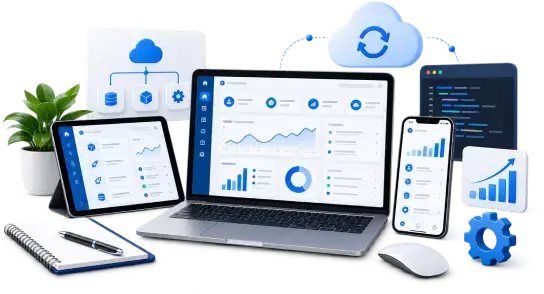
Define the SaaS product around good technical architecture even before development starts. We evaluate the requirements, determine the application architecture, identify critical workflows, choose appropriate technologies, and develop the engineering roadmap for your product.
Build customized web applications in line with your processes, users' roles, business rules, and product architecture. This custom SaaS web application development service includes the integration of front-end, back-end, API, database, and application logic into one product.
Provide an easy-to-navigate interface for complicated processes on the SaaS platform. We connect the dots from user research, information architecture, interaction design, design system, and frontend development to ensure performance across the entire application.
Move from product concept to a working SaaS MVP with the functionality needed to test your proposition with real users. We prioritize critical workflows, establish the right technical foundations, and leave room for measured iterations as product feedback comes in.
Refresh aging SaaS applications where dated interfaces, rigid codebases, or inefficient workflows are holding the product back. We restructure components, update frameworks, refine user journeys, and enhance the product considering existing users and operational needs.
Transition legacy SaaS applications to modern architectures, frameworks, or cloud environments with a planned approach. We address dependencies, data movement, API layers, infrastructure changes, and phased cutovers to minimize disruption during transition.
Hire SaaS engineering talent in addition to your current product team whenever you require extra bandwidth or specific skills. Our developers plug into established workflows and contribute across frontend, backend, architecture, integrations, and feature development.
Continue updating your application through enhancements in features, coding, performance, fixing problems, and upgrading versions after its release. With our engineering support, the B2B SaaS team adapts to new requirements without losing momentum on their roadmaps.
Display SaaS solutions that are based on challenging workflows, changing customer requirements, and business requirements. Every project shows our expertise in application engineering , product re-engineering, integrations, and SaaS application development.
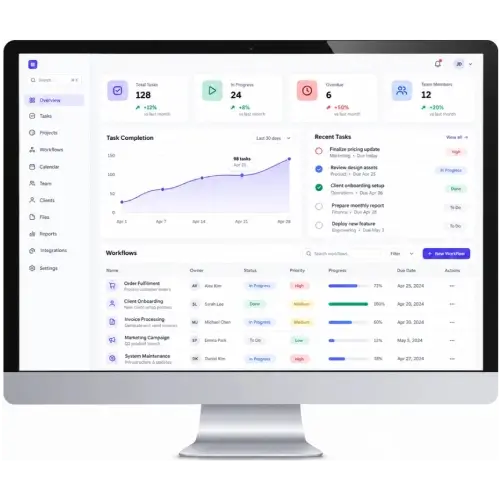
Our client required the implementation of an integrated SaaS solution to replace disjointed workflows and allow distributed teams to handle tasks, users, records, and approvals. The application also needed flexible permissions for different customer organizations.
A web application was created with configurable workflows, role-based permissions, centralized management, and API-based intercommunication among application components. The design of the application was such that it could easily support new workflows and customizations for customers without having multiple codebases.
faster completion of core operational workflows
fewer manual handoffs between teams
reduction in administrative processing time
improvement in cross-team task visibility
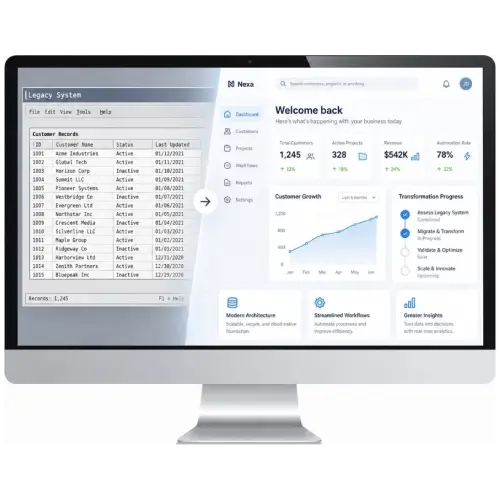
An established SaaS product was operating on an aging application stack that made feature releases increasingly difficult. The client wanted to refresh the product experience while addressing technical constraints without interrupting existing customer operations.
We reworked the application incrementally, introducing modern frontend components, reorganizing backend services, improving API boundaries, and revising the deployment workflow. Existing functionality was transitioned in phases to reduce disruption during modernization.
faster average feature-release cycles
reduction in application-related defects
improvement in page response performance
less effort spent on legacy maintenance
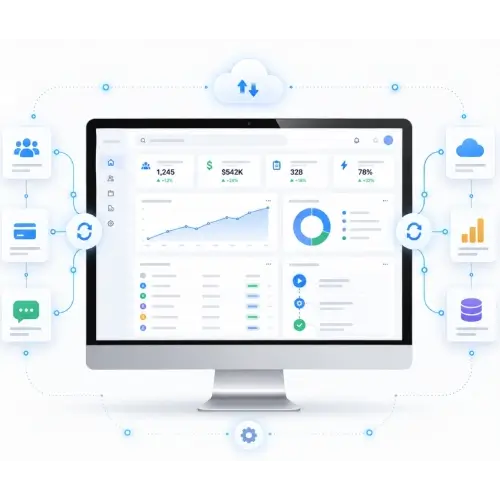
The client needed the SaaS solution to have seamless interaction with third-party CRM, payment, communications, and analysis tools. The manual transfer of data was leading to the creation of duplicated records and causing significant delays in processing.
This was achieved by introducing a layer of integration that involved structured data exchange, event-based flows, authentication, error management, and synchronization features. This helped enable the SaaS application to interact with other tools without making the core product components dependent on vendors.
fewer manual data transfers
faster synchronization of operational records
reduction in integration-related support requests
improvement in data-processing turnaround
We create SaaS products around your business model, workflows, users, and data. Our SaaS web development services span B2B platforms, enterprise applications, AI-powered system development , and data-intensive systems.
We create B2B products to manage complex workflows, team collaboration, streamline account management, and support recurring operations. Role-based access, automation, administration, and business logic are tailored to how your organization operates.
Our custom SaaS web development approach supports enterprise applications with distributed users, interconnected systems, and complex workflows. The product is designed with a view towards governance, scalability, and evolving operational needs.
We integrate AI to enhance product design and create an intelligent user experience. Forecasts, recommendations, communication, and workflow automation contribute to intelligence built into the product through the application layer.
We build SaaS web platforms that turn product data into dashboards, reports, alerts, and workflow insights. Data models, processing pipelines, visualization, and access controls are designed around each platform’s users and business requirements.
We develop SaaS web platforms around the workflows, terminology, compliance needs, and operational processes of specific industries. Our approach supports SaaS products across healthcare, finance, logistics, education, real estate, and IT..
The SaaS product does not exist in isolation. We will connect the APIs, platforms, identity providers, payment, and data services that your application uses with well-defined data flow and dependable communications between the systems.
REST, GraphQL, webhooks, and custom APIs facilitate communication between your SaaS platforms via data exchange. We manage authentication, payload transformation, versioning, retransmissions, and errors during integration.
Providers such as Stripe and PayPal handle your plans, trials, recurring billing, invoicing, upgrades, and cancelations. Subscription events are closely aligned and synchronized with account details, entitlement levels, and product access permissions.
SSO, OAuth, MFA, and enterprise identity providers simplify access across users and organizations. Authentication flows will be aligned with tenants, roles, permissions, and account policies for seamless security and access management.
Customer and operational data will be transferred between your SaaS application and your CRM, ERP , accounting, support, or any other business application. Automated synchronization reduces duplicate entry and keeps records aligned.
Emails, SMS, chats, and push notifications are integrated into your workflow, enhancing communication and engagement with your users. Event-driven triggers manage user onboarding, notifications, transactions, alerts, and the customer journey.
Product events are integrated into analytics platforms, reporting systems, data warehouses, and external data sources. We structure event schemas and pipelines to support reporting without adding unnecessary load to application workloads.
Integrating AI into the application’s data, permissions, and workflow is more beneficial. Intelligent capabilities are added to SaaS solutions in order to help users perform operations, find patterns, and make decisions.
Offer AI assistance to users within the interface, ensuring they have the guidance and support to navigate and use the features. AI copilots answer questions, summarize records, explain data, create content, and walk users through product workflow.
Automation of operations that goes further than mere rules and includes information classification, data extraction, task routing, activity summarization, and predefined actions. Business rules remain explicit while AI handles variable inputs.
Use historical and current data about products to recognize trends, predict demand, detect anomalies, and highlight possible risks. Models can provide valuable support for operational planning, enhance customer intelligence, and inform critical product decisions.
Make large SaaS knowledge bases easier to navigate with natural-language queries and contextual retrieval. AI has the capability to connect users with records, documents, conversations, and product information, enhancing their experience and efficiency.
Adapt dashboards, content, workflows, and recommendations to individual users or account behavior. Models analyze interaction patterns and product context to create experiences that are significantly more relevant and tailored to individual user needs.
Introduce AI agents for multi-step tasks where the product benefits from autonomous execution. Permissions, tool usage, approval points, and fallback procedures are all designed so that agentic workflows are controlled through the logic of applications.
A good design for a SaaS application goes beyond delivering software via the browser. The architecture, workflow, monetization strategy, and product experience all contribute toward making the application easy to manage, develop, and market.
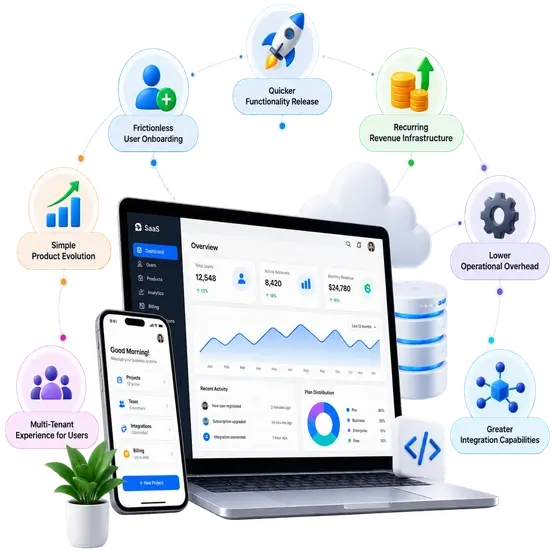
The application architecture is such that any additions do not disrupt the workflow of processes that are not affected by these changes. Modularity, automated testing, and CI/CD pipelines help organizations to have a consistent release schedule.
Streamlined registration, workspace creation, guided setup, role assignment, and trial flows help users reach product value sooner. The user experience adapts to plans, account types, and user roles, ensuring each user navigates the application effectively.
SaaS applications can also have subscription plans, trials, usage-based pricing, upgrades, downgrades, billing, and entitlement management. Billing events remain connected to account access and product functionality, ensuring a seamless user experience.
Centralized management, automation, observability, and self-service capabilities minimize the amount of repetitive operations. Teams behind the product can control a greater number of activities using the platform, instead of having to intervene manually.
An intelligent design of your SaaS product will leave boundaries between different parts of the product clear: core domains, integrations, data, and UI features. This allows for adding new components to your application without redesigning it each time.
The use of tenant-aware architecture, permissions by role, common workflows, and account settings allows you to use one application for different users. This aspect is valuable for B2B SaaS solutions, as it enhances their effectiveness and experience.
Clear APIs and flows allow connecting CRM, payment, identification, analytics, communication, and business platforms to your SaaS product. This ensures your product fits into the technology ecosystem and does not operate as a stand-alone application.
Industry domain knowledge allows us to see the processes, data, compliance, and other elements of the business model that go into SaaS products.

We develop FinTech platforms for payments, lending, banking, financial data, security, and regulatory workflows.

We understand the way catalog management, customers, checkout, orders, payments, inventories, and other e-commerce systems interact.

We know how to create logistics software that involves route planning, tracking shipments, fleet management, deliveries, and dynamic data.

Property businesses involve listings, leasing, transactions, documentation, tenant relationships, and navigating the complexities via real estate systems.

Insurance systems need an understanding of underwriting, policy lifecycle, claims, risk assessment, renewals, and document-intensive processes.

We have experience in developing platforms dealing with procurement, inventory, machines, quality control, staff activity, and manufacturing solutions .

Experience in the development of a retail platform includes merchandising, retail solutions, inventory, customer engagement, and omnichannel journeys.

Automotive experience includes dealerships, fleet management, sales, and data connecting these operational workflows through automotive software .

Our agricultural software development experience focuses on processes influenced by crop cycles, field conditions, equipment, inventory, and procurement.

Our AdTech software solutions cover target audience, inventory, campaigns, bidding, attribution, analytics, and high-frequency advertising workflows.

Our experience in the gaming industry relates to player journey, gaming operations, payments, promotions, account activity, and iGaming systems.
Healthcare SaaS must account for patient data, clinical workflows, appointments, billing, integrations, and privacy requirements across healthcare software .
Our SaaS web development approach combines application architecture, cloud infrastructure, data engineering, and release automation to support evolving product requirements.
Cloud architecture supports distributed workloads, traffic management, resource allocation, and environment separation across development, staging, and production.
We structure SaaS applications around clear domains, service boundaries, business logic, and tenant-aware components to keep the product easier to evolve.
Data models include the handling of tenant relationships, transactions, indexing, reporting, migrations, and the need for consistency in SaaS applications.
Containers standardize the application environment, while orchestration manages service deployment, workloads, and infrastructure health monitoring.
Queues, event streams, and asynchronous workers handle tasks, notifications, scheduling, and highly scalable tasks without blocking user requests.
Pipeline automation controls code validation, testing, environment promotion, deployment, and rollbacks to release products using a managed process.
Visibility into logs, metrics, traces, health checks, and alerts allows us in order to detect failures, latency, capacity, and production bottlenecks.
Our SaaS web development services connect product strategy, user experience, architecture, engineering, testing, and continuous product evolution.
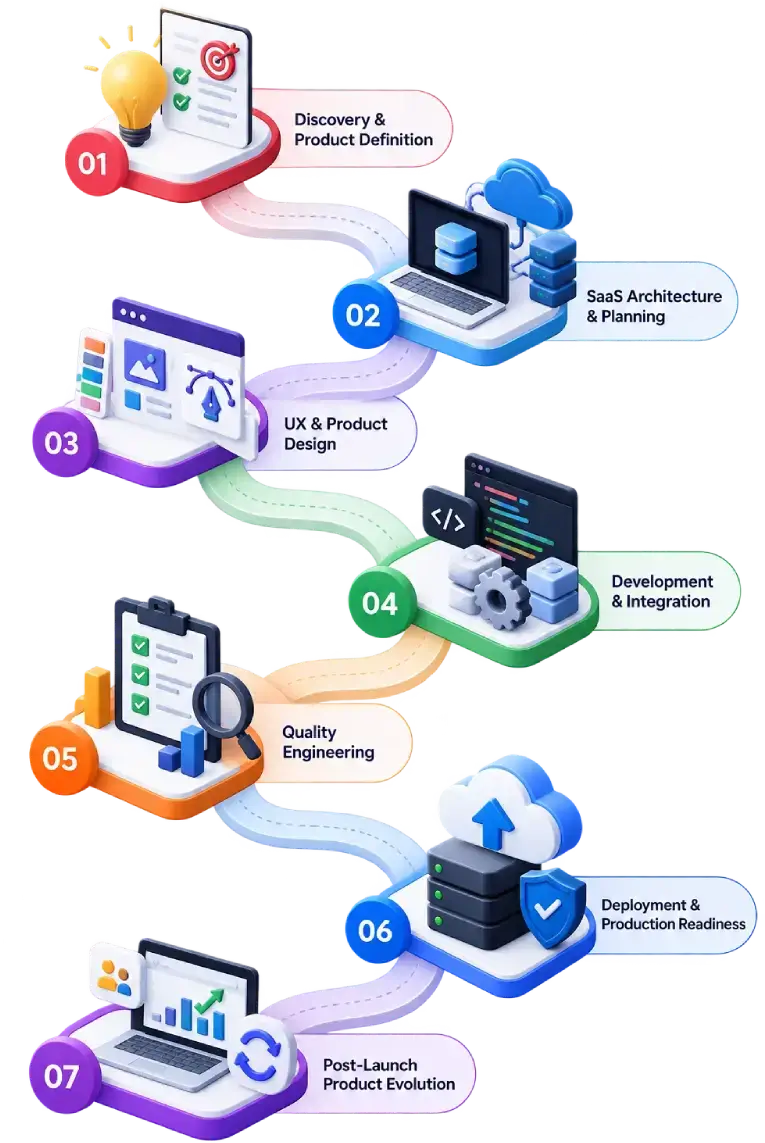
We define target users, business models, workflows, subscription logic, core features, integrations, and product priorities. This gives your SaaS web development company a clear foundation for technical planning and implementation.
We map tenant models, domain boundaries, data structures, APIs, application components, infrastructure requirements, and technical dependencies. Architecture decisions stay aligned with your roadmap and future product requirements.
User flows, information architecture, onboarding, dashboards, navigation, and workflows are designed based on how the customer will use the product. Prototyping and design validation assist in identifying friction points before development begins.
Frontend interfaces, backend services, business logic, databases, APIs, and third-party services come together via development cycles. Our SaaS web application development approach keeps implementation aligned with the product architecture.
Functional integration, regression, performance, and end-to-end testing include processes for various users, devices, integrations, and application stages. Automated coverage is introduced where it adds value across repeated release cycles
Cloud environments, databases, CI/CD pipelines, configuration, monitoring, logging, and release procedures are prepared for production. Custom SaaS web development projects move via controlled deployment workflows with rollback procedures.
After launch, usage patterns, customer feedback, application metrics, and changing requirements inform releases. SaaS web application development keeps features, workflows, integrations, and technical components aligned with the roadmap.
SaaS web development costs normally start between USD $15,000 and $150,000, based on product complexity, different users' rights, integration types, architecture, and features.
From product discovery and architecture to launch and ongoing improvements, our clients share how working with our SaaS development team has supported their product goals, engineering needs, and evolving roadmaps.


“Before this, our teams were working across different tools, and a lot of things were handled by Suffescom manually. Having one platform for the workflows, users, and approvals has made a noticeable difference. The biggest improvement for us was having everyone work from the same system. We have better visibility now, and we spend much less time chasing updates between teams.”

After the changes, the team could move faster without constantly working around the limitations of the old system. What stood out was the way the modernization was handled. We were able to improve the technology underneath without putting the customer experience on hold.”

“We were dealing with duplicate records and delays between systems. Automating data movement has taken a lot of that manual work off the team. The integration setup has made a real difference to our day-to-day operations. We have fewer manual transfers and much better visibility into what is happening across the systems.”

We design our SaaS applications, keeping data protection, access management, and security controls to make our products comply with regulatory requirements and industry expectations.

Choose a collaboration model based on your product development stage, tech needs, and required engineering involvement. Our SaaS web development services can adapt from defined project delivery to long-term product engineering.
The dedicated team allows you to always have access to developers, designers, QA engineers, and other professionals who match your product. It works well for evolving roadmaps that require consistent involvement from a SaaS web development company.
Transform your business by integrating specialists who excel in architecture, feature development, integrations, testing, and software product engineering . This model suits teams needing extra capacity for custom SaaS web development without a separate delivery structure.
Designed for existing SaaS products affected by legacy architecture, outdated dependencies, technical bottlenecks, or growing maintenance demands. Work can be phased around modernization priorities while existing product operations continue.
Advance development post-launch through maintenance, performance upgrades, feature enhancements, and monitoring. This model suits products requiring SaaS web application development services as their roadmap continues to evolve.
Our experience in software engineering, product development, and cutting-edge technologies has been acknowledged by professional associations within the industry, indicating our experience in providing technological solutions to various business needs.
Business Awards 2025
Recognized for app excellence in Mobile Technology

Appfutura
Top App Development Company

GoodFirms
Top AI Development Company

Clutch
Top 100 Companies 2025
ITFirms
World’s Top Mobile App Development Companies 2025

Clutch
Top Developers in India 2025

Global 100 - 2026
Best Information Technology & Services Firm of the Year - US
Our company utilizes cutting-edge technologies in all the frontend, backend, database, cloud, DevOps, and AI layers depending on the requirements of your product.
























• SUFFESCOM SOLUTIONS
Build Smarter. Scale Faster. Grow More.
Have a Vision? Let’s Turn It Into a Digital Reality.
Get a quick response from our best experts in under 10 minutes.
Suffescom easily understood our main goal and delivered the best digital solution. Their team was very cooperative, and it was a very good experience working with them. I would highly recommend them.

Working with Suffescom was a really great experience. Their developers demonstrated technical knowledge and delivered our mobile app solution with all required functionalities on time.

Suffescom helped us build a logistics software solution that completely improved our fleet operations. Their professionalism and transparency are what make them a reliable technology partner.

Share Your Requirements. Our Experts Will Shape the Solution.
• SUFFESCOM SOLUTIONS
Build Smarter. Scale Faster. Grow More.
Have a Vision? Let’s Turn It Into a Digital Reality.
Get a quick response from our best experts in under 10 minutes.
Suffescom easily understood our main goal and delivered the best digital solution. Their team was very cooperative, and it was a very good experience working with them. I would highly recommend them.
Working with Suffescom was a really great experience. Their developers demonstrated technical knowledge and delivered our mobile app solution with all required functionalities on time.
Suffescom helped us build a logistics software solution that completely improved our fleet operations. Their professionalism and transparency are what make them a reliable technology partner.
Share Your Requirements. Our Experts Will Shape the Solution.
• SUFFESCOM SOLUTIONS
Build Smarter. Scale Faster. Grow More.
Have a Vision? Let’s Turn It Into a Digital Reality.
Get a quick response from our best experts in under 10 minutes.
Suffescom easily understood our main goal and delivered the best digital solution. Their team was very cooperative, and it was a very good experience working with them. I would highly recommend them.
Working with Suffescom was a really great experience. Their developers demonstrated technical knowledge and delivered our mobile app solution with all required functionalities on time.
Suffescom helped us build a logistics software solution that completely improved our fleet operations. Their professionalism and transparency are what make them a reliable technology partner.
Share Your Requirements. Our Experts Will Shape the Solution.
Fret Not! We have Something to Offer.