Home › Artificial Intelligence › AI Agent Development Services

AI Agent Development Services

Put AI agents to work across your business workflows. Suffescom is an AI agent custom development company with hands-on experience in agent architecture, large language models (LLMs), retrieval-augmented generation (RAG), tool calling, memory, and orchestration. Suffescom builds agents that comprehend context, interact with business data, make use of connected tools, and perform tasks on enterprise systems.

AI Agent Development Services

Turn Your Existing Systems Into AI-Powered Workflows

Tell us about your workflows, systems, and business goals. Our AI developers can design custom agents that connect with your APIs, databases, CRM, ERP, and internal systems to automate tasks and keep your teams in control.

AI Agent Development for Real-World Workflows

List of Our AI Agent Development Services for Enterprise Systems

Our AI engineers work across consulting, agent architecture, development, integration, validation, deployment, and ongoing optimization to align agent behavior with defined business objectives.

AI Agent Consulting

Our AI agent consulting services help enterprises determine where agentic AI systems fit within existing technology landscapes and workflows. We evaluate business processes, application architecture, data sources, APIs, model requirements, and governance factors to define technically feasible strategies.

Custom AI Agent Development

We build AI agents tailored to business requirements by combining large language models with tools, APIs, retrieval, memory, orchestration, and application logic so agents can understand context and perform actions instead of only generating responses.

AI Agent Architecture & Design

We design enterprise agent architectures covering model selection, orchestration, context management, tool interfaces, memory, retrieval pipelines, data flows, and human-approval paths so agents can fit into existing applications.

Enterprise AI Agent Integration

Our developers connect AI agents with CRM and ERP platforms , databases, SaaS applications, knowledge repositories, and APIs with controlled interactions, permissions, and workflow rules.

AI Agent PoC & MVP Development

We develop focused proofs of concept and MVPs around defined workflows so teams can evaluate model behavior, tool usage, retrieval quality, integration requirements, and user interaction before broader deployment.

LLM Fine-Tuning & Model Optimization

We optimize the model layer around workload, domain requirements, response characteristics, and operational constraints using model selection, prompt and context optimization, fine-tuning, structured outputs, model routing, and inference configuration.

AI Agent Testing & Evaluation

Our AI agent development services include evaluating model outputs and agent behavior. We test task completion, retrieval accuracy, tool selection, instruction adherence, failure paths, latency, and human handoffs against defined scenarios and criteria.

AI Agent Deployment & Lifecycle Management

We take agents from validated implementation to production deployment and ongoing engineering, including monitoring, evaluation, model updates, knowledge-source changes, API modifications, workflow adjustments, and agent behavior optimization.

AI Agent Development Across Our Portfolio

We deliver AI agents for customer interactions, operations, software engineering, document processing, recommendations, and autonomous workflows, integrated with the systems and processes your business already uses.

IT operations AI agent for logistics company

IT Operations Agent for a German Logistics Company

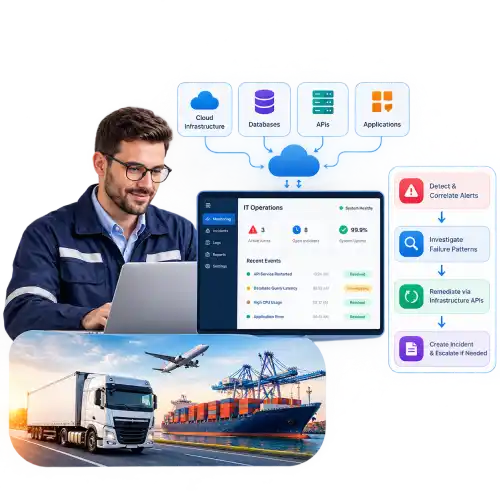
Business Requirements: A logistics firm based in Hamburg with facilities located across Europe required round-the-clock monitoring of its cloud infrastructure, APIs, databases, and internal applications.

Solution: Suffescom implemented an IT operations agent that performs event monitoring, alert correlation, and investigation of failure patterns, and performs pre-authorized remediation actions via infrastructure APIs. The agent restarts selected services, creates incident records, and escalates unresolved conditions to engineers with the relevant diagnostic context.

Outcomes:

46%

fewer manual alert investigations

62%

faster response to recurring incidents

38%

fewer unnecessary escalations

View Case Study
conversational voice AI agent for healthcare

Conversational Voice Agent for a U.S. Healthcare Network

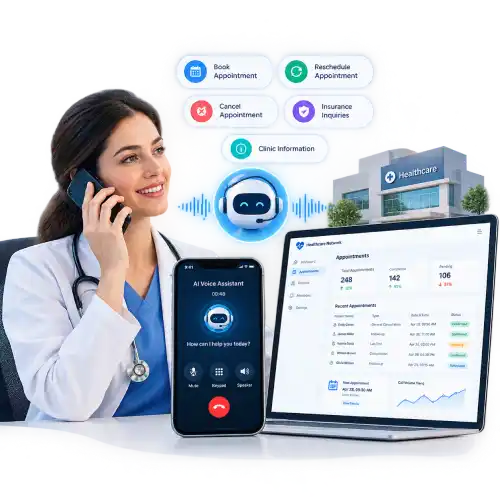
Business Requirements: A healthcare provider operating from multiple locations in Texas had many phone calls coming in for appointments, cancellations, rescheduling, insurance inquiries, and clinic information.

Solution: We designed a conversational voice bot that was integrated into the provider’s appointment management and customer service systems. The agent interprets spoken requests, verifies caller information, checks availability, performs permitted scheduling actions, and transfers complex conversations to staff with the interaction context preserved.

Outcomes:

57%

of routine calls handled autonomously

43%

lower average call-handling time

31%

fewer routine calls transferred to staff

View Case Study
AI coding agent for FinTech software company

AI Coding Agent for a UK FinTech Software Company

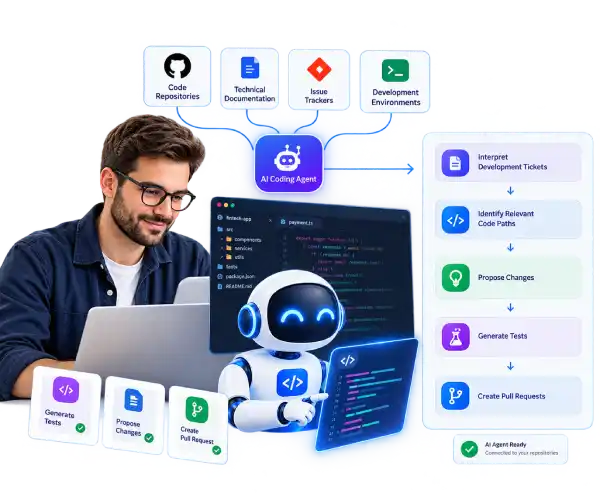
Business Requirements: A FinTech software company in London had multiple large code repositories and was looking for ways to minimize repeated efforts like identifying code, writing tests, and documenting changes.

Solution: Suffescom implemented an AI coding agent connected to approved repositories, technical documentation, issue trackers, and development environments. The agent interprets development tickets, identifies relevant code paths, proposes changes, generates tests, and prepares pull requests for developer review.

Outcomes:

51%

faster completion of routine development tasks

44%

less time spent locating relevant code

36%

faster test-generation cycles

View Case Study
Recommendation agent for fashion marketplace

Recommendation Agent for a UAE Fashion Marketplace

Business Requirements: A fashion online marketplace in Dubai needed a system to factor in user intent, activity, characteristics, inventory, and merchandising into the process, rather than depending on logic.

Solution: We created an AI recommendation agent that integrates behavioral inputs, semantic product search, metadata from the catalog, and business policies. This agent understands the intent of browsing at present and recommends appropriate products while considering availability, category rules, and merchandising priorities.

Outcomes:

32%

increase in recommendation engagement

21%

higher product discovery

18%

increase in assisted conversions

View Case Study
Connect AI Agents to the Systems

Connect AI Agents to the Systems That Power Your Business

Tell us where your workflow begins, and our AI developers map the agent architecture needed to execute the right tasks across your existing systems.

AI Agent Types and Solutions for Enterprise Workflows

Suffescom delivers custom AI agent development services for organizations integrating intelligent agents into workflows , applications, and business systems. Our AI agent development services cover different architectures based on autonomy, data, tools, workflow complexity, and human oversight.

AI Copilot Solutions

AI Copilot Solutions

AI copilots support employees by providing them with data, summarizing their documents, producing content, and suggesting what to do. They also utilize a range of approved tools while ensuring that users remain actively involved in the critical decision-making processes.

Conversational AI Agents

Conversational AI Agents

Our AI agent development services include conversational agents that combine language models with enterprise knowledge, APIs, and workflow actions. They maintain context, handle chat or voice interactions, perform defined tasks, and escalate cases when required.

RAG-Based Knowledge Agents

RAG-Based Knowledge Agents

RAG agents connect language models with approved enterprise knowledge sources to retrieve context before responding. Our custom AI agent development approach covers embeddings, vector search, reranking, metadata filters, permissions, and source attribution.

Workflow & Task Agents

Workflow & Task Agents

Workflow agents combine reasoning with tool and API access to execute defined business processes. They retrieve information, update records, trigger downstream actions, request approvals, and handle predefined exceptions according to business rules.

Autonomous AI Agents

Autonomous AI Agents

Autonomous agents work toward defined objectives with limited step-by-step direction from users. Our AI agent development agency establishes their boundaries through tool permissions, decision rules, task constraints, approval points, and termination conditions.

Multi-Agent Systems

Multi-Agent Systems

Multi-agent architectures coordinate specialized agents through an orchestration layer for complex workflows. Our enterprise AI agent development services connect agents for planning, research, validation, execution, or communication via shared workflow state.

Domain-Specific AI Agents

Domain-Specific AI Agents

Domain-specific agents are configured around specialized terminology, business rules, data structures, and operating procedures. Custom AI agent development services adapt models, retrieval, tools, prompts, and evaluation criteria to specific domain requirements.

Enterprise AI Agent Integration

Enterprise AI Agent Integration

We connect AI agents with CRMs, ERPs, databases, SaaS platforms, internal applications, APIs, and knowledge repositories. Our AI agent development specialists implement tool calling, system orchestration, event triggers, permissions, and human approval paths.

AI Analytics and Reporting Solutions

AI Analytics and Reporting Solutions

AI agent analytics solutions monitor performance, track workflow, measure completion rates, and identify bottlenecks. We integrate monitoring dashboards, execution logs, error tracking, and performance metrics to evaluate agent behavior and optimize workflows.

AI Agent Use Cases Across Process-Driven Operations

Suffescom applies AI agent development services to use cases where agents access relevant context, work with approved tools, and move tasks forward across connected business systems.

Customer Support & Resolution

Routine customer queries are handled by our AI agents, who utilize advanced conversational AI technology with comprehensive enterprise information to provide accurate and timely responses. They fetch account information and give answers to product queries, generate tickets, perform approved actions, and elevate difficult cases to the support teams.

Lead Qualification & Sales Operations

Our customized development services for AI agents assist the sales teams in prospect research, lead evaluation, CRM updates, and follow-ups. Agents connect with sales platforms and approved data sources to effectively advance qualified opportunities through clearly defined stages with appropriate human review for quality assurance.

Knowledge Retrieval & Enterprise Research

RAG-powered agents retrieve relevant information from internal documents, databases, and knowledge repositories before generating responses or completing research tasks. These enterprise AI agent development services incorporate permission-aware retrieval so users receive information appropriate to their access level and business role.

Document Processing & Data Extraction

The AI agent has the capability to classify, extract, validate, and transfer the extracted data from business documents such as invoices, application forms, agreements, and other similar forms into downstream applications. This AI agent development service additionally facilitates the routing of exceptions to designated employees for thorough review and assessment.

Workflow & Task Automation

Suffescom's custom AI agent development company approach turns multi-step operational processes into agent-driven workflows involving data retrieval, decision rules, tool calls, approvals, and system updates. Agents manage and synchronize routine tasks across various applications while ensuring the continuity of workflow and defined paths for operations.

Fraud Detection & Case Triage

Fraud-focused agents analyze transaction and customer information, retrieve supporting records, identify relevant risk indicators, and organize findings for investigators. As part of our AI agent development services, agents connect with fraud platforms and case-management systems while routing higher-risk cases for human assessment.

Financial Analysis & Reporting

AI agents assist finance teams by retrieving financial data, comparing records, identifying anomalies, and preparing structured summaries or reports. Connected tools facilitate seamless access to authorized accounting and business systems, ensuring that all financial actions remain subject to defined approval controls to maintain integrity and compliance.

Claims & Application Processing

AI agents review submitted information, retrieve supporting documents, identify missing fields, and route applications or claims according to configured business rules. AI agent consulting services assist in identifying areas within workflows that gain advantages from agentic execution, all while ensuring that handling is managed by the appropriate teams.

IT Incident Management

AI agents assist IT staff through classification of incidents, knowledge acquisition, investigation of system data, and proposing/remedying according to predefined solutions. Our team of experienced AI integration specialists integrates agents with service desks, monitoring systems, infrastructure management, and other enterprise applications.

Procurement & Order Management

AI agents process purchase requests, retrieve supplier information, check order status, compare records, and initiate approved procurement actions. The areas of specialization for our AI agent development firm include connections with the ERP, inventory, vendor management, and order management systems to keep workflows synchronized.

Appointment Scheduling & Coordinating

Using conversational agents along with the scheduling system allows for appointment scheduling, taking into account availability, data collection, confirmation, and updates of the connected systems. Such artificial intelligence services help the agents become an integral part of the scheduling workflow by handing over unusual requests to humans.

Compliance Monitoring & Review

AI agents examine business records, policies, transactions, or operational activity against defined compliance criteria. Enterprise AI agent development services incorporate evidence retrieval, exception detection, review summaries, and human approval paths rather than allowing agents to make uncontrolled regulatory decisions.

Key Components of Our AI Agent Development Services

Suffescom engineers AI agents as coordinated systems in which models, memory, tools, knowledge, and planning work together. Our custom AI agent development services configure components around the agent’s role, data, connected systems, and required autonomy.

Agent Core for Task Execution

The agent core combines an LLM with instructions, contextual inputs, and workflow logic to interpret requests and determine appropriate actions. It processes information, selects available capabilities, generates responses, and initiates the next step in a defined workflow.

Memory Module for Context Retention

The memory layer allows agents to retain relevant information throughout an interaction or across longer-running workflows. Depending on the use case, this includes conversation history, task state, user context, previous actions, or selected business information.

Tools Layer for External Actions

Tools extend an agent beyond text generation by giving it controlled access to external capabilities. These include APIs, databases, search services, code execution environments, RAG pipelines, calculators, CRM functions, and other business-system operations.

Planning Module for Multi-Step Tasks

The planning layer lets an agent decompose a goal into sub-actions and formulate the execution plan for such actions. The agent chooses the tools, plans the activities, assesses the outcomes, and modifies the workflow if any step needs another way of handling it.

Knowledge Layer for Contextual Intelligence

RAG gives agents access to relevant information from enterprise documents, knowledge bases, databases, and other approved sources at runtime. Retrieval, filtering, reranking, and contextual injection are techniques to handle data that varies independently of the model used.

Orchestration Layer for Agent Coordination

The orchestration layer manages how an agent moves between reasoning, retrieval, tool calls, and workflow. For complex enterprise AI agent development services, it coordinates agents for research, validation, analysis, or execution while maintaining shared task context.

AI Agent Development for Specific Industry Workflows

We design AI agents with respect to operational needs, datasets, and software ecosystems of various industries. Each solution may combine conversational agents, RAG, tool calls, workflow orchestration, and enterprise integrations depending on the task.

Healthcare

AI agent development for healthcare

AI agents assist in clinical information retrieval, patient interactions, administrative workflows, and healthcare operations.

  • Medical Billing & Coding Agent
  • Clinical Decision Support Agent
  • Hospital & Patient Management Agent
  • Healthcare Administration Agent

Fintech

AI agent development for fintech

AI agents assist with financial operations, customer interactions, fraud workflows, and information-intensive processes.

  • Fraud Detection & Triage Agent
  • KYC/AML Verification Agent
  • Financial Advisory Agent
  • Customer Onboarding Agent

Real Estate

AI agent development for real estate

Agents coordinate property-related workflows across listings, real estate platforms, customer communications, and transaction processes.

  • Property Search Agent
  • Real Estate Lead Qualification Agent
  • Property Valuation Assistant
  • Viewing & Appointment Scheduling Agent

Insurance

AI agent development for insurance

Insurance processes entail extensive paperwork, information regarding policies, claim processing, and customer interaction.

  • Claims Processing Agent
  • Insurance Underwriting Agent
  • Policy Recommendation Agent
  • Fraud Investigation Agent

Ecommerce

AI agent development for ecommerce

AI agents operate across product discovery, customer service, order management, and commerce platforms.

  • AI Shopping Assistant
  • Product Recommendation Agent
  • Order Tracking Agent
  • Returns & Refund Management Agent

Logistics

AI agent development for logistics

Logistics agents coordinate shipment information, delivery operations, exception handling, and communication across connected systems.

  • Shipment Tracking Agent
  • Route Planning Agent
  • Dispatch Coordination Agent
  • Delivery Exception Management Agent

Manufacturing

AI agent development for manufacturing

Manufacturing environments use agents to connect operational knowledge with production, maintenance, quality, and enterprise systems.

  • Predictive Maintenance Agent
  • Quality Inspection Agent
  • Production Planning Agent
  • Inventory Management Agent

Retail

AI agent development for retail

Retail agents assist both customers and employees through interactions with commerce, inventory, CRM, and store management systems.

  • Retail Customer Support Agent
  • Inventory Intelligence Agent
  • Store Operations Agent
  • Personalized Shopping Agent

Automotive

AI agent development for automotive

Automotive companies have the ability to employ agents in their dealerships, maintenance, customer service, technical information, and vehicles.

  • Automotive Sales Agent
  • Vehicle Service Assistant
  • Parts Information Agent
  • Service Scheduling Agent

Agriculture

AI agent development for agriculture

Agricultural agents may integrate domain expertise with farming data, machinery data, weather data, crops, and logistical data.

  • Crop Advisory Agent
  • Farm Management Agent
  • Crop Monitoring Agent
  • Agricultural Equipment Support Agent

AdTech

AI agent development for AdTech

AI agents are used by AdTech professionals to collaborate on campaign research, data analysis, optimization, and reporting.

  • Campaign Optimization Agent
  • Audience Intelligence Agent
  • Media Planning Agent
  • Advertising Performance Analysis Agent

iGaming

AI agent development for iGaming

AI agents assist with player operations, customer support, account workflows, risk monitoring, and responsible-gaming processes.

  • Player Support Agent
  • Responsible Gaming Agent
  • Fraud Detection Agent
  • Player Onboarding Agent

AI Agent Development Challenges and How We Address Them

Enterprise AI agent development services must account for existing applications, business rules, data environments, and operational boundaries. Suffescom addresses these challenges through architecture-led custom AI agent development, controlled system access, and continuous evaluation.

Inaccurate Outputs and Unreliable Responses

Challenge: When AI systems form a part of processes that require correct data inputs, LLMs may generate incorrect facts, misconstrue the inputs, and generate incorrect outputs.

Our Approach: Our solution includes retrieval-augmented generation, source-grounded responses, structured outputs, and domain-specific validation datasets. Rules for validation and confidence thresholds trigger clarification or human intervention when the AI agent does not generate a trustworthy response.

Enterprise Information Access and Context Management

Challenge: Business information is stored in databases, documentation, cloud services, and legacy systems. Half or outdated context affects decision-making.

Our Approach: We connect approved data sources through APIs, retrieval pipelines, and application connectors. Metadata filtering, permission-aware retrieval, data validation, and context management help ensure agents receive information relevant to the task and authorized for the user.

Integration With Existing Business Systems

Challenge: Customized solutions for enterprises have distinct data formats, authentication techniques, API structures, and workflows.

Our Approach: We develop API-based connectors, services, webhooks, and workflows depending on the desired target architecture. Tool schemas, input validation, authentication, and error-handling processes determine how agents interface with CRM, ERP, database, and other internal systems.

Uncontrolled Agent Actions and Excessive Autonomy

Challenge: Agents with broad tool access may initiate unintended actions, repeat operations, or execute steps beyond their intended responsibilities.

Our Approach: Our custom AI agent development services define explicit permissions, boundaries, execution limits, and approval requirements. Idempotency controls, transaction validation, and human approval gates are applied to operations, while predefined escalation paths handle exceptions.

Multi-Agent Coordination and Workflow Failures

Challenge: Multi-agent systems introduce complexity through task delegation, shared context, communication, and dependencies between specialized agents.

Our Approach: We use orchestration patterns with explicit task ownership, workflow state, defined agent responsibilities, and controlled handoffs. Timeouts, retries, validations, and backup methods address unfinished actions and help mitigate secondary failures.

Data Privacy, Security, and Regulatory Compliance

Challenge: AI agent development services might include confidential company information, personally identifiable information, financial statements, or regulated material.

Our Approach: We include role-based access control, encryption, identity management, data minimization, auditing, and proper configuration of model providers. Data storage, regional considerations, and regulatory requirements depend on the project location and business setting.

Latency, Model Costs, and Resource Consumption

Challenge: Multi-step reasoning, repeated model calls, retrieval operations, and external tool execution increase response times and operating costs.

Our Approach: We optimize model selection, prompt and context sizes, caching, and tool-call sequences. Model routing and asynchronous processing are introduced where appropriate, with latency and token consumption tracked against workload requirements.

Testing and Measuring Agent Performance

Challenge: Traditional software tests alone cannot fully assess an agent's reasoning, retrieval quality, tool selection, or behavior across variable inputs and changing context.

Our Approach: Our approach combines conventional software testing with task-specific evaluation datasets, scenario-based testing, tool-call validation, regression testing, and human review. Production monitoring helps detect behavioral modifications, repeated mistakes, and the need for improvements.

Production Monitoring and Maintenance

Challenge: Changes to models, APIs, business rules, source documents, and application dependencies may impact agent behavior after deployment.

Our Approach: We implement observability for agent runs, model responses, tool calls, workflow states, failures, and operational metrics. Version control, regression evaluations, controlled releases, and ongoing maintenance help keep AI agent development solutions aligned with evolving enterprise requirements.

Connect AI Agents to the Systems That Power Your Business

Tell us where your workflow begins, and our AI developers map the agent architecture needed to execute the right tasks across your existing systems.

Our End-to-End AI Agent Development Process

Our AI agent development services follow an architecture-led process that takes an agent from workflow assessment to production. We account for models, enterprise data, tools, integrations, permissions, evaluation, and operational controls at each stage.

AI Agent Development Process

01. Assess the Workflow & Define the Agent's Role

We start with the business process the agent needs to support. Our AI agent consulting services begin by mapping user interactions, decisions, data dependencies, applications, APIs, manual handoffs, and exception paths to determine where agent-based execution is appropriate.

Key activities:
  • Identify the target workflow and business objectives
  • Map existing applications, data sources, and integrations
  • Define agent responsibilities and autonomy boundaries
  • Identify human approval and escalation points
  • Establish measurable success criteria

02. Design the Agent Architecture

We translate the workflow into an agent architecture covering the model layer, context and retrieval, tools, memory, orchestration, integrations, and control mechanisms. This forms the technical foundation for custom AI agent development services tailored to the enterprise environment.

Key activities:
  • Select appropriate foundation models
  • Define single-agent or multi-agent architecture
  • Design RAG and knowledge-retrieval pipelines
  • Define tools, APIs, and function schemas
  • Establish memory and workflow-state requirements
  • Plan permissions, guardrails, and human-in-the-loop controls

03. Connect Enterprise Data & Tools

Our AI developers connect the agent to the information and systems required to perform its responsibilities. Enterprise AI agent development at this stage focuses on practical integration with existing technology rather than creating an isolated AI interface.

Key activities:
  • Connect APIs, databases, SaaS platforms, and internal applications
  • Configure document and knowledge sources
  • Implement retrieval and indexing pipelines
  • Define tool inputs, outputs, and authorization rules
  • Establish authentication and data-access boundaries

04. Engineer the Agent Workflows

Our experienced AI developers implement the agent's instructions, reasoning flow, tool interactions, memory, and orchestration logic. Custom AI agent development allows workflow states and decision boundaries to be tailored to the way your organization operates.

Key activities:
  • Implement prompts and system instructions
  • Configure tool and function calling
  • Implement workflow orchestration
  • Add memory and contextual state
  • Configure agent-to-agent communication where required
  • Introduce validation and exception paths

05. Evaluate Agent Behavior

Testing extends beyond whether an agent produces a valid response. We evaluate whether it retrieves the right information, selects appropriate tools, follows workflow rules, handles ambiguous requests, and reaches the intended outcome.

Key activities:
  • Create use-case-specific evaluation datasets
  • Test retrieval and response quality
  • Validate tool selection and execution
  • Test edge cases and failure conditions
  • Run regression evaluations across model or prompt changes
  • Measure task completion, latency, and operational behavior

06. Validate Integrations & Enterprise Controls

Before production release, we verify how the agent behaves across connected applications and under real access and workflow conditions. Our AI agent development services incorporate the technical and governance requirements relevant to the deployment environment.

Key activities:
  • Validate API and system integrations
  • Test authentication and authorization
  • Verify data-handling and audit requirements
  • Test human approval and escalation paths
  • Review logging, monitoring, and failure recovery
  • Conduct security and compliance checks relevant to the environment

07. Deploy to the Target Environment

We release the agent into the appropriate cloud, private, or enterprise environment with controlled configuration and deployment practices. Depending on the requirements, the deployment supports conversational agents, workflow agents, copilots, or multi-agent systems.

Key activities:
  • Configure production infrastructure
  • Establish model and service dependencies
  • Set up observability and operational logging
  • Configure deployment and rollback procedures
  • Validate production integrations
  • Monitor initial agent activity

08. Monitor, Optimize & Evolve

We watch how things work in the real world and keep refining the process as business processes, modeling, knowledge bases, integration, and requirements change. This approach supports the AI agent development company model for organizations that need continued technical ownership.

Key activities:
  • Monitor agent runs, tool calls, errors, and workflow outcomes
  • Review evaluation results and production feedback
  • Tune prompts, models, retrieval, and orchestration
  • Update tools and integrations
  • Re-evaluate behavior after significant changes
  • Introduce new workflows and agent capabilities as requirements evolve

How Much Does AI Agent Development Cost?

The cost of developing AI agents depends on the process that will be automated, the systems the agent needs to interact with, model requirements, data and RAG complexity, integration scope, and the level of autonomy and control required.

Basic AI Agent Development

USD $10K – $25K

  • Single-purpose AI agent
  • LLM integration and prompt configuration
  • Basic conversational interface
  • Standard API or knowledge-base integration
  • Basic tool calling and task execution
  • User authentication and access controls
  • Testing, deployment, and launch support
Get a Quote

Enterprise AI Agent Solutions

USD $25K – $60K

  • Custom AI agent development
  • RAG and enterprise knowledge integration
  • CRM, ERP, and third-party API connectivity
  • Multi-step workflow orchestration
  • Agent memory and contextual processing
  • Human approval and exception handling
  • Evaluation, monitoring, and deployment
Get a Quote

Advanced Multi-Agent Systems

USD $60K – $150K+

  • Multi-agent orchestration and coordination
  • Specialized agents with defined responsibilities
  • Complex enterprise data and system integrations
  • Advanced tool execution and workflow management
  • Custom memory and state management
  • Governance, audit trails, and approval workflows
  • Advanced evaluation, observability, and deployment support
Get a Quote

Security & Compliance for Enterprise AI Agents

We apply access controls, data protection, guardrails, auditability, and human approvals based on your workflow, data sensitivity, industry, and deployment environment.

Key Benefits of Deploying AI Agents Across Enterprise Workflows

By utilizing custom AI agent development services, companies automate specified processes, manage multi-step workflows, and integrate smart workflows with systems used by their employees.

Key Benefits of AI Agents Across Enterprise Workflows

Automate Multi-Step Workflows

−

AI agents are capable of collecting data, analyzing input, using preapproved software solutions, updating databases, and performing tasks at different workflow steps. Custom AI agent development provides assistance in automating workflows that include several operations, interactions with systems, and decision points instead of one request or rule.

Eliminate Redundant Tasks and Manual Transfers

+

AI agent development services automate repetitive processes like data retrieval, document handling, ticket classification, updates of CRMs, reporting, and collecting information. By connecting different tasks performed within connected software applications, agents help minimize repetitive operations and unnecessary transfers of data between systems.

Integration of Existing Business Systems

+

Through enterprise AI agent development services, companies will be able to integrate their agents with CRMs, ERPs, databases, SaaS platforms, internal systems, and APIs. Consequently, it lets businesses integrate their agents' workflows with technology infrastructure without changing their existing software, data sources, and business processes.

Give Teams Faster Access to Enterprise Knowledge

+

RAG-powered AI agents retrieve relevant information from approved documents, knowledge bases, databases, and other enterprise sources at runtime. Permission-aware retrieval, along with metadata filtering and effective source handling, works together to provide context while ensuring that user roles and information access requirements are maintained.

Improve Employee and Customer Assistance

+

Custom AI agent development services support employees and customers with information retrieval, summarization, response preparation, routine questions, and approved actions. AI copilots integrate into apps to enhance user experience, while customer-facing agents escalate complex or sensitive cases, ensuring the context is preserved throughout the process.

Support Consistent Process Execution

+

AI agents implement defined instructions, adhere to established business rules, execute validation steps, manage tool permissions, and fulfill requirements throughout the workflow. This helps custom AI agent development solutions execute routine processes more consistently while keeping human oversight for decisions or actions that require additional review.

Support Faster, Data-Informed Decisions

+

AI agents have the ability to collect information from various sources, compile relevant information, summarize results, and provide necessary context. This reduces the time required to search for information across various systems, thereby facilitating quicker reviews and more informed decision-making based on the enterprise information that is readily available.

Improve Workflow Visibility and Scalability

+

Enterprise AI agent solutions provide visibility into agent runs, tool calls, workflow states, errors, and outcomes through appropriate observability mechanisms. Reusable components for models, retrieval, tools, permissions, and orchestration also support expansion into additional business workflows as requirements continue to evolve over time.

Maintain Control Over AI-Driven Actions

+

Developing AI agents may include access controls such as role-based access control, restricted tools, validation, approval gateways, auditing, and paths. This guarantees that the degree of agent autonomy aligns with the risk associated with each workflow instead of permitting unrestricted automated actions that could lead to potential issues.

What Clients Say About Our AI Development Services

See how businesses and product teams have experienced working with Suffescom’s AI and software engineering teams. These testimonials reflect client feedback on our development approach, technical collaboration, delivery, and ongoing support.

CLIENT STORY Suffescom logo AI development client story

We had too many alerts that needed someone to look into them manually. The agent now handles a lot of the investigation and routine fixes for us. It has made our IT team much more responsive, especially for recurring incidents.

Christopher Hayes
Christopher Hayes Operations Manager, German Logistics Company

The biggest difference is that patients now get help with routine appointment requests without waiting for our staff. The agent handles the simple conversations well and passes the more complex ones to our team with the right context.

Brian Wilson
Brian Wilson Director of Patient Services, U.S. Healthcare Network

Our developers were spending a lot of time finding code and handling small repetitive tasks. The coding agent has taken a lot of that work off their plate. It gives the team a solid starting point while keeping developers in control of the final changes.

Kyle Henderson
Kyle Henderson Engineering Manager, UK FinTech Software Company

We wanted recommendations to understand what shoppers were actually looking for, not just match products based on a few fixed rules. The new agent gives us much more relevant recommendations and has noticeably improved product discovery.

Reem Al Marri
Reem Al Marri Head of Product, UAE Fashion Marketplace

Your Next AI Agent Use Case Starts With the Right Workflow

Share your requirements with Suffescom and get a development approach aligned with your systems and operational needs.

AI-First Delivery for Enterprise AI Agent Development Services

Our approach for building and deploying agents is AI-first and considers AI agents as an integral part of software architecture. We consider workflows, data, models, integration, control, user experience, and production environments together to build fitting agents.

Start With the Right AI Opportunity

Our AI agent consulting services begin by assessing business workflows to determine where agents provide practical value. We consider task complexity, available data, system dependencies, decision points, and human involvement to identify workflows rather than application logic or fixed automation.

Design AI Around the Existing Architecture

Our custom AI agent development services align agent capabilities with existing applications, APIs, databases, enterprise knowledge, and workflow services. Depending on the requirements, the architecture may combine LLM-based tasks with deterministic logic, RAG, tool calling, orchestration, and human approval paths.

Select Models for the Actual Workload

AI agent development services require model selection based on reasoning requirements, context needs, latency, cost, data sensitivity, and workload. Where appropriate, model routing assigns different tasks to suitable foundation models instead of applying the same model configuration across every enterprise workflow.

Engineer Retrieval and Tools as Core Capabilities

Enterprise AI agent development incorporates retrieval pipelines using embeddings, vector or hybrid search, metadata filtering, reranking, and source handling. Agents also interact with approved APIs, databases, CRM, ERP, SaaS platforms, and internal services through defined tools and function interfaces.

Evaluate Before Expanding Agent Autonomy

Our custom AI agent development approach includes testing against representative workflows, edge cases, retrieval scenarios, tool calls, and task outcomes. Evaluation results help identify issues with instructions, model selection, retrieval, orchestration, or integrations before broader production use.

Build Controls Into Agent Execution

Enterprise AI agent solutions incorporate permissions, validation, approval gates, action boundaries, audit logging, and escalation paths according to workflow sensitivity. This allows organizations to determine which tasks an agent executes independently and which require human review.

Validate the Complete Workflow

AI agent development services extend beyond testing model responses to validating APIs, authentication, authorization, data flows, workflow state, failure handling, and downstream system behavior. This helps verify that the complete agent workflow performs as intended within the enterprise environment.

Deploy With Production Observability

AI agent development services include production monitoring for agent runs, tool calls, latency, errors, workflow outcomes, and other operational signals. This gives technical and operations teams visibility into how agents behave after deployment and helps identify issues requiring intervention.

Continuously Improve the Agent System

AI agent development is an ongoing engineering process as models, knowledge sources, APIs, business rules, and workflows change. We use production observations and evaluation results to refine prompts, retrieval, model routing, tools, orchestration, and workflow controls as enterprise requirements evolve.

Why Businesses Choose Suffescom for AI Agent Development

Selecting an AI agent development company requires more than LLM expertise. Suffescom combines AI development and software product engineering to develop agent-based solutions that integrate with the rest of the technology landscape.

01

Enterprise Integration Expertise

Our enterprise AI agent development services connect with existing CRMs, ERPs, databases, SaaS platforms, applications, and APIs. Integration architecture considers authentication, authorization, data flows, tool interfaces, workflow state, and downstream system behavior.

02

Custom Agent Architecture

Our custom AI agent development services are structured around the requirements of each business workflow. Depending on the use case, solutions combine single agents, multi-agent systems, RAG, tool calling, memory, deterministic logic, and human-in-the-loop controls.

03

RAG & Enterprise Knowledge Engineering

We implement retrieval pipelines using embeddings, vector or hybrid search, metadata filtering, reranking, and permission-aware access. This enables AI agents to work with relevant enterprise knowledge while keeping retrieval aligned with application and access requirements.

04

Agent Evaluation & Quality Controls

AI agent development services require testing beyond conventional application functionality. We evaluate retrieval, responses, tool selection, task completion, edge cases, workflow failures, and other use-case-specific behaviors to identify issues before and after deployment.

05

Controlled Agent Autonomy

These AI agent-based solutions have defined permissions that include tools, validation criteria, approval levels, escalation, and auditing procedures. This gives companies the opportunity to choose which actions to automate and when human intervention is necessary in the process.

06

Application & AI Architecture Alignment

Our custom AI agent development approach considers the agent alongside the surrounding application architecture, APIs, data layer, infrastructure, and user experience. This creates agents to operate within the enterprise rather than functioning as disconnected interfaces.

07

Ongoing Engineering & Optimization

AI agents require continued attention as models, knowledge sources, integrations, and business workflows evolve. Our AI agent development services support improvements across prompts, retrieval, model configuration, integrations, evaluation, monitoring, and agent workflows.

08

End-to-End Delivery Capability

From AI agent consulting services and architecture through development, integration, evaluation, deployment, and ongoing support, we contribute across the complete lifecycle. This provides a clear path from an identified use case to a production-ready AI agent solution.

Awards & Industry Recognition

Suffescom’s technology expertise has been recognized through industry awards and professional acknowledgments across software development and technology services.

Tech Stack We Use for AI Agent Development Services

Our AI agent development services use a combination of AI models, agent frameworks, retrieval technologies, backend systems, databases, and cloud infrastructure selected according to the workflow and deployment requirements.

  • OpenAI

    OpenAI

  • Anthropic

    Anthropic

  • Google Gemini

    Google Gemini

  • Hugging Face

    Hugging Face

  • Open-source LLMs

    Open-source LLMs

  • LangChain

    LangChain

  • LangGraph

    LangGraph

  • LlamaIndex

    LlamaIndex

  • AutoGen

    AutoGen

  • CrewAI

    CrewAI

  • Pinecone

    Pinecone

  • Weaviate

    Weaviate

  • Qdrant

    Qdrant

  • pgvector

    pgvector

  • Elasticsearch

    Elasticsearch

  • OpenSearch

    OpenSearch

  • Python

    Python

  • Node.js

    Node.js

  • FastAPI

    FastAPI

  • REST APIs

    REST APIs

  • GraphQL

    GraphQL

  • Webhooks

    Webhooks

  • PostgreSQL

    PostgreSQL

  • MySQL

    MySQL

  • MongoDB

    MongoDB

  • Redis

    Redis

  • AWS

    AWS

  • Microsoft Azure

    Microsoft Azure

  • Google Cloud

    Google Cloud

  • CRM and ERP platforms

    CRM & ERP Platforms

  • SaaS applications

    SaaS Applications

  • Internal enterprise applications

    Internal Enterprise Applications

  • Business APIs

    Business APIs

  • Authentication and authorization services

    Authentication & Authorization

  • Event-driven and service-based integrations

    Event-Driven & Service-Based Integrations

Frequently Asked Questions

An AI agent is an artificial intelligence system that uses LLMs, tools, memory, retrieval, and orchestration capabilities to understand the context and perform defined tasks. In contrast to solutions that just produce responses, AI agents have access to business systems, retrieve data, utilize integrated tools, and execute actions as per workflow requirements.
While AI chatbots deal mostly with conversations, RAG systems retrieve contextual information from approved knowledge sources to give answers. The AI agent makes use of this combination of both skill sets, along with other means such as tools, APIs, memory, and workflow logic to get tasks done. The selection of the solution is based on the kind of workflow you are trying to achieve, your data, systems involved for integration, and the autonomy required.
AI agents help a business perform its customer service tasks, lead qualification tasks, retrieval of knowledge, document handling, workflow automation, fraud case handling, financial reporting, IT incident handling, procurement activities, scheduling, and many other process-related activities. They fetch information, use approved tools, update records, initiate workflows, and handle exceptions.
They automate multi-task workflows, save repetitive tasks, bridge existing systems, get access to knowledge faster, and help you to carry out the process consistently. When controlled appropriately, they help your teams to scale their workflows while maintaining human oversight for sensitive or consequential actions.
Our AI agent development process starts by assessing the target workflow, applications, data sources, decisions, integrations, and human approval points. We then design the agent architecture, connect enterprise data and tools, engineer the workflows, evaluate agent behavior, validate integrations and controls, deploy the solution, and continuously monitor and optimize it.
Yes. AI agents connect with CRM and ERP platforms, databases, SaaS applications, internal applications, knowledge repositories, and APIs. Our enterprise AI agent development services use API-based integrations, tool calling, authentication, authorization, and workflow rules to allow agents to retrieve information and perform approved actions across existing systems.
Yes. AI agents work with internal documents, databases, knowledge repositories, and other approved enterprise data sources. Our custom AI agent development services incorporate RAG, embeddings, vector or hybrid search, metadata filtering, reranking, and permission-aware retrieval to provide agents with relevant business context at runtime.
Yes. Workflow and task agents retrieve information, apply decision rules, call tools and APIs, update records, request approvals, and trigger downstream actions. Our AI agent development services also maintain workflow state, handle predefined exceptions, and introduce human escalation paths where a process requires additional review.
AI agent security depends on the systems, data, integrations, and deployment environment involved. Our enterprise AI agent development approach incorporates identity and access management, role-based access control, encryption, API security, audit logging, AI guardrails, data minimization, monitoring, and human-in-the-loop controls.
AI agents operate within defined access boundaries using authentication, authorization, role-based permissions, and restricted tool access. Permission-aware retrieval, validation, approval gates, audit logging, and escalation paths are also implemented so agents only access approved information and perform authorized actions.
Yes. RAG-based AI agents retrieve relevant information from private enterprise documents, databases, knowledge bases, and other approved sources at runtime. Our AI agent development services incorporate embeddings, vector or hybrid search, metadata filtering, reranking, and permission-aware retrieval to provide contextual information while respecting access requirements.
The technology stack is selected according to the workflow, reasoning requirements, context needs, latency, cost, data sensitivity, and deployment environment. Our AI agent development tech stack includes OpenAI, Anthropic, Google Gemini, Hugging Face, and open-source LLMs, along with frameworks such as LangChain, LangGraph, LlamaIndex, AutoGen, and CrewAI.
AI agent development cost depends on the workflow, number of system integrations, model requirements, RAG and data complexity, and required level of autonomy and control. Our pricing ranges from $10,000–$25,000 for basic AI agent development, $25,000–$60,000 for enterprise AI agent solutions, and $60,000–$150,000+ for advanced multi-agent systems.
The development timeline depends on the agent architecture, workflow complexity, integrations, data requirements, testing scope, and deployment environment. A focused single-purpose agent generally requires less implementation work than an enterprise or multi-agent system involving RAG, multiple integrations, complex workflows, and advanced operational controls.
Key factors include workflow complexity, the number of systems and tools involved, LLM requirements, RAG and enterprise knowledge integration, integrations with CRM, ERP, and third-party APIs, memory and orchestration requirements, human approval workflows, evaluation, monitoring, security, and deployment requirements.
Ongoing AI agent maintenance depends on changes to models, APIs, knowledge sources, business rules, workflows, and integrations. Post-deployment AI agent support includes monitoring agent runs and tool calls, evaluating production behavior, tuning prompts and models, updating retrieval and integrations, and re-evaluating the agent after significant changes.

Beware of Scams

Don't Get Lost in a Crowd by Clicking X

Your App is Just a Click Away!

Fret Not! We have Something to Offer.