Key takeaways:
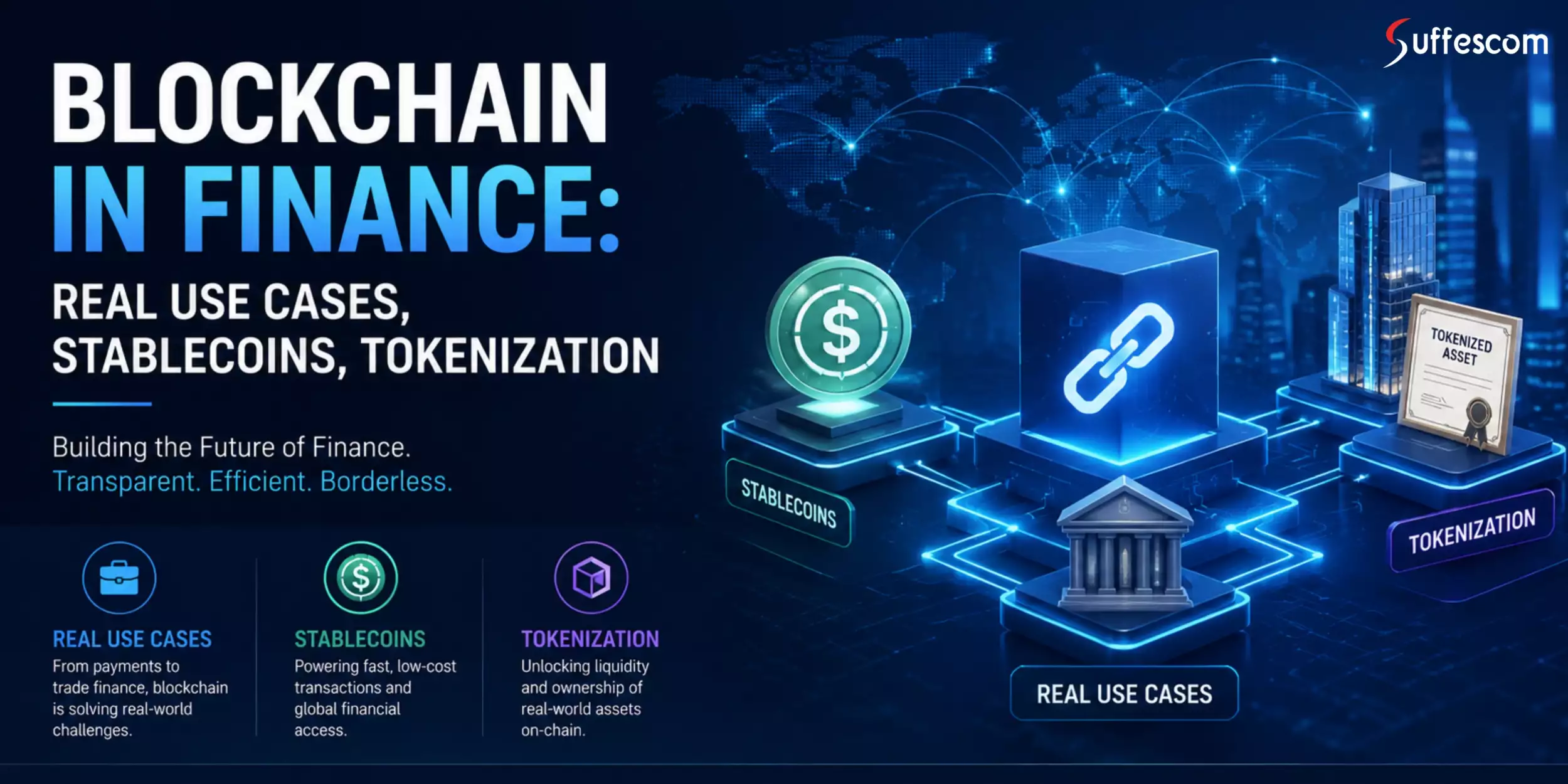
- Stablecoins (crypto tokens pegged to a currency like the US dollar) and tokenization of real-world assets, not ICOs, are the use cases actually driving institutional adoption in 2026.
- Industry data puts global blockchain-in-banking adoption at 83% of financial institutions exploring or deploying it, with the market projected to grow from $6.98 billion in 2024 to $58.2 billion by 2029.
- Blockchain is not a fit for every financial process. A single institution moving data internally usually does better on a conventional database. Blockchain earns its place when multiple parties need to share a transaction record without fully trusting one operator.
- Regulatory clarity, including the 2025 US stablecoin legislation, is accelerating enterprise adoption rather than slowing it down.
- The practical entry points for most financial businesses right now are cross-border payments, trade finance, and identity verification, not speculative token launches.
Want similar results? → Get a Free Quote
Blockchain in finance is a distributed ledger system: a record of transactions maintained simultaneously across many computers, where each new entry is cryptographically linked to the one before it and cannot be altered without the network's agreement. That structure removes the need for a single central authority to verify every transaction, which is why banks and fintechs use it to settle payments, move assets, and automate contracts without routing everything through a chain of intermediaries.
Where Blockchain in Finance Actually Works Right Now
It is important to point out that not all components of banks and fintechs can benefit from blockchain technology. The use of blockchain becomes efficient when several participants (banks, regulators, counterparties) need to agree on a certain transaction history but nobody can control that transaction history. There is no benefit in using the technology where information needs to be transferred across internal systems of a single institution.
By 2026, the technology is beyond the pilot phase in just a few narrow spheres. The Digital Finance Outlook of Moody's for 2026 talks about the emergence of digital asset infrastructure as a basic layer of financial services thanks to tokenized Treasury products, stablecoin settlement, and programmable payment rails.
Top Blockchain Use Cases in Finance for 2026
Stablecoins and Cross-Border Payments
Stablecoins that are pegged one-to-one against a fiat currency such as the US dollar have emerged as the key blockchain use case for payments. Stablecoin-backed international payments reduce costs by up to 96% according to industry estimates, while settlement times have been reduced to a matter of minutes instead of several days. As of early 2026, the total market value of stablecoins is estimated to be around $301 billion, which has seen an increase due to US regulation provided in 2025 through stablecoin legislation. While Ripple continues to work in this space, many banks have started their own stablecoin infrastructure.
Real-World Asset (RWA) Tokenization
Tokenization converts an illiquid asset, real estate, private credit, a bond, into a digital token that can be traded in fractional units. This is still an earlier-stage use case than stablecoins, but it's moving fast: BlackRock has named tokenization one of its core investment themes for 2026, and digital finance platforms now host tokenized US Treasurys and structured credit products directly. For financial businesses, this is the use case most likely to unlock new liquidity and new products over the next two years, rather than a pure cost-cutting play.
Central Bank Digital Currencies (CBDCs)
A CBDC is a government-issued digital currency built on the same distributed ledger principles as stablecoins, but backed and controlled by a central bank rather than a private issuer. As of 2026, 11 countries have fully launched a CBDC, and 49 more are running active pilots. Cross-border wholesale settlement projects between central banks, such as mBridge, are testing CBDCs specifically for institution-to-institution transfers rather than consumer use. Financial businesses operating internationally should be tracking this, since it will affect settlement infrastructure regardless of whether they issue tokens themselves.
Trade Finance
Finance for international trade transactions relies heavily on documentation – bills of lading, letters of credit, and several participants who need the same document simultaneously. Blockchain technology allows such documentation to become digitalized and be accessible to everyone involved in the process via a single copy that cannot be tampered with.
Digital Identity Verification
Every financial transaction requires proving who someone is: video verification, secure login, proof of intent. Traditionally, a customer repeats this entire process every time they open a new account or request a new service, even at the same bank. Blockchain-based identity management lets a customer verify their identity once and reuse that verified credential across services, cutting onboarding time without weakening the verification itself.
Syndicated Lending
Syndicated loans involve multiple lenders funding a single loan, which historically means each lender runs its own KYC (know your customer) and AML (anti-money laundering) checks separately. Recording those checks on a shared ledger instead of duplicating them across lenders has cut processing time on some syndicated deals from around 19 days down to hours, according to industry reporting on blockchain-based lending platforms.
Accounting and Auditing
Accounting runs on the same problem trade finance does: everyone needs to see the same numbers and trust they haven't been altered. Blockchain supports this with a shared ledger where transactions are visible to authorized parties but cannot be edited without permission, which strengthens the audit trail regulators actually check. Smart contracts, self-executing code that runs automatically when preset conditions are met, are increasingly used to trigger invoice payments without manual processing.
Credit Reporting
Blockchain-powered credit reporting allows lenders to look into a person’s history of transactions that are verified by the blockchain technology, without having to go through a centralized credit agency or an intermediary. The process of generating a credit report becomes more affordable and quicker for businesses and individuals who do not have a conventional credit history yet.
Stock and Share Settlement
Traditional stock trades still route through brokers who charge a commission and take multiple days to fully settle. Blockchain-based settlement removes that intermediary layer and lets trades settle peer-to-peer, which is part of why securities settlement is one of the areas Blockchain Council flags as production-ready in banking today, alongside custody and compliance workflows.
Planning a Blockchain-Based Financial Solution?
Start by evaluating the right blockchain model, integration requirements, security controls, and compliance considerations for your use case.
Role of Smart Contracts in Financial Services
Smart contracts are self-executing programs that automatically perform predefined actions when specified conditions are met. In financial services, they can reduce manual intervention and automate rule-based processes such as payments, settlement, lending, and asset transfers.
Key applications include:
- Loan Disbursement: Release funds automatically when predefined lending conditions are satisfied.
- Collateral Management: Monitor collateral requirements and trigger predefined actions when conditions change.
- Interest and Coupon Payments: Automate scheduled payments based on predefined terms.
- Insurance Claims: Trigger claim processing when verified conditions are met.
- Escrow Execution: Release funds automatically after contractual requirements are fulfilled.
- Trade Settlement: Coordinate asset and payment transfers based on predefined settlement conditions.
- Compliance Rules: Apply predefined transaction limits, eligibility criteria, or approval conditions.
Where Blockchain Is Still Overkill
Single-institution data doesn't need a shared ledger. If only your organization touches the data, a conventional database is faster and cheaper to run.
ICOs (initial coin offerings) as a fundraising mechanism have mostly fallen out of favor since the 2018 wave, replaced by more regulated tokenization and stablecoin structures. If a vendor is still pitching ICO platforms as a 2026 growth strategy, ask why.
Regulatory uncertainty is still real in some jurisdictions, even with the US stablecoin framework now in place. Cross-border deployments need legal review before technical review.
Public blockchains trade privacy for openness. For sensitive financial data, a private or permissioned blockchain like Hyperledger is usually the better starting point, not a fully public network.
Blockchain vs Traditional Financial Infrastructure
The key difference lies in how transaction data is shared, validated, reconciled, and settled across financial participants.
| Area | Traditional Finance | Blockchain-Based Finance |
| Transaction records | Institution-specific ledgers | Shared distributed ledger |
| Reconciliation | Often performed between institutions | Shared state reduces reconciliation |
| Settlement | Batch/cut-off dependent | Can support near-real-time settlement |
| Intermediaries | Multiple intermediaries | Potentially fewer intermediaries |
| Auditability | Records distributed across systems | Tamper-evident transaction history |
| Automation | Rule-based legacy systems | Smart contracts |
| Availability | Often business-hour dependent | Can operate continuously |
Benefits of Blockchain in Financial Services
Security
Cryptography and consensus mechanisms help validate transactions and detect unauthorized changes.
Transparency and Trust
A shared ledger gives authorized participants a consistent, traceable view of transaction records.
Privacy Controls
Permissioned networks can restrict participation and data access to authorized users.
Faster Settlement and Reconciliation
Shared transaction records can reduce duplicate data and manual reconciliation, supporting faster settlement.
Programmable Financial Processes
Smart contracts can automate predefined workflows such as payments, asset transfers, and settlement.
Auditability
Chronological transaction records make financial activities easier to trace, verify, and audit.
Scalability
Private and hybrid blockchains, such as Polygon, now handle thousands of transactions per second, which is what makes production use at bank scale realistic rather than theoretical.
How to Implement Blockchain in Your Financial Business
Choose Public vs. Private Blockchain
Public blockchains are open to anyone but offer less control over sensitive data. For most financial use cases, a private or permissioned blockchain like Hyperledger gives you the scalability and access control regulated data requires.
Select a Blockchain Framework
Hyperledger Fabric is a common choice for permissioned access in financial services. The right framework depends on your compliance requirements and transaction volume, which is worth scoping before development starts.
Find a Hosting Provider
Reliable infrastructure, such as Amazon for Ethereum-based deployments or IBM for Hyperledger, affects uptime and performance once you're live.
Develop Smart Contracts Carefully
Smart contracts automate financial processes, but a coding error in a contract that moves money is expensive to fix after deployment. Working with an experienced smart contract development company for testing and code audits before launch reduces that risk substantially rather than discovering it in production.
If you're evaluating vendors for a build, look for a blockchain app development company that can speak to compliance and audit requirements as fluently as it speaks to the technical stack. That combination is what separates a working financial product from a working demo.
Technical Challenges Involved with Implementing Blockchain within Financial Services
Blockchain technology can help increase the speed, transparency, and efficiency of the financial system, yet implementing it within the current financial structure involves a number of technical challenges.
Scalability and Performance
High-frequency finance relies on low latency and processing a large amount of transactions. Blockchain-based networks can have certain performance issues when there is a surge in the number of transactions that need to be completed.
Compatibility with Existing Systems
Traditional banks and FinTech companies use existing banking, payments, trading, and compliance systems. Linking up blockchain networks with existing legacy systems would require creating certain APIs and middleware solutions.
Data Privacy
Financial institutions work with sensitive customer and transaction data that might not be suitable for display within the public network. Permissioned networks, data encryption, and off-chain data storage might be needed for complying with privacy and regulatory requirements.
Smart Contract Security
Using smart contracts can streamline financial processes and eliminate the risk of human error. Yet, coding bugs might result in transactions being processed incorrectly or cause financial damage to the user. Proper code development practices and auditing should be used.
Building the Next Generation of Financial Infrastructure?
Explore practical blockchain applications across stablecoins, tokenization, settlement, lending, and programmable financial workflows.
Building Blockchain-Based Financial Infrastructure with Suffescom
Suffescom builds across the use cases covered above, not just the technology stack underneath them. That includes:
- RWA Tokenization Development, for converting real-world assets such as real estate, funds, and credit into digitally represented assets.
- Stablecoin Development, for businesses exploring programmable payment, treasury, and settlement infrastructure.
- DeFi Development, for decentralized lending, financial markets, liquidity, and other blockchain-based financial applications.
- Smart Contract Development for automating predefined financial workflows such as settlement, escrow, lending, payments, and asset transfers.
This is where blockchain-based fintech development services earn their budget: not as a standalone technology project, but as infrastructure tied directly to a payments, lending, or settlement outcome your business already needs.
Schedule a free consultation to discuss your project.
FAQs
1. How does blockchain technology improve financial transactions?
It removes intermediaries from the settlement process, which cuts cost and speeds up transactions. For cross-border payments specifically, stablecoin-based transfers now settle in minutes instead of days, at a fraction of traditional remittance fees.
2. What are the main use cases of blockchain in banking right now, in 2026?
Stablecoins and cross-border payments, real-world asset tokenization, and CBDC-related settlement infrastructure lead current adoption, alongside trade finance, digital identity verification, and securities settlement.
3. Is blockchain secure for financial services?
Yes, when implemented correctly. Consensus-based verification and cryptographic linking between transactions make tampering detectable, but security also depends on smart contract code quality and how access is managed, which is why code audits matter as much as the underlying blockchain.
4. How much does it cost to implement blockchain in finance?
It varies significantly based on whether you're deploying a permissioned enterprise blockchain, building smart contracts on an existing network, or building custom infrastructure from scratch. A narrow smart contract deployment can run in the low tens of thousands of dollars; a full custom platform with compliance tooling runs considerably higher. Share your scope and we'll give you a real range rather than a placeholder.
5. What is the difference between public and private blockchain?
Public blockchains are open to anyone and prioritize decentralization. Private or permissioned blockchains restrict who can participate, which is usually the better fit for financial data that carries regulatory or privacy requirements.