+971-8000321216



Key Takeaways
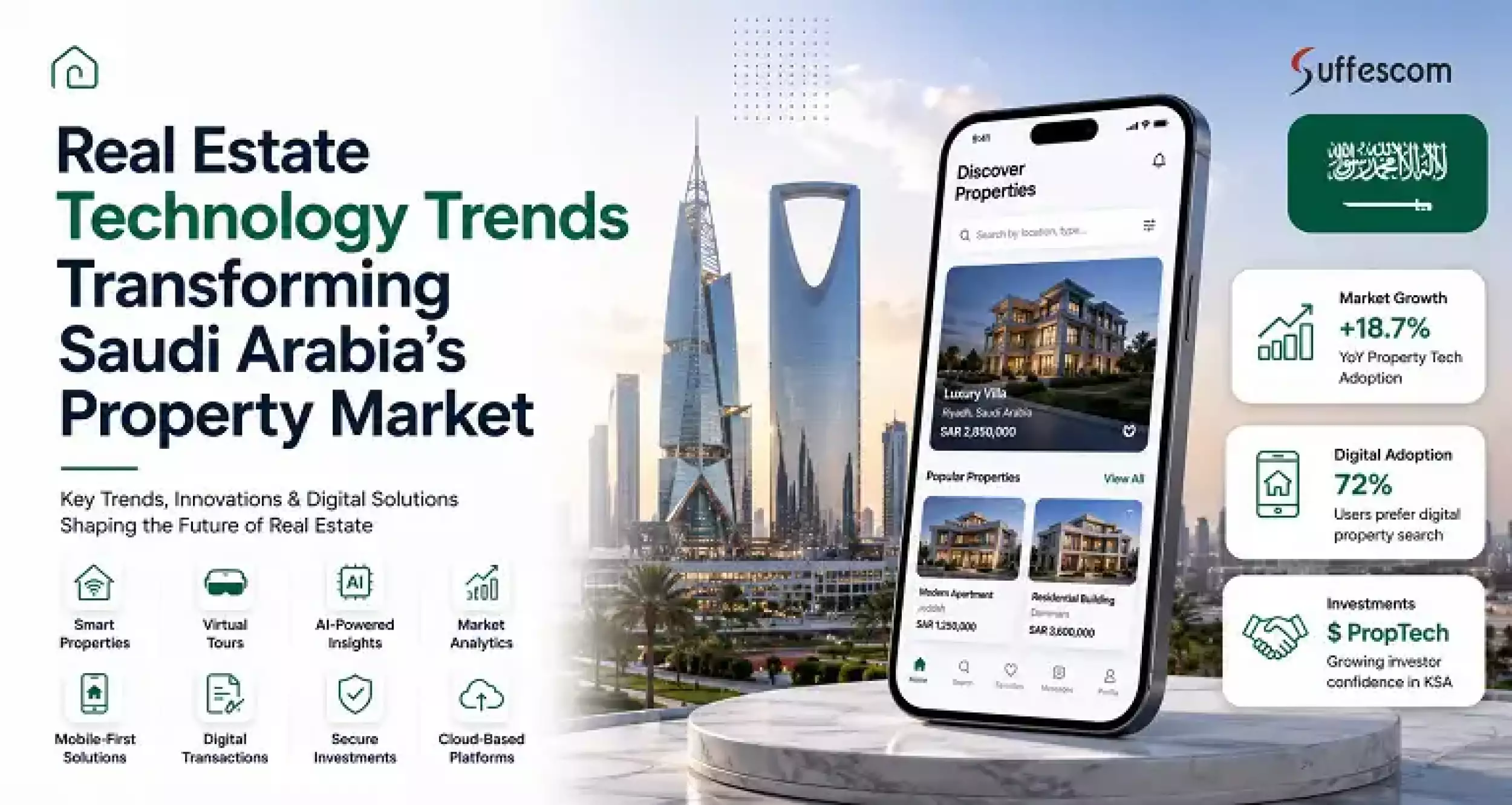
- The real estate sector in Saudi Arabia is undergoing digital transformation under the vision of 2030, smart cities, and PropTech.
- Such technologies as artificial intelligence, IoT, digital twin, BIM, and automation are bringing transformation in the real estate sector through increased efficiency, effective decision-making, and customer satisfaction.
- Projects like NEOM and The Red Sea are increasing the pace of innovation in the industry and demanding more efficient, sustainable, and connected projects.
- There are challenges that businesses need to address to ensure a successful implementation of technology, such as cost, cybersecurity, integration, and technical know-how.
- Real estate businesses that are future-ready and adapt to the changes will be at an advantage by working with experienced real estate application development firms like Suffescom.
The real estate market in Saudi Arabia is undergoing a digital transformation at a rapid pace through the use of PropTech in designing, marketing, managing, and transacting properties. The support from Saudi Vision 2030, along with the creation of smart cities, has led to the emergence of innovations like artificial intelligence (AI), IoT, smart buildings, digital twins, and blockchain in the real estate market.
The Saudi government is also working towards promoting PropTech innovation through several initiatives, such as the Saudi PropTech Hub, that can help in increasing the digital transformation within the real estate market. In light of these innovations, it is essential to understand the current trends in real estate technology in Saudi Arabia.
As these technologies mature, businesses are increasingly investing in custom real estate applications that combine AI, IoT, cloud computing, and automation into a seamless digital experience. The below-mentioned list provides some PropTech trends impacting the real estate industry of Saudi Arabia in 2026 and their influence on the business.
Why Real Estate Technology Is Growing Rapidly in Saudi Arabia
The real estate industry in Saudi Arabia is witnessing rapid digital transformation due to the efforts of Vision 2030, mega projects, and growing demands for technological property-related solutions. Government initiatives, investment in PropTech, and implementation of artificial intelligence, Internet of Things, cloud platform solutions, and other smart building systems are revolutionizing the ways of property development, management, and utilization.
Vision 2030 Accelerating Real Estate Digital Transformation
Saudi Arabia's Vision 2030 strategy is making innovation in the digital sphere one of the drivers of real estate growth thanks to digital economy development and creation of smart cities. As noted in the Vision 2030 2025 Annual Report, non-oil activities have contributed up to 55% to the GDP of Saudi Arabia, which reflects the achievements of the kingdom in creating a diverse economy powered by innovations. To further accelerate innovation, the Saudi PropTech Hub (SPH) was launched to support startups, developers, and investors while encouraging the adoption of advanced real estate technologies.
Growing Demand for Digital Property Experiences
Modern buyers and investors want smooth experiences starting from the discovery of the property online through mobile applications, virtual tours, and automated customer journeys. Due to this, there has been an adoption of recommendation engines, digital paperwork, and self-service portals in real estate businesses to streamline transactions and engage their customers.
Mega Projects Driving Technology Adoption
The giga-developments in Saudi Arabia, such as NEOM, The Red Sea, Qiddiya, and Diriyah, are spurring the development of smart cities and towns in which AI, IoT, digital twins, and smart infrastructure have been deployed to make them connected communities, setting new standards for technology-driven urban planning and real estate innovation.
Changing Expectations of Real Estate Customers
The changing requirements of real estate customers are rapid transactions, process transparency, personalization, and ease of use of digital tools. Developers and real estate companies have started using mobile applications, AI-enabled assistance, secure digital transactions, and cloud-based property management in response to the changed requirements.
Top Real Estate Technology Trends Transforming Saudi Arabia
The real estate industry in Saudi Arabia has incorporated technology to increase efficiency, improve customer experiences, and foster intelligent urban planning. With Vision 2030 and giga-projects supporting PropTech innovations, the sector is revolutionizing its processes in terms of planning, construction, marketing, management, and investment of properties. The following are some of the major technology trends that will be experienced in the real estate industry in Saudi Arabia in 2026.
1. Artificial Intelligence (AI) Revolutionizing Real Estate Decisions
AI is having a major impact on decision-making in real estate companies through efficiency and customer experience. The use of AI ranges from valuation to predictive analytics in various stages of the property life cycle.
How AI Is Used in Real Estate
- Automated property valuation and pricing
- Personalized property recommendations
- AI-powered chatbots and virtual assistants
- Lead qualification and sales automation
- Market trend analysis and demand forecasting
- Predictive maintenance for smart buildings
Business Benefits
- Faster and smarter decision-making
- Improved customer experience
- Lower operational costs through automation
- Better investment and pricing strategies
- Increased sales and productivity
Saudi Arabia in Action
The Kingdom of Saudi Arabia is leveraging AI technology through Vision 2030 and smart city projects. NEOM leverages AI for urban planning and development, and AI is being increasingly used by developers and agencies for property recommendation, customer service, and market research.
Future Outlook
The future of PropTech lies in the use of AI for the next level of innovation, which will include automation of property management processes, investment platforms, and enhanced customer experience in the real estate industry in Saudi Arabia.
2. Generative AI Changing Real Estate Operations
Generative AI is transforming real estate business operations through its use in creating content, automating processes, and improving customer experience. It allows for faster working, along with offering a more personalized customer experience.
How Generative AI Is Used in Real Estate
- AI-generated property descriptions and listings
- Marketing content for websites and social media
- Automated reports and market summaries
- AI virtual assistants for customer support
- Document drafting and contract processing
- Personalized email and marketing campaigns
Business Benefits
- Faster content creation and document processing
- Improved marketing efficiency
- Personalized customer communication
- Reduced administrative workload
- Higher team productivity
Saudi Arabia in Action
Real estate developers in Saudi Arabia are utilizing generative AI technology to help them make their processes of marketing, selling, and engaging with customers more efficient. This can be seen through the actions of ROSHN, which is one of the largest residential developers in Saudi Arabia and is using digital and AI-based solutions for property discovery, sale, and homeownership services.
Future Outlook
It is expected that generative AI technology will develop into intelligent real estate assistants that will provide investment insights, document automation, customer service, and property management.
3. Smart Cities Becoming the Foundation of Future Real Estate
Smart cities are revolutionizing real estate in Saudi Arabia as they bring together technology and digital solutions into city development. These data-driven environments enhance quality of life while improving the efficiency, sustainability, and management of modern communities.
How Smart Cities Are Transforming Real Estate
- Connected infrastructure and digital services
- Intelligent traffic and mobility systems
- Smart utilities and energy management
- AI-driven urban planning
- Integrated public safety and security
- Sustainable community development
Business Benefits
- Improved operational efficiency
- Enhanced resident and tenant experiences
- Lower infrastructure and maintenance costs
- Greater sustainability and resource optimization
- Increased long-term property value
Saudi Arabia in Action
In addition, NEOM is regarded as one of the most advanced smart cities in the world, which involves AI, the Internet of Things, digital twins, and self-driving cars. Likewise, the company ROSHN is creating smart residential communities with interconnected facilities and digital services, illustrating that technology is becoming the key feature of the modern real estate industry in the country.
Future Outlook
With the implementation of Vision 2030, smart city technologies will be part of all new developments, making possible connected, sustainable, and digitized communities in Saudi Arabia.
4. Smart Buildings and Connected Properties with IoT
IoT has revolutionized the real estate industry in Saudi Arabia with its ability to connect various buildings’ systems, devices, and sensors for higher efficiency, security, and sustainability. Smart buildings allow real-time monitoring of operations and automated maintenance and provide a more comfortable experience for occupants.
How IoT Is Used in Real Estate
- Smart energy and water monitoring
- Automated lighting and climate control
- Security and access management systems
- Predictive maintenance for building equipment
- Occupancy and space utilization analytics
- Remote monitoring through cloud platforms
Business Benefits
- Lower operational and energy costs
- Improved tenant comfort and satisfaction
- Reduced equipment downtime
- Better maintenance planning
- Enhanced building security
- Support for sustainability and ESG goals
Saudi Arabia in Action
The Red Sea project is adopting IoT-enabled infrastructure, smart energy, and smart buildings within its hospitality and residential projects. This ensures efficient consumption of resources and increased operational efficiency and supports the sustainability objectives within the projects.
Future Outlook
IoT adoption is expected to accelerate across commercial towers, residential communities, hotels, and mixed-use developments, making connected and energy-efficient buildings a standard feature of Saudi Arabia’s future real estate landscape.
5. Digital Twin Technology for Real Estate Development
Digital twin technology is enabling real estate companies to virtually replicate buildings and infrastructure in order to optimize their performance and increase decision-making processes throughout the property lifecycle.
How Digital Twins Are Used in Real Estate
- Virtual building modelling and simulation
- Real-time monitoring of building performance
- Construction planning and progress tracking
- Predictive maintenance and asset management
- Space and facility optimization
- Lifecycle performance analysis
Business Benefits
- Better planning and project coordination
- Reduced construction risks and costs
- Improved operational efficiency
- Faster issue detection and maintenance
- Longer asset lifespan
Saudi Arabia in Action
Digital twin technology is being used by NEOM for designing, simulating, and managing their huge development projects before and after they have been constructed. The use of digital twins along with AI and IoT will allow them to optimize their planning, infrastructure management, and efficiency in their smart city network.
Future Outlook
With the expansion of smart cities and mega projects in the future, the use of digital twins is likely to become a common practice in the design, management, and maintenance of intelligent buildings and communities in Saudi Arabia.
6. Blockchain Technology Changing Property Transactions
The use of blockchain technology has helped to improve the security, efficiency, and transparency of real estate transactions using tamper-proof and validated digital records. With more widespread use, it could help make the process of transferring property easier, reduce fraud, and streamline administrative processes.
How Blockchain Is Used in Real Estate
- Secure digital ownership records
- Smart contracts for property transactions
- Digital identity and document verification
- Transparent transaction history
- Tokenized real estate assets
- Faster cross-border property transactions
Business Benefits
- Greater transparency and trust
- Reduced paperwork and processing time
- Lower risk of fraud
- Faster and more secure transactions
- Improved operational efficiency
Saudi Arabia in Action
The Real Estate General Authority (REGA) is leading the digitization of the real estate market in Saudi Arabia through innovations in property services. Even though blockchain technology is not yet widely adopted, these innovations will pave the way for secure transactions and smart contract usage in the future, including the tokenization of real estate property.
Future Outlook
As property ecosystems become increasingly digitized, the use of blockchain technology will increase in property registration, verification of ownership, tokenization of investments, and secure transactions in real estate in Saudi Arabia.
7. Virtual Reality (VR) and Augmented Reality (AR) Property Experience
Both VR and AR are revolutionizing the process of marketing for property by giving buyers the chance to go through their properties virtually. This has proven to be helpful in making developers market their projects better while improving buyer confidence.
How VR & AR Are Used in Real Estate
- Virtual property tours
- Interactive 3D property visualizations
- Interior design and furnishing previews
- Off-plan project demonstrations
- Remote property inspections
- AR-enabled sales presentations
Business Benefits
- Enhanced buyer engagement
- Faster sales decisions
- Reduced need for physical site visits
- Improved off-plan project marketing
- Greater reach to international investors
Saudi Arabia in Action
Diriyah Company applies digital immersion and visualization tools to present its large-scale project, giving the investors and buyers the ability to see the upcoming community before it becomes reality. This approach will facilitate more engaging marketing of properties and will also contribute to attracting foreign investors.
Future Outlook
As immersive technologies become more accessible, VR and AR are expected to become standard tools for property sales, remote viewings, interior visualization, and customer engagement across Saudi Arabia's real estate market.
8. Big Data Analytics Driving Real Estate Investment Decisions
Real estate firms have adopted big data analytics to convert huge amounts of data regarding their market and customers into useful information that can guide decision-making. This includes analysis of trends, pricing, and consumer behavior.
How Big Data Is Used in Real Estate
- Market intelligence and trend analysis
- Buyer and tenant behavior analysis
- Property price forecasting
- Demand and supply analysis
- Investment opportunity identification
- Portfolio performance monitoring
Business Benefits
- Better investment decisions
- More accurate pricing strategies
- Improved market forecasting
- Reduced investment risk
- Enhanced business planning
Saudi Arabia in Action
ROSHN utilizes data analytics to aid in master planning, customer preferences, and optimizing residential projects. Through an understanding of the market demand and buying trends, the developer is able to create residential communities that meet the demands of its customers and investment opportunities.
Future Perspectives
As more information becomes available in real estate, there will be an increased use of big data analytics for predicting market trends, creating investment opportunities, and making sound and informed decisions in Saudi Arabia’s real estate industry.
9. Predictive Analytics for Real Estate Market Forecasting
Predictive analysis allows one to forecast future trends using historical and current data. It makes decision-making in the business very easy. This is because it helps in identifying opportunities, forecasting demand, and reducing investment risks.
How Predictive Analytics Is Used in Real Estate
- Rental demand forecasting
- Property price trend prediction
- Investment opportunity analysis
- Market risk assessment
- Sales and occupancy forecasting
- Portfolio performance optimization
Business Benefits
- Smarter investment decisions
- Improved pricing accuracy
- Reduced financial risk
- Better resource and inventory planning
- Higher returns through data-driven strategies
Saudi Arabia in Action
ROSHN uses analytics and market intelligence to understand the demand for houses and to build communities that are in alignment with changing consumer preferences. This will help the developers to better plan their ventures and adapt to market changes.
Future Outlook
As artificial intelligence and big data keep advancing, predictive analytics will be at the heart of predicting market changes, portfolio optimization, and long-term property investment strategies in Saudi Arabia.
10. PropTech Marketplaces Changing Property Discovery
PropTech marketplaces are revolutionizing property search processes for buyers, sellers, tenants, and investors alike by making property searches easier and enabling users to access verified listings and deliver a faster, more personalized buying experience.
How PropTech Marketplaces Are Used
- Online property listings and search
- AI-powered property matching
- Advanced filters and location-based search
- Virtual property tours
- Agent and developer portals
- Integrated inquiry and booking systems
Business Benefits
- Greater property visibility
- Faster buyer and tenant acquisition
- Improved lead generation
- Streamlined sales processes
- Enhanced customer experience
Saudi Arabia in Action
Sakani, one of Saudi Arabia's leading digital housing platforms, enables users to search properties, access housing programs, and complete key property services online. Its digital-first approach reflects the Kingdom's growing adoption of PropTech marketplaces that make property discovery more accessible and efficient.
Future Outlook
With the continuing advancements in the fields of AI, big data, and automation, PropTech marketplaces will deliver advanced property suggestions, smooth online transactions, and a more personalized experience for their users, thus becoming the leading means of discovering property in Saudi Arabia.
11. Cloud-Based Property Management Platforms
Real estate companies are benefiting from the help of cloud-based property management systems that are helping them become more organized and collaborate in a better way through the provision of information in real-time to the developers, landlords, and facility managers.
How Cloud Platforms Are Used in Real Estate
- Digital tenant and lease management
- Online rent and payment tracking
- Maintenance request management
- Financial reporting and analytics
- Document storage and workflow automation
- Multi-property management from a single platform
Business Benefits
- Centralized property operations
- Improved team collaboration
- Faster maintenance response times
- Better financial visibility
- Reduced administrative workload
Saudi Arabia in Action
Ejar, which is the Kingdom’s online leasing platform, has revolutionized the way leases can be managed because of its electronic tenancy agreements, digital registrations, and rental services. This platform is an example of how cloud technology has revolutionized the management of property in Saudi Arabia’s rental sector.
Future Outlook
The increased use of technology means that cloud-based platforms will soon be the norm when it comes to the management of both residential and commercial properties.
12. Real Estate Mobile Applications Becoming Essential
Mobile applications are transforming how properties are bought, rented, leased, and managed. As customer expectations continue to evolve, businesses are increasingly investing in mobile app development services to simplify property discovery, streamline transactions, and improve customer engagement. Today, feature-rich real estate apps have become a key component of Saudi Arabia's growing PropTech ecosystem.
How Mobile Apps Are Used in Real Estate
- Property search and discovery
- Virtual tours and appointment booking
- Digital document submission
- In-app messaging and customer support
- Rent payments and maintenance requests
- Real-time property alerts and notifications
Business Benefits
- Improved customer convenience
- Higher user engagement and retention
- Faster communication and transactions
- Increased lead generation
- Stronger brand loyalty
Saudi Arabia in Action
Sakani provides a mobile platform that enables users to search for properties, access housing programs, apply for housing services, and complete essential real estate transactions digitally. Its success reflects the growing demand for mobile-first property experiences across Saudi Arabia.
Future Outlook
As smartphone adoption and digital services continue to grow, demand for real estate mobile app development is expected to rise as developers, agencies, and property managers invest in digital solutions that deliver seamless property experiences.
13. Building Information Modeling (BIM) Improving Construction Technology
BIM stands for Building Information Modeling, which is a technology that is revolutionizing construction in terms of creating an intelligent 3D model of the building process to enhance planning, coordination, and execution of the project. It helps architects, engineers, builders, and developers use one digital model through the entire building life cycle.
How BIM Is Used in Real Estate
- 3D building design and visualization
- Cross-team collaboration and coordination
- Clash detection before construction
- Construction scheduling and cost estimation
- Asset and facility management
- Lifecycle planning and maintenance
Business Benefits
- Reduced construction errors and rework
- Better project collaboration
- Improved cost and time management
- Higher construction quality
- More efficient building lifecycle management
Saudi Arabia in Action
Diriyah Company has taken advantage of BIM and digital construction methods in the development in order to increase efficiency and project coordination. BIM is crucial for the timely completion of complex projects at reduced cost and improved quality.
Future Outlook
As Saudi Arabia continues to invest in giga-projects and smart cities, BIM will become a standard practice for delivering faster, more efficient, and sustainable real estate developments.
14. Sustainable Real Estate Technology and Green Buildings
Technology within the sustainable development field is assisting property developers to lessen their environmental footprint, as well as to build better-performing and more efficient structures. Through integration of smart technology into green buildings, one can achieve healthy, resilient, and cost-effective properties.
How Sustainable Technology Is Used in Real Estate
- Smart energy and water management
- Renewable energy integration
- Intelligent building automation
- ESG monitoring and reporting
- Green building design and materials
- Waste and resource optimization
Business Benefits
- Lower operating and energy costs
- Reduced carbon emissions
- Improved ESG compliance
- Higher asset value and market appeal
- Enhanced occupant comfort and wellbeing
Saudi Arabia in Action
The Red Sea is establishing new standards for sustainable development through the use of renewable energy, smart utilities, and environmentally friendly building techniques within its destinations. The project illustrates the role of technology in facilitating the process of large-scale real estate development without harming the environment in accordance with the sustainability targets set out by Saudi Arabia.
Future Outlook
With the ongoing focus on sustainability as a result of Vision 2030, it can be predicted that innovations like green buildings and smart energy will be adopted by both residential and commercial mixed-use developments in Saudi Arabia.
15. Robotics and Automation in Real Estate Development
Robots and automation are making processes of real estate development even more efficient. Automation technologies through construction and facility management assist in decreasing the amount of manual work, improving precision and optimization.
How Robotics and Automation Are Used in Real Estate
- Construction robots for repetitive tasks
- Drone-based site inspections and monitoring
- Automated building inspections
- Robotic cleaning and facility maintenance
- Warehouse and material handling automation
- AI-powered construction progress tracking
Business Benefits
- Faster project delivery
- Improved workplace safety
- Reduced labor-intensive tasks
- Greater construction accuracy
- Lower operational costs
Saudi Arabia in Action
NEOM is applying the use of advanced robotics and automation in construction and infrastructure developments in order to increase efficiency and facilitate future smart city projects. The use of these technologies increases the speed of project delivery without reducing their quality and efficiency.
Future Outlook
With the evolution of automation technologies, robotics will become increasingly prevalent in the construction industry, property management, inspection, and facility management in order to achieve fast, safe, and efficient real estate operations in Saudi Arabia.
16. GIS Mapping Technology Improving Property Intelligence
The geographic information systems (GIS) technology helps developers and investors analyze location-based data and make the appropriate real estate decisions based on this data. Through this process, one can achieve effective site selection and urban planning and conduct proper investment analysis.
How GIS Is Used in Real Estate
- Location and site suitability analysis
- Investment and market mapping
- Urban planning and zoning analysis
- Infrastructure and accessibility assessment
- Demographic and population analysis
- Risk and environmental mapping
Business Benefits
- More informed site selection
- Better investment decisions
- Improved urban planning
- Reduced development risks
- Enhanced market intelligence
Saudi Arabia in Action
The Royal Commission for Riyadh City uses the technologies of GIS for urban planning and development, construction of infrastructure, and city management. The application of GIS in the abovementioned processes provides for planning based on data analysis, which enables sustainable growth through optimization of land use.
Future Outlook
With Saudi Arabia continuing to develop smart cities and mega-urbanization projects, GIS will have increased application in property intelligence, infrastructure planning, and real estate investments.
17. Cybersecurity Becoming Critical for Digital Real Estate
With the increasing digitization of real estate, cybersecurity is necessary to ensure the security of data, finances, and infrastructure of the property. Good cybersecurity can be instrumental in protecting companies, clients, and smart buildings from cyberattacks.
How Cybersecurity Is Used in Real Estate
- Data protection and privacy management
- Secure digital property transactions
- Cloud platform and network security
- Identity and access management
- IoT and smart building security
- Threat detection and incident response
Business Benefits
- Stronger protection against cyber threats
- Increased customer trust
- Improved regulatory compliance
- Reduced risk of data breaches
- Greater business continuity
Saudi Arabia in Action
The National Cybersecurity Authority (NCA) is bolstering the Kingdom’s cybersecurity environment through developing standards and controls that enable organizations to secure digital infrastructure and sensitive information. Such steps aid real estate companies in adopting cloud platforms, smart buildings, and PropTech in general safely.
Future Outlook
With an increase in the use of PropTech, cybersecurity will play an essential role in ensuring that the digital real estate ecosystem is safe, secure transactions are made, and buildings are connected with resilient property operations.
18. 5G Technology Enabling Next-Generation Real Estate Experiences
5G technology is transforming the new generation of smart real estate by offering faster connectivity and low-latency communication with the integration of connected devices. It supports real-time data exchange, making smart buildings and digital property services more efficient and reliable.
How 5G Is Used in Real Estate
- Real-time smart building connectivity
- IoT device communication
- High-quality virtual property tours
- Remote building monitoring
- Smart security and surveillance
- Connected community infrastructure
Business Benefits
- Faster and more reliable connectivity
- Improved smart building performance
- Enhanced tenant and customer experiences
- Better operational efficiency
- Greater scalability for connected properties
Saudi Arabia in Action
STC is rolling out 5G network capabilities across the entire kingdom of Saudi Arabia, facilitating developers and smart cities in their efforts to deploy connected buildings, IoT platforms, and sophisticated digital solutions. The deployment will further strengthen the foundation for intelligent communities and innovative real estate.
Future Outlook
As 5G network rollouts continue, the adoption of smart buildings, AI-driven property management, immersive virtual experiences, and connected communities drives the future of PropTech in Saudi Arabia.
Real Estate Technology Trends Comparison: Adoption, Impact & Future Potential
Not all real estate technologies are at the same stage of adoption in Saudi Arabia. Although AI, IoT, and BIM have been widely adopted in smart developments, other developing technologies, including blockchain and digital twin technology, are gaining prominence. The table below provides a comparison of the adoption rate, business impact, and future potential of major PropTech trends that are currently transforming the real estate industry in the Kingdom.
| Technology Trend | Current Adoption in Saudi Arabia | Business Impact | Future Growth |
| Artificial Intelligence (AI) | High | Very High | Very High |
| Smart Buildings | High | High | Very High |
| Digital Twins | Growing | High | Very High |
| Blockchain | Emerging | Medium | High |
| Virtual Reality (VR) & Augmented Reality (AR) | Growing | Medium | High |
| Internet of Things (IoT) | High | High | Very High |
| Building Information Modeling (BIM) | High | High | High |
As seen from the above discussion, it becomes clear that at present, technology applications like AI, smart buildings, and IoT are playing a crucial role in technology adoption by the real estate industry in Saudi Arabia; nonetheless, in the future, the applications of digital twins and blockchain are expected to grow significantly through Vision 2030 projects.
Challenges Affecting Real Estate Technology Adoption in Saudi Arabia
Despite the fact that technology is revolutionizing the property market of the Kingdom, there are several challenges associated with such adoption of innovations. From high implementation costs to integration and cybersecurity concerns, businesses must overcome these barriers to maximize the value of their digital transformation initiatives.
High Implementation Costs
Implementation of advanced technologies like AI, the Internet of Things, digital twins, and smart buildings involves a lot of investment in software, infrastructure, and highly skilled professionals. In many cases, the initial cost is quite discouraging for small and medium real estate enterprises when the cost of implementation outweighs operational benefits that the company can gain from such investments.
Data Privacy Issues
As digital platforms gather and analyze more and more data about customers and properties, data privacy becomes one of the main concerns. The real estate firm needs to ensure the cybersecurity of all data and adhere to the data protection laws of Saudi Arabia.
Lack of Skilled Personnel
Implementation of PropTech technologies requires a lot of knowledge about AI, cloud computing, cybersecurity, data analysis, and smart buildings. The lack of specialists with digital skills is an issue, and many firms prefer to train their employees or cooperate with tech companies.
Integration With Existing Systems
Some real estate businesses continue to use outdated software and traditional methods. Integration of new technologies such as PropTech with current software and systems is difficult, and it should be done carefully to provide seamless data transfer and reduce any disruption of the business.
Technology Adoption Resistance
Adoption of digital technology means that some traditional business practices need to be changed. Resistance to new systems could arise due to a lack of training and change management. Support and business value may be helpful for organizations in realizing the best out of the investment that has been made.
Real Estate Technologies' Future in Saudi Arabia Towards 2030
The future of real estate in the Kingdom of Saudi Arabia would depend on the technological trends. The use of artificial intelligence, smart technologies, automation, and sustainability technologies in the coming years will shape the real estate industry in the country, owing to Vision 2030. The kingdom is advancing digital transformation of its cities and real estate ecosystem.
Digital First Property Transactions
Transactions related to property will continue transitioning to digital-first approaches. Through electronic documents and verification of these documents, among other approaches, digital technologies make property services faster and more efficient. New digital platforms have made property services more efficient, transparent, and convenient for customers, investors, and businesses.
AI-Powered Real Estate Ecosystem
It is inevitable that the real estate industry will employ AI technology since it will deliver predictive analysis, personal real estate recommendations, customer service by means of artificial intelligence, and smart building management systems. In order to reinforce the focus on the use of AI technology, 2026 has been proclaimed as the Year of Artificial Intelligence in Saudi Arabia, supporting wider adoption of AI technologies across industries through national strategies and digital infrastructure development.
Autonomous Intelligent Communities
Communities of the future will make use of AI technology, IoT, 5G, and advanced infrastructure to ensure optimal use of energy resources, transportation, security, and other municipal services. The pace of development of Saudi Arabia's smart cities has also increased significantly, with Riyadh being 24th in the global IMD Smart City Index 2026, reflecting improvements in digital services and technology-enabled urban management.
Advanced PropTech Investment Platforms
AI-enabled platforms for investment will make real estate investments easier by providing insights through AI, automating portfolio management, and making transactions digital. Such platforms will be beneficial in helping investors make data-backed decisions much faster.
Technology-Led Sustainable Development
Sustainability will continue to be an important aspect since developers will use smart energy, digital twins, and other technologies related to ESG. Projects like NEOM and The Red Sea have shown how technology can lead to sustainability. By 2030, technology will be at the core of Saudi Arabia's real estate industry through smart cities, operational efficiency, and sustainable property development, supporting the goals outlined in Saudi Arabia's Vision 2030 Real Estate Sector Strategy.
How to Choose the Right Real Estate App Development Company in Saudi Arabia
It is important to select the correct technology provider for your real estate platform. The correct provider should have an understanding of the real estate market in Saudi Arabia, PropTech advancements, and technical knowledge to build secure, scalable, and user-friendly products.
Check Real Estate App Development Experience
Explore top PropTech companies in Saudi Arabia with experience in real estate platforms, property marketplaces, management systems, and mobile apps. An experienced developer like Suffescom can convert the business needs of your real estate company into a scalable technology solution by making sure that the platform is consistent with industry workflows and customer expectations.
Evaluate Technology and AI Expertise
The real estate solutions available now rely increasingly on the use of AI, cloud computing, IoT, big data, and automation technologies. The company having proficiency in deploying the mentioned technologies will make your real estate application efficient and personalized for your clients. We at Suffescom understand the importance of deploying new technologies for future-proof real estate applications that support automation and data-driven decision-making.
Review Portfolio and Case Studies
Before selecting a development partner, review previous projects, client outcomes, and technical capabilities. Strong case studies demonstrate the company's ability to handle complex real estate solutions, from property marketplaces to smart property management platforms, while delivering measurable business value.
Assess UI/UX Design Capabilities
An effective real estate application has to provide an easy-to-navigate platform for searching properties, communicating, and making transactions. Assess how the development company cares about UX design, mobile responsiveness, and customer journey in order to develop intuitive solutions.
Check Security and Scalability
Real estate apps store and process users' personal information and sensitive data. Thus, the company that is going to develop an application for you has to implement proper security measures and scalability options. At Suffescom, we develop secure and scalable solutions designed to evolve with changing business needs.
Compare Support, Pricing, and Value
Not only do you need to be attentive to the cost of developing an application but also to the further support and possible updates. A reliable technological partner will help you adapt to new PropTech trends in the market.
Conclusion
The PropTech revolution is currently taking place in the Saudi Arabian property industry, fueled by initiatives like Vision 2030 and the increasing need for innovative, connected, and digital-first solutions.
With the use of artificial intelligence, the Internet of Things, smart building systems, digital twins, BIM technology, and automation, the process of property development, management, and experiences is being completely revolutionized. By collaborating with us as the best real estate app development company in Saudi Arabia, you can take advantage of PropTech innovations for your organization.
By developing innovative solutions through the use of these technologies as Saudi Arabia develops more smart cities and mega projects, your business will be at an advantage.
FAQs
1. What are the biggest real estate technology trends transforming Saudi Arabia?
Technologies that have made an impact in the real estate industry in Saudi Arabia are artificial intelligence, smart buildings, the Internet of Things, digital twins, building information modeling, blockchain, virtual reality/augmented reality, PropTech marketplaces, and automation. Such technologies make companies more efficient, provide better customer experience, and help to manage property more effectively.
2. How is Vision 2030 influencing real estate technology adoption?
Vision 2030 is playing a major role in the adoption of real estate technology in several ways, including the creation of smart cities, digital transformation, sustainability, and technology-led urban planning, among others. Some of the projects that have triggered innovation in the industry include NEOM and The Red Sea.
3. Why is AI becoming important in Saudi Arabia's real estate sector?
AI provides real estate businesses with the ability to make sense of the market data available to them. Some of the ways through which this technology can help in real estate include analysis of market data, predicting demand, recommending property choices, providing automated customer support, and improving decision-making. It enables more personalized and efficient property experiences.
4. How are smart cities changing property development in Saudi Arabia?
Smart cities benefit from the connection between infrastructure, the Internet of Things, artificial intelligence, and data analytics to improve the efficiency of their services, energy savings, mobility, and quality of life. These cities will change the future of housing and business.
5. What role does IoT play in smart buildings?
IoT enables the connection of various systems and devices within buildings to control and monitor their performance in terms of energy consumption, security, occupation, maintenance, etc., to cut down on operational costs.
6. How can digital twins improve real estate projects?
The technology allows for the creation of virtual representations of buildings and infrastructure to design and analyze the buildings and their performance to identify problems and increase efficiency throughout their lifecycle.
7. Is blockchain technology being used in Saudi real estate?
Blockchain adoption in Saudi real estate is still emerging, but it has potential applications in secure property records, digital verification, smart contracts, and future tokenized real estate transactions.
8. How are VR and AR changing property marketing?
VR and AR allow buyers to explore virtual property tours, visualize spaces, and experience off-plan projects remotely. These technologies improve engagement and support faster purchasing decisions.
9. What impact does big data have on real estate investment?
Big data helps investors analyze market trends, customer behavior, pricing patterns, and demand forecasts, enabling more informed and lower-risk investment decisions.
10. Why are real estate companies adopting mobile applications?
Mobile apps provide convenient property searches, digital transactions, communication tools, virtual tours, and property management services, creating better customer experiences.
11. How does PropTech improve property management?
PropTech platforms automate tenant management, maintenance requests, payments, reporting, and property operations, helping businesses improve efficiency and transparency.
12. What is the future of AI-powered real estate platforms?
AI-powered platforms will offer smarter property recommendations, automated management, predictive insights, and personalized experiences for buyers, investors, and property managers.
13. How does BIM technology improve construction projects?
BIM improves construction planning through 3D modeling, better collaboration, clash detection, cost estimation, and reduced construction errors.
14. What are sustainable real estate technologies?
Sustainable real estate technologies include smart energy systems, renewable integration, green building solutions, ESG monitoring, and resource optimization tools.
15. What challenges affect real estate technology adoption?
Common challenges include high implementation costs, data privacy concerns, limited technical expertise, system integration issues, and resistance to adopting new technologies.
16. How much does real estate technology implementation cost?
The cost depends on the project's complexity, features, integrations, security requirements, and technology stack. Advanced solutions using AI, IoT, and automation require higher investment than basic digital platforms.
17. Which technology trend will dominate Saudi real estate by 2030?
AI, smart cities, IoT, and sustainable technologies are expected to be among the biggest drivers of Saudi real estate transformation by 2030.
18. How can businesses prepare for future PropTech changes?
Businesses can prepare by adopting scalable digital solutions, investing in emerging technologies, partnering with experienced technology providers, and continuously improving their digital capabilities.