+971-8000321216



Key Takeaways:
- Blockchain provides timestamped, tamper-resistant proof of IP creation and ownership history.
- It supports IP protection but does not replace copyright, patent, or trademark registration.
- AI-assisted work should include prompts, drafts, edits, and human contribution records.
- Smart contracts can automate licensing, royalty splits, and usage-based payments.
- The strongest IP strategy combines blockchain, legal agreements, registration, and ongoing monitoring.
Generative AI has made text, images, music, and code effortless to produce and just as easy to copy, which is why blockchain in intellectual property protection is now a boardroom topic rather than a crypto side project. The scale of the problem is already large. An OECD–EUIPO study estimated global trade in counterfeit goods at USD 467 billion in 2021, or 2.3% of world trade, and 4.7% of EU imports.
Blockchain is attracting attention because it gives creators a tamper-resistant, timestamped record of their work. Luxury houses are a good example. The Aura Blockchain Consortium, backed by LVMH, Prada and OTB, has registered more than 50 million luxury products.
In this guide, we cover how industries can use blockchain technology to protect their work and data, step by step. That includes AI-assisted work, licensing, and how different countries treat it.
How does blockchain protect intellectual property?
You already know your business. Here is the blockchain part, once, briefly.
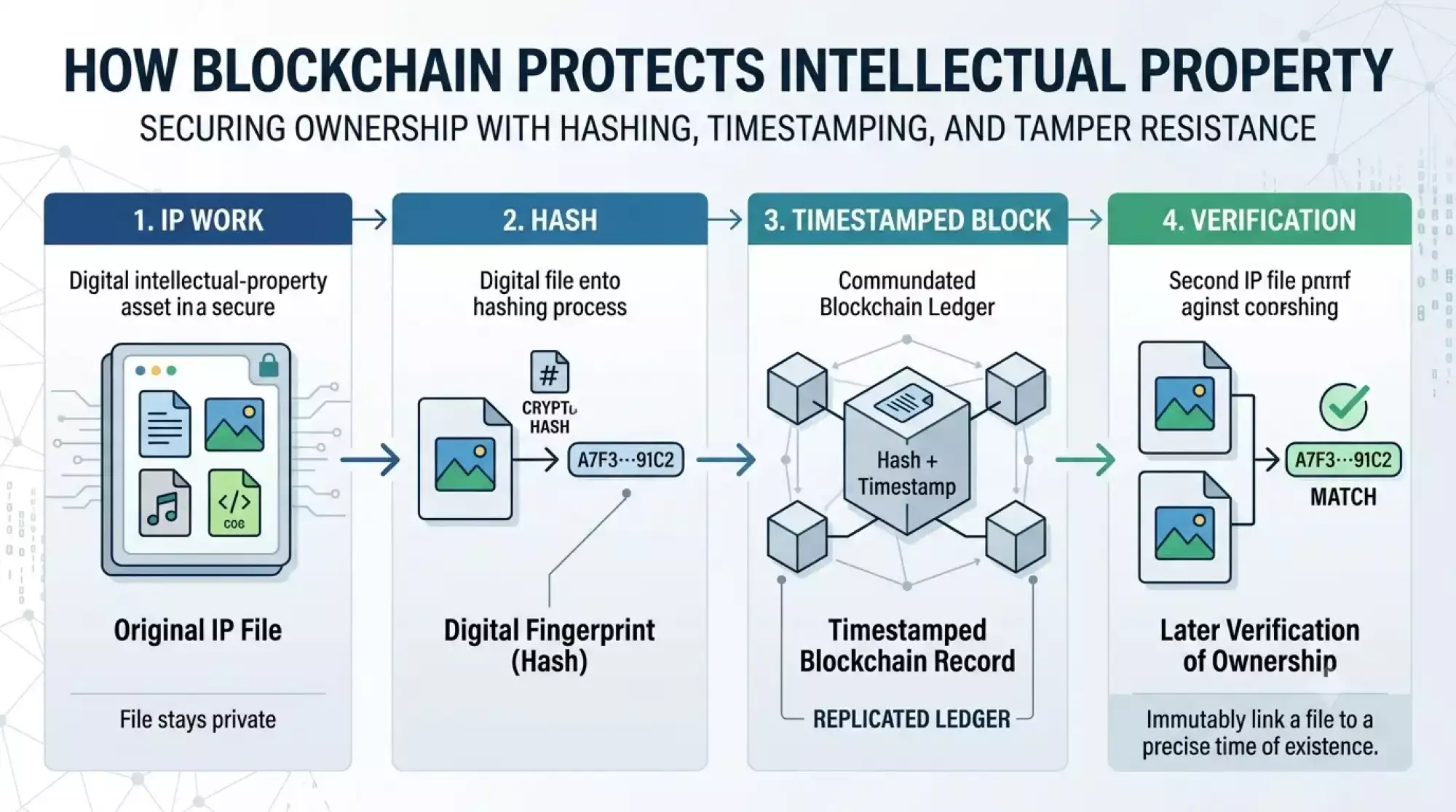
The three ideas that matter
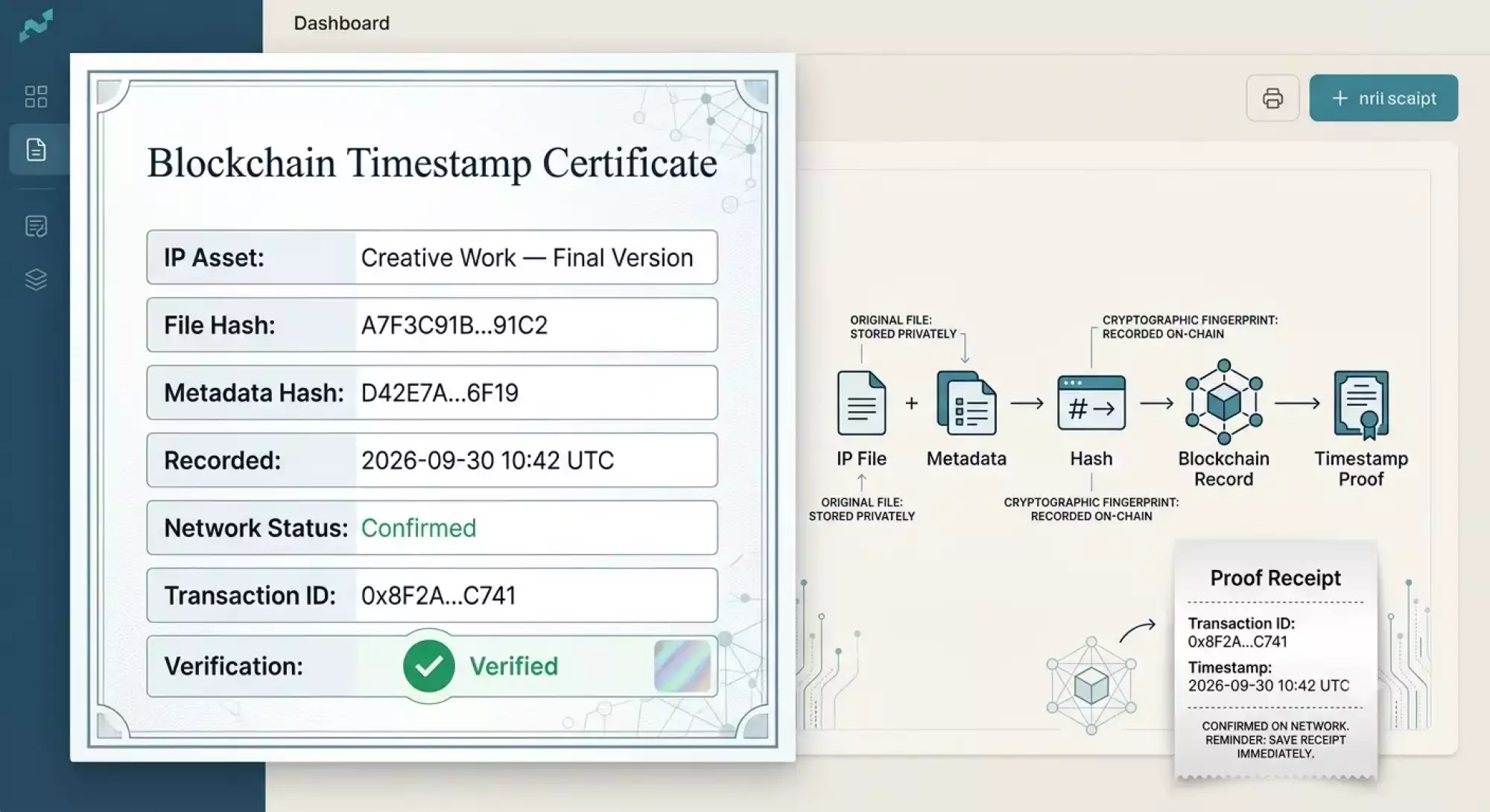
- Hashing. Software turns a file into a short, unique digital fingerprint. The file itself stays private. Change one pixel or one comma and the fingerprint changes completely.
- Timestamping. The fingerprint is recorded on a blockchain together with a time.
- Tamper resistance. Once the record is on a widely replicated ledger, it can't be quietly edited afterward.
The hashing step is also what courts care about. In a 2018 copyright case, the Hangzhou Internet Court checked the hashes stored on the Factom and Bitcoin blockchains. It compared them with the hash values of the evidence the claimant submitted, and concluded they matched, so the data had not changed since it was uploaded.
These capabilities explain why blockchain in intellectual property protection is useful primarily as an evidence and rights-management layer rather than a replacement for conventional IP law.
What this gives an IP owner
- Dated proof that your work existed
- Proof the file hasn't changed since
- An audit trail of who held and licensed it
What it does not give you is a legal right. A blockchain record shows what existed and when. Ownership still comes from creation, contracts, and registration.
Ready to put your IP protection workflow on-chain?
Talk to our blockchain team about your assets, evidence requirements, and implementation approach
Which types of IP can blockchain protect?
It can support all of them as evidence, and it can create none of them. Patents and registered trademarks still come from an office. Copyright arises on creation. The most practical blockchain intellectual property use cases depend on the type of IP involved and the evidence you need to maintain. Here is how it plays out by type.
Copyright works (music, art, writing, film, software)
Copyright arises automatically when an original work is created, so the practical question is proof. A timestamped record of the finished file and its drafts shows who had what, and when.
Patents and inventions
Hashing lab notebooks, design iterations, and prototypes creates dated invention records. They can help in disputes over inventorship or prior art. The patent right itself still comes from filing.
Trademarks and brand assets
Here blockchain mostly supports authenticity and supply-chain tracking, such as serialized product passports, rather than the mark itself.
Trade secrets and confidential know-how
You can prove what you held and when without revealing it, because only the fingerprint is recorded. WIPO built a service for exactly this kind of use case. It noted that such a timestamp can support a prior-use defense for processes kept as trade secrets.
Designs and unregistered rights
Where no registry entry exists, your own evidence carries the most weight. A dated record of the first design file is a strong start.
Data and datasets
Fingerprinting a dataset at a point in time shows which version you held when a model was trained, or a license was granted.
| IP type | What blockchain adds | Best paired with |
| Copyright | Dated proof of the work and its versions | Registration where available; contributor agreements |
| Patents | Dated invention records, lab notebooks | Patent filing; invention disclosure forms |
| Trademarks | Authenticity and supply-chain records | Trademark registration; customs recordal |
| Trade secrets | Proof of what you held, without revealing it | NDAs; access controls |
| Designs / unregistered rights | Evidence of first creation | Registration where available |
| Data and datasets | Version and integrity proof | Licenses; data-governance policy |
Blockchain Applications in Intellectual Property
The use of blockchain in intellectual property provides a secure and tamper-resistant way to establish ownership, record creation, track IP assets, and improve transparency. There are also several blockchain applications in intellectual property that can help creators and businesses protect their intellectual assets and manage IP-related transactions more efficiently.
Proof of ownership and creation
Establishing an unalterable record of creation is one of blockchain’s most direct applications in IP protection. By generating a cryptographic hash of a work and its preliminary iterations, creators establish a verifiable timeline of development. If an ownership or copyright dispute arises, this chronological audit trail provides independent, objective evidence that a specific file existed in a specific state at a precise date and time.
IP marketplaces and registries
Use it when you want searchable records of works, rights holders and license terms. Government registries are moving this way. The EUIPO launched a European IP register on blockchain in April 2021, with participating offices storing data on registered rights.
IP exchanges and payments
Use it when many parties share revenue. Smart contracts can split royalties automatically and pay across borders. The need is real in music. Twenty digital music providers transferred USD 424.4 million in historical unmatched royalties to the US Mechanical Licensing Collective, money owed to owners nobody could identify. That is fundamentally a data-matching problem. Clean, shared rights data is what ledger-based registries aim to provide.
Evidence of IP usage
Use it when you license a work and need an audit trail of where and how it's used. Usage events can be hashed and recorded for later enforcement.
Version control of IP assets
Use it for design files, source code, manuscripts, and prototypes. Every revision gets a dated fingerprint, so you can show how a work evolved.
Protecting unregistered IP rights
Use it for copyright, unregistered designs, and trade secrets. With no official record, your own evidence is what you rely on.
Step-by-step guide: How to protect your IP with blockchain
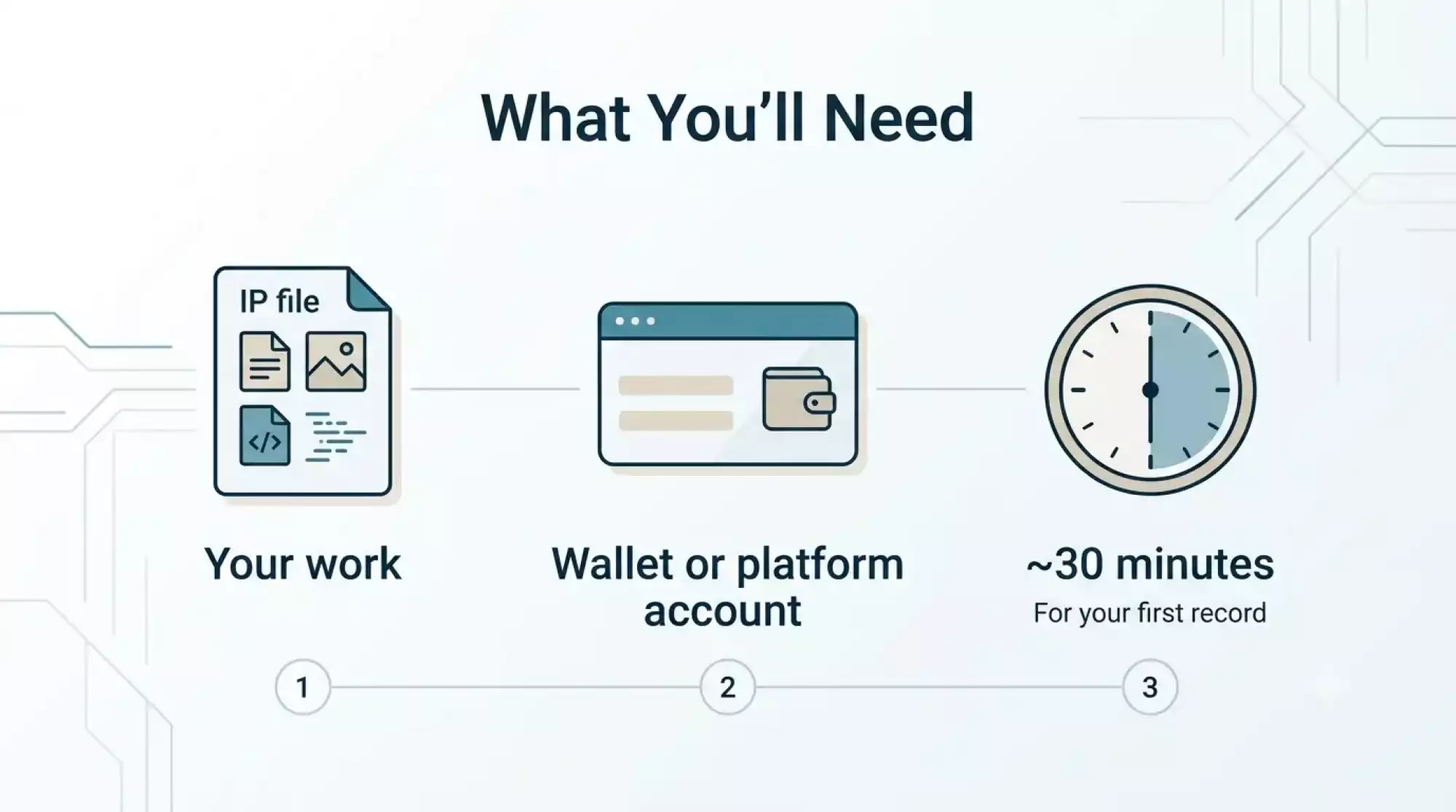
Step 1: Identify what you're protecting and choose your goal
What to do: List the asset and decide whether you need proof of creation, licensing, authenticity, or all three. A logo needs a different plan from a manuscript or a product line.
Pro tip: Write the goal in one sentence. If you can't, you're not ready to choose a platform.
AI note: Decide now whether the work is AI-assisted. That changes what evidence you need in Step.
Step 2: Gather and organize creation evidence
What to do: Collect drafts, source files, dated versions, and contributor agreements in one folder with consistent file names.
Pro tip: Get contributor agreements signed before recording anything. A timestamp can't fix unclear ownership.
AI note: Keep your prompts, the tool and version, and your edits. This matters legally. A Beijing Internet Court decision put the burden on users of AI tools to show their creative thinking, inputs, and selection and modification of outputs.
Step 3: Hash your work and record it on-chain
What to do: Hash the file and its metadata together, then record the hash through a platform or protocol. Keep the original file safe, since the hash can't recreate it.
Pro tip: Expect a delay. One platform's documentation describes batching submissions, with a mean wait of around three hours for the proof. Save the receipt and transaction ID immediately.
AI note: Hash the whole creation set (prompts, drafts, final) as one package.
Step 4: Choose the right network
What to do: Decide between a public, private, or consortium chain.
| Network | Public chain | Private chain | Consortium chain |
| Cost | Low per record; fees vary | Platform or set-up fees | Membership fees |
| Privacy | Hash only is public | High | High within the group |
| Permanence | Strong, independent of any vendor | Depends on operator | Depends on the consortium |
| Court-friendliness | Proven in early cases | Needs an expert to explain | Needs an expert to explain |
Pro tip: Public chains suit permanence. Private and consortium chains suit confidentiality, which is why Aura uses a private blockchain that gives member brands more control over sensitive data.
AI note: None. The choice is about permanence and privacy, not content type.
Step 5: Verify your identity and link it to the record
What to do: A timestamp proves something existed, not who made it. Link the record to a verified identity through your platform's identity check or a qualified e-signature.
Pro tip: Use the same legal name as on your registrations and contracts.
AI note: Tie the record to the person who made the creative choices, not just the account that ran the tool.
Step 6: Add licensing terms and smart contracts
What to do: Automate only what's mechanical: fixed royalty splits, usage-triggered payments. Keep a normal written contract for anything needing judgement, such as exclusivity or termination.
Pro tip: Have the smart contract reference the signed agreement, not replace it.
AI note: If AI output is licensed, state in the contract what is human-authored and what is machine-generated.
Step 7: Connect the record to formal registration
What to do: File for copyright, trademark, or patent protection where available. Use the blockchain record as supporting evidence.
Pro tip: Registration timing rules differ by country, so check them before you publish.
AI note: Be ready to disclose AI involvement in filings.
Step 8: Monitor, enforce, and keep an evidence pack
What to do: Watch for copies and misuse, and keep an evidence pack: transaction ID, hash, original file, creation log, identity proof, and an independent timestamp.
Pro tip: Store two copies in two places. Test once a year that you can still verify the proof.
AI note: Keep the prompt and edit history inside the pack.
How an IP blockchain platform works
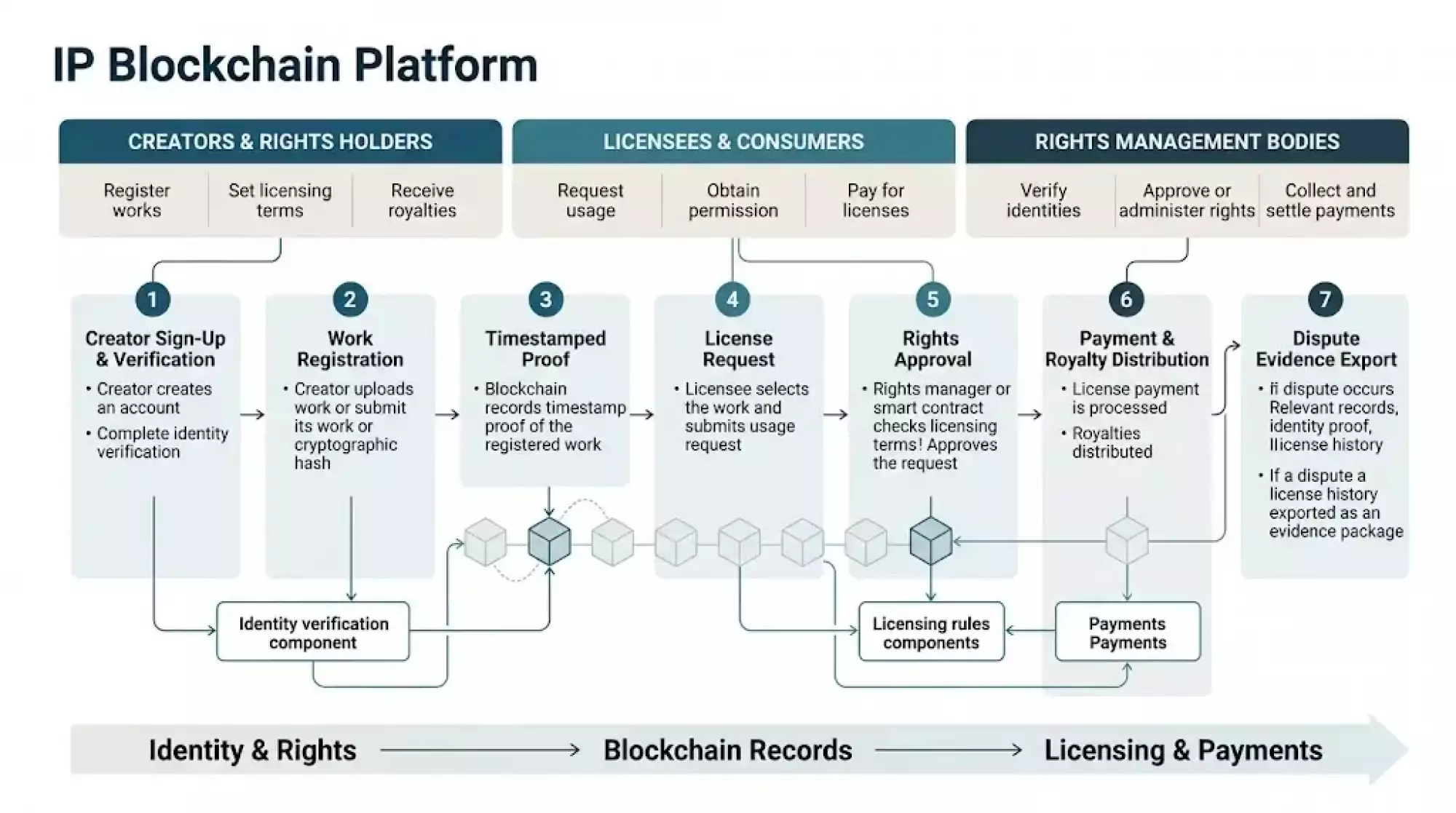
The three participants
- Creators and rights holders who register and license works
- Licensees and consumers who request permission to use them
- Rights-management bodies, such as collecting societies and legal or registry entities, who approve, collect, and settle
The workflow
- The creator signs up and is verified.
- They upload the work or its hash to the network.
- The network records a timestamped proof.
- A licensee sends a usage request.
- The rights manager or smart contract approves it.
- Payment and royalties are distributed automatically.
- Dispute path: the record, identity proof, and license history are exported as evidence.
Making your blockchain proof legally stronger
Will it hold up in court? Often yes, as supporting evidence. Rarely on its own.
The strongest combination: blockchain plus registration
Registration gives you legal standing in many countries. Blockchain gives you dated proof. Together they cover both sides of a dispute.
Five ways to strengthen your record
- Keep creation logs
- Verify identity
- Hash the metadata
- Add an independent timestamp
- Keep the original file and the transaction proof
How courts tend to treat blockchain evidence
Courts in several jurisdictions have accepted it as supporting evidence. In June 2018, the Hangzhou Internet Court admitted blockchain-preserved evidence in a copyright case, after checking hashes stored on the Factom and Bitcoin blockchains against the submitted evidence. A Supreme People's Court interpretation effective 7 September 2018 then allowed blockchain-verified evidence in the three internet courts. In the US, Vermont enacted a law in 2016 declaring blockchain-registered records admissible and authentic under its evidence rules.
The limits matter too. Admission is not the same as winning. Courts still ask how the evidence was collected, and what gets challenged is usually the process, not the ledger.
| Evidence type | Role it plays | How to strengthen it |
| On-chain hash and timestamp | Shows the file existed and is unchanged | Keep the original file and transaction ID |
| Creation log and drafts | Shows how the work was made | Date everything; keep native files |
| Identity proof | Links the record to a person | Use verified identity at recording |
| Independent timestamp (e.g. qualified trust service) | Adds a second, recognized source | Use a recognized provider in your jurisdiction |
| Registration certificate | Gives legal standing | File early; match names and dates |
Blockchain, AI-generated content and digital art
Recording human and AI contribution
Log the prompts, tool and version, each draft, your edits, and the dates. This is the evidence that supports your claim to the human part of the work.
The US position is clear about why. The Copyright Office concluded that prompts alone do not give users enough control to be the authors of AI output. Protection can still reach human-authored selection, arrangement, or modification of AI output. The courts agree on the pure-AI end. The Supreme Court denied certiorari in Thaler v. Perlmutter on 2 March 2026, leaving in place a ruling that copyrightable works need a human author. That denial isn't a ruling on the merits, and no court has drawn a bright line on how much human input is enough.
Blockchain alongside content credentials (C2PA) and watermarking
These are complementary layers, not rivals. C2PA Content Credentials do not rely on blockchain; they use hashing and digital signatures to make provenance data tamper-evident. They can also use watermarking or fingerprinting to help recover credentials if the metadata is stripped. Use credentials to travel with the file, and a blockchain anchor as an independent, time-fixed record.
NFTs and digital art
Owning a token is not owning the copyright. Copyright stays with the creator unless it is assigned or licensed in writing, so attach clear license terms to the token. If you mint your own work, use a wallet you control, record the license terms in the token metadata and on your site, and keep the source files.
Protecting crypto and Web3 projects' IP
Trademarks, logos, code and brand assets need conventional protection first. The MetaBirkins case shows why. A jury found that Mason Rothschild's MetaBirkins NFTs infringed and diluted Hermès' Birkin mark, and awarded about USD 133,000. Register your marks and check for conflicts before you mint.
Licensing training data on-chain
Some projects are exploring on-chain consent and payment for creators whose work trains AI. I found no verified large-scale deployment, so treat this as emerging. Policy is moving in parallel. India's DPIIT committee proposed in December 2025 a mandatory blanket license for AI training with statutory remuneration.
Have an existing IP system that needs blockchain integration?
We can help connect your current IP records, licensing workflows, and evidence management with a blockchain layer.
Industry-by-industry guide
- Media and entertainment: Fragmented rights data delays payment. Use ledgers for registries, splits, and usage records.
- Fashion & luxury: Fakes are the threat. Clothing, footwear and leather goods made up 62% of seized counterfeits in the OECD–EUIPO data. Use serialized product passports.
- Software & open source: Code is copied and forked freely. Hash releases and record license terms.
- Art & gaming: Provenance and resale matter. Pair tokens with explicit licenses.
- Publishing & media: Piracy and AI scraping. Record manuscripts and editions, and log licenses.
- Healthcare: Trade secrets and counterfeit parts. Record process versions and batch authenticity.
Country-by-country guide
| Country | Blockchain as evidence | AI authorship stance | Practical tip |
| China | Accepted in internet courts since 2018 (courts recognize blockchain-stored data with digital signatures, reliable timestamps, and hash verification when the technology's authenticity is proven) | Copyright is possible, but the user must prove creative effort | Keep prompt and edit logs; use a court-recognized platform |
| United States | No federal blockchain rule. Rule 902(13)–(14) allow self-authentication of electronic records, including by hash; Vermont has a statute | Prompts alone are not enough; human contribution is protected | Document human selection and modification; disclose AI in filings |
| European Union | eIDAS 2.0 (Art. 45k) bars denying an electronic ledger legal effect solely for being electronic, and gives qualified ledgers a presumption of integrity and ordering. One review found implementing acts were still under development, and no blockchain-native service had qualified status | Human authorship required (not verified in detail) | Add a qualified timestamp alongside the chain |
| India | Section 63 of the BSA replaced Section 65B from 1 July 2024, with a certificate that includes a hash value; the Supreme Court upheld Section 63(4) in Pune Bar Assn. v. Union of India | DPIIT's training-license proposal is a consultation, not law; outputs are for a later paper | Prepare the two-part certificate and record the hash and algorithm |
| United Kingdom | No blockchain-specific rule found (not verified) | Section 9(3) CDPA protects computer-generated works for 50 years; AI-assisted works remain protected if original. The government's March 2026 report favors removing section 9(3) | Don't rely on section 9(3); document human creativity |
| Singapore | No blockchain-specific rule found (not verified) | Authorial works need a human author; a computational data analysis exception covers AI training | Log human contribution |
| UAE | The civil evidence law defines electronic evidence broadly, covering data stored or generated by information technology | The copyright law treats only persons as authors, so work by AI alone may not qualify | Keep documented human input |
| WIPO | Not a court. WIPO PROOF, launched 27 May 2020, produces a dated fingerprint token; the browser generates the fingerprint. It is timestamp technology, not blockchain | n/a | Useful as an independent timestamp |
Real-world examples
Aura Blockchain Consortium
Founded in April 2021 by LVMH, Prada Group and Cartier, with OTB joining in October 2021, it is a non-profit based in Switzerland. WWD reported 50 members and more than 80 million registered products.
EUIPO
Pilots of the EUIPO authentication infrastructure involved rights holders ENDSTATE and Prada Group, logistics operator JAS, and Dutch and Italian customs. The results were described as promising, and the work is still at the pilot and promotion stage.
Hangzhou Internet Court (2018)
The case, filed by Huatai against Dautong, was decided on 27 June 2018. The result: infringement found, with blockchain-preserved evidence admitted.
MetaBirkins
After a 2023 jury verdict for Hermès, the court ordered the domain transferred and enjoined further sales. Rothschild appealed, and the Second Circuit heard the argument in October 2024. I couldn't confirm the appeal's outcome, so I checked it before publishing.
Costs, tools and choosing a provider
What it costs
Your costs fall into three buckets:
- Transaction fees. The cost of writing your record to a blockchain. On public chains, it varies with network conditions.
- Platform subscriptions. A recurring fee for a platform that handles wallets and hashing for you.
- Set-up and legal support. Organizing your evidence and having a lawyer check it will hold up where you operate.
You can start for free. OpenTimestamps runs public calendar servers that need no registration or API key. The catch is time: confirmation on Bitcoin takes about an hour. You also keep your own files, hashes, and proofs. A platform or managed service takes that off your hands for a fee.
Build vs. buy
Build only if you have engineering capacity and a specific need. Otherwise buy a platform or managed service, and keep your own copy of every proof.
Provider checklist
- Legal recognition of certificates in your jurisdiction
- Exportable evidence
- Identity verification
- Security practices
- What happens if the service closes
- Data portability
| Option | Typical cost | Effort | Best for |
| DIY on a public chain | Fees only; some tools free | High technical skill | Individuals, developers |
| SaaS platform | Subscription (varies by vendor) | Low | Most SMEs |
| Managed service | Custom quote | Lowest | Enterprises needing legal support |
Not sure whether to build, buy, or use a managed blockchain solution?
Get help evaluating your IP workflow, technical requirements, network options, and implementation scope.
Best practices
Checklist
- Keep your own backups of files, hashes, and transaction IDs
- Register formally alongside any blockchain record
- Document contributors and get agreements signed first
- Review licences regularly
- Re-check local rules yearly. This area moves fast (the UK and India both have open reforms)
How Suffescom helps protect your IP
Suffescom is a leading software development and blockchain development company that caters to organizations worldwide. We assist organizations in developing a digital solution for their IP protection needs, which includes IP recording, licensing, tracking, and management.
How can we assist you?
- Assessment of your IP process flow and determining ways to leverage blockchain.
- Develop architecture for your identity, hashing, proofing, licensing, and access control.
- Develop IP solutions using blockchain technology.
- Integrate with your existing system, database, storage, and business applications.
- Develop smart contracts for your suitable licensing and royalty process flows.
Planning a blockchain solution for IP protection?
Talk to our team about your requirements and implementation options.
Conclusion
Blockchain technology may offer creators of intellectual property a reliable way to document creation, track revisions, administer licenses, and maintain evidence. However, blockchain technology functions most efficiently within a more general IP protection framework involving contractual agreements, registration, identity proofing, and monitoring.
When it comes to applying blockchain technology for IP protection, an optimal process begins with identifying your rights, workflows, and evidentiary needs. Blockchain development can then integrate those needs into a safe system for IP registration, licensing, provenance, and royalty administration without substituting blockchain for legal protection.
FAQs
1. How does blockchain protect intellectual property?
Blockchain in intellectual property can record a timestamped, tamper-resistant fingerprint of your work. That gives you dated proof that it existed and hasn't changed.
2. Is blockchain evidence accepted in court?
Courts in several countries, including China, have accepted it as supporting evidence. It's strongest with creation logs, identity verification, and registration.
3. Can blockchain replace copyright registration?
No. It works best alongside registration, which gives you legal standing in many countries.
4. Does blockchain prove I own or created something?
It proves what existed and when. For a full ownership case, you need to add creation history and identity verification.
5. Can blockchain protect patents?
It can hold dated invention records. The patent right comes from filing with a patent office.
6. Can blockchain protect trade secrets?
Yes, as evidence. You can prove what you held and when without revealing the contents.
7. Does owning an NFT mean I own the copyright?
Not automatically. Copyright stays with the creator unless assigned or licensed in writing, so attach clear license terms.
8. Can I copyright AI-generated content?
Rules vary. In the US, copyright requires human authorship and remains available where AI is an assistive tool. Document your role and check your market's current guidance.
10. How much does it cost to protect IP on blockchain?
Costs will be between $5-$100+ per piece of work for basic blockchain evidence and timestamping, up to $150,000+ for a custom enterprise IP platform.
The cost of an easy evidence and timestamping service will be about $5-$100+ per piece of work, whereas a more elaborate system with identification and rights management tools and integration with other systems will cost from $30,000 to $150,000+.
The price will depend on the number of assets, used blockchain technology, storage and security measures, and complexity of your IP workflow. While blockchain can enhance evidence and rights management procedures, it is not a substitute for legally enforced copyright, patent, or trademark protection.
11. Which blockchain should I use?
Public chains suit permanence. Private or consortium chains suit confidentiality. Many businesses use a platform that handles the choice.
12. How do smart contracts help IP owners?
They automate license terms and royalty splits, so payments trigger when conditions are met.