Key Takeaways
- As for a platform like Revolut, the specifications will not only be limited to mobile application development but will also include finance backend, security, compliance, and payments right from the very beginning.
- It is better to start with a targeted MVP to test the business model and then move further towards advanced financial solutions.
- Banking solutions, payment services, card issuing, and KYC services can cut development complexity and accelerate the time to market.
- Development expenses could vary, starting from $25,000-$50,000 for an MVP solution to $200,000 and above for the whole Revolut-like ecosystem, based on the chosen scope.
- When designing the solution, it is important to consider the aspects of security, reliability, scalability, and auditability along with UX.
- AI can add financial knowledge, fraud detection, services, and predictive warnings to the product.
Building an app like Revolut in the USA entails much more than just designing a mobile bank UI. A fintech product may require the digital account feature, payment systems, card handling, KYC/AML procedures, detection of fraud, accounting, banking, or BaaS, and secure controls. All these factors affect the design, development, security, and cost of the product.
This article covers all these aspects, explaining how to create an app similar to Revolut and its features, architecture, tech stack, compliance with U.S. regulations, development costs, development process, monetization, and launch strategy for building a Revolut-like fintech app in the USA.
Quick Overview of Revolut-Like App Development
Before diving into the features, costs, and development process, here’s a quick overview of what it takes to build a Revolut-like fintech app.
| Factor | Estimated Range / Details |
| MVP development cost | $25,000–$50,000 |
| Advanced fintech platform | $50,000–$120,000 |
| Full Revolut-like ecosystem | $120,000–$200,000 |
| MVP development timeline | 4–7 months |
| Full platform timeline | 12–24+ months |
| Development team | 8–15+ specialists |
| Target market | USA |
| Core infrastructure | Banking/BaaS, payments, KYC/AML, card issuing, ledger, fraud & compliance |
| Business model | Subscriptions, interchange, FX/transfer fees, partnerships & financial products |
What Is a Revolut-Like App?
A fintech app similar to Revolut is a mobile-based platform that provides a wide range of services in one app. Depending on the business model, it may include the following services: digital bank account management, payment processing, money transfer, card management, budgeting, savings, investment services, and many more.
For a fintech startup creating an app like Revolut, it is important not to replicate everything Revolut already offers but to pick the services that would fit your target audience and develop a financial infrastructure.
What Makes Revolut Unique?
Revolut is unique in offering various services like payments, cards, multicurrency services, transaction insights, virtual cards, identity checks and fraud detection, and much more.
The main idea is integration, as the user can perform different financial operations using one mobile application.
Global Fintech Market Size & Growth in 2026
- The global fintech market is valued at approximately US$320.81 billion in 2025, reflecting strong demand for digital financial services.
- It is projected to reach US$652.80 billion by 2030, growing at a 15.27% CAGR from 2026 to 2030.
- Growing adoption of digital payments, neobanking, digital wallets, and mobile-first financial services is creating strong opportunities for Revolut-like apps.
Source: https://www.mordorintelligence.com/industry-reports/global-fintech-market
Revolut vs. Traditional Digital Banking Apps
| Capability | Traditional Banking App | Revolut-Like App |
| Mobile onboarding | Varies | Core experience |
| Multi-currency | Often limited | Core feature |
| P2P payments | Usually available | Core feature |
| Budgeting | Basic | Integrated |
| Virtual cards | Limited | Common |
| Real-time alerts | Varies | Core feature |
| Personalization | Limited | Data-driven |
| Financial services | Often separate | Integrated ecosystem |
This integrated model is what makes the Revolut-like app development approach different from traditional digital banking app development and gives startups room to build a focused fintech product around a specific customer need.
How Does a Revolut-Like App Work?
A Revolut-like fintech application links the mobile interface with a financial backend, payments system, identification process, regulatory frameworks, and a centralized ledger of transactions. A simplified process would be something like this:
User → Mobile App → API Gateway → Authentication → Banking/BaaS Layer → Payment Processor → Card Network → Ledger → Compliance & Fraud Engine → Notifications
Each layer has a specific role in processing and securing financial activity.
User Authentication
Before providing users with access to financial services, the application uses secure login, multi-factor authentication, device checks, and session management to confirm their identities.
KYC and Identity Verification
Identity verification services can help with the onboarding process by collecting and validating customer data, performing document checks, and providing support for risk-based workflows.
Digital Wallet and Account Ledger
The ledger shows balances and all transactions in terms of credits, debits, transfers, and more. An accurate ledger is important so that the balance shown is consistent with transactional information.
Payment Processing
Payments will be made using payment processors and banking partners who will manage payments as applicable, while the platform will help in coordinating the transactions between the user, banks, and payment systems.
Card Issuing
The card-issuing partner will provide the infrastructure for physical and virtual cards, while the application will take care of various controls like activation, spending limits, freezing, and transaction visibility.
Fraud and Transaction Monitoring
Risk management systems examine transactions and user activity to identify potentially suspicious behavior, unusual patterns, or transactions that require further investigation.
Notifications
Push notifications, email, and SMS can provide timely and real-time updates on a variety of activities, such as payments, transfers, card activity, security events, and account changes.
Admin and Compliance Dashboard
With the help of a secure back-office setup, the designated teams will be able to handle users, transactions, alerts, risks, and work processes.
Build a Revolut-Like Fintech App With the Right Features, Technology, and Financial Infrastructure
How to Develop a Revolut-Like App in the USA
For creating an app similar to Revolut in the USA, it is not enough to think only about developing a banking app interface. It is necessary to decide on the financial product, infrastructure, partner solutions, ledger and payments architecture, compliance issues, and finally develop the customer experience part. A proper procedure for the app creation process will help to avoid additional technical development.
Step 1: Define Your Fintech Business Model
Start by deciding exactly what your fintech product will do. A Revolut-like platform could be positioned as a:
- Digital wallet
- Neobank-style platform
- Money transfer app
- Payment app
- Card management platform
- Investment app
- Multi-currency fintech
- Financial super app
The choice affects almost every later decision, including financial infrastructure, third-party integrations, compliance requirements, revenue model, and development scope. A startup focused on international transfers, for example, will have different infrastructure requirements from one offering cards, investments, lending, and business accounts.
Step 2: Define Your Target US Customer
It is essential not to attempt developing an MVP that targets all types of customers right from the start. It is important to select the user segment with the most apparent problem to be addressed by the MVP.
Examples of the potential user segments include Gen Z, millennials, travelers, freelancers, international workers, small and medium businesses, creators, and users of cross-border payments.
For example, a FinTech app that is created for freelancers can be based on features like multi-currency accounts, fast payments, expense management, invoices, and business cards instead of features like investments or cryptocurrencies.
Step 3: Select the Banking and Regulatory Model
One of the most important decisions is determining how your fintech will access and deliver financial services. The right model depends on what the app actually does, how customer funds are handled, which states you operate in, and which financial partners are involved.
Option A: Banking Partnership or BaaS
The startup may decide to work with a regulated bank or banking infrastructure provider instead of implementing all the banking functions from scratch. The exact services to be offered by the partner might include account infrastructure, payments, card programs, or banking rails.
Best suited for: Startups wishing to get to market faster without actually being a bank.
Important to note: Partnership does not automatically mean a lack of compliance obligations and regulation. The roles of the fintech, bank, and other providers should be well-defined.
Option B: Payment or Money Transmission Model
If the startup provides some kinds of money movement, it may become subject to federal and/or state regulation, as its product falls under the money services business or money transmission.
Best suited for: Products focused on payments and transfers.
Key consideration: Licensing, registration, compliance programs, and state-specific requirements need to be assessed based on the actual business model rather than assuming one universal license applies.
Option C: Own Banking Charter
A business enterprise can apply for its own banking license and operate as a licensed bank if it has a strong enough business case to meet all these requirements.
Best suited for: Fintech firms that are larger and want to have more control over their bank operations and are prepared for significantly higher regulatory and operational complexity.
Key consideration: This is generally a much more demanding path than partnering with an established regulated institution.
Option D: Hybrid Infrastructure
Some fintech platforms use a combination of providers and internal systems. For example, a company may use a banking partner for certain account services, a separate provider for card issuing, another provider for identity verification, and its own technology for the customer experience, financial logic, analytics, and other components.
Best suited for: Fintech companies that require flexibility when implementing their multiple financial products.
Key consideration: The more providers you choose, the more integration will be needed, along with vendor lock-ins, reconciliation, and complications.
This decision needs to be done before designing the overall architecture, since the decision will impact the ledger, API, payments process, compliance, data, and third-party integration. Note also that one needs to distinguish software architecture from the legal entity structure; just selecting a tech provider doesn’t define your regulatory obligations.
Step 4: Define MVP Scope
Having clarified the business model and its targeted audience, you should now distinguish MVP features from those you plan to implement later on.
A typical Revolut-like MVP might include:
- User registration and identity verification
- Secure login and MFA
- Digital account or wallet
- Add-money functionality
- Domestic payments or transfers
- Transaction history
- Card management
- Push notifications
- Basic fraud monitoring
- Admin and compliance dashboard
Advanced capabilities such as investments, crypto, disposable virtual cards, AI financial assistants, family accounts, and business banking can be introduced later.
Step 5: Design the UX and Financial Architecture
UX for the fintech app and backend architecture have to be designed in conjunction with each other. The user interface has to make such activities as money transfer, card management, transaction history viewing, and security alert resolution easy and clear.
Technically, the following aspects of the product need to be defined: financial ledger, API architecture, authentication, payment orchestration, KYC and AML integrations, fraud protection, storage, notifications, and administrative systems before development.
The financial ledger is especially crucial since it has to register all accounts' balances, transactions, fees, and reversals.
Step 6: Mobile Application and Backend Development
Develop the customer-facing application along with the backend services that perform financial tasks. Depending on the product, the developers can implement a native iOS and Android or use a cross-platform framework such as Flutter or React Native.
The backend has to establish connections between the application and selected banking, payment, card issuance, identity verification, and other fintech services through APIs.
Step 7: Integrate Security and Compliance Controls
Security and compliance should be built into the product throughout development rather than added immediately before launch. Implement appropriate authentication, encryption, access controls, audit logging, transaction monitoring, fraud detection, and data-protection mechanisms.
Third-party integrations should also be evaluated for security, reliability, data handling, and operational dependencies.
Step 8: Test the Product and Financial Flows
Testing should cover more than the mobile interface. Validate transactions, balances, payment failures, refunds, card controls, authentication, API security, device compatibility, performance, fraud scenarios, and system recovery.
Financial flows should be tested carefully to ensure that transactions are recorded correctly across connected systems.
Step 9: Pilot and Launch
Before a broad launch, release the product to a controlled group of users where appropriate. Monitor transaction behavior, fraud signals, system performance, customer support issues, and operational processes.
After the required partner, security, compliance, and regulatory conditions are satisfied, expand the user base gradually. Continuous monitoring remains important after launch because fintech products must adapt to new risks, regulations, payment requirements, and customer needs.
Compliance Requirements for a Revolut-Like App
Building a fintech app requires compliance planning alongside product and technical development. The exact obligations depend on the financial services offered, how customer funds are handled, the company's structure, its banking or financial partners, and the states in which it operates. Therefore, founders should determine the applicable requirements with qualified legal and compliance professionals before launch.
KYC and Customer Identification
A Revolut-like application development will also require the use of identity verification and customer identification as part of the onboarding process. Some of the activities that can be undertaken include gathering customer data, verifying identity papers, and user screening from databases, among others.
The KYC process needs to be incorporated into the product flow rather than being treated as a separate manual process. The app may need to support verification status, document uploads, verification results, manual reviews, and account restrictions where required.
AML and Transaction Monitoring
Fintech products that fall within applicable anti-money-laundering requirements need appropriate controls for identifying and managing suspicious activity.
Depending on the business model, an AML framework may include:
- Customer risk assessment
- Transaction monitoring
- Sanctions screening
- Suspicious activity workflows
- Risk scoring
- Case management
- Recordkeeping and reporting processes
For businesses that qualify as money services businesses, FinCEN requirements can include registration, AML program obligations, reporting, and recordkeeping. The specific obligations depend on the business's activities and structure.
State Money Transmitter Requirements
State requirements are another important consideration for US fintech products that move or transmit money. There is no universal rule that every fintech startup simply needs a fixed number of state licenses.
Requirements can vary according to the services offered, how money is received and transmitted, the role of banking or payment partners, and the states in which the business operates.
This assessment should therefore happen before development and market expansion rather than after the product has already been built.
PCI DSS
If the platform stores, processes, or transmits payment card data within the applicable PCI DSS scope, its payment environment must be designed and operated with the relevant PCI DSS requirements in mind.
PCI DSS v4.0.1 is the current revision of the standard. A fintech application should consider areas such as secure payment environments, access controls, authentication, vulnerability management, monitoring, and secure software practices.
Consumer Financial Protection
The obligation related to consumer protection may differ according to the type of financial product used and how it is provided. Thus, some prepaid account products may be subject to the obligations regarding Regulation E, such as providing disclosures and resolution of errors.
In that case, it means that the appropriate consumer protection obligations need to be mapped based on the financial services provided, not on the assumption that all fintech apps are subject to the same obligations.
GLBA and Financial Data Privacy
Organizations operating in the financial sector that fall under the Gramm-Leach-Bliley Act are obliged to protect consumer information, including its privacy and security. This may impact the process of collection, usage, storage, sharing, and protection of financial information through the use of a fintech product.
Technical teams should account for these requirements when designing data storage, access controls, encryption, audit logs, vendor integrations, and data-management processes.
FDIC Insurance
A fintech app is not automatically an FDIC-insured bank simply because users can hold money through the platform.
Where deposits are held at a partner bank, the relationship between the fintech company, partner bank, customer accounts, and applicable deposit-insurance coverage needs to be clearly understood and accurately represented. The FDIC specifically advises consumers to understand who is providing the banking service and how deposit insurance applies.
For this reason, FDIC insurance should be treated as part of the product's legal, banking-partner, operational, and customer-communication structure, not simply as a feature added to the application.
Turn Your Fintech Idea Into a Scalable Revolut-Like App Built for the US Market
Features to Build a Banking App Like Revolut
A successful Revolut-like app should not attempt to launch with every possible financial feature. Begin with the capabilities necessary to address the target customer’s biggest problem, and grow the platform as usage, infrastructure, and regulatory readiness grow.
Essential MVP Features
| Feature | Priority | Complexity |
| Registration & onboarding | High | Medium |
| KYC & identity verification | High | High |
| Secure login & MFA | High | Medium |
| User profile | High | Low |
| Digital account/wallet | High | High |
| Add money | High | High |
| Send money | High | High |
| Transaction history | High | Medium |
| Push notifications | High | Low |
| Card management | High | High |
| Fraud monitoring | High | High |
| Admin & compliance dashboard | High | High |
All of these factors contribute to the creation of the basis of a working fintech solution. The specific MVP depends on what kind of functionality the application implements: payments, digital accounts, remittances, cards, etc.
Advanced Features
Once the MVP has established a reliable foundation for accounts, payments, cards, identity verification, and fraud controls, the platform can expand into more sophisticated financial services.
Multi-Currency Accounts
Allow users to easily hold and manage their balances in a variety of currencies, view real-time exchange rates, and make or receive eligible international payments all from the same comprehensive app.
Virtual and Disposable Cards
Offer virtual cards for online purchases and disposable card numbers for eligible transactions. Users are also able to change the status of the cards, spending limits, merchant controls, and other safety features through the application.
International Money Transfers
Enable users to make money transfers to international destinations with full transfer tracking, exchange rates, delivery estimates, and transfer status notifications.
Budgeting and Spending Analysis
Allow users to easily categorize and structure transactions, analyze spending behavior by merchant or category, create budgets according to their needs, and show visual feedback about it in order to make people spend their money more wisely.
Savings and Financial Targets
Allow users to set up their own saving goals, identify the targets for reaching those goals, make automated savings if possible, and follow their progress through the application's intuitive interface to stay aligned with their financial objectives.
Investment Services
Enable portfolio tracking and eligible investment transactions through regulated partners. Depending on the service, requirements may include SEC/FINRA rules, suitability or best-interest obligations, disclosures, and brokerage/custody requirements.
Crypto Services
Offer crypto buying, selling, holding, and transfers where permitted. Requirements may include FinCEN AML obligations, applicable state money-transmitter or virtual-asset rules, OFAC sanctions compliance, and appropriate custody and transaction-monitoring controls.
Rewards and Premium Subscriptions
Introduce paid plans with additional benefits such as enhanced account features, premium card options, higher limits where applicable, or other value-added services. Rewards can also encourage recurring usage.
Family Accounts and Controls
Include features like customizable spending limits, detailed permissions, collaborative financial goals, and improved transaction visibility to make managing multiple users under one account easier and more user-friendly.
Business Accounts
Add business cards, improve expense management, add more payment options, fine-tune team permissions, improve transaction classification, and improve financial reporting to broaden the platform's capabilities for businesses and independent contractors.
AI Features for a Next-Generation Revolut-Like App
Artificial Intelligence can make the Revolut-like fintech application even more personalized and proactive. Rather than relying on AI merely for an AI chatbot, fintech companies can leverage artificial intelligence in areas such as spending analysis, model validation, fraud detection, customer service, bias monitoring, and finance analysis.
AI Financial Assistant
Such an AI personal assistant can help users analyze their finances by asking natural language questions like:
- “How much did I spend on restaurants this month?”
- “What were my biggest expenses last week?”
- “How much did I spend while travelling?”
- “Show me my recurring subscriptions.”
The assistant can use authorized account and transaction data to provide contextual answers without requiring users to manually search through transaction records.
AI Spending Insights
Machine learning algorithms have the ability to process transaction patterns and categorize expenses automatically, recognize regular transactions, spot changes in spending habits, and provide customized descriptions.
For instance, the application might alert its user that his discretionary spending is much higher than it was before.
AI-Powered Fraud Detection
AI can identify unusual transaction and account behavior using signals such as device activity, transaction patterns, location anomalies, velocity, merchant risk, and historical behavior. Models should be regularly validated and monitored for accuracy, false positives, bias, and model drift, with high-risk cases escalated for human review.
Personalized Financial Recommendations
AI can identify spending patterns, recurring expenses, and potential saving opportunities using authorized financial data. Recommendations should be explainable, based on permitted data, and subject to appropriate human or rule-based controls where they could materially influence financial decisions.
AI Governance & Model Controls
AI models should be validated before deployment and continuously monitored for accuracy, bias, drift, and unexpected outcomes. Financial data should be accessed only with appropriate authorization and protected through strong privacy and access controls. Important or high-risk AI decisions should have clear explanations and a path to human review.
AI Customer Support
A customer support system based on AI technology would be able to address typical customer questions about their transactions, credit card, transfers, settings of the financial product, etc. More complicated cases would be resolved by a human agent with all information regarding the conversation available.
Predictive Cash-Flow Alerts
Based on analysis of income, recurring expenses, and spending patterns, AI algorithms warn customers about potential cash-flow problems in advance. The app could alert users about upcoming recurring expenses or unusually low projected balances before they become a problem.
Tech Stack for Building an App Like Revolut
The technology stack for a Revolut-like fintech platform development must include technologies that provide reliable transaction processing, secure data processing, scalability, integration with third-party services and tools, and compliance with regulations. The following stack can be suggested for fintech platform development, but it is not the technologies utilized by Revolut.
| Layer | Technology |
| iOS | Swift |
| Android | Kotlin |
| Cross-platform | Flutter / React Native |
| Backend | Node.js / Java / Go |
| APIs | REST / GraphQL |
| Database | PostgreSQL |
| Cache | Redis |
| Cloud | AWS / Azure / GCP |
| Authentication | OAuth 2.0 / OpenID Connect |
| KYC | Third-party identity-verification provider |
| Bank connectivity | Open-banking / banking infrastructure provider |
| Payments | Payment processor/payment infrastructure provider |
| Card issuing | Card-issuing infrastructure provider |
| Notifications | Firebase Cloud Messaging / Apple Push Notification service |
| Analytics | Product analytics + custom data infrastructure |
| AI/ML | Python + ML infrastructure |
| Monitoring | Cloud-native logging, monitoring & observability |
Revolut-Like App Architecture
The well-designed fintech app architecture links the mobile interface to authentication, finance accounts, payment systems, ledgers, compliance management systems, fraud detection, and third-party financial service systems.
Revolut-Like App Architecture Flow
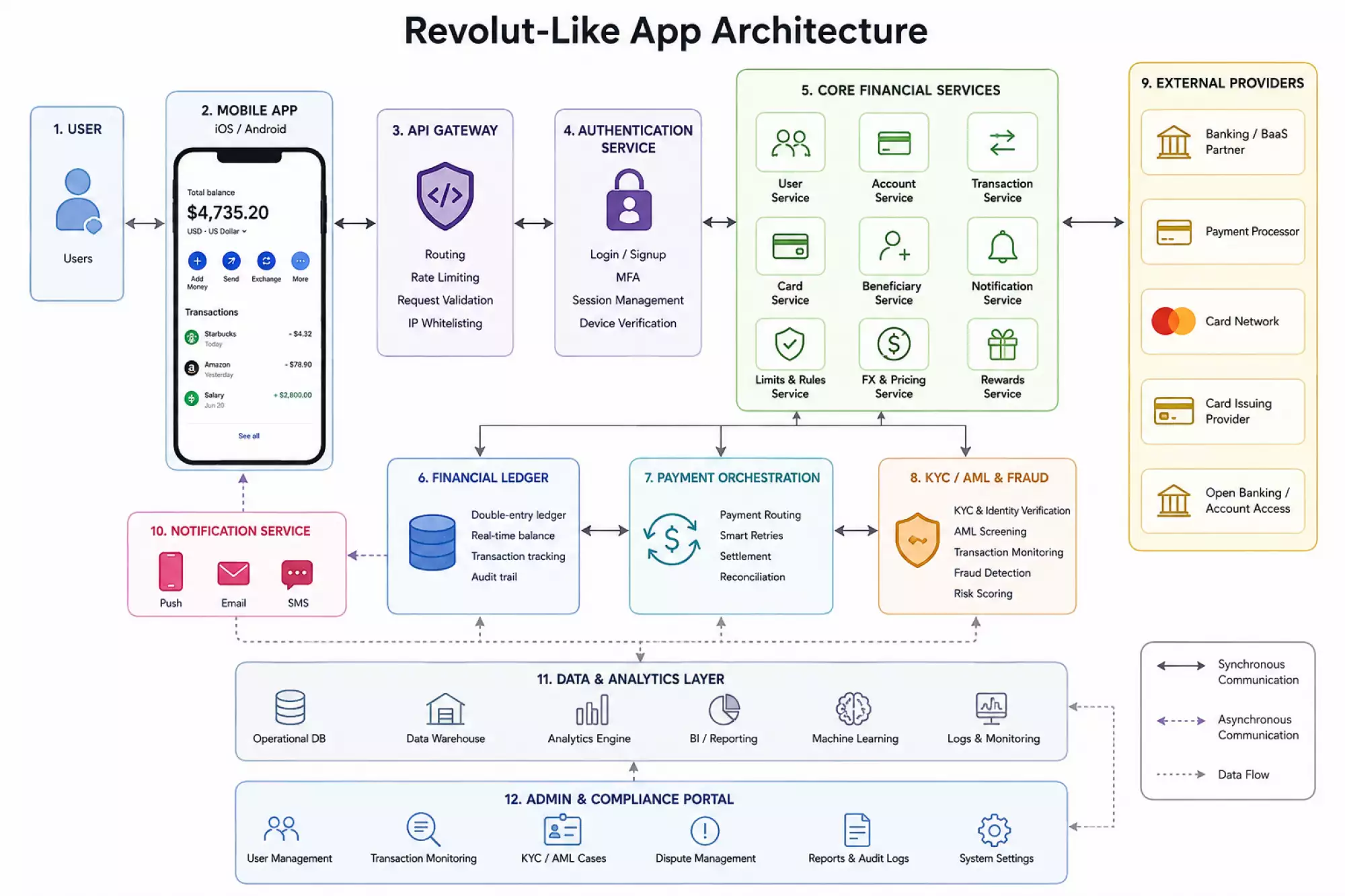
The exact architecture will vary based on the financial products and infrastructure providers used, but these layers form a practical foundation.
Frontend Layer
The mobile application provides the user interface for registration, account management, payments, transfers, cards, transaction history, and financial insights. It communicates with backend services through secured APIs rather than connecting directly to financial providers.
API Layer
The API Gateway is used as an intermediary that interacts with the mobile app as well as backend services. There are certain operations that the API gateway may undertake, including authentication, routing, throttling, request validation, and access control, before requests reach internal services.
Authentication Layer
This layer handles secure login, MFA, session management, device verification, password recovery, and additional verification for sensitive actions. Strong authentication is a core part of both neobank architecture and modern banking applications.
Financial Ledger
The ledger is one of the most important components of the architecture. It records financial events such as credits, debits, transfers, fees, reversals, and account balances. The system should maintain accurate, auditable records rather than relying only on the mobile app's displayed balance.
Payment Orchestration
The payment layer coordinates transactions between the application's business logic and external banks, payment processors, card networks, and other financial infrastructure. A well-designed banking app architecture keeps payment integrations modular so providers can be managed or replaced without rebuilding the entire mobile application.
KYC/AML and Fraud Detection
KYC services support customer identity verification during onboarding, while AML and fraud systems evaluate customers and transactions against applicable requirements and risk controls. These services form an important part of fintech app architecture, particularly for products handling payments, accounts, cards, or money movement.
Notification System
A dedicated notification layer can send push notifications by email, SMS, or both for transactions, card activity, security events, verification updates, and other important account events.
Data and Analytics
Analytics infrastructure can process product and transaction data to support reporting, customer insights, fraud analysis, operational monitoring, and personalized experiences, subject to applicable privacy and data-governance requirements.
Admin and Compliance Portal
Authorized teams need a secure back-office system for user management, transaction reviews, alert investigations, operational monitoring, and compliance workflows. A secure admin portal is crucial for a neobank architecture, as financial operations cannot rely solely on customer-facing interfaces or automation.
How Much Does It Cost to Build an App Like Revolut?
The cost to develop an app similar to Revolut is estimated to be between $25,000 and $200,000, depending on the scope of services and features. The variance is explained by the amount of finance-related services, connections, security measures, compliance issues, software, and back-end development included in the project.| Product Type | Estimated Cost | Timeline |
| Fintech MVP | $25,000–$50,000 | 4–7 months |
| Advanced fintech platform | $50,000–$120,000 | 7–12 months |
| Full Revolut-like ecosystem | $120,000–$200,000 | 12–24+ months |
Fintech MVP: $25,000–$50,000
A typical MVP for fintech companies would have several basic features such as onboarding, KYC, accounts/wallets, payments, transaction history, cards, notifications, security against fraud, and an admin panel.
The use of financial infrastructure from third parties decreases the functionality that is necessary to build from scratch.
Fintech Platform Advanced: $50,000–$120,000
At the advanced level, there are more complex possibilities for the provision of a wider range of financial services with the following features: multi-currency accounts, international money transfer, virtual cards, advanced fraud detection, budgeting tools, financial analytics, additional payment systems, etc.
The backend, compliance workflows, testing, security requirements, and operational tooling also become more sophisticated at this stage.
Full Revolut-Like Ecosystem: $120,000–$200,000
A comprehensive fintech ecosystem can combine multiple financial products, advanced card capabilities, investments, savings, business accounts, AI features, sophisticated risk systems, and extensive integrations.
This way, the cost of development is only one component of the investment. Infrastructure, security, compliance, third-party services, operations, customer support, and maintenance can add up to make the total launch costs much higher.
Why Are There Such Differing Cost Estimates?
Cost estimates for a Revolut clone can be highly varied because they may not all be comparing the same thing. One estimate may cover software engineering and design, while another may include banking infrastructure, third-party services, compliance, licensing-related expenses, security, operations, or post-launch costs.
Therefore, these ranges should be treated as software-development planning estimates, not a complete budget for launching a regulated financial business.
Revolut-Like App Development Cost Breakdown
The total budget required for building an app like Revolut is divided into product design, development of the mobile application and backend, financial integration, security, testing, and infrastructure. These proportions may differ according to the specifics of the project, but the following example shows how this can be done.
| Development Area | Approx. Share of Development Budget |
| UI/UX design | 8–12% |
| Mobile app development | 20–25% |
| Backend development | 20–25% |
| Payment integrations | 8–12% |
| KYC/AML integrations | 5–10% |
| Security | 8–12% |
| Admin panel | 5–8% |
| QA & testing | 8–12% |
| DevOps & infrastructure setup | 5–8% |
| Maintenance & support | 15–20% of initial development cost (annual) |
Factors That Affect Revolut-Like App Development Cost
Ultimately, the total cost of a fintech app similar to Revolut will depend on much more than the screen numbers and the number of developers working on the project. The financial infrastructure, security, integrations, compliance requirements, and the number of services offered can dramatically increase the efforts required to develop an MVP.
Number of Financial Products
An MVP of a payments-based or wallet solution would definitely be far easier to build compared to an MVP with card issuance, savings, investing, loans, cryptocurrency, business banking, and international payments. Every new product type brings its own workflows, integrations, risk management, and regulatory challenges.
Integration with Banking Platform/BaaS
The specific infrastructure partner that will be used for the development can have a significant effect on the complexity of the development process and future operating costs. The different partners have different capabilities when it comes to accounts, cards, payments, and financial data, so integration requirements should be evaluated before development begins.
Number of Payment Rails
Additional rails will add to the complexity of the development process. Different types of payments, including domestic and cross-border payments, wire payments, ACH, card transactions, etc., can be quite different from each other.
Card Issuing
Physical and virtual card functionality requires additional systems for issuing, activation, controls, authorization, transaction handling, and card lifecycle management. Advanced controls can increase the development scope further.
Compliance Requirements
KYC, AML, transaction monitoring, sanctions screening, reporting workflows, recordkeeping, and other applicable controls can add both development and operational requirements. The exact scope depends on the financial services and operating model.
Security Architecture
Fintech applications need robust security mechanisms, including authentication, APIs, databases, infrastructure, access controls, encryption, and monitoring for incident response. More stringent security requirements can increase development and testing effort.
AI Capabilities
Basic transaction categorization is very different from building fraud models, predictive financial insights, AI customer support, or a financial assistant. The sophistication of the AI functionality directly affects data, engineering, testing, and infrastructure requirements.
Native vs. Cross-Platform Development
Building separate native iOS and Android applications can increase development effort compared with using a cross-platform framework. However, the right choice depends on required native functionality, performance, security, integrations, and the long-term product roadmap.
Number of Supported States or Countries
A product operating across multiple US states or expanding internationally may face additional infrastructure, compliance, localization, payment, currency, and operational requirements. Geographic expansion should therefore be included in the architecture and business plan early.
Development Team Location
Developer rates vary significantly by location, experience, and specialization. However, choosing a lower-cost team does not necessarily produce a lower total project cost if the team lacks fintech, security, integration, or compliance experience.
Ultimately, the most important cost driver is scope. Defining the financial products and infrastructure required for the first release can prevent unnecessary development while keeping the platform ready for future expansion.
How Long Does It Take to Build an App Like Revolut?
The timeline for developing a Revolut-like fintech app depends on the product scope, number of integrations, development approach, security requirements, and third-party approvals. A focused MVP may take around 4–7 months, while a broader fintech platform can require 12–24+ months.
| Development Phase | Estimated Timeline |
| Discovery & planning | 2–4 weeks |
| UX/UI design | 4–8 weeks |
| MVP development | 12–20 weeks |
| Financial integrations | 4–10 weeks |
| Security & compliance | Continuous |
| QA & testing | 4–8 weeks |
| Launch preparation | 2–4 weeks |
Discovery and Planning
The team defines the product scope, target users, financial services, technical architecture, infrastructure partners, and initial compliance requirements. Making these decisions early can prevent significant rework during development.
UX/UI Design
Design covers user journeys, onboarding, account management, payment flows, card controls, transaction history, and other core experiences. Complex fintech workflows may require multiple rounds of prototyping and testing.
MVP Development
Developers build the mobile application, backend services, financial ledger, authentication, APIs, admin tools, and selected integrations. The actual duration depends heavily on the number of features and how much infrastructure is integrated rather than built internally.
Integrations
Banking, payment, card-issuing, KYC, fraud, and other third-party integrations can require additional development and testing. Provider onboarding and technical approvals may also affect the schedule.
Security, Compliance, and QA
Security and compliance should run throughout development rather than being left until the end. QA then validates mobile experiences, APIs, transactions, integrations, performance, security, and failure scenarios.
Launch Preparation
Before launch, the team can complete production configuration, monitoring, support processes, final testing, partner requirements, and controlled-user testing where appropriate.
Important: These phases can overlap. Compliance work, integrations, design, development, and testing do not always happen sequentially, so the total calendar time cannot be calculated simply by adding every phase together. Third-party approvals and regulatory requirements can also affect the actual launch date.
How Does a Revolut-Like App Make Money?
A Revolut-like fintech app can generate revenue from multiple sources rather than relying on a single transaction fee. The right monetization model depends on the target users, financial products, pricing structure, partnerships, and applicable regulatory requirements.
Subscription Plans
Offer free and paid tiers with different features, limits, benefits, or premium services. Subscriptions can create predictable recurring revenue while encouraging users to remain within the platform.
Interchange Revenue
Eligible card transactions can generate interchange-related revenue through the card-payment ecosystem. The economics depend on the applicable rules, card program, partners, transaction volume, and market.
Foreign Exchange and Transfer Fees
A fintech platform serving international users can generate revenue through applicable foreign-exchange spreads or transfer fees. Pricing should remain transparent so users understand the cost before completing a transaction.
Premium Financial Products
Savings, investments, insurance, lending, or other financial products can create additional revenue opportunities where the business model and regulatory structure support them.
Business Accounts
Business and freelancer accounts can provide subscription revenue through paid plans, business cards, expense management, payment tools, and additional account capabilities.
Partner Commissions
A fintech platform can generate revenue through partnerships with financial or non-financial service providers where appropriate. Examples may include referral or distribution arrangements for eligible financial products.
| Revenue Stream | Best For |
| Premium subscriptions | Consumer fintech |
| FX and transfer fees | International users |
| Card interchange | High transaction volume |
| Business accounts | SMB and freelancer fintech |
| Lending | Mature platforms |
| Investment-related revenue | Wealth-focused products |
| Partner commissions | Financial marketplaces |
How to Launch a Revolut-Like App
Launching a Revolut-like fintech app involves more than publishing the mobile application. Banking and financial infrastructure, compliance, security, partner readiness, customer support, and transaction monitoring all need to be prepared before a broader rollout.
Validate the Product
Start with a clearly defined customer segment and use case. Validate whether users actually need the proposed financial services before investing in a broad product ecosystem.
Select Banking and Infrastructure Partners
Choose the banking, BaaS, payment, card-issuing, KYC, fraud, and other infrastructure providers required by the product. Evaluate their capabilities, security, integration requirements, reliability, pricing, and operational responsibilities.
Define the Compliance Scope
Determine the regulatory and compliance requirements that apply to the specific business model, financial services, partners, and operating states. This should happen before launch rather than after the product has been developed.
Build and Test the MVP
Develop the core product, integrate the required financial infrastructure, and test the complete user and transaction journeys. Testing should include payment failures, reversals, authentication, fraud scenarios, API failures, and account-related edge cases.
Complete Security Testing
Conduct appropriate application, API, infrastructure, access control, vulnerability, and penetration testing. Review third-party integrations and ensure sensitive financial information is protected throughout the system.
Complete Partner and Regulatory Requirements
Before opening the product to a wider audience, complete applicable provider onboarding, contractual requirements, compliance processes, security reviews, and other required approvals or conditions.
Pilot With Controlled Users
A limited pilot can help identify usability problems, transaction issues, fraud patterns, support requirements, and infrastructure bottlenecks before a wider launch.
Launch Gradually
Expand availability in controlled stages rather than immediately targeting the entire market. Monitor system performance, transaction activity, customer complaints, fraud alerts, and operational issues as adoption grows.
Monitor and Improve
Post-launch monitoring should cover transactions, fraud, account activity, infrastructure performance, security events, and customer support. A fintech product also needs ongoing updates as its financial products, partners, technology, and applicable requirements evolve.
Why Build a Revolut-Like App for the US Market?
The US fintech market offers opportunities for products that make payments, money management, and financial services more convenient through a single mobile experience. Rather than attempting to replicate Revolut feature-for-feature, startups can focus on specific customer segments with underserved financial needs.
What US Users Expect From Modern Fintech Apps
US users increasingly expect financial apps to provide fast onboarding, convenient payments, real-time transaction updates, card controls, transparent fees, strong security, and personalized financial insights. For international users, features such as multi-currency support and cross-border transfers can add significant value.
The strongest products typically combine a simple mobile experience with reliable financial infrastructure behind the scenes.
Where Revolut-Like Products Have an Opportunity
The opportunity is not necessarily to compete with established financial platforms across every category. A more focused approach can target a specific financial problem, customer group, or use case and then expand the product over time.
For example, a fintech company could begin with cross-border payments for international workers and later introduce multi-currency accounts, cards, budgeting tools, or business services as the product matures.
US Fintech Niches Worth Targeting
| Niche | Example Opportunity | Core Features |
| International workers | Cross-border money | FX + transfers |
| Freelancers | Global payments | Multi-currency + invoicing |
| SMBs | Business banking | Cards + expense management |
| Travellers | Travel fintech | FX + cards |
| Gen Z | Mobile money | P2P + budgeting |
| Immigrants | Remittance | Transfers + multi-currency |
Build a Scalable Revolut-Like Fintech Platform From MVP to Full-Scale US Launch
Common Mistakes When Building a Revolut-Like App
Building a fintech platform involves financial, technical, security, and operational risks. Avoiding common mistakes early can reduce development rework and prevent expensive problems after launch.
Trying to Clone Every Revolut Feature
Recreating every feature from the beginning can dramatically increase development time and cost. Start with a focused product that solves a specific customer problem, then expand based on user demand and business performance.
Treating Compliance as a Final-Stage Task
Compliance requirements can influence onboarding, data handling, transaction monitoring, account structures, and reporting workflows. Leaving these decisions until after development can result in major architectural changes.
Building a Wallet Without a Proper Ledger
A fintech wallet needs reliable financial records for balances, credits, debits, fees, reversals, and other transactions. Treating the displayed wallet balance as the primary financial record can create reconciliation and accounting problems.
Underestimating Fraud Prevention
Fraud controls should be considered from the beginning. Authentication, transaction monitoring, device intelligence, risk scoring, velocity checks, and manual-review workflows may all be required depending on the product.
Choosing Vendors Before Defining Requirements
Choosing a service provider just because they are widely known can pose issues in terms of integrating that service into your operations. First of all, define the product's needs and then compare service providers based on their capabilities and other parameters.
Assuming BaaS Eliminates Compliance Responsibility
Using a banking or BaaS partner does not automatically remove every compliance or operational responsibility from the fintech business. Responsibilities depend on the arrangement, financial services, contracts, and applicable requirements.
Building Before Validating the Business Model
No matter how developed the product is, if there is no drive to utilize it by the users’ side, or it is not profitable to build financial infrastructure, it won’t be able to provide any value. Make sure you validate your audience, your use case, your pricing, and your monetization strategy before scaling.
Under-Budgeting for the Post-Launch Operations
The initial development budget is just a starting point. Additional costs might include those associated with cloud computing infrastructure, outside financial services, security, fraud operations, support and maintenance, compliance-related activities, and feature upgrades.
Build or Buy: Which FinTech Features Should You Build Internally?
A Revolut-style FinTech platform does not need to build everything itself. Working with already existing infrastructure will help save time and get access to specific services more quickly, while developing custom features gives you better control over the product experience and core business logic.
| Component | Build | Buy / Integrate |
| Mobile UI | ✅ | |
| Business logic | ✅ | |
| Financial ledger | Usually build/customize | Sometimes |
| KYC | ✅ | |
| AML screening | ✅ | |
| Card issuing | ✅ | |
| Bank connectivity | ✅ | |
| Payment processing | ✅ | |
| Fraud tools | Hybrid | Hybrid |
| Analytics | Hybrid | Hybrid |
| Customer support | Hybrid | Hybrid |
What Should You Build?
The customer-facing experience and product-specific business logic are usually strong candidates for custom development. Unique mobile interfaces, processes, customer experience, unique functionalities, and product rules could set the fintech apart from other similar businesses.
Moreover, a financial ledger could demand extensive customization, as it must be able to represent account structures, transactions, fees, and reconciliations specific to that particular platform.
What Should You Integrate?
Certain services like KYC, AML verification, card issuance, bank connections, and payment processing could have solutions from reputable vendors. Developing these functions in-house could involve heavy spending on software development, cybersecurity, compliance management, operations, and other related aspects.
It should be noted that leveraging third-party infrastructure does not mean that there is no need for integrating these systems. Developers will need to integrate such tools with appropriate measures in terms of security, error handling, data management, and so on.
Where Does a Hybrid Approach Work Best?
Third-party products could be helpful when it comes to implementing fraud detection, analytics, and customer support.
For instance, one could utilize an external fraud detection tool while creating its own rules and processes related to fraud management. Similarly, product analytics can combine a commercial analytics platform with proprietary financial insights.
The right approach is therefore not simply to build everything or buy everything. Build the components that create product differentiation and control your core financial experience, while integrating mature infrastructure where doing so provides greater reliability, speed, security, or specialized capability.
How to Choose a Fintech App Development Company
Choosing the right app development partner like Suffescom can significantly affect the security, scalability, and long-term cost of a Revolut-like app development. A general mobile app development company may not have the financial infrastructure or compliance experience required for a fintech platform.
Check Fintech Experience
Look for a company with experience building financial products involving payments, digital accounts, cards, financial dashboards, KYC, or other fintech workflows. Ask for relevant case studies rather than relying only on general mobile app portfolios.
Ask About Security Practices
A fintech development partner should be able to explain how it approaches authentication, encryption, secure APIs, access controls, testing, monitoring, and sensitive financial data. Ask how security is incorporated throughout development rather than added before launch.
Review Previous Financial Products
Investigate past experiences of the company with fintech projects to gauge the kind of complexity they have managed. Previous work with transaction processing, banking integration, payments, or financial bookkeeping will be especially useful.
Check Their Experience With API Integration
A Revolut-type project might require many third-party services. Check if they have any prior experience with integrating banking APIs, payments APIs, card issuance, KYC, fraud prevention, open banking, and other financial APIs.
Ask Who Handles Compliance Architecture
The development company needs to know the implications of compliance for the architecture of their product, but the legal and regulatory advice should be provided by certified experts. Discuss how you will implement KYC, AML, transaction monitoring, audit trails, data protection, and access control into your product.
Evaluate Post-Launch Support
The fintech product needs continuous maintenance, monitoring, security updates, integrations, and feature updates. Find out how the development team will provide post-launch support and whether they are able to handle the product once it is launched and in production.
Request a Technical Proposal
A good technical proposal involves much more than simply detailing features and costs. It contains information regarding the scope, architecture, integration, technology stack, security, schedule, test strategy, organizational structure, ownership, and maintenance after launch.
Check If They Can Scale Beyond the MVP
Your development partner should be able to support the product when it grows, gains new users, and adds additional financial services, payment rails, and other integrations. A cheap MVP that will need a full rebuild can turn out to be more costly than starting with a scalable architecture.
Ready to Build Your Revolut-Like Fintech App but Unsure About the Right Approach?
Share your requirements with us, and we’ll help you define the right product scope, technology, infrastructure, and roadmap for launching in the US market.
Conclusion
Building an app like Revolut in the USA requires more than mobile development. Financial infrastructure, security, compliance, payments, and scalability all play their parts in the resulting product and budgeting.
A specific fintech MVP will cost about $150,000–350,000, while a full-fledged Revolut-like platform can cost around $2.5M, depending on its scope, integrations, and financial infrastructure.
The way to go is to start with developing a specific use case, validate the idea, choose the right fintech platform development company, and lay out a scalable foundation. In choosing the right partner, consider not only the costs but also fintech knowledge, architecture, security, integration, schedule, ownership, and after-launch support.
Frequently Asked Questions
How much does it cost to build an app like Revolut?
Development of a fintech app like Revolut may cost $25,000-$50,000 for an MVP, $50,000-$120,000 for an advanced platform, and $120,000-$200,000 for the product ecosystem. These are software development estimation numbers and don't take into account the costs of running a financial business.
How long does it take to develop an app like Revolut?
A focused fintech MVP can take around 4–7 months, while an advanced platform may require 7–12 months. A broader Revolut-like ecosystem can take 12–24+ months depending on features, integrations, security requirements, testing, and third-party approvals.
Can I build a Revolut-like app without becoming a bank?
Potentially, depending on the product and operating model. Some fintech companies work with banks, BaaS providers, payment companies, and other financial infrastructure partners rather than operating as banks themselves. The appropriate structure depends on the services offered, partners, business model, and applicable requirements.
Do I need a banking license to launch a fintech app?
Not necessarily. A fintech app's licensing and regulatory requirements depend on what financial activities it performs, how customer funds are handled, where it operates, and which financial institutions or infrastructure providers it uses. A qualified fintech attorney should assess the specific business model.
What features should a Revolut-like MVP include?
Core MVP features can include registration, KYC, secure login and MFA, digital accounts or wallets, adding money, payments or transfers, transaction history, card management, notifications, fraud monitoring, and an admin dashboard. The exact scope should match the target customer and financial use case.
What technology stack is best for a Revolut-like app?
A recommended stack can include Swift or Kotlin for native mobile development, Flutter or React Native for cross-platform apps, Node.js/Java/Go for backend services, PostgreSQL for structured data, Redis for caching, and AWS/Azure/GCP for cloud infrastructure. Financial integrations should be selected according to the product requirements.
Can I build a Revolut-like app using Flutter?
Yes. Flutter can be used to build a cross-platform application for iOS and Android. Whether it is the right choice depends on the product's performance requirements, native integrations, security needs, team expertise, and long-term roadmap.
How do fintech apps perform KYC?
Fintech apps commonly integrate identity-verification providers to collect customer information, verify identity documents, perform applicable screening, and return verification results. The onboarding flow can then use those results to approve, reject, restrict, or manually review accounts according to the applicable requirements.
How do Revolut-like apps prevent fraud?
Fraud prevention can combine MFA, device intelligence, transaction monitoring, velocity checks, behavioral analysis, risk scoring, sanctions screening, and manual review. AI and machine learning can also identify unusual transaction patterns, but they should operate alongside broader security and risk controls.
What APIs are needed for a fintech app?
Depending on the product, APIs may be required for banking or BaaS services, payments, card issuing, KYC, AML screening, fraud detection, open banking, notifications, currency exchange, analytics, and customer support. The exact integrations depend on the financial services the app provides.
How does a Revolut-like app make money?
Potential revenue streams include premium subscriptions, card interchange, applicable FX or transfer fees, business accounts, lending, investment-related services, and partner commissions. Not every model will suit every fintech, so monetization should align with the target customers, product economics, infrastructure costs, and applicable requirements.
Can AI be integrated into a fintech app?
Yes. AI can support financial assistants, spending categorization, personalized insights, fraud detection, customer support, predictive cash-flow alerts, and other use cases. Financial AI should be designed with appropriate privacy, security, human oversight, and governance controls.
Should I build or buy banking infrastructure?
Most startups should evaluate a hybrid approach. Custom-build the customer experience and core product logic while integrating specialized services such as KYC, payment processing, card issuing, and banking connectivity where appropriate. This can reduce development effort while allowing the fintech to maintain control over its differentiated product experience.
What is the difference between a neobank and a fintech app?
A fintech app is a broad category covering technology-driven financial services, while a neobank generally refers to a digital-first banking experience without traditional branch-based banking. The exact regulatory and business structure varies, so the terms should not automatically be treated as interchangeable.
Can a startup launch a Revolut-like app in the USA?
Yes, a startup can build and launch a Revolut-like fintech product, but the path depends on its financial services, infrastructure partners, regulatory obligations, and operating states. Starting with a focused MVP and appropriate banking and financial infrastructure, it can be more practical than attempting to launch a full financial super app immediately.