+971-8000321216




In May 2026, DentaQuest, the second-largest dental insurer in the U.S., disclosed a cyberattack that compromised the systems holding its patients' data. In all, 15 million patients were exposed through this security breach, including their names, Social Security numbers, Medicaid, Medicare, and extensive medical information. It's currently the largest healthcare data breach of 2026. At the rate these incidents are piling up, that record won't last.
Here's the uncomfortable truth behind almost every one of these incidents: The data were stored in one location. There was one database, one provider; hence, one point of failure. And once you gain access to that door, everything behind it belongs to you.
This is exactly where the blockchain technology comes into play. Instead of using one central repository, which can be attacked in the next phishing scam, data is distributed and secured through encryption over a network, so that there is no one point of entry to bring down the whole system, and patients can manage access themselves. In this blog post, we will discuss blockchain's use cases in healthcare, the challenges that arise during its implementation, and how they can be resolved.
What Is Blockchain in Healthcare?
Blockchain technology in healthcare is the use of distributed ledger technology to document, validate, and share data transactions between approved users. Rather than having a single body responsible for a shared ledger, blockchain technology enables a number of approved users to hold a shared ledger.
The use of blockchain in healthcare is typically a complement to already established systems rather than as a replacement for EHRs, hospital database systems, or other healthcare software solutions. Some possible applications of blockchain in healthcare include data provenance, consent and access logging, trusted data exchange, and more.
Blockchain in Healthcare Explained Simply
A blockchain consists of several participants, or nodes, that maintain a shared ledger. Transactions added to the ledger are validated according to the network's rules and protected using cryptographic techniques.
For healthcare applications, the ledger does not necessarily contain the patient's complete medical record. Instead, it can store information such as:
- A cryptographic hash of a healthcare record
- A reference to an off-chain record
- Patient consent status
- Data-access events
- Record provenance
- Transaction or workflow information
The actual clinical information can remain in an EHR, hospital database, cloud storage, or another appropriate system.
Permissioned vs. Public Blockchain
| Factor | Permissioned Blockchain | Public Blockchain |
| Network access | Restricted to approved participants | Generally open to participants |
| Participants | Known and authorized organizations | Broad participation |
| Governance | Managed by defined network members | Governed by the public network protocol and community |
| Privacy | Better suited to controlled healthcare environments | Requires additional privacy considerations |
| Healthcare example | Hyperledger Fabric | Ethereum |
| Typical healthcare use | EHR sharing, claims, audit trails, and data exchange between known organizations | Research prototypes, patient-data applications, and specific decentralized workflows |
Blockchain vs. Conventional Databases and Federated Systems
| Factor | Conventional Database | Federated Architecture | Blockchain |
| Data control | Usually controlled by one organization | Each organization controls its own database | Shared ledger maintained by multiple authorized participants |
| Data sharing | Requires integrations and defined access mechanisms | Organizations exchange data through common standards and interfaces | Participants can share verified records, transactions, or events through a common ledger |
| Trust model | Relies primarily on the database owner | Relies on participating organizations and agreed standards | Distributes verification across participating organizations |
| Data provenance | Can be implemented through logs and audit trails | Depends on each participating system | Can provide a shared, tamper-evident record of provenance and events |
| Performance | Generally well suited to high-volume transactions | Depends on the participating systems and integrations | Depends on the network design and consensus mechanism |
| Healthcare example | Hospital EHR or laboratory database | Multiple providers exchanging FHIR-based data | Authorized healthcare organizations recording consent, access, or data-provenance events on a shared ledger |
Example: Consider three hospitals that want to exchange information about their patients. With a traditional database, one organization would centralize all the information. With the federated model, each hospital will have its own EHR but can exchange the information using a FHIR API. With a blockchain solution, you can add an additional layer for tracking.
The most important thing to remember is that using blockchain does not necessarily mean it is superior to a database or federated model. If current solutions can provide enough security, interoperability, governance, and performance, there is no need to complicate things with blockchain.
Importance of Blockchain in Healthcare
The need for stronger healthcare data infrastructure is also reflected in the growing number of breaches and investment in blockchain-based healthcare solutions.
- In 2021, 59 million patient data were breached, as reported by the Protenus Breach Barometer. This demonstrates the magnitude of the problem of protecting patients' information in healthcare.
- The blockchain in the healthcare market is expected to grow at a rate of 76.3% during 2022 to 2028, as per the cited estimate of market research, indicating that blockchain in healthcare data exchange and security is becoming increasingly popular.
- The blockchain in genomics market is expected to grow at a rate of 63.8% from 2021 to 2028, as per the cited estimate of Verified Market Research.
Looking to build a blockchain solution for healthcare?
Get expert guidance on the right technology, architecture, and integrations.
Why Healthcare Data Interoperability Is Difficult
Interoperability within healthcare goes beyond just transferring information from one system to another. The various entities may have different EHR and EMR software, standards for storing information, identity management systems, and workflows. Even when the information is transferable, it must be interpreted, verified, and authorized consistently.
Siloed EHR and Healthcare Systems
Information systems of hospitals, labs, pharmaceuticals, insurance companies, and many other healthcare organizations tend to work separately from each other, using distinct vendors, interfaces, and methods of access.
As a result, it becomes rather challenging to build a comprehensive picture of a patient’s data. Integration standards like HL7 FHIR help solve this problem; however, compatible APIs and identity management are needed to do so.
Fragmented Patient Histories and Duplicate Data
The medical information of a patient could be scattered in several different places. There are different patient records, IDs, or different versions of information about the patient in different places.
It results in:
- Duplication of patient records
- Incomplete patient histories
- Out-of-date information
- Redundant data input
- Additional reconciliation of data by institutions
For that reason, interoperability not only needs data transfer but also needs information on whether the information belongs to the same patient or not.
Identity, Consent, and Access-Control Complexity
It does not suffice that two IT systems are linked to share data related to healthcare because it becomes necessary to verify the identity of the person asking for the information, who the patient is, what that person is allowed to access, and whether consent is provided.
Identity management becomes even trickier when several independent entities are part of the interaction process. A common approach to identity management, authorization, and consent can ease the process. Blockchain-based identity management can provide a decentralized approach to managing digital identities and access rights across multiple independent healthcare entities. By enabling verifiable identities and tamper-resistant records of authorization and consent, blockchain can help establish trust without relying entirely on a single central authority.
Data Provenance and Auditability Gaps
The source of data, its creation time, or modification time, and access or dissemination of the same may have to be known by the healthcare organizations.
Each individual system can have its own audit trail, but getting a common view for all organizations is tough. Having a common tamper-proof audit log might help participating organizations keep track of events like consent changes, data access, etc.
Technical, Syntactic, Semantic, and Organizational Interoperability
Healthcare interoperability has several layers:
| Layer | What it means | Example |
| Technical | Systems can connect and exchange data | APIs and network connectivity |
| Syntactic | Systems use compatible data structures | HL7 FHIR resources |
| Semantic | Systems interpret data consistently | Standard clinical terminology |
| Organizational | Organizations agree on policies and workflows | Data-sharing agreements and access policies |
The blockchain primarily solves problems related to trust, coordination, provenance, and validation. Blockchain does not help with the standardization of data formats like FHIR or with issues like the variation in clinical terminologies and policies.
How Blockchain Can Secure Patient Data
Blockchain technology could help improve healthcare security by providing an immutable trail for data provenance, access, and consent. It should work alongside encryption, authentication, access control, and secure data storage.
Cryptographic Hashing and Tamper-Evident Records
Hashing using cryptography can allow blockchain to determine whether a document has been tampered with. Rather than storing all of the information about patients' healthcare in the blockchain, a hash or proof can be stored that will then help verify the integrity of the information.
Permissioned Access and Identity Management
Blockchain technology with permission may limit access to only those authorized healthcare institutions and their members. This will be controlled by identity and access management systems.
Audit Trails and Data Provenance
Blockchain can create a shared record of important events, such as:
- Data access
- Data sharing
- Consent changes
- Record submissions
This can help participating organizations verify the history and origin of healthcare data.
Consent and Authorization
Blockchain could document consent events and their statuses, which would enable applications to determine if a certain data-sharing request is actually authorized. Blockchain does not substitute for legal and administrative procedures necessary for the obtaining and managing of consent.
Why Blockchain Does Not Automatically Make Healthcare Data Secure
Blockchain technology is just one component in the healthcare security architecture; encryption, APIs, authentication, authorization, key management, and off-chain storage in a secure fashion are still needed.
Even an ill-conceived blockchain application can be vulnerable when the underlying ledger itself is tamper-evident.
Blockchain, FHIR, APIs, and Healthcare Interoperability
Blockchain does not replace interoperability standards in healthcare. HL7 FHIR, APIs, and other similar standards take care of data transfer, while blockchain can offer a shared platform for trust, provenance, consent, and access events.
What Is HL7 FHIR?
HL7 FHIR (Fast Healthcare Interoperability Resources) is a protocol for the representation and exchange of healthcare information. FHIR includes resources for information about patients, drugs, lab test results, encounters, and diagnostic results.
With the use of FHIR, various healthcare applications can exchange information among themselves.
Blockchain vs. FHIR: They Solve Different Problems
FHIR concentrates on the structure and exchange of healthcare information. Blockchain technology concentrates on maintaining and verifying the common records or events among the participants.
The two technologies can hence cooperate rather than compete:
| Technology | Primary role |
| FHIR | Standardizes healthcare data exchange |
| APIs | Connect healthcare applications and systems |
| Blockchain | Records shared transactions, provenance, consent, or access events |
| Off-chain storage | Stores the actual clinical data |
FHIR Resources and Blockchain-Based Audit Trails
A blockchain healthcare app may use FHIR APIs to retrieve or send clinical information and log these events on the blockchain.
For instance, whenever the practitioner accesses the patient’s FHIR data, it will be possible to log this event on the blockchain while the actual clinical information is stored elsewhere.
SMART on FHIR and Patient-Authorized Applications
The SMART on FHIR initiative offers standards for interfacing with FHIR-enabled healthcare systems using authorization and authentication protocols.
The technology of blockchain could supplement this framework by logging selected instances of consent, authorization, or access when a shared record across organizations is needed.
API Gateways and Interoperability Middleware
API gateways and interoperability middleware link blockchain services to EHRs, FHIR servers, laboratories, pharmacies, and other healthcare applications.
The responsibilities of an API gateway include:
- API authentication and authorization
- Data mapping and transformation
- FHIR-based healthcare integration
- Request routing
- Legacy system integration
Semantic Interoperability and Standardized Clinical Terminology
The FHIR standard can help to standardize the format of the exchanged data, but at the same time, there should be a standardized interpretation of the clinical concepts by various systems. SNOMED CT, LOINC, and ICD are examples of standardized terminologies.
However, blockchain is unable to fix any terminology problems or deal with low-quality data.
Where Blockchain Adds Value and Where It Does Not
A blockchain is useful in situations where more than one separate entity requires an auditable log of events but does not want one entity to have control over that log.
A blockchain will not be useful in situations where there exists a central database or federated architecture that fulfils the necessary requirements.
On-Chain vs. Off-Chain Healthcare Data
An ideal blockchain solution for healthcare is expected to avoid storing full patient records in the blockchain itself. A hybrid approach would be able to maintain patient records in safe off-blockchain systems while using the blockchain for proof of transactions and other functions.
Why Complete Medical Records Should Generally Remain Off-Chain
These records may have confidential data such as patient notes, images, laboratory tests, and medication prescriptions. There are problems with privacy, storage space, performance, and data corrections when all this data is stored on a blockchain.
By keeping this data outside the blockchain, health institutions will be able to use their existing data management and storage solutions.
What Healthcare Data Should Be Stored On-Chain?
The blockchain can store limited information needed to establish trust or verify activity, such as:
- Cryptographic hashes or data proofs
- Consent records and status changes
- Data-access events
- Transaction records
- References to off-chain records
- Provenance information
The exact data stored on-chain depends on the use case and regulatory requirements.
What Healthcare Data Should Remain Off-Chain?
Sensitive or large clinical datasets should generally remain in protected systems, such as:
- EHR databases
- Encrypted cloud storage
- FHIR servers
- Medical imaging repositories
- Laboratory information systems
- Other controlled healthcare databases
The blockchain can store a reference or cryptographic proof rather than the underlying information.
Hybrid Blockchain Architecture for Healthcare
A typical hybrid model works as follows:
- Patient data
- Secure off-chain storage
- Blockchain records proof, consent, or access events
When an authorized application needs the data, it retrieves the information from the appropriate off-chain system and can use the blockchain record to verify its provenance or related authorization.
Immutability, Data Correction, and Deletion
Even though blockchain entries should be immutable, the medical information might require correction, revocation, or deletion. This is yet another reason not to use a pure on-chain approach and to keep patient information off-chain.
A hybrid model can help achieve that and make use of blockchain for auditing purposes.
Blockchain Healthcare Architecture: How a Production System Works
Blockchain-based healthcare platforms for production usually comprise identity, consent, FHIR APIs, clinical systems off-chain, blockchain, and healthcare applications. All layers perform unique functions in the process of data sharing.
Patient Identity and Authentication Layer
This layer authenticates the patient, the provider, and any other authorized user. This may employ identity and access management systems, multi-factor authentication, and any other accepted form of identity.
Consent and Authorization Layer
The consent layer decides if a person or an organization is entitled to access particular health data. The status of consent and events associated with it can be stored using blockchain technology.
FHIR and API Integration Layer
FHIR APIs and integration services link the blockchain platform with EHRs, laboratories, pharmacies, insurers, and other healthcare systems.
This layer manages data transfer without needing organizations to change their current systems.
Blockchain or Distributed-Ledger Layer
The ledger includes transaction details, authorization activities, access activities, provenance data, or cryptographic proofs. In a permissioned network, such activities can be verified by authorized parties.
Off-Chain Clinical Data Storage
Clinical records stay in their correct EHRs, FHIR server, database, or even encryption software. The blockchain can have a pointer or reference to that data.
Smart-Contract and Workflow Layer
Smart contracts can automate pre-defined rules and workflows, for example, checking permissions or documenting approved data exchanges.
Healthcare Application and Provider-Access Layer
Applications serve as the interface that connects patients, providers, laboratories, insurers, and others to access healthcare-related services and information.
Audit and Monitoring Layer
Monitoring systems monitor system activities, access, transactions, and security events. The logs can help with operational and compliance monitoring.
Example Patient-Data Transaction Flow
The simplified workflow can be presented as follows:
- Authentication of the patient
- Verifying the consent of the patient
- Establishing a FHIR/API connection
- Submitting a request for data
- Verification of the authorization
- Getting the necessary record from the off-chain storage
- Audit on the blockchain
- Information is available through the provider application
For instance, when a provider requests a laboratory record, the system authenticates the provider, verifies the patient's consent and the provider's authorization, retrieves the laboratory record via the FHIR API, and records the audit on the blockchain.
Reference Technology Stack
| Layer | Technologies / Standards |
| Data exchange | HL7 FHIR |
| Medical imaging | DICOM |
| APIs | REST, SMART on FHIR |
| Ledger | Permissioned blockchain / DLT |
| Storage | Encrypted cloud or object storage |
| Identity | IAM, PKI, verifiable credentials |
| Automation | Smart contracts |
| Security | Encryption, key management |
| Analytics | Governed AI/ML |
Blockchain in EHR Systems
Blockchain can be a complementary technology for EHR systems, allowing for a common platform for data verification, origin, consent, and access management. Blockchain does not necessarily have to replace the EHR or become the main repository for the records.
How Blockchain Complements Rather Than Replaces EHRs
The EHR will continue to have the responsibility to manage and store all the clinical data. The use of blockchain will be able to link up the organizations participating in the exchange by creating a history of the chosen transactions.
This technology allows the organizations to retain their existing EHR while integrating blockchain technology where necessary.
Cross-Provider Record Verification
Blockchain technology can assist in ensuring the provenance and authenticity of information when moving healthcare data between healthcare providers.
In particular, when a healthcare provider receives a patient's medical record via a FHIR-based exchange, they can check the blockchain proof of that information before utilizing it.
Patient Access and Consent-Driven Sharing
Blockchain can facilitate consent-based data exchange through recording consent transactions and maintaining a reliable record of changes in authorization.
The patient portal application can enable the patient to monitor or manage selected permissions for data exchange, whereas the authorized provider accesses the actual data from EHRs.
Auditability of Record Access
The common ledger provides a consistent source of documentation about the events of selective access and sharing by participating organizations. It helps the organization know when the information was accessed or shared.
Practical Limitations of Blockchain-Based EHRs
Blockchain fails to resolve all interoperability issues of EHRs. It requires healthcare organizations to ensure that there are compatible data standards, APIs, identity management systems, security controls, and governance agreements.
Other issues involve:
- Integration with legacy EHR systems
- Governance of the blockchain network
- Ensuring the protection of private keys and user credentials
- Addressing requirements for correction and deletion of data
Cost management
For these reasons, blockchain is considered more practical as a layer added around existing EHR systems than as an alternative to traditional EHR systems.
Use Cases of Blockchain in Healthcare
Blockchain is being explored and deployed across healthcare where multiple organizations need to share trusted records, verify transactions, or maintain an auditable history. The following examples show where the technology has been applied in practice.
1. Drug Traceability
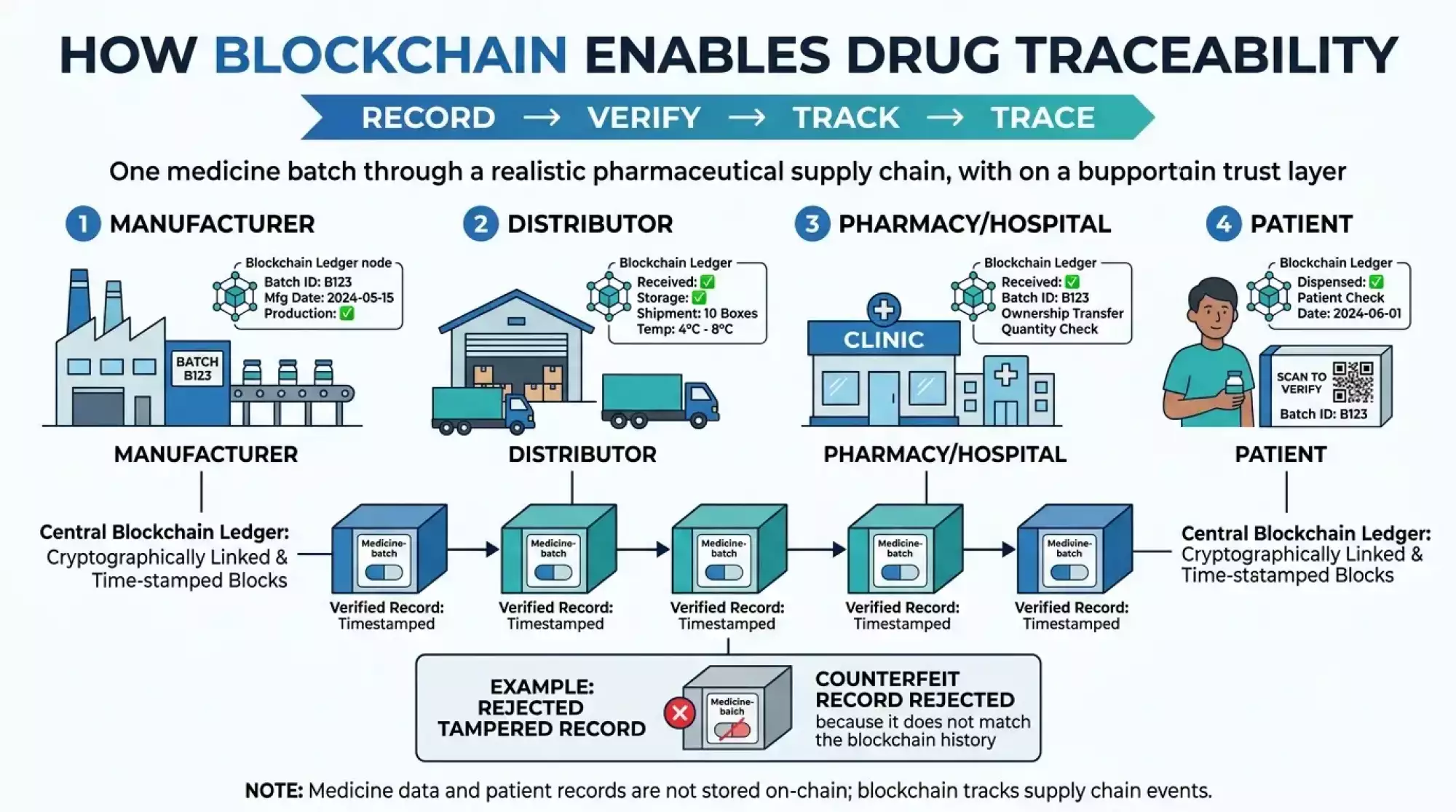
Medicine products go through many parties including manufacturing firms, wholesale distributors, retailers, pharmacies, and more. The blockchain technology can establish a common ledger to track the progress of medicine from its source to its destination.
Real use case: MediLedger
MediLedger Project was designed in collaboration with pharmaceutical manufacturers, distributors, dispensers, logistics firms, and other members of the supply chain. In the FDA pilot, this project examined the possibility of implementing blockchain technology in the tracing of changes in ownership of prescription drugs according to the DSCSA in the USA. This pilot confirmed that the application of blockchain technology in the tracing of drug is possible.
This platform could enable pharmaceutical companies and distributors to trace products from manufacture to distribution while also helping to investigate any suspicious transactions.
2. Electronic Health Records (EHRs)
Healthcare professionals may find themselves exchanging patient data between various systems. Blockchain technology can act as a trusted layer that will document all the data accesses, permissioning, and modifications, while the actual medical data will be stored on secure databases.
Real use case: Estonia's healthcare system
Estonia has used KSI blockchain technology as part of its national digital infrastructure to protect the integrity of health records. The blockchain-based layer helps detect unauthorized or inappropriate changes to patient data and provides an audit trail for access to health information.
The example shows an important implementation pattern: blockchain does not need to store the patient's complete medical record directly. Instead, it can help protect the integrity and auditability of records stored in existing healthcare systems.
3. Blood and Plasma Supply Chain
Blood and plasma products go through various steps such as collection, testing, processing, storage, transportation, and transfusion. The use of blockchain technology can document such occurrences and facilitate easier verification of information on their provenance, state, and handling.
Real use case: India's BloodChain concept
India's Centre of Excellence in Blockchain Technology documents a blockchain-based BloodChain use case connecting donors, collection centres, testing centres, blood banks, hospitals, and patients. The proposed system records information such as blood group, testing results, expiry, temperature, availability, and movement through the supply chain.
This is best described as a documented government blockchain use case/proposed implementation, rather than claiming that blockchain has already transformed India's entire blood supply network.
For a production system, a similar architecture could be used to create an auditable chain of custody for blood and plasma products.
4. Prescription Drug Monitoring
Blockchain can also be used to create a verifiable record of electronic prescriptions, dispensing events, and controlled-substance checks.
Real use case: PAGR Prescriptions
Researchers evaluated a distributed-ledger electronic prescribing system called Prescription Abuse Greatly Reduced (PAGR) Prescriptions at three family medicine clinics. The system incorporated prescription records with medication reconciliation and prescription drug monitoring program (PDMP) checks for controlled substances. The study reported lower prescription-writing time compared with the existing process at those clinics.
A blockchain-based prescription platform could therefore connect prescribers, pharmacies, patients, and monitoring systems while maintaining a verifiable transaction history.
5. Medical Staff Credential Verification
The hospitals and healthcare organizations need to confirm the credentials of the licensed clinicians before bringing them aboard. This process may be duplicated by each hospital and healthcare organization, thus becoming repetitive and cumbersome.
Real use case: ProCredEx
ProCredEx built a healthcare credentialing network using distributed ledger technology. Its platform allows participating organizations to exchange verified credential information and maintain provenance and traceability of credential data. Its members have included hospitals, health systems, payers, telemedicine and staffing organizations, and healthcare technology companies.
A similar blockchain-based credentialing platform could allow a hospital to verify a clinician's previously validated credentials rather than repeatedly collecting and checking the same information.
6. Breakthroughs in Genomics
Genomic information is very sensitive and has many uses in medical research, pharmaceutical development, and personalized medicine. Blockchain can be used in conjunction with encryption and other privacy-preserving methods to grant people more control over how their genomic information is accessed.
Real use case: Nebula Genomics
The company Nebula Genomics created a genomic data marketplace built using the blockchain technology that would enable people to have access to their data and use it to collaborate with researchers and buyers of data.
What matters here is not the idea of storing genomes using blockchain technology but rather the fact that the blockchain can become a tool for managing transactions and access controls for genomic data, with the genome being safely stored somewhere else.
7. Healthcare Supply Chain Management
Healthcare supply chains consist of manufacturers, suppliers, distributors, hospitals, pharmacies, and logistics companies. Blockchain technology is able to create a common ledger for orders, goods transportation, ownership, and other inventory events.
Real use case: Boston Scientific and IBM
Boston Scientific worked with IBM and other partners on a blockchain-based supply-chain solution in Colombia. The system connected Boston Scientific with hospitals and clinics and used blockchain to mirror transactions, orders, and documents through smart contracts. IBM reports that fulfilment time for new orders at Clínica Las Américas Auna was reduced from roughly 5–6 days to an average of 36 hours during the implementation.
This demonstrates a broader use of blockchain in pharma industry and beyond: medical-device and hospital supply chains can also use shared ledgers to coordinate orders and improve visibility between organizations.
8. IoT Security for Remote Patient Monitoring
Continuous gathering of health data by devices that are interconnected to each other is necessary for remote patient monitoring and involves data such as the patient's heart rate, blood pressure, glucose level, and other vital signs. IoT in healthcare enables these devices to continuously collect and transmit patient data, supporting remote monitoring and allowing healthcare providers to track changes in a patient's condition.
Real use case: Blockchain-based remote monitoring research
The U.S. Department of Health and Human Services has documented a blockchain use case for IoT-based remote patient monitoring. The proposed architecture connects patient sensors, healthcare practitioners, reports, and caregivers through a blockchain layer intended to improve access control and reduce opportunities for unauthorized manipulation or disruption of IoT data.
Research has also demonstrated blockchain-and-fog architectures for remote patient monitoring, where blockchain is used to strengthen the security and integrity of data exchanged between medical IoT devices and healthcare systems.
This is an area where it is better to say "blockchain-based architectures and pilots are being explored" rather than imply that blockchain is already the standard security layer for remote monitoring.
Planning to bring blockchain into your healthcare platform?
Explore the right approach for your data, systems, and users.
Privacy, Compliance, and Governance in Blockchain Healthcare
It is necessary for healthcare blockchain systems to meet the privacy, data protection, security, and governance requirements from the start of implementation. Such requirements differ from one country or region to another, and therefore, the architecture should be designed according to the relevant laws.
Healthcare Data Protection Requirements
The healthcare information system deals with very sensitive personal and clinical information. It depends on the jurisdiction whether the organization needs to have policies and guidelines on data protection, access control, consent, security controls, data retention, and patients' rights.
For instance, organizations should think about guidelines such as GDPR in the EU or HIPAA in the US, or the relevant laws in other jurisdictions for healthcare and data protection.
Blockchain is not going to make the healthcare system compliant automatically.
Data Minimization and Off-Chain Architecture
Only the information required for the blockchain validation process should be recorded in the blockchain. The sensitive clinical data should remain off-chain.
It helps reduce privacy threats and offers more flexibility to manage, correct, or delete healthcare information.
Consent and Data Access
An application in the field of healthcare should be able to log patient permissions in line with the relevant laws and policies.
Blockchain could provide an audit trail for consent events and accesses, but it is the application itself that enforces permissions.
Encryption and Key Management
Healthcare information needs to be safeguarded during transfer and at rest. In addition, blockchain technology requires the security of cryptographic keys for user authentication and authorization.
Access Controls and Identity Verification
Healthcare data can only be accessed by authorized entities or any other organization, while performing blockchain transactions is permitted as well. The authentication and verification of identities should be incorporated into the architecture as well.
Data Retention and Deletion
Data from the healthcare industry could be required to adhere to certain retention, modification, or even deletion policies. As data stored on blockchain cannot easily be modified, any sensitive personal data should not be kept on the blockchain.
Cross-Border Healthcare Data Governance
If healthcare information traverses international boundaries, there may be the need to contend with varying privacy laws, data transfer rules, and data localization policies.
The blockchain design should be in a position to outline data storage, data access, and regulatory compliance.
Smart-Contract and Network Governance
Governance rules for healthcare blockchain networks also include:
- Who can be a member of the network?
- Who can validate the transactions?
- Who can change smart contracts?
- Dispute resolution process
- Security incident management
- Approvals for any changes to the network
The governance approach depends on the organizations involved, regulations, and the healthcare scenario.
Limitations and Challenges of Blockchain in Healthcare
Blockchain technology can be used for particular applications within healthcare workflows; however, there are also various difficulties associated with its deployment.
Scalability and Transaction Throughput
Healthcare systems produce large amounts of data and transaction information. Blockchain technology may not be the most efficient way of handling large volumes of clinical data, which is why the production architecture does not allow storing big data sets on the blockchain.
Latency in Clinical Workflows
There are some workflows within the healthcare sector that require quick access to data. In blockchain transactions, there may be other steps included, which is why the architecture should ensure that unnecessary steps in the blockchain are not added.
Legacy EHR Integration
Current EHRs and healthcare systems might have various interfaces, database designs, and integration processes. Integrating those systems with the blockchain network requires FHIR APIs, middleware, data transformation, and customization services.
Privacy vs. Immutability
Blockchain is meant to be permanent, but healthcare information might be incorrect, have limited permissions, or even be removed. This necessitates great care when designing both on- and off-chain data.
Key Management and Account Recovery
Cryptographic keys are used in blockchain systems to ensure authentication and authorization. In case of key loss, this becomes an issue. Therefore, management and recovery of keys become an important architectural requirement.
Smart-Contract Vulnerabilities
The smart contract may be used for automating healthcare processes; however, programming mistakes or wrong business logic may lead to wrong results. Therefore, the contract needs to be tested and deployed in a safe way.
Multi-Organization Governance
Healthcare blockchain systems can include hospitals, labs, insurance companies, pharmacists, researchers, and IT firms. There must be clear rules regarding access to the network, handling data, validation, upgrading, and dispute resolution.
Implementation and Integration Costs
Blockchain development costs more than just creating the blockchain itself. Integration with EHRs, APIs, security, identity management, testing, infrastructure, and maintenance can influence the overall costs.
Limited Production Evidence
Most healthcare-related blockchain initiatives remain at the research, pilot, or proof-of-concept stage. The decision-making organizations need to assess whether the proposed initiative has proven its usefulness in a similar production environment.
Regulatory and Cross-Jurisdictional Complexity
There may be issues regarding privacy, data sharing, retention, and healthcare regulations for healthcare organizations that span several countries. These regulations can have an impact on network planning and data management.
How to Implement a Blockchain Healthcare Solution
The adoption of blockchain technology in healthcare is not just about the choice of a blockchain platform but requires defining the workflow, data needs, integration, governance structure, and security controls beforehand.
Step 1 — Identify the Healthcare Workflow
Choose an initial problem involving more than one party and requiring cooperative verification or coordination.
This could be in health information sharing, consent handling, claims handling, clinical trials, and logistics tracking.
Step 2 — Map Stakeholders and Trust Relationships
Define the participants and what information each participant requires to supply, access, or validate.
This will assist in determining whether a distributed ledger is really required and which participants can access the network.
Step 3 — Classify Healthcare Data
Separate private and clinical data from those that may have to be stored on the blockchain.
Decide which data needs to be kept in current EHRs or databases, and which proofs/transactions/events need to be stored on-chain.
Step 4 — Select Interoperability Standards
Specify how the blockchain solution will interface with the current healthcare systems.
FHIR, APIs, DICOM, and clinical terminology standards might be necessary, based on the use case.
Step 5 — Design the On-Chain/Off-Chain Architecture
Determine what the blockchain will store and where the supporting healthcare data will be stored.
The architecture should consider issues of privacy, performance, corrections, retention, and regulation.
Step 6 — Establish Identity and Consent Management
Clarify how patient authentication will take place; how access privileges will be determined, altered, and rescinded.
Step 7 — Select the Blockchain or DLT Framework
Choose the technology based on factors such as:
- Network governance
- Privacy requirements
- Performance
- Interoperability
- Smart-contract support
- Identity management
- Deployment requirements
Step 8 — Build APIs and EHR Integrations
Link the blockchain technology to EHRs, FHIR servers, labs, insurers, pharmacies, or any other necessary systems.
The integration services have to deal with authentication, communication, transformation, and routing.
Step 9 — Conduct Security and Compliance Assessments
Test the entire system together with APIs, smart contracts, identity services, storage, key management, and access control.
The solution must also be evaluated in terms of privacy and healthcare considerations that apply to its intended jurisdictions.
Step 10 — Pilot and Measure KPIs
It is recommended that the process start off with an organized pilot using only a few individuals and a set workflow.
Results can be measured technically and operationally before expanding the network.
Step 11 — Validate Clinical and Operational Workflows
Test the solution using the actual users of the solution, such as service providers, administrators, patients, or other participants where necessary.
It enables the identification of any issues that may not be identified through technical testing.
Step 12 — Scale Through Governance and Interoperability
Once the pilot demonstrates value, expand the network gradually. Establish clear governance rules and maintain interoperability as additional organizations and systems join.
Healthcare Blockchain KPIs to Measure
Useful metrics can include:
- Data-access latency
- Transaction throughput
- API response time
- Consent-processing time
- Record reconciliation time
- Audit completeness
- Unauthorized-access attempts
- Integration uptime
- Cost per transaction
- Provider adoption
- Patient engagement
Cost of Blockchain Healthcare Development
Blockchain app development costs may vary significantly because each blockchain healthcare application has its own needs, integrations, users, and security requirements. It will be better to talk about the needs of your product before trying to provide a general estimate.
A blockchain healthcare development company will assist you in breaking up the whole project into features, integrations, architecture of the blockchain, and other needs. You will be able to provide an accurate estimate based on this scope.
| Product | Where it is needed/Target audience | Realistic development cost |
| Blockchain Patient Portal Solution | Healthtech startups, hospitals, healthcare networks | $30K–$80K |
| Patient Consent Management System | Hospitals, clinics, healthtech SaaS companies | $20K–$50K |
| Healthcare Data Exchange Platform | Healthtech companies, hospital groups, HIE projects | $50K–$120K |
| Blockchain Patient Identity System | Hospitals, health networks, healthtech platforms | $25K–$60K |
| Medical Record Verification Platform | Hospitals, insurers, healthtech companies | $25K–$60K |
| Pharmaceutical Traceability Platform | Pharma manufacturers, distributors, supply-chain companies | $40K–$100K |
| Clinical Trial Data Integrity Platform | Pharma, biotech companies, CROs, research organizations | $50K–$120K |
| Healthcare Claims Verification System | Insurers, TPAs, hospitals, claims-processing companies | $40K–$100K |
| Medical Credential Verification Platform | Hospitals, healthcare staffing and credentialing companies | $20K–$50K |
| Medical Device Data Provenance Platform | Medical-device companies, healthcare IoT businesses | $35K–$90K |
| Healthcare Supply Chain Tracking Platform | Hospitals, pharma, medical-device distributors | $40K–$100K |
| Blockchain Healthcare Payment Platform | Healthtech/fintech companies, insurers, healthcare providers | $40K–$100K |
Factors That Influence Development Cost
- Blockchain network and governance: Decisions on the type of network, number of nodes, and governance will affect the development cost.
- Integration of EHR and FHIR: Integration of many EHRs, FHIR servers, laboratories, insurance, or legacy systems will involve higher integration efforts.
- On-chain/off-chain structure: Number of data sources, storage options, and blockchain workflows will impact the structure and complexity of development.
- Identity and consent management: Additional authentication, authorization, identity verification, and consent workflows will impact development and security requirements.
- Complexity of smart contracts: Complex healthcare workflows and business rules will require more development, testing, and auditing.
- Security and compliance considerations: Encryption, access controls, key management, security testing, and compliance requirements may have a cost impact.
- Scope of application: Portal, mobile application, patient portal, and other applications will influence development costs.
- Number of participants and users: Support for many healthcare organizations, users, roles, and permissions will have an impact on infrastructure requirements.
- Testing and deployment: Functional testing, integration testing, security testing, and performance testing will impact time and development cost.
- Maintenance and scalability: Infrastructure costs, security maintenance, API evolution, blockchain evolution, monitoring, and integrations will impact ongoing costs.
Need to understand what your blockchain healthcare project will cost?
Share your requirements and get a tailored development estimate.
Blockchain, AI, and IoMT: Emerging Healthcare Data Architecture
The blockchain can help augment AI and IoMT applications by providing information about provenance, access, and informed consent management. However, it is not advisable to use blockchain for processing and storing large amounts of healthcare data directly on the blockchain.
Blockchain as a Trust Layer for AI-Generated Insights
AI relies on accurate data. Blockchain technology can document the provenance of selected data sets and AI activities to enable companies to track how data was acquired or utilized.
Provenance of Wearable and IoMT Data
Connected devices can generate continuous streams of health information. Blockchain can record selected metadata or proofs associated with this data to help verify its source and integrity.
The actual sensor data should remain in suitable databases or cloud storage.
Consent-Aware Health Data Sharing for AI Research
Blockchain can support consent workflows for sharing healthcare data with approved research or AI applications. Consent events and access activity can be recorded on a shared ledger while the underlying datasets remain off-chain.
Why Blockchain Should Not Process High-Volume Sensor Streams
Wearable devices and clinical devices can generate huge amounts of data that need to be processed and stored quickly. Placing this data stream directly onto the blockchain is just going to add overhead.
The right approach is to store this data using conventional storage while applying blockchain only where needed.
Blockchain in Healthcare: Real-World Adoption vs. Proof of Concept
Blockchains have been studied for EHR interoperability, claims processing, clinical studies, supply chains, and data sharing within healthcare. However, a prototype does not imply that the solution works at scale.
Why Healthcare Blockchain Pilots Struggle to Scale
Although a blockchain pilot may be feasible in a confined setting, there can be several other difficulties faced during implementation within various healthcare institutions.
Some of the common obstacles include:
- Integration with existing healthcare systems
- Varied data and interoperability standards
- Need for patient privacy
- Network governance among different organizations
- Cost considerations
- Low participation of healthcare industry players
What Qualifies as a Meaningful Production Deployment?
The successful deployment of the product must not only reflect its functionality but also must prove that the product works in real healthcare workflows and can help real users and participants in the process.
Some of the relevant information could be:
- Product deployment by the healthcare organization
- Product integration with other systems used in healthcare
- Real transaction or workflow volumes
- Governance and security controls
- Operational performance metrics
- Sustainability after initial pilot deployment
How to Evaluate Blockchain Healthcare Case Studies
When assessing a blockchain healthcare project, consider:
- Deployment level: Research, proof of concept, pilot, or implementation
- Participants: How many healthcare organizations were involved and their type
- Use case: The particular problem that the blockchain solves
- Architecture: What is on-chain and what is off-chain
- Interoperability: Standards and systems used to integrate
- Outcomes: Any quantitative results of its operational or technical performance
- Persistence: Whether the solution stayed after the pilot
Metrics to Examine in Published Research
Research papers and case studies may be evaluated by quantifiable measures like transaction capacity, latency, data access times, system availability, interoperability performance, security outcomes, and implementation.
This is because it enables companies to determine whether the blockchain healthcare initiative has any value in practice or is just a theoretical one.
How to Implement Blockchain in a Healthcare System
- Define the Healthcare Problem: Determine the exact point at which blockchain will have an impact in terms of consent management, data origin, claims, or inter-provider data exchanges.
- Assess the Need for Blockchain Technology: Compare blockchain technology to a regular database or federation system prior to implementing blockchain technology.
- Identify Stakeholders and Trust Assumptions: Define who the participants are, what each organization owns, and what shared validation is required.
- Define Functional Requirements: Outline the user, workflow, transaction, access, notification, and reporting requirements of the system.
- Classify Healthcare Data: Distinguish between clinical and sensitive data versus the rest of the data that might require on-chain logging or verification.
- Architect On-Chain and Off-Chain Design: Figure out what the blockchain will log, where the clinical information will reside, and how the layers will interact.
- Select Healthcare Interoperability Standards: Decide which standards, such as FHIR, API, DICOM, terminology standards, etc., will be used to make existing healthcare systems interoperable.
- Decide the Systems to Integrate with EHR and Legacy System Integration: Figure out the EHRs, labs, pharmacies, insurance companies, databases, and others that should integrate with your solution.
- Choose Blockchain Platform: Based on privacy, governance, scalability, interoperability, and smart contract needs, choose from a permissioned or public blockchain.
- Identity, Authentication, and Access Control: Design how patients, providers, organizations, and applications would be authenticated.
- Consent Management Design: Describe how the consent will be obtained, verified, altered, removed, and stored.
- Specify the Security and Data Protection Needs: Create plans for the encryption, key management, API protection, access control, logging, retention, and regulatory compliance.
- Smart Contract and Business Rule Design: Identify what workflows should be implemented through automation and what rules should remain outside the blockchain.
- Define Network Governance: Outline the criteria for joining the network, transaction validation, upgrade management, dispute resolution, and incident handling.
- Implement and Integrate the Solution: Implement the blockchain layer, APIs, integrations, smart contracts, backend services, and web or mobile application, if needed.
- System Testing: Perform testing of functionality, integration, smart contracts, security, performance, data flows, and healthcare workflows.
- Deployment and Monitoring: Deploy the solution, monitor its performance and security, onboard participating organizations, and update the system.
Blockchain Healthcare Platforms and Technology Choices
A blockchain platform for the healthcare industry would depend upon the application scenario, network participants, privacy needs, and governance model. The platform to be used must be chosen keeping in view its capabilities, not just based on the general perception that some technology is the best.
Hyperledger Fabric for Enterprise Healthcare Workflows
Hyperledger Fabric is a permissioned blockchain technology developed to be used in environments where all the parties involved are known and have been permitted to participate.
This type of solution can be implemented in a healthcare ecosystem that consists of hospitals, labs, insurers, pharmacies, and other relevant entities that need limited access to the network.
Moreover, this blockchain platform can be utilized in the field of healthcare for managing such processes as provenance, claims, consents, and transactions between approved entities.
Yet, implementing Hyperledger Fabric will not substitute secure off-chain storage, identity management, API, interoperability standards, and necessary governance.
Ethereum-Based Healthcare Architectures
Ethereum is an open-source blockchain framework that facilitates the development of smart contracts and decentralized applications. Ethereum-based solutions for the healthcare industry can leverage smart contracts to facilitate programmable processes, transactions, and selective data sharing processes.
As public networks have distinct features regarding privacy and governance when compared to permissioned healthcare networks, private clinical data should be kept off-chain. Ethereum-based frameworks could utilize blockchain technology for the verification of events such as proofs, transactions, permissions, and others while interacting with the databases and APIs of the healthcare sector.
Other Distributed-Ledger Options
Other distributed ledger technologies may be considered as well if they meet the technological and governance criteria of the healthcare process flow. The selection needs to consider issues like network topology, privacy, performance, interoperability, identity management, deployment, and maintenance.
The organization must consider the technology in the context of its own needs and not pick a platform based solely on popularity or blockchain technology.
How to Select a Blockchain Platform
These are some of the considerations to be made during the assessment of a platform:
- Privacy: Assess whether the platform can support the necessary degree of privacy for data and transactions.
- Throughput: Assess whether the platform can accommodate the expected number of transactions without compromising clinical workflow.
- Governance: Outline who is eligible to run the nodes, validate transactions, and upgrade the platform.
- Interoperability: Test the capability of the platform to interoperate with FHIR, APIs, EHR, DICOM, and other healthcare facilities.
- Support for smart contracts: Determine whether the platform supports the implementation of necessary business rules and workflow processes.
- Identity Management: Ensure support for identity verification of participating entities, role-based access control, and organizational identities.
- Ecosystem: Look at available developer tools, libraries, documentation, and developer skills.
- Vendor/Community Support: Assess available vendor/community support, maintenance, monitoring, and production capabilities.
- Deployment: Understand if the platform can be deployed within the necessary cloud, on-premises, hybrid, and/or multi-vendor model.
- Regulatory Requirements: Determine if the overall architecture is capable of meeting relevant data protection, retention, access, and cross-border data transfer requirements.
The blockchain solution alone is not enough to solve the healthcare problem; integration with the EHR, FHIR APIs, identity, consent management, off-chain storage, security controls, and governance play an equally important part in the ability to go into production.
Future of Blockchain in Healthcare
While blockchain technology in the healthcare industry has progressed from theoretical studies to prototypes, pilots, and some implementations, production-level applications are few. Further development of the technology will probably be oriented towards solving particular problems that could benefit from shared verification, provenance, identity, or consent.
Blockchain-Enabled Health Information Exchanges
Tests have been conducted on how Blockchain could be used for exchanging patient records and coordination among various healthcare organizations in relation to FHIR and off-chain storage of data. More integration with existing interoperability standards would enable Blockchain to facilitate trusted exchange of information without necessarily having to replace EHR systems.
Patient-Centric Digital Identity
Patient identity and access control using blockchain technology has been showcased in research and pilot projects. Future systems can leverage blockchain along with interoperable digital identity and verifiable credentials for assisting in the verification of identity and authority within multiple healthcare organizations.
Verifiable Healthcare Credentials
There have been several attempts to implement blockchain technology in validating credentials and qualifications within the field of healthcare. Greater utilization of verifiable credentials can facilitate credential issuing and validation across different healthcare organizations.
Privacy-Preserving Health Data Sharing
In most healthcare blockchains that have been proposed to date, the medical data remains outside the blockchain itself and the blockchain is used for permissions, consent, provenance, and auditing. In the future, it is possible that blockchains will be combined with encryption techniques to facilitate secure data sharing.
Blockchain and Decentralized Clinical Research
Applications of blockchain have been seen in the context of clinical trial management and sharing of research data. The use of blockchain in the form of distributed ledgers can help in maintaining research documentation and tracking of consent forms.
AI-Ready Clinical Data Provenance
Blockchain technology has been applied to trace the provenance of EHRs, IoMTs, and other medical data used in digital and AI-based processes. With an increasing use of healthcare AI applications that make use of more and more data, blockchain can help to keep a provenance log of chosen datasets/inputs.
From Pilots to Production Healthcare Infrastructure
Healthcare blockchains have developed working prototypes and pilot implementations, although there is very little evidence of large-scale production deployment. Greater adoption will require practical applications that meet requirements for interoperability, privacy, security, governance, scalability, and regulation.
Blockchain has shown promise within targeted healthcare applications, but it is far from being an alternative to current healthcare infrastructure. Its future lies in targeted layers of trust and coordination operating along with EHRs, FHIR, APIs, identities, and data storage solutions.
Not sure where to start with blockchain in healthcare?
Get help turning your idea into a clear technical and development plan.
Conclusion
Blockchain in healthcare can help organizations with systems that require reliable coordination. It is important to understand that the question here is not whether blockchain technology can be applied or not; it is about how a shared ledger would benefit from the existing database or integration.
Before starting the software development, you must identify one measurable outcome of using blockchain technology, which could be anything from reduced record verification time to improved tracking of consent or a shared audit trail across organizations. Measure how well the current process works and see if blockchain would make this better without introducing additional challenges.
Such a strategy gives organizations a clearer way to decide whether to move forward with their blockchain project. If you're exploring how blockchain could improve your healthcare processes, our experts can help you identify the right use case, evaluate the potential benefits, and plan the next steps. Get in touch with our team today to discuss your requirements.
FAQs
How do I determine whether blockchain is suitable for my healthcare use case?
Consider the problem first, then the technology. Blockchain could be an option if there are several independent parties who need to have access to, or validate the same record or event. If a traditional database or federated system could solve the problem, blockchain would not be needed.
Should we build our own blockchain network or use an existing network?
It all comes down to the type of project at hand. A permissioned network could help healthcare companies manage users and governance more easily. Meanwhile, a public network is a completely different approach that might work well in certain instances. The best thing to do would be to consult an expert who can review your needs first.
Who should own and govern a healthcare blockchain network?
The governance process has to incorporate the organizations that use the network. This is because they will require specific guidelines for joining, running nodes, making amendments, and resolving disagreements. Such matters have to be sorted out before deployment since governance may become a problem after that.
Who operates the blockchain nodes in a healthcare network?
The users who are authorized can run these nodes. They can be either hospitals, insurance companies, laboratories, healthcare networks, or research institutes, among others, depending on the network architecture. The roles and responsibilities of each one of them must also be clearly outlined.
What happens to the blockchain network if a participating healthcare organization leaves?
The network should have an exit process. Access and credentials can be revoked while existing records remain available to authorized participants. Governance rules should define what happens to the organization's node and data references. Planning this process early makes the network easier to manage as participants change.
How can patients recover access if they lose their digital identity or private keys?
The platform should have a secure recovery mechanism. Depending on the design, this could involve identity verification, delegated recovery, institutional support, or issuing new credentials. Recovery needs to balance patient convenience with strong access controls. This is an area where identity architecture should be reviewed carefully before implementation.
How can inaccurate healthcare information be corrected when blockchain records are immutable?
The original blockchain record should generally remain unchanged. The actual clinical record can be corrected in the appropriate off-chain system. A new blockchain event can then record that a correction was made. This preserves the audit history without making the blockchain the primary storage system for editable medical records.
What should a blockchain healthcare MVP include?
Start with one specific healthcare workflow. The MVP solution may include user identity, permissions, blockchain transactions, off-chain storage, APIs, and a basic application. Avoid building every possible feature at once. A development team can help convert the selected workflow into a practical MVP scope and development plan.
How do I determine the cost of implementing blockchain in healthcare?
Start by defining what the system needs to do. Identify the workflow, users, participating organizations, integrations, data architecture, and required blockchain functions. Then account for development, infrastructure, security, testing, and ongoing maintenance. A development partner can review these requirements and prepare a scope-based estimate instead of giving you a generic price.