Legacy-to-Cloud Patient Portal Transformation With FHIR Integration For a US-Based Healthcare Provider

Learn how we helped a US-based healthcare provider transform its outdated patient portal by modernizing legacy systems with modern UI/UX and cloud-native architecture.

This case study outlines how a leading U.S. healthcare provider transformed its patient portal to address fragmented data, manual workflows, and limited accessibility. By implementing FHIR-compliant APIs, cloud-native infrastructure, and a mobile-first interface, we enabled seamless data exchange, automated processes, and multi-platform access to enhance patient engagement and clinical efficiency.

Project Overview

A U.S.-based healthcare provider with multiple clinics and a large patient base was struggling with an outdated patient portal built on legacy architecture. As the provider scaled, patient data became fragmented across disconnected systems, leading to duplicate records, incomplete clinical information, and limited patient accessibility. Patients found it difficult to schedule appointments, access test results, or communicate with care teams, while staff spent excessive time on manual data entry and paper-based processes.

To address this, patient portal modernization was undertaken using modern UI/UX design and cloud-native architecture. As part of the implementation, React/Node.js development services were leveraged to build a responsive web portal and mobile apps for iOS and Android. FHIR-compliant APIs were integrated to enable seamless EHR connectivity, while AWS cloud infrastructure with auto-scaling ensured reliable performance. This enabled patients to manage appointments, access health records, communicate with providers, and complete pre-visit tasks from any device, while reducing administrative burdens on staff.

Challenges - Legacy-to-Cloud Patient Portal Transformation

Challenges

Challenges - Legacy Patient Portal Modernization
  • Fragmented Patient Identity Matching

    The legacy portal could not reliably match patients to their existing EHR records. Duplicate records were common, leading to patients seeing incomplete or incorrect health information. Staff spent hours manually reconciling patient identities across systems.

  • Incomplete Clinical Data Display

    The portal displayed only a fraction of the clinical data available in the EHR. Key information like lab results from external providers, historical diagnoses, and care plan details were missing. Patients were confused about their health status and often called the clinic for clarification.

  • No Offline Capability for Patients

    Patients in rural areas or with limited internet access could not use the portal effectively. They needed a way to view essential health information offline, especially during emergencies or when traveling.

  • Manual Document Uploads

    Patients had to fax or mail documents like insurance cards, consent forms, and medical records to the clinic. These were manually scanned and attached to patient records, causing delays and errors. The portal did not support secure document uploads with automatic attachment to patient records.

  • Provider Communication Bottlenecks

    Patients used the portal's messaging feature to ask questions, but responses were slow because messages were routed to generic clinic inboxes rather than directly to the appropriate care team. This increased response times and patient frustration.

Solution Delivered

Unified Patient Identity Resolution

Implemented identity resolution engine using demographic matching and historical interaction data. Eliminated duplicate records, ensuring accurate, complete health information.

Comprehensive Clinical Data Aggregation

Integrated EHR and external lab systems via FHIR APIs. Displayed complete patient records including lab results, diagnoses, medications, allergies, and care plans in a unified view.

Offline Data Access

Enables limited offline access to essential health information (medication lists, allergy information, emergency contacts) using local storage with automatic sync when connectivity is restored.

Secure Document Management

Implemented secure document upload with automatic attachment to patient records via REST APIs. Patients upload insurance cards, consent forms, and medical records directly, eliminating faxing/mailing.

Intelligent Message Routing

Implemented rule-based routing engine that automatically directs patient messages to appropriate care teams based on message content classification and patient's care team assignment. Reduced response times significantly.

AI Support Assistant

Outcomes

The modernized patient portal delivered measurable improvements:

Unified Patient Identity Resolution

eliminated duplicate records, ensuring patients always access accurate health information.

Comprehensive Clinical Data Aggregation

integrated external lab results and historical diagnoses, reducing clarification calls by 40%.

Offline Data Access

enabled patients in low-connectivity areas to view essential health information during emergencies.

Secure Document Management

replaced manual faxing with direct uploads, reducing processing delays by 60%.

Self-Service Record Requests

empowered patients to download and share records independently, cutting administrative requests by 70%.

Intelligent Message Routing

directed inquiries to appropriate care teams, improving response times by 70%.

Our Patient Portal Modernization Success

Discover how we helped a US-based healthcare provider modernize its legacy patient portal, transforming it into a modern digital ecosystem to boost patient engagement and operational efficiency.

  • Patient Portal Modernization

    Patient Portal Modernization

    65% increase in patient portal adoption

  • FHIR Integration & Data Aggregation

    FHIR Integration & Data Aggregation

    70% reduction in administrative record requests

  • Cloud Migration & Automation

    Cloud Migration & Automation

    60% reduction in administrative workload

Technology Stack

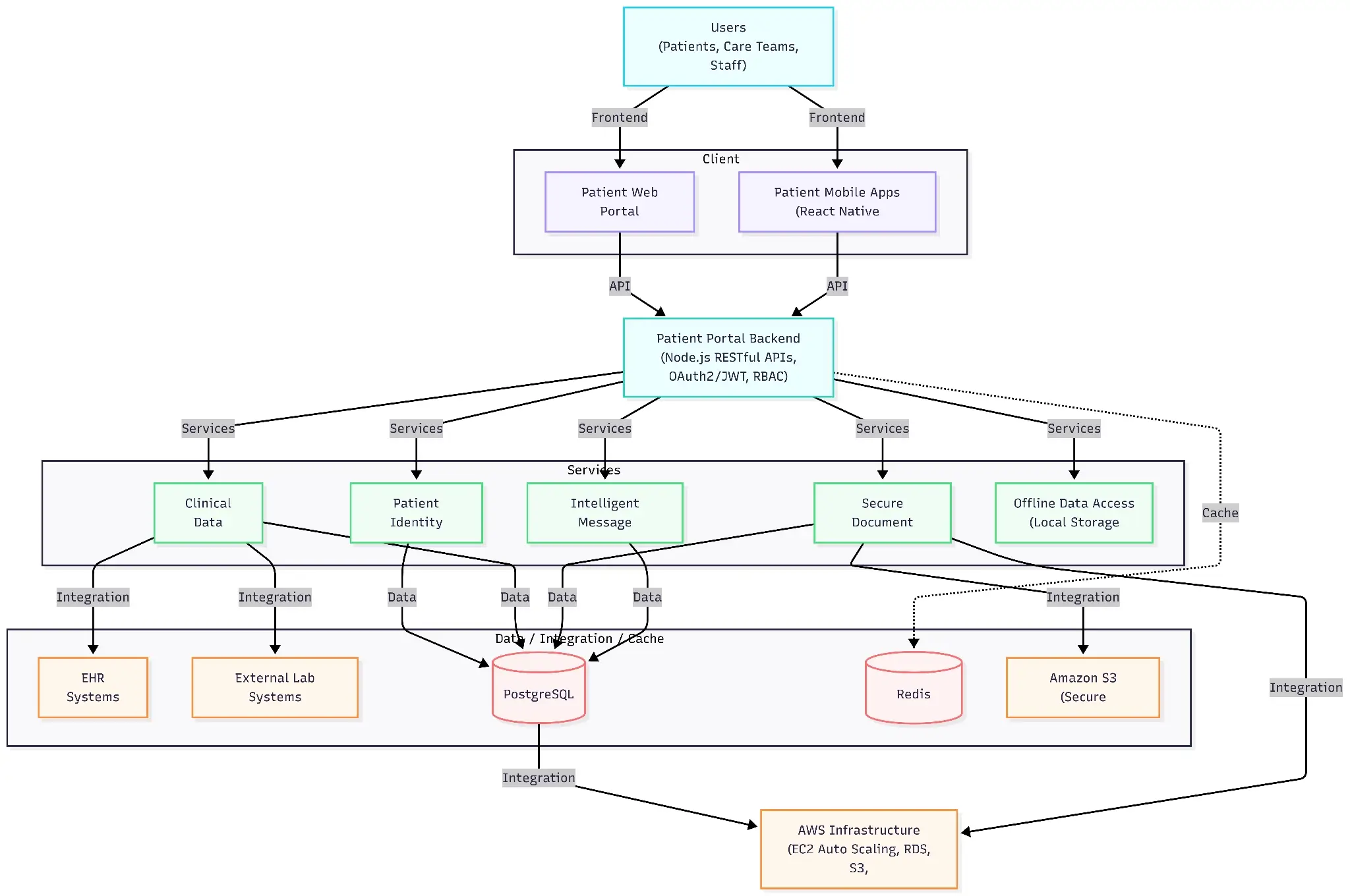
  • Frontend: React.js for web, React Native for iOS/Android
  • Backend: Node.js with RESTful APIs
  • Integration: FHIR-compliant APIs for EHR connectivity
  • Cloud Infrastructure: AWS (EC2 Auto Scaling, RDS, S3, CloudFront)
  • Data Management: PostgreSQL, Redis caching
  • Security: OAuth2/JWT, RBAC, TLS 1.3, AWS WAF
  • Compliance: HIPAA, GDPR
Legacy Patient Portal Modernization Architecture
×

Conclusion

The Legacy Patient Portal Modernization project demonstrates how addressing specific usability and data integration gaps can transform the patient experience. By implementing unified identity resolution, comprehensive clinical data aggregation, offline access, and intelligent message routing, we helped the healthcare provider reduce administrative workload by 60% and improve patient communication response times by 70%. The solution achieved 99.95% uptime while ensuring HIPAA compliance, proving that strategic modernization can deliver exceptional value while building trust and engagement with patients.

Beware of Scams

Don't Get Lost in a Crowd by Clicking X

Your App is Just a Click Away!

Fret Not! We have Something to Offer.