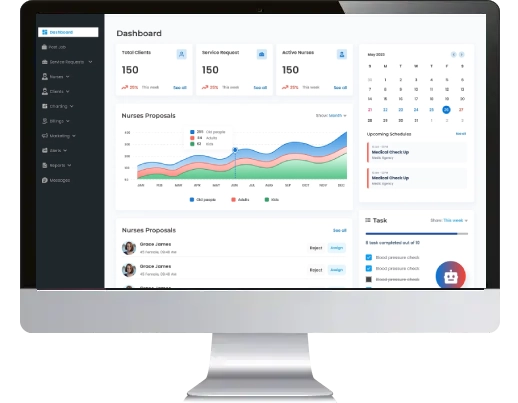
A Canada-based patient care provider (Clinique Omicron) required a modernized digital healthcare app to organize processes like patient intake, registration, payment, communications, and administration. Its current application relied on outdated components and separate systems, which complicated the exchange of patient information, introduced new functionalities, and scaled healthcare operations.
We modernized the digital healthcare app by restructuring old components, implementing REST API integration, and establishing connections between EHR systems and digital payment gateways. The app also included automated workflows, role-based access control, and audit logging to improve the healthcare staff's working environment.
Current application components made it difficult to add new functionalities and maintain the app efficiently.
Exchange of information between the healthcare platform, EHRs, and other applications was not effective.
Patient intake, registration, payment, and communication processes required a lot of manual intervention.
The existing app lacked flexible integration capabilities for connecting healthcare and payment systems.
Patient information spread across various platforms made it difficult for authorized users to access the full information.
The existing architecture made it challenging to accommodate increasing patient volumes and evolving operational requirements.
Handling sensitive healthcare information required stronger access controls, audit trails, and secure data exchange mechanisms.
We modernized the digital healthcare app by upgrading its architecture and simplifying patient and administrative workflows within a centralized platform. The modernization focused on improving interoperability and operational efficiency without disrupting existing healthcare processes.
We assessed the existing application structure and identified legacy components that restricted scalability and future development. These components were refactored and modernized into more modular application services to simplify maintenance and support the addition of new healthcare functionalities.
The software was connected with Electronic Health Record (EHR) systems through secure REST APIs for very smooth exchange of patient information. API-based integration supported authentication, data mapping, validation, synchronization, and error handling between connected systems.
We integrated digital payment gateways like Stripe and PayPal into the healthcare platform to connect payment processing with patient and administrative workflows. Payment-related information could be exchanged securely and also help maintain appropriate authentication and access controls.
A centralized data exchange layer was implemented to synchronize patient information across connected healthcare systems. This helped authorized users access relevant patient details without relying on separate interfaces for every connected application.
The platform was improved with automated workflows for various processes like patient intake, registration, and communication. Workflow automation decreased repetitive administrative activities and helped healthcare teams handle patient interactions more efficiently.
We implemented audit logging to record important user and system activities across the platform. Administrators can track access and workflow activities, providing greater visibility into changes and supporting healthcare data governance requirements.
The modernized platform uses authenticated API communication, authorization controls, input validation, encrypted data transmission, and secure credential management to protect patient information exchanged between the platform and integrated systems.
The application architecture was modernized with cloud-ready components to support flexible deployment and scaling. This provided a stronger foundation for handling increasing healthcare workloads and integrating additional systems as operational requirements evolved.
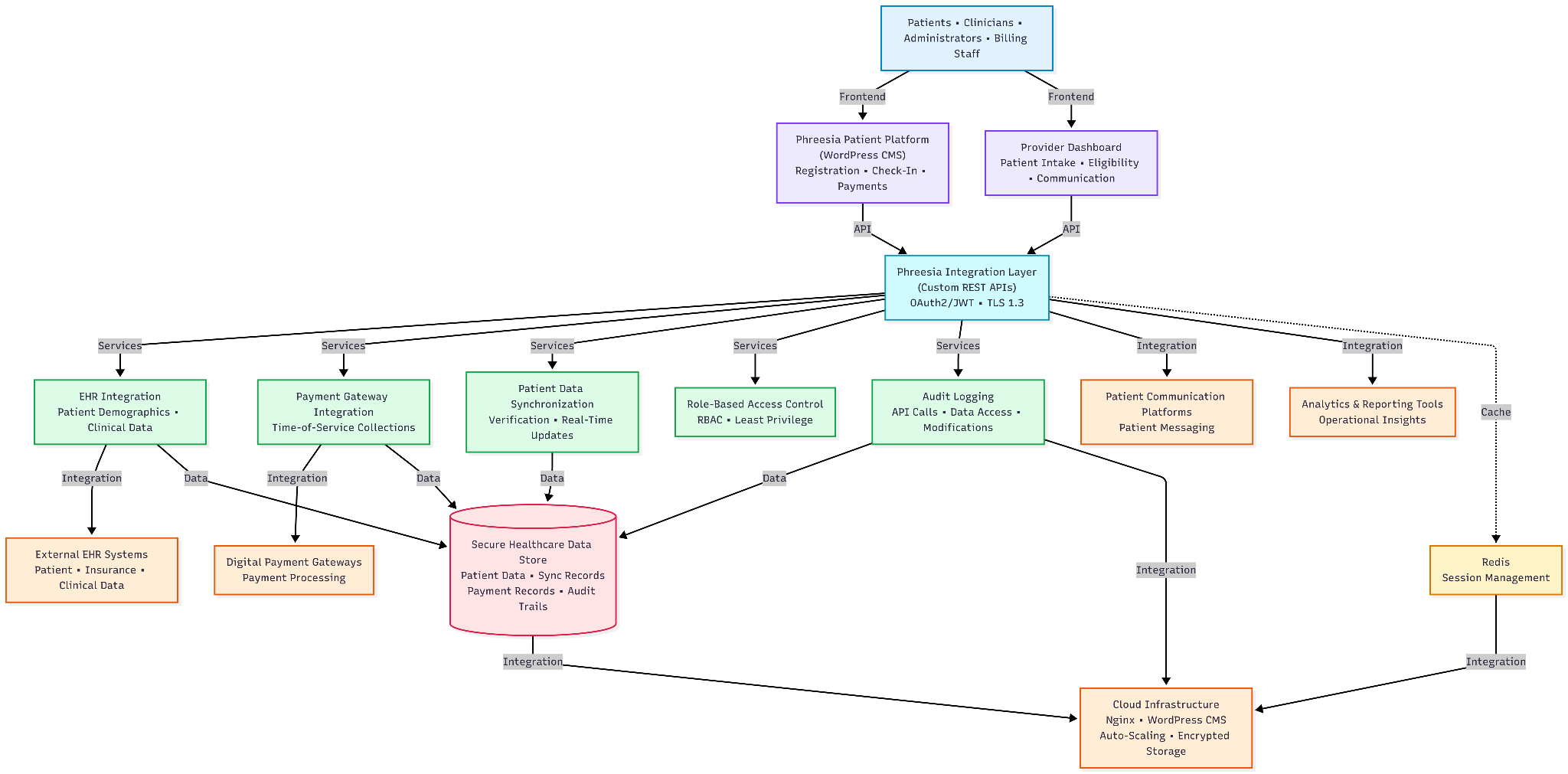
Patient intake and management digital interface. Features – patient registration & check-in, patient eligibility checks, payment processing, communication tools, physician dashboard, patient portal.
Secure API orchestration services. Services – EHR systems integration (patient information synchronization), digital payment gateway integration, authorization and authentication services, audit logging, data synchronization service, notifications service. API requests throughput – 6,200+ req/min.
EHR systems: Patient demographics, clinical data
Digital payment gateways: Payment processing
Patient communication platforms
Reporting/analytics tools
Nginx web server with custom WordPress CMS. Cloud-hosted with auto-scaling capabilities. Secure data storage with encryption support. 99.95% uptime. RTO 15-min with Terraform, RPO less than 5-min.
Different healthcare organizations use different EHR systems, each with different data formats.
Integrated our system securely using REST API to synchronize patient data in real-time. Automated exchange of demographic information and insurance data. Three times more pre-visit patient data gathered.
Result: Easy data exchange process, decreased manual work, increased accuracy.
Payment process was carried out manually and therefore error-prone.
Integrated system with digital payment gateways to automate payment process. Facilitated time-of-service collections. Average 73% increase in collections within 6 months.
Result: Increased revenue, optimized payments.
Patient data was stored separately, causing inaccuracies.
Implemented real-time patient data synchronization between our system and other systems. Automated verification and updating of data. Decreased call volume by 87%.
Result: Decreased call volume by 87%.
Healthcare data requires strict access controls.
Introduced RBAC for all integrated systems. Access to information is limited to the users’ roles. Increased security and compliance level.
Result: HIPPA compliance, no illegal access to information.
Need to monitor all changes in information.
Logging of activities for all API calls. Logging of user activities, information changes, and system access.
Result: Compliance monitoring, security investigations.
Unit tests (Jest, 85% coverage) for each commit; integration tests (Postman, 200+ cases) daily; load testing (k6/Artillery) on staging infrastructure weekly. Deployment will be blocked in case of performance regression (p95) of >10%.
Registration → EHR data synchronization → Eligibility → Payments → Audit logging. Mix of users: 50% of check-ins, 30% of EHR sync, 15% of payments, and 5% of administration.
4,700+ healthcare organizations, 1B+ patient interactions, 1 in 6 of all U.S. patient visits.
PostgreSQL — 200 connections (pool: 20/node × 10 nodes). Redis — session management (80% hit rate). Auto Scaling — 10-node limit at 70% CPU.
RTO — 15 minutes (Terraform). RPO — <5 minutes (RDS Multi-AZ). Monthly DR testing.
Patient data exists in silos across systems. Secure REST API integrations enable real-time synchronization.
3x more patient data captured, reduced manual entry.
Manual payment processing is inefficient. Connected payment gateways automate time-of-service collections.
73% average increase in collections within 6 months.
Inconsistent data causes errors and delays. Real-time sync with automated verification.
87% reduction in call volume, reduced front-desk chaos.
Healthcare data requires strict access controls. Granular RBAC ensures least privilege.
HIPAA compliance, zero unauthorized access.
Compliance requires tracking all data access. Comprehensive audit logging for all API calls.
Full compliance visibility, security investigations.
Healthcare integrations require security. OAuth2 authentication, TLS 1.3 encryption.
1 in 6 U.S. patient visits supported, 99.95% uptime.
The digital healthcare platform integration proves that secure REST API orchestration can transform patient intake and payment workflows. EHR integration, digital payment connectivity, and role-based access control drive efficiency while maintaining HIPAA compliance.

"What stood out was the team's ability to turn complex requirements into a practical digital experience. The result was aligned with the needs of healthcare professionals."
Clinical Care Coordinator, Clinique Omicron
• SUFFESCOM SOLUTIONS
Build Smarter. Scale Faster. Grow More.
Have a Vision? Let’s Turn It Into a Digital Reality.
Get a quick response from our best experts in under 10 minutes.
Suffescom easily understood our main goal and delivered the best digital solution. Their team was very cooperative, and it was a very good experience working with them. I would highly recommend them.

Working with Suffescom was a really great experience. Their developers demonstrated technical knowledge and delivered our mobile app solution with all required functionalities on time.

Suffescom helped us build a logistics software solution that completely improved our fleet operations. Their professionalism and transparency are what make them a reliable technology partner.

Share Your Requirements. Our Experts Will Shape the Solution.
• SUFFESCOM SOLUTIONS
Build Smarter. Scale Faster. Grow More.
Have a Vision? Let’s Turn It Into a Digital Reality.
Get a quick response from our best experts in under 10 minutes.
Suffescom easily understood our main goal and delivered the best digital solution. Their team was very cooperative, and it was a very good experience working with them. I would highly recommend them.
Working with Suffescom was a really great experience. Their developers demonstrated technical knowledge and delivered our mobile app solution with all required functionalities on time.
Suffescom helped us build a logistics software solution that completely improved our fleet operations. Their professionalism and transparency are what make them a reliable technology partner.
Share Your Requirements. Our Experts Will Shape the Solution.
• SUFFESCOM SOLUTIONS
Build Smarter. Scale Faster. Grow More.
Have a Vision? Let’s Turn It Into a Digital Reality.
Get a quick response from our best experts in under 10 minutes.
Suffescom easily understood our main goal and delivered the best digital solution. Their team was very cooperative, and it was a very good experience working with them. I would highly recommend them.
Working with Suffescom was a really great experience. Their developers demonstrated technical knowledge and delivered our mobile app solution with all required functionalities on time.
Suffescom helped us build a logistics software solution that completely improved our fleet operations. Their professionalism and transparency are what make them a reliable technology partner.
Share Your Requirements. Our Experts Will Shape the Solution.
Fret Not! We have Something to Offer.