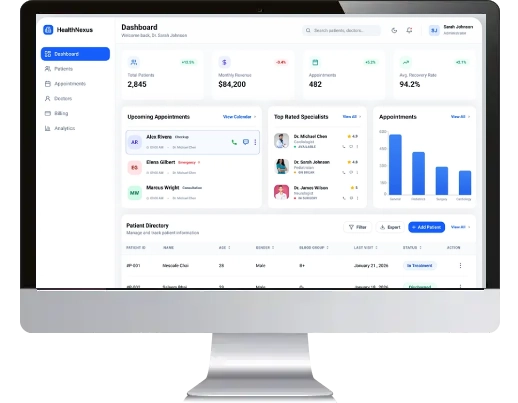
With the expansion of the outpatient network of the hospital group, there was a need to integrate their scheduling, billing, and reporting tools into the practice management platform without interfering with clinical processes. Manually transferring information from one system to another was making the process of scheduling slower and complicating financial reporting.
That's where we at Suffescom stepped in. Instead of redeveloping the platform, we augmented its capabilities through the creation of customized connectors that were built over the existing open APIs of the platform, providing the possibility of integrating with external scheduling, billing, and reporting software automatically and securely.
Our efforts focused on the orchestration of APIs for appointment scheduling, financial report generation, and secure exchange of data across the platform’s integration capabilities.
Healthcare companies employ various third-party software for appointment scheduling, billing, reporting, and patient management, which needs to be integrated with the platform’s API layer without breaking the core processes.
Appointments across different systems were scheduled manually and thus became prone to delays and errors and required automated orchestration between external software and the platform’s appointment scheduling mechanism.
Financial data resided in many systems, thus complicating the generation of consolidated reports.
The data exchange in healthcare had to comply with EU GDPR regulations regarding data security.
Data from external applications had to be available right within the existing workflows, rather than in separate applications.
Inconsistent, outdated data across connected systems was creating downstream errors and needed real-time sync.
We addressed these challenges through a set of custom integration connectors and secure API orchestration, built on the platform's existing framework rather than a new build. Rather than rebuilding the platform, our approach focused on integrating third-party scheduling, billing, and reporting tools critical to daily hospital operations.
We developed custom connectors using the platform’s open APIs to allow other third-party scheduling, billing, reporting, and patient engagement tools to integrate into the platform suite without affecting core functionality.
We developed API orchestration to automatically book appointments, schedule changes, and cancellations between external apps and the scheduling engine of the platform in real-time.
We designed API orchestration that automatically pulls data from different financial systems in isolation and integrates them to synchronize billing and financial data with real-time dashboards for reporting.
We directly pulled in the data from external applications into the platform interface and provided a single sign-on (SSO) experience, where users can work in a single interface without needing to use any other system.
We have adopted real-time synchronization along with automatic conflict resolution and webhooks to notify about key events related to scheduling and finance.
We ensured that all APIs were secured, as all the data transfers were encrypted with OAuth2, RBAC, and TLS 1.3 according to EU GDPR standards.
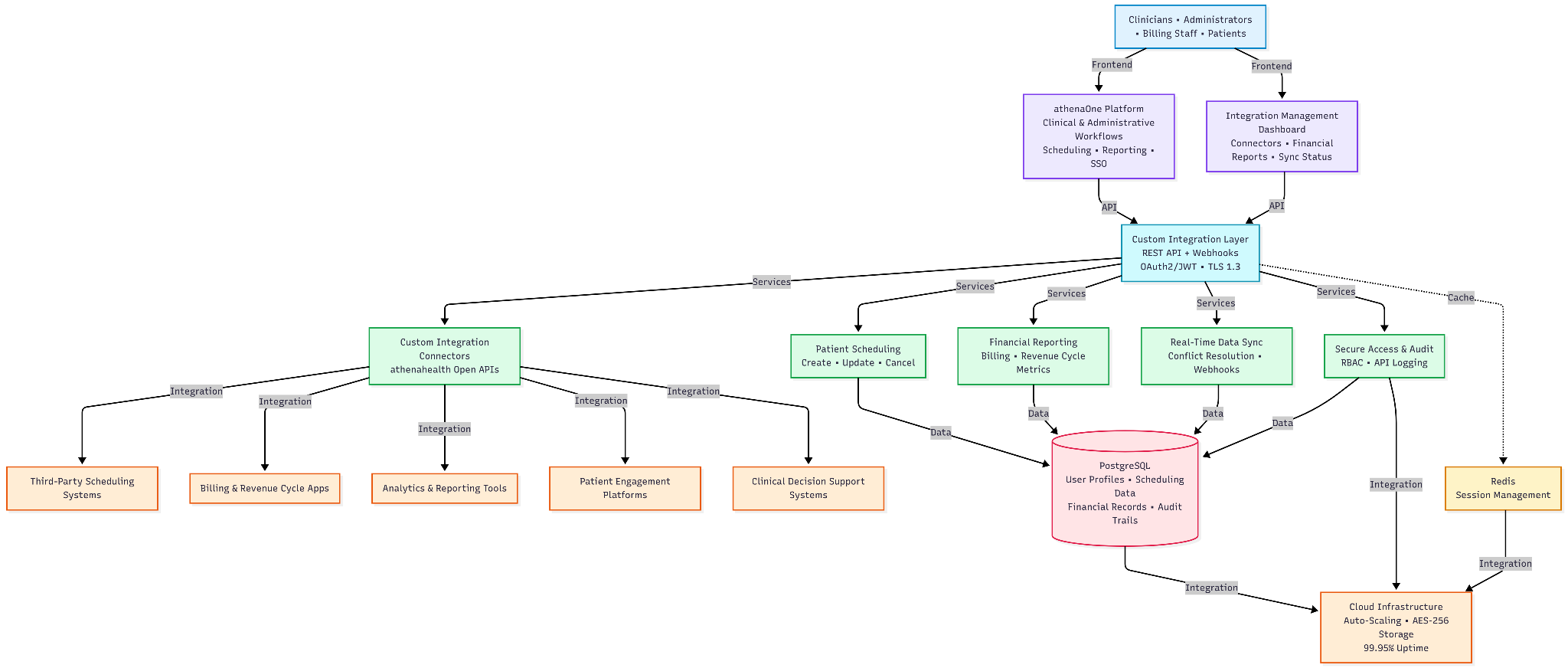
Combined user interface for clinical & administrative workflows. Functionality – automated scheduling interface for patients, financial reports dashboard, external applications data integrations, single sign-on (SSO), contextual data rendering.
REST API & Webhook services. Services – automated scheduling interface for patients, financial data aggregation, integration services for workflows, data sync engine, secure API gateway, auditing. API throughput – 6,200+ reqs/min.
Scheduling systems, billing applications, analytics & reporting systems, patient engagement platforms, decision support system.
Users’ profiles, scheduling data, financial data, integration data, audit trail.
Cloud-based with auto-scaling. Data storage security with AES-256 encryption. Uptime 99.95%. 15-min RTO with Terraform, <5-min RPO.
The healthcare industry uses multiple third-party applications that require integration into athenahealth's system.
Created custom connectors by leveraging athenahealth's APIs. Seamless data integration for scheduling, billing, reports, and patient engagement. Highly extensible and maintainable.
Results: 277,000+ clinical integrations, smooth data flow between systems.
Manually schedule appointments in different systems was inefficient.
API orchestration to automate appointment scheduling between external applications and athenahealth's scheduling system. Appointment booking, updates, and cancelation in real time. Eliminate manual data entry and scheduling conflicts.
Results: Decreased administrative efforts, increased accuracy of scheduling.
Siloed financial data hindered reporting processes.
Created automated data extraction and consolidation processes for financial reporting. Real-time synchronization of billing and revenue cycle data. Custom dashboards with drill-downs capabilities.
Results: Real-time financial insights, decreased reporting time.
Health care data is subject to HIPAA compliance and encryption.
OAuth2 authentication and role-based access control. TLS 1.3 encryption of all API communications. Audit logging for compliance needs. 98.4% clean claim submission rate provided by athenahealth.
Results: HIPAA compliant, no security incidents.
Inconsistent or outdated data across multiple systems results in mistakes.
Real-time data synchronization via secure API orchestration. Automated conflict management. Notifications via webhooks for significant events.
Results: Consistency of data across multiple systems
Unit testing using Jest (85% code coverage per commit). Integration testing using Postman (over 200 tests daily). Load testing weekly on staging using k6/Artillery. A degradation of performance above 10% on p95 prevents deployment.
Patient scheduling -> financial reports -> workflow integration -> data integration. User distribution: 50% clinical workflows, 30% administrative workflows, 20% reporting/analytics.
Over 277,000 clinical integrations, over 160,000
PostgreSQL — 200 connections (pool: 20/node × 10 nodes). Redis — session management (80% hit rate). Auto Scaling — 10-node limit at 70% CPU.
RTO — 15 minutes (Terraform). RPO — <5 minutes (RDS Multi-AZ). Monthly DR testing.
Healthcare facilities deploy various third-party applications. Custom connectors built using the open APIs of athenahealth facilitate data integration.
277,000+ integrations, smooth workflows.
Manually scheduling appointments across multiple systems increases the possibility of errors. Secure API orchestration for appointment scheduling.
Fewer scheduling errors, efficiency.
Incomplete data in silos results in limited insights. Automated data extraction and aggregation for financial reporting.
Real-time financial insights, reduced reporting time.
Health care data needs stringent security measures. OAuth2 authentication, TLS 1.3, and audit logging.
98.4% clean claim rate, no security breaches.
Switching systems makes things difficult for users. Integration in athenahealth environment.
Productivity, less training time.
Outdated data results in errors. Real-time data synchronization with conflict resolution.
Consistency of data, informed decision-making.
Thus, integration of practice management has shown that custom integration connectors and secure API orchestration can add value to health care platforms.
• SUFFESCOM SOLUTIONS
Build Smarter. Scale Faster. Grow More.
Have a Vision? Let’s Turn It Into a Digital Reality.
Get a quick response from our best experts in under 10 minutes.
Suffescom easily understood our main goal and delivered the best digital solution. Their team was very cooperative, and it was a very good experience working with them. I would highly recommend them.

Working with Suffescom was a really great experience. Their developers demonstrated technical knowledge and delivered our mobile app solution with all required functionalities on time.

Suffescom helped us build a logistics software solution that completely improved our fleet operations. Their professionalism and transparency are what make them a reliable technology partner.

Share Your Requirements. Our Experts Will Shape the Solution.
• SUFFESCOM SOLUTIONS
Build Smarter. Scale Faster. Grow More.
Have a Vision? Let’s Turn It Into a Digital Reality.
Get a quick response from our best experts in under 10 minutes.
Suffescom easily understood our main goal and delivered the best digital solution. Their team was very cooperative, and it was a very good experience working with them. I would highly recommend them.
Working with Suffescom was a really great experience. Their developers demonstrated technical knowledge and delivered our mobile app solution with all required functionalities on time.
Suffescom helped us build a logistics software solution that completely improved our fleet operations. Their professionalism and transparency are what make them a reliable technology partner.
Share Your Requirements. Our Experts Will Shape the Solution.
• SUFFESCOM SOLUTIONS
Build Smarter. Scale Faster. Grow More.
Have a Vision? Let’s Turn It Into a Digital Reality.
Get a quick response from our best experts in under 10 minutes.
Suffescom easily understood our main goal and delivered the best digital solution. Their team was very cooperative, and it was a very good experience working with them. I would highly recommend them.
Working with Suffescom was a really great experience. Their developers demonstrated technical knowledge and delivered our mobile app solution with all required functionalities on time.
Suffescom helped us build a logistics software solution that completely improved our fleet operations. Their professionalism and transparency are what make them a reliable technology partner.
Share Your Requirements. Our Experts Will Shape the Solution.
Fret Not! We have Something to Offer.