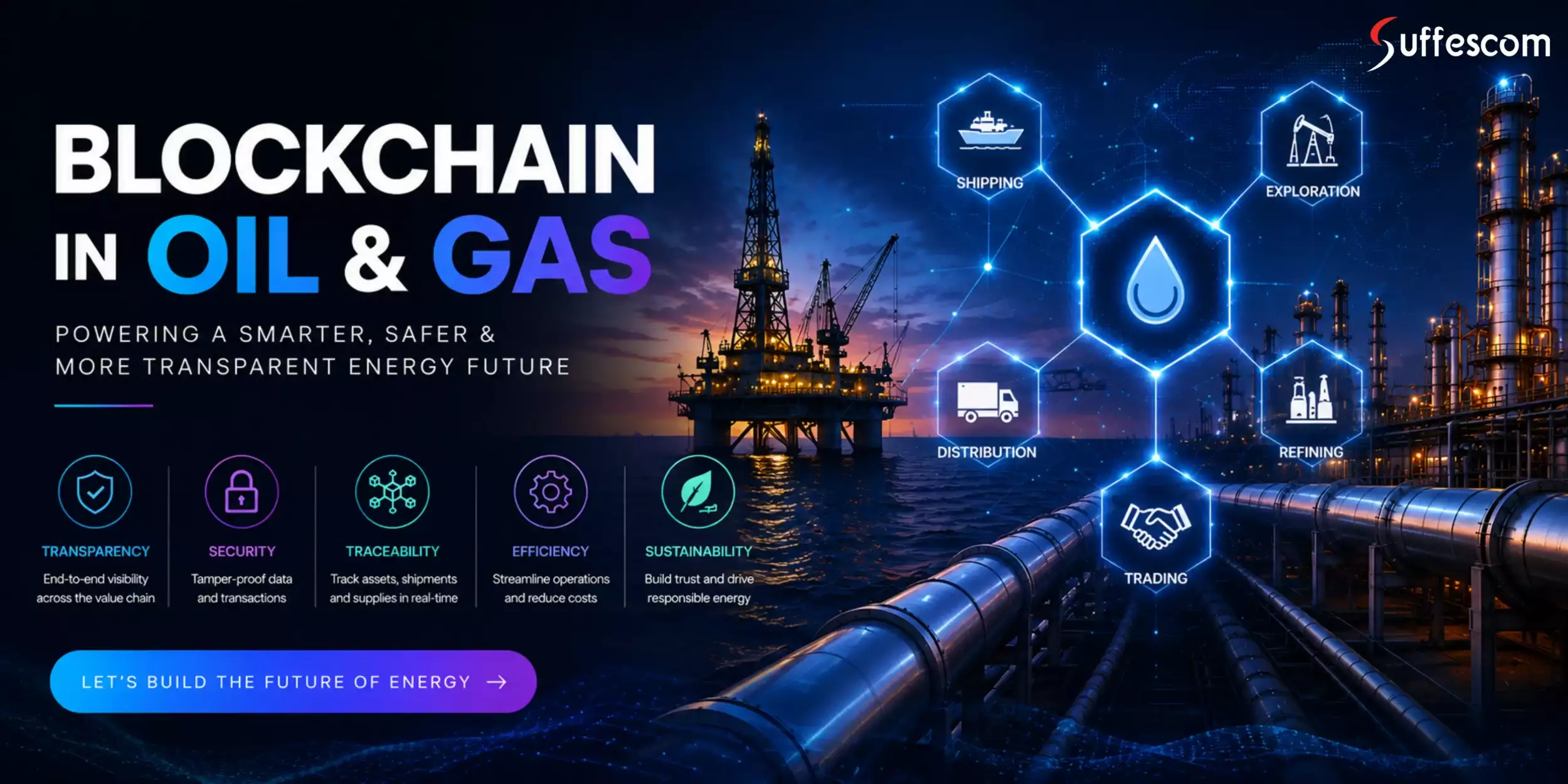
Key takeaways:
- Blockchain in oil and gas is past the pilot stage. Platforms like VAKT (backed by BP, Shell, Equinor, and Chevron) have been processing live crude oil trades since 2018.
- The clearest, best-documented gains are in trade settlement, smart contract automation, and compliance recordkeeping, not in exploration or drilling itself.
- Smart contracts (self-executing agreements that release payment automatically once agreed conditions are met) are the single most cited use case, because they remove the manual invoice-matching step that causes most trade disputes.
- Adoption is real but uneven. Legacy ERP integration, unclear digital-signature regulation in some jurisdictions, and a shortage of blockchain-literate staff are still slowing rollouts, even at well-funded operators.
- The market is projected to grow from $1.1 billion (2024) to $23.5 billion (2034), according to Market.US, driven by production systems replacing pilots rather than new pilots being launched.
Want similar results? → Get a Free Quote
No sector can ignore the power of blockchain technology! The Oil & Gas industry is the next name on the list that wants to leverage the potential of this compelling technology. The oil & Gas industry understands that blockchain allows new approaches for price discovery, cost-saving, improving the transaction processes, etc. Therefore, blockchain technology in the oil and gas industry is the latest buzz in the market that will entirely reshape the company’s working culture and improve the business outputs.
A survey was conducted by the Founder and Executive Director of the World Economic Forum, Klaus Schwab, which featured around 800 executives. Of these, 58% believe that more than 10% of the total GDP will be reserved for blockchain technology. And 55% of the gas industry executives agreed that blockchain technology is a must to attain a competitive advantage. At the same time, 47% accepted that the blockchain carries disruptive behavior for various industries.
Considering the pressure on this industry by the shareholders to cut down on the expenses while raising their income is quite high. That’s why the industry under this enormous pressure wants to consider the automation of the supply chain and transparency & security in the other operations to improve the system’s efficiency. And it ensures that the future of blockchain in the oil and gas industry is bright for sure!
Why This Matters Now
Shareholders are pushing oil and gas companies to cut costs while regulators are pushing them to prove environmental and safety compliance in real time. Those two pressures used to work against each other. Blockchain is one of the few technologies that addresses both at once: it automates away manual reconciliation cost while producing an audit trail regulators can verify instantly instead of requesting and waiting for.
That is the actual reason adoption has moved from experimentation to production in the last few years, not because blockchain is fashionable, but because it answers a cost problem and a compliance problem with the same infrastructure.
What Blockchain Actually Changes in Oil and Gas
Faster, disputed-free trade settlement. Every party in a crude oil or gas trade normally keeps its own ledger. When records disagree, which happens often across international trades with multiple intermediaries, settlement stalls while everyone reconciles. A shared ledger removes that step because there is one version of the transaction, not five.
Smart contracts that execute without a middle step. A smart contract is code that automatically carries out an agreement once its conditions are met. In oil and gas, that typically means: oil is delivered, a sensor or logistics system confirms delivery, and payment releases automatically. No invoice sitting in someone's inbox for two weeks.
Verifiable compliance records. Environmental checks, safety inspections, and emissions data get logged in a way nobody can quietly edit after the fact. Regulators and auditors can check the record directly instead of requesting documents and waiting on a response.
Cleaner land and title records. Land and mineral rights in this industry are worth enormous sums and are still, in many regions, tracked on paper or in siloed systems prone to error and, in some documented cases (Ghana and Georgia among them), forgery. A blockchain-based record makes ownership and transfer history harder to falsify.
Supply chain traceability. From drill bits to turbine components, oil and gas supply chains are long and hard to audit. Blockchain lets a company track a part or a shipment through every hand it passes through, which cuts down on counterfeit components and delivery disputes.
If your organization is evaluating any of these for a live rollout rather than a proof of concept, this is usually where the conversation with our blockchain development services team starts: which one of these five problems is actually costing you money today, not which one sounds most impressive in a board deck.
Real Deployments: Who Is Actually Using This
Most content on this topic describes blockchain in the abstract. Here is what is actually running in production.
VAKT. A blockchain-based post-trade platform backed by BP, Shell, Equinor, and Chevron, live since 2018. It digitizes the paperwork behind crude oil deals, so buyers, sellers, and terminal operators are working from the same record instead of reconciling separate ones. It remains one of the longest-running production blockchain systems in the industry, not a pilot.
ADNOC and IBM. Abu Dhabi National Oil Company partnered with IBM to track oil and gas production from the well to the customer, recording each step, including CO2 emissions, in real time. It shortens reporting time and gives ADNOC a verifiable environmental record instead of a periodic self-reported one.
Equinor and Data Gumbo. Equinor uses Data Gumbo's GumboNet platform to automate payments in drilling operations. Field sensors feed performance data (volume pumped, hours worked) directly into a smart contract, which releases payment once conditions are met. Data Gumbo has stated this reduced the number of manual touches in the supply chain from around 23 to 4.
Chevron and ConsenSys. Chevron worked with ConsenSys to manage joint venture accounting on a shared ledger, so partner companies see the same financial data at the same time instead of reconciling it after the fact. This speeds up revenue sharing and cuts the audit disputes that come from mismatched books.
Repsol. The Spanish energy company used blockchain to run internal quality control on safety certifications across its facilities, replacing manual checks. Repsol has reported a 40 percent reduction in error rates as a result.
OOC Oil & Gas Blockchain Consortium. Formed in 2019 by major operators including ExxonMobil, Chevron, ConocoPhillips, and Equinor, this consortium has run production pilots including a digitized voting and spending-authority system, aimed at setting shared standards so blockchain systems from different companies can actually talk to each other.
5 Blockchain Use Cases in Oil and Gas Industry
- Blockchain for Financial Transactions
- Smart Contracts
- Blockchain for Regulation and Compliance
- Waste Management & Recycling
- Blockchain for Performance-Based Contracts
- Blockchain for Energy Supply Chain Security
- Blockchain for Recording Land Use Rights
Challenges Oil & Gas Industry Faces Currently Blockchain Can Mitigate Are:
The industry applies advanced technologies for executing mechanical operations. Examples are hydraulic fracturing, 3D seismic extraction methods, etc. The supply chain & finances come under the back-office operations and are still suffering from the high cost and less transparency.
So consequently, these unresolved issues/challenges hamper the business processes:
- The outdated platforms and unreliable tools are still in use for resource trading and final products.
- Manual entry and supervision under the data management process are still popular in the oil and gas industry. It can lead to high chances of human error and security threats.
- Transactions involve sharing valuable documents, invoices, shipping documents, bank releases, etc., across various database collections.
- The companies face difficulties working in accordance with the global regulations and are still unsure whether the security needs are followed by the parties involved in the supply chain management. And blockchain in the oil and gas supply chain needs time to mitigate these issues.
Blockchain Technology in Oil and Gas Industry
Globally, Blockchain has recently experienced unprecedented growth as a result of rising cryptocurrency demand and increased digitalization.
It is no surprise that Blockchain is gaining traction in the oil and gas industry, given the wide range of applications and areas in which it may affect and impact the industry.
As the industry embraces sensor technology to its full potential, Blockchain enables the storage of transactions and accounting data directly on these devices. Blockchain substantially saves process time and ultimately transforms contracting by allowing secure cooperation by connecting assets directly to service contracts. While adoption is still in its early stages, the potential of Blockchain in the O&G sector is poised to soar once organizations discover its genuine potential.
Can Blockchain Prevent Oil and Gas Incidents?
The use of blockchain in emergency management and prevention provides more efficient and cost-effective methods of dealing with these hazards and decreasing casualties. Businesses can employ a decentralized network of IoT devices to generate alerts and promptly notify the appropriate personnel.
Blockchain technology can enable centralized storage for compliance documents and emergency response activities. Regulations can be implemented at any point in the technical process. Immutable proof reports keep the organization informed and allow it to track how safety measures are implemented. Seeing when an emergency alert was received and how quickly the team responded enables the improvement of fail-safe approaches and the prevention of repeat incidents.
Finally, blockchain emergency control applications in the oil and gas industry can help you save money on fines, prevent legal issues, cut costs on damage repair and cleanup, and enhance your company's environmental imprint.
Launch Your Own Blockchain-Based App For Oil Industry
Want to launch your blockchain based platform for your oil industry, then look no further away from Suffescom Solutions Inc. Our team of expert developers will help you create a platform which meets your business goals.
The Different Blockchain Oil and Gas Use Cases
Digitalization of Crude Oil Transactions
The oil and gas sector is complicated, with various stakeholders and partners, and each supplier keeps its ledger in accordance with its policies. Because each member in the supply chain duplicates a single contract, the transaction processes become wasteful. It is costly because the replication of work and the requirement for third-entity transaction validation raises the administrative expense for business and makes it powerless against cyberattacks because suppliers keep their own records.
The blockchain enables the contract to be included in the transaction database for asset transfer. The contract is considered done only after it has been validated and deployed by all parties. Blockchain facilitates information flow and automatically tracks each transaction.
It automates various accounting, financial, and compliance procedures, lowering operating costs and the frequency of transactional errors.
Data Storage & Management
The O&G industry is of a complex nature, and it is quite challenging for the companies to effectively manage records and coordinate the whole data at the site and between the stakeholders. With the integration of blockchain technology, data storage and management can become easy and well organized as all the information can be maintained in a single repository. Also, implementing smart contracts makes the whole process more automatic and eliminates the need for manually reorganizing the data into digestible chunks.
Implementing Smart Contracts
This industry handles the millions of oil tankers and millions of cubic meters of gas when sold and bought across the world every day. This humungous volume of oil and gas is being distributed at different locations globally. Therefore, the companies have started implementing smart contracts and blockchain platforms for cross-border delivery. Incorporating smart contracts can reduce paperwork, increase efficiency and save on expenditure.
The EVM(Ethereum Virtual Machine) and the smart contracts get the transaction requests and have the potential to start the new transactions by running the code in advance. Smart contracts immediately update the ledger status on the ethereum blockchain network and restrict data manipulation after confirming the operation. Also, it is entirely free from the interference of any third entity.
Waste Management & Recycling
Proper management of waste is still the biggest concern in most prominent industries. When it comes to the oil and gas businesses, the waste generated can be dangerous for humans and the environment too.
Therefore, the right way is to handle the waste management process with blockchain-powered solutions. These solutions make possible the optimization of the waste products, which promotes recycling in return and adds to the economic incentives. Through performance-based Contracts (PBC), the companies can improve the daily operations for waste management. Also, it can help the businesses in the long and short terms to align with the stakeholders to facilitate a more beneficial, safer, and better way.
Financial Rectifications
The transactions are confirmed at the end of the reporting period when the companies use the traditional systems. However, when the fusion of blockchain with the O & G industry happens, the auditors quickly receive the immutable records of the transactions in the financial territory, which assists the uninterrupted auditing for the companies.
The need to access multiple databases ends with the blockchain introduction due to the distributed ledger technology, which also saves time and decreases the chances of human errors.
Commodity Trading
Trading oil and gas products can be challenging because crude oil is one of the most widely exchanged commodities in the modern economy. Currently, businesses collect, manage, and record data using proprietary systems to carry out these exchanges. Oil & gas corporations maintain several intricate and segregated ledgers to track commodities trading. These decentralized systems are challenging, expensive, and frequently vulnerable to manipulation and threats.
Commodity traders benefit from greater dependability and auditability, improved access to data, and increased exchange speed when they trade physical commodities on a Blockchain solution.
Automatic payments occur at the time of delivery as per the agreed-upon contract. The distributed ledger makes the transaction data accessible to all participants and the system operator. Few companies are already developing a platform for trading energy commodities to make use of the blockchain's potential.
Why stay behind your competitors? Build your blockchain-powered solution for efficient management with our assistance. We have expert blockchain developers to deliver high-quality results under your budget! Reach us Now!
Supply Chain Transparency
Blockchain in the oil and gas supply chain is another major use case that can bring unparalleled transformation in the company’s supply chain management operations.
Suppliers, producers, and distributors on the physical side are all involved in oil and gas operations. Support streams are necessary for the logistics chain's billing, paperwork, and regulatory needs. Due to these problems, companies are now looking for strategies to improve transaction processing and the supply chain.
IoT devices, combined with blockchain and smart contracts, have the potential to transform the current oil and gas supply chain. Distributed storage and embedded smart contracts enable transparency. High security can be added to the oil supply chain with the help of smart contracts and IoT devices.
Regulatory Compliance
Every country has strict and bulk rules/regulations for the oil and gas industry to save the environment and malicious activities. Therefore, the usage of blockchain technology in this field will bring maximum transparency as the transactional details are stored on the blockchain networks and offer real-time access to the participants on the blockchain network.
Enhanced transparency and better management align with the reporting frameworks that come under the regulatory compliance of the countries. Blockchain incorporation can prevent the companies from getting into the hardships related to compliance by supporting sharing of the attestations, certifications, and reports on time and without errors.
Land Record Management
Land investments are worth millions of dollars in the oil and gas industry. So, managing the land sale records is a daunting task. Manually or with the existing technology, handling the records is prone to errors and forgery. However, with blockchain integration, the data can be stored safely on immutable records showing the ownership of the land, land value, and transfer details. The examples of high land forgery cases are in Ghana and Georgia, per the studies and history. To make this condition better, blockchain solutions are the most feasible choice.
Build Ultimate Blockchain-Based Platform For O&G Industry
Take your oil and gas business to new heights with our blockchain development services. Our blockchain developers will help you build a platform which meets your goals and business needs.
Ending Note: Future of Blockchain in Oil and Gas!
The most trustworthy platform for the industries right now is none other than “blockchain.”The energy companies choose it over any other emerging technology due to its unmatchable benefits. In other words, we can proudly say that the new age O & G industry will catch success with the fusion of blockchain technology with their business processes. The rising acceptance of blockchain technology in the oil and gas industry to increase the quality will surely make your mind adopt this trend.
So, if you are interested in building blockchain-powered solutions for your energy business, then dont delay any more and partner with an experienced company like Suffescom to start your dream project and skyrocket your business. When you want to integrate blockchain technology into the oil and gas industry, we are the ones that can help you excel in this business with innovative and advanced solutions!! Get In Touch!!
FAQs
1. How does blockchain improve oil and gas supply chains?
Blockchain ensures transparency by tracking shipments and automating logistics with smart contracts, reducing fraud and delays.
2. Can blockchain reduce costs in oil and gas?
Yes, by automating transactions, eliminating intermediaries, and reducing manual errors, blockchain cuts administrative expenses.
3. Is blockchain secure for oil and gas data?
Blockchain’s cryptographic protocols and decentralized structure make it highly secure against cyberattacks and data tampering.
4. What are smart contracts in oil and gas?
Smart contracts are self-executing agreements on the blockchain that automate processes like payments and deliveries, ensuring trust and efficiency.
5. How does blockchain help with regulatory compliance?
It provides real-time, immutable records of compliance data, making it easier to meet environmental and safety regulations.