+971-8000321216



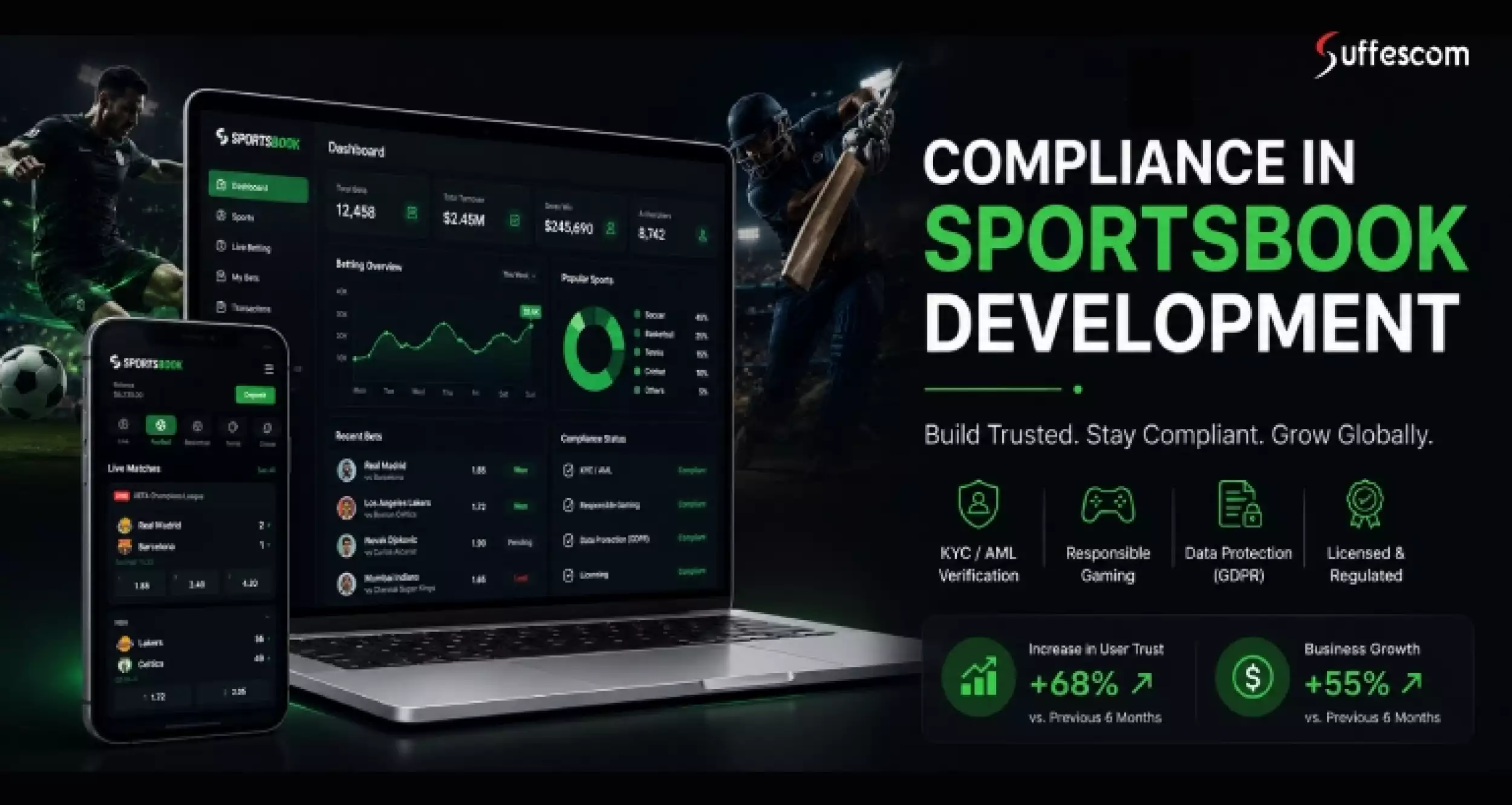
In today’s world, sports betting compliance is about user trust and authority. The betting market is highly regulated and demands strict legal measures. Thus, it's important for sportsbook software businesses to understand these regulatory compliances to avoid unlawful troubles, safeguard user data, and maintain a reputable brand image, and sportsbook software development fits perfectly within this framework.
The concern we are referring to is that you need to navigate the complex landscape of laws and regulations that vary by jurisdiction. A slight misstep and you may end up with substantial penalties.
This guide specifically targets this sector. Here we will walk you through the legal ecosystem of sportsbook software development, including data privacy, security, fraud prevention, advertising, marketing restrictions, and more essential insights.
Decoding the Legal Landscape of Sportsbook Software
The legal landscape of sports betting software mandates strict adherence to Anti-Money Laundering (AML) protocols, fragmented regional regulations, geolocation verification, and data privacy laws. Operators must ensure their tech stack is fully regulated and equipped with legally compliant APIs for secure payment processing, age verification, and responsible gaming.
Core Compliance Pillars
I. Geolocation & IP Blocking: Operators must implement strict geo-restriction compliance measures to ensure betting services are only accessible in legally approved regions. For example, US betting platforms require users to be present physically in the state to place bets.
II. KYC & Age Verification: “Know Your Customer” workflows must verify the user's identity to ensure sports betting compliance with legal age requirements. Valid identity proof, such as a Social Security Number (SSN), is typically required.
III. Data Protection: Data is a critical asset in the betting industry. Managing this asset ensures robust compliance with privacy frameworks, such as the GDPR.
IV. Responsible Gaming: The software must include features like deposit limits, self-exclusion options, and reality checks to promote Responsible Gambling (RG).
Stay Ahead with Compliance-Driven Sportsbook Development
Federal vs. State vs. Regional Licensing
| Factor | Federal | State | Regional |
| Scope | Sets nationwide legal boundaries | Grants market-entry permission per state | Enables cross-border international operations |
| Software Obligation | Interstate data & payment restrictions | Geolocation, KYC, state-specific reporting modules | Multi-currency, multi-language, jurisdiction-specific rule engines |
| License Issuer | No federal sportsbook license exists | Each state independently post-PASPA (2018) | Independent international regulatory bodies |
| Developer Priority | Hardcode legal payment & data flow limits | Implement a configurable compliance layer that can adapt to different state rules (geolocation, KYC, reporting) | Design jurisdiction-agnostic scalable framework |
Types of Sportsbook Licenses and What Each Legally Permits
Sportsbook licenses are typically categorized by their business model, operational platform, and specific regulatory jurisdictions. They are differentiated into five main types:
1. Operator License
What It Is: A mandatory legal authorization required by businesses to offer betting services to users that aligns with the regional legal obligations.
Who Needs It: Key executives and directors, significant stakeholders, technology and platform providers
What It Legally Permits
- Real-money sports wagering
- Securely accepting wagers
- Establish betting odds
- Process payouts within a specific jurisdiction
2. Vendor/Supplier License
What It Is: Another mandatory legal authorization for sportsbook businesses aiming to offer goods, technology, or services to licensed sports betting operators instead of users, unlike operator licenses.
Who Needs It: Software providers, data providers, payment processors, marketing/media affiliates
What It Legally Permits
- Software and platform integration
- Data provision and odds compiling
- Hardware supply
- Ancillary and peripheral services
3. Management Service Provider (MSP) License
What It Is: Mandatory license required by sportsbook businesses to operate, maintain, and manage key aspects of the betting software on behalf of a licensed master/retail casino operator.
Who Needs It: White-label providers, managed trading & risk services, payment processors, key executives & significant vendors
What It Legally Permits
- Platform provisioning
- Backend management
- Odds & risk management
- Third-party integrations
4. Key Employee License
What It Is: A regulatory certification required by senior-level officials in a sports betting company to ensure the industry’s integrity, rigorous background checks, and continuous oversight.
Who Needs It: Executive management, directors and board members, core financial and compliance roles, operational managers, and significant investors
What It Legally Permits
- Corporate governance
- Operational control
- Financial oversight
- Regulatory liaison
5. Online / Mobile Betting License
What It Is: An online and mobile sports betting license that authorizes a business to operate sportsbook platforms legally.
Who Needs It: Sportsbook operators and B2C platforms, game developers and B2B software providers, payment processors and financial gateways, affiliates and advertising networks
What It Legally Permits
- Real-money wagering
- Corporate advertising
- Commercial partnerships
- Player data processing
How to Get a Sportsbook License for Businesses?
Getting a sportsbook license requires businesses to undergo strategic steps and meet sports betting compliance, apart from regulatory approvals. The typical timeline ranges from a few weeks to several months, depending on the business model and chosen jurisdictions. For companies investing in online gambling platform development with regulatory compliance, obtaining the right sportsbook license becomes the foundation for legal operations and long-term scalability.
Step 1: Choose Your Jurisdiction
The first step to acquiring the sportsbook license is to choose the right jurisdiction that aligns with your project’s budget and long-term business goals. In general, some jurisdictions are suitable for startups due to their lower registration costs, while some jurisdictions are better suited for large enterprises due to their extensive treaty networks. You must apply directly through the state gaming or lottery board of the respective entity, which often mandates in-person presence and tax compliance.
Step 2: Prepare Financial and Corporate Documents
Once you have chosen your preferred jurisdiction, prepare the necessary documents to demonstrate your eligibility for the sportsbook software. Financial documents are generally required to prove that you possess the required funds to operate the sports betting platform. The key documents include:
- Proof of incorporation (Articles of Association, Certificate of Incorporation)
- Certified financial statements
- Bank references
- Proof of sufficient capitalization
- Notarized fund sources
Step 3: Undergo Background Checks
The regional legal bodies perform background checks to verify and validate the information you provide. To meet this requirement, you must submit police clearance certificates, CVs, and government-issued ID proofs. Moreover, the local authorities may ask additional questions pertaining to your business integrity and financial stability.
Step 4: Meet Technical and Security Requirements
To maintain robust fair play and responsible gaming, the authorities require you to include features like self-exclusion and deposit limits into your sportsbook software. Additionally, you must also demonstrate the data security measures, such as encryption and fraud detection, and incorporate these as mandated by responsible gaming regulations.
Step 5: Submit Application & Pay Non-Refundable Application Fees
Submit the final application and pay the non-refundable fees (varied by jurisdiction) to the respective authority. At this stage, the regulator begins their formal review. During the process, they may ask certain questions and require you to submit additional documents. Abide by those requirements and wait for the final license to be issued.
[Disclaimer: This information is provided for general purposes only. Gambling and betting laws vary by jurisdiction. Always consult your regional licensed gaming attorney for better guidance.]
Data Privacy, Security, and Fraud Prevention
Modern gambling software compliance solutions combine data security, fraud prevention, AML monitoring, and regulatory automation to help betting businesses operate legally across multiple jurisdictions. Data privacy, security, and fraud prevention in sportsbook software rely on a combination of end-to-end encryption, AI-driven behavioral monitoring, and strict compliance frameworks.
1. Sportsbook Data Privacy Regulations
Sportsbook software isn’t only about collecting basic data (name, DOB, or address) but also about their behavior patterns, financial data, and responsible gambling data that play a key role in the user’s betting experience. This data is sensitive and demands strict measures for preventing breaches and unauthorized access controls. Moreover, to address the rapidly expanding cyberattacks, businesses must ensure all their data are strictly complying with the regional jurisdiction laws.
Core Data Privacy Principles
- A business cannot retain the data beyond the permissible time unless it is mandatory and as per user consent.
- The user has the right to modify, add, or delete their personal information at all times within the sportsbook repository.
- Businesses must enforce all the security measures on the data.
2. Sportsbook Platform Security
For optimal platform security, the sportsbook businesses should integrate robust security measures and adhere to globally accredited standards. It serves as the key foundation of the business models. Without adequate security standards, the sportsbook software business cannot legally operate. A few of the critical security measures include encryption, Identity and Access Management (IAM), network security, and Distributed Denial of Service (DDoS) protection.
Key Security Standards
- ISO/IEC 27001: Internationally recognized standard for Information Security Management Systems (ISMS) to help betting companies manage sensitive information securely, mitigate cyber risks, and ensure strict compliance.
- PCI-DSS: The international security standard mandated specifically to safeguard cardholder information.
- NIST Cybersecurity Framework: a voluntary, globally adopted framework created by the U.S. National Institute of Standards and Technology to help organizations manage and reduce cybersecurity risks.
- GLI Certification: An independent testing company that checks if the software is fair, secure, and fully compliant.
- RNG Certification: Mainly required to ensure the Random Number Generator (RNG) produces fair and unpredictable results.
- Audit Logging: Monitoring the system that keeps track of every action taken in sportsbook software.
- Jurisdictional Licensing: A legal approval required to execute the sportsbook software in a specific region or country.
3. Sportsbook Fraud Detection Standards
Fraud is a constant threat in sportsbook software. Malicious users leverage automation, synthetic identities, and coordinated rings to exploit different data points for performing illegal activities. Automated fraud prevention is not optional—it’s a mandatory requirement.
Different Types of Fraud in Sportsbook Software
- Bonus Abuse: Fraudsters impersonate different digital identities to claim welcome bonuses, referral rewards, and other promotions, leading to enormous losses.
- Account Takeover (ATO): Fraudsters steal users’ credentials through data breaches and use those credentials to log in through a legitimate player’s ID (often referred to as credential stuffing).
- Synthetic Identity Fraud: Fraudsters take a hybrid approach by stealing users’ data and using that fabricated information to sneak critical parametric checks like KYC.
- Match Fixing and Insider Betting: Players, referees, or insiders manipulate the event’s result and utilize that known result for betting.
- Money Laundering: Fraudsters use their illicit funds in sportsbook betting to make them legitimate and bypass formal legal verifications.
Payment Processing Regulations
Sportsbook software represents the intersection of technology and finance. Safe and secure payment gateways help a sports betting website perform seamless transactions and demonstrate strong brand loyalty.
Importance of Payment Compliance in Sportsbook Software
Legal Licensing and Market Entry: Maintaining payment compliance enables companies to obtain and maintain their operator license seamlessly, a compulsory requirement for sportsbook businesses.
KYC and AML Enforcement: These sports betting compliances allow businesses to verify player identities and monitor transactions for suspicious activities.
Payment Processing Reliability (PCI-DSS): They help businesses adhere to PCI-DSS, a critical payment regulatory standard that enables them to facilitate seamless transactions through payment cards.
Player Trust and Retention: Bettors demand fast and transparent deposits and withdrawals. Modern online casino compliance software uses secure encryption and tokenization to safeguard user data against cyber threats.
Compliance Considerations for Crypto Betting Payments
KYC and Identity Verification Requirements: Even with crypto payments, Sportsbook businesses should verify the user’s identity through methods like KYC before processing transactions.
Jurisdiction-Specific Crypto Regulations: The crypto laws and regulations shift with jurisdiction. As a sportsbook operator, you must ensure these transactions comply strictly with local regulatory standards.
Secure Wallet and Payment Infrastructure: Businesses should implement secure measures like multi-signature wallets and fraud monitoring mechanisms to safeguard digital assets.
Fraud Prevention and Risk Management: Sportsbook businesses must deploy advanced fraud detection systems to identify high-risk wallets, unusual transaction behavior, bonus abuse, and unauthorized account access attempts.
How to Choose the Right Compliant Payment Gateway Provider
Verify Licensing and Security Standards: Verify the provider’s adherence to PCI-DSS and check if they utilize tokenization to safeguard player data.
Review Fee Structures: Sportsbook payment gateways often carry higher processing and chargeback fees. Assess whether the provider charges setup fees, monthly maintenance, or a percentage per transaction.
Assess Technical Integration: Analyze the accuracy of their sportsbook platform’s connectivity with your chosen APIs.
Research Industry Reputation: Partner only with established aggregators, and review their online feedback and case studies.
Responsible Gambling Software Requirements
Responsible gambling software requirements are mandatory frameworks integrated into sports betting website to protect players from gambling addiction and ensure businesses comply with age restrictions in the betting industry. Modern sportsbook platforms rely on responsible gambling tools to protect users from harmful betting behavior and maintain regulatory compliance.
Legally Mandated Responsible Gambling Software Features
Deposit Limits: Allow users to set daily, weekly, or monthly deposit caps to control excessive or harmful gambling spending.
Self-Exclusion Options: Allow users to block themselves (for a particular duration or permanently) to restrict harmful gambling behavior and prevent financial losses.
Age and Identity Verification (KYC): Prevents illegal underage gambling through automated KYC checks.
Reality Checks/Session Timers: Display regular pop-up reminders on users’ spending, session duration, and wins/losses to promote responsible gambling.
Time-Out/Cool-Off Periods: Provides a temporary account break for users (often 24 hours to 7 days) from betting activities. Different from self-exclusion options in terms of tenure length.
Technologies Driving the Responsible Gambling Framework
AI-Driven Risk Assessment & Behavioral Monitoring: Automatically detect suspicious activities in betting and report fraudulent transactions in real-time.
KYC & Automated Digital Onboarding: Perform biometric authentication and AI-powered document verification to prevent underage betting and fraudulent access.
Self-Exclusion & Player Control Tools: A comprehensive toolset of safety features that helps users control their betting habits.
Blockchain for Transparency & Audit Trails: Leverage blockchain technology to record tamper-proof betting transactions.
RegTech & Compliance Automation: Modern online casino compliance software utilizes smart digital systems to automatically follow gambling laws, monitor financial risks, and maintain real-time regulatory compliance.
Consequences of Responsible Gambling Non-Compliance
Financial Penalties and Fines: Regulators often issue financial penalties to non-compliant sportsbook software operators that include the inability to conduct adequate affordability checks or ignore self-exclusion protocols.
License Suspension or Revocation: Without a license, no betting business can function. In critical cases, the license can be temporarily or permanently suspended depending on the severity of the violation.
Criminal Liability and Imprisonment: Beyond corporate entities, top-level management, such as executives and CEOs, may face criminal liability for allowing illegal betting activities.
Operational Disruption and Reputational Damage: Non-compliance can also lead to reputational damage and erode the brand’s trust. Additionally, the payment gateway providers are banned from providing their services to the respective sportsbook platform.
Key Compliance Challenges in Sportsbook Software Development
Sportsbook software development is inadequate without meeting necessary regulatory requirements. Compliance helps to position your market presence among thousands of other competitors. Yet certain challenges arise that every sportsbook business must address regarding regulatory compliance. These challenges are dynamic and vary according to the operational complexity.
1. Fragmented Legalities
The Challenge: Sports betting is highly fragmented across legal frameworks. Strict compliance with varying local laws remains the foremost challenge for sportsbook businesses.
Suffescom Expertise: Integrate robust GPS and IP-tracking APIs to pinpoint a user's location. Additionally, we enforce strict geo-blocking to immediately restrict betting in the event of any violation.
2. Identity (KYC) and AML Controls
The Challenge: Preventing illicit activities such as bonus abuse and money laundering requires robust KYC measures and AML controls.
Suffescom Expertise: Enforces stringent KYC checks and real-time transaction monitoring systems to flag suspicious deposit patterns.
3. Responsible Gambling (RG) Features
The Challenge: Promoting responsible gaming to mitigate compliance risks requires user protection against gambling addiction.
Suffescom Expertise: Supports automated RG interventions and advanced responsible gambling tools such as customized deposits, panic buttons, self-exclusion periods, and regular reality checks.
4. Data Privacy Laws Compliance
The Challenge: Handling highly sensitive users' financial data requires businesses to adhere to data privacy laws, such as the General Data Protection Regulation (GDPR).
Suffescom Expertise: Implements secure database storage, end-to-end encryption (TLS/SSL), and strict data-retention and erasure policies.
5. Multi-Jurisdictional Frameworks
The Challenge: Operating across different licensed regions simultaneously means complying with distinct laws and regulations altogether. Such mandates require robust reporting standards and distinct technical requirements for each regulator.
Suffescom Expertise: Builds highly modular backend architecture that allows operators to easily toggle specific compliance modules.
Compliance-Related Questions to Ask the Vendor Before Setting a Deal
Choosing the right sportsbook software development company is the pivotal decision that impacts your business strategies and ensures your legitimacy within legal boundaries through safe and efficient operations.
1. Market Coverage Inquiry: What Specific Regulated Markets Are You Currently Living in?
Such questions are asked to assess whether the development company is adhering to all the gambling laws in the specific countries or regions you want to operate. Moreover, this question helps you analyze the company’s alignment with the rapidly changing landscape of betting operations.
2. Liability Clarification: Who Assumes Liability for Compliance Breaches?
This question is a must-ask inquiry for any sportsbook business to identify the entities responsible for any legal or compliance-related challenges. In numerous instances, the third-party creates a sudden compliance crisis, leading to unexpected legal troubles and burdensome paperwork.
3. KYC & AML Practices: How Do You Handle KYC and AML Processes?
Such queries aren’t overly critical, yet they carry similar weight compared to the above-mentioned questions. The sportsbook business wants to know whether the development company can easily verify user identities and prevent money laundering or other fraudulent activities. Effective AML/KYC for betting platforms helps operators maintain legal compliance while securing player onboarding and transaction monitoring.
4. Regulatory Update Management: How are Rapid Regulatory Updates Handled?
The gambling laws and regulations are volatile and can change quickly (often several times a week). Asking this question helps sportsbook businesses gauge how quickly the company updates the platform to meet dynamically changing regulatory requirements.
5. Responsible Gaming Features: What Responsible Gaming Features are Built Into the Platform?
Responsible Gaming (RG) is, undoubtedly, the operational cornerstone. By asking such questions, you are demonstrating your responsibility that goes beyond conventional operations. It helps sportsbook businesses to confirm if the development company has sufficient tools to promote safe gambling practices.
Develop Reliable Sportsbook Software with Legal Compliance
Conclusion
iGaming software development with regulatory compliance is a continuous operational commitment. As regulatory frameworks continue evolving globally, gambling license integration is becoming a critical component of scalable sportsbook software architecture.
By breaking down different sportsbook licenses and other aspects such as KYC, AML, data privacy, fraud prevention, and Responsible Gambling (RG), you position yourself at the forefront of the business without compromising the user’s trust and credibility. In the modern business landscape, such measures are indispensable.
As a responsible sportsbook business, you should prioritize both operations and sports betting compliances, which lay the cornerstone of the complete betting ecosystem.
Suffescom Solutions, the leading provider of robust, legally compliant sportsbook software development, empowers the betting industry with effortless solutions and unwavering integrity for 13+ years. Our key objective lies in promoting ethical and transparent practices, stepping beyond the conventional operational sportsbook betting mechanism.
FAQs
1) Can Sportsbook Software be Built Compliance-Ready From Day One?
Yes, sportsbook software can be built compliance-ready from the beginning through pre-integrated white-label and turnkey solutions. Custom-built solutions may also work, but they require localized frameworks during the initial architecture phase to display this compliance readiness.
2) How Does Regulatory Compliance Affect Sportsbook Software Development Cost & Timeline?
Regulatory compliance is a significant driver behind sportsbook software development cost and timeline. It can inflate development costs by $10,000 to $200,000+ and increase the timeline to several months from several weeks. Despite this, compliance remains the most critical asset for upgrading business credibility—the key parameter behind sustainable growth and navigating the competitive landscape.
3) What Role Does AI Play in Automating Sportsbook Compliance Workflows?
AI can convert sports betting compliance from retrospective, manual checking into real-time, automated oversight. It enables operators to instantly verify identities, monitor transactions for money laundering, detect abnormal betting patterns indicating fraud, and trigger responsible gaming interventions across multiple jurisdictions.