+971-8000321216



Suffescom provides advanced GDPR solutions for healthcare systems in order to secure patients’ data. This solution also supports a privacy-oriented digital transformation strategy. The growing need to enhance security measures for healthcare organizations demands data protection regulations to protect sensitive patient data.
Suffescom Solutions focuses on solving these industry demands by expanding its GDPR services for healthcare providers to build secure, scalable, and compliant solutions.
The GDPR compliance healthcare software aligns with modern healthcare confidentiality requirements. Such services are beneficial for hospitals, telehealth service providers, healthcare startup companies, and digital health enterprises. The alarming growth of healthcare-sensitive data has made GDPR an important role in maintaining the privacy and security of the data.
The Rising Need for GDPR Compliance in Healthcare
The management of sensitive patient information, online prescriptions, and virtual interactions between patients and doctors will demand secure software. The increasing digitalization in the healthcare sector, the potential risks to cybersecurity, and regulations have been rising.
GDPR-compliant healthcare confidentiality requires healthcare organizations to adopt secure processes for data processing, consent management, healthcare communication, and access governance.
Factors Increasing Priority of GDPR Compliance for Healthcare Data:
- Strengthen patient data confidentiality
- Improve healthcare cybersecurity
- Reduce regulatory risks
- Enable secure healthcare interoperability
- Support a compliant cloud healthcare infrastructure
Common GDPR Challenges Faced by Healthcare Organizations
Fragmented Healthcare Systems
It is common for health care institutions to have an array of disparate software systems, such as EHRs, patient portals, billing systems, and telehealth programs. The use of such software makes compliance and patient data management extremely challenging.
Legacy Databases
Healthcare institutions still utilize their legacy databases, which do not possess adequate security features. Legacy databases present difficulties when implementing data protection practices such as encryption and retention policies
Multi-Vendor Integrations
GDPR compliance issues arising from the use of third-party providers, cloud storage systems, laboratories, or insurance companies in healthcare ecosystems increase the risk of improper data handling and unauthorized access to such data.
Cross-Border Healthcare Data
Use of digital healthcare platforms to exchange patients' personal information across various jurisdictions imposes additional GDPR compliance requirements. It concerns ensuring the lawfulness of cross-border processing and the transferability of patient data across various jurisdictions.
Consent Complexity
In many cases, patient consent may be required for multiple health procedures or platforms. It means managing patient consent processes is more complicated in this context.
Audit Readiness
Achieving continuous audit readiness is difficult due to changes in compliance rules and the increased volume of healthcare information. There must be structures for monitoring, auditing, and documenting activities to demonstrate GDPR compliance during audits.
How Suffescom Integrates GDPR Compliance into Existing Healthcare Platforms
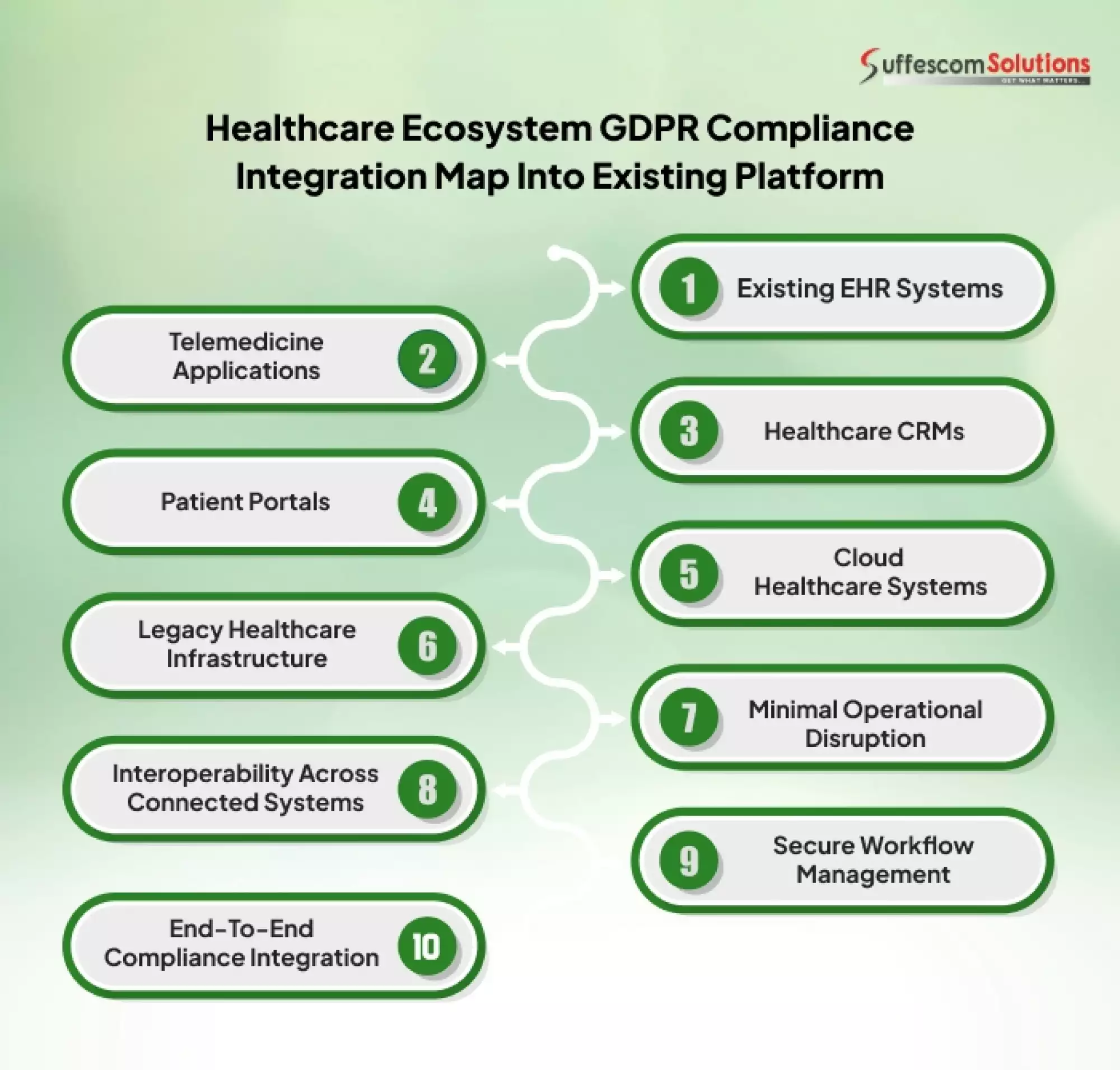
The approach of Suffesom focuses on an easy, direct integration method for GDPR compliance frameworks into existing digital ecosystems. It enables secure workflows, maintains interoperability between connected healthcare systems, and strengthens healthcare data governance.
The implementation process involves analyzing existing healthcare infrastructure, data flows and third party dependencies. It aligns with the operational requirements while minimizing disruption to daily healthcare processes.
Existing EHR Systems
GDPR compliance measures within the existing EHR system are implemented through encrypted data storage, access control policies, and patient consent tracking mechanisms. It ensures that sensitive medical records are secure while allowing authorized healthcare professionals to access patient information through workflows.
Telemedicine Applications
For telemedicine platforms, the GDPR compliance measures are integrated into appointment scheduling, virtual consultations and healthcare data sharing workflows to protect confidentiality during remote interactions.
Healthcare CRMs
CRM platforms process sensitive patient communication and engagement data. Suffescom integrates GDPR governance frameworks by enabling role-based access controls, patient communication and automated consent management with a compliant healthcare marketing workflow
Patient Portals
Patient portals are strengthened by the implementation of multi-factor authentication, encrypted login environments, secured patient record access and transparent consent management systems
Cloud Healthcare Systems
GDPR compliance through secure cloud governance, encrypted healthcare data transmissions, regional data storage alignment and continuous compliance monitoring systems. It supports secure healthcare scalability without compromising patient privacy.
Legacy Healthcare Infrastructure
Healthcare providers continue to operate on outdated systems that lack modern compliance capabilities. It involves modernizing legacy healthcare infrastructure by integrating secure APIs, automated audit mechanisms, and compliance-monitoring frameworks without a complete system replacement.
Minimal Operational Disruption
A phased integration approach allows healthcare organizations to implement GDPR compliance measures while maintaining uninterrupted clinical and operational workflows. It minimizes downtime and reduces disruption across healthcare environments.
Interoperability Across Connected Systems
Interoperability among interdependent healthcare platforms allows for the secure exchange of data among EHR solutions, telemedicine platforms, healthcare CRMs and third-party healthcare applications.
Secure Workflow Management
Incorporates identity management systems, role-based access control and encrypted communications with real-time monitoring mechanisms to improve the cybersecurity of healthcare organizations within the connected ecosystem.
End-to-End Compliance Integration
The integration approach will include consent management, audit preparation, data retention policies, access monitoring and breach detection mechanisms to ensure GDPR compliance of healthcare organizations.
GDPR Services for Healthcare Platforms Catered by Suffescom
Integrating GDPR principles into each stage of healthcare platform development enables healthcare providers to maintain operational efficiency and digital scalability. Suffescom delivers GDPR compliance healthcare platforms through a comprehensive, driven development approach.
The focus is on maintaining privacy by design, architecture, and secure healthcare software engineering. A team of experts also supports GDPR for healthcare providers by implementing advanced healthcare cybersecurity measures. These capabilities reduce privacy risks across modern healthcare systems.
- GDPR-compliant healthcare software development
- Secure healthcare cloud architectures
- Consent management systems
- Patient data encryption frameworks
- Role-based access control systems
- Audit logging and compliance monitoring
- Data retention and deletion workflows
- Secure API integrations for healthcare interoperability
Mitigate Privacy and Financial Risks with GDPR Services
Our GDPR services offer an end-to-end approach to data privacy, ensuring healthcare organizations deliver world-class care without compromising patient trust
Key GDPR Healthcare Confidentiality Requirements Addressed by Suffescom
Patient Consent Management
Helps healthcare organizations implement transparent consent workflows. It assists patients in managing how healthcare data is collected, processed and shared.
Healthcare Data Encryption
Integrates secure encryption protocols to protect healthcare information across cloud systems and patient communication channels.
Role-Based Access Governance
Control user base access through secured mechanisms to avoid the risk of data theft or cyber crimes.
Healthcare Data Retention Compliance
Address healthcare data retention requirements under the GDPR for healthcare organizations by implementing automated schedules and secure, compliant data deletion/archival mechanisms.
Audit Trails and Breach Monitoring
Establishes monitoring systems, compliance reporting frameworks, and breach detection mechanisms that support regulatory readiness.
GDPR Integration Across Connected Healthcare Ecosystems
Modern healthcare systems depend on platforms that ensure the seamless and secure exchange of healthcare data in real-time. Hospitals, telemedicine platforms, laboratories, pharmacies, insurance companies, and other healthcare applications consistently exchange patient data within the interconnected systems.
The Suffescom platform ensures GDPR-compliant interoperability by enabling the implementation of healthcare data exchange frameworks within interconnected healthcare systems. It includes HL7/FHIR integration, API-level security controls, consent synchronization, and secure connections with third-party healthcare applications.
The organization also helps in improving the governance of healthcare APIs with the use of encrypted communication protocols, role-based access management, and continuous compliance monitoring.
- HL7/FHIR integrations
- API security
- third-party healthcare apps
- cloud interoperability
- secure healthcare data exchange
Best Practices for GDPR Compliance in Healthcare
Healthcare organizations adopt proactive security and compliance strategies to protect sensitive data. Implementation of privacy-first operational frameworks strengthens healthcare cybersecurity.
Encryption
This phase is important because encrypting healthcare data during storage and transmission prevents unauthorized access to sensitive patient information.
Role-Based Access Control (RBAC)
RBAC frameworks restrict healthcare data access. It is based on user responsibilities, minimizing internal security risks and unauthorized access.
Audit Logs
It helps healthcare organizations to track system activity, monitor data access and maintain compliance readiness.
Data Retention Policies
Automated retention and deletion policies manage patient data according to GDPR storage limitations.
Multi-Factor Authentication (MFA)
Added a layer of identity verification to help secure healthcare systems and patient portals with multi-factor authentication.
Zero-Trust Access
It continuously verifies users and devices before granting access to any healthcare information.
Regular Compliance Assessments
Regular security audits and compliance assessments help healthcare providers to identify vulnerabilities and maintain GDPR readiness.
Emerging Technologies Transforming GDPR Compliance in Healthcare
1. Artificial Intelligence (AI)
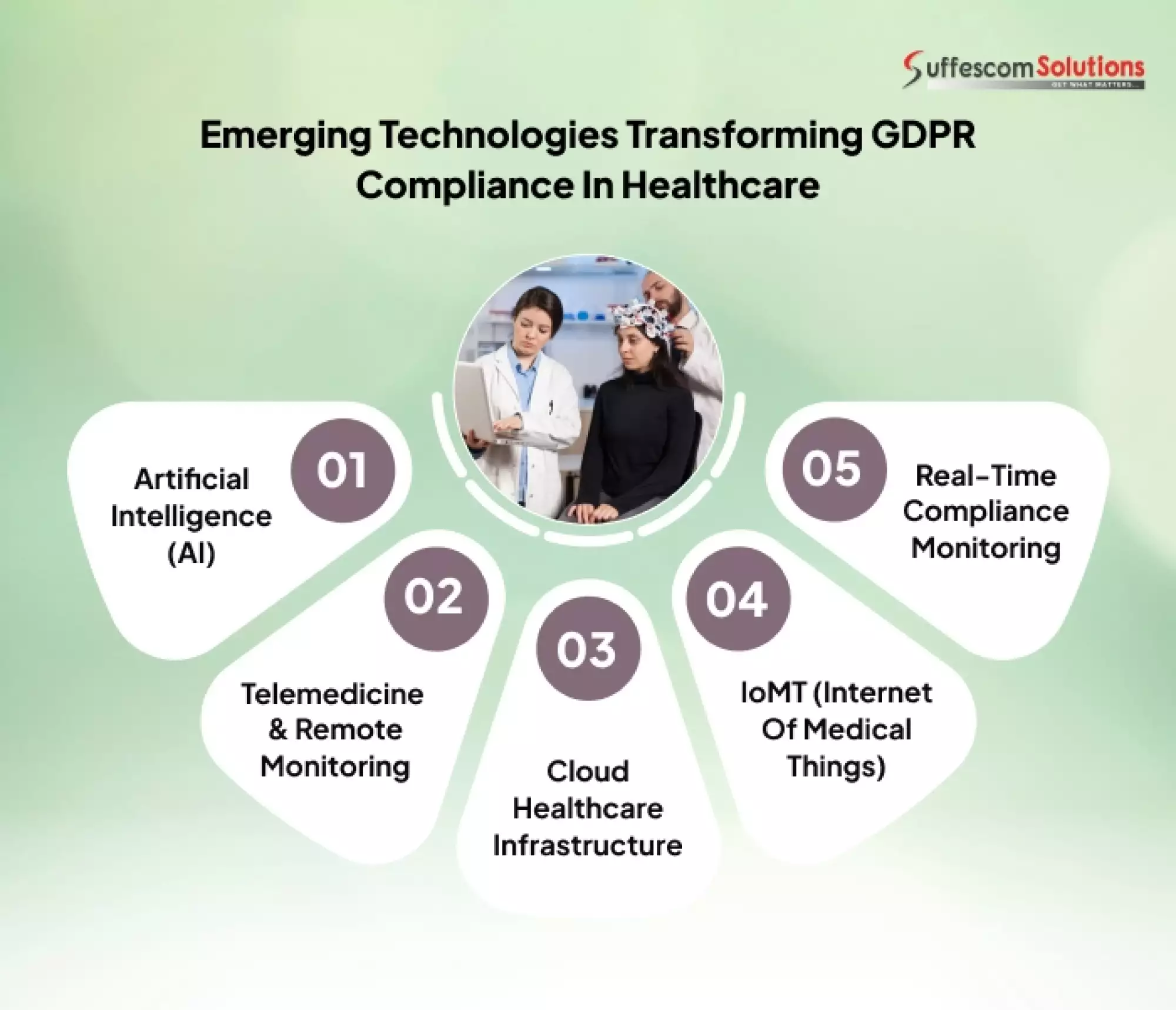
AI in the telemedicine industry, with GDPR healthcare systems, enables the processing of large amounts of patient data. It helps with diagnostics, predictive analytics, and treatment recommendations. It allows ethical use of patient data with transparent data processing and secure AI training datasets.
- AI diagnostics
- Predictive analytics
- Automated decision-making
- AI governance
2. Telemedicine & Remote Monitoring
Remote healthcare equipment and telemedicine software transmit and share sensitive patient data. GDPR compliance enables safe virtual consultations, encrypted communications, and remote processing of patient data.
- Virtual consultations
- Wearable devices
- Remote healthcare data security
3. Cloud Healthcare Infrastructure
The use of a cloud-based healthcare system enhances access as well as scalability within healthcare institutions. The use of GDPR compliant cloud environment requires secure data storage, healthcare encryption, and a GDPR compliance monitoring framework.
- Cloud governance
- Encrypted healthcare storage
- Data residency
4. IoMT (Internet of Medical Things)
Wearable and healthcare devices enable real-time collection of patient health information. The use of GDPR compliant IoT requires device-level security, API security, and patient data access.
- Connected healthcare devices
- Medical device data security
5. Real-Time Compliance Monitoring
Adoption of automated compliance monitoring systems detects security vulnerabilities and unauthorized use or access. Real-time monitoring frameworks help maintain continuous audit reports and strengthen cybersecurity operations.
- Automated compliance tracking
- AI-driven threat detection
- Continuous audit readiness
How Suffescom Becomes One of The Best GDPR Services Providers for Healthcare
The growing market presence of Suffescom Solutions is presented through its industry recognition and strong portfolio. By combining healthcare domain expertise with best practices strengthen their position as one of the best GDPR service providers.
- Over 250+ successfully delivered projects signify strong expertise in healthcare software development.
- Maintained a 4.9 rating on Clutch for enterprise-focused software development solutions.
- Received recognition as a next-gen healthcare platform provider from Yahoo for its innovative and customer-centric approach.
Leadership Perspective
“Today’s healthcare organization requires more than traditional compliance frameworks. Our GDPR services for healthcare providers are designed for improving patient trust, operational security, and building future-ready healthcare platforms with compliance embedded at every stage”, Gurpreet Singh Walia, MD from Suffescom Solutions.
About Suffescom Solutions
Suffescom Solutions, a leading AI healthcare software development company, delivers custom, AI-powered, and cybersecurity-driven solutions. The aim is to help businesses across industries to build scalable, secure, and innovation-focused digital ecosystems. The solutions are aligned with modern compliance and operational requirements.