+971-8000321216




Real estate is another industry that is undergoing a transformation phase. There are high stakes associated with investment in properties, and everyone looks forward to earning huge profits. You cannot afford to be risky with the properties that you deal with. If you have been using the conventional ways of analyzing the market and finding a good property, you need to think about changing your way of doing things. AI in Real Estate will offer new opportunities. Using AI tools ensures safe transaction and efficient management of properties along with other mundane jobs for the investor and seller. The rise in the use of AI applications is being witnessed because of the personalized recommendations that these apps offer in real estate. This means there is no need to visit the property physically to check it. Virtual tours of the property have become very convenient for real estate enthusiasts. However, there is more to come from AI in real estate. AI has allowed 49% of real estate businesses to cut down on operational costs. Leave all those stressful chores to AI, and see your real estate dreams come true!
Let's take you through some interesting facts on what is artificial intelligence in real estate, its uses in real estate industry, some best examples of using artificial intelligence in real estate industry, and many more. Discover the power of AI in real estate with this blog post and be a part of the new era.
Explore the Real-World Impact of AI in Real Estate
See how artificial intelligence is revolutionizing lending, property management, marketing, tenant screening, and more.
How AI Is Transforming the Complete Real Estate Industry
AI in Mortgage Lending
AI is changing mortgage lending through automation of credit evaluations, faster loan approval, and decreased chances of errors. It allows banks to evaluate many applications quickly without compromising on efficiency or adhering to regulations.
- Accelerated loan approvals through automated underwriting
- More accurate credit risk profiling using alternative data sources
- Reduced fraud risk with AI-powered identity verification
- Improved borrower experience through faster, transparent communication
Generative AI in Real Estate
The generative AI makes it possible for the real estate industry professionals to create property descriptions, copywriting, and visuals. The process of creating content gets faster while staying relevant and personalized to the target audience.
- AI-crafted email campaigns tailored to specific buyer personas
- Auto-generated, SEO-optimized property listings in seconds
- Virtual staging visuals generated without physical furniture
- Faster content iteration for A/B testing marketing materials
AI for Commercial Property Management
AI is revolutionizing commercial property management through predictive maintenance, energy management, and automated communication between tenants. It allows property managers to manage multiple properties with the same number of staff.
- Predictive maintenance alerts to prevent costly breakdowns
- Energy consumption monitoring to reduce utility expenses
- Automated lease renewals, invoices, and tenant notifications
- Real-time occupancy tracking for revenue optimization
AI for Tenant Screening
The screening of tenants through AI takes place in minutes with assessments of their past performance as tenants, financial stability, and behavior patterns. Such an approach is not only objective but also increases efficiency.
- Instant background and credit checks with higher accuracy
- Bias-free evaluation based on objective data criteria
- Fraud detection to identify falsified application documents
- Improved tenant-property matching for longer lease retention
AI in Construction and Real Estate
AI improves the planning process of construction projects and helps keep track of risks involved in real estate developments. In this way, AI aids in completing construction projects on time and within budget.
- AI-powered site feasibility analysis before ground breaks
- Real-time project monitoring using computer vision and drones
- Early risk detection to prevent delays and budget overruns
- Material demand forecasting for smarter procurement planning
AI in Real Estate Marketing
AI makes it possible for real estate marketing to be extremely personalized because of its ability to study customer behavior, search patterns, and engagement metrics. This means that the correct marketing message can reach the targeted consumers at the right time.
- Behavioral targeting to serve listings to the most relevant buyers
- Automated social media and ad campaign management
- AI-generated video walkthroughs for online property promotion
- Lead scoring to prioritize high-intent prospects for agents
AI-Powered Real Estate CRM Systems
AI-enabled CRM software aids real estate companies in managing their leads, automating follow-up activities, and analyzing interactions with clients. Real estate agents have lesser administrative activities to undertake.
- Smart lead nurturing with automated, personalized follow-ups
- Predictive analytics to identify which leads are most likely to convert
- Conversation tracking across email, calls, and chat in one platform
- Performance dashboards to monitor agent productivity in real time
Watch how AI is reshaping real estate with intelligent automation
How Does Artificial Intelligence in Real Estate Work?
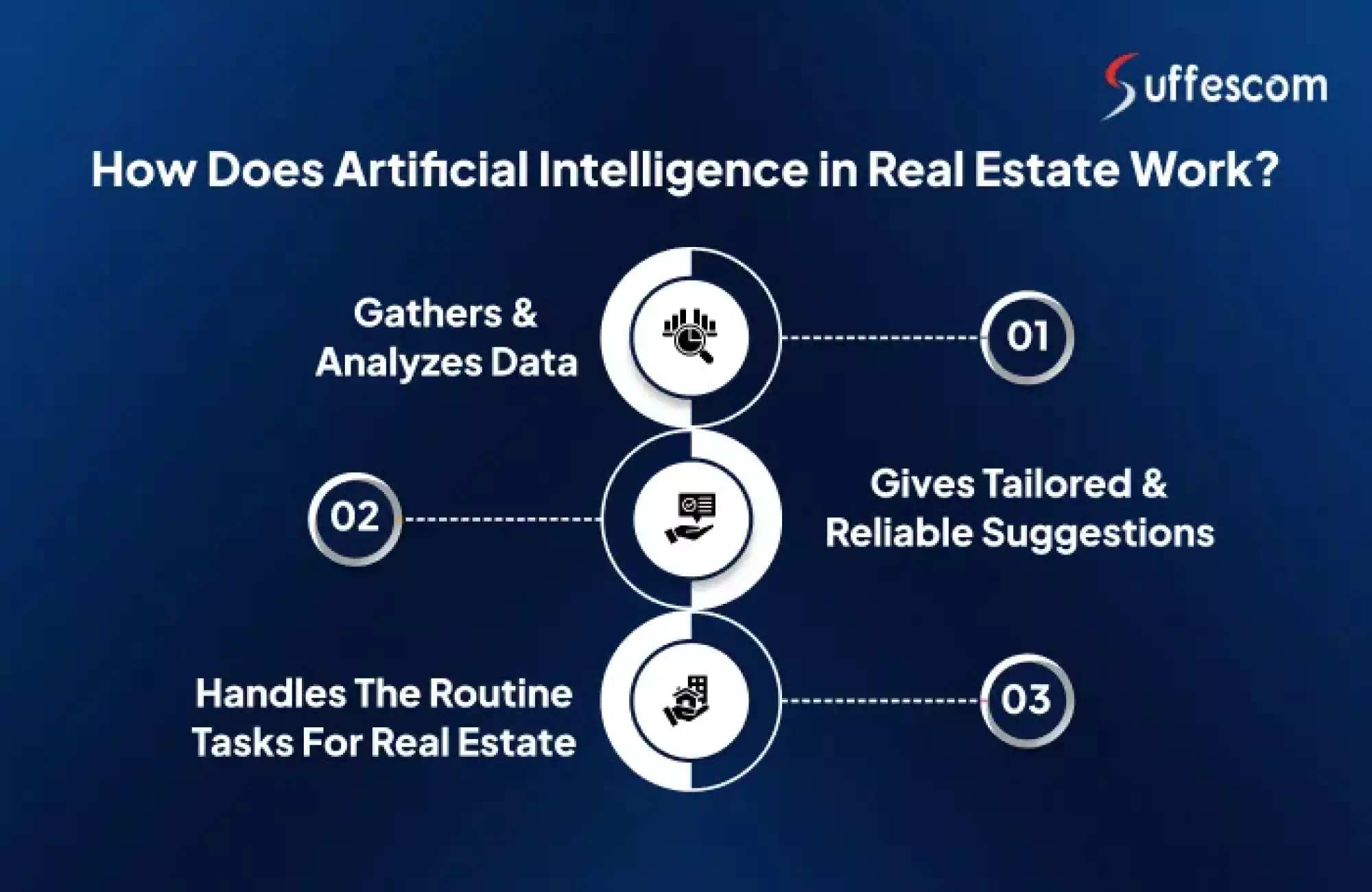
AI is truly a boon for the buyers, sellers, and investors in the real estate industry. It is because this high-level technology utilizes the concepts of algorithms and machine learning to produce accurate and reliable results. The huge data analysis that was required to analyze the market situation, find out the price of the property, and provide personalized recommendations can be done easily using AI. This way, you do not need to waste many hours working on the complex data. Here’s how AI in Real Estate works:
Gathers & Analyzes Data
The participants in the real estate sector require data for making proper decision and achieving their vision for the future. The process involved in collecting the data through the traditional means could prove to be very costly. The use of artificial intelligence would help in gathering the data to study the preferences of the buyers, market conditions, and also the historical data of the sale of properties. Such efforts would help the AI in making predictions about the future trend in the real estate industry.
Gives Tailored & Reliable Suggestions
Artificial Intelligence is helpful in the commercial real estate process, right from the start of the journey until its end. It offers tailor-made recommendations about investing or selling the property according to the user's choices. The Artificial Intelligence real estate apps can give the best recommendations to the investors by studying their search and behavior pattern related to previous property searches. With their help, they can purchase the property that will generate them regular income for the years to come. They even offer attractive content to the sellers for making an enticing listing.
Handles the Routine Tasks for Real Estate
Time and energy can be saved in the process of managing the property with the help of AI technology. This assists in making quick work of tasks such as organizing the documentation of properties as well as answering queries raised by investors. AI helps the buyers meet the sellers and make arrangements regarding the viewing of the property.
How to Use AI to Make Money in Real Estate?
AI has presented itself as an extremely efficient and data-driven way through which one can improve returns from their investments or real estate dealings. As a property flipper, manager of rental properties, or a lead generator, the use of AI can improve your performance by removing any guesswork involved.
AI Property Flipping Analysis
The AI looks at the historical sales figures, neighborhood trends, and renovation costs to find properties that are undervalued with the most potential for flipping. Investors can make decisions quicker with more data-driven confidence.
Predicting High-Growth Neighborhoods
AI models analyze changes in zoning, infrastructural development, migration, and economics to identify the emerging neighborhoods before they reach their peak levels. Early investors, who take advantage of such information, invariably beat market averages.
Automated Lead Generation
AI systems monitor constantly to detect possible buyers and sellers even before they become active players in the market. This is where agents and developers get an upper hand in highly competitive markets.
Vacancy Prediction
The AI system predicts future vacancies based on tenant behaviors, expiring leases, and absorption rates in the market. This helps property owners be proactive in finding new tenants to fill any vacated spots.
Portfolio Optimization
The AI analyzes the performances of all assets in your investment portfolio based on prevailing market situations, to give a decision whether to hold, sell, or buy. This guarantees that you are investing capital in the most profitable ventures.
Predictive Maintenance Cost Reduction
The AI sensors and monitoring devices recognize any signs of wear, equipment malfunction, and building damage. Scheduling repairs helps prevent any serious incidents from happening. It lowers costs of urgent repairs significantly and preserves the value of your property.
Reduce Cost Through Workflow Automation
AI streamlines processes that consume too much time, such as document management, collection of rents, inspection planning, and compliance documentation. Less cost spent on operations leads to better bottom lines for all your properties.
Ready to Revolutionize Your Real Estate Business with AI?
Build intelligent, scalable, and future-ready real estate software with Suffescom Solutions.
Benefits of Real Estate Software Development with AI Tech: Explained
There are many challenges that individuals face in the real estate industry. AI works miracles to address these pain points and spot the opportunities in the market. Wondering about how to use AI in real estate business?
Let’s look at some ways AI can be used in the real estate industry:
Determines the Market Value of Properties
The value of a property depends on the market conditions and the type of property. It can be hard to figure out the market value of a property due to the changing factors in the market. No need to get puzzled with the numbers! AI can examine the vast data to analyze the trends in the market. It can provide an accurate property value based on the detailed research of the market. This reduces errors and helps in making better decisions.
Virtual Property Tours to Engage Buyers
It can be inconvenient to arrange a physical viewing of the property due to the time and place barriers. These tours have started to gain much attention due to engaging visual elements. 3D property tours are no longer a fantasy. The mix of AI and virtual reality allows potential buyers to view every corner of the property with ease. It looks just like a natural setting, and the user feels as if they are actually walking through the property. AI personalizes the experience by ensuring that the property images match the buyer's liking.
AI Real Estate Chatbots for Property Search
Searching for a property might seem stressful while you look through several properties online or travel to visit multiple properties. AI Real Estate Chatbots
and Virtual assistants can help the investors to spot the right property for their needs. The chatbots can answer the user queries and provide the details about properties based on the user’s interest and liking. This helps to save investors from the hassle in the property search.
Creates Profitable Strategies for Investors
AI can help in effectively managing the portfolio for investors. AI real estate apps can look into the future and tell what’s next on the cards. It can predict how the components of the market will be. This allows the investors to implement a tailored strategy for investing in different properties to maximize their returns. AI creates a strategy based on what’s going on in the market currently. It can help investors make an informed decision while minimizing the risk in investment.
Handles Routine Tasks for Managing Properties
It can be hard to keep a constant watch on rental properties in different locations. Managing properties is one of the key applications of AI in real estate. Using AI can be beneficial whether you own a rental or a multifamily property. AI can help spot any potential issues in property that might arise in the future, which helps with early maintenance. It can streamline routine tasks like the collection of monthly rent and communicating with tenants. This improves efficiency in operations and saves time when handling tasks.
Produces Engaging Content for Property Listings
Creating property listings can be quite a headache for the sellers. AI systems like ChatGPT can be integrated into the existing systems to produce engaging and unique content for property descriptions in listings. These systems create content that matches the requirements of the target audience. This helps in catching the attention of the potential buyers and increases the property sales and revenue.
Top 5 AI-Powered Real Estate Software Platforms Streamlining the Industry
The real estate industry has seen a surge in AI-powered platforms that are redefining how professionals buy, sell, manage, and invest in properties. These tools eliminate manual effort, surface actionable insights, and give businesses a competitive edge in a fast-moving market. Here are five leading platforms that are setting the benchmark for AI in real estate:
Key Steps to Implement AI in Your Real Estate Business
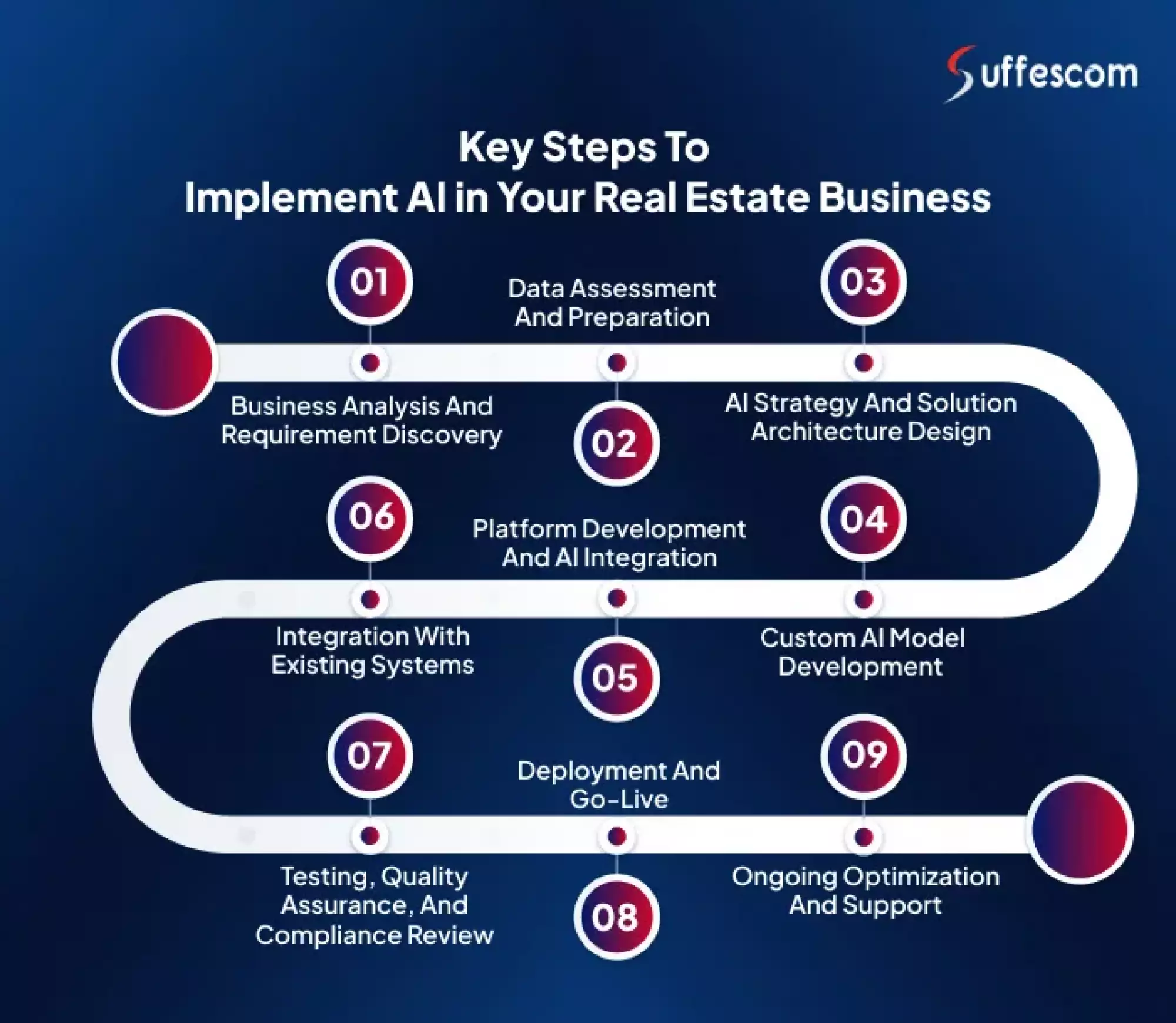
The process of embedding an artificial intelligence solution within a real estate company does not happen all at once; it is a systematic approach which begins with analysis of your existing processes and ends with implementation of intelligent technology to produce tangible outcomes. The following is an accurate roadmap for your success:
Step 1 — Business Analysis and Requirement Discovery
In order to successfully implement AI into your organization, the first step you must take is getting a clear picture of where you stand at present. This process involves a detailed review by your technology partner of your current processes, data infrastructure, challenges, and goals. The objective here is to determine the areas that would benefit most from artificial intelligence intervention.
The major output from this stage includes requirement documents, priority use cases based on their business value, and an analysis on feasibility by mapping AI functionalities to address your business problems.
Step 2 — Data Assessment and Preparation
AI models depend on the quality of training data. The first thing to do prior to any development is a thorough examination of all the current data sources that you have such as CRM entries, MLS properties, transaction logs, tenant information databases, and market news feeds. Any data shortages will be uncovered and a plan for collecting/enriching data sources will be established.
Also, data governance rules need to be determined, privacy compliance (e.g., GDPR or CCPA) needs to be ensured, and data pipelines need to be set up for AI model consumption.
Step 3 — AI Strategy and Solution Architecture Design
With the needs and data specifications clearly defined, the next step involves creating the system architecture. This involves determining which technologies are most suitable for your use case — whether these include machine learning to calculate valuations and make predictions, NLP for developing chatbots and generating content, or computer vision for offering virtual tours and analyzing property images.
System architecture is responsible for laying out all connections and integrations required between individual AI modules, and even third-party APIs and other data sources. A clear technology stack is finalized at this stage, along with a project timeline and milestone plan.
Step 4 — Custom AI Model Development
This is the stage at which the brain of your platform comes into being. Data scientists and AI developers create, train, and test custom models designed according to the needs of your real estate business. If it is going to be a model for property valuations, a lead generation algorithm, a content creation machine or a recommender – each is going to be thoroughly tested for precision and dependability.
Performance levels are gauged against industry benchmarks in order to verify that your AI delivers the expected business benefits.
Step 5 — Platform Development and AI Integration
The AI models are implemented in a completely functioning platform, which could be either a new platform that has been created from scratch or an intelligence layer added on top of your existing real estate software. Front-end UI, administrative tools, and functionality are being developed along with the backend AI architecture.
In this phase, we will also develop API for integrating your AI solution with external data sources like MLS systems, listings, financial data, and mapping services that enrich the intelligence your system delivers.
Step 6 — Integration with Existing Systems
Among the most important stages in case of real estate enterprises is making sure that new AI functionality is well integrated with other technology that is currently being used by you. This could be a CRM system like Salesforce or HubSpot, a property management system, an ERP platform, accounting software, or even marketing automation systems.
Data integration will happen with the help of APIs and middleware layers or custom integrations so that data can be exchanged in both directions. This means that your people won’t need to give up their favorite tools but, rather, will have their functionality improved by AI added to them.
Step 7 — Testing, Quality Assurance, and Compliance Review
Before launching any system, QA testing is done on its functional performance, data accuracy, security, and usability aspects. This includes conducting AI tests using various edge cases to detect potential failure points. Security tests are also performed to guarantee that all confidential property and client data is secured at all times.
In cases where the platform serves many regional real estate firms, compliance testing is done to ensure that all regulations have been adhered to concerning data protection and fair lending.
Step 8 — Deployment and Go-Live
The implementation process takes place in a well-controlled manner by conducting the launch in a series of steps, where the first step involves piloting before the actual implementation. This helps us to identify any other problems in advance to fix them during the implementation phase. Trainings will be provided to your teams on how to effectively utilize the AI technology.
The post-launch monitoring plan will monitor system performance and the accuracy of the models along with the usage statistics.
Step 9 — Ongoing Optimization and Support
AI is not an installation once-and-done technology. After the deployment phase, the system is regularly observed for signs of performance drift because of changing market dynamics. The process of regularly training your AI keeps it up to date and accurate. Additional capabilities are designed to meet the needs of users and your changing objectives.
A specially designated team of experts will help you grow through your AI-powered real estate platform.
Cost to Build a Real Estate System with AI Capabilities
The costs associated with developing an AI-powered real estate platform will depend on the number of features, level of customization, required infrastructure, and scalability of the system. Please find below the details of the main expense items to be taken into account:
Discovery and Requirement Analysis — $3,000 to $8,000
The above budget item includes a business audit, gathering requirements, feasibility analysis, and designing the solution architecture. This initial investment helps avoid any additional expenses resulting from mistakes in future implementation.
Data Infrastructure and Pipeline Setup — $5,000 to $20,000
The creation of the data layer including the data acquisition, processing, structuring, storing systems, as well as integration of data from external sources like MLS feeds or market data APIs, is essential groundwork that will have an impact on model performance.
Custom AI Model Development — $15,000 to $60,000
This often makes up the biggest part of the expense. Building and validating AI models to value properties, score leads, create predictive models, develop recommendation systems, and even deploy chatbots that use natural language processing involves a lot of work from data scientists and machine learning engineers.
Platform and Application Development — $20,000 to $80,000
Developing the complete application, including front end and back end architecture, administrator console, mobility, and API integration layers, represents a large chunk of the development cost. The cost span is based on the gap between a single-feature product and an entire suite of real estate features.
System Integration and API Connections — $5,000 to $25,000
Integration of the AI platform with other applications, such as CRMs, property management systems, accounting solutions, and even outside databases requires custom API development and middleware integration. It is based on the amount and technical complexity of applications to be connected.
Testing, QA, and Security Auditing — $4,000 to $12,000
All types of testing, such as functional quality assurance testing, AI accuracy testing, performance stress testing, security, and compliance testing, should not be negotiable, since they protect both your business and your users.
Deployment and Infrastructure Setup — $3,000 to $10,000
Cloud infrastructure deployment, configuration, monitoring, and go live assistance will be done within this phase. The expenses will depend on the chosen cloud service provider, traffic volume, and redundancy needs.
Ongoing Maintenance and Optimization — $2,000 to $8,000 per month
After launch, AI models need to be continuously retrained; there will be continuous security updates and performance tuning for the platform; and new features need to be developed. Monthly retainers account for the resources that are needed to sustain the competitiveness of the platform.
AI Enriched Real Estate Software System Development:- Why Only Suffescom Solutions
Suffescom Solutions is a top-notch company offering AI software development, which ensures customized AI solutions for realtors dealing with their challenges. Our state-of-the-art features in AI real estate applications guarantee smooth business operations and better gains. Unlock the full potential of your property with our AI development solutions!
FAQs:
1. What are the Benefits of Commercial Real Estate AI Apps?
Commercial real estate AI apps allow real estate professionals to make informed decisions for all aspects of their business. By analyzing vast amounts of data from multiple sources, AI can analyze vast data to predict market trends and identify investment opportunities.
2. Is There Any Challenge of AI Integration in the Real Estate Market?
One big challenge of AI integration in the real estate market is the lack of high-quality data. The effective functioning of AI models depends on the quality of data that your business gathers. Poor or inaccurate data can affect the performance of AI systems and might not give the relevant outcomes.
3. What are the Applications of AI in real estate listings?
There are many interesting applications of AI in real estate listings. AI apps can generate personalized property descriptions for real estate professionals to attract potential buyers and increase sales.
4. How to optimize for AI Overviews in real estate?
Real estate businesses can optimize for AI Overviews by publishing authoritative, structured content, answering buyer-focused questions, implementing schema markup, and maintaining accurate local property information.
5. How does AI improve sales conversions in real estate?
AI boosts sales conversions through lead scoring, personalized property recommendations, automated follow-ups, predictive analytics, and 24/7 virtual assistance that accelerates buyer engagement.
6. Does Suffescom provide fully compliant AI real estate software development?
Yes, Suffescom develops AI-powered real estate solutions with a strong focus on data security, regulatory compliance, privacy standards, and scalable architecture for businesses.