Key Takeaways:
- P2P payments continue to grow as consumers increasingly prefer fast, digital, and account-to-account money transfers.
- Secure transfers, authentication, payment integrations, KYC/AML workflows, and fraud prevention are essential components of a P2P payment app.
- Before development starts, the payment model, target market, and regulatory requirements should be outlined.
- The cost of a basic P2P payment MVP is between $25,000 and $35,000, whereas that of advanced fintech platforms is more expensive.
- The production time for an MVP is approximately 3-5 months, depending on features, integrations, and complexity.
- Security and compliance are paramount from the get-go, particularly for applications that process monetary transactions.
- Revenue can be generated through transaction fees, subscriptions, business services, and other value-added services.
Want similar results? → Get a Free Quote
Modern P2P payments have transcended simple transfers of money to become an integral component of the digital payment system. The demand for real-time payments, a mobile-first approach to banking services, and a preference for cashless payments drive companies to develop secure and scalable P2P payment applications.
The rising use of concepts such as open banking, embedded finance, AI-driven fraud detection, and international payment solutions transforms the digital payments process for consumers and enterprises. Modern P2P payment applications are therefore expected to provide customers with speed, security, compliance, and a seamless experience.
This guide covers all the aspects of developing P2P payment applications, from the current market trends, key features of the product, required technology stack, development costs, security measures, compliance, ways to earn on the developed application, and future developments of the industry.
What is P2P Payment App?
A P2P payment app is a mobile or web application that lets two individuals transfer money directly to each other instantly, without a middleman like a bank branch or a paper check. The app handles authentication, moves funds between linked accounts or in-app wallets, and confirms the transaction in real time.
In contrast to a payment made with a credit/debit card in a merchant establishment, the P2P transfer is personal and involves one individual paying another individual, whether it be a friend, a tenant paying a landlord, or a contractor paying a client. This alone dictates practically all the decisions regarding the design and compliance of a P2P payment app.
Global P2P Payment Market Overview and Future Opportunities
According to Statista's Digital Payments Market Outlook, the global digital payments market is projected to reach a total transaction value of US$37.45 trillion in 2026, growing to an estimated US$46.25 trillion by 2031.
The GSMA State of the Industry Report 2025 found that 31 billion P2P mobile money transactions worth US$688 billion were processed globally in 2024, underlining the growing reliance on instant peer-to-peer payment services that highlights the increasing demand for secure and real-time digital payment solutions.
According to the Worldpay Global Payments Report 2026, digital wallets accounted for 56% of global e-commerce transaction value in 2025, making them the world's most preferred online payment method and accelerating demand for P2P payment applications
Common Types of Peer-to-Peer Payment Apps
The different types of P2P payment applications have varying infrastructures for the purposes of making payments. This is determined by the payment infrastructure, audience or demographic, and payment transaction ecosystem. The best option will depend on your business objective, regulation, and desired payment experience.
Stand-Alone P2P Payment Applications
These are dedicated platforms where payment transactions can be made independently through sending, receiving, and management of money. Examples of stand-alone payment applications include:
Examples: PayPal, Venmo, Cash App
Bank-Centric P2P Payment Applications
This type of P2P payment application involves integration into the banking system whereby users can transfer funds from one account to another through the banks without the need for having a separate wallet balance. Bank-centric P2P payment applications emphasize security, compliance with regulations, and a good banking experience.
Examples: Zelle, Dwolla
Social Networking Payment Applications
These are payment applications that are integrated into messaging or social networking platforms where users get to transfer money during chats with friends. Examples of social networking payment applications include:
Examples: Facebook Pay, WeChat Pay
Blockchain Enabled P2P Payment Application
The use of blockchain and cryptocurrency enables the execution of peer-to-peer transactions directly without the involvement of traditional intermediaries. Smart contracts, decentralized infrastructure, multi-currency wallets, and enhanced transaction transparency make them ideal for global payments and digital asset transfers.
Examples: Binance Pay, Trust Wallet, Coinbase Wallet
Ready to Enter the Booming P2P Payments Market?
Launch a future-ready payment platform that delivers seamless transactions, enterprise-grade security, and long-term scalability.
Payment Apps vs Digital Wallets vs Mobile Banking Apps
Although these terms are often used interchangeably, P2P payment apps, digital wallets, and mobile banking apps serve different purposes. Understanding their core differences helps businesses choose the right solution based on their payment ecosystem and user requirements.
| Feature | P2P Payment App | Digital Wallet | Mobile Banking App |
| Primary Purpose | Transfer money directly between users | Store payment methods and make digital payments | Manage banking services and financial accounts |
| Money Transfers | Instant peer-to-peer transfers | Supports P2P and merchant payments | Primarily bank-to-bank transfers |
| Wallet Functionality | Optional | Core functionality | Limited or unavailable |
| Bank Integration | Connected through banking APIs | Connects cards, banks, and wallets | Directly linked to the user's bank account |
| Merchant Payments | Limited or optional | Widely supported | Available through banking services |
| Transaction Speed | Near real-time | Real-time for most transactions | Depends on banking infrastructure |
| Typical Users | Friends, families, freelancers, marketplaces | Consumers making online and offline payments | Existing bank customers |
| Examples | Venmo, Cash App, Zelle | Google Pay, Apple Pay, Samsung Wallet | Chase Mobile, Bank of America, HSBC Mobile |
How Does a Peer-to-Peer Payment App Work?
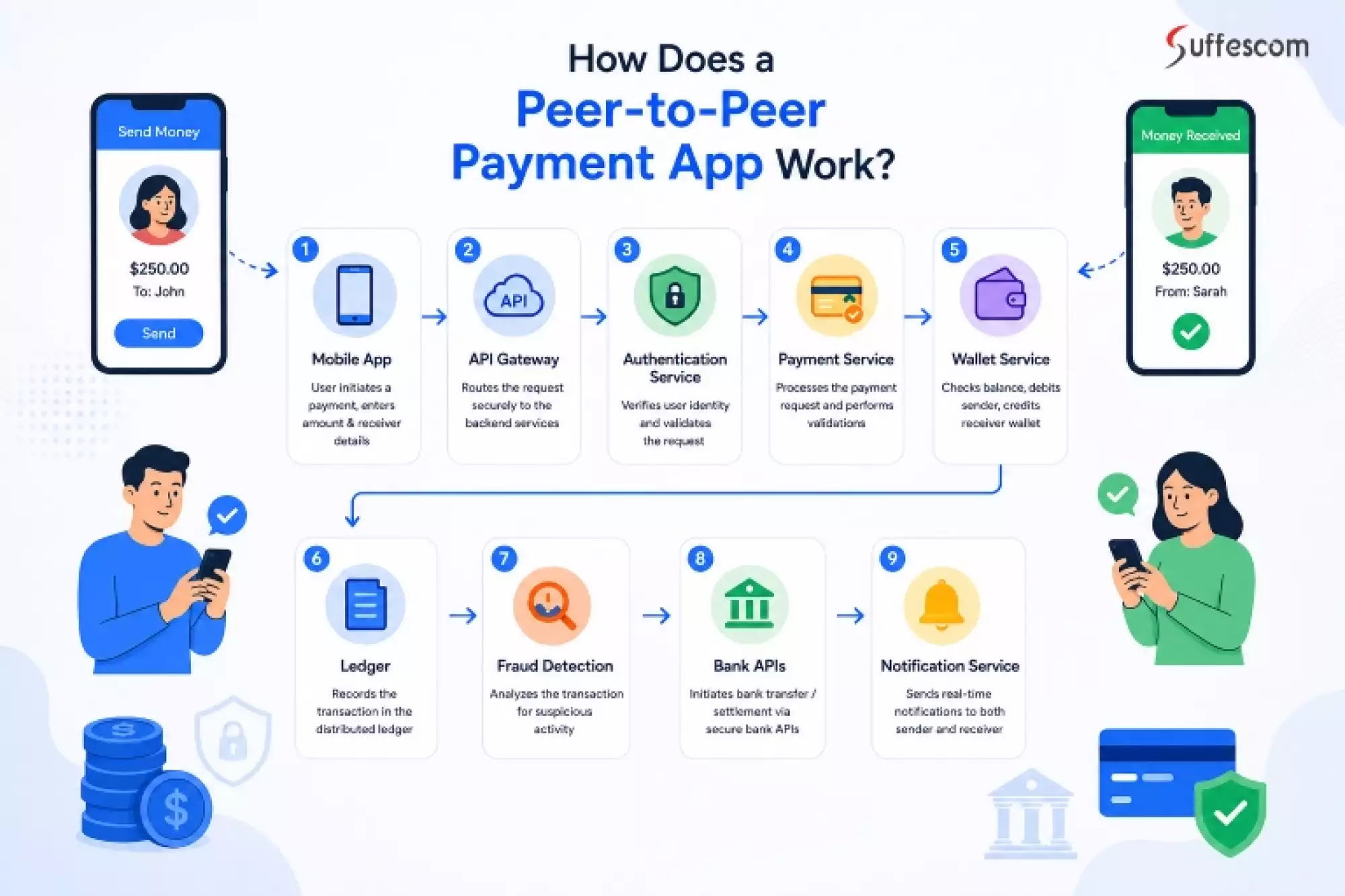
User Registration & Verification: Users create an account and complete identity verification for secure access and regulatory compliance.
Wallet & Bank Account Linking: Users securely connect bank accounts, cards, or digital wallets to enable seamless transactions.
Payment Initiation: Users enter recipient details, payment amount, and optional notes to initiate a transfer.
Payment Authorization: The app authenticates the transaction using PIN, password, biometrics, or multi-factor authentication.
Transaction Processing & Settlement: The payment is securely processed and settled through banking networks or payment infrastructure.
Payment Confirmation & Notifications: Both sender and recipient receive instant notifications confirming the successful transaction status.
Real-World Examples of P2P Payment Apps
| P2P Payment App | Description | Unique Selling Proposition (USP) | Approx. Downloads |
| Venmo | A mobile payment app that enables users to send and receive money while sharing transactions through an optional social feed. | Social-first payment experience with peer activity feeds, bill splitting, and merchant payments. | 100M+ |
| Cash App | A digital payment platform that supports peer-to-peer transfers along with stock investments, Bitcoin trading, and banking services. | Combines digital payments, investing, and cryptocurrency services within a single application. | 100M+ |
| Zelle | A bank-integrated payment network that facilitates direct account-to-account transfers through participating financial institutions. | Instant bank transfers without requiring users to maintain a separate digital wallet balance. | 10M+ (Zelle app; most usage occurs through partner banking apps) |
| PayPal | A global digital payments platform supporting P2P transfers, online payments, business transactions, and international money transfers. | Trusted global payment ecosystem with extensive merchant acceptance and cross-border payment capabilities. | 500M+ |
| Google Pay | A digital wallet that enables contactless payments, online purchases, and peer-to-peer money transfers through connected bank accounts. | Seamless integration with the Android ecosystem, contactless NFC payments, and digital wallet services. | 1B+ |
Benefits of P2P Payment App Development for Businesses
Businesses are increasingly investing in P2P payment app development to streamline digital transactions, enhance customer experiences, and unlock new revenue opportunities. Similar principles also apply to money transfer app development, where security, speed, and scalability are equally critical.
Faster Payment Processing
Real-time payments allow for quick and efficient transactions, increasing business productivity and customer satisfaction due to faster processing of payment transactions.
Enhanced Customer Convenience
Customers do not have to switch between different websites or applications because all of their payments can be made with one mobile app. A frictionless payment process will result in customer engagement, retention, and increased transaction volume.
Lower Transaction Costs
Using automated payment workflows and minimizing the need for bank procedures will ensure business optimization of transaction costs.
Improved Financial Accessibility
P2P payment apps make the digital payment process simple for users in different regions through various payment options and banking.
Real-Time Transaction Tracking
Instant notifications, transaction tracking, and history increase financial transparency for businesses and customers who gain more trust for each transaction they make.
Increased Revenue Opportunities
Through transaction fees, subscription models, merchant relationships, referrals, and financial services, P2P payment apps offer a variety of income sources to generate sustainable profits for businesses.
Must-Have Features for a Secure P2P App
Modern Peer-to-Peer (P2P) payment apps combine advanced security, real-time payment capabilities, and intuitive user features to support secure and scalable digital transactions.
Secure User Authentication
Implement multi-factor authentication, biometric methods, and proper session management. It is going to help protect against unauthorized access and increase the security of users' accounts.
Digital Wallet Integration
Ensure digital wallets can store, send, and receive payments. Moreover, offer integration with multiple payment providers to enhance transactions.
Bank Account & Card Linking
Integrate banking APIs and card networks to enable the secure verification of accounts and transaction processing. Consequently, users will be able to make money transfers instantly.
Instant Money Transfer
Ensure instant payment processing with minimum latency to deliver timely settlement of transactions and provide reliable payment services even under heavy traffic.
QR Code Payments
Allow users to complete payments by scanning QR codes. By eliminating manual data entry, this feature improves transaction speed and reduces payment errors.
Contact-Based Transfers
Provide users with the ability to make payments based on verified contacts' phone numbers. As a consequence, users will be able to streamline peer-to-peer payments.
Request Money Feature
Allow users to create payment requests with automated reminders and status tracking. Consequently, collecting payments becomes faster and more organized.
Transaction History
Maintain detailed transaction records with searchable logs and audit trails. This provides greater transparency while supporting financial reporting and regulatory compliance.
Push Notifications
Send real-time alerts for successful payments, failed transactions, and security events. As a result, users remain informed and can quickly respond to suspicious activities.
In-App Chat
Provide secure messaging between transaction participants. This enables faster communication for payment confirmations, dispute resolution, and customer support interactions.
Multi-Currency Support
Support multiple fiat and digital currencies with dynamic currency conversion. This allows businesses to serve international users without payment limitations.
AI-Based Fraud Detection
Leverage machine learning to monitor user behavior and transaction patterns. This helps identify fraudulent activities in real time before they impact the platform.
Admin Dashboard
Provide administrators with centralized control over users, transactions, compliance, and analytics. This simplifies platform management while improving operational visibility and decision-making.
Advanced Features That Differentiate Modern P2P Payment Apps
Modern P2P payment apps are evolving beyond basic money transfers by integrating intelligent, value-added features that enhance user engagement, strengthen security, and create new revenue opportunities.
AI-Powered Financial Insights
Use artificial intelligence to examine spending habits and offer personalized financial recommendations to enable better decision-making related to budgeting and payments.
Voice-Enabled Payments
Users can use voice commands to initiate transactions and give permissions to conduct such operations as an added layer of convenience and accessibility.
Recurring Payments
Give users the ability to pay recurring bills such as rent, utility payments, and subscriptions automatically without any need for further interaction.
Bill Splitting
Make splitting bills between multiple users easy and possible to complete through the application for seamless payments.
Cashback and Rewards Engine
Generate incentives for making transactions through the app with cashback options and reward users for spending money with the app.
Virtual Cards
Generate secure virtual payment cards for online transactions, reducing the risk of exposing users' actual banking or card information.
Crypto Payment Support
Support cryptocurrency transfers and digital asset payments, enabling users to transact across both traditional and blockchain-based payment ecosystems.
NFC Tap-to-Pay
Enable contactless payments using Near Field Communication (NFC) technology for faster, secure, and convenient in-store transactions.
Cross-Border Payments
Facilitate international money transfers with real-time settlement, competitive exchange rates, and compliance with regional payment regulations.
Who Needs a P2P Payment App?
Whether you are looking to introduce a new payment application or modernize your existing financial infrastructure, P2P payment transfer app development enables businesses to deliver secure, scalable, and seamless digital payment experiences. Below is the list of business models that will get the most out of a customized P2P payment application.
Digital Payment Applications Startups
Develop an easily scalable MVP with basic payment capabilities, wallets, authentication, and cloud-native technology to enable fast, efficient feature extensions and customer acquisition.
Banks and Credit Unions
Revamp your legacy payment solutions by integrating real-time funds transfers, APIs, increased security, and compliance to make your digital banking system more convenient for your customers.
Super Apps
Integrate P2P payment solutions into your super app without changing your core functions, and increase customer engagement and revenue streams.
Marketplaces and Gig Economy Platforms
Offer instant payments to users and streamline their transactions using wallets and payment reconciliation systems.
Custom P2P Payment App vs White-Label Solution
Choosing between a custom-built and a white-label P2P payment app depends on your business goals, scalability requirements, budget, and long-term product vision. Understanding the trade-offs helps you make an informed investment decision.
| Factor | Custom P2P Payment App | White-Label P2P Payment Solution |
| Customization | Fully customizable UI, workflows, integrations, and business logic tailored to your requirements. | Limited customization based on the provider's framework and available configuration options. |
| Security | Security architecture is built according to your compliance requirements, risk model, and business policies. | Includes standard security features but offers limited control over the underlying security infrastructure. |
| Scalability | Designed to support growing users, transaction volumes, and future feature expansion. | Suitable for initial growth but may require migration as business needs become more complex. |
| Development Cost | Higher upfront investment due to custom design, development, and integrations. | Lower initial cost, making it suitable for startups with limited budgets. |
| Time to Launch | Typically takes several months depending on feature complexity and compliance requirements. | Can be deployed within a few weeks since the core infrastructure is already built. |
| Maintenance & Upgrades | Complete ownership with full control over updates, security enhancements, and future roadmap. | Updates and maintenance depend largely on the white-label solution provider. |
P2P Payment App Development Process: Step-by-Step Guide
A well-defined payment P2P app development process ensures secure transactions, regulatory compliance, seamless user experiences, and scalable platform performance from concept to launch.
1. Discovery and Requirement Analysis
To start, you will need to identify your business goals, your audience, the revenue model, the regulatory needs, and the technical requirements. The discovery stage gives you a chance to outline the product roadmap, key features, technology stack, and project timeline before moving on to the development process.
2. UI/UX Design and Product Prototyping
Then, intuitive user flows, wireframes, and interactive prototypes are created to facilitate P2P transactions. Collaboration with a professional P2P payment app development company will make sure that your application will be convenient, secure, and compliant from the start.
3. MVP Development
Development of the MVP with critical features, including user authentication, wallet connection, payments, and transaction tracking, will allow companies to verify their product, get customer feedback, and reduce time-to-market.
4. Payment Integration and Core Development
Core functionalities such as payment gateways, banking APIs, digital wallets, KYC/AML verification, notification services, and security components are integrated to enable secure transactions, seamless payment processing, and reliable platform performance.
5. Quality Assurance and Security Testing
Testing is done extensively for the validation of functionalities, performance, usability, and security aspects. Processes such as vulnerability assessment, penetration testing, compliance testing, and performance testing assist in building a reliable payment system.
6. Deployment and App Launch
The application is released into the production environment and made available on all the platforms that are required. Configuration of infrastructure, implementation of monitoring solutions, and strategies for release are used.
7. Post-Launch Support and Continuous Optimization
After deployment, monitoring, enhancement of features, security, and performance optimization ensure that the application is still safe, complies with all policies, and meets ever-changing business needs and expectations of users.
Build Faster. Launch Smarter. Scale Confidently.
Bring your payment idea to market with a custom P2P payment app engineered for performance, security, and growth
The Core Architecture of a P2P Payment App
While a P2P payment app might seem straightforward at the consumer level, there are numerous systems that operate behind the scenes in every transaction. A good architecture can be helpful in the management of secure access, payment systems, transaction records, monitoring, and platform operations. The configuration will vary according to the business model, payment partners, and regulations.
1. User Experience Layer
This is the part that the customers will use on their mobile or web device. It features account registration, selection of recipients, initiation of payment, transaction history, and notifications. The objective is to make monetary transactions easy and secure sensitive actions.
2. Identity and Trust Layer
This layer handles authentication, access control, and identity verification workflows. It can also be used for product implementation, AML screening, customer due diligence, risk controls, and KYC. The application's security design should also include the proper monitoring of authentication and access events.
3. Payment Orchestration Layer
The payment orchestration layer links the app to the supported banking systems, payment gateways, and other financial infrastructure. Handles payment instructions routing, processing, and tracking, and deals with payment statuses and integration responses.
4. Transaction Ledger
A transaction ledger keeps the payment events and transaction states in a reliable way. It is able to monitor transfers, fees, reversals, settlements, and balances depending on the architecture of the platform. This layer is especially relevant for consistency and tracking the history of transactions.
5. Notification Layer
This layer will notify users of important events by sending a push notification, email, or SMS. It can notify you of successful transfers, failed transactions, requests to pay, security alerts, and more in your account.
6. Admin and Compliance Layer
The admin layer provides teams with a view into users, transactions, disagreements, and activity. It can also be used for investigations, reporting, risk monitoring, compliance workflows, and more. Secure logging and monitoring are important here, as OWASP recommends protecting logs, centralizing relevant monitoring, and avoiding the unnecessary logging of sensitive information such as passwords, access tokens, and payment data.
Technology Stack for P2P Payment App Development
Building a secure and scalable P2P payment app requires a modern technology stack that supports real-time transactions, seamless integrations, high availability, and enterprise-grade security. The following technologies are commonly used to develop high-performance payment applications.
| Technology Layer | Technologies |
| Frontend | React Native, Flutter, Swift (iOS), Kotlin (Android), React.js |
| Backend | Node.js, Java (Spring Boot), Python (Django/FastAPI), Go |
| Databases | PostgreSQL, MySQL, MongoDB, Redis |
| Cloud & DevOps | AWS, Microsoft Azure, Google Cloud Platform, Docker, Kubernetes |
| Payment Gateway Integration | Stripe, PayPal, Adyen, Razorpay, Braintree |
| Banking APIs | Plaid, TrueLayer, Yapily, Tink |
| Authentication & Security | OAuth 2.0, OpenID Connect, JWT, Firebase Authentication, Auth0 |
| Real-Time Communication | WebSockets, Firebase Cloud Messaging (FCM), Socket.IO |
| AI & Fraud Detection | TensorFlow, PyTorch, OpenAI APIs, Scikit-learn |
| Analytics & Monitoring | Google Analytics, Firebase Analytics, Prometheus, Grafana |
| Blockchain (Optional) | Ethereum, Polygon, Solana, Hyperledger Fabric |
| CI/CD & Testing | GitHub Actions, Jenkins, GitLab CI/CD, Selenium, Postman |
Payment Infrastructure Required for P2P Payment App Development
A reliable payment infrastructure is the foundation of successful Peer-to-Peer (P2P) payment apps, enabling secure transactions, real-time settlements, seamless integrations, and consistent platform performance.
Payment Gateway Integration
Integrate secure payment gateways to enable seamless payment authorization, processing, and settlement across multiple payment methods.
Banking APIs (Plaid, TrueLayer, Yapily)
Connect banking APIs to securely access account information, verify users, and facilitate real-time bank-to-bank transactions.
ACH, RTP, UPI, SEPA, SWIFT Integration
Support domestic and international payment networks to enable fast, reliable, and compliant money transfers across regions.
Digital Wallet Infrastructure
Build secure wallet functionality to store balances, manage transactions, and support multiple payment instruments within the application.
Ledger Management System
Maintain an accurate transaction ledger that records every debit, credit, and account balance for financial transparency and reconciliation.
Notification Services
Deliver real-time alerts for payment requests, transaction confirmations, security updates, and account activities across multiple communication channels.
Fraud Detection Engine
Continuously monitor transaction behavior using AI-driven risk analysis to identify suspicious activities and prevent fraudulent payments.
Regulatory Compliance in P2P Payment App Development
Regulatory compliance is a critical aspect of launching a P2P payment app, ensuring secure transactions, legal operations, and seamless user experiences across different financial markets.
KYC/AML Implementation
Validate users' identities and monitor their transactions to avoid fraudulent activities and financial crimes.
Region-Wise Licensing (US, EU, India)
Abide by regional regulations like FinCEN in the US, PSD2 in the EU, and RBI/NPCI in India to operate legally in the field of P2P payments.
Data Privacy Laws
Data of the users should be protected according to GDPR, CCPA, and other local data protection laws.
Security Architecture — Deep Technical Breakdown
A robust security architecture is essential to build a P2P payment app that safeguards sensitive financial data, prevents fraud, and ensures regulatory compliance across every transaction layer.
End-to-End Encryption
Encrypt sensitive user data and payment information during transmission and storage using industry-standard cryptographic protocols such as TLS 1.3 and AES-256, ensuring data confidentiality and preventing unauthorized access.
Tokenization of Sensitive Payment Data
Replace card numbers and banking credentials with unique payment tokens, preventing sensitive financial information from being exposed even if application databases or networks are compromised.
PCI DSS Compliance
Implement PCI DSS requirements by securing cardholder data, enforcing network segmentation, vulnerability management, regular security audits, and continuous monitoring to reduce payment fraud and maintain regulatory compliance.
Multi-Factor & Biometric Authentication
Strengthen account security through layered authentication, combining passwords or PINs with OTPs, device verification, fingerprint recognition, or Face ID to prevent unauthorized account access.
AI-Powered Fraud Detection & Risk Engine
Leverage machine learning to monitor transaction behavior, identify anomalies, calculate real-time risk scores, and automatically block suspicious payment activities before fraud occurs.
Secure API & Banking Integration
Protect payment gateways and banking APIs using OAuth 2.0, OpenID Connect, API gateways, rate limiting, digital signatures, and certificate-based authentication to prevent API abuse and unauthorized access.
Continuous Security Monitoring & Audit Logging
Maintain comprehensive audit trails, SIEM-based security monitoring, real-time alerts, and immutable transaction logs to detect threats, simplify forensic investigations, and support regulatory compliance.
Cost to Build a P2P Payment App
The cost to create a P2P payment app typically ranges from $5,000 to $100,000+, depending on feature complexity, payment integrations, security requirements, regulatory compliance, and platform selection. Businesses can start with a lean MVP and gradually scale the application as user adoption and business needs evolve.
MVP P2P Payment App
A minimum viable P2P payment app that includes necessary features such as user registration, wallet, bank account integration, and money transfer functionality may cost $5,000 to $15,000. The app will be perfect for start-ups that are ready to validate their product ideas with minimal investment.
Standard P2P Payment App
A good P2P payment app with additional features like KYC verification, integration of a payment gateway, QR payments, transaction history, push notifications, and a high level of security may cost from $15,000 to $40,000. Such an app is good for companies that plan to create a feature-rich payment platform.
Enterprise-Grade P2P Payment App
Enterprise-level P2P payment apps that have artificial intelligence-based fraud detection, multi-currency functionality, cross-border payment functionality, integration of bank APIs, advanced analytics, and custom dashboards cost from $40,000 to $100,000+ (sometimes even more). Such apps are suitable for banks, enterprises, and fintech companies.
Estimated Cost Breakdown
| App Type | Estimated Cost | Best Suited For | Key Features |
| MVP P2P Payment App | $5,000 – $15,000 | Startups validating an idea | User registration, wallet, bank account linking, money transfers, basic authentication |
| Standard P2P Payment App | $15,000 – $40,000 | Growing businesses | KYC verification, payment gateway integration, QR payments, transaction history, push notifications, enhanced security |
| Enterprise-Grade P2P Payment App | $40,000 – $100,000+ | Banks, fintechs, enterprises | AI fraud detection, multi-currency support, cross-border payments, banking APIs, advanced analytics, custom dashboards |
Factors Affecting P2P Payment App Development Cost
Features Complexity
The number and complexity of implemented features, including digital wallets, QR payments, bill split function, artificial intelligence-based fraud detection system, or international payments capabilities, affect the development period and the total cost of the project.
Platform Choice
The choice of platforms to develop for, such as Android, iOS, web, or any other combination, influences engineering efforts, testing process, and maintenance costs. Cross-platform frameworks help to save money during the initial stage of development.
Payment Technology
The presence of payment gateways, banking APIs, digital wallets, regional payment networks such as UPI, ACH, RTP, SEPA, and SWIFT increases the level of complexity and the cost of payment technology integration.
Security and Compliance
PCI DSS, KYC/AML, GDPR, multi-factor authentication, data encryption, and fraud detection implementation require specific knowledge, making security one of the most expensive parts of app development.
UI/UX Design
Custom design, convenient flow of payments process, accessible interface require more iterations but positively affect users' adoption and loyalty.
Technology Stack
The choice of technologies to implement the app, cloud services, database, DevOps, and third-party integrations affects both development and operation costs in the future.
Development Team and Location
Development costs vary based on the team's expertise, engagement model, and geographic location. Experienced fintech development teams may have higher rates but typically deliver better quality, faster execution, and lower long-term maintenance costs.
How to Reduce Development Cost Without Compromising Quality
Businesses can significantly reduce development costs by focusing on core features, leveraging reusable technologies, and adopting scalable development practices without sacrificing performance or user experience.
Create an MVP
Opting for MVP development services allows businesses to launch a feature-focused Minimum Viable Product (MVP), minimize development costs, gather real-world feedback, and iteratively expand the application with advanced capabilities.
Apply Cross-Platform Approach
Implement cross-platform development using frameworks like Flutter and React Native, and thus create one codebase for both Android and iOS. It reduces development time and maintenance costs and provides a similar user experience on different platforms.
Utilize Third-Party APIs
Make use of trustworthy third-party APIs for such components as payment functionality, KYC verification, notifications, and analytics rather than developing everything in-house. This will help save a lot of development time.
Use Scalable Cloud Infrastructure
Employ cloud solutions with pay-per-use billing schemes to avoid paying extra fees for infrastructure. Scalable cloud services allow you to reduce operational costs and cope with further growth in the number of your users.
Cooperate with an Experienced Payment App Development Company
Using the expertise of an experienced payment app development company will allow you to avoid mistakes that cost money, speed up the development process, and ensure adherence to industry standards.
Effective Monetization Strategies for P2P Payment Apps
A well-defined monetization strategy helps maximize revenue while delivering value-driven payment experiences that encourage user engagement and long-term platform growth.
Transaction Fees
Charge a small fee on instant transfers, business payments, or premium transactions. It is still one of the most popular revenue models used by P2P payments applications while keeping low prices for the customers.
Subscription Plans With Additional Features
Provide users with subscription-based plans that include additional features like higher transaction limit, fast transactions, expense management, premium customer support, or specialized financial tools.
Interest Earned
Generate revenue by earning interest on users' pooled account balances or idle funds, where permitted by financial regulations. This model is commonly adopted by licensed fintech platforms and digital payment providers.
Revenue from Partnerships and Referrals
Partner with merchants, banks, or third-party service providers in order to generate referral fees and other income sources like integrated financial products, discounts, cashbacks, and more.
Future Trends in P2P Payment App Development
The future of P2P payment apps is being shaped by emerging technologies and evolving payment ecosystems, enabling faster, smarter, and more secure digital payment experiences.
AI Fraud Detection
By using artificial intelligence to analyze transactions in real-time, fraudulent activities will be identified, minimize false positives, and make it possible for payment platforms to detect and prevent any kind of financial fraud even before the transactions are made.
Open Banking
The open banking solution uses APIs that are secure to facilitate connections between the bank and various financial service providers that enable fast verification of accounts and the transfer of funds seamlessly.
CBDC Payments
With the introduction of digital currencies by central banks, it means P2P payment applications will facilitate the process of making payments by using the CBDC, which offers secure, government-backed payments with minimal settlement costs.
Stablecoin Payments
It is becoming popular with P2P payments due to the faster settlement process and minimal price volatility, with reduced transaction fees compared to other cryptocurrencies being used.
Biometric Authentication
Biometric authentication like fingerprints and facial recognition technology helps to secure your account by eliminating passwords from the authentication process, thereby increasing security and offering a fast and convenient user experience.
Voice Payments
Voice payments are payments that are facilitated by the use of voice assistants to initiate and authorize payment transactions.
Cross-Border Instant Payments
Advancements in payment infrastructure and blockchain technology are enabling near-instant cross-border transfers with lower fees, transparent settlement, and real-time currency conversion, making international peer-to-peer payments more efficient and accessible.
Common Challenges & How to Solve Them
Every P2P payment app faces technical, regulatory, and operational challenges. Understanding these obstacles and implementing the right strategies helps ensure secure, scalable, and reliable payment experiences.
Security Risks
Peer-to-peer payment apps are vulnerable to fraud attacks, account takeovers, and unauthorized payments. Ensure that your apps are protected against such threats through MFA, end-to-end encryption, artificial intelligence fraud detection, and transaction monitoring.
How Suffescom Solves It: Security-first development integrates robust authentication, encryption protocols, and intelligent fraud prevention mechanisms to protect every transaction and user interaction.
Regulatory Complexity
There exist different financial regulations depending on various geographical locations, and compliance requirements include KYC, AML, PCI DSS, and GDPR. Establishing compliance requirements at the planning stage saves you from possible redesign and deployments.
How Suffescom Solves It: Compliance-ready solutions are built with configurable KYC/AML workflows and industry-standard security practices, simplifying regulatory alignment across multiple markets.
Scalability Challenges
Increased volumes of transactions may affect the performance of the application and its reliability. It is important to have cloud-based infrastructure, microservices, and scalable APIs to ensure consistent performance.
How Suffescom Solves It: Cloud-native architectures and modular development practices enable payment platforms to scale efficiently while maintaining speed, availability, and transaction reliability.
Building User Trust
Users' trust is crucial for adoption and continued usage. To achieve users' trust, you need to establish transparent fees, secure authentication, instant payment confirmations, transaction history, and user-friendly support.
How Suffescom Solves It: User-centric payment experiences are designed with transparent workflows, secure payment processes, and intuitive interfaces that inspire confidence and encourage long-term engagement.
Why Businesses Choose Suffescom Solutions for P2P Payment App Development
Being a top fintech software development company, Suffescom Solutions develops highly secure, scalable, and feature-packed P2P payment apps that cater to current business requirements. From user experience design, payment gateway integration, banking API's and digital wallets, KYC/AML compliance, AI-driven fraud prevention, and more, every product we develop ensures secure payment processing.
P2P payment applications are revolutionizing how people and organizations make payments through quicker, safer, and extremely convenient online payments. With the continued development of technology, including AI-based anti-fraud systems, open banking, blockchain technology, and real-time payment systems, businesses will get more opportunities to create payment innovations to cater to their customers’ needs.
Equipped with in-depth knowledge of fintech, blockchain technology, and digital payment systems, Suffescom Solutions can help startups, enterprises, banks, and marketplaces bring their payment platforms to market quickly. Whether you are developing your very first P2P payment app or updating an existing one, our complete development and support services will ensure scalability and security.
FAQs
1. How much does P2P payment app development cost?
The cost of P2P payment app development typically ranges from $5,000 to $100,000+, depending on the app's complexity, supported platforms, security requirements, third-party integrations, and regulatory compliance.
2. Can a P2P payment app support international transfers?
Yes, a P2P payment app can support international transfers by integrating cross-border payment networks, banking APIs, and foreign exchange services. Features such as multi-currency support, real-time currency conversion, and compliance with regional regulations help enable secure global transactions.
3. Which APIs are commonly used in P2P payment app development?
P2P payment apps commonly integrate banking APIs such as Plaid, TrueLayer, and Yapily for account verification, along with payment gateways like Stripe, PayPal, Adyen, and Razorpay. Additional APIs for identity verification, notifications, fraud detection, and analytics are also used to enhance functionality and security.
4. Can I integrate cryptocurrency payments into a P2P payment app?
Yes, cryptocurrency payments can be integrated into a P2P payment app by connecting blockchain networks, crypto wallets, and digital asset payment gateways. This enables users to send, receive, and manage cryptocurrencies alongside traditional payment methods while maintaining secure and compliant transactions.
5. What security measures should a P2P payment app include?
A secure P2P payment app should implement end-to-end encryption, multi-factor authentication, biometric login, tokenization, AI-based fraud detection, and KYC/AML verification while complying with standards such as PCI DSS and GDPR.