Key Takeaways:
- Digital transformation in the restaurant works best when technology addresses real operational issues, not just digital ordering channels.
- Connected POS, inventory, kitchen, staffing, and financial systems give restaurants better visibility into costs, service, and profits.
- You will make the right investment if you choose the restaurant model and biggest challenge.
- Start with one high-impact problem, test the proposed solution in a real restaurant setting, and observe results before moving to another.
- Budget for integration, staff training, rollout, and support and maintenance costs alongside development costs.
- Use AI if operational data is solid and business goals are measurable; then verify results at scale.
Running a restaurant is not just about serving good food. It takes keeping food costs under control. You have to manage staff. There should be minimal waste. Besides, you also have to maintain consistent service, understand customer demand, and, most importantly, make enough profit to sustain the business. That's why you can no longer rely on disconnected systems or manual records.
As per the 2025 report of the National Restaurant Association concerning restaurant operations, the median cost of labor for those full-service restaurants that made a profit before tax was equivalent to 34.2% of the sales of those businesses in 2024, while for those restaurants that incurred losses, it was 42.9%. This is where digital transformation comes into play because it integrates the point of sale (POS), inventory, staffing, customer relationship management (CRM), accounting, and business intelligence- all the things that a restaurant requires. Through such systems, one can track their sales and costs and make decisions accordingly.
The industry already recognizes the value of restaurants' digital transformation. The National Restaurant Association's 2024 technology research also found that 76% of restaurant operators said technology gave them a competitive edge. That does not mean every restaurant needs new tools. It means restaurant owners have a business reason to assess where technology can solve operational problems and deliver measurable value.
This blog will help you connect the dots between your restaurant's biggest operational challenges, the technology worth investing in, the budget you'll need, and the results to prove before expanding.
What Does Digital Transformation Mean in the Restaurant Industry?
The digital transformation of the restaurant sector involves using digital technologies for better management of a restaurant's operational processes. The latter may cover finance, human resources, relations with customers, and decision-making. This technology brings together different processes so that the owner of a restaurant can use up-to-date data.
Which Parts of a Restaurant Business Can Be Transformed?
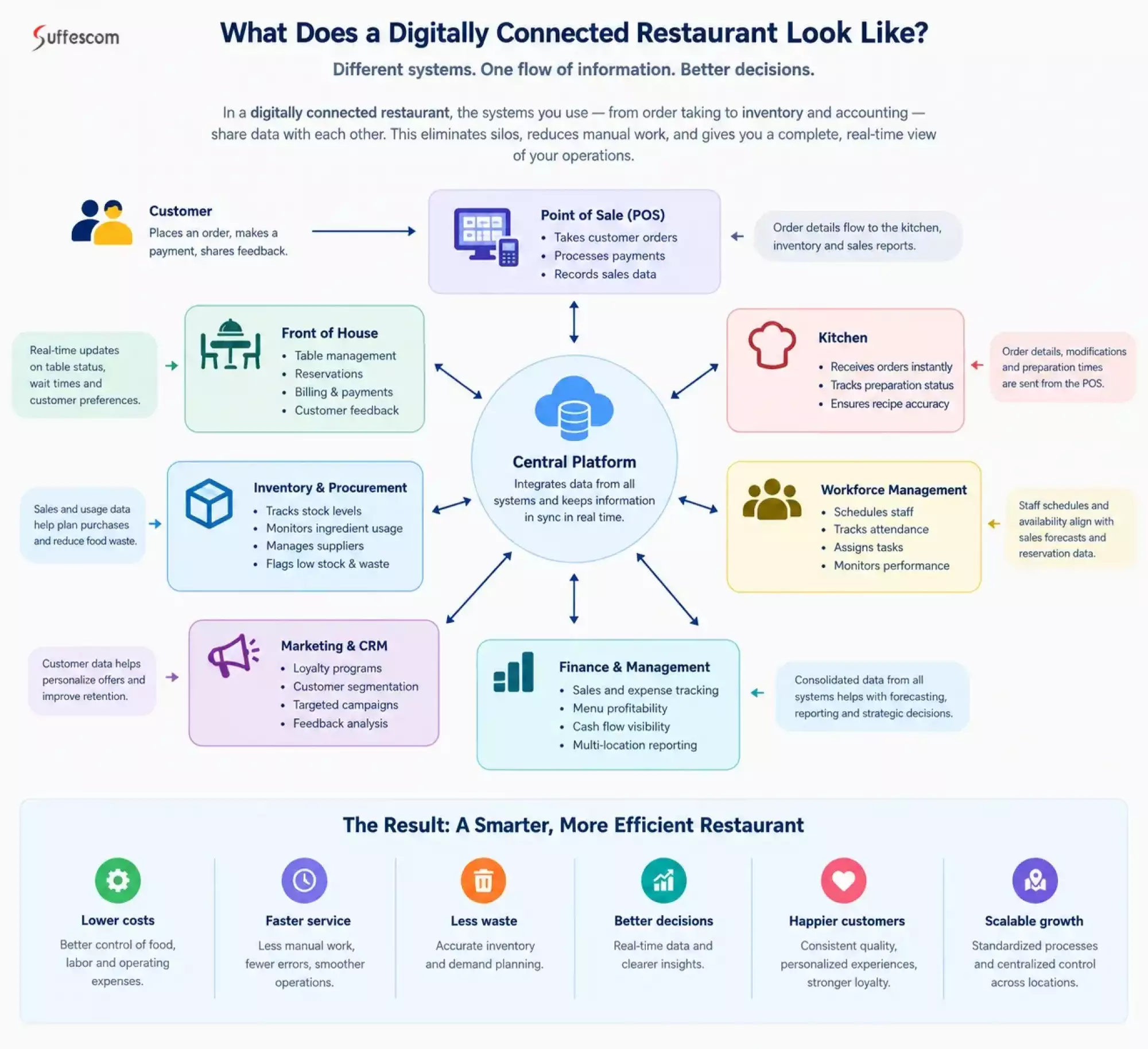
Digital transformation is possible for nearly all areas of operation in restaurants, including food preparation and finance management.
- Front-of-the-house operations: It is able to help improve table management, the booking process, invoicing and payments, and customer feedback.
- Kitchen operations: It may result in improved order management, status of preparation, recipes, and coordination between kitchen and service staff.
- Inventory and purchasing: It can improve inventory management software, supplier management, ingredient usage, and purchasing.
- Management of employees: Employee scheduling, attendance, shift management, and job assignment can be greatly improved through digital transformation.
- Marketing and customer relations: Customer loyalty schemes, customer feedback, marketing campaigns, and customer retention analysis can be greatly improved using digitalization.
- Finance and management: Sales reports, expenditure recording, menu profitability, cash flow analysis, and branch performance can be performed ten times better with digital transformation.
What Does a Digitally Connected Restaurant Look Like?
Are you losing orders to operational gaps?
Our experts can help you find where those gaps lie.
What Things to Consider Before Going For Digital Transformation
The value from the digital transformation can only be generated if the restaurants recognize their weaknesses. Prior to adopting new technology, restaurants should avoid looking at digital sales alone and analyze the impacts on demand, profitability, and cooking.
1. Separate Channel Migration from Incremental Demand
A higher level of digital orders doesn't necessarily signify that the restaurant has acquired more customers. The customer ordering food at the counter could opt to use a mobile app or a web-based portal. In such a case, the order becomes digital, but that doesn't necessarily mean that the restaurant has gained an additional customer or extra revenue.
When assessing the success of the digital transformation, it becomes important to differentiate between the following aspects:
- Channel migration: Customers who use digital channels are simply channeling their existing orders into those mediums.
- Additional demand: The digital channel generates new customers and makes the existing customers order additional food.
- Operational efficiencies: The technology helps to minimize order mistakes, speeds up processes, boosts employees' productivity, or decreases costs.
2. Calculate Profitability for Each Ordering Channel
Each ordering channel incurs different cost structures. The commission and cost associated with delivery of the order could arise if it is booked via the delivery platform. Using the restaurant's website or app might incur costs of development, maintenance, payments, and marketing but avoid other costs like delivery commissions.
Comparing channels based on sales volume only would give an inaccurate result.
The restaurant needs to determine the margin that an order from each channel brings when taking into account all the costs involved in each channel. They include:
- Commission of the platform.
- Promotions, discounts, and customer acquisition costs.
- Cost of packaging, delivery, and processing the order.
- Cost of maintaining technology and other operational costs of the channel.
3. Make Kitchen Capacity Part of the Digital Ordering Strategy
Digital ordering will lead to an increase in order numbers, but there should be capacity to meet this demand without affecting the quality of food and delivery time.
This means that the restaurant can receive many orders for delivery apps at the peak hour, when the kitchen is also working on serving diners in the restaurant. Without capacity controls, the increase in order volumes leads to longer delays in delivery and errors in all service channels.
Ordering should align with the kitchen's capabilities. The restaurant can set up preparation times, order throttling, availability of items, and order limits per channel to control incoming demand.
However, the objective here is not to accept as many orders as possible. The objective here is to accept the right amount of orders at the right time.
Why Restaurant Businesses Need Digital Transformation in 2026
Restaurant digital transformation is no longer just about adding online ordering or accepting digital payments. It is about connecting the systems that manage customer interactions, sales, inventory, kitchen operations, and business performance.
As restaurants adopt more digital tools, gaps between these systems can become harder to ignore. Sales data may not match inventory records. Delivery orders may disrupt dine-in service. Managers may struggle to understand which channels are actually profitable.
Here is why restaurants need a more connected digital operating model in 2026.
1. Digital Adoption Can Reveal Operational Gaps
The addition of a digital channel does not mean that restaurant operations will necessarily be enhanced. If the ordering platform, POS, inventory management, and kitchen display system work separately, employees can still have to enter information manually or fix any mismatched orders.
The problem becomes more obvious as order amounts grow. There may be cases when an item is marked as not available in the kitchen but is still available on the delivery app, or a menu change at one location is not reflected at the others.
Digital transformation allows restaurants to integrate such systems for better exchange of order data and other information.
2. Revenue Growth Must Translate Into Better Margins
Sales performance could give an impression of success with higher sales, but the actual profitability is hard to tell based on the revenues generated.
A lot of discounting would lead to lower profit margins on the orders made. There might be other factors such as delivery fees, packaging costs, payment processing costs, and return fees, all of which may eat into the bottom line. An ordering channel that has many orders may have lower profitability compared to another that has few but more profitable orders.
For restaurants, sales and financial data are crucial for performance analysis beyond the revenue number.
3. Customer Retention Depends on Consistent Execution
Customers need to be sure that no matter how the order is placed, the restaurant will provide the same quality experience. It includes having up-to-date menus, accurate preparation times, the right orders, and quality service irrespective of whether the customer visits personally, uses a self-service kiosk, orders via the restaurant app, or via the delivery platform.
The issues occur when each channel works on different information. The customer could be faced with an old price online, order food that is no longer available, or be provided with inconsistent delivery information.
The digital transformation will make it easier for the restaurant to provide the same quality experience for their customers through each channel. The customer history will allow the staff to better understand the customer and provide better services in the future.
4. AI Needs Reliable Operational Data to Deliver Value
AI can help with predictions of consumer demand, food recommendations, personalization, and even with inventory planning. However, the success of these predictions will depend on how much information the system has.
Let us consider a case when a restaurant does not offer customers portions of some product, which was very popular, due to the lack of ingredients. The company's system may have just one piece of information about the number of sales of this product. In this case, the AI prediction or AI decision-making solution may interpret the reduced number of sales as reduced consumer demand. As a result, the company will reduce its inventory and will experience the same problems in the future.
Thus, the task of connected systems is to collect additional information, which helps to make accurate predictions with the use of AI.
5. Expansion Makes Manual Processes Harder to Sustain
A process that works for one restaurant may become difficult to manage across 20 or 50 outlets. Menu changes, supplier updates, inventory adjustments, promotions, and performance reporting all become more complicated when each location uses separate systems or follows different procedures.
Without a connected operating model, head-office teams may struggle to maintain accurate information across locations. Managers may also spend more time consolidating reports instead of addressing performance issues.
Digital transformation gives restaurant groups a way to standardize core processes while retaining the flexibility to accommodate local requirements. Centralized oversight and shared reporting can help businesses identify problems earlier and maintain greater consistency as they expand.
Where Should Restaurants Focus Their Digital Transformation Investments?
Not every digital feature is worth a heavy investment. When considering digital investments, restaurant operators should focus on capabilities that address their particular business pain points, enable their business operating model, and deliver clear advantages. Find out what the additional investment will do and how you will measure its success.
1. Direct Ordering Built Around Repeat Purchases
If the restaurant has a good number of repeated consumers, it can be proposed to build a website or an app. This will make direct ordering a very good opportunity for consumers to re-order their most loved dishes and to create a web of solid relationships without having to be dependent on external websites.
Investment areas to consider: Facilitate follow-on ordering from preferences, order history, one-click ordering, payments & promos. This type of experience should give customers the motivation to order directly.
Critical measures of success: Percentage of repeat sales, direct order percentage, cost of a new customer order, profit per direct order.
Most relevant for: Businesses that cater to returning visitors and have the volume for several repeats.
2. Ordering That Respects Kitchen Capacity
The digital food delivery platform should accurately reflect what the kitchen can actually handle and reflect the exact time of delivery, which builds strong trust and engagement. The same is true for delivery orders, making the kitchen too busy to manage the dine-in orders.
Investment areas: Ordering systems coupled with the kitchen, accurate prep times, item availability, order restrictions, and standby periods.
Indicators: Order delivery on time, average preparation time, percentage of canceled orders, number of late orders.
This solution is perfect for: Restaurants with multiple order channels dealing with challenges during busy times or unable to handle both on-premise and delivery orders.
3. Loyalty That Rewards Consistent Customers
Loyalty programs work better if they cause the customer to do something productive rather than if they just cause the customer to save money. The restaurant can cause the customer to return, to buy again, and to engage with the restaurant without providing the same incentive.
Areas for investment: Reward based on purchase history, reward thresholds, appropriate rewards, and automated reward calculation. All offerings should encourage repeat visits and not discount products that the consumer would have purchased anyway.
Metrics: Repeat visit rate; redemption rate; incremental sales by loyalty program members; contribution margin (post-awards).
Perfect For: Any restaurant that has a lot of repeat customers, like cafés, quick service, and casual dining chains.
4. Forecasting That Changes Business Decisions
The interesting thing about forecasting, though, is that it should help decision makers make more informed decisions before a problem hits them. Knowing in advance that a certain day will be a busy one is of no use unless the restaurant can act on that knowledge to prepare to respond.
Investment focus: Connect previous sales to inventory, marketing programs, and seasonality for the whole product line and corresponding operating environment, and make forecasts for managers to use as the basis of purchasing, scheduling, and preparation planning.
Key performance indicators: Forecast accuracy, food wastage, out-of-stocks, emergency purchasing, and productivity.
For restaurants with seasonal demand, life-limited inventory, stock-outs, and multiple sites.
5. Management Tools That Tell Teams What Needs Attention
Managers of restaurants shouldn't be clicking from dashboard to dashboard and trying to compare reports to figure out what is going on and what actions need to be taken. Managers need a clear view of what's wrong: are sales dropping, are items running out of stock, are orders being placed too late, and is spending rising?
Being investment-conscious: Bringing POS, inventory management, workforce management, ordering, and financial software information into a single picture. Presenting the manager with the right information based on his/her roles using role-specific dashboards and alerts.
Criteria for success: Report time, time spent identifying and fixing problems, number of unsolved operational exceptions, report uniformity across outlets.
Most suited for: Restaurant companies operating multiple locations and large emerging chains where managers rely on numerous external systems for daily operations.
What is important is the link between each spend and a business result. Repeat orders will grow because of direct ordering; kitchen knowledge will improve fulfillment; forecasting will impact the way decisions are made in operations.
Digital Transformation Priorities by Restaurant Business Model
The optimal digital investment will vary based on where in the customer-serving system a restaurant is under stress. A quick-service restaurant will seek to sustain speed during rush hours, a full-service operator will focus on coordinating the dining experience, and a delivery-first establishment will focus on order economics and fulfillment reliability.
1. Quick-Service Restaurants (QSRs)
Main operating pressure: Rapidly processing a large number of orders without generating mistakes, queues, or putting pressure on the kitchen.
What to focus on: Connect POS terminals, self-service kiosks, mobile ordering, kitchen display systems, and inventory systems. All orders from any channel should go into a shared order system, with accurate prep times and portable readings based on the kitchen's status.
The initiatives that make a difference:
- Average order-to-ready time
- Order correctness and remake rate
- Orders fulfilled on time during peak periods
- Cost of labor for each order
- Contribution margin per transaction
Priority for investment: Expedited order delivery, kitchen order coordination, order throttling in real-time. Loyalty and direct ordering gain value when they translate into more, not fewer, revisits without them compromising service times or margins.
2. Fast-Casual Restaurants
Main operating pressure: How to find the balance between customization, food quality, and an appropriate time to serve, while managing ingredient cost and wastage.
Technology priority: Implement digital menus, POS, ingredient-level inventory, kitchen production workflows, and customers' ordering history. The system must include options for modifications/substitutions so the kitchen receives the correct prepared items.
The most important measures:
- Order accuracy (customizations)
- Average time to prepare and fulfill
- Food cost as a percentage of sales
- Ingredient waste and stockout frequency
- Repeat purchase rate and channel-level profitability
How we can do it: Well-set-up menu structure, staff-friendly ingredient management, demand forecasting, and simple direct ordering. Offering loyal customers benefits (not necessarily discounts) can bring them back time and again.
3. Full-Service Restaurants
Main Operating Pressure: Managing the reservation, seating, servers, kitchen prep work, and payment to ensure you provide your guests with a consistent experience.
Technology top priority: Integrate reservation and table management with your point of sale, kitchen display, staff scheduling, and customer relationship management solutions. Table and Kitchen are a team. Your front-of-house and kitchen teams require a common understanding of table status and order status.
The most important stats:
- Table turnover and average dining duration
- Reservation no-show and cancellation rates
- Order accuracy and time between courses
- Average check and contribution margin per cover
- Guest satisfaction and repeat visit rate
Focus of investment: Reservation control, table status, knowledge of course coordination, customer relationship management. The goal: Smooth out service flow without compromising the sense of a quality experience.
4. Delivery-First Restaurants
Operating pressure: Ensure profitable orders across delivery platforms and own channels by monitoring commissions and packaging costs, and minimizing delivery delays and complaints.
Technology priority: Integrate online ordering, POS, kitchen workflows, inventory, delivery integrations, and channel-level financial reporting. The system should align menu availability and real-time prep times between channels.
Measures that matter most:
- Contribution margin per order and per channel
- On-time fulfillment and order cancellation rates
- Refunds, complaints, and order error rates
- Customer acquisition cost and repeat ordering
- Food waste and average preparation time
Additional investments: Order consolidation; kitchen capacity management; channel profitability reporting; repeat customer direct ordering. A direct channel has low transaction costs and some repeat-purchase potential and is worthwhile to invest in.
Comparing the Priorities
| Restaurant model | First technology priority | Most important outcome |
| Quick-service | POS, kiosks, and kitchen integration | Speed and order accuracy |
| Fast-casual | Customization and ingredient-level inventory | Reliable fulfillment with controlled food costs |
| Full-service | Reservations, tables, and kitchen coordination | Guest experience and profitable table utilization |
| Delivery-first | Order aggregation and channel economics | Profitable, reliable fulfillment |
What Should Your Restaurant Business Modernize First?
The first step should be finding the area of your operations that creates the largest inefficiencies, whether in terms of profitability, quality of service, or customer retention. It is not necessary to revamp all systems at once; it suffices to find the source of the largest loss and update the systems involved.
1. If Orders Are Delayed or Frequently Incorrect
Order management and kitchen integration should be the first step. Integrate your POS system, online ordering system, and kitchen display system to ensure that orders get delivered to the appropriate department with all necessary information. Install capacity controls if your incoming orders usually exceed your kitchen’s capabilities.
Performance metrics: Order accuracy, preparation time, and timely delivery.
2. If Sales Are Growing but Profits Are Not
Begin by gaining financial visibility at the channel level. Integrate sales information with commissions, discounts, refunds, packaging, and other order costs. This will enable you to find out which channels yield profitable sales and which require some adjustments.
Measurement metrics include contribution margin per order, cost per order, and profitability per channel.
3. If Food Waste and Stockouts Are Frequent
Begin with the inventory and purchase system. Streamline your inventory management process and link ingredient utilization to sales data. Add forecasting as soon as your inventory and sales data are accurate enough for it.
Measuring results: Waste, stockout rate, cost percent, and purchasing variance.
4. If Customers Rarely Return
Let's start with the customer order and retention experience. Make ordering and repeat ordering easy and consistent. Implement loyalty functionality where relevant for your customers. Think about having an application or website devoted to ordering if there is enough demand.
Metrics to consider: repeat purchase ratio, customer retention, direct orders, and net margin after promotions.
5. If Managing Multiple Outlets Is Becoming Difficult
Start by looking at the area of centralized reporting and systems integration. Bring sales, inventory, staffing, and operations data at an outlet level into a standardized reporting framework. Wherever possible, create standardization while taking into account local variations.
Measure results: Time spent on reporting, inventory mismatches, performance variations, and problem-solving time.
A Practical Way to Prioritize Your Investment
Before choosing technology, evaluate the following criteria for each operational challenge:
- Business impact: What impact does this challenge have on sales, expenses, or customer satisfaction?
- Frequency: How frequently does this happen? Which number of branches or customers are affected by the issue?
- Readiness: Do you have the necessary systems and information ready to implement this technology?
Focus on issues that have significant impact and occur frequently, but only if it is realistic to solve them from a business perspective.
The main idea is to improve the business process using modern technology to solve an existing business problem. Use the results obtained after implementing the first solution to move on.
Best Practices to Digitize Your Restaurant Without Disrupting Operations
It is imperative that, when implementing digitalization at restaurants, it should not only increase efficiency but also not put strain on the workers or have any effect on the clients at all. It is better to start out small, try things out, and then move on further.
1. Start With One Operational Problem
First, identify the problem that is creating chaos before opting for a technology. The problem may be anything from problems with orders to stock-out problems, slow service, or no knowledge of the price of deliveries.
Secondly, maintain the performance level at present so that there would be a basis for comparison. It will also save you time from buying additional features.
2. Introduce Changes in Phases
Avoid trying to substitute too many systems at the same time. Start with a narrower range and, for example, integrate online ordering with the point of sale or enhance stock management at just one store.
As you've seen your new process working once, you can then apply it more broadly in other processes and locations.
3. Pilot the Technology During Real Operations
Experiment with the solution in a lively restaurant setting before implementing it in your business. This might include intense situations, order modifications, refunds, out-of-stock items, and other things that take place during the regular working hours of staff.
Use results of the pilot to benchmark against the baseline. Resolve workflow issues before scaling.
4. Train Staff Around Their Actual Workflows
Your system could be perfect but is bound to fail just because the employees don't find it user-friendly. Send your employees to training based on their roles, whether handling orders, preparing the food, managing inventory, or managing the outlets. Educate your staff about what they can do to keep the operation going when the system is down.
5. Check Integration and Data Accuracy
Connected systems are only helpful if they share data accurately. Check that menu pricing, item availability, order handling, payment processing, refunds, and updates to inventory are all synchronized across all platforms. Designate responsibility for data accuracy. Discard stale data or duplicate files prior to report use or AI prediction.
6. Keep a Backup Process for Critical Operations
Technical issues should not be a reason for closing the restaurant. The restaurants need to ensure how they will handle the payment and processing of orders in case of technical issues.
Whether that entails implementing manual procedures for order-taking, an offline payment portal where possible, etc.
7. Measure Results Before Expanding
Set success criteria for each implementation. These should be operational measures rather than direct measures of online sales or the number of employees making use of the technology.
For example, in an order management upgrade, you should see proof of more accurate processing or faster deliveries. When it comes to inventory management, you should see more visibility of your stock and prevent unnecessary stock shortages.
Measure the effect after implementation and determine whether to expand, adapt, or rethink the solution.
One lesson learned: Digitize one valuable piece of your restaurant operations at a time. Validate it, train your people, protect the critical piece, and move on.
How to Know If Your Restaurant Pilot Is Ready to Scale
For the restaurant tech pilot, the metrics lie in how the system performs day in and day out. Before expanding to other locations, collect the numbers that show it enhances the service, automates the process, and enables more profitable orders.
What to Measure During the Pilot
| Measure | What to track | What the results tell you |
| Order accuracy | Percentage of orders fulfilled correctly, including modifiers and special requests | Whether the new system reduces mistakes, remakes, and incorrect orders |
| On-time handoffs | Percentage of orders handed to customers or delivery partners within the promised time | Whether the kitchen and front-of-house teams can maintain service standards during busy periods |
| Refunds and cancellations | Rates and reasons for refunds, cancellations, missing items, and failed orders | Whether the pilot is reducing fulfillment problems or introducing new points of failure |
| Staff adoption | Percentage of relevant orders processed through the new system and frequency of active use by staff | Whether employees are incorporating the technology into their regular workflows |
| Manual intervention | Frequency of duplicate data entry, order corrections, workarounds, and staff assistance needed | Whether integrations are working properly or employees still have to compensate for system gaps |
| Contribution per order | Revenue per order minus relevant variable costs, such as ingredients, packaging, commissions, payment fees, and discounts | Whether the new process supports profitable transactions rather than merely increasing order volume |
How to Interpret the Results
The pilot comes to life when the accuracy of the orders and their handoff can be received on time, refunds and cancellations drop, and the staff can handle those orders with minimal manual intervention.
There is still workaround activity; lots of errors are flying through one or two order types, or service quality drops at peak times: dig further before scaling.
The financial case remains unproven if order volume grows but contribution per order declines. Re-evaluate review discounts, channel commissions, fulfillment costs, and other expenses to assess if the incremental sales will be valuable.
Prior to testing, note the baseline levels and quantify goal results for individual metrics. Benchmark metrics with similar operating periods, such as busy shifts, so that variations in demand do not skew the results.
Scale once the pilot produces repeatable operational gains without eroding profit. Next, roll out to a handful of other outlets and confirm results are robust to further variations in operating conditions.
How to Budget for Restaurant Digital Transformation
The cost of restaurant digital transformation depends on what you need to change, which systems you already use, and how many locations the solution must support. A restaurant investing in a direct-ordering app will have different requirements from a multi-location chain connecting POS, inventory, kitchen operations, customer data, and reporting.
Restaurant app development can start at around $30,000 and reach $200,000 or more, depending on the features and complexity. However, this is an indicative range for mere product engineering, not the total budget for transforming restaurant operations.
Separate Development Costs From Rollout Costs
Developing the technology is just one aspect of the investment. The full budget should include costs of bringing the technology into use and keeping it there.
- Discovery & planning: Understand current processes, define what needs to be integrated, and outline what your solution will help achieve.
- Software Development: Construct or modify the app, ordering features, dashboards, and other functionalities that are needed.
- Third-party integration: Integrate the solution with other front-end, delivery, payment, POS, inventory, and kitchen systems.
- How to implement: Set up outlets, migrate data, train the team, and launch the new workflows while avoiding service downtime.
- Operations in progress: Budget for hosting, bug fixes, technical support, security patches, and future enhancements.
Separating these costs helps to understand where the money is going and will prevent the underestimation of the funds necessary when development is complete.
What Has the Biggest Impact on Your Budget?
Several factors can change the estimate significantly.
- Existing systems: Systems that are well documented and have reliable APIs are often easier to work with than legacy systems that might require writing custom connectors or workarounds.
- Data quality: Poor menu data, duplicate customer accounts, and incorrect inventory numbers can result in more cleanup and migration effort.
- Service continuity: To keep restaurants open during deployment, the rollout may need to be phased, use parallel workflows, include employee training, and require additional testing.
- AI needs: Basic reporting is one thing; predictive demand forecasting or personalized recommendations is another. Advanced uses of AI could mean more data cleansing and preparation, model building, system integration, and monitoring.
Compare the Three-Year Cost of Ownership
The smallest initial development estimate may not be the best deal. Consider the total cost of one of these options over three years – including construction, deployment, operation, and maintenance.
Consider a hypothetical example:
| Cost component | Option A | Option B |
| Initial development and integration | $60,000 | $90,000 |
| Annual operating and support costs | $20,000 | $12,000 |
| Three-year total cost | $120,000 | $126,000 |
Illustrative figures only, not market quotations.
While additional funding is certainly needed upfront in Option B, the annual ongoing expense is less, and its three-year total is consequently closer. If the performance is right, it will certainly be worth that needed investment.
Still Unsure How to Budget for Your Restaurant App?
Get a clearer estimate of your development costs, essential features, and integration needs with guidance from our experts in a free consultation.
Tie Payback to Measurable Financial Improvement
Use expected returns based on the tangible benefits you may get from the transformation process, rather than simply assuming that more digital orders lead to better financial gains.
For instance, let us say a restaurant spends $100,000 to develop a connected ordering and operations solution that generates $50,000 in additional annual tangible financial benefit through reduced costs and increased contribution margin from direct orders. Annual operating cost is $15,000, so the annual benefit is $35,000.
The simple payback period would be:
Payback period = $100,000 ÷ $35,000 per year ≈ 2.86 years
Assumption here is that the benefit will be constant throughout the year and does not include financing, tax costs, and the timing of cash flows. However, the budget of the restaurant business should include the costs of implementation, time required to realize the benefits, and channel reallocation revenue.
So, a practical budgeting plan is to relate every high cost to an expected improvement and the associated financial metric. This way, the restaurant owner will have an idea about what to develop at the moment, what to develop later on, and whether it's even worth scaling.
Where Does AI Fit Into Restaurant Operations, and What Should You Prove Before Scaling?
AI can assist in decision-making for restaurants, but its worth depends on the issue that the technology helps solve. Before implementing any AI feature broadly, it is wise to evaluate whether the AI solution increases efficiency, saves money, or helps employees make sound decisions.
Voice Ordering: Is It Right for Your Restaurant?
Voice ordering technology could assist in processing orders over the phone or using voice-operated systems. Nevertheless, it has to be able to recognize the menu items, options, accents, and changes in the order.
Prior to going big, one should assess the accuracy of the orders, frequency of corrections, speed of completing the task, and the necessity of staff intervention. Otherwise, it is not worth implementing.
Predictive Preparation: Understand What to Prepare and Why Items Do Not Sell
The prediction system may take into account past sales data, seasonality, promotional activities, and existing patterns of demand for goods in order to predict which goods will sell. It will help to plan the preparation of meals and avoid waste.
Also, the system will facilitate managers' analysis of poor sales. Poor sales could be caused by low demand, scarcity of goods, wrong placement on the menu, pricing policy, or delay in preparation. Sales information alone is not sufficient to understand the cause.
First, it is necessary to compare forecasts with sales data. It is important to measure the volume of food waste, stock-outs, accuracy of forecasts, and quantity of prepared items that were not sold.
Personalized Recommendations: Encourage Relevant Repeat Purchases
Recommendations based on personalization could recommend menu options according to the purchase history or preferences of the individual. For instance, an app at the restaurant could recommend a particular side dish often purchased by the customer or offer additional options when placing the order.
The purpose of offering recommendations is not only to increase the average order value. The recommendation should help increase repeat purchases and order profitability without discounting the items.
Test the effectiveness of the recommendation, repeat order, average order value, and contribution per order with a control group.
AI Assistants for Restaurant Managers
The manager assistant can provide insights into day-to-day performance of teams without having to analyze several reports manually. It may be able to answer inquiries related to fluctuations in sales, odd inventory consumption, as well as canceled and overdue orders.
The quality of the answers will be no better than the quality of information it can get access to. Test whether it provides up-to-date information and whether its answers can be validated by managers before they act upon it.
Measure time savings, quality of its answers, and frequency at which managers have to amend its suggestions.
Scaling guideline: During AI app development, you should plan the scaling whenever it delivers measurable value in actual operating environments. Proof of concept alone does not do – it should function effectively during peak times and in locations where it will operate.
How to Choose a Restaurant App Development Company for a Connected Business
The restaurant application is just one component of a connected system. It is essential for the development company to know how orders, payments, stock, kitchen operations, customer data, and outlets are managed in unison.
Look for Relevant Integration Experience
Talk to the development team about how it has integrated the customer apps with the POS systems, payment gateways, kitchen display systems, inventory systems, and delivery services.
The critical aspect here is how the systems have communicated with each other. The new order has to go into the correct workflow, record an update on the system, and take into account changes like unavailability of dishes and order status updates.
Request examples of similar integrations.
Review How the Team Handles Failed Orders
Ordering process success is not the end of the story. Think of what will happen in case of successful payment but failed order delivery to the kitchen, integration downtime, or double ordering.
The approach must determine failure detection criteria, reconciliation procedures, and when human intervention is required. All these scenarios must be tested prior to launch, not discovered during a busy period of service.
Make Outlet Adoption Part of Delivery
A system that works technically can still fail if employees struggle to use it. Staff training, outlet-specific workflows, and a clear process for reporting problems should be part of the implementation plan.
For multi-location businesses, confirm how the team will manage differences between outlets while keeping essential processes consistent. Pilot feedback should inform the rollout before more locations are added.
Confirm Ownership and Support Terms
Prior to agreeing on any deal, determine ownership of the source code, designs, data, and integration elements. Ensure access to the documentation and system transfer procedures should the developer and you part ways.
In addition, discuss post-launch support, bug fixing, maintenance, security updates, server requirements, and the costs associated with modifications going forward. Such considerations impact the ongoing expense of running the product.
Pick a developer capable of creating a connected system that meets the current requirements of your restaurant while providing you with a way to make it better in the future.
Ready to Build a Restaurant Experience That Works Better?
From disconnected systems to ordering delays, let's turn your restaurant's biggest operational challenges into growth opportunities. Our experts can help you plan the right solution for your business.
How Suffescom Helps Restaurant Brands Improve Customer Experience
The growth of restaurants does not depend only on the expansion of digital channels. The ordering process should be coordinated with the processes of preparation, fulfillment, and management of orders.
Suffescom provides assistance in developing and integrating digital AI native products according to the operational needs of the restaurant business. The emphasis is placed on solutions that improve the customer experience and make management easier.
Build the Next Phase of Your Restaurant's Growth
Different restaurants have different needs. For one restaurant, there may be a need for a good ordering system, and for another, there may be a need to link different locations together.
The development process should start from these needs and not the other way around.
What We Help With
Focus on the correct problem areas: Find out where there is friction, manual effort, or system gaps that impact the experience of the customer and the business performance.
Align ordering process to the current processes: Ensure integration between the customer-facing apps and appropriate POS, payments, inventories, and kitchen processes.
Measure performance before scaling up: Conduct an assessment, analyze its results, and use them to drive your next step forward.
Your goal is to develop a digital infrastructure that will help your restaurant operate efficiently not only now but in the future as well, without making things overly complicated.
Considering implementing a digital solution at your restaurant? First, determine what problem you want to address, and then build your solution based on your processes and desired outcome.
FAQs
Should we build a custom app or use an off-the-shelf platform?
Off-the-shelf solutions and white-labeled solutions have a quicker time to market and are generally cheaper than building a solution from scratch. This type of solution works well if your needs are routine. A custom solution is preferred if you have some integration needs that are more complex or other specific needs that require customization.
How long does restaurant app development take?
The development time for a targeted launch takes a few months at most, depending on the features that need to be integrated into the product. If the project involves multiple channels or has an existing system that needs to be integrated, then more time is needed.
What if our POS system is old or has no open API?
In some cases, you can still integrate using middleware or integration services provided by the POS vendor. It can also make sense to replace the system for one pilot store. Consider your options early on, including the implications of POS being down.
Who owns our customer data, and what compliance is required?
Ensure that the restaurant owns all the customer, order, and loyalty data and will be able to export the data in case the supplier is changed. Employ an appropriate payment gateway so as not to manage any card numbers. It’s also important to consider privacy requirements in each market.
How do we encourage customers to order directly?
Create a compelling reason for customers to place orders through your app, for instance, easy ordering, rewards, and pick-ups. Market it through the receipt, packaging, and interaction in the store. Measure repeat orders and profit per direct order.
Is custom development worthwhile for one or two locations?
It could be, but begin with an actual challenge rather than a comprehensive platform. Improving the accuracy of orders, minimizing stock-outs, or determining the profitability of channels could add more value upfront. Weigh the potential financial gain against the costs involved in developing it.
What will our team need to contribute?
You will require someone who will authorize decisions, provide precise details about the menu and prices, and coordinate the testing at the pilot site. The managers and employees must be allowed time to try out the workflow and the new system.
What happens after launch?
The system will need ongoing maintenance, security updates, bug fixes, and adjustments when integrations change. Agree on support hours, response times for critical issues, and the cost of future updates before development begins. Include these expenses in your long-term budget.