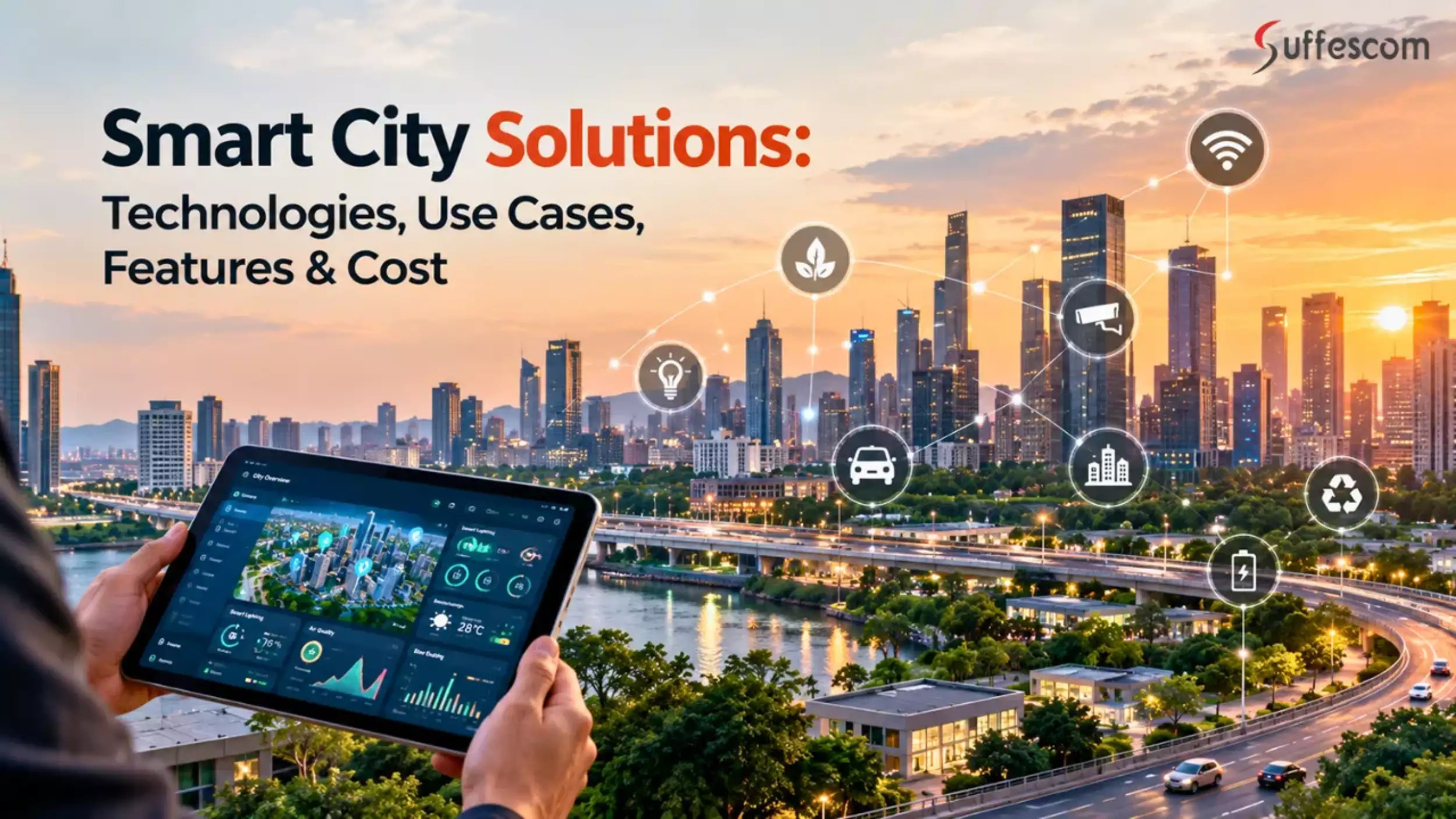
Smart city solutions development combines artificial intelligence (AI), the Internet of Things (IoT), cloud computing, data analytics, and connected infrastructure to address urban challenges. These solutions help cities improve traffic flow, monitor public utilities, manage waste collection, optimize energy consumption, strengthen public safety, and deliver more responsive citizen services.
For municipalities, urban planners, infrastructure operators, and technology businesses, developing software for smart city involves more than connecting sensors or deploying a centralized dashboard. It requires interoperable systems, reliable data pipelines, secure device connectivity, and software that can translate real-time information into actionable decisions.
This guide explores the types of smart city solutions, their applications, the technologies involved, the development process, architecture considerations, and implementation costs.
Types of Smart City Solutions and Their Applications
Smart city initiatives can address individual urban challenges or connect multiple municipal services through a unified technology ecosystem. The appropriate solution depends on a city's infrastructure, operational priorities, existing systems, and long-term development goals.
1. Smart Traffic and Urban Mobility Solutions
Urban mobility solutions use connected sensors, traffic cameras, GPS data, and analytics to help transportation authorities understand traffic conditions and improve road network operations.
Common capabilities include:
- Real-time traffic monitoring: Collect information about vehicle movement, congestion, and road conditions.
- Adaptive traffic signal control: Adjust signal timing based on traffic conditions where the infrastructure supports it.
- Smart parking management: Identify parking availability and help drivers locate suitable spaces.
- Public transportation monitoring: Track vehicle locations, service disruptions, and route performance.
- Incident detection: Identify potential road incidents and notify traffic operators for investigation.
AI models can analyze historical and real-time traffic data to forecast congestion and support route planning. Integrating these capabilities with mapping systems and transportation applications helps authorities coordinate responses across different parts of the urban road network.
2. Smart Energy and Streetlight Management
Smart energy solutions help cities monitor electricity consumption, manage connected infrastructure, and identify opportunities to reduce unnecessary energy use.
For example, connected streetlights can report their operational status, while lighting controllers can adjust brightness according to schedules, ambient light, or validated occupancy signals.
Key capabilities include remote switching, energy consumption monitoring, fault detection, automated alerts, and performance reporting. At a broader scale, smart grid integrations can help utilities monitor network conditions and balance electricity demand.
Developers should account for equipment compatibility, communication reliability, and the safety requirements of electrical infrastructure when designing these systems.
3. Smart Water Management Solutions
Water utilities can use IoT sensors, connected meters, pressure monitoring equipment, and analytics to improve water distribution and detect potential infrastructure problems.
Smart water solutions commonly support:
- Water consumption monitoring and demand forecasting.
- Leak detection through abnormal flow or pressure patterns.
- Reservoir and water tank level monitoring.
- Water quality monitoring using appropriate sensors.
- Pump performance monitoring and maintenance alerts.
- Irrigation scheduling based on environmental conditions.
AI-based analytics can help identify unusual consumption patterns or prioritize infrastructure inspections. However, automated alerts should be validated against sensor quality, operating conditions, and established engineering thresholds.
4. Smart Waste Management Solutions
Smart waste management systems help municipalities optimize collection schedules, monitor waste containers, and coordinate collection vehicles.
Connected bin sensors can estimate fill levels and transmit readings to a waste management platform. Route optimization software can then help collection teams prioritize locations, subject to vehicle capacity, collection rules, and road conditions.
A complete software solution may include container monitoring, route planning, fleet tracking, missed-collection reporting, recycling analytics, and operational dashboards.
The objective is to replace rigid collection schedules with better-informed planning while maintaining service coverage and compliance with local waste management requirements.
5. Smart Public Safety and Emergency Response
Public safety solutions combine incident reporting, connected infrastructure, geographic information systems (GIS), and communication workflows to help authorized personnel respond to emergencies.
Depending on the use case, the platform may include emergency alert management, incident mapping, infrastructure alarms, disaster monitoring, and coordination between relevant response teams.
Computer vision can assist with specific tasks, such as detecting blocked roads or identifying defined safety events in authorized camera feeds. Such deployments require careful attention to privacy, access controls, data retention, and false-positive rates.
These systems should support trained responders rather than assume that automated predictions can independently determine every emergency response.
6. Smart Buildings and Infrastructure Monitoring
Buildings, bridges, roads, public facilities, and other urban assets require regular inspection and maintenance. Smart infrastructure solutions help operators monitor equipment conditions and identify maintenance needs earlier.
Connected vibration, temperature, pressure, or structural sensors can provide data about asset performance. Analytics can flag unusual readings, while maintenance software can create inspection tasks and track repairs.
These capabilities also extend to building operations, where a smart building management platform can help centralize the monitoring and management of building systems. For infrastructure owners managing large asset portfolios, centralized asset records, maintenance histories, condition monitoring, and work-order integrations can improve operational visibility and maintenance planning.
7. Environmental Monitoring and Pollution Control
Environmental monitoring solutions collect data about air quality, noise, temperature, water quality, and other environmental conditions.
A citywide monitoring network can combine sensor readings with weather data, geographic information, and historical observations. Analytics can help authorities identify pollution hotspots, compare conditions across locations, and investigate unusual readings.
The platform should account for sensor calibration, placement, data gaps, and measurement accuracy. Low-cost sensors can support supplementary monitoring, but their readings should not automatically be treated as equivalent to certified regulatory measurements.
8. Digital Citizen Services and E-Governance
Digital citizen service solutions make it easier for residents to access municipal services and report local issues.
Common features include online applications, service requests, complaint tracking, appointment scheduling, payment integrations, notifications, and status updates.
For example, a resident could report a damaged streetlight through a mobile application. The system would record the location, route the complaint to the responsible department, create a maintenance request, and notify the resident when the issue is resolved.
Integration with existing municipal systems is essential to avoid creating another disconnected application that requires staff to duplicate work.
How AI Is Transforming Smart City Solutions
AI helps smart city systems interpret large volumes of operational data, identify patterns, forecast potential problems, and support decisions that would otherwise require extensive manual analysis.
However, the value of AI depends on the problem being addressed, the availability of suitable data, and the reliability of the resulting predictions.
AI-Powered Predictive Maintenance
Traditional maintenance often relies on fixed schedules or repairs after equipment failure. Predictive maintenance uses equipment readings, operating history, and analytical models to estimate the likelihood of faults or identify abnormal behavior.
For example, a connected water pump may generate temperature, vibration, pressure, and power-consumption readings. A model can identify patterns associated with unusual operating conditions and flag the equipment for inspection.
An AI-enabled maintenance workflow can include:
- Collect telemetry from connected assets.
- Validate and normalize incoming readings.
- Establish operating baselines and detect anomalies.
- Prioritize alerts according to asset criticality and risk.
- Create maintenance tasks through an integrated work-order system.
- Track inspections, repairs, and subsequent equipment performance.
Organizations developing these capabilities can explore AI development services to assess model development requirements, data availability, and integration needs.
Intelligent Traffic Prediction and Optimization
Machine learning models can analyze historical traffic volumes, current road conditions, and other relevant signals to forecast congestion or estimate travel patterns.
These predictions can support traffic planning, adaptive signal systems, and transportation operations. The implementation must account for changing traffic patterns, incomplete sensor coverage, and the need to evaluate performance across different locations and conditions.
AI-Assisted Incident Detection
AI-powered video analytics and sensor analysis can help identify predefined events, including unusual traffic conditions, equipment anomalies, or environmental threshold violations.
The application should establish confidence thresholds, escalation rules, and human review procedures appropriate to the consequences of an incorrect detection.
Urban Resource and Demand Forecasting
Cities can use data analytics and machine learning to forecast water consumption, electricity demand, public transport usage, and waste collection requirements.
Forecasts can help operational teams plan capacity and allocate resources. Their usefulness should be measured against actual outcomes and compared with simpler forecasting methods before they are used for important decisions.
IoT Solutions for Smart Cities: Devices, Sensors, and Connectivity
IoT solutions for smart cities connect physical infrastructure to software systems, enabling continuous monitoring, remote control where appropriate, and data-driven operations.
An IoT deployment typically includes connected devices, communication networks, data ingestion services, processing systems, and applications used by operators.
Common IoT Components
- Sensors and connected devices: Measure parameters such as temperature, pressure, vibration, occupancy, fill levels, or electricity consumption.
- Connectivity: Transfers device data through suitable technologies such as cellular networks, Ethernet, Wi-Fi, or low-power wide-area networks, depending on coverage, power consumption, and bandwidth requirements.
- IoT gateways and edge devices: Aggregate sensor data, translate protocols, filter readings, and perform local processing when required.
- Device management: Supports device registration, health monitoring, configuration, secure updates, and lifecycle management.
- Data processing: Validates readings, applies rules, detects threshold violations, and forwards information to analytics or application services.
- Applications and integrations: Present operational information, generate alerts, manage assets, and connect with existing city systems.
Businesses planning these capabilities can evaluate IoT development services when defining connected-device applications, monitoring interfaces, and integration requirements.
Integrating IoT Devices With Smart City Platforms
Device integration is often one of the more complex parts of a smart city project because infrastructure may include equipment from multiple manufacturers and generations.
A practical integration strategy should establish supported communication protocols, common data formats, device identity requirements, and clear rules for handling missing or inconsistent readings.
Protocols such as MQTT can support lightweight telemetry messaging, while HTTP-based APIs can connect applications and enterprise systems. The right combination depends on the device capabilities, network conditions, and operational requirements.
Essential Technologies Behind Smart City Solutions
Smart city platforms usually combine several technologies rather than relying on a single framework or product.
| Technology | Role in smart city solutions |
| Artificial intelligence and machine learning | Forecasting, anomaly detection, optimization, and predictive maintenance |
| Internet of Things | Connecting sensors, equipment, vehicles, and infrastructure |
| Cloud computing | Hosting applications, processing data, and supporting scalable services |
| Edge computing | Processing time-sensitive data close to devices |
| Geographic information systems | Mapping assets, incidents, service requests, and environmental conditions |
| Digital twins | Representing physical assets or systems for monitoring, simulation, and planning |
| Data analytics | Reporting, trend analysis, performance measurement, and operational insights |
| APIs and integration services | Connecting applications, devices, and existing enterprise systems |
| Cybersecurity technologies | Protecting devices, networks, identities, applications, and data |
The technology stack should follow the use case. A streetlight monitoring application may need reliable telemetry and straightforward alerting, while a citywide traffic analytics platform may require high-volume data processing, geospatial analytics, and low-latency integrations.
Smart City Software Architecture and Integration
A smart city solution requires an architecture that can ingest data from multiple sources, process it reliably, and make it available to authorized users and connected applications.
A typical architecture includes the following layers.
1. Device and Infrastructure Layer
This layer contains sensors, smart meters, traffic controllers, cameras, environmental monitors, connected vehicles, and other infrastructure equipment.
Each device should have a defined identity, data schema, communication method, and lifecycle management process.
2. Connectivity and Data Ingestion Layer
This layer receives telemetry and events through gateways, messaging brokers, APIs, or other suitable integration mechanisms.
It should handle temporary connectivity failures, duplicate messages, delayed readings, and differences in device protocols.
3. Data Storage and Processing Layer
Incoming data can be routed to appropriate storage systems, including time-series databases for sensor measurements, relational databases for operational records, and object storage for files or historical datasets.
Data validation and processing pipelines should identify missing values, inconsistent timestamps, and readings outside expected ranges before downstream analytics use them.
4. AI and Analytics Layer
This layer supports rules engines, statistical analysis, forecasting, anomaly detection, and machine learning models.
Not every use case requires AI. Established rules and deterministic calculations may be more appropriate for safety-critical thresholds or regulatory checks, while machine learning can add value when patterns are complex and sufficient data is available.
5. Application and Integration Layer
This layer contains operator dashboards, mobile applications, citizen portals, reporting interfaces, and integrations with municipal systems.
For example, a water monitoring service might send a high-priority alert to an operations dashboard and create a work order in an existing maintenance application.
6. Security and Governance Layer
Security and governance must extend across the entire architecture. Important controls include encrypted communications, device authentication, role-based access, audit logging, secure updates, backup and recovery, and defined data retention policies.
The architecture should also support interoperability. Common data models, versioned APIs, documented interfaces, and clear ownership of integrations make it easier to expand the platform without replacing every connected system.
How to Develop Custom Smart City Solutions
Developing smart city solutions requires a structured process that aligns technical decisions with measurable urban or operational outcomes.
Step 1: Identify Urban Challenges and Business Requirements
Start by identifying the problem that needs to be solved. Examples include recurring water leaks, inefficient waste collection, limited visibility into public assets, or delays in responding to citizen complaints.
Define the intended users, existing systems, operating constraints, and measurable outcomes. Useful indicators might include incident response time, equipment downtime, water loss, energy consumption, or service request resolution time.
Step 2: Select and Prioritize Use Cases
Avoid attempting to digitize every city service in the first release. Prioritize use cases based on operational impact, feasibility, data availability, integration complexity, and implementation risk.
A focused pilot, such as connected streetlight monitoring or water leak detection, can help validate device connectivity, workflows, and data quality before expanding to additional departments.
Step 3: Define the Software and IoT Architecture
Determine how devices, gateways, applications, databases, analytics services, and external systems will communicate.
Choose suitable communication protocols, deployment models, data storage systems, and integration interfaces. Consider whether the solution needs local processing, centralized cloud services, or a hybrid approach.
Document availability requirements, data ownership, access permissions, and expected data volumes before committing to the architecture.
Step 4: Develop the Application and Core Software Components
Build the required interfaces and operational workflows, including dashboards, maps, alerting, asset records, user management, reporting, and maintenance tasks.
Custom applications should reflect the needs of the people using them, from field technicians working on mobile devices to control-room operators monitoring multiple systems.
A dedicated software development service can be relevant when the project requires custom applications, backend services, APIs, or integrations tailored to municipal operations.
Step 5: Integrate AI and Analytics Where They Add Value
Identify which decisions benefit from forecasting, anomaly detection, computer vision, or optimization.
Prepare representative datasets, establish baseline performance, validate models, and test how predictions affect actual workflows. Include confidence thresholds, human review, monitoring, and fallback behavior when model outputs are unreliable.
If a city already has operational software but needs to add AI capabilities, AI integration services may be relevant to connecting models with existing applications and business processes.
Step 6: Test Devices, Integrations, Security, and Performance
Testing should cover more than whether the application works under ideal conditions.
Validate device interoperability, network interruptions, duplicate readings, delayed data, API failures, user permissions, peak loads, and recovery procedures.
Security testing should address connected-device risks as well as application vulnerabilities. Where the solution influences critical infrastructure, define safe fallback behavior and ensure that automated actions comply with operational requirements.
Step 7: Run a Pilot and Measure Results
Deploy the solution in a controlled environment or a limited geographic area. Compare results with a documented baseline and evaluate the solution against the objectives defined at the beginning of the project.
For example, a smart waste pilot could measure collection distance, missed pickups, overflow incidents, and operating costs before and after deployment.
Report the measurement period, sample size, operating conditions, and limitations. Avoid attributing improvements to the software without considering other changes that occurred during the pilot.
Step 8: Scale and Optimize the Solution
After validating the pilot, expand the system to additional locations, devices, or departments.
Use monitoring data to improve reliability, refine analytics, optimize cloud resources, and plan ongoing maintenance. Establish processes for device replacement, software updates, incident response, and model performance reviews where AI is used.
For organizations building a long-term platform rather than a single-purpose application, software product engineering services can be relevant to product architecture, lifecycle planning, scalability, and continuous enhancement.
Smart City Solutions Development Cost
Smart city solutions development can cost approximately $20,000 to $50,000 for a basic proof of concept, while complex, multi-system deployments can exceed $500,000. The actual budget depends on the number of connected devices, AI capabilities, infrastructure requirements, integrations, and deployment scale.
| Smart city solution type | Estimated development cost |
| Basic smart city monitoring dashboard | $20,000–$50,000 |
| IoT-based asset and infrastructure monitoring | $40,000–$100,000 |
| Smart waste management solution | $35,000–$100,000 |
| Smart energy and streetlight management | $40,000–$120,000 |
| AI-powered predictive maintenance | $50,000–$150,000 |
| Smart traffic monitoring and analytics | $60,000–$180,000 |
| Integrated smart city software platform | $150,000–$500,000+ |
| Large-scale, multi-department smart city ecosystem | $500,000–$1 million+ |
These estimates represent indicative software development budgets. IoT hardware, sensor installation, connectivity, specialized infrastructure, third-party licensing, and ongoing cloud operations may add significant costs.
What Affects the Final Development Budget?
Number of connected devices: More sensors and gateways increase integration, testing, and device management requirements.
- AI complexity: Predictive models, computer vision, and real-time optimization require suitable datasets, validation, and ongoing monitoring.
- Software integrations: Connecting legacy municipal systems, GIS platforms, traffic controllers, and utility infrastructure adds engineering effort.
- Deployment requirements: High availability, edge computing, data residency, and stringent security requirements can increase implementation costs.
- Ongoing maintenance: Cloud usage, device replacement, security updates, technical support, and model monitoring contribute to the total cost of ownership.
How to Plan a Smart City Development Budget
For an initial project, consider starting with one well-defined use case, such as smart streetlight monitoring, water leak detection, or connected waste collection. Validate the technical feasibility and operational benefits before expanding to additional departments.
Ask development partners to separate the costs of discovery, software development, hardware and installation, integrations, deployment, and ongoing support. This provides a more transparent estimate and makes proposals easier to compare.
Note: The figures above are preliminary planning estimates, not independently verified market averages. Obtain a project-specific estimate based on the intended scope, location, infrastructure, and technical requirements.
Challenges in Implementing Smart City Solutions
Interoperability With Existing Infrastructure
Cities often operate equipment and software from different vendors. Incompatible protocols and inconsistent data formats can complicate integration.
Recommended approach: Document interfaces early, use established standards where appropriate, and test integrations with representative devices before scaling.
Cybersecurity and Data Privacy
Connected infrastructure expands the number of devices, interfaces, and systems that need protection. Some smart city applications may also process sensitive location or personal information.
Recommended approach: Implement secure device identities, least-privilege access, encryption, audit logs, and controlled data retention. Consult cybersecurity experts for tailored cybersecurity services to protect connected infrastructure.
Data Quality and Connectivity
Sensor readings can be incomplete, delayed, inaccurate, or unavailable during network interruptions. Analytics built on poor-quality data can produce misleading results.
Recommended approach: Validate incoming readings, monitor device health, establish data quality checks, and design for temporary disconnections.
Scalability and Long-Term Maintenance
A solution that works for a small pilot may struggle when device counts, data volumes, or user activity increase.
Recommended approach: Test realistic workloads, monitor performance, design modular services, and establish a clear plan for software updates, hardware replacement, and ongoing support.
Measuring Business and Public Value
Technology deployment alone does not guarantee better city services. Results depend on operational adoption, existing infrastructure, maintenance processes, and local conditions.
Recommended approach: Define baseline measurements and success criteria before implementation. Review performance after deployment and adjust the solution based on observed results.
The Future of Smart City Solutions
Smart city development is moving toward more connected, data-driven infrastructure in which separate systems can exchange information and support coordinated operations.
Several areas are worth monitoring:
- Digital twins: Virtual representations of infrastructure that support monitoring, simulation, and planning.
- AI-assisted operations: Models that help forecast demand, prioritize maintenance, and identify unusual conditions.
- Edge intelligence: Local processing that reduces unnecessary data transmission and supports time-sensitive applications.
- Connected mobility: Better coordination between traffic systems, public transportation, parking, and road infrastructure.
- Integrated environmental monitoring: Combining sensor readings, weather information, and spatial analysis to understand urban conditions.
- Interoperable platforms: Systems designed to exchange data across vendors and departments without requiring complete infrastructure replacement.
The most effective implementations will focus on specific, measurable needs rather than adopting emerging technologies simply because they are available.
Conclusion
Smart city solutions development brings together AI, IoT, cloud computing, analytics, and custom software to address practical urban challenges. The right approach begins with a clearly defined use case, followed by an interoperable architecture, secure integrations, reliable data collection, and measurable performance goals.
Whether the priority is traffic optimization, connected utilities, predictive maintenance, environmental monitoring, or digital citizen services, a phased development strategy can help organizations validate requirements before expanding to larger deployments.
Suffescom's capabilities across AI, IoT, cloud, analytics, and software engineering can be considered when evaluating a partner to build or integrate these technologies. Start by defining the operational challenge, the systems that need to connect, and the outcomes the solution must deliver.
FAQs
What are the main types of smart city solutions?
Major categories include smart mobility, energy management, water monitoring, waste collection, public safety, environmental monitoring, infrastructure maintenance, and digital citizen services. Cities can deploy these independently or integrate them into a broader technology ecosystem.
How is AI used in smart city solutions?
AI can support predictive maintenance, traffic forecasting, anomaly detection, demand planning, and selected computer vision applications. Its effectiveness depends on data quality, model validation, operational integration, and appropriate human oversight.
How do IoT solutions work in smart cities?
IoT solutions connect sensors and equipment to networks and software platforms. Devices transmit data to gateways or ingestion services, where the information can be validated, analyzed, displayed, and used to trigger alerts or operational workflows.
How much does smart city solutions development cost?
Costs vary according to the number of use cases, connected devices, hardware and installation requirements, software scope, AI capabilities, third-party integrations, infrastructure, and support. A reliable estimate requires a defined scope and a breakdown of both implementation and recurring expenses.
How long does it take to develop a smart city solution?
The timeline depends on the use case, integration complexity, hardware procurement, testing requirements, and deployment scale. A focused software prototype may take considerably less time than a production system involving field installations, multiple agencies, and critical infrastructure. A phased roadmap provides a more reliable estimate than a single timeline for all smart city projects.
What technologies are required to build smart city software?
Common technologies include IoT devices and protocols, cloud or edge computing, databases, APIs, GIS, AI and machine learning, data analytics, and cybersecurity controls. The exact stack should be selected according to the operational problem, data requirements, existing infrastructure, and reliability needs.
How can cities ensure smart city solutions are secure?
Security requires device authentication, encrypted communications, least-privilege access, secure updates, vulnerability management, audit logs, backup and recovery, and appropriate privacy controls. Security requirements should be established during architecture design rather than added after deployment.
What should organizations look for in a smart city development partner?
Evaluate technical capabilities, integration experience, security practices, project delivery processes, documented case studies, scalability, and long-term support. Ask for a solution architecture and a phased implementation plan that explains how the proposed system will address the project's specific requirements.