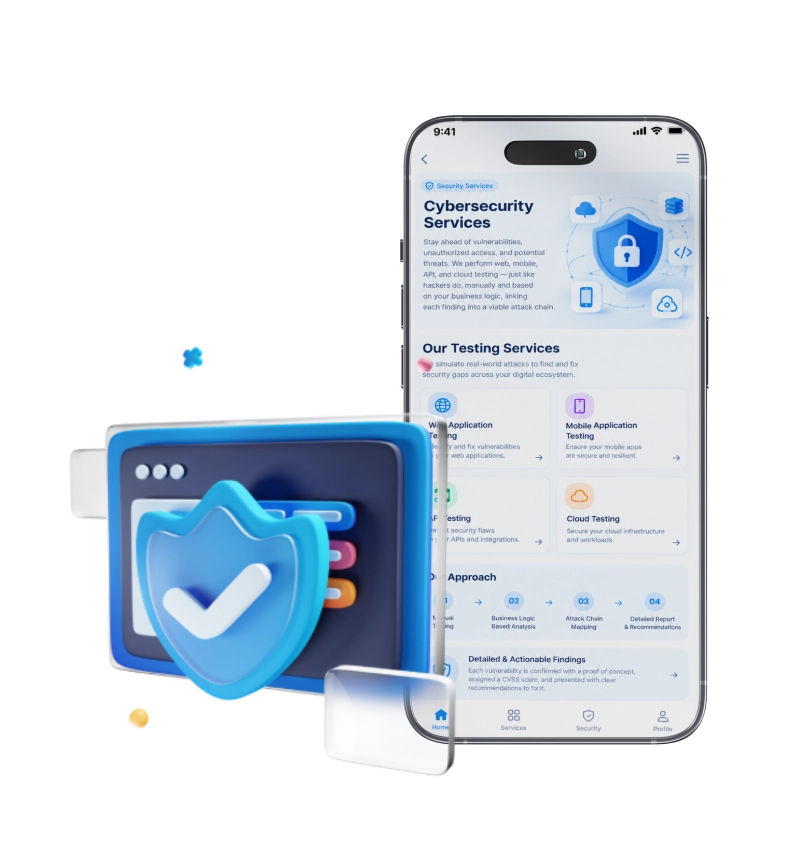
Suffescom keeps you ahead of vulnerabilities, unauthorized access, and potential threats to avoid any future expensive breaches. We perform web application testing, mobile application testing, API testing, and cloud testing just like hackers do, manually and according to your business logic, linking each finding into a viable attack chain. Each vulnerability is confirmed with a proof of concept, assigned a CVSS score, and presented with recommendations on how to fix it.
Your Partner for Application and Infrastructure Security
Most vulnerabilities lie within the code, the configuration, and access design. That’s where we search for them. Suffescom uses its software product engineering experience combined with security tests to find any weaknesses in applications, APIs, cloud platforms, and AI systems before any attacker does.
Each project is custom-built for your unique stack and risk tolerance. Based on your needs, whether it be a pre-release penetration test, cloud security evaluation, secure code review, or a certain LLM-based capability evaluation, we manually confirm each issue, rate it, and give you instructions on how to solve it.
0+
Penetration Tests and Security Assessments Delivered
0+
Years in Application and Network Security
0+
Critical and High-Severity Vulnerabilities Identified
0+
Critical Findings Remediated Before Release
Explore Our Comprehensive Cybersecurity Services for Businesses
Security engineers at Suffescom test, debug, and keep monitoring important systems such as applications, APIs, clouds, networks, and AI components. Every assessment is conducted within a certain scope and under the rules of engagement. Findings are verified manually, CVSS-rated, and provided together with solutions ready for implementation by your developers.
1. Penetration Testing (VAPT)
Manual and authorized testing of web applications, APIs, mobile applications, network, and cloud infrastructures, moving beyond automated scanning findings towards creating attack vectors.
Black-box: no prior access, simulating an external attacker
Gray-box: user-level credentials and multiple roles, best for finding authorization flaws
White-box: source code and architecture access for maximum coverage
Authenticated and unauthenticated testing, privilege escalation, and exploit chaining within scope.
Production-safe testing: agreed windows, no destructive payloads unless approved
Optional add-ons: phishing and social engineering simulations
2. Application and API Security
Security testing across the application layer, aligned to OWASP Top 10, API Security Top 10, ASVS, and MASVS (mobile).
Authorization: broken object- and function-level authorization (BOLA/BFLA), IDOR, and role and tenant isolation
Authentication and sessions: JWT and OAuth/OIDC misconfigurations, weak token validation, password reset, and MFA bypass paths
API-specific: mass assignment, excessive data exposure, missing rate limits, GraphQL introspection, and query batching abuse
Business logic: race conditions in payment and refund flows, price and limit manipulation, workflow bypass
Segmentation testing between environments (corporate, production, vendor)
Active Directory attack paths
Firewall and access-rule review
6. AI and LLM Security
Assessment of AI-powered features against the OWASP Top 10 for LLM Applications.
Direct and indirect prompt injection (via documents, web pages, emails)
System prompt and sensitive-data leakage
Excessive agency: tool and API permissions available to agents
Insecure output handling (model output reaching a browser, database, or shell)
RAG risks: cross-tenant retrieval, poisoned documents, weak access control on embeddings
7. Identity and Access Management (IAM)
Design and review of how users, administrators, and services get access.
RBAC and least-privilege design, SSO configuration review (SAML/OIDC)
MFA coverage and bypass paths such as weak recovery flows and fallback methods
Joiner-mover-leaver lifecycle, privileged access, service accounts, secrets handling
8. SIEM and Detection Engineering
Centralized logging with detections designed to find real attacker behavior.
Log-source onboarding, parsing, and retention planning
Detection rules mapped to MITRE ATT&CK, tuned to cut false positives.
Triage and escalation runbooks
9. Managed Security and Incident Response
Ongoing monitoring plus structured response when something goes wrong.
Managed: alert triage, scheduled vulnerability scans, and reporting
Response (NIST SP 800-61): scoping, log and system artifact analysis, evidence preservation, containment guidance, root-cause analysis
Incident response playbooks and tabletop exercises
10. Compliance Readiness
Gap analysis and remediation support for SOC 2, ISO/IEC 27001, PCI DSS, HIPAA, and GDPR.
Control mapping, policy drafting, evidence checklists
Penetration test evidence aligned to framework requirements (for example, PCI DSS testing requirements)
Readiness support only: certification and attestation come from accredited auditors, and outcomes depend on your implementation.
11. Security Consulting and Program Development
Independent review and a roadmap sized to your team.
Threat modeling (e.g., STRIDE) for critical systems, architecture review
NIST CSF or CIS Controls gap assessment
Policies, a risk register, and a phased roadmap separating quick wins from long-term work
Our Cybersecurity Projects
Explore Suffescom's project portfolio to understand our approach to solving technology and security challenges.
Application Security for a Fintech Company
Description: An online payments firm based in Dubai, UAE, was looking for ways to enhance the security of its payments application and APIs to safeguard its customers' sensitive data, user access, and transaction information while providing an excellent user experience.
Business Requirement: Increase the security of the application, identify vulnerabilities with high impact, and protect their application from any unauthorized users through better authentication and authorization.
Our Approach: An application security assessment was carried out, their authentication and authorization process was evaluated, and their vulnerabilities were identified along with recommendations based on risk.
Outcomes:
35%Fewer high-risk security findings after remediation
100%Of identified critical vulnerabilities addressed before release
ImprovedVisibility into application security risks
Description: A digital marketplace for retailers that is based in London, UK, required help to enhance the security of its cloud infrastructure due to growth in its digital capabilities.
Business Requirement: Minimize cloud misconfigurations, secure access, and gain visibility into the security threats present within its applications, infrastructure, and business data.
Our Approach: We performed an assessment of the cloud configuration, access rights, and identities and identified any resource exposure and security gaps within the environment. As per the assessment, we helped build a roadmap for improving cloud security.
Outcomes:
40%Fewer high-risk cloud configuration findings
30%Reduction in excessive permissions across the reviewed environment
ClearerVisibility into cloud security gaps and remediation priorities
Description: A healthcare organization that operates out of multiple locations in Toronto, Canada, needed a more centralized process for security monitoring, as it was not able to effectively correlate security events, investigate incidents, and detect any possible threats within different systems.
Business Requirement: Centralization of security event monitoring, better threat detection, and the development of incident escalation procedures.
Our Approach: A centralized SIEM process was adopted to gather logs from all the relevant systems, correlate security events, and prioritize the alerts according to the level of risk. We also helped establish incident escalation workflows to support faster investigations and improve coordination among security and IT teams.
Outcomes:
25%Reduction in average time to detect incidents
40%Reduction in average time spent investigating alerts
20Systems and data sources covered by centralized monitoring
Strengthen Your Business Security With the Right Cybersecurity Strategy
Every business faces different security risks. Work with Suffescom to explore cybersecurity services that align with your applications, infrastructure, data protection needs, and business priorities.
Security Assessment Types: Choose the Right Test for Your Risk
Our approach to a cybersecurity assessment is an all-round one, including applications, networks, cloud, etc. This enables us to assess areas where an organization needs to focus on remediation in order to enhance its cybersecurity position. The scope of each assessment is based on your technology stack and risks you face.
Application Security Assessment
Web applications, mobile applications, and application programming interfaces are tested in the same way a hacker tests them: by authenticating into the application and accessing data and functions that the role is not allowed to access. We provide you with a complete list of vulnerabilities with the necessary proof and fix recommendations, along with a test coverage report.
Network and Infrastructure Security Assessment
Testing is conducted from the external network and the internal network, assuming that one host has been compromised. The open ports serve as the preliminary check. The main point is how many open ports are exploitable and whether the hacker can jump from one to another. The result is the list of vulnerabilities ranked by the level of threat, along with the segmentation holes enabling them.
Cloud Security Assessment
Your AWS, Azure, or Google Cloud deployment is assessed using read-only access and is then mapped for vulnerabilities in permissions that can be used to obtain sensitive data or hijack an account. Most assessments will lead to a catalog of misconfigurations. It is those configurations that form an attack path that will stand out. Recommendations will include least privilege policies and infrastructure as code solutions to remediate the findings.
Vulnerability Assessment and Penetration Testing (VAPT)
A scan will reveal vulnerabilities. The manual assessment will test the critical vulnerabilities to see if they can be exploited and linked to form an attack path leading to a harmful outcome such as accessing customer data. Based on the objective, testing can be black box, gray box, or white box and is safe for production by default. The report includes proof of exploitation, risk ratings, and a retest of fixed issues where agreed.
Secure Code Review
Source code is reviewed carefully at places where errors are very costly: logging in, permissions, payments, file manipulation, and data manipulation. Automated scans are used for everything else. Since our reviewers are expert security engineers with software development experience, each identified error includes the exact file name and line number, as well as the correct pattern, making it easy to fix.
Cybersecurity Risk Assessment
The systems, data, and current controls are first mapped out and then sorted according to how much potential threat they pose to your organization. You get your very own risk register, not just any pre-existing one available. A roadmap with priorities will help you distinguish between fast gains and long-term investments, making sure that you get value for your money when it comes to security.
Security Compliance Assessment
Your controls, policies, and evidence are evaluated in relation to the chosen standard, like ISO 27001, SOC 2, or PCI DSS, in order to show exactly what you are lacking. Testing can also provide evidence for your pen tests that auditors require. This is a readiness assessment, and certification will be done by accredited auditors. The deliverables are a gap matrix and a clear remediation plan.
Social Engineering and Phishing Assessment
The phishing, phone, and pretexting tests are pre-planned and are conducted using realistic scenarios as opposed to template-based. The test doesn’t merely rely on who clicked; it looks at how fast the team reported and reacted. This way, the results are shared collectively to avoid singling out individuals. The end product is the department-level feedback and training recommendations.
AI and Machine Learning Security Assessment
AI functionalities will be assessed by simulated attacks such as prompt injection via user interface, documents, or web pages, and attempts to extract hidden prompts, sensitive information, and unauthorized activities via other integrated applications. How the rest of the system uses model output is checked as well. The result is a set of reproducible attack cases with transcripts, plus specific recommendations on guardrails and permission limits.
IT Components Our Cybersecurity Assessment Covers
We help businesses identify and address security weaknesses across the technology components that support their digital operations. Here are the key components we assess and help secure:
Web Applications and Websites
Mobile Applications
APIs and Web Services
Networks and Firewalls
On-Premises IT Infrastructure
Cloud Infrastructure and Environments
Servers and Operating Systems
Databases and Data Storage Systems
Identity and Access Management Systems
Software Source Code
Development Environments and CI/CD Pipelines
Endpoints and User Devices
AI and Machine Learning Systems
IoT Devices and Connected Systems
Third-Party Integrations and Enterprise Applications
Cyber Threats and Attack Types We Address
Suffescom helps organizations evaluate security weaknesses associated with common attack techniques and potential threat scenarios.
Credential and Authentication Attacks
Brute force and password spraying
Credential stuffing against login and API endpoints
JWT, OAuth, and OIDC misconfigurations
Session fixation and session hijacking
MFA and password-reset bypass
Account takeover
Web Application and API Attacks
SQL injection and command injection
Cross-site scripting (XSS)
Cross-site request forgery (CSRF)
Server-side request forgery (SSRF)
Broken access control (IDOR, BOLA, BFLA)
Mass assignment and excessive data exposure
Business logic abuse and race conditions
Insecure deserialization
Network and Availability Attacks
Distributed denial-of-service (DDoS)
Man-in-the-middle (MitM) attacks
DNS spoofing and subdomain takeover
Weak segmentation and lateral movement
Application-layer denial of service (pre-approved testing only)
Replay attacks on unsigned requests
Social Engineering and Email Attacks
Phishing and spear phishing
Business email compromise (BEC)
Executive impersonation and whaling
Voice phishing and SMS phishing
Email spoofing from missing SPF, DKIM, or DMARC controls
Cloud and Data Security Threats
Cloud storage misconfigurations
Publicly exposed storage and snapshots
Over-permissive IAM roles and privilege escalation
Secrets exposed in code, environment variables, or metadata services
Unencrypted data and weak key management
Data exfiltration paths
AI-Specific Security Threats
Prompt injection (direct and indirect)
Sensitive data and system prompt disclosure
Insecure output handling
Excessive permissions granted to AI agents and tools
Cross-tenant retrieval and poisoned documents in RAG systems
Advanced Technologies That Drive Our Cybersecurity Solutions
We employ modern technology and methods to help organizations detect weaknesses in their environment, harden their security posture, and defend themselves against cyber threats.
01
Artificial Intelligence and Machine Learning
We employ artificial intelligence-enabled techniques to accelerate our triaging process, and all findings are validated by our engineers. We also perform testing of AI-enabled applications for prompt injection, data leakage, and unsafe tool usage.
02
Cloud Computing
AWS, Azure, and Google Cloud platforms are assessed against CIS benchmarks as follows: IAM, storage, network exposure, workload, and logging.
03
DevSecOps/Automation
Our automation tools will assess your code, dependencies, containers, and Infrastructure as Code (IaC) in your CI/CD pipeline before release.
04
Internet of Things (IoT)
Analysis of the IoT devices, pathways through which IoT devices communicate, firmware updates, and APIs used by IoT devices shall be conducted.
Cybersecurity Capabilities for an Evolving Threat Environment
Standard testing and compliance checklists assist in assessing the known threats at one point in time. The following capabilities will help assess the risks that emerge between testing periods: forgotten assets, trusted build processes, undetected detections that will never get tested, and cryptography that will not survive.
Attack Surface Management
We discover and catalog all that you expose to the internet and help you build a list of all that should be retired or secured.
Software Supply Chain Security
We take a look at how code, dependencies, and credentials make their way from development to production and inject pipeline safeguards against any tampering.
Identity Abuse Review
We look for ways to use stolen or over-privileged accounts, including privilege escalation, risky service accounts, and token theft, and define the detections that would catch them.
Detection Validation
We run controlled attack scenarios mapped to MITRE ATT&CK to check whether your alerts actually fire, then tune the rules that don’t.
Ransomware Resilience Review
We will run an exercise on your ability to perform backup isolation, restore readiness, and evaluate your response planning through a tabletop exercise.
Post-Quantum Cryptography Readiness
We will identify instances of your dependency on public key cryptography and provide a plan for you to transition your data to post-quantum cryptography.
Cybersecurity Integrations for Your Existing Technology Stack
Security tools only help if they work with the systems you already run. We connect testing and monitoring to your existing platforms, within the project scope and subject to platform compatibility.
Application, cloud, identity, and network logs are centralized, with detections mapped to MITRE ATT&CK and tuned to cut false positives. SOAR playbooks and an autonomous SOC approach can take over repetitive first-level triage. Examples: Microsoft Sentinel, Splunk, Elastic Security
Identity and Access Management Platforms
+
The evaluation and alignment of the SSO, MFA, RBAC, and user lifecycle processes are conducted thoroughly to ensure they are compatible with the capabilities and features offered by the selected identity provider. Examples: Okta, Microsoft Entra ID, AWS IAM Identity Center
Authentication and authorization mechanisms and data exchange between internal systems, third-party systems, and API gateways are reviewed, including key/token issuance and rotation mechanisms. Examples: REST, GraphQL, SOAP APIs; API gateways
Development and CI/CD Tools
+
We add code analysis, dependency scanning, secrets detection, container scanning, and infrastructure-as-code checks to your pipeline, with severity gates, and send findings to your issue tracker. Examples: GitHub Actions, GitLab CI, Jenkins, Jira
Not Sure What to Test First? We'll Help You Scope It!
Describe your systems, your release plans, and any audit or customer security requirements. A security engineer will recommend a scope, explain what each option covers, and tell you what we need from your team to get started.
Industries experience different threats, different data types, and different regulations. The scope of every assessment is based on threats important to your industry, e.g., payment fraud, exposure of personal health information, or tenant isolation. We test according to the appropriate standards, yet testing alone does not guarantee compliance or certification.
FinTech
We perform tests of payment paths, financial API, and login security for account takeover, transactional fraud, and exposure of card/bank data.
We conduct testing of accounts, checkouts, and payments for manipulation of prices, coupon abuse, and exposure of customer information.
SaaS
We perform tenant isolation, permissions, and API access testing to ensure that one client cannot have access to the other client’s information.
Telecommunications
We audit customer portals, subscriber systems, and network segmentation for account takeover and unauthorized access.
Manufacturing & Retail
We perform testing of the interconnections between office networks, manufacturing systems, retail stores, and payment gateways.
Logistics
We test tracking apps, partner APIs, and shipment systems for weak access controls and insecure integrations.
Education
We test learning platforms and student portals for exposed records and weak separation between students, staff, and admins.
Insurance
We test policy, claims, and customer portals for unauthorized access to documents and policyholder data.
Real Estate
We review real estate portals and document sharing services for exposure of contract data, permission flaws, and payment fraud.
Hospitality
We scan booking engines and guest systems for exposure of personal data, payment process vulnerabilities, and third-party risks.
Media and Entertainment
We review streaming and content platforms for account sharing abuse, unprotected assets, and cloud storage misconfigurations.
Our Full-Scale Cybersecurity Assessment Process
A single scan does not provide a true picture of how an attacker could leverage a vulnerability. The process is built around critical assets, tested with an attacker’s mindset, and results in proven fixes, not just findings.
01. Scope and Asset Discovery
The first step ncludes setting the boundaries for the testing of applications, APIs, cloud services, and networks, along with the identification of critical assets such as customer data, payments, and administrative interfaces. The testing windows and credentials are also set, and we agree upon the rules of engagement. You will be provided with a signed scope and the test plan.
02. Security Configuration Assessment
The second step will be an assessment of cloud service permissions, firewall rules, sessions, and TLS settings based on the CIS benchmark and best practices from vendors. The huge number of vulnerabilities discovered is due to misconfiguration and does not require any exploitation. You will receive a list of vulnerabilities sorted by priority with fast solutions.
03. Vulnerability Discovery and Testing
We perform automated scanning along with manual testing of issues that cannot be detected by scanners, access control issues, injections, SSRF, token/session vulnerabilities, and abuse of business logic. If required within the scope of your project, we include secure coding and penetration testing according to OWASP WSTG, PTES, and NIST SP 800-115.
04. Vulnerability Validation and Risk Analysis
Every finding is reproduced by an engineer to remove false positives. Confirmed vulnerabilities are evaluated and assigned scores using the CVSS, and they are subsequently organized according to their exploitability and the associated risks of exposure. You get a sorted list that tells you how to remediate the confirmed vulnerabilities and why.
05. Technical Report and Remediation Plan
Each finding is documented with supporting details, reproducibility information, impacted assets, and remediation instructions, including secure coding samples where necessary. An executive summary is provided, while the technical report is provided to your team along with a call to clarify your questions. You get a prioritized remediation plan that works on right away.
06. Remediation Verification
When applicable, we will re-test any fixed findings, ensure there are no side effects from the applied fixes, and classify the issue as fixed, partially fixed, or not fixed at all. For repetitive issues, we will make a recommendation for testing to prevent their recurrence. You get a retest report with supporting evidence that you can show to your auditors or clients.
Cybersecurity Services Cost: What Should You Expect to Pay?
Cost depends on what is being tested, how deep the testing goes, and how complex your environment is. The ranges below show typical engagement types. Every project is scoped individually, and you receive a fixed quote before work begins.
Security Standards and Compliance Frameworks We Support
We test and assess your controls against recognized standards and regulations, so findings map to requirements your auditors and customers already use.
01
Information Security
ISO/IEC 27001
SOC 2
NIST Cybersecurity Framework
CIS Critical Security Controls
02
Data Privacy and Protection
GDPR
CCPA/CPRA
India DPDP Act
03
Application and API Security
OWASP Top 10
OWASP API Security Top 10
OWASP Application Security Verification Standard (ASVS)
04
Cloud Security
ISO/IEC 27017
ISO/IEC 27018
CSA Cloud Controls Matrix (CCM)
CIS Benchmarks
05
Industry-Specific Security
PCI DSS — Payment security
HIPAA — Healthcare data protection
IEC 62443 — Industrial and operational technology security
06
AI Security
NIST AI Risk Management Framework (AI RMF)
ISO/IEC 42001
OWASP Top 10 for Large Language Model Applications
What Our Clients Say
CLIENT STORIES
“We wanted to make sure our payment application and APIs were properly secured, especially when it came to customer data and transactions. Suffescom helped us identify the key vulnerabilities and understand what needed to be fixed before release. The findings gave our team a much clearer direction for improving application security.”
Hamdan Al Mazrouei Chief Technology Officer, Digital Payments Company
“As our business grew, we needed a better understanding of the security gaps in our cloud environment. The assessment helped us identify configuration issues and permissions that needed attention. We came away with a clearer picture of our risks and a practical plan to address them.”
Iona Whitcombe Head of Cloud Infrastructure, E-commerce Marketplace
“We needed a more centralized way to monitor security events across our systems. They brought the relevant data together and established a more structured process for investigating alerts. It made it easier for our teams to get visibility into potential issues and coordinate their response.”
Tavish Brar Director of Information Security, Healthcare Provider
Get a Cybersecurity Project Estimate Aligned With Your Requirements
Share your requirements with Suffescom to discuss the scope of work and the factors that may influence your project estimate.
A single scan does not provide a true picture of how an attacker could leverage a vulnerability. The process is built around critical assets, tested with an attacker’s mindset, and results in proven fixes, not just findings.
01
Scope and Asset Discovery
The first step includes setting the boundaries for the testing of applications, APIs, cloud services, and networks, along with the identification of critical assets such as customer data, payments, and administrative interfaces. The testing windows and credentials are also set, and we agree upon the rules of engagement. You will be provided with a signed scope and the test plan.
02
Security Configuration Assessment
The second step will be an assessment of cloud service permissions, firewall rules, sessions, and TLS settings based on the CIS benchmark and best practices from vendors. The huge number of vulnerabilities discovered is due to misconfiguration and does not require any exploitation. You will receive a list of vulnerabilities sorted by priority with fast solutions.
03
Vulnerability Discovery and Testing
We perform automated scanning along with manual testing of issues that cannot be detected by scanners, access control issues, injections, SSRF, token/session vulnerabilities, and abuse of business logic. If required within the scope of your project, we include secure coding and penetration testing according to OWASP WSTG, PTES, and NIST SP 800-115.
04
Vulnerability Validation and Risk Analysis
Every finding is reproduced by an engineer to remove false positives. Confirmed vulnerabilities are evaluated and assigned scores using the CVSS, and they are subsequently organized according to their exploitability and the associated risks of exposure. You get a sorted list that tells you how to remediate the confirmed vulnerabilities and why.
05
Technical Report and Remediation Plan
Each finding is documented with supporting details, reproducibility information, impacted assets, and remediation instructions, including secure coding samples where necessary. An executive summary is provided, while the technical report is provided to your team along with a call to clarify your questions. You get a prioritized remediation plan that works on right away.
06
Remediation Verification
When applicable, we will re-test any fixed findings, ensure there are no side effects from the applied fixes, and classify the issue as fixed, partially fixed, or not fixed at all. For repetitive issues, we will make a recommendation for testing to prevent their recurrence. You get a retest report with supporting evidence that you can show to your auditors or clients.
Why Should Businesses Choose Suffescom for Cybersecurity Services?
At Suffescom, we combine our software engineering knowledge with a security approach that enables us to identify vulnerabilities, improve security controls, and address risks across your digital environments.
01
Engineering-First Security Remediation
The security results are mapped to implementation solutions in software code, API security, and infrastructure configuration. This way, we make sure that the solutions we recommend are incorporated into the developers’ workflow in order to eliminate vulnerabilities and avoid their reappearance.
02
Application and API Attack Surface Testing
We perform testing on web applications, mobile applications, and APIs for any possible vulnerabilities regarding authentication, authorization, session management, and application logic. It assists in identifying any possible attack vectors that can lead to exposure of sensitive information or even core business processes.
03
Cloud Security Posture Assessment
We evaluate cloud configurations, identity permissions, network exposure, and data storage controls to identify weaknesses across cloud environments. Risk-based findings help teams prioritize configuration improvements and strengthen access restrictions.
04
DevSecOps Security Integration
We help teams integrate appropriate security tests within the development and CI/CD pipeline, which includes code analysis, dependency scans, and vulnerability assessments when necessary. The integration of such tests will help developers detect and fix security problems before deployment.
05
AI Application Security Testing
We review AI applications to understand relevant risks that may be associated with them, including prompt injection, sensitive data exposure, insecure integrations, and vulnerabilities in access control mechanisms. Testing is mainly focused on input, access to the system, and output by an application.
06
Risk-Based Compliance Gap Analysis
This involves testing the organization's current state of security and compliance with applicable standards and regulations. The result is a gap analysis report, while the remediation strategy assists organizations in identifying where they can improve and get ready for compliance review.
Awards that Showcase our Cybersecurity Expertise
Our industry awards as well as technology certifications highlight our experience in constructing and securing digital environments. We are a managed cybersecurity service provider that enables businesses to handle cybersecurity risks.
Technology Stack for Assessing Vulnerabilities of Applications and Networks
We collaborate with security solutions, cloud technologies, and development platforms in order to assist businesses in vulnerability assessment, improving security controls, and integrating security into their environment. The technology stack is chosen based on your infrastructure, security objectives, and the requirements of the project.
Ready to Take the Next Step in Your Cybersecurity Journey?
A clear implementation plan helps turn security objectives into practical action. Start by discussing your current technology environment, key concerns, implementation requirements, and priorities to determine the appropriate next steps for your organization.
The cost depends on application complexity, API coverage, user roles, authentication requirements, and testing depth. Suffescom's indicative security assessment ranges start at $10,000, with mid-level engagements ranging from $25,000 to $40,000+ and enterprise-grade assessments from $40,000 to $60,000+. We provide a project-specific quote after defining the scope.
Automated scanning identifies known vulnerabilities and common configuration issues, while manual penetration testing investigates business logic, access control weaknesses, and potential attack paths that scanners may miss. Suffescom combines automated tools with manual validation to produce evidence-backed findings and practical remediation guidance.
Yes, production testing can be planned around agreed testing windows, defined rules of engagement, and safeguards against disruptive activity. Suffescom establishes testing boundaries before starting and avoids destructive payloads unless explicitly approved. However, no active security test can guarantee zero operational disruption.
Yes. Suffescom's assessment process includes validated findings, reproduction steps, supporting evidence, risk ratings, and technical remediation guidance. Findings are scored using CVSS and prioritized according to exploitability and business impact. Retesting can verify fixes that are included in the engagement.
We examine authentication, object-level and function-level authorization, role permissions, tenant isolation, and access to sensitive endpoints. Testing may include BOLA, BFLA, and IDOR scenarios to determine whether users can access records or perform actions beyond their permissions.
Yes. Cloud security assessments cover identity permissions, public storage, network exposure, encryption, audit logging, and workload configurations. Suffescom reviews relevant AWS, Microsoft Azure, and Google Cloud controls against applicable CIS Benchmarks and provides prioritized recommendations for addressing identified weaknesses.
We assess direct and indirect prompt injection, sensitive-information disclosure, insecure output handling, excessive tool permissions, and retrieval-augmented generation (RAG) risks. Testing also examines whether AI features respect user permissions and tenant boundaries when accessing connected tools, documents, and data sources.
Yes. Secure code reviews examine high-risk areas such as authentication, authorization, cryptography, input validation, and payment logic. Depending on the project, we can help integrate static application security testing (SAST), software composition analysis (SCA), secrets detection, container scanning, and infrastructure-as-code checks into CI/CD workflows.
Yes. Penetration testing and security gap assessments can help identify weaknesses relevant to applicable control requirements and provide evidence for remediation. Suffescom also supports control mapping, policy documentation, and readiness planning. Certification and formal attestation remain the responsibility of the appropriate independent auditors or assessment bodies.
We review identity permissions, privileged accounts, service accounts, token handling, authentication controls, and potential privilege-escalation paths. Depending on the engagement, identity abuse reviews and controlled attack scenarios can help identify weaknesses and assess whether existing detections can recognize suspicious activity.
Yes. Detection validation can use controlled attack scenarios mapped to MITRE ATT&CK to evaluate whether relevant security events generate the expected alerts. We can review log coverage, tune detection rules, and recommend improvements to triage and escalation workflows within the agreed scope.
A ransomware resilience review can examine backup isolation, restore readiness, and incident response procedures, including tabletop exercises. Software supply chain security reviews can assess dependencies, exposed credentials, build pipelines, and CI/CD controls to help identify weaknesses that could affect software integrity or recovery.
We typically need details about the applications, APIs, cloud environments, networks, user roles, and critical business workflows to be assessed. Your release schedule, compliance requirements, testing access, and desired deliverables also help determine the scope, timeline, and project estimate.
The timeline depends on the number of assets, application complexity, testing depth, access availability, and the time needed to validate findings. Manual testing, secure code review, multi-cloud assessments, and remediation retesting can require additional effort. Suffescom confirms the expected timeline after the scope is agreed.
Suffescom provides technical remediation guidance to help development and infrastructure teams address identified weaknesses. Depending on the engagement, support may also include engineering assistance, CI/CD security improvements, and retesting to verify that fixes have resolved the reported issues.
Yes. Recurring assessments can be planned around major releases, infrastructure changes, evolving threats, and applicable compliance requirements. Depending on your needs, the engagement may include scheduled vulnerability scans, periodic penetration testing, continuous security checks in CI/CD, and follow-up testing of resolved findings.
🍪We use cookies
Our website requires some cookies to function properly.
•SUFFESCOM SOLUTIONS
Build Smarter. Scale Faster. Grow More.
Have a Vision? Let’s Turn It Into a Digital Reality.
Get a quick response from our best experts in under 10 minutes.
“
Suffescom easily understood our main goal and delivered the best digital solution. Their team was very cooperative, and it was a very good experience working with them. I would highly recommend them.
James AndersonFounder & CEO, FinTech Company
“
Working with Suffescom was a really great experience. Their developers demonstrated technical knowledge and delivered our mobile app solution with all required functionalities on time.
Sarah MitchellProduct Manager, Healthcare Startup
“
Suffescom helped us build a logistics software solution that completely improved our fleet operations. Their professionalism and transparency are what make them a reliable technology partner.
Michael RobertsCEO, Logistics Company
Our Customer Say:EXCELLENT★★★★½✓ Goodfirms
Have a project idea or need expert guidance? Share your requirements at sales@suffescom.com and our team will get back to you shortly.
Share Your Requirements. Our Experts Will Shape the Solution.
Expert consultation within 10 minutes.Your project details are completely secure under NDA protection.
Get Outstanding Business Outcomes With Future Ready Solutions
Get Free Consultation From Top Industry Experts
Begin A Generous Partnership Now
•SUFFESCOM SOLUTIONS
Build Smarter. Scale Faster. Grow More.
Have a Vision? Let’s Turn It Into a Digital Reality.
Get a quick response from our best experts in under 10 minutes.
“
Suffescom easily understood our main goal and delivered the best digital solution. Their team was very cooperative, and it was a very good experience working with them. I would highly recommend them.
James AndersonFounder & CEO, FinTech Company
“
Working with Suffescom was a really great experience. Their developers demonstrated technical knowledge and delivered our mobile app solution with all required functionalities on time.
Sarah MitchellProduct Manager, Healthcare Startup
“
Suffescom helped us build a logistics software solution that completely improved our fleet operations. Their professionalism and transparency are what make them a reliable technology partner.
Michael RobertsCEO, Logistics Company
Our Customer Say:EXCELLENT★★★★½✓ Goodfirms
Have a project idea or need expert guidance? Share your requirements at sales@suffescom.com and our team will get back to you shortly.
Share Your Requirements. Our Experts Will Shape the Solution.
Expert consultation within 10 minutes.Your project details are completely secure under NDA protection.