In today's hyper-connected digital landscape, cybersecurity is no longer a back-office concern, it is a boardroom priority. Organizations across every industry face an unprecedented surge in cyber threats like ransomware, advanced persistent threats (APTs), zero-day exploits, and insider attacks that bypass conventional defenses.
Even as threats increase, however, most SOC operations find themselves understaffed. Analysts have to deal with hundreds or even thousands of alerts each day, only for them to discover that most alerts are false alarms. This leads to what is called alert fatigue, a condition where real threats get overlooked due to an overload of notifications. The traditional methods of SOC operations involving a lot of manual processes and investigations simply cannot keep up.
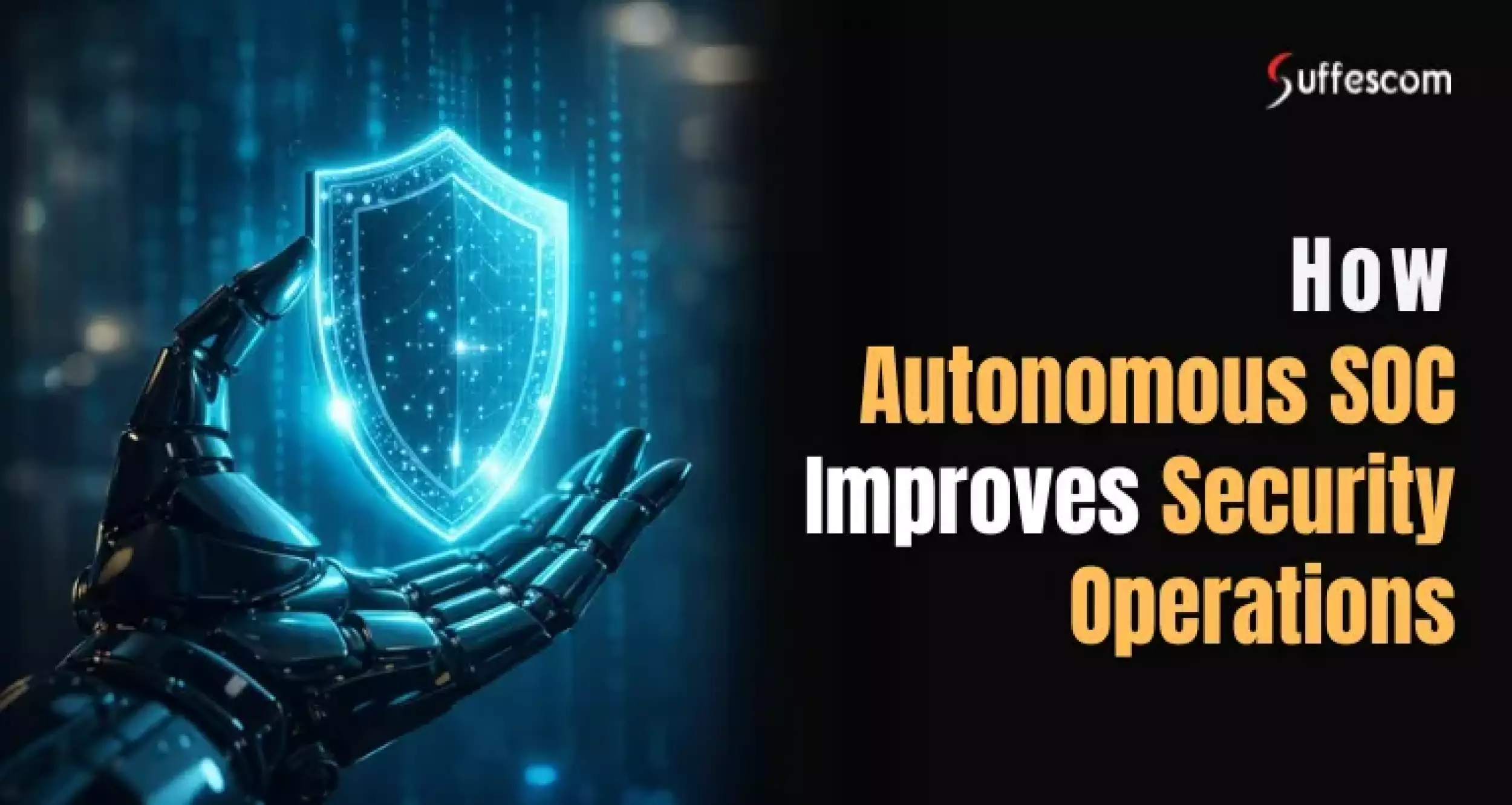
This is where the Autonomous SOC enters the picture. Powered by artificial intelligence, machine learning, and automation, an autonomous SOC takes on the repetitive, time-consuming tasks that consume analyst bandwidth, freeing human experts to focus on high-value investigation and strategy.
In this blog, we explore what an Autonomous SOC is, why legacy models are failing, how AI-driven automation transforms security operations, the best platforms and tools available today, and what the future holds.
What is an Autonomous SOC?
An Autonomous SOC is a security operations center that leverages artificial intelligence, machine learning, security orchestration, automation and response (SOAR), and real-time threat intelligence to detect, investigate, and respond to cybersecurity threats with minimal human intervention.
Unlike a traditional SOC, where analysts manually review alerts, run queries, and execute response playbooks, an Autonomous SOC performs these functions automatically. It can ingest millions of events per second, correlate patterns across data sources, triage alerts by severity, and even initiate containment actions, all in real time.
Key components of an Autonomous SOC:
- AI and Machine Learning engines for behavioral analysis and anomaly detection
- SOAR platforms for automated orchestration and response workflows
- Security Information and Event Management (SIEM) for centralized log aggregation
- Threat intelligence feeds that enrich alerts with contextual data
- User and Entity Behavior Analytics (UEBA) to detect insider threats and compromised accounts
In essence, the Autonomous AI SOC mimics the investigative reasoning of a skilled human analyst, but operates at machine speed.
Why Traditional SOC Models Are No Longer Enough?
For years, the traditional SOC model served as the backbone of enterprise cybersecurity. But the threat landscape has evolved faster than the model can adapt. Here is why legacy SOCs are struggling:
Alert Overload and False Positives: The average enterprise SOC receives tens of thousands of alerts daily. Industry research consistently shows that the vast majority sometimes over 70% are false positives. Analysts spend enormous time chasing ghosts instead of responding to genuine threats.
Manual Investigation Delays: In traditional SOCs, incident investigation is a largely manual process: pulling logs, correlating events, querying threat intelligence, writing reports. This takes hours or even days far too slow when a breach can exfiltrate sensitive data within minutes.
Skill Gap: The shortage of skills within the cybersecurity domain is an issue that has been discussed extensively. Unfortunately, there are just not enough SOC analysts who are capable of taking up all the available jobs.
High Operational Costs: Running a 24/7 SOC with qualified human analysts is expensive. Salaries, training, tooling, and infrastructure costs add up quickly, making comprehensive coverage inaccessible for many mid-sized organizations.
Increasing Threat Complexity: Modern adversaries use sophisticated techniques: living-off-the-land attacks, polymorphic malware, AI-generated phishing, and multi-stage intrusions that unfold slowly across weeks. Human analysts working in isolation simply cannot correlate the breadth of signals required to catch these threats in time.
The Autonomous AI SOC was built specifically to address each of these pain points.
Transform Your Security Operations with AI
Core Benefits of Autonomous SOC for Enterprise Security
Real-Time Threat Detection
AI-driven detection engines continuously monitor network traffic, endpoint telemetry, cloud activity, user behavior, and application logs. Machine learning models trained on historical threat data identify anomalies the moment they appear often before any alert is even generated in a traditional SIEM.
Automated Alert Triage
Instead of requiring an analyst to manually assess each alert, autonomous systems apply risk scoring and contextual enrichment automatically. Through seamless AI integration with existing tools like SIEM and EDR platforms, alerts are ranked by severity, mapped to attack frameworks like MITRE ATT&CK, and routed appropriately, allowing analysts to focus only on high-priority incidents.
Faster Incident Response
When a threat is confirmed, automated response playbooks kick in within seconds. Powered by AI workflow orchestration, actions such as isolating infected endpoints, blocking malicious IPs, revoking compromised credentials, or triggering forensic data collection happen automatically, drastically reducing mean time to respond (MTTR). Rather than waiting for an analyst to manually execute each step, AI workflow orchestration ensures the right action is triggered by the right tool at the right moment, turning a process that once took hours into one that completes in seconds.
Reduced False Positives
AI models correlate multiple signals before declaring a threat, dramatically reducing the false positive rate. Over time, these models learn from analyst feedback, becoming increasingly precise in distinguishing real threats from benign activity.
Security Operations
Unlike human teams that require shift rotations and are subject to fatigue, an Autonomous AI SOC operates continuously. Threats detected receive the same immediate response as those detected during business hours.
Cost Optimization
By automating tier-1 and tier-2 analyst tasks, organizations can do more with smaller teams. The cost per alert handled drops significantly, and high-value human expertise is concentrated where it genuinely matters: complex investigations, threat hunting, and strategic planning.
Top AI-Powered Autonomous SOC Platforms Transforming Security
Several innovative platforms are leading the Autonomous SOC revolution. Here is a look at the top solutions reshaping how organizations defend themselves:
1. Prophet Security
Prophet Security deploys AI agents that autonomously investigate alerts end-to-end gathering evidence, correlating events, and producing investigation reports with recommended actions. Its strength lies in dramatically reducing time-to-investigate while maintaining the audit trail compliance teams require.
2. Radiant Security
Radiant Security uses generative AI to auto-triage every alert, dynamically building investigation plans and executing them in real time. It integrates with existing SIEM and EDR tools, making it accessible for teams that want AI augmentation without a full platform replacement.
3. Dropzone AI
Dropzone AI serves as a complete, autonomous SOC level-1 analyst. Dropzone AI autonomously investigates phishing, endpoint incidents, cloud events, and identity incidents without any human intervention and provides summary reports that analysts can investigate further. Dropzone AI is ideal for smaller security teams who require round-the-clock monitoring but cannot hire more staff members.
4. Torq HyperSOC
Torq HyperSOC utilizes the combination of a no-code automated workflow generator along with artificial intelligence-powered case management. Teams can craft intricate, multiple step response workflows that cover an organization’s whole security infrastructure and analyze their operations’ efficiency. This hyper-automation system makes it one of the leading incident response software solutions.
5. Stellar Cyber Open XDR
Stellar Cyber Open XDR delivers a unified security operations platform that ingests and correlates data from across the entire attack surface, endpoints, network, cloud, email, and identity into a single AI-powered interface. Its Open XDR architecture eliminates tool silos, enabling autonomous threat detection and response without requiring analysts to pivot between multiple consoles.
6. Palo Alto Cortex XSOAR
Cortex XSOAR by Palo Alto is one of the most advanced SOAR solutions currently available in the market. It integrates security orchestration, automation, case management, and collaboration into one platform. The solution comes with more than 900 pre-built integrations and lets organizations automate all their repetitive tasks using all their security tools. Its playbook technology allows for automating institutional knowledge into consistent processes.
Core SOC Analyst Tools Every Security Team Needs
Regardless of the automation level, effective security operations depend on a core set of SOC analyst tools. Every security team should be equipped with:
- SIEM (Security Information and Event Management): Centralizes log data from across the environment for real-time monitoring, correlation, and alerting. Leading platforms include Splunk, Microsoft Sentinel, and IBM QRadar.
- EDR (Endpoint Detection and Response): Provides deep visibility into endpoint activity, enabling detection of malware, ransomware, and lateral movement. CrowdStrike Falcon and SentinelOne are industry leaders.
- Network Monitoring Tools: Analyze network traffic for signs of intrusion, data exfiltration, and command-and-control communication. Darktrace and Vectra AI are popular AI-powered options.
- Incident Response Platforms: Structure and streamline the response process, maintaining case records, timelines, and collaboration. Palo Alto XSOAR and ServiceNow SecOps are widely used.
- Log Management Solutions: Store, search, and analyze vast volumes of log data for forensic investigation and compliance reporting. Elastic SIEM and Graylog are strong choices for log management at scale.
Together, these tools form the foundation on which both traditional and autonomous SOCs are built. The difference lies in how they are orchestrated and how much human intervention is required to act on their outputs.
Affordable Tools for SOC Analyst Teams
The perception that effective security operations require enterprise-grade budgets is outdated. There is a growing ecosystem of affordable tools for SOC analyst teams that deliver serious capability without enterprise price tags.
Open-Source Tools
- Wazuh: A fully open-source SIEM and XDR platform capable of log analysis, intrusion detection, and compliance monitoring.
- Suricata: A high-performance network threat detection engine that operates as an IDS/IPS and network security monitoring tool.
- TheHive: An open-source security incident response platform designed for SOC teams, with case management and collaboration features.
- MISP: An open-source threat intelligence platform for sharing, storing, and correlating indicators of compromise.
Budget-Friendly SOC Setup Strategies
- Start with open-source tools and layers in commercial solutions as the budget allows.
- Use cloud-native security tools bundled with existing cloud subscriptions (AWS GuardDuty, Azure Defender).
- Consider co-managed SOC services where a provider supplements a small in-house team at a fraction of full managed SOC cost.
Key Technologies Behind Autonomous SOC
The capabilities of an Autonomous SOC are made possible by a convergence of several advanced technologies:
- Artificial Intelligence and Machine Learning: Supervised and unsupervised ML models power anomaly detection, behavioral baselining, and predictive threat scoring.
- SOAR (Security Orchestration, Automation and Response): Connects security tools through APIs and executes automated workflows in response to detected threats.
- UEBA (User and Entity Behavior Analytics): Establishes behavioral baselines for users and devices, flagging deviations that may indicate compromise or insider threat.
- Threat Intelligence Platforms: Continuously feed real-time data on known threat actors, malware signatures, and TTPs (tactics, techniques, and procedures) into detection systems.
- API Integrations: Enable seamless data exchange between disparate security tools, ensuring that the SOC has a unified view of the threat landscape and can act across its entire toolstack.
Challenges in Implementing Autonomous SOC
Despite its transformative potential, Autonomous SOC implementation is not without challenges:
- Initial cost: Building or deploying an autonomous SOC requires upfront investment in AI platforms, integration work, and possibly new infrastructure.
- Integration complexity: Connecting AI tools to legacy security systems and diverse data sources can be technically challenging and time-consuming.
- Data dependency: AI models are only as good as the data they train on. Poor data quality, gaps in telemetry, or misconfigured log sources degrade detection accuracy.
- Skill gap: While automation reduces the need for tier-1 analysts, operating an Autonomous SOC effectively still requires skilled professionals who understand AI systems, threat hunting, and complex incident response.
These challenges are real, but they are surmountable, especially with the right development and implementation partner.
Future of Autonomous SOC
The trajectory of autonomous security operations points toward increasingly proactive and self-sufficient systems. Key trends shaping the future include:
- Predictive security: AI models will shift from reactive detection to predictive threat anticipation identifying attacker pre-positioning behavior and blocking intrusions before they materialize.
- Self-healing systems: Future SOCs will not just detect and respond, but automatically remediate patching vulnerabilities, reconfiguring misconfigurations, and restoring systems to known-good states without human intervention.
- Fully autonomous cybersecurity ecosystems: The convergence of AI, zero-trust architecture, and autonomous response will create security ecosystems where the entire posture adapts dynamically to the threat environment in real time. This is precisely where agentic AI development plays a defining role enabling systems that don't just react to threats, but autonomously plan, prioritize, and execute multi-step responses across the entire security stack without waiting for human prompts.
Organizations that invest in Autonomous SOC capabilities today will be vastly better positioned to defend against the threats of tomorrow.
Build Your Autonomous SOC with Suffescom Solutions
Suffescom Solutions is a leading technology development company specializing in AI-powered security solutions, blockchain applications, and enterprise software development. With a dedicated team of cybersecurity engineers and AI specialists, Suffescom brings deep expertise to Autonomous SOC development, helping organizations of all sizes transform their security operations.
Whether you are a fast-growing startup building your first SOC or an enterprise looking to modernize legacy security infrastructure, Suffescom delivers custom Autonomous SOC solutions tailored to your environment and risk profile.
What Suffescom offers:
- End-to-end Autonomous SOC design, development, and deployment
- AI-driven threat detection and automated response engineering
- Integration with your existing SIEM, EDR, and threat intelligence tools
- SOAR workflow automation and custom playbook development
- Scalable architectures that grow with your business
- Ongoing support, tuning, and optimization of AI detection models
From proof-of-concept to production, Suffescom's AI engineers team work alongside your security stakeholders to deliver autonomous security that is accurate, reliable, and built for the real world.
Modernize Your SOC with AI-Powered Automation
Conclusion
The age of the manual, alert-driven SOC is ending. As threats grow faster, more sophisticated, and more numerous, the limits of human-only operations have become impossible to ignore. Autonomous SOC represents the necessary evolution, one where AI handles the scale problem and humans focus on the judgment problem.
By combining real-time AI detection, automated triage, continuous response, and intelligent learning, autonomous SOC models deliver a level of security coverage that no traditional team can match. Organizations ready to make this shift can hire AI autonomous developers from Suffescom to accelerate their journey from traditional to autonomous security operations.
The transition will not happen overnight, and it will require investment and careful planning. But for any organization serious about cybersecurity in the years ahead, building toward an Autonomous SOC is not optional, it is essential.
Frequently Asked Questions (FAQs)
1. What is an Autonomous SOC and how does it differ from a traditional SOC?
An Autonomous SOC uses AI, machine learning, and automation to detect and respond to threats with minimal human intervention, whereas a traditional SOC depends on manual analyst work for alert triage, investigation, and response. The key difference is speed and scale: an autonomous SOC can process millions of events in real time and respond in seconds, while traditional workflows take hours or days.
2. Is an Autonomous SOC suitable for small and mid-sized businesses?
Yes. Many platforms offer tiered pricing and cloud-native deployments that make Autonomous SOC capabilities accessible to SMBs. Open-source tools combined with lightweight AI platforms can deliver strong automation at a fraction of enterprise costs.
3. What are the best SOC analyst tools for a modern security team?
The most essential SOC analyst tools include a SIEM for centralized visibility, an EDR for endpoint coverage, a network monitoring solution, an incident response platform, and a log management tool. AI-powered options such as Wazuh, Splunk, CrowdStrike, and Microsoft Sentinel are widely recommended.
4. How long does it take to implement an Autonomous SOC?
Implementation timelines vary based on the complexity of the environment and the tooling involved. A basic deployment with existing tools can take 4–8 weeks. A fully custom, enterprise-grade Autonomous SOC build typically takes 3–6 months, including integration, testing, and model tuning.
5. What affordable tools exist for SOC analyst teams with limited budgets?
Open-source tools like Wazuh, Suricata, TheHive, and MISP provide strong capabilities at no licensing cost. Cloud-native security tools bundled with AWS, Azure, or Google Cloud subscriptions also deliver significant value. Co-managed SOC services are another cost-effective option for smaller teams.
6. Can Suffescom Solutions build a custom Autonomous SOC for my business?
Yes, Suffescom Solutions specializes in custom autonomous SOC development for startups, SMBs, and enterprises. Their team handles everything from architecture design and AI model development to integration with existing tools and ongoing optimization.
7. How does Suffescom ensure the Autonomous SOC integrates with our existing security stack?
Suffescom's development process begins with a thorough assessment of your existing tools and data sources. Their engineers design API-based integration layers and custom connectors to ensure the Autonomous SOC communicates seamlessly with your SIEM, EDR, threat intelligence feeds, and ticketing systems, preserving your existing investments while adding autonomous capabilities on top.