Key takeaways:
- Custom hospital staff management software automates scheduling, credential tracking, attendance monitoring, and workforce allocation to reduce administrative overload and improve patient care outcomes.
- AI-powered nurse rostering and predictive staffing engines analyze patient census data, staff availability, and fatigue thresholds to optimize workforce distribution in real time.
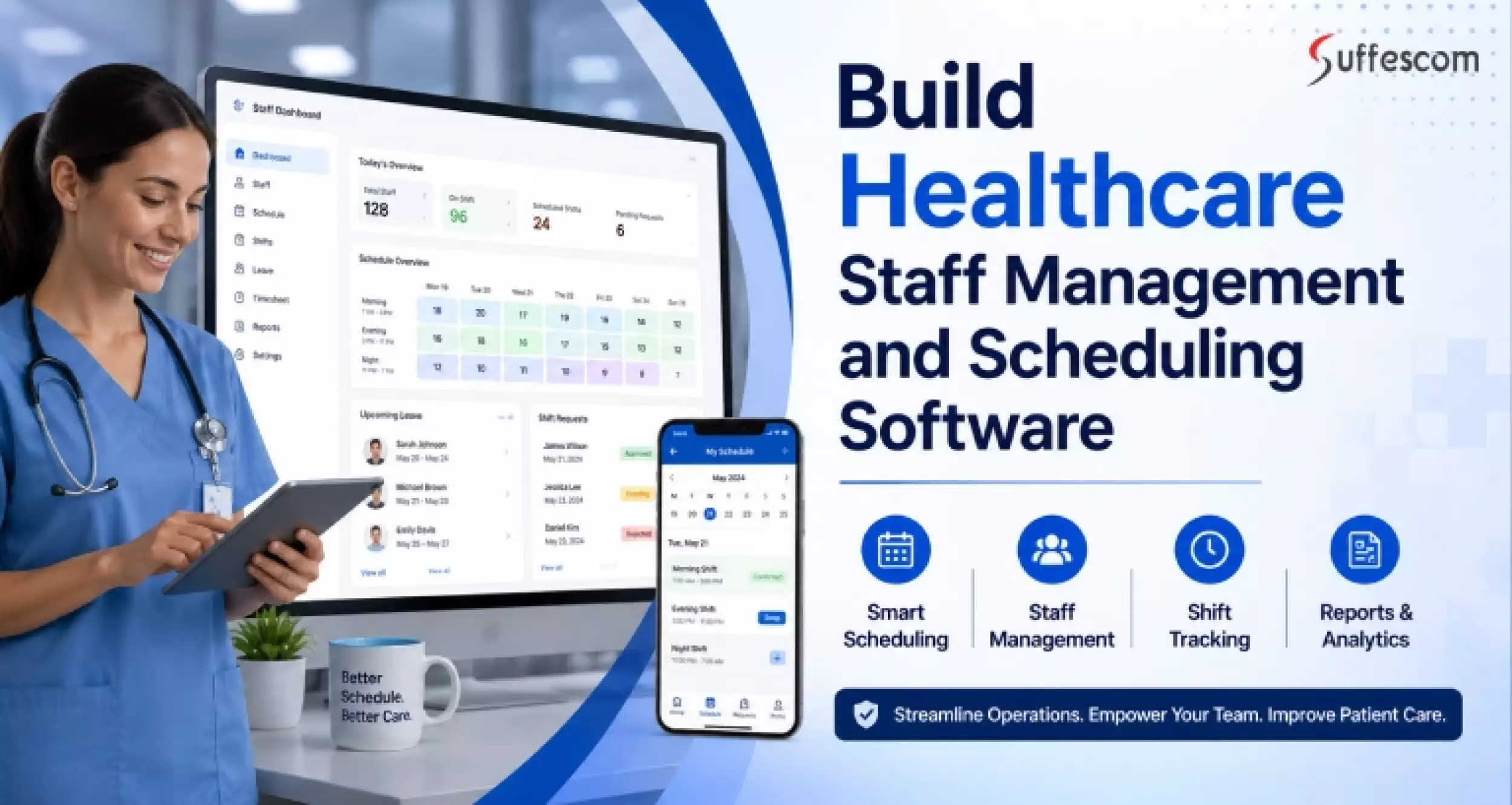
- Modern healthcare staff scheduling software development includes core modules like shift planning, payroll integration, leave tracking, department allocation, and compliance validation.
- HIPAA compliant staff scheduling software development ensures secure handling of sensitive operational data through AES-256 encryption, TLS 1.3 protocols, audit logging, and role-based access controls.
- Advanced integrations with HL7/FHIR APIs, EHR systems, HRIS platforms, and payroll gateways create a unified healthcare workforce management ecosystem across departments and locations.
- Enterprise-grade hospital scheduling software development typically follows a phased process covering compliance discovery, scheduling engine development, system integrations, security testing, and staged deployment.
Modern medical facilities face unpredictable patient surges and severe administrative burnout. Traditional, manual scheduling creates operational bottlenecks that compromise patient care. To solve this, organizations are adopting custom software development for healthcare staff management.
Investing in tailored hospital management software development for staff scheduling optimizes workforce distribution, automates complex credential-tracking compliance, and improves clinical retention by directly mitigating staff fatigue.
Optimize Hospital Workforce Operations
Build AI-powered healthcare staff scheduling software with automated rostering, attendance tracking, and compliance management.
Core Features of Custom Medical Staff Scheduling Software Development
To eliminate administrative friction and maximize operational efficiency, modern healthcare app development requires a robust architecture divided into three core functional modules:
Automated Credential Tracking Compliance
Real Time Validation
Automatically cross-reference shift assignments with a centralized database of active state medical licenses, board certifications, and DEA registrations.
Hardcoded Guardrails
Restricts schedulers from assigning a clinician to a department (e.g., ICU or ER) if the clinician's mandatory certifications have expired, thereby instantly mitigating legal liability.
Predictive Demand & Workforce Distribution
Data-Driven Forecasting
Integrates with historical EHR data to analyze past patient admission trends, seasonal surges, and peak hours.
Proactive Scheduling
Dynamically calculates necessary staff-to-patient ratios by deploying an AI scheduling assistant for hospitals and clinics, generating optimized rosters weeks in advance to prevent emergency understaffing.
Shift Bidding & Fatigue Mitigation Logic
Burnout Prevention
Tracks cumulative working hours across consecutive days, automatically flagging schedules that violate internal safety thresholds or labor laws.
Open Shift Marketplace
Allows qualified practitioners to view, bid on, or swap open slots via an API driven mobile interface, maintaining high clinical retention without administrative intervention.
Operational Guardrails & Built-In Core Capabilities
Building an efficient scheduling ecosystem simplifies complex clinical tasks across your network, making hospital scheduling software development a highly strategic undertaking.
Automated Shift Pattern Generation
Advanced platforms rely on deterministic algorithms during nurse rostering software development to handle complex rotating schedules while balancing nurse seniority and department-specific skill mixes.
Mobile Portals for Remote Caregivers
Designing a dedicated caregiver scheduling software development framework requires low-friction mobile interfaces so traveling aides can access live itineraries, update care notes, and sync dispatch details securely.
Point of Care Verification Pipelines
To fulfill federal mandates, the platform must develop EVV software for home healthcare requirements, using encrypted GPS coordinates and tamper-proof timestamps to validate remote service delivery.
On-Demand Labour Allocations
To mitigate sudden staffing deficits, the system manages a float pool management infrastructure, creating an internal gig marketplace where cross-trained, on-call personnel can instantly claim unassigned shifts.
Dynamic Inter-Departmental Floating
Eliminating operational data silos requires an architecture focused on developing multi-department hospital scheduling software, enabling administrators to float resources between distinct medical units during acute volume surges.
Escalation Pathways for Critical Traumas
Integrating an automated on-call scheduling software for hospitals module via secure WebSockets guarantees that trauma, surgical or specialty physicians are notified instantly during emergency events.
Ancillary Department Alignment
A comprehensive clinical staff scheduling software development strategy must sync the specialized calendars of allied health professionals, including radiologic technologists and laboratory teams, matching ancillary hours to active operating room demands.
Data Driven Workload Balancing
High performing systems pull patient diagnostic data directly from EHR APIs to enable acuity-based staffing software development, dynamically increasing nurse allocation for high-risk, intensive wards.
Residency Rotation & Clinic Calibration
Incorporating doctor shift management software development logic that accounts for complex medical residency rotations and outpatient clinic hours explicitly prevents scheduling conflicts across multiple locations.
Biometric Access & Time Tracking
Interfacing with physical terminals or geofenced mobile check-ins during hospital attendance management system development allows facilities to track true operational hours, eliminating manual time card fraud.
Predictive Labor Deficit Forecasting
Deploying machine learning models for AI powered healthcare staff management development allows systems to analyze historical admission patterns and regional weather trends to forecast labor shortages before they occur.
Institutional Business Intelligence
Building a robust healthcare workforce analytics platform development layer provides interactive BI dashboards tracking critical institutional metrics, including overtime leakage, turnover correlations, and labor cost utilization.
Automated Primary Source Verification
Hardcoding a dedicated credential management system development for the healthcare pipeline continuously monitors primary national databases for license renewals, board certifications, and mandatory compliance competencies.
Protected Health Information Security
Securing the end to end ecosystem through HIPAA compliant staff scheduling software development mandates the use of AES-256 encryption and Transport Layer Security (TLS 1.3) to guarantee patient privacy during shift handoffs.
Cross Platform Mobile Ecosystems
Bundling these advanced capabilities into a unified healthcare workforce management software development project ensures that medical personnel can manage their professional lives on both iOS and Android responsive interfaces.
Suffescom's Experts Guide on Staff Scheduling Software Works: Features & Automation Flow
| Module | How It Works | Automation Scope | Business Benefit |
| Employee Profile Management | Stores employee roles, departments, skills, certifications, availability, and shift preferences | Auto-sync employee data and availability | Reduces manual HR coordination |
| Shift Creation & Scheduling | Admin creates shifts based on business hours, workload, and staffing demand | AI-based auto shift allocation | Faster workforce planning |
| Smart Shift Assignment | System assigns employees according to rules, compliance, availability, and skills | Automated roster generation | Avoids scheduling conflicts |
| Attendance & Time Tracking | Tracks login/logout, biometric data, GPS check-ins, or clock-in/out records | Real-time attendance automation | Accurate payroll and monitoring |
| Leave Management | Employees request leave through portal/app | Auto leave approval workflows and shift replacement | Simplifies HR operations |
| Overtime Management | Detects overtime hours automatically from schedules and attendance | Overtime alerts and calculations | Controls labor costs |
| Compliance Monitoring | Validates labor laws, work-hour limits, and mandatory breaks | Compliance automation | Reduces legal risks |
| Payroll Integration | Sends attendance and working hours directly to payroll systems | Automated salary calculations | Eliminates manual payroll errors |
| Shift Swap Management | Employees request shift exchanges with approval workflows | Automated swap approvals | Improves workforce flexibility |
| Real-Time Notifications | Sends alerts for shifts, approvals, overtime, and updates | Push/email/SMS automation | Better communication |
| Multi-Location Workforce Management | Manages staff across branches or facilities | Centralized scheduling automation | Useful for enterprises and franchises |
| Demand Forecasting | Predicts staffing requirements using historical data and trends | AI workforce forecasting | Prevents understaffing/overstaffing |
| Reporting & Analytics | Generates workforce reports, productivity insights, and labor cost analysis | Automated reporting dashboards | Better business decisions |
| Mobile Employee App | Employees view schedules, request leaves, swap shifts, and receive alerts | Self-service automation | Enhances employee experience |
| AI-Based Workforce Optimization | Uses AI to optimize schedules, costs, and staffing efficiency | Intelligent scheduling automation | Improves operational efficiency |
Technical Architecture & the Cost to Develop Healthcare Staff Management Software
Building an enterprise-grade hospital staff scheduling management platform requires a robust, scalable backend capable of handling heavy data orchestration. The overall cost to develop a healthcare staff management software ecosystem depends directly on the complexity of your technology stack and the depth of your integrations.
To maximize system uptime and maintain data security compliance, the core system architecture should be divided into three distinct operational layers.
Database Schema & Multi-Tenant Infrastructure
A reliable hospital staff scheduling management software development framework relies on a relational database (such as PostgreSQL) to handle complex data relationships with strict referential integrity.
[Practitioners] 1 ---- * [Shifts] * ---- 1 [Departments]
|
* [Compliance_Logs]
To optimize query performance during peak scheduling periods, the database must use connection pooling and read replicas. This ensures that heavy administrative reporting workloads do not slow down the mobile interface used by frontline medical staff.
Core API Integrations & Interoperability
To deliver true information gain and eliminate data silos, your custom platform must communicate with existing medical infrastructure via secure APIs.
Achieving an optimized workflow requires highly specialized medical staff scheduling software development that connects directly to the industry standard protocols.
HL7/FHIR Web Services
Necessary for syncing real-time patient census data from the EHR to predict staffing demand.
HRIS & Payroll Gateways
Connects directly to systems like Workday or ADP via secure REST endpoints to automate labor cost allocation and shift differentials.
Step-by-Step Cost & Milestones Breakdown
When budgeting for comprehensive healthcare staff management software development, resources must be allocated across distinct milestones to ensure a high-performing product.
Phase 1: Architecture & Compliance Discovery
Focuses entirely on database schema design, HIPAA compliance mapping, and EHR API documentation. This phase establishes the technical foundation to prevent future compliance failures.
Phase 2: Core Scheduling Engine & Logic
The heaviest phase of software development for healthcare staff management involves the engineering of algorithmic shift-matching, rule enforcement for medical certifications, and real-time push notifications.
Phase 3: Integration & Deployment
Involves building the FHIR/HL7 data pipelines connecting payroll gateways for automated shift differentials and conducting beta testing across active hospital departments.
Step-by-Step Hospital Staff Scheduling Management Software Development Process
Successfully executing development for healthcare staff management software requires a disciplined engineering lifecycle.
Hospital management software development experts transition from initial planning to live deployment without skipping crucial validation phases, because clinical software handles highly sensitive operational data and directly impacts patient safety.
Requirements & Compliance Scoping
Map out HIPAA data encryption, record retention, and state-mandated staffing ratios. Document third-party EHR integrations (Epic/Cerner) early to prevent structural workflow bottlenecks during subsequent software development for healthcare staff management.
Medical Staff Scheduling Software Development Setup
Construct multi-tenant database schemas and deploy secure REST/WebSockets APIs for real-time syncing. Skipping this technical foundation causes your overall healthcare staff management software development cost to balloon later.
Algorithmic Engineering & UI Development
Code core matching algorithms that block expired credentials and enforce fatigue thresholds. Concurrently, design intuitive mobile shift-bidding interfaces and desktop administration dashboards to maximize clinical retention and adoption.
Quality & Security Assurance
Execute high-load simulation testing for peak holiday shift swaps alongside strict penetration tests. Validating these complex backend workflows ensures the final cost to develop healthcare staff management software solutions meets enterprise security standards.
Phased Deployment & EHR Integration
Deploy the system to a single department first to monitor live FHIR/HL7 data pipelines. Once API synchronisation proves stable, scale across the entire network to create a unified medical staff scheduling software development ecosystem.
BookDoc
Healthcare case study showcasing streamlined doctor scheduling and workforce coordination.
View Case StudyBest Practices for Scaling & Deploying a Custom Solution
Deploying enterprise-grade software into a live hospital network requires a delicate balance between engineering speed and operational security.
To maintain high system availability during transition periods, development teams should execute the following core deployment strategies.
Continuous Integration & Blue-Green Deployment
Utilize containerized microservices (such as Docker and Kubernetes to run two identical production environments. Upgrades to the scheduling logic or database schemas are pushed to the idle environment first, ensuring instant rollback capabilities if an active system fault occurs.
Granular Role-Based Access Control
Medical networks demand strict data privacy. The platform must enforce end to end encryption for both data at rest and data in transit, restricting schedule modifications to authorized administrators while providing read-only mobile views for frontline clinicians.
Automated Audit Logging
Every shift change, credential update, or override must be permanently recorded with a cryptographic timestamp. This creates an unalterable trail necessary for institutional audits and labor law compliance verifications.
Conclusion
Successful hospital scheduling software development requires balancing dense technical compliance with fluid user experiences. By anchoring your engineering roadmap to a unified approach to healthcare workforce management software development, your organization can eliminate operational silos and achieve sustained, long-term growth.
Develop Custom Healthcare Staff Management Software
Launch a HIPAA compliant workforce management platform with smart scheduling, payroll integrations, and real-time staffing analytics.
FAQs
What are the key benefits of custom hospital staff management software development over rigid legacy tools?
Traditional legacy infrastructure relies on isolated, single-tenant data structures that cannot cope with sudden surges in emergency clinical room demand. Opting for custom hospital staff management software development gives medical institutions full control over database layers. This level of control allows technical teams to build real-time data pipelines that link EHR active patient registries directly to shift allocations.
Can a dedicated home healthcare staff management software ecosystem handle remote regulatory compliance?
Managing remote aides requires specialized home healthcare staff management software that incorporates EVV pipelines. The software ingests encrypted GPS coordinates and unalterable digital timestamps, guaranteeing point-of-care accuracy while fulfilling strict national regulatory compliance standards.
What are the main engineering challenges during hospital staff management software development?
The primary challenge in hospital staff management software development is handling high concurrency. The system must process thousands of simultaneous requests during shift handoffs without database lag, while keeping shift logs perfectly synchronized across multiple wards.
What compliance standards are followed during healthcare staff app development?
During development, we ensure the app adheres to globally recognized standards such as HIPAA, GDPR, and region-specific frameworks. For UK-based care providers, this includes CQC-compliant home care app development practices that govern how staff data, care records, and patient information are handled at the architecture level from role-based access controls and encrypted data storage to audit-ready documentation and secure API integrations.
What is the expected timeline for an enterprise hospital scheduling software development project?
A typical lifecycle for hospital scheduling software development spans six to nine months depending on the number of active legacy EHR integrations required. The initial phases focus entirely on mapping complex clinical database relations, followed by extensive parallel testing across live hospital units to ensure zero scheduling friction.
How do you ensure high user adoption during a healthcare workforce management software development rollout?
To drive strong adoption, a healthcare workforce management software development strategy must prioritize low-friction, mobile-first interfaces. Providing staff with clear visual calendars, simple push notifications for shift swaps, and rapid biometric check-ins ensures that busy clinicians actively engage with the system daily.