Key takeaways:
- CQC-compliant inspection service for unalterable audit trails, real-time care tracking, and automated compliance reporting to satisfy the latest Single Assessment Framework.
- Aged home care app depends on offline-first architecture, localized encrypted storage, and seamless NHS interoperability using FHIR and HL7 standards.
- CQC-ready software must integrate eMAR systems, GPS verification, BLE beacons, and automated incident escalation to ensure safe and verifiable care delivery.
- Include role-based access control (RBAC), MFA authentication, and end-to-end encryption to comply with UK GDPR and DSPT regulations.
- A comprehensive Digital Social Care Record (DSCR) system enables providers to streamline care documentation, reduce manual errors, and maintain continuous inspection readiness.
- CQC compliant improves safeguarding through real-time alerts, fluid monitoring, medication tracking, and automated deterioration detection workflows.
- Build scalable multi-tenant platforms with family portals, live dashboards, and regional workflow customization.
- Modern CQC compliance transforms care operations from retrospective reporting into continuous, data-driven regulatory evidence generation.
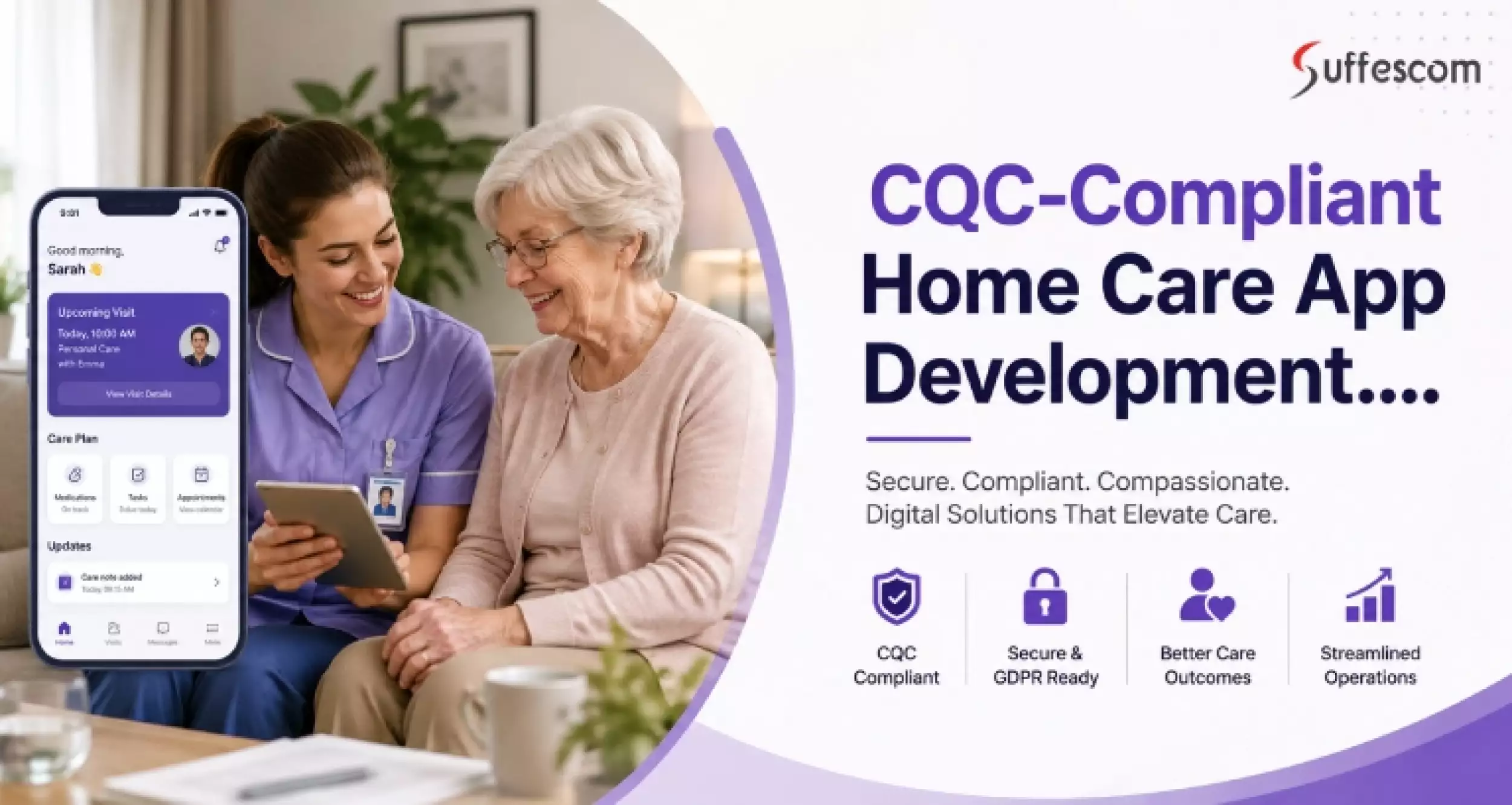
To secure a CQC outstanding rating under the regulatory framework, platform infrastructure must actively validate care delivery data rather than just store it. Building CQC-ready home care software solutions requires moving beyond basic scheduling utilities to develop a resilient data core capable of real-time operational auditing.
Successful custom home care app development in the UK hinges on deploying an architecture that maintains localized data integrity during offline rural visits, integrates with NHS systems, and automates incident escalation pathways.
This specific focus on CQC compliant focused elderly care app development in the UK ensures that unalterable, time-stamped eMAR audit trails are hardcoded into the platform's foundation.
Deploying advanced aged care management software development workflows maps directly onto the regulator’s single assessment framework to continually evidence continuous compliance.
Core Engineering Specifications for eMAR & Care Tracking
Dynamic eMAR Architecture
Implementing a comprehensive Digital Social Care Record (DSCR) system requires a robust electronic medication administration record (eMAR) with mandatory dual-signature validation, automated dosage alerts, and instantaneous pharmacy API sync protocols.
Offline-First Data Layer
Network dropouts are an operational certainty in home care. When executing custom software development for UK home care agencies, engineers must use localized SQLite encryption so that care notes and medication entries are securely cached locally and auto-sync when a cellular connection is restored.
Tamper-Proof Verification
Satisfying the CQC’s safety and governance vectors requires hardcoding unalterable audit trails. CQC compliant home care mobile app development depends on integrating background GPS telemetry and Bluetooth Low Energy (BLE) beacons to verify a caregiver’s physical presence before unlocking care plans.
Clinical Schema Precision
The platform must seamlessly process complex clinical data inputs during specialized elderly care application development in the UK. This includes configuring a strict validation field for PRN (as-needed) medication intervals, dynamic risk assessments, and fluid intake monitoring.
Bespoke Escalation Pathways
Choosing bespoke home care app development UK allows you to hardcode customized data schemas and immediate incident escalation pathways directly into the core engine, delivering an interoperable framework that confidently withstands strict regulatory audits.
Build CQC-Ready Care Apps
Secure, audit-ready home care software for UK agencies.
Data Security, Regulatory Interoperability & System Governance
Zero-Trust Security Framework
Securing sensitive clinical profiles requires strict adherence to cryptographic controls. Developing CQC-ready home care software solutions means every endpoint must enforce role-based access control (RBAC), multi-factor authentication (MFA), and end-to-end data encryption at rest and in transit, fully aligning with UK GDPR and the NHS Data Security and Protection Toolkit (DSPT).
Interoperable NHS Data Exchange
Medical software cannot operate in isolation within the British healthcare ecosystem. Implementing custom healthcare app development with EHR/EMR integration ensures that care records seamlessly sync with centralized frameworks using localized HL7 and FHIR protocols, eliminating manual data handling.
Unified Administrative Governance
Scaling clinical operations requires real-time overview capabilities to monitor field worker efficiency. Utilizing a comprehensive hospital and clinic dashboard for care management allows home care providers to view live scheduling metrics, manage incoming service updates, and generate automated compliance data.
Automated Adherence Ecosystem
Direct interaction tools significantly lower the occurrence of missed medical checks or unscheduled visits. Deploying on demand home care software with patient engagement features introduces automated notification loops, digital triage pathways and interactive communication portals directly to the service user’s family.
Validated Care Delivery Infrastructure
Verifying care hours requires undeniable administrative proof. Partnering with a specialized CQC compliance focused home care app development company in the UK allows you to build a highly responsive, CQC-compliant technical architecture featuring background telemetry, secure payment gateways, and unalterable clinical audit trails.
Technical Architecture & Feature Mapping for CQC Inspections
To consistently evidence compliance under the current CQC single assessment framework the platform’s user interface and backend logic must directly map to regulatory quality statements.
Deploying CQC compliant home care app development shifts an agency’s operational posture from retrospective reporting to continuous real-time audit readiness through the following engineering implementations:
Evidence Generation for the Safe Domain
The application functions as an active safety barrier by cross-referencing live field worker data against mandatory training matrices. If a caregiver’s specific competencies do not match a service user’s complex risk profile, the dispatch algorithms within the CQC compliance app development UK framework automatically block the scheduling allocation to prevent avoidant harm.
Real-Time Point of Care Documentation
To support contemporaneous recording, the interface features structured mobile entry fields and voice to text inputs. This allows frontline staff to capture observations instantly during a visit, ensuring that home care app development UK moves away from retrospective, memory-reliant logging toward accurate, real-time data capture.
Strategic Vendor Selection for Care Providers
When home care agencies evaluate potential technology partners, collaborating with an established home care app development company ensures the software's underlying codebase is built exclusively for domiciliary workflows, accounting for complex variables such as travel time calculations and geographic route optimization.
NHS Assured Solutions Alignment
Achieving an outstanding governance rating requires full integration with the wider British healthcare ecosystem. By delivering CQC ready home care software solutions, engineers implement GP Connect protocols that grant authorized care workers secure, direct access to a client’s real-time GP records at the point of care.
Person Centered Care Planning Modules
Custom home care app development in the UK incorporates dynamic, highly adaptable care planners. These modules track individual life histories, personal preferences, and changing daily routines, allowing coordinators to update care profiles instantly across the entire distributed workforce.
Continuous Quality Monitoring Metrics
The administrative backend features automated scoring algorithms that track compliance KPIs weekly. These CQC care app development services provide registered managers with an interactive oversight dashboard that highlights unreviewed care plans or incomplete risk assessments before they attract regulatory scrutiny.
Advanced Safeguarding & Incident Protocols
Specifically designed to satisfy strict UK clinical governance CQC compliant focused elderly care app development in the UK hardcodes automated alerting loops. Any recorded fall, missed medication window, or unexpected clinical deterioration triggers an instant, high-priority push notification to the office dashboard, along with an unalterable step-by-step action-tracking log.
Unified Information Standard Compliance
The platform structure complies directly with the adult social care minimum operational data standard. Building this comprehensive digital social care record system ensures that all personal care, mental capacity, and mobility data fields align with the exact cryptographic and data-sharing taxonomy required by NHS England and local integrated care systems.
Strategic Implementation & Vendor Selection Framework
Transitioning from legacy processes to modern digital infrastructure requires a clear roadmap that aligns procurement with the absolute latest UK healthcare mandates. When selecting an agency or architecting a blueprint, providers must evaluate engineering choices through the dual lens of technical scalability and stringent regulatory compliance.
Mandatory Data Standard Alignment
The baseline requirement for any modern platform is absolute alignment with the Department of Health and Social Care's minimum operational data standard. When provisioning mobile care solutions, engineers must ensure that all data pipelines, care notes, and interoperability points natively process these standardized schemas to allow smooth regional integration with the local integrated care system.
Proactive Inspection Readiness
Under the CQC’s evolving inspection parameters, providers are no longer judged on static folders but continuous, living data. Implementing CQC ready home care software solutions means giving registered managers the ability to instantly compile and export automated compliance reports, dramatically simplifying the preparation of the yearly provider information return.
Transitioning from KLOEs to Modern Evidence
As the regulator completes its historic shift away from the traditional key lines of inquiry toward sector-specific assessment frameworks, evidence must be systematically logged at the exact point of care. Procuring professional CQC care app development services ensures your digital architecture is built from day one to serve as a continuous, immutable evidence-gathering engine that actively demonstrates compliance across all quality domains.
National Care Standards Assurance
To qualify for public funding and NHS procurement paths, software must be vetted by the government’s digitizing social care programme. Investing in custom home care app development UK that mirrors these verified parameters ensures your agency maintains structural advantages, including verified compliance with annual data security and protection toolkit self-assessments at standards met or higher.
Specialized Vulnerable User Safeguarding
Managing the safety of high-acuity, vulnerable clients requires dedicated mobile workflows built with specialized care logic. Successfully delivering CQC compliant focused elderly care app development in the UK relies on deploying background safety features such as automated fluid chart recalculations, missing entry warnings, and instant alert routing. Which turn the application into an active digital safeguarding tool rather than a passive file store.
UX/UI Design Patterns, Accessibility & Stakeholder Integration
Inclusive Interface Design
Frontline care applications must comply with WCAG 2.2 AA standards. Implementing high contrast layouts, scalable text, and screen-reader compatibility ensures the software remains usable for an age-diverse workforce.
Minimizing Operational Friction
High-stress care environments require Cognitive Load Optimization. Interfaces must use clean, single-action workflows rather than dense data screens, ensuring that field staff can accurately log notes without distracting from service users.
Rapid, Secure Device Access
To eliminate tedious password entry during busy shifts, platforms use biometric authentication (Face ID/fingerprint). This maintains strict data security and instant user validation without slowing down physical rounds.
Reliable Field Operations
To prevent data loss in areas with low connectivity, the mobile architecture relies on local caching and offline data synchronization. Caregivers log medication data uninterrupted, and the app background syncs the data payload when a cellular signal returns.
Secure Enterprise Scaling
Selecting a specialized home care app development company that builds on a multi-tenant architecture enables multi-branch agencies to securely partition client data by region, ensuring compliance with local authority data segregation rules.
Instant Critical Alerts
A robust push notification architecture is essential for immediate safety updates. Any schedule changes, missed medication windows, or automated risk alerts route instantly from the field to the central dashboard, bypassing manual review delays.
Transparent Family Communication
Dedicated family portal modules provide relatives with real-time updates on care visits, daily fluid intake logs, and general well-being notes, directly supporting the CQC’s focus on transparent, inclusive care delivery.
Verifiable Attendance Tracking
Integrating real-time telemetry through GPS and background geofencing provides objective verification of arrival and departure times, completely eliminating manual timesheet falsification.
Unalterable Regulatory Evidence
To withstand strict regulatory scrutiny, CQC ready home care software solutions enforce audit log immutability. Every record modification, deletion attempt, or access request creates a permanent time-stamped cryptographic trail for inspectors.
Tailored Local Workflows
Specialized home care app development in the UK shifts the focus from generic scheduling to localized clinical care. App structures must natively support specific UK social care terminology, local authority funding structures, and regional commissioning requirements. Building these systems using an expert healthcare app development company’s practices ensures the entire mobile infrastructure perfectly supports regional commissioning requirements and medical governance.
Conclusion
Achieving a CQC outstanding rating requires moving beyond basic scheduling utilities toward intelligent, data-validated architectures. Partnering with an experienced home care app development company ensures your system hardcodes unalterable audit trails, offline eMAR sync, and native NHS interoperability from day one. By deploying these CQC-ready home care software solutions, UK providers confidently safeguard high-acuity vulnerable individuals while generating the immutable digital evidence necessary to breeze through modern regulatory inspections.
Launch Your CQC-Ready Platform
Build secure, compliant, and audit-ready home care software tailored for UK providers.
FAQs
How much does it cost to develop a custom home care app in the UK?
Custom home care app development costs in the UK vary significantly depending on feature complexity, compliance requirements, and integration needs. Expenses are driven by backend infrastructure for eMAR, NHS database interoperability, real-time telemetry, and data security protocols to satisfy the Data Security and Protection Toolkit and the CQC Single Assessment Framework.
How to integrate home care software with NHS GP systems?
To integrate home care software with NHS GP systems, developers utilize GP Connect APIs based on the global FHIR standard. The application must complete the NHS England digital onboarding process, pass SCAL (Supplier Conformance Assessment List) assurance, and prove data security via the Data Security and Protection Toolkit (DSPT.
How to implement digital incident reporting for CQC safety?
Implement digital incident reporting by hardcoding real-time, mandatory input fields for falls or medication errors into the care app. Automatically trigger high-priority push notifications to manager dashboards using localized triage logic. Ensure all entries generate an unalterable, time-stamped cryptographic audit log that maps directly to the CQC’s Safe quality statements.
Do home care apps need a family portal for CQC?
Under the CQC single assessment framework, inspectors heavily prioritize people's experience and transparent communication. The short answer is no, a family portal is not a mandatory CQC requirement. A family portal serves as strong digital evidence for the Caring and Responsive domains by demonstrating real-time family involvement and robust information sharing.