Key takeaways:
- Stablecoin neobanks combine DeFi, neobanking UX, and zero-knowledge privacy, enabling programmable and privacy-first financial systems.
- Market growth is accelerating rapidly, driven by the shift toward stablecoin-based global payment rails and digital banking adoption.
- A production system is built on a multi-layer architecture covering custody, settlement, fiat on/off-ramps, compliance, and user experience.
- ZK-KYC and privacy-preserving compliance are becoming core requirements for regulatory-ready financial infrastructure.
- Core product capabilities include multi-stablecoin wallets, DeFi yield, instant cross-border transfers, and card-based payments.
- Key challenges include trust, legacy banking dependency, institutional scalability, and privacy limitations, solved via regulated + cryptographic design.
- These platforms are emerging as foundational infrastructure for the AI-driven agent economy and autonomous financial systems.
Want similar results? → Get a Free Quote
Traditional banking infrastructure struggles to meet the demands of a digital-first economy. Expensive cross-border payments, delayed settlement periods, and centralized databases are some of the key challenges faced by both users and companies. With the increasing popularity of stablecoins, a new set of financial service providers is developing to offer the best of both worlds.
Privacy-centric stablecoin neobanks bring the convenience of digital banks with stablecoin payments and self-custody services, along with privacy features like zero-knowledge proofs. In contrast to legacy banking systems, stablecoin neobanks provide instant settlements, reduced fees, cross-border access, programmable money, and compliance with evolving regulations.
This guide covers everything builders and business decision-makers need to know. If you are evaluating a neobank app development partner or planning to launch your own privacy-first stablecoin neobank platform, this is your definitive starting point.
What Is a Privacy-First Stablecoin Neobank?
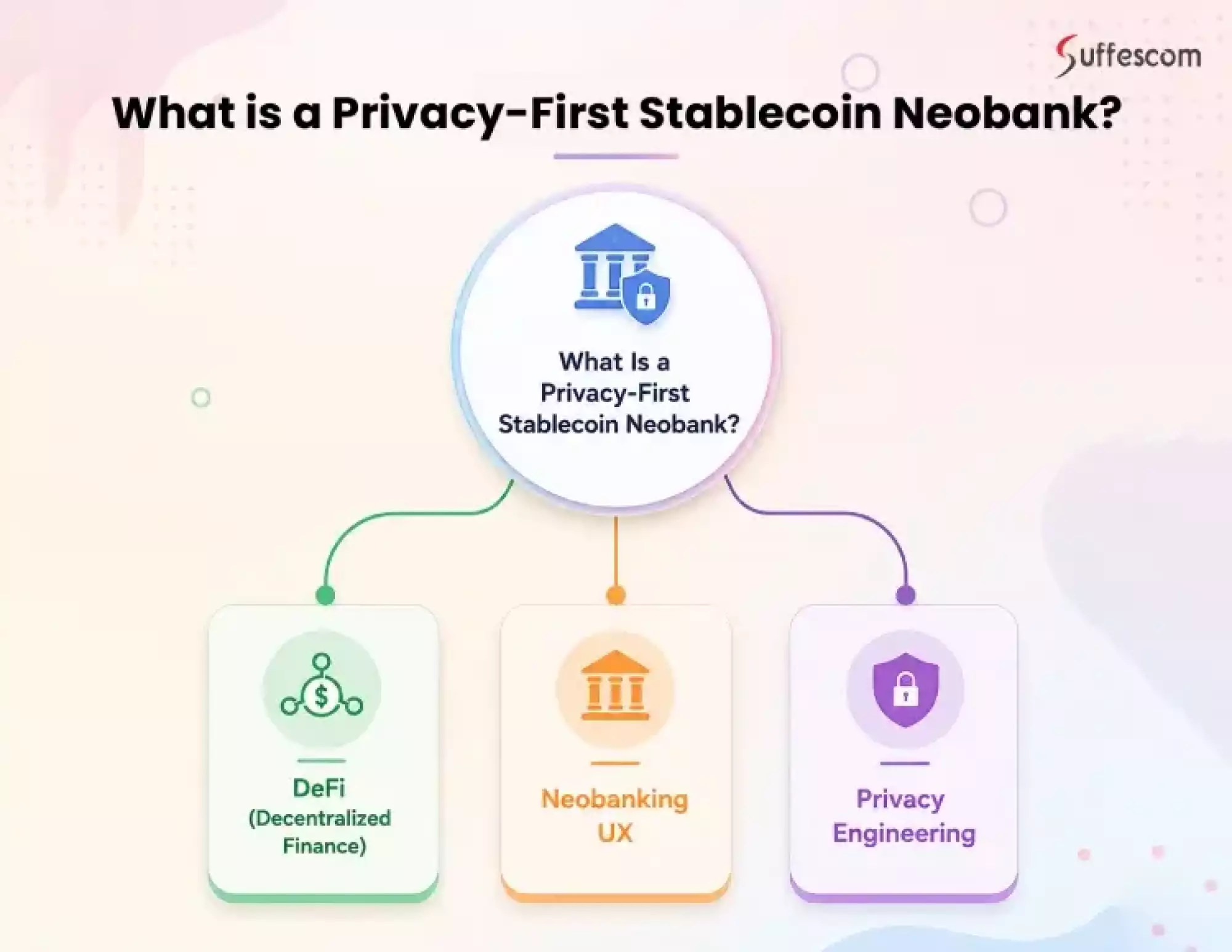
A privacy-first stablecoin neobank can be defined as a complete digital bank powered by blockchain technology that uses stablecoins, cryptocurrencies tied to stable value units such as the US dollar, as the principal currency medium for money storage, transfers, and spending, with the focus on user data privacy and protection in mind.
In contrast to legacy digital neobanks and legacy crypto wallets that fall short of providing a neobank-like user experience, a privacy-first stablecoin neobank is a convergence of the following trends:
- DeFi (Decentralized Finance): Yield, lending, payments without permission on decentralized blockchains
- Neobanking UX: Mobile-first, immediate onboarding, push notifications, virtual/real cards
- Privacy Engineering: Zero knowledge, selective KYC, non-custodial/hybrid custody
The $33 Trillion Signal: Why Stablecoin Neobanks Are Rewriting the Rules of Global Finance
The financial ecosystem of the world is evolving at a fast pace on account of continuous problems associated with accessing traditional banking due to cost, geographical issues, and documentation concerns, as per the Global Findex report of 2025 prepared by the World Bank. Simultaneously, there is a rapid rise in the development of a new financial layer that consists of stablecoins, neobanks, and privacy-oriented compliance, thus providing an integrated approach for access for banked and unbanked consumers. The market size for neobanks will increase from about $210 billion to $385 billion in 2026.
The Neobank Market: Scale, Speed, and the Crypto Convergence
As per Grandview Research, the global neobanking market size was estimated at USD 211.20 billion in 2025 and is projected to reach USD 9,384.73 billion by 2033, growing at a CAGR of 61.9% from 2026 to 2033. The rising demand for convenience among customers in the banking sector is expected to drive market growth.
According to Coinlaw, the global neobanking market size outlook was revised downward and tightened, shifting from an aggressive long-term forecast ($7.93 trillion by 2032, 58.6% CAGR) to a near-term, evidence-based projection of $552.0 billion in 2026, up from $382.8 billion in 2025.
Planning to Build a Privacy-First Stablecoin Neobank?
Build a scalable, compliance-ready neobank with the right blockchain, wallet, and payment infrastructure.
Market Landscape: Who Is Building Stablecoin Neobanks in 2026?
Understanding the competitive landscape is essential before building. Here is a snapshot of the leading players shaping this space:
| Platform | Model | Key Features | Target Market | Funding |
| Plasma One | Stablecoin-native neobank | 10%+ yield, 4% cashback, self-custody, Visa card | Emerging markets | Peter Thiel / Founders Fund, $373M reserve |
| Zoth | Privacy-first stablecoin neobank | Open-dollar economy, DeFi yield, neobank UX | Retail & institutional | Taisu Ventures, Blockchain Founders Fund |
| Fasset | Regulated stablecoin neobank | 50+ banking corridors, AI risk management | Asia, MENA, emerging markets | $51M Series B |
| Kontigo | Stablecoin neobank | Cross-border payments, banking app | US & Latin America | $20M seed funding |
| AllScale | Self-custody stablecoin neobank | Passkey onboarding, invisible crypto | Freelancers & SMBs | $6.5M funding |
| Gnosis Pay | Non-custodial payment platform | User-controlled funds, Visa debit card | Web3 users | Gnosis ecosystem |
| RedotPay | Custodial stablecoin neobank | 5M+ users, $10B annual volume | Global retail | $47M raised (2025) |
Core Architecture of a Privacy-First Stablecoin Neobank
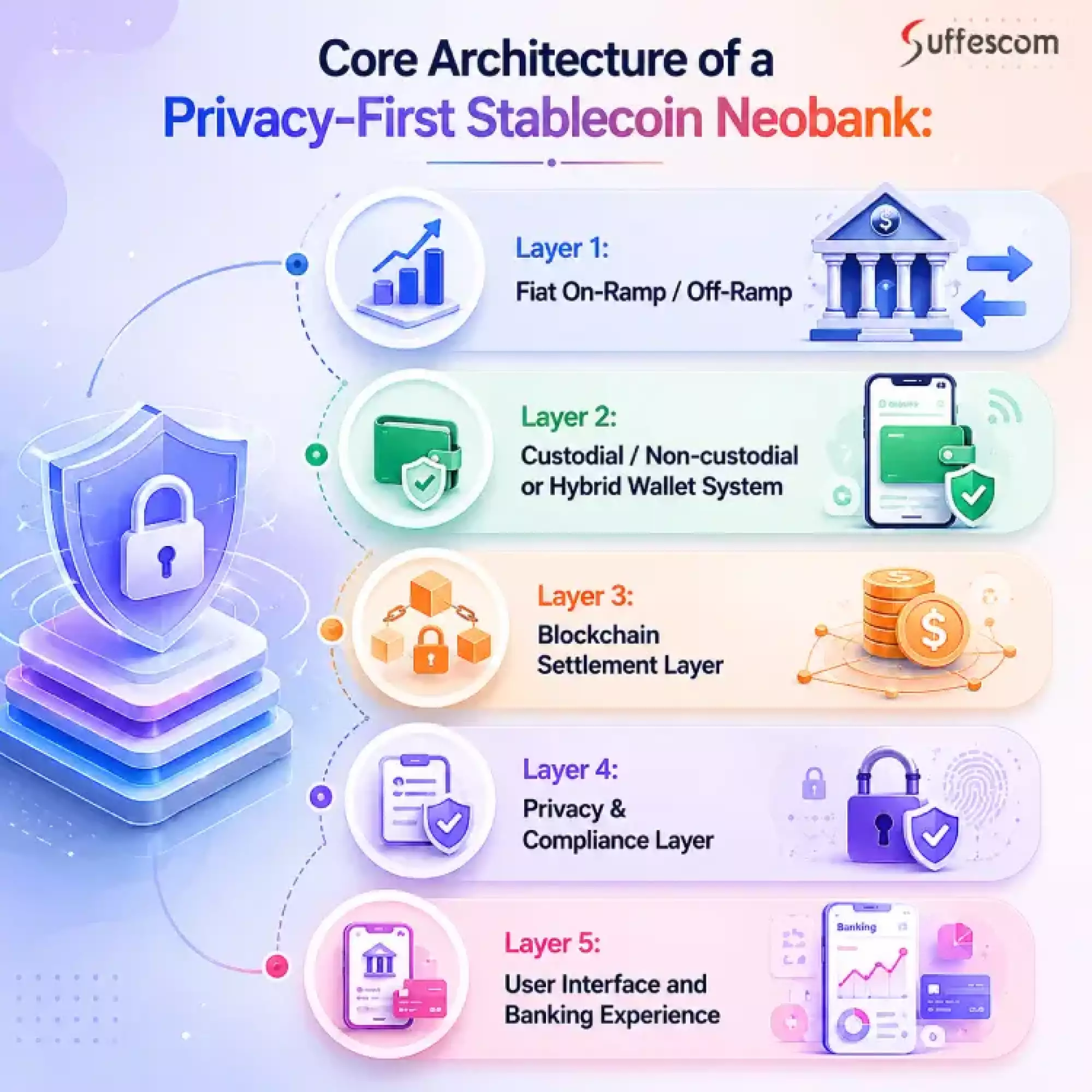
The core of a privacy-first stablecoin neobank is based on a multi-tier infrastructure system connecting traditional banking institutions with blockchain-enabled financial systems. This architecture includes fiat on/off-ramps, custody and wallet infrastructure, blockchain rails, and a mobile interface to provide a banking experience.
Layer 1: Fiat On-Ramp / Off-Ramp
This layer provides the ability for customers to transfer funds between fiat currencies and stablecoins via bank transfers, cards, or payment partners and ensures a seamless deposit/withdrawal process through API integration and payment processors.
Layer 2: Custodial / Non-custodial or Hybrid Wallet System
The platform's crypto wallet development approach determines user trust, regulatory posture, and UX complexity. The three models available:
Custodial: the platform is responsible for managing users' money.
Non-custodial: users can keep their funds under personal control;
Hybrid: allows maintaining user control while providing convenience.
Layer 3: Blockchain Settlement Layer
All transactions take place on the blockchain rails using stablecoins, which makes payments faster, 24/7, and cheaper. Moreover, they allow implementing programmable transactions.
Layer 4: Privacy & Compliance Layer
Zero-knowledge technology, encryption, and identity verification are essential components of any privacy-first neobank, ensuring customer data security while following KYC laws.
Layer 5: User Interface and Banking Experience
A mobile app development-led interface abstracts all blockchain complexity. Users interact with a familiar neobank app, such as virtual and physical cards, instant transfers, a yield dashboard, and spending analytics.
Must-Have Features for Building Privacy First Stablecoin Neobank
Not all stablecoin neobanks are created equal. The platforms gaining traction in 2025–26 share a consistent set of must-have features. Here is what your product roadmap should include:
1. ZK-KYC Onboarding
Traditional KYC requires scanning of your passports and sending the scans to a server that you don’t control. With ZK-KYC, the KYC process happens only once, the credential is issued, and it enables users to prove their eligibility across different products without the risk of exposing their personal information again. By implementing ZK-KYC in full, Tria was the first neobank to show how privacy and compliance work hand in hand.
2. Multi-Stablecoin Wallet
It should allow to store, transfer and swapping different stablecoins such as USDC, USDT, EURC, and other regional stablecoins. Multichain support (Ethereum, Solana, Base, BNB Chain, Polygon) makes sure you are not limited in the ecosystem.
3. Visa/Mastercard Physical and Virtual Cards
Card is a crucial feature in the mass adoption of decentralized solutions. It’s necessary to spend your stablecoins anywhere the Visa or Mastercard payment networks go, with an instant exchange of stablecoin to fiat currency at a point of sale. Some leading projects, such as Plasma One, provide 4% cashback on all payments made through your card.
4. DeFi Yield on Balances
Idle stablecoin balances can earn 4–12%+ annually via DeFi protocols (Aave, Compound, or native yield strategies). This is a 10–100x improvement over traditional savings accounts and becomes a core retention mechanic. Smart contracts automate yield allocation and enforce spending policies without manual intervention.
5. Instant Cross-Border Transfers
Stablecoin rails enable near-instant, low-cost international transfers. For a business making 1,000 transfers monthly on traditional rails, fees can exceed $12,500. On ZK-rollup optimized stablecoin rails, the same volume costs approximately $350, a 97% reduction.
See Suffescom's guide on building a global payment app with stablecoins for the technical implementation details.
6. Programmable Spending Policies
Smart contracts enforce customizable rules: daily spend limits, merchant category restrictions, automated payroll, recurring payments, and multi-sig approvals for large transactions. This is especially powerful for business banking and treasury management use cases.
7. Self-Custody or Hybrid Custody Options
Privacy-conscious users want the option to retain cryptographic control of their funds. Offer both a custodial 'easy mode' for mainstream users and a non-custodial or hybrid mode for advanced users. ERC-4337 smart wallets make this possible without requiring users to manage seed phrases.
8. Regulatory Reporting Module
For compliance teams, an automated reporting module that generates AML reports, Travel Rule data, and tax-relevant transaction summaries without exposing individual user identities to third parties beyond regulatory necessity.
How It Differs from Traditional Neobanks and Crypto Wallets
| Feature | Traditional Neobank | Crypto Wallet | Privacy-First Stablecoin Neobank |
| Settlement Layer | ACH / SEPA / SWIFT | Blockchain (native tokens) | Stablecoin rails (USDC / USDT / EURC) |
| Privacy Model | Full KYC data stored centrally | Pseudonymous / no KYC | ZK-KYC: verify without exposing data |
| Yield on Balance | 0.01% – 2% (bank-dependent) | N/A | 4% – 12%+ via DeFi protocols |
| Card Spend | Fiat debit / credit | Rare, limited acceptance | Visa/Mastercard stablecoins settled globally |
| Cross-Border Speed | 1–5 business days | Minutes (volatile fees) | Near-instant, low-cost, 24/7 |
| Custody | Bank holds funds | User holds keys | Hybrid: user-controlled + insured custodian |
| Regulation | Full banking license | Varies by jurisdiction | Compliant under MiCA / GENIUS Act framework |
The Four Structural Bottlenecks Every Stablecoin Neobank Must Solve
The stablecoin neobank space is growing rapidly, but the ecosystem faces four structural bottlenecks that determine which platforms succeed and which stall. Understanding them is essential before committing to any architecture decision.
Bottleneck 1: The Trust Gap
Stablecoins lacking bank-grade accountability, transparent reserves, and governance structures struggle to earn mainstream confidence. Users who have never interacted with blockchain technology need institutional-grade assurance before entrusting their savings to a stablecoin platform.
How to solve it: Build on regulated fund structures (such as Cayman SPC arrangements or licensed custodians in your target jurisdiction). Consider deploying a white-label neobank platform with a pre-audited infrastructure layer to fast-track institutional credibility without building custody infrastructure from scratch.
Bottleneck 2: The Legacy Hurdle
Many neobanks still operate on aging financial rails, constraining the native speed, transparency, and capital efficiency that stablecoins are designed to deliver. A stablecoin neobank built on traditional fiat rails defeats its own purpose. It inherits all the costs and latency of legacy banking while adding the complexity of crypto.
How to solve it: Design for stablecoin-native settlement from day one. Choose blockchain infrastructure (Ethereum/Base, Solana, or a purpose-built L1/L2) as your primary settlement layer. Your fiat rails should be on-ramps and off-ramps only.
Bottleneck 3: The Institutional Barrier
True scale requires more than consumer APIs. Institutional capital, family offices, sovereign wealth funds, and corporate treasuries demand robust risk management and governance standards. Without these, stablecoin neobanks remain a retail-only product and miss the B2B revenue opportunity.
How to solve it: Build a parallel institutional layer with multi-sig approvals, governance dashboards, compliance reporting modules, and a regulated fund wrapper. This is what makes platforms like Fasset ($51M Series B) and Zoth institutionally investable.
Bottleneck 4: The Privacy Deficit
As digital finance expands, privacy becomes foundational. Users and autonomous agents alike require secure, consent-based financial identity and transaction frameworks that protect data without sacrificing compliance. The current dominant approach, which stores full KYC data on centralized servers, creates honeypots vulnerable to breaches, regulatory overreach, and misuse.
How to solve it: Implement ZK-KYC as a core infrastructure component, not a feature add-on. Use zero-knowledge credentials for identity verification, selective disclosure for regulatory reporting, and on-chain audit trails that contain cryptographic proofs rather than raw personal data.
Why Stablecoin Rails Are the Only Infrastructure That Works for AI Agents?
Traditional banking infrastructure is fundamentally incompatible with agentic operations. Bank APIs require human authentication, operate within business hours, process transactions in batches, and take 1–5 days for cross-border settlement. An AI agent cannot wait three days for a wire to clear.
Stablecoin rails solve this. They operate 24/7, settle in seconds, are programmable via smart contracts, and require no human intervention once the agent is authorized. The combination of programmable money (smart contracts), stable value (stablecoins), and privacy (ZK credentials) creates the infrastructure layer that the agentic economy needs.
Suffescom's AI agent development company practice and agentic AI development capabilities provide the foundation for building agent-native authorization frameworks. The core infrastructure that distinguishes a next-generation stablecoin neobank from a standard crypto wallet with a banking UI.
| Agent Use Case | Traditional Banking | Stablecoin Neobank Infrastructure | Advantage |
| Treasury Management | Manual transfers, delayed settlement | Smart contract automation, instant settlement | Faster liquidity movement |
| Cross-Border Payroll | High fees, 3–5 day transfers | Low-cost stablecoin payments, near-instant settlement | Reduced costs and faster payouts |
| AI Expense Management | Manual tracking and reconciliation | Real-time spend controls via smart contracts | Automated expense oversight |
| DeFi Yield Allocation | Not supported | Automated yield optimization | 24/7 capital growth |
| Compliance Reporting | Manual audits | ZK-based audit logs with selective disclosure | Privacy with compliance |
Turn Your Stablecoin Neobank Vision Into a Market-Ready Platform
From product strategy to deployment, we help you build secure and future-ready fintech solutions.
Tech Stack for Privacy-First Stablecoin Neobank
| Layer | Core Technologies |
| Blockchain / Settlement | Ethereum, Base, Solana, Polygon zkEVM, BNB Chain |
| Smart Wallet / Custody | ERC-4337, Safe (Gnosis Safe), Privy, Fireblocks |
| Stablecoin Infrastructure | Circle USDC, Circle Payments Network, Tether USDT, EURC, Stripe Bridge |
| Privacy / ZK Layer | zkMe, Billions Network, Aleo, zkSync Era, Scroll, Chainlink |
| Regulated Fund / Custody | Fireblocks, BitGo, Cayman SPC structures |
| Yield Engine | Aave, Compound, Morpho, Ondo Finance, Superstate |
| On / Off Ramp | Transak, MoonPay, Ramp Network, Stripe Bridge |
| Card Issuance | Marqeta, Galileo, Unit, Visa Fintech Fast Track, Mastercard Crypto Credential |
| Agent API Layer | Custom API layer, webhooks, smart contract triggers, ERC-4337 delegation |
Step-by-Step Guide to Building a Privacy-First Stablecoin Neobank
Building a stablecoin-powered neobank involves more than integrating payments. From selecting blockchain architecture and implementing self-custody wallets to ensuring AML/KYC compliance and cross-border banking capabilities, each development phase plays a critical role in long-term scalability.
Phase 1: Discovery and Strategy (Weeks 1 - 4)
Primary use case: Define whether retail banking, cross-border remittance, business treasury, or agentic economy stack
- Define geolocation and regulatory environment (GENIUS Act/MiCA/sandbox)
- Privacy model: Custodial, non-custodial, or both? Who will be the ZK KYC provider?
- Stablecoin(s): What stablecoins will you need? (USDC: regulated, multi-chain support, USDT, highest liquidity, regional)
- Define the 4 layer ecosystem model: Will you develop all 4 layers yourself, or only develop Layer 1 (custody) using a regulated partner?
- Agent Native requirements: Will your platform allow AI agent participation at launch or Phase 2?
Phase 2: Architecture and Compliance Design (Weeks 5–10)
- Blockchain network selection and smart contract architecture
- ERC-4337 smart wallet design and gas abstraction strategy
- ZK-KYC provider integration design and credential schema
- Regulated fund structure setup (if targeting institutional users)
- Yield vault strategy selection and smart contract specification
- Travel Rule and AML monitoring integration planning
- Agent API specification includes agentic economy features
Phase 3: Building Core Infrastructures (Weeks 11 – 26)
- Development of smart contracts (wallet contracts, yield vaults, enforcement of spending policies)
- Security audit by third parties on all smart contracts before the testnet launch
- ZK-KYC onboarding: issuing credentials, selective disclosure interface, regulatory reporting mechanism
- Core banking API (account management, ledger, compliance reporting, yield generation)
- On and off-ramp of stablecoins (a minimum of two services for redundancy)
- Card issuance program setup — Suffescom's Web3 neobank app development service covers card program setup via Marqeta or Visa Fintech Fast Track
- Defi yield generation (implementation of first two strategies: stablecoin lending & tokenized T-Bills)
- Mobile App MVP (wallet, transfers, card management, yield management & privacy control)
- Agent API layer (if Phase 1 priority) (agent authentication & programmable spending)
Phase 4: Beta and Compliance Validation (Weeks 27–36)
- Closed beta with 1,000–5,000 waitlist users; invite institutional beta testers separately
- Third-party penetration testing and smart contract re-audit
- Regulatory sandbox submission in primary target market
- Transaction monitoring system calibration and AML policy tuning
- Card program live testing and merchant acceptance validation
- Agent API beta: invite 3–5 enterprise partners to test autonomous payment workflows
Phase 5: Public Launch and Scale (Weeks 37+)
- Phased geographic rollout beginning with sandbox-approved markets
- Referral program and yield incentives for early adopters (target 100K users in 90 days)
- B2B API offering: white-label stablecoin banking infrastructure for fintechs
- Additional yield strategy deployment: expand vault menu as TVL grows
- Cross-chain expansion and additional stablecoin support
- Full agentic economy feature launch: public agent API, agent identity framework, coordination protocols
- License applications in secondary markets
Monetization Models: How Privacy-First Stablecoin Neobanks Generate Revenue
Privacy-first stablecoin neobanks use ways to make money, not just the usual bank fees. They make money from things like transactions, subscription plans and services for institutions and they do all this while keeping their costs lower than traditional banks.
Interchange Fees
When people use their debit or virtual cards to buy things, privacy-first stablecoin neobanks get a fee. The more people use their cards, the more money the privacy-first stablecoin neobanks make.
Yield Spread
These platforms make money by putting the money people deposit into things like DeFi protocols or real-world investments. They share some of the money they make with the people who deposited it. They keep the rest as their own money. The privacy-first stablecoin neobanks make money from this.
FX Conversion Spread
The privacy-first stablecoin neobanks also make money when people change one kind of money into another, like from a currency to a stablecoin. They charge a fee for this, and the more people do it, the more money they make.
Premium Subscriptions
The privacy-first stablecoin neobanks offer plans that cost more money, but they give people more benefits, like higher interest rates, higher spending limits, lower fees, and better customer service. The privacy-first stablecoin neobanks make money from these plans.
Agent API Licensing
The privacy-first stablecoin neobanks also let artificial intelligence systems use their payment systems. They charge them a fee for it. They make money from this. It helps the privacy-first stablecoin neobanks.
Institutional Fund Management
The privacy-first stablecoin neobanks help big institutions manage their money. They charge them a fee for it. They make money from this. It is based on how much money the institutions have.
Cross-Border Transfer Fees
Platforms charge small fees for international transfers while remaining significantly cheaper than traditional remittance or SWIFT-based systems.
DeFi Protocol Commissions
The privacy-first stablecoin neobanks also make money when they work with DeFi protocols. They get a commission or a share of the money. It helps the privacy-first stablecoin neobanks make more money. The privacy-first stablecoin neobanks do all these things to make money.
Regulatory Framework: GENIUS Act, MiCA, and Global Compliance Strategy
Regulatory clarity in 2025–26 is functioning as an accelerant for stablecoin neobanks rather than a constraint. Seven major economies now mandate full reserve backing, licensed issuers, and guaranteed redemption rights for stablecoins. Understanding this landscape is the first architecture decision, not an afterthought.
United States: The GENIUS Act and The STABLE Act
While the GENIUS Act introduced by the US House Committee on Financial Services in June 2025 complements the STABLE Act to regulate stablecoin issuers through the Bank Secrecy Act, mandatory Know Your Customer (KYC), Anti-Money Laundering (AML), and Counter Financing of Terrorism (CFT) standards will be required from all entities enabling digital assets' transfer, custody, and issuance.
Europe: MiCA Framework
Europe's Markets in Crypto-Assets (MiCA) regime delivers a harmonized framework across all 27 EU member states. A single MiCA license allows a stablecoin neobank to operate across all of Europe. It is a very compelling reason to pursue EU regulatory approval early in your roadmap.
Offshore Structures: Regulatory Positioning
Platforms like Zoth use Cayman Islands Segregated Portfolio Company (SPC) structures regulated by CIMA and BVI FSC. This creates a compliant yet privacy-preserving legal wrapper for DeFi yields offshore enough to access DeFi without onerous US banking regulations and compliant enough to attract institutional capital and establish banking partnerships.
Why Choose Suffescom for Privacy-First Stablecoin Neobank Development
A well-structured development approach ensures faster time-to-market, reduced compliance risk, and a scalable foundation for building next-generation stablecoin banking ecosystems.
1. Architecture-Led Product Engineering
We design the complete stablecoin neobank architecture before development begins, including blockchain selection, custody model, wallet infrastructure, and payment rails.
2. Compliance-Integrated Development
We embed global compliance standards such as KYC/AML, FATF Travel Rule, and MiCA-ready frameworks directly into the system architecture.
3. End-to-End Neobank Development
From mobile banking apps to backend systems, smart contracts, and payment integrations, we deliver a complete stablecoin neobank stack.
4. Stablecoin & Wallet Infrastructure Expertise
We build custodial, non-custodial, and hybrid wallet systems with stablecoin settlement layers for secure digital asset management.
5. DeFi & Yield Integration Capabilities
We integrate DeFi protocols, yield engines, and automated treasury systems to enable revenue-generating financial products.
6. Secure & Scalable System Design
We focus on enterprise-grade security, smart contract audits, and scalable cloud-native infrastructure for long-term growth.
FAQs
1. What is a privacy-first stablecoin neobank?
A fully digital banking platform that uses stablecoins, price-stable digital currencies, as its primary monetary layer. While using zero-knowledge cryptography to protect user privacy at the infrastructure level. Users hold, spend, and earn yield on digital dollars without surrendering unnecessary personal data to centralized servers.
2. How does a stablecoin neobank serve AI agents?
The next generation of stablecoin neobanks is building agent-native infrastructure: programmable payment APIs, smart contract-based authorization frameworks, and agent identity systems that allow autonomous AI agents to transact, manage treasury, and settle payments on behalf of users and businesses, which is 24/7, without human approval for each step.
3. What is the difference between a stablecoin neobank and a crypto exchange?
A crypto exchange facilitates the buying and selling of volatile cryptocurrencies. A stablecoin neobank uses price-stable digital currencies as a medium for everyday banking, holding, spending, and earning yield on money.
4. What does it cost to build a stablecoin neobank?
A white-label MVP with standard customization ranges from $25,000–$50,000. A fully custom build with ZK-privacy features, four-layer ecosystem architecture, multi-chain support, and enterprise compliance ranges from $50,000 to $120,000+. Suffescom offers modular pricing based on your specific requirements and timeline.
5. How long does development take?
A white-label MVP can launch in 6–12 weeks. A fully custom platform with ZK-KYC, DeFi yield integration, card issuance, agent API, and multi-jurisdiction compliance typically takes 9–18 months from architecture design to public launch.
6. Is ZK-KYC actually compliant with the GENIUS Act and MiCA regulations?
Yes. ZK-KYC is not about avoiding compliance. It is all about achieving the same regulatory outcome through a cryptographically superior mechanism. Users verify identity once; the system issues a reusable zero-knowledge credential. Regulators with legal authority can request selective disclosure of specific data. The outcome is full KYC, AML, and Travel Rule compliance with dramatically better data protection than traditional approaches.
7. Why should my stablecoin neobank target the Global South?
The Global South represents the largest addressable market for stablecoin neobanks: 1.4 billion unbanked adults who need dollar access, yield generation, and cross-border payments. But it lacks the documentation, proximity to bank branches, or minimum balance requirements that traditional banks demand. Stablecoin rails with ZK-KYC onboarding solve all three barriers simultaneously.
8. What blockchain should I build on?
For USDC-based consumer products targeting emerging markets, the base (low cost, Coinbase backing, USDC-native) is the strongest choice in 2026. For high-throughput consumer applications: Solana. For ZK-privacy-first architectures: Polygon zkEVM or zkSync Era. For maximum reach: multi-chain from day one, using cross-chain bridge infrastructure.
9. What is the Four-Layer Ecosystem Model?
A production architecture framework derived from leading stablecoin neobanks. Layer 1 (regulated fund/custody foundation), Layer 2 (strategy-specific yield vaults), Layer 3 (dynamic capital allocator), and Layer 4 (global payment network). This separation of concerns allows each layer to be independently audited, upgraded, and scaled.