+971-8000321216



Key takeaways:
- A privacy layer for tokenized assets is a multi-layer cryptographic system ensuring confidentiality, compliance, and auditability in RWA platforms.
- It relies on zero-knowledge proofs, selective disclosure credentials, and confidential execution to secure sensitive data.
- The five-layer architecture (encryption, identity, compliance gate, execution, access control) forms the core framework of a private asset tokenization platform.
- Regulatory alignment is achieved through verifiable proofs, view keys, and controlled data exposure instead of full transparency.
- Privacy-first design enables secure institutional adoption of RWA systems without exposing investor or asset data.
- The future of RWA infrastructure depends on privacy-native, compliant tokenization architectures.
Want similar results? → Get a Free Quote
Tokenization of real-world assets (RWAs) is revolutionizing the world of finance. Be it US Treasuries, real estate, private credit, or even commodities, it is expected that by 2030, the total amount of tokens will exceed $16 trillion (BCG). Nevertheless, while the potential for institutional adoption of tokenization grows by the day, one key engineering problem remains to be addressed: the development of a privacy layer.
To address this gap, enterprises are increasingly adopting RWA tokenization privacy solutions that combine cryptographic confidentiality with regulatory-grade transparency for institutional markets. This shift is driving demand for privacy-focused asset tokenization and private asset tokenization platform architectures designed for institutional use.
In this guide, we break down how to build a privacy layer: zero-knowledge proofs, confidential execution, and compliance-grade identity systems.
Why Privacy Matters in RWA Tokenization
Privacy is often misunderstood as simply hiding data from public view. In enterprise RWA tokenization, privacy is a strategic capability that enables institutions to share only the information necessary for a transaction while protecting everything else. It creates a balance between transparency for regulators and confidentiality for market participants.
Unlike decentralized finance (DeFi), where pseudonymous wallets and public transaction histories are widely accepted, tokenized real-world assets represent regulated financial instruments tied to identifiable investors, legal ownership records, valuation reports, and contractual agreements. These assets carry legal obligations that extend far beyond blockchain technology.
- Protecting Sensitive Investor Information
- Supporting Regulatory Compliance
- Enabling Institutional Adoption
- Preventing Market Manipulation
- Building Trust Across the Entire Ecosystem
Build Institutional-Grade Privacy Infrastructure
Design a production-ready privacy layer for RWA tokenization with zk-proofs, confidential execution, and compliance-grade identity systems tailored for regulated markets.
Which Blockchain Is Best for Confidential RWA Transfers with Selective Disclosure?
One of the most frequently asked questions companies consider before designing a tokenization infrastructure.
Firstly, we should say that there is no "perfect" or universal blockchain.
The optimal privacy technology stack will vary according to a range of aspects, such as regulatory restrictions, requirements for interoperability, processing speed, regulatory requirements, availability of development tools, and community ecosystem.
In some cases, companies will look for blockchain platforms that have Ethereum-like capabilities due to well-developed ecosystems and liquidity. Others will demand support for private smart contracts, and others for permissioned blockchain systems.
Key Evaluation Criteria
Before comparing platforms, consider these critical technical requirements:
- Confidential Transaction Support: Can transaction details remain private while maintaining verifiable integrity?
- Selective Disclosure: Does the platform allow users to reveal only the information required for compliance?
- Ethereum Compatibility: Can existing Ethereum smart contracts and developer tools be reused?
- Compliance Readiness: Does the ecosystem support KYC, AML, audit trails, and regulator access?
- Developer Ecosystem: Are mature SDKs, documentation, and auditing tools available?
- Enterprise Adoption: Is the platform already trusted by financial institutions?
Comparison of Leading Privacy Blockchains for RWA Tokenization
| Blockchain | Privacy Technology | Best Use Case | Ethereum Compatible | Compliance Readiness |
| Ethereum + Aztec | Zero-Knowledge Rollups | Institutional asset tokenization | Yes | Excellent |
| Oasis Sapphire | Trusted Execution Environments (TEE) | Confidential smart contracts | Partial | Excellent |
| Secret Network | Encrypted smart contract state | Private DeFi and RWAs | Partial | Very Good |
| Hyperledger Besu | Permissioned blockchain with privacy groups | Consortium finance | No | Excellent |
| Polygon zkEVM | Zero-Knowledge Rollups | High-volume RWA transactions | Yes | Very Good |
The Five-Layer Privacy Architecture for a Private Asset Tokenization Platform
A production-grade privacy layer in a private asset tokenization platform is built as a modular, multi-component architecture. It decomposes into five distinct strata, each addressing a different surface of data exposure. Understanding this layered model is essential before writing a single line of smart contract code.
| Layer | Primary Function | Core Technologies | Privacy Guarantee |
| L1: Data Encryption Layer | Protects sensitive asset records, ownership documents, and financial data during storage and transmission. | AES-256-GCM, TLS 1.3, IPFS, Lit Protocol | Confidentiality |
| L2: Identity & Credential Layer | Enables investor verification while allowing selective disclosure of identity attributes. | W3C Decentralized Identifiers (DIDs), Verifiable Credentials (VCs), Zero-Knowledge Proofs (ZKPs) | Selective Disclosure |
| L3: Compliance Gate Layer | Performs privacy-preserving KYC, AML, sanctions screening, and eligibility verification for tokenized asset privacy compliance across RWA platforms. | zkKYC, Compliance Oracles, Merkle Tree Attestations | Auditability Without Data Exposure |
| L4: Confidential Execution Layer | Executes smart contract logic and validates transactions without revealing underlying data. | Trusted Execution Environments (Intel SGX), Aztec Network, Secret Network, Oasis Network | Computational Privacy |
| L5: Permissioned Access Layer | Restricts asset visibility and transaction participation based on predefined policies and user roles. | Access Control List (ACL) Contracts, Policy Engines, Token-Gated Access Mechanisms | Access Minimization |
Layer 1: Encrypted Data Architecture for Tokenized Asset Metadata
The first attack surface in any tokenized asset is raw data: the asset description, ownership records, valuation reports, legal documents, and transfer history. These are typically stored off-chain, but the encryption key management strategy is what determines whether your privacy guarantee is cryptographically sound or merely procedural.
Implementing Asymmetric Encryption for Off-Chain Asset Documents
Store asset documents on IPFS or Arweave encrypted with the asset issuer's public key. Only parties holding the corresponding private key. The recommended approach is proxy re-encryption (PRE) via Umbral or NuCypher:
- Issuer encrypts documents with a master key pair (secp256k1 or BLS12-381)
- A re-encryption key fragment (kFrag) is generated for each authorized counterparty
- The proxy server applies kFrag to transform ciphertext without exposing plaintext
- The counterparty decrypts using their own private key
This model means no single intermediary ever has access to plaintext data, satisfying data minimization requirements under Article 5 of GDPR.
Layer 2: Zero-Knowledge Proofs for RWA Asset Tokenization
Zero-knowledge proofs (ZKPs) are the fundamental cryptographic building block of every viable privacy layer. With ZKP, one party (prover) can demonstrate to another party (verifier) the veracity of a claim without conveying any information except for the knowledge that such a claim is true. As you can see from the name, this property can be used in the RWA realm effectively.
zk-SNARKs or zk-STARKs for Asset Proof Circuits: How to Choose?
As the name implies, this is the decision that will directly affect your RWA tokenization design:
| Attribute | zk-SNARKs | zk-STARKs | RWA Recommendation |
| Proof Size | 200 bytes (highly compact) | 45–200 KB (larger proofs) | Use zk-SNARKs for on-chain verification due to lower storage and transmission overhead. |
| Setup Requirement | Requires a trusted setup ceremony (e.g., KZG commitments) | Transparent setup with no trusted assumptions | Use zk-STARKs for regulatory audit frameworks where transparency is a priority. |
| Post-Quantum Security | Potentially vulnerable to future quantum attacks | Quantum-resistant through hash-based cryptography | Use zk-STARKs for long-lived tokenized assets requiring future-proof security. |
| Verification Cost (EVM) | Approximately 250K–400K gas | Approximately 1–5M gas | Use zk-SNARKs for high-frequency asset transfers to minimize transaction costs. |
| Tooling Maturity | Mature ecosystems including Circom, Groth16, and PLONK | Growing ecosystem led by StarkWare and Polygon Miden | Use zk-SNARKs for faster deployment and broader developer support. |
Core ZK-Proof Circuits for RWA Privacy Layer Implementation
The following ZKP circuit types are foundational for a production RWA privacy layer:
1. Ownership Proof Circuit
Proves an investor holds a valid ownership stake in a tokenized asset without revealing the exact quantity. Implemented using Circom with a Pedersen commitment scheme:
// Circom circuit: Ownership range proof
template OwnershipRangeProof() {
signal input balance; // private: actual token balance
signal input threshold; // private: minimum threshold
signal input salt; // private: blinding factor
signal output commitment; // public: Pedersen commitment
signal output isEligible; // public: 1 if balance >= threshold
component rangeCheck = LessThan(64);
rangeCheck.in[0] <== threshold;
rangeCheck.in[1] <== balance;
isEligible <== rangeCheck.out;
}
2. ZK-KYC Compliance Circuit
Proves that an investor has passed KYC verification and meets accreditation thresholds without revealing identity data on-chain. The circuit commits to the KYC result hash issued by a trusted identity provider:
- Input (private): full KYC record, verifier signature, accreditation level
- Output (public): ZK proof of valid KYC + accreditation level ≥ required threshold
- On-chain verifier: Groth16 verifier contract checks proof validity
- Nullifier set: prevents proof replay attacks across transfers
3. Asset Valuation Range Proof
For institutional RWA markets, counterparties need to verify an asset's value falls within an acceptable range without exposing exact appraisals. Implement using a Bulletproofs range proof circuit with the following structure:
- Private inputs: appraisal value, appraiser signature, appraisal timestamp
- Public outputs: commitment to value, proof that value ∈ [min_threshold, max_threshold]
- Verifier: deployed as a Solidity verifier using snarkjs output
Layer 3: Selective Disclosure Credentials and Decentralized Identity for RWA
Selective disclosure is the ability to present only a subset of verified credential attributes that is necessary without exposing what is not. This is essential for investor onboarding, secondary market transfers, and regulatory reporting in tokenized asset platforms.
Implementing W3C Verifiable Credentials with BBS+ Signatures
Standard digital signatures (ECDSA, Ed25519) sign a credential as a whole, so you cannot reveal partial attributes without invalidating the signature. BBS+ signatures solve this with multi-message commitment schemes that enable attribute-level selective disclosure:
- Identity provider (e.g., Jumio, Onfido) issues a BBS+-signed Verifiable Credential (VC) containing full name, DOB, nationality, accreditation status, AML check timestamp, and issuer DID
- Investor generates a derived presentation proof revealing only required attributes (e.g., nationality = US, accreditedInvestor = true) using the BBS+ derive function
- The smart contract verifier (or off-chain relying party) validates the presentation proof against the issuer's public key without seeing undisclosed attributes
- A nullifier mechanism ensures the same credential cannot be presented twice to the same verifier, which prevents linkability across transactions
Layer 4: Confidential Smart Contracts and Privacy-Preserving Execution Environments
Even with encrypted data and ZK proofs at the identity layer, smart contract execution state remains a privacy vulnerability on public blockchains. Every EVM state transition includes token balances, transfer amounts, and contract logic. It is visible to anyone scanning the chain.
Intel SGX and AMD SEV provide hardware-enforced enclaves where smart contract logic executes in an isolated memory region, encrypted against the host OS, hypervisor, and even the hardware manufacturer. For RWA tokenization, TEE integration enables:
- Private order books for tokenized real estate or private credit secondary markets
- Confidential dividend calculation and distribution logic
- Secure multi-party computation (sMPC) for asset valuation aggregation
- Encrypted compliance screening before state transition finalization
Oasis Network's ParaTime and Secret Network's WASM contracts are production-ready examples of TEE-backed confidential execution for tokenized assets. Both support Ethereum-compatible tooling via bridges.
Aztec Protocol: ZK-Rollup-Based Confidential Asset Transfers
Aztec provides a ZK-rollup execution environment where transaction amounts, sender, and receiver remain encrypted, with validity proofs published to Ethereum. For RWA use cases, Aztec's architecture offers:
| Feature | Technical Implementation | RWA Application |
| Private Notes Model | UTxO-based shielded state architecture | Conceals asset ownership records and transaction details from public view. |
| Noir Circuit Language | Rust-inspired zero-knowledge domain-specific language (ZK DSL) | Enables development of custom compliance, eligibility, and investor verification proofs. |
| Compliance Escape Hatches | Designated verifier proofs and controlled disclosure mechanisms | Provides regulator-specific view keys for audits and compliance investigations. |
| ERC-20 Integration | Aztec.js SDK integrated with Ethereum bridge infrastructure | Supports privacy-preserving RWA token issuance and shielded asset transfers on Ethereum-compatible networks. |
Layer 5: Permissioned Access Control Layer for Institutional RWA Platforms
This layer manages data visibility by ensuring only authorized users can access specific information based on predefined rules and permissions.
Role-Based Access Control (RBAC) vs. Attribute-Based Access Control (ABAC) in RWA Smart Contracts
Traditional RBAC assigns permissions based on predefined roles (Admin, Issuer, Investor, Regulator). While simple to implement, RBAC is insufficiently granular for complex RWA use cases. ABAC (Attribute-Based Access Control) evaluates access decisions against dynamic attributes of the requester, resource, and environment:
- Example ABAC policy: GRANT_VIEW(asset_valuation) IF investor.jurisdiction == asset.jurisdiction AND investor.accreditedStatus == true AND request.timestamp < asset.restrictionLiftDate
- Implemented using on-chain policy contracts (e.g., OpenZeppelin AccessControlEnumerable + custom policy extension)
- Off-chain policy evaluation engines (e.g., Open Policy Agent / OPA) for complex rule evaluation before on-chain proof submission
Token-Gated Data Views with Lit Protocol
Lit Protocol provides programmable key management and access control conditions tied to on-chain state. For RWA platforms, Lit enables decentralized token-gating of encrypted documents:
- Asset issuer encrypts documents using a Lit-generated symmetric key
- Access condition is defined: wallet must hold ≥ X tokens of asset contract Y
- Lit network nodes verify the on-chain condition using threshold cryptography
- Only wallets satisfying the condition receive decryption key shares
- Document is decrypted client-side, no server-side decryption
This architecture ensures zero server-side trust for document access control, satisfying both privacy and decentralization requirements.
Want to Architect a Secure Private RWA Ecosystem
Enable end-to-end confidentiality across asset data, investor identity, and transactions using advanced cryptographic privacy frameworks.
Core Technology Stack for Privacy Layer in RWA Tokenization
A structured roadmap for enterprises to implement a secure, compliant, and privacy-focused RWA tokenization architecture from design to production.
| Category | Technology | Use Case | Maturity Level |
| ZK Proof Tooling | Circom + snarkjs | Custom zero-knowledge circuits for RWA privacy verification | Production-ready |
| ZK Proof Tooling | Noir (Aztec) | ZK-based smart contract logic for Ethereum privacy applications | Production-ready |
| Identity | W3C DID + Verifiable Credentials | Decentralized identity and compliance-grade investor onboarding | W3C standard |
| Confidential Compute | Oasis Sapphire | Confidential smart contracts using TEE infrastructure | Mainnet live |
| Confidential Compute | Secret Network | Encrypted WASM-based smart contract execution | Mainnet live |
| Access Control | Lit Protocol | Token-gated access and selective data encryption/decryption | Production-ready |
| Encryption Layer | NuCypher (Umbral) | Proxy re-encryption for secure data sharing in RWA systems | Production-ready |
| Key Management | AWS CloudHSM / Vault | Enterprise-grade secure key storage and cryptographic operations | Enterprise standard |
Step-by-Step Implementation Roadmap: Building Your RWA Privacy Layer
A phased development framework for designing and deploying a scalable privacy layer within RWA tokenization platforms, guiding teams to build RWA tokenization platform systems with privacy, compliance, and ZK-proof integration.
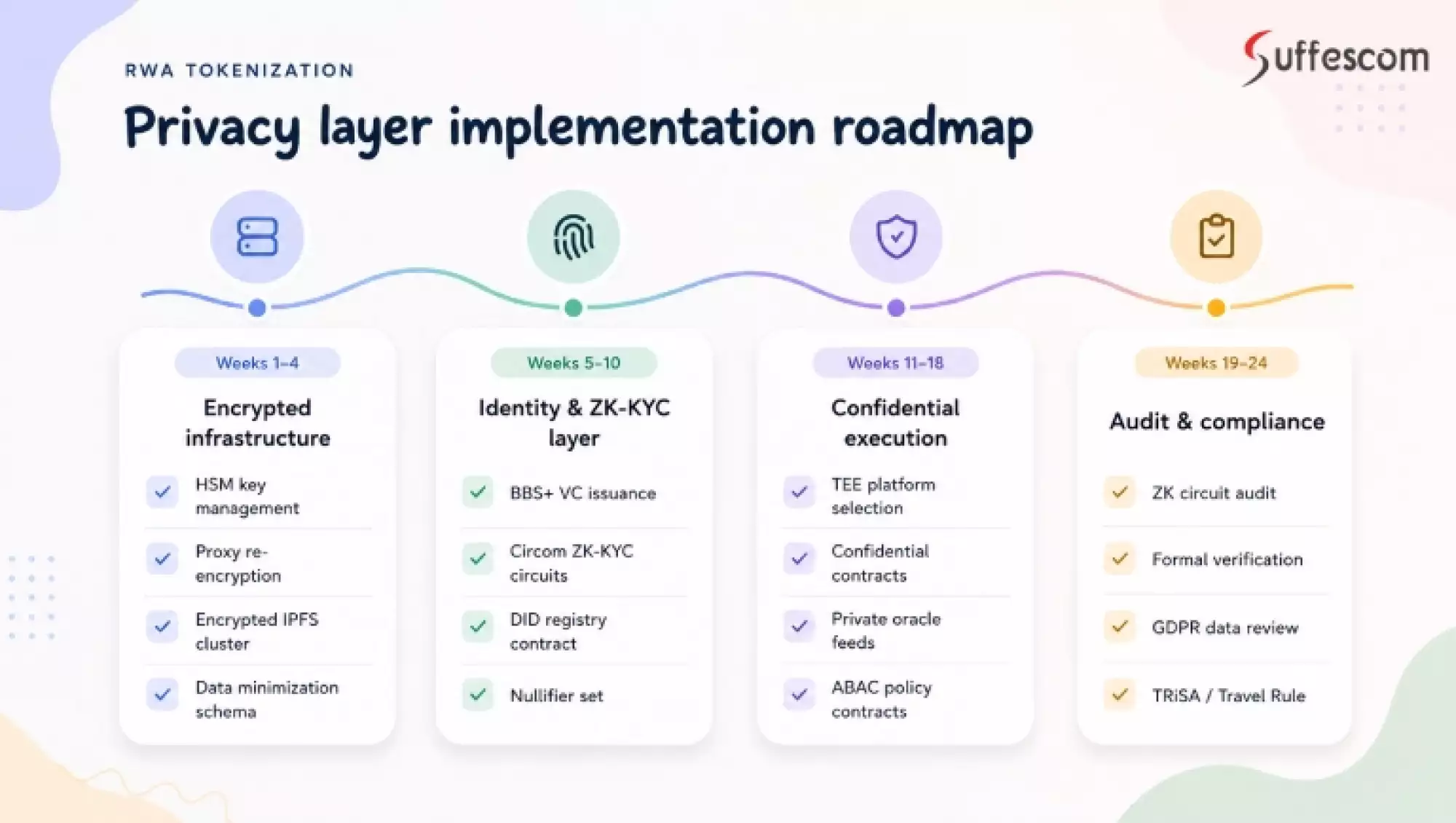
Phase 1: Foundation (Weeks 1–4) — Encrypted Infrastructure Setup
- Provision HSM-backed key management service (AWS CloudHSM or HashiCorp Vault with FIPS 140-2 Level 3 hardware)
- Implement proxy re-encryption for off-chain asset document storage using Umbral PRE or Lit Protocol
- Deploy encrypted IPFS node cluster (Filebase or Pinata with at-rest encryption) for asset metadata
- Define on-chain data minimization schema: determine the exact fields that must vs. must never touch the ledger
- Establish key rotation schedule and disaster recovery for master encryption keys
Phase 2: Identity Layer (Weeks 5–10) — ZK-KYC and Credential Infrastructure
- Integrate approved KYC provider with BBS+ Verifiable Credential issuance capability
- Write and audit ZK-KYC Circom circuits using Groth16 proving system
- Deploy on-chain ZK proof verifier contracts (generated via snarkjs) on target chain
- Implement DID registry contract with Merkle attestation tree for investor eligibility
- Build credential revocation list (CRL) with efficient on-chain revocation proofs
- Integrate nullifier set to prevent credential replay attacks
Phase 3: Confidential Execution (Weeks 11–18) — Smart Contract Privacy
- Evaluate TEE platforms (Oasis Sapphire, Secret Network, or Phala Network) against your chain requirements
- Port core token logic (transfers, dividend distribution, compliance checks) to confidential execution environment
- Implement privacy-preserving oracle integration (Chainlink DECO or TEE-based feeds)
- Write and deploy ABAC policy contracts with role and attribute definitions
- Integrate Lit Protocol for token-gated document access control
- Implement regulator-view key infrastructure: designated verifier proofs enabling regulatory access without public disclosure
Phase 4: Audit and Compliance Hardening (Weeks 19–24)
- Commission a ZK circuit audit from a specialist firm (e.g., Trail of Bits, Veridise, Least Authority)
- Conduct formal verification of critical smart contract components using Certora or Echidna
- Run GDPR compliance review against all data processing flows and document legal basis for each data category
- Implement automated Travel Rule compliance with TRISA integration
- Penetration test the TEE implementation and key management infrastructure
- Deploy monitoring and anomaly detection for the compliance oracle pipeline
Pitfalls in RWA Privacy Layer Development
Even well-resourced teams make predictable mistakes when building privacy infrastructure for tokenized assets. Avoid these critical errors:
Pitfall 1: Treating Privacy as an Afterthought
Privacy retrofitted to an existing token architecture requires re-architecting the data model, re-issuing credentials, and migrating on-chain state, which typically costs more than building it correctly from the start. Privacy by design is not a philosophy; it is an engineering requirement.
Pitfall 2: Confusing Access Control with Privacy
A permissioned blockchain restricts who can join the network. It does not encrypt or hide data from network participants. On Hyperledger Fabric or Besu-based permissioned chains, all validators can read all state. True privacy requires cryptographic mechanisms (ZK proofs, TEE, PRE) on top of permissioning.
Pitfall 3: Broken ZK Circuit Security Assumptions
ZK proofs are only as secure as their arithmetic constraint systems. Common vulnerabilities include: under-constrained circuits (allowing fake proofs), trusted setup ceremony compromise (SNARKs), and signal malleability. Every ZK circuit deployed in production must be formally audited by a specialist firm.
Pitfall 4: Ignoring Key Management Complexity
The most sophisticated ZK circuit is worthless if the encryption key is stored in a hardcoded environment variable or a developer's laptop. Build HSM-backed key management, multi-signature key ceremonies, and automated key rotation into your architecture from the first sprint.
Pitfall 5: No Regulator Escape Hatch
Total privacy where even regulators cannot access transaction data under legal process. It is not commercially viable in regulated markets. Architect designated verifier proofs, regulator view keys, or an ABAC-gated audit trail from the beginning. Regulatable privacy is the design target.
Privacy-Preserving KYC/AML Architecture for Compliant RWA Tokenization
KYC/AML compliance is non-negotiable in tokenized securities markets, yet traditional on-chain KYC implementations create a dilemma: either publish sensitive investor data (unacceptable) or rely entirely on off-chain whitelists (trust-dependent and opaque). Privacy-preserving KYC architecture resolves this with cryptographic compliance infrastructure.
ZK-KYC: On-Chain Compliance Without On-Chain PII Exposure
The ZK-KYC architecture involves three parties: the identity verifier (e.g., Fractal ID, Worldcoin, Synaps), the compliance smart contract, and the investor. The protocol flow:
- Investor completes KYC with an approved identity provider
- Identity provider issues a signed attestation: {kycPassed: true, accreditedInvestor: true, sanctions Checked: true, checkTimestamp: T}
- Investor generates a ZK proof from the attestation that reveals only required compliance claims (e.g., sanctionsClean = true) without exposing identity data
- Proof is submitted to the RWA token contract's compliance gate
- Contract verifies the ZK proof and the issuer's signature; records a nullifier to prevent replay
- Investor is approved for token transfers — no PII ever touches the chain
FATF Travel Rule Compliance with Encrypted Counterparty Data
The FATF Travel Rule requires VASPs (Virtual Asset Service Providers) to transmit originator and beneficiary information for transfers above $1,000. Complying on a public chain requires the following privacy-preserving approach:
- Use the IVMS 101 data standard for structured Travel Rule data formatting
- Encrypt Travel Rule payload with the recipient VASP's public key using ECIES
- Submit only the encrypted payload hash on-chain; transmit full data off-chain via TRISA or Sygna Bridge
- Generate a ZK proof of payload structure validity (proves fields are populated and correctly formatted without revealing values)
- Regulator view keys allow authorized access to decrypted Travel Rule payloads under legal process
Why Enterprises Prefer a Layered Privacy Architecture
The first thought that many enterprises have when it comes to implementing a privacy blockchain is that it solves all the issues related to confidentiality. But in reality, it is necessary to ensure privacy at several layers, not at one particular level.
There are several reasons for this approach.
Scalability
It becomes possible to scale each layer separately. Enterprises can update the ID provider, zero-knowledge proofing tool, or custody without changing the entire infrastructure.
Regulatory Requirements
It makes it easy to adjust policy enforcement to the evolving regulatory landscape without any updates of smart contracts.
Stronger Security
Compartmentalizing responsibilities reduces attack surfaces. Even if one component experiences a vulnerability, other layers continue protecting sensitive information.
Better Vendor Interoperability
Enterprises rarely rely on a single technology vendor. A modular architecture enables organizations to integrate:
- Fireblocks
- Chainlink
- Lit Protocol
- Azure HSM
- AWS CloudHSM
- Existing banking infrastructure
without introducing unnecessary dependencies.
Common Challenges While Building Privacy Layers for RWA Tokenization
Professional teams experienced in building blockchain infrastructure face considerable technical issues when building privacy-friendly RWA tokenization systems. Implementation problems usually occur due to bad architecture design rather than cryptography. Early comprehension of these issues is important to decrease development costs, improve compliance processes, and increase scalability.
Treating Privacy as a Feature Instead of Core Infrastructure
Most projects try to build a privacy layer after having developed a tokenization platform. Unfortunately, adding privacy to the solution involves redesigning smart contracts, changing identity management, and data migration. It is crucial to have a privacy-friendly architecture defined before writing smart contracts.
Publishing Excessive Data On-Chain
When working with blockchain, many developers consider that transparency increases trust levels. In finance, transparency brings security issues. All sensitive data like identities, legal documents, valuation report, financial statements need to stay off-chain and be stored encrypted.
On-chain data must only include cryptography-based commitments or proofs.
Confusing Permissioned Networks with Confidential Transactions
Permitted blockchains limit who can join the network. These networks do not provide automatic encryption for transactions. Organizations using Hyperledger Besu or any other consortium networks need:
- Zero-knowledge proofs
- Selective disclosure
- Confidential storage
- Secure key management
to achieve meaningful privacy.
Weak Cryptographic Key Management
Encryption provides little protection when private keys are poorly managed. Common mistakes include:
- Hardcoded private keys
- Shared administrator credentials
- Infrequent key rotation
- Insecure backups
Enterprise-grade HSMs should protect all production signing keys.
Ignoring Regulatory Audit Requirements
Absolute privacy is rarely acceptable within regulated financial markets. Authorities must retain lawful access under specific circumstances. Platforms should implement:
- Designated verifier proofs
- Regulator view keys
- Controlled disclosure workflows
- Attribute-based access policies
These mechanisms balance investor confidentiality with regulatory oversight.
Best Practices for Building Privacy-First RWA Platforms
Organizations planning enterprise-scale tokenization projects should adopt the following engineering principles.
Design for Privacy from Day One
Integrate encryption, decentralized identity, and selective disclosure into the platform architecture during the planning stage rather than adding them after deployment.
Minimize On-Chain Data
Only store information that requires blockchain immutability.
Everything else should remain encrypted within decentralized storage.
Separate Identity from Wallet Ownership
Wallet addresses should never function as identity records.
Maintain independent identity systems using decentralized identifiers and verifiable credentials.
Encrypt Every Sensitive Asset
Property records, valuation reports, financial statements, and legal documentation should always be encrypted before storage.
Automate Compliance
Compliance rules should execute programmatically rather than relying on manual review.
Automation reduces operational costs while improving regulatory consistency.
Future Trends in Privacy-First RWA Tokenization
The world of privacy moves forward, alongside rapid institutional adoption. There are several new technologies that are set to reshape confidential asset tokenization in the coming years.
Fully Homomorphic Encryption (FHE)
FHE allows performing operations on encrypted data without the necessity to decrypt it. Despite being extremely costly at the moment, this technology has the potential to enable confidential analytics, portfolio management, and risk calculation in a completely secure way.
zkVMs
Specialized general-purpose zero-knowledge virtual machines make it easy to prove complex business logic. RISC Zero, SP1, and Succinct platforms have already made the process of building privacy-focused applications significantly easier.
AI-Assisted Compliance
Artificial intelligence is being used for automated AML controls, sanctions screening, fraud detection, and regulatory reporting. AI-based tools together with zero-knowledge proofs can confirm compliance without exposing sensitive personal information of customers.
Cross-Chain Privacy
With tokenized assets transferring between different blockchain platforms, privacy-preserving interoperability solutions will play an increasingly important role. Cross-chain messaging protocols, along with confidential execution, will allow transferring assets safely and anonymously.
Privacy-Native Token Standards
In the future, token standards will incorporate confidentiality, programmable compliance, and identity natively in the standard, decreasing the amount of custom work
Conclusion
Designing the privacy layer for RWA tokenization isn’t a compliance box to check off; it’s a competitive advantage. Institutional investors, sovereign wealth funds, and regulators all want one thing: privacy that can be independently verified and audited as necessary. Only platforms capable of doing so will have access to the institutional capital that otherwise stays off-chain. The future of real-world asset tokenization platform development will be defined by privacy-native infrastructure rather than retrofitted compliance layers.
The framework outlined in this document includes five privacy layers, ranging from encryption at the level of infrastructure and data to ZK-proofs, selective disclosure of credentials, confidential execution, and permissioned access control. It is state-of-the-art in RWA privacy engineering today.
Implementation may be difficult, but the path forward is clear: first encryption and data minimization, followed by privacy and compliance layers based on zero-knowledge proofs and confidential execution, and lastly audits and regulatory view keys.
FAQs
1. What is a privacy layer in RWA tokenization?
A privacy layer in RWA tokenization is a cryptographic framework that protects sensitive data such as investor identity, asset details, and transaction history while maintaining compliance and blockchain integrity through controlled access and encryption mechanisms.
2. Do zero-knowledge proofs help with GDPR compliance in tokenized assets?
Yes. Zero-knowledge proofs support GDPR compliance by enabling data minimization and selective disclosure, allowing verification of required information without exposing underlying personal or sensitive data.
3. Which blockchain is best for privacy-preserving RWA tokenization?
There is no single best blockchain. Ethereum with zk-rollups is preferred for composability, while Oasis and Secret Network offer native confidential execution, and Hyperledger Fabric is used for enterprise-grade permissioned environments.
4. How does selective disclosure work in RWA KYC/AML compliance?
Selective disclosure uses Verifiable Credentials and BBS+ signatures to prove compliance attributes like KYC status or jurisdiction without revealing full identity data, enabling privacy-preserving regulatory verification.
5. Why do RWA platforms need a privacy layer?
A privacy layer for tokenized assets is required in RWA platforms to protect sensitive investor and asset data while ensuring compliance, auditability, and secure transaction processing in regulated environments.
6. What is the FATF Travel Rule in RWA platforms?
The FATF Travel Rule requires VASPs to share sender and receiver information for certain transactions. Privacy-preserving RWA systems comply by encrypting this data off-chain and sharing only cryptographic proofs or hashes on-chain.