+971-8000321216



Key takeaways:
- Businesses use blockchain verification to reduce fraud, lower administrative costs, streamline compliance, and enable trusted cross-border credential validation.
- Industries including education, healthcare, real estate, digital identity, and insurance leverage blockchain to verify credentials faster and prevent forgery.
- Blockchain-based document verification platforms create tamper-proof, decentralized records that facilitate instant and secure document authentication.
- Advanced features such as cryptographic hashing, smart contracts, Decentralized Identity (DID), and immutable audit trails strengthen document security and trust.
- Successful platform development requires scalable blockchain architecture, decentralized storage, regulatory compliance, and seamless integration with existing enterprise systems.
Want similar results? → Get a Free Quote
Blockchain is a reflection of how technology has transformed over the years. Practices of the past, when document verification was through an expert's perception. Today, that same verification is performed by blockchain technology.
Blockchain-based document verification platforms are leading the next wave of innovation, backed by tamper-proof, highly secure mechanisms.
In this blog, we will shed a spotlight on blockchain document verification platforms and understand why they are increasingly vital for modern businesses. More importantly, we will explore how you can leverage this platform to your benefit and beyond.
What is a Blockchain-Based Document Verification Platform?
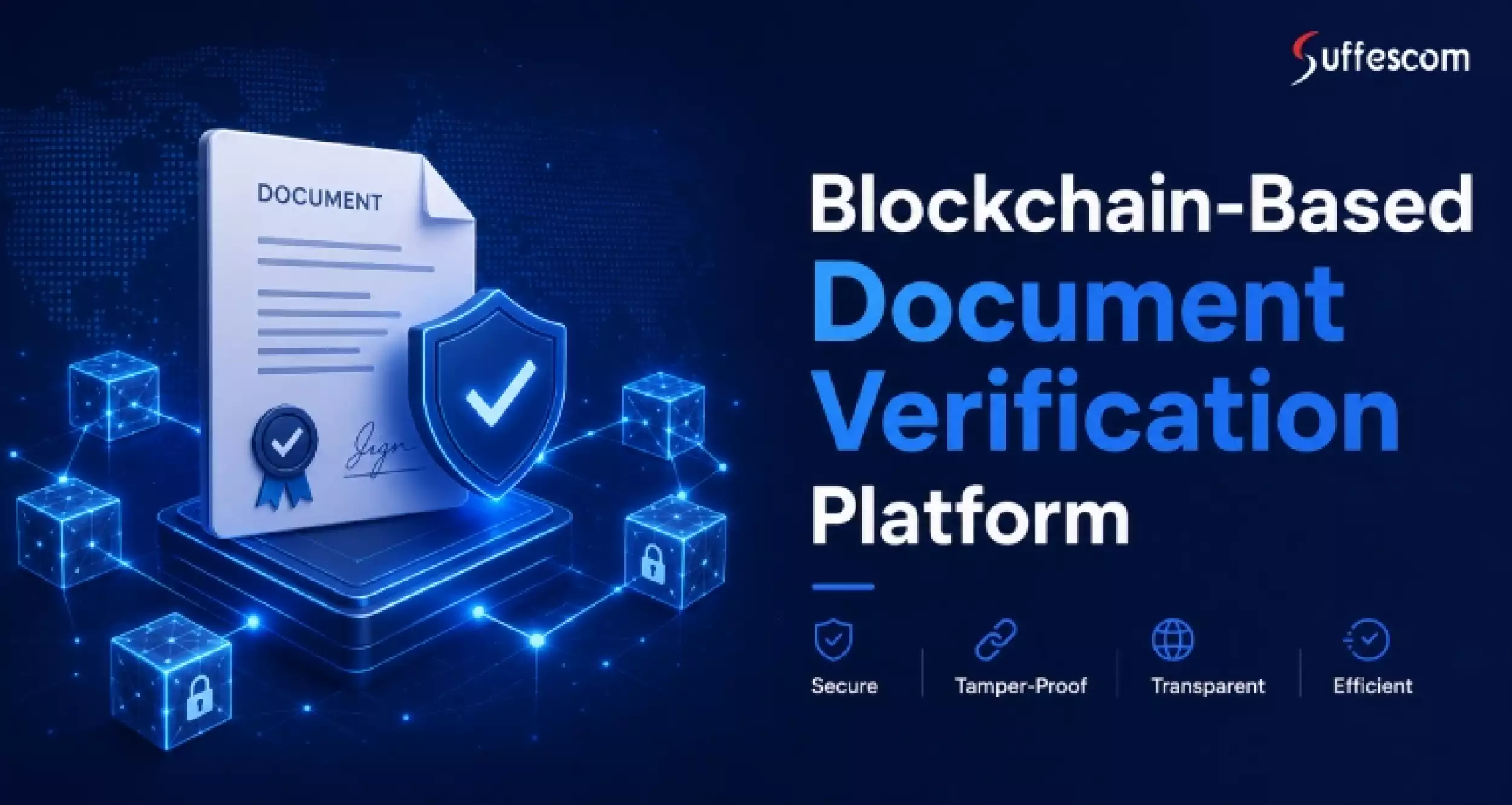
A document verification platform using blockchain refers to a decentralized system that uses cryptographic hashing and blockchain technology to verify and authenticate digital documents, such as a PDF file. In a simple context, it is a blockchain-oriented way of verifying and securing documents.
For example, a university issues its students a degree certificate. For this, they upload that specific document to the secure document verification platform. The platform generates a Unique Identifier (UI), a sort of unique code.
Now, whenever that student applies for the job, that employer will verify the authenticity and credibility of his degree certificate by uploading it on the same platform. If the document matches the UI, the candidate is selected (and so forth).
How is it Different From a Traditional Document Verification Platform
| Aspect | Blockchain-Based Document Verification Platform | Traditional Verification Platform |
| Data Integrity | Immutable: Records are immutable and tamper-resistant once stored on the blockchain | Alterable: Documents can be altered, duplicated, or manipulated without immediate detection. |
| Verification Speed | Instant: Enables near real-time verification through automated blockchain document validation | Delayed: Verification often involves manual checks, resulting in longer processing times |
| Data Storage | Decentralized: Stores document hashes and verification records on a decentralized ledger | Centralized: Relies on centralized databases controlled by a single organization. |
| Privacy | Cryptographic: Uses cryptographic techniques to verify authenticity without exposing sensitive data | Exposed: Sensitive information is typically stored and accessed through centralized systems. |
| Dependence | Distributed: Operates on a distributed network, reducing reliance on intermediaries | Intermediated: Depends heavily on central authorities or third-party verification agencies. |
Seal the Trust Like None Other With Suffescom Solutions
Build Blockchain Document Authentication Solution That Deliver Security, Transparency, and Authenticity
Why Businesses Need Blockchain Document Verification in 2026
In 2026, the blockchain document authentication solution is no longer an experimental concept; it is the critical infrastructure for enterprises’ safety today.
1. Eliminates Fraud: Cryptographic immutability ensures that once the contract or a document is recorded, it cannot be altered, preventing the takeover of fabricated credentials.
2. Cuts Administrative Costs: By removing the intermediary, businesses can significantly reduce the overall administrative costs from seconds to minutes or hours.
3. Streamline Audits and Compliance: Auditors can clearly time-stamp and decentralize audit trails. This simplifies exhaustive regulatory reporting without digging through siloed paper records.
4. Bypasses Cross-Border Barriers: Blockchain-based verification platforms prevent localized bureaucracy and allow documents to be universally verified without language or timezone barriers.
5. Boosts User Privacy: Employees, customers, and partners can easily share their documents in crypto wallets without exposing their sensitive data.
6. Supports Emerging Decentralized Ecosystems: Blockchain verification frameworks power Web3 applications, including decentralized traded fund platforms, by enabling secure transactions and transparent validation.
Key Stakeholders Involved (Issuers, Holders, Verifiers)
| Issuers | Holders | Verifiers |
| Create and issue digital documents/certificates on the blockchain | Own and manage the issued documents | Validate document authenticity through blockchain records |
| Examples: Universities, employers, government agencies | Examples: Students, employees, citizens | Examples: Recruiters, institutions, regulatory bodies |
| Upload and cryptographically sign documents | Share documents when required | Instantly verify document legitimacy without intermediaries |
| Ensure document accuracy and integrity | Maintain ownership and access control | Detect tampering or fraudulent modifications |
How to Develop a Blockchain Document Verification Platform
A blockchain document verification platform helps organizations issue, store, verify, and validate documents such as certificates, licenses, academic records, contracts, and IDs without relying on manual verification.
Step 1: Define the Business Requirements
Successful blockchain document verification software development requires a structured approach that combines secure blockchain architecture, decentralized storage, smart contracts, and seamless user experiences. Before writing any code, identify:
- What documents will be verified?
- Who will issue documents?
- Who will verify documents?
- Which industries will use the platform?
- What compliance requirements must be met?
Example
| User Type | Role |
| Issuer | Uploads and issues documents |
| Holder | Owns the document |
| Verifier | Checks document authenticity |
Step 2: Choose the Blockchain Network
Select a blockchain that will store verification and tamper-proof records.
Popular Options
| Blockchain | Best For |
| Ethereum | High security |
| Polygon | Low-cost transactions |
| Solana | Fast processing |
| Hyperledger Fabric | Private enterprise solutions |
Goal
Store proof of document authenticity on the blockchain instead of the actual document.
Step 3: Design the System Architecture
Create a blueprint of how the platform will work.
- Main Components
- User Dashboard
- Document Management System
- Smart Contracts
- Blockchain Network
- Verification Portal
- Decentralized Storage (IPFS)
Step 4: Build Smart Contracts
Smart contracts automate document verification.
Functions to Create
- Register document
- Verify document
- Revoke document
- Update issuer permissions
- Retrieve verification records
Stored Data
- Document hash
- Issuer ID
- Timestamp
- Verification status
- Revocation status
Step 5: Generate Document Hashes
When a document is uploaded:
- Apply SHA-256 hashing.
- Convert the file into a unique hash value.
- Store the hash on the blockchain.
Why?
Even a minor change in the document creates a completely different hash, making tampering immediately detectable.
Step 6: Store Documents Securely
Do not store large files directly on the blockchain.
Better Approach
Store documents in:
- IPFS
- Arweave
- Secure Cloud Storage
Store only:
- Hash
- Document ID
- Storage reference
on the blockchain.
Benefit
Lower costs and faster performance.
Step 7: Develop the Backend
The backend connects users, blockchain networks, and storage systems.
Key Responsibilities
- User authentication
- Hash generation
- Smart contract interaction
- API management
- Document management
- Notification handling
Common Technologies
- Node.js
- Express.js
- NestJS
- PostgreSQL
- MongoDB
Step 8: Build the User Dashboard
Create separate portals for different users.
Issuer Portal
- Upload documents
- Issue certificates
- Revoke documents
- View activity logs
Holder Portal
- Access documents
- Share verification links
- Download certificates
Verifier Portal
- Upload document for verification
- Scan QR codes
- View verification results
Step 9: Add QR Code Verification
Generate a distinct QR code for every document.
Verification Process
- Verifier scans QR code.
- The platform fetches blockchain records.
- Hashes are compared.
- Verification results are displayed instantly.
Benefit
- Fast and user-friendly verification.
Step 10: Implement Role-Based Access Control
Restrict actions based on user roles.
Example
| Role | Permissions |
| Admin | Full control |
| Issuer | Issue and revoke documents |
| Holder | View and share documents |
| Verifier | Verify documents only |
Benefit
Improved security and governance.
Step 11: Add Document Revocation Features
Sometimes documents need to be canceled or replaced.
Examples
- Expired licenses
- Revoked certifications
- Updated credentials
Smart Contract Action
Update document status from valid to revoked. The blockchain keeps a permanent record of the change.
Step 12: Integrate Digital Identity Verification
Verify user identities before issuing documents.
Methods
- Email verification
- Phone verification
- KYC verification
- Decentralized Identity (DID)
Benefit
Prevents fake issuers and fraudulent records.
Step 13: Test the Platform
Perform thorough testing before launch.
Testing Types
| Test | Purpose |
| Functional Testing | Check features |
| Security Testing | Find vulnerabilities |
| Smart Contract Audit | Validate contract security |
| Load Testing | Measure performance |
| User Testing | Improve usability |
Step 14: Deploy the Platform
Deploy each component.
Deployment Checklist
- Frontend Hosting
- Backend Server
- Smart Contracts
- Database
- IPFS Storage
- Monitoring Tools
Common Platforms
- AWS
- Google Cloud
- Azure
- Docker
- Kubernetes
Step 15: Monitor and Scale
After launch, continuously monitor:
- Transaction volume
- Verification requests
- Blockchain fees
- Storage usage
- Security events
Scaling Options
- Layer-2 networks
- Batch processing
- Multi-chain support
- Load balancing
Key Features to Include in a Blockchain Document Verification Platform
Blockchain document verification platforms are explicitly designed to address the multi-dimensional nature of modern industrial needs. Its features span beyond the verification and authentication processes. It blends blockchain with other innovative technologies to broaden its functionality.
Basic Features
1. Cryptographic Hashing: A secure way of turning a particular piece of data (numbers or words) into a fixed, scrambled mixture of letters and numbers.
2. QR Code/Barcode Embedding: An innovative way of hiding the sensitive or critical information in the form of a barcode, which can only be accessed if the user has genuine access from the authorized party.
3. Multi-Format Document Support: Authenticate and verify any document form, whether PDF or Docs.
4. One-Click Verifier Portals: An instant and secure way of confirming your identity through a single website, for example, scanning your uploaded ID card.
5. Tamper-Proof Digital Signatures: A form of digital signature that cannot be manipulated or tampered with by leveraging the capability of blockchain technology.
Intermediary Features
6. Immutable Audit Trails: A record of events that cannot be changed or altered by anyone, not even the admin or the system owner.
7. Role-Based Access Control (RBAC): The blockchain-oriented access system that restricts access based on their job functions rather than their individual identity.
8. Document Revocation & Expiry Management: A mechanism that enables senders to revoke access to a document or define expiration periods.
9. Real-Time Notification System: Instant, automated alerts to involved parties whenever an on-chain event occurs, keeping them updated in real-time.
10. Analytics & Reporting Dashboard: Similar to any other analytics dashboard, it provides a comprehensive overview of the entire process undertaken in a specific blockchain-based document verification platform.
Advanced Features
11. Smart Contracts: Although common in blockchain technology, they possess a profound impact on businesses by executing predefined rules when specific conditions are met.
12. Decentralized Identity (DID): A cryptographically secure, globally unique digital identifier that belongs entirely to the user.
13. Batch Processing & L2 Scaling: Securely group and record thousands of digital documents at once to prevent network congestion.
14. Multi-Chain Support: The ability of the platform to verify, anchor, and retrieve document records across multiple different blockchain networks.
15. API & SDK Integration: Serves as the connector to connect your existing decentralized document verification software directly.
Real-World Use Cases of Blockchain Document Verification Across Industries
Blockchain document verification platforms are mainly used across education, healthcare, real estate, insurance, and blockchain identity document verification systems to secure document hashes on a tamper-proof, decentralized ledger.
1. Education & Employment
The Problem It Solves
- Identifies fake transcripts and counterfeit university certificates.
- Accelerate background checks to verify academic records accurately.
- Prevent lost or altered records susceptible to tampering.
How Verification Works
- The credential is created and converted into a unique cryptographic hash.
- The hash is timestamped and stored on the blockchain.
- The hash is re-checked against the blockchain.
2. Healthcare
Key Challenges Addressed
- Stopping Counterfeit Drugs.
- Accelerating Clinician Credentialing.
- Protecting Patient Data & Identity.
How It Works
- Document hashing is performed.
- This hash is time-stamped and added as the new block.
- The node validates the authorized data.
3. Real Estate/Legal
Common Title Fraud Issues
- Timely addressing Identity theft and forgery.
- Sellers exploiting the delays in local sub-registrar offices.
- Manipulating, destroying, or altering physical registry papers to hide existing property liens or encumbrances.
Verification Process Explained
- A program is run through a cryptographic algorithm to generate a unique digital fingerprint.
- This hash and timestamp is recorded on the blockchain.
- The verifier submits the documents to the system to verify the document's authenticity.
4. Digital Identity
Why Identity Fraud Happens
- Millions of user records as single point targets for hackers.
- Physical and digitized 2D documents can be easily altered, faked, or stolen.
- Bypass traditional security checks by tricking individuals into handling personal information.
How Blockchain Verifies Identity
- The underlying document or data is run through a mathematical algorithm to create a unique, tamper-evident digital fingerprint.
- Trusted authorities (e.g., banks or governments) digitally sign these hashes.
- Users can prove specific facts about their identity (e.g., being over 18) without sharing their actual identity documents.
5. Insurance
Claims Fraud Challenges
- Interoperability as different insurers or health networks may struggle to verify documents across isolated systems.
- Striking a balance between an immutable, public-facing ledger and highly sensitive personal/medical data could be challenging.
- Transitioning from entrenched paper-heavy and legacy IT systems to decentralized networks requires heavy upfront capital.
How Verification Speeds Claims
- Pre-agreed policy conditions are coded into self-executing contracts.
- Shared ledgers allow brokers, reinsurers, and healthcare providers to instantly validate records (like medical bills or police reports) on a unified network.
- Blockchain cross-checks claim data in real-time with real-world inputs (e.g., matching car telematics or weather indices) to instantly approve parametric insurance payouts.
Tech Stack for Building a Blockchain Verification Platform
Building a blockchain verification platform requires a layered architecture, splitting duties between the user-facing application, the smart contracts (on-chain logic), decentralized storage, and blockchain node infrastructure.
| Layer | Key Technologies |
| Smart Contract & Blockchain Layer | Ethereum, Polygon, Solana, Hyperledger Fabric, Hardhat, Foundry |
| Infrastructure & Nodes | Alchemy, Infura, QuickNode, The Graph |
| Decentralized Storage | IPFS, Arweave, Pinata, Web3.Storage |
| Backend & API Layer (Off-Chain) | Node.js (Express/NestJS), Python (FastAPI), IDfy, HyperVerge |
| Frontend & Web3 Integration Layer | React.js, Next.js, ethers.js, viem, RainbowKit, Web3Modal |
Cost to Develop a Blockchain-Based Document Verification Platform
The total cost to develop a blockchain document verification platform depends on several major factors, which include the project’s complexity, the team's expertise, regional inflation rates, and platform demand. Broadly, this cost bracket falls between $20,000 for a basic MVP and $250,000+ for enterprise solutions.
| Development Stage | Timeline | Estimated Cost | Key Inclusions |
| Basic MVP | 2–4 Months | $20,000 – $40,000 | Document hashing (SHA-256), basic frontend, issuer & verifier portal, public Layer-2 blockchain integration (Polygon/Arbitrum) for low-cost document anchoring |
| Middle-Tier DApp | 4–8 Months | $40,000 – $90,000 | Role-based access control (RBAC), automated smart contracts, IPFS-based decentralized storage, multi-organization support, enhanced security and workflow automation |
| Enterprise Solution | 9–12+ Months | $100,000 – $250,000+ | Private/permissioned blockchain networks (Hyperledger Fabric), biometric KYC, HR/ERP API integrations, advanced compliance management, enterprise-grade scalability and governance |
Challenges in Blockchain Document Verification and How to Solve Them
Blockchain document verification eliminates fraud by creating tamper-proof digital fingerprints (hashes) and logging them on a distributed ledger. However, its adoption is hindered by privacy compliance, high data storage costs, and the inability to natively verify physical paper authenticity.
1. Data Privacy (GDPR Compliance)
Why Does This Happen?
Storing sensitive Personally Identifiable Information (PII) on a decentralized ledger conflicts with the GDPR's "Right to be Forgotten," as the blockchain's immutable nature makes permanent data deletion impossible.
How to Fix It?
Store all raw Personally Identifiable Information (PII) in secure, off-chain storage while recording only cryptographic proofs or hashed pointers on the blockchain for tamper-proof verification.
Real-World Business Impact
Instantly authenticates credentials, contracts, and certificates without middlemen—slashing verification times by up to 80% while near-eliminating costly credential fraud.
2. Scalability and Costs
Why Does This Happen?
Transactions are slow and expensive because every single node must compute, validate, and store massive amounts of data to maintain a secure, decentralized consensus.
How to Fix It?
Store only lightweight cryptographic hashes (like SHA-256) or document proofs on the main blockchain using zero-knowledge rollups and decentralized storage like IPFS to massively increase transaction throughput while reducing network fees to cents.
Real-World Business Impact
By replacing slow, manual, and easily forged paper trails with tamper-proof distributed ledger technology creates a single source of truth that completely eliminates document fraud and eradicates the need for expensive third-party intermediaries.
3. Storage Limits
Why Does This Happen?
Block sizes are strictly restricted to maintain network speed and decentralization, meaning storing heavy document files directly on-chain would quickly bloat the ledger and cause prohibitive transaction fees.
How to Fix It?
Store the actual documents in secure, off-chain decentralized networks (like IPFS) and save only the unique cryptographic hash (digital fingerprint) of the file on the blockchain.
Real-World Business Impact
Replaces slow, manual audits and fraud-prone paper trails with instantly verifiable, tamper-proof digital records to eliminate counterfeiting and drastically cut administrative overhead.
4. The "Garbage In, Garbage Out" Problem
Why Does This Happen?
Because blockchains are isolated, deterministic systems that secure whatever data they are fed, meaning they evaluate and preserve the occurrence of the data input but cannot independently verify the physical or factual truth of the document.
How to Fix It?
By enforcing cryptographic hashing at the source, using trusted oracles for off-chain storage, and requiring multi-signature biometric authentication.
Real-World Business Impact
By integrating trusted AI-based data validation and trusted oracles to verify authenticity at the source before it gets recorded on the chain.
5. Lack of Standardization
Why Does This Happen?
Stems from organizations developing isolated applications with incompatible technologies.
How to Fix It?
Implement decentralized identifiers (DIDs) and W3C-compliant verifiable credentials to ensure universal interoperability across all platforms.
Real-World Business Impact
Fragmented standardization and unverified credentials cost businesses millions in delayed hiring and fraudulent onboarding, severely diminishing operational efficiency.
Why Choose Suffescom Solutions for Blockchain Document Verification Development
As a leading blockchain-based document verification platform development company, Suffescom Solutions helps enterprises build secure, scalable, and compliant verification ecosystems tailored to their industry requirements.
1. Robust Cryptographic Expertise
Our team possesses widespread experience in creating unique digital code for every document through advanced cryptographic hashing (e.g., SHA-256), digital signatures, and public/private key encryption.
2. Smart Contract & Protocol Security
Our intelligent systems, including smart contracts, automatically check and verify documents. We test these documents comprehensively to prevent bugs, errors, or hacking attempts.
3. Scalable Decentralized Architecture
Because storing heavy documents on blockchain can be time-consuming and expensive, our team stores large documents directly in secure decentralized storage to prevent such overheads.
4. Regulatory and Data Privacy Compliance
Our team follows strict private laws and ensures the eligible users have complete control over their visibility of the personal information and verified documents.
5. Seamless Legacy System Integration
We ensure our blockchain verification platform is easily connected with existing software, databases, and businesses through advanced APIs and legacy systems without undergoing major changes.
Conclusion
Blockchain-based document verification platforms have emerged as the key solution to the traditional document verification system, which requires human intervention and is inefficient. However, with the blockchain-powered platforms, businesses can easily create tamper-proof, decentralized records that enable instant and secure document authentication.
They mainly leverage these platforms to reduce fraud, lower administrative costs, streamline compliance, and enable trusted cross-border credential validation. Today, many industries, including education and healthcare, are utilizing blockchain document verification platforms to verify credentials faster and prevent forgery.
However, to develop such platforms, you require scalable blockchain architecture, decentralized storage, regulatory compliance, and seamless integration with existing enterprise systems.
Suffescom Solutions, one of the leading blockchain app development companies, with our state-of-the-art developer’s team, adheres to all these criteria with scalable solutions that adapt precisely to your business needs and deliver products that offer both quality and reliability.
FAQs
1. How Does Blockchain Document Verification Platforms Integrate With Existing ERP Systems?
Blockchain document verification platforms integrate with existing ERP systems by transforming digital files into secure, tamper-proof cryptographic hashes. These hashes are sent from the ERP to the distributed ledgers via APIs, allowing companies to automatically verify the authenticity of invoices, certificates, and supply chain documents.
2. Can Blockchain Document Verification Platforms Support Multi-Party Approval Workflows?
Absolutely. Blockchain document verification platforms are highly capable of supporting multi-party approval workflows through smart contracts and enforcing rule-based verification. Consequently, multiple stakeholders review and approve a document to create an immutable, transparent trail of approvals across organizational boundaries.
3. What Post-Launch Maintenance Does a Blockchain Verification Platform Require?
A blockchain verification platform requires continuous post-launch maintenance to remain secure, compliant, and efficient. Because smart contracts are immutable, routine updates require careful architectural planning.