+971-8000321216



Key takeaways:
- Automated Market Makers (AMMs) harness smart contracts and liquidity pools to enable decentralized, permissionless, and continuous crypto trading without traditional order books.
- Different AMM models, including CPMM and Dynamic AMMs, are designed to optimize trading efficiency for specific use cases and asset types.
- The platform addresses key market challenges such as liquidity shortages, centralized control, trading delays, and custody risks through algorithm-driven liquidity management.
- AMMs power major DeFi applications such as decentralized exchanges, yield farming, stablecoin swaps, cross-chain trading, and token launches while offering significant benefits to businesses and investors.
- AMM development costs range from $10,000 for white-label deployments to $150,000+ for enterprise-grade systems, with the biggest cost drivers being pricing engine complexity, security audit scope, cross-chain integration, and MEV protection architecture.
- The future of AMMs lies in concentrated liquidity, programmable pools, cross-chain interoperability, intent-based trading, and increasing institutional adoption despite challenges like impermanent loss, MEV, and smart contract risks.
Want similar results? → Get a Free Quote
Automation has reshaped cryptocurrency trading and Automated Market Makers are at the center of it. Top AMM protocols recorded over $38.497 billion in trading volume within a single 30-day period as of May 2026, making AMMs one of the most commercially significant infrastructure categories in all of decentralized finance.
Unlike Coinbase or Binance, which cover AMMs for retail learners, this guide targets builders, DeFi developers, and enterprises evaluating AMM architecture for their own platforms. It covers the mechanics that matter for implementation: how each of the five AMM models works, the full technology stack, the five structural problems AMMs solve, the challenges you'll face in production, and the development cost structure that determines your investment.
What are Automated Market Makers (AMMs)?
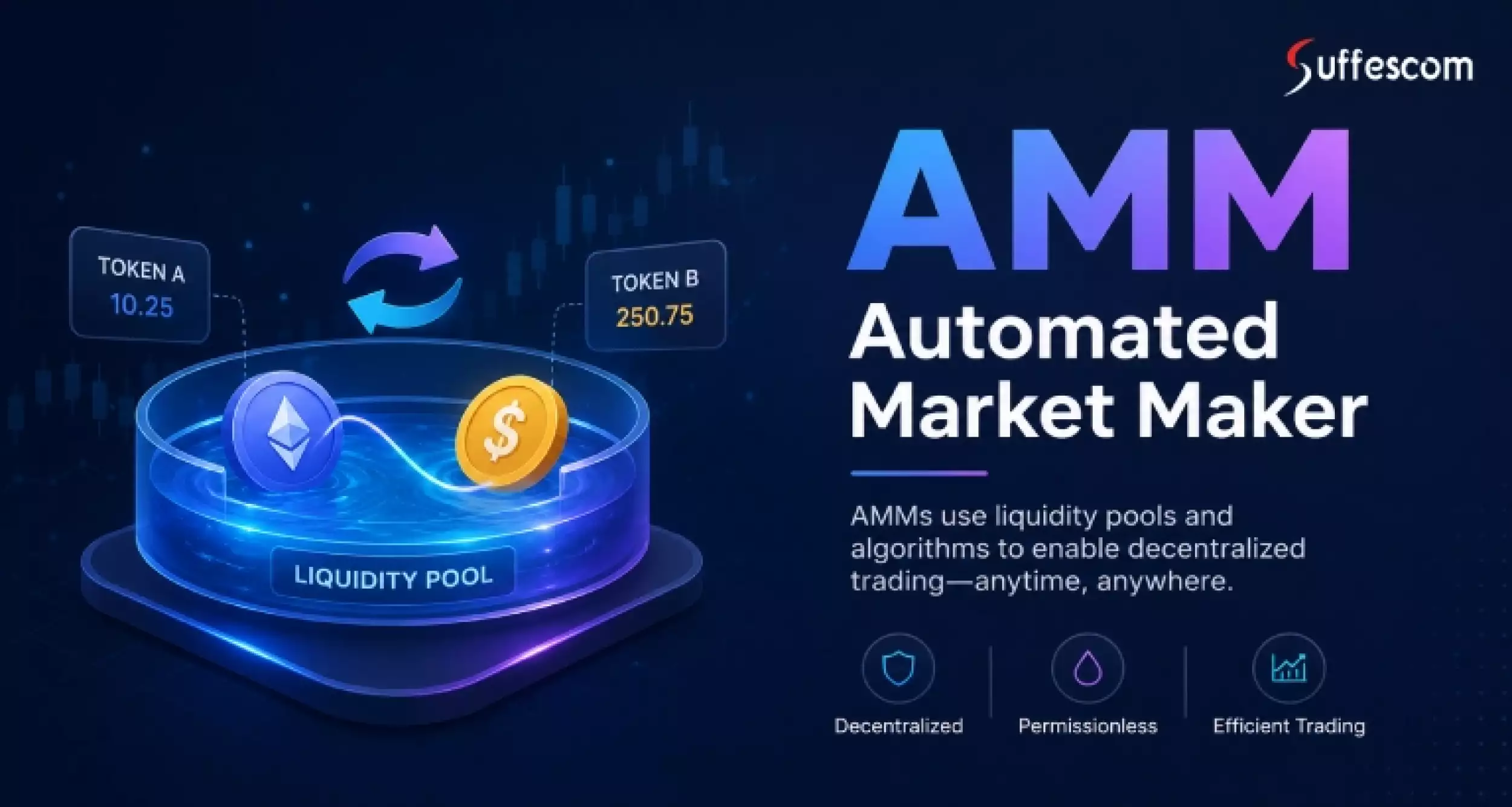
Automated Market Makers are smart contract programs that allow users to trade tokens directly against crowdsourced liquidity pools without traditional order books, without market makers, and without a counterparty for every trade.
Instead of matching buy and sell orders between traders, AMMs use mathematical algorithms to determine prices automatically based on the ratio of assets in the liquidity pool. When a user swaps Token A for Token B, they trade against the pool — the algorithm adjusts prices in real time to reflect the new pool composition.
For a better understanding, let’s suppose a user wants to purchase digital tokens. He opens a decentralized exchange platform and searches for the relevant digital tokens. The smart contract optimizes that token’s prices and offers the best possible price. Consequently, the user decides whether to opt based on their budget and needs.
AMM vs Order Book vs RFQ: Which Trading Model Is Right for Your Platform?
Choosing the right trading mechanism directly impacts liquidity efficiency, execution speed, user experience, and operational complexity. While Automated Market Makers (AMMs) dominate decentralized exchanges, order book and Request for Quote (RFQ) models continue to play a major role in institutional and hybrid trading platforms.
| Feature | Automated Market Maker (AMM) | Order Book | RFQ (Request for Quote) |
| Liquidity Source | Liquidity Pools | Buy & Sell Orders | Professional Market Makers |
| Price Discovery | Algorithmic Formula | Market Supply & Demand | Dealer Quotes |
| Trade Execution | Instant | Depends on Matching Orders | Quote Acceptance |
| Best For | DeFi Platforms | Centralized Exchanges | Institutional Trading |
| Slippage | Medium | Low in High Liquidity | Very Low |
| Capital Efficiency | High (CLMM Highest) | Moderate | Very High |
| Infrastructure Complexity | Medium | High | High |
Transform AMM Innovation Into Impeccable DeFi Solutions With Suffescom
Five Structural Problems AMMs Solve
AMMs mainly solve the cold starting of liquidity within a decentralized exchange by facilitating autonomous token movements between the investor and the platform.
1. Liquidity Shortage
The problem: Insufficient buyers, sellers, or capital makes token trades challenging or expensive, particularly for long-tail assets with thin markets.
How AMMs solve it: By eliminating the need for human counterparties entirely. Traders interact directly with liquidity pools governed by deterministic mathematical formulas — no waiting for a matching order.
2. Centralization of Market Making
The problem: Traditional market making depends on a small group of institutions to provide liquidity and determine prices, creating centralization risk and single points of failure.
How AMMs solve it: Crowdsourced liquidity pools and deterministic algorithms handle transactions autonomously. Anyone can become a liquidity provider by depositing token pairs — removing institutional gatekeeping from price discovery.
3. Censorship and Custody Risks
The problem: Centralized intermediaries can restrict transactions, freeze funds, or take custody of user assets.
How AMMs solve it: Non-custodial smart contracts and permissionless liquidity pools replace centralized intermediaries. Users trade directly from personal wallets, retaining full asset ownership until transaction finalization.
4. Order Book Limitations
The problem: Traditional order books require a matching counterparty before a trade executes creating latency, failed fills, and thin markets for less liquid assets.
How AMMs solve it: A peer-to-contract model replaces peer-to-peer matching. Users execute swaps directly against smart contracts holding pooled reserves, no counterparty required.
5. Trading Delays and Downtime
The problem: Centralized systems have operating hours, experience outages, and introduce latency through intermediary processing.
How AMMs solve it: Smart contracts run 24/7 with no operating restrictions. Trades execute against autonomous contracts not human operators, eliminating downtime and reducing latency to block confirmation time.
How AMMs Work: The Core Mechanics
AMMs operate on a simple principle of liquidity pools and a constant product formula that balances the price fluctuations through smart algorithms.
Step 1: Users Stake Tokens Into a Liquidity Pool
Users deposit a pair of tokens into a liquidity pool. Together, liquidity pools and liquidity providers lay the foundation of AMM-based trading.
Step 2: The AMM Calculates Token Prices
When the user deposits a pair of tokens, the price shifts due to a shift in the token ratio. Typically, the ‘constant product formula’ is a widely used algorithm in this scenario, which formulates to
k = x * y
Where ‘x’ and ‘y’ are the first and second reserve balances of tokens, respectively.
Step 3: Large Trades May Cause Slippage
When the users perform large investments, there is a sudden deficit in prices, leading to ‘slippage,’ a term commonly used for the difference between the expected trade price and the actual execution price.
Step 4: Liquidity Providers Earn Trading Fees
Liquidity providers, the key stakeholders behind the AMMs, earn a percentage of fees when a user performs a swap or trade. This percentage depends on their quantity and the current liquidity pool share.
Step 5: Liquidity Providers May Experience Impermanent Loss
When you put your tokens into a liquidity pool, the pool automatically rebalances them as people trade. If the price of one token rises drastically, you may end up with less of that valuable token and more of the less valuable one. Consequently, when you withdraw your funds, their total value might be lower than if you had simply kept the tokens in your wallet without adding them to the pool.
Automated Market Maker Development Architecture
A production-grade AMM platform consists of several interconnected layers that work together to process trades securely and efficiently.
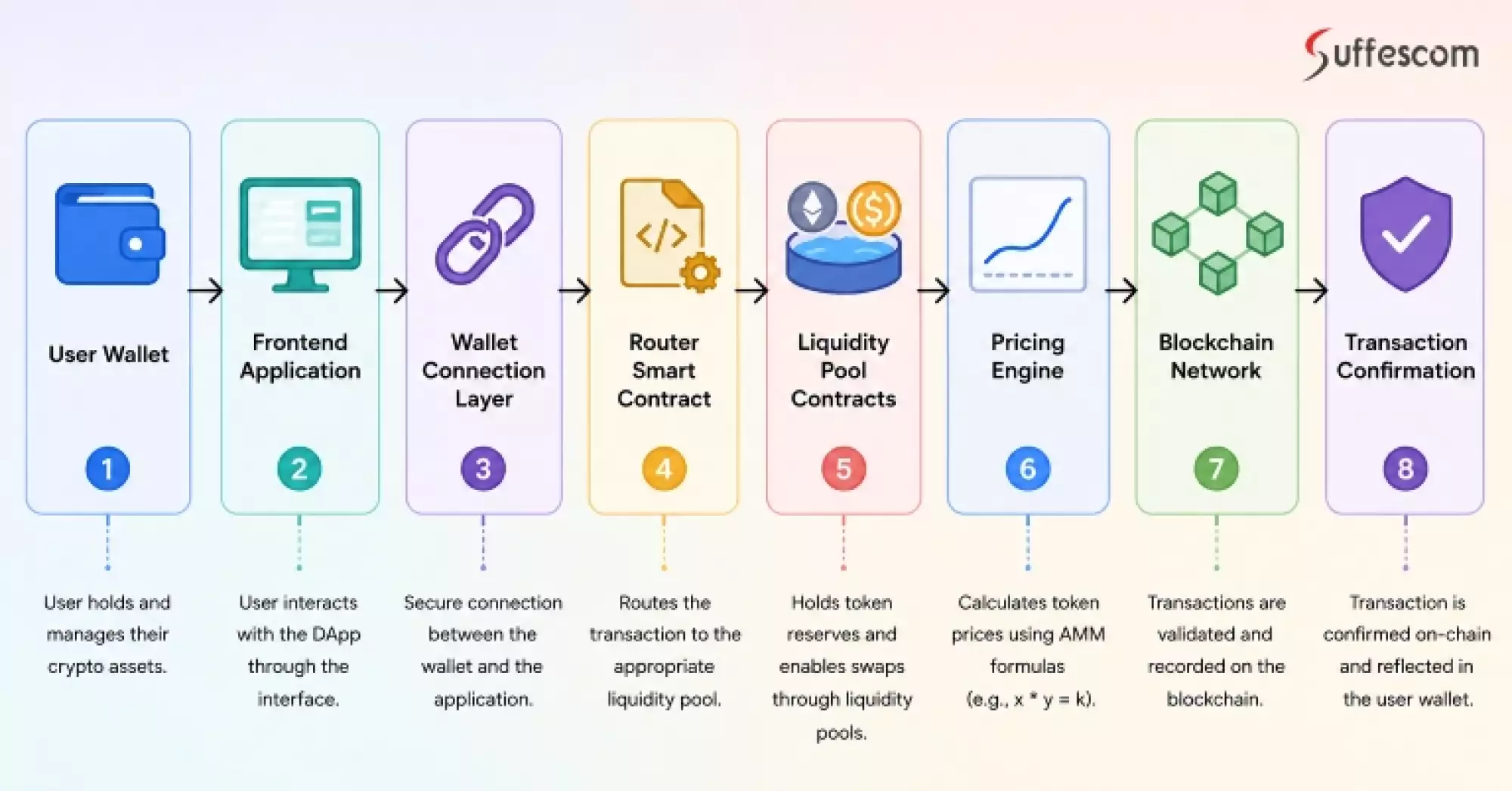
Each layer performs a specific function, from wallet authentication and routing trades to calculating token prices and recording transactions on the blockchain. A modular architecture also makes it easier to integrate additional features such as staking, governance, cross-chain bridges, and analytics dashboards.
Core Tech Stacks of Automated Market Makers (AMMs)
The tech stacks of Automated Market Makers (AMMs) comprise multi-layered tech stacks that span across base layer blockchains, dynamic pricing engines, liquidity smart contracts, and user-facing frontend applications.
| Core Tech Stack Layer | Key Components | Role in Automated Market Makers (AMMs) |
| Base Layer (Blockchain & Consensus) | Ethereum, Solana, Arbitrum, Proof-of-Stake, ERC-20, SPL | Processes transactions, validates network activity, manages fees, and provides token standards for seamless asset swaps. |
| Smart Contracts & Liquidity Layer | Liquidity Pools, LP Tokens, Liquidity Provider Contracts | Holds token reserves, enables non-custodial trading, distributes fees, and manages liquidity provider participation. |
| Pricing & Market-Making Engine | CPMM (x × y = k), CSMM (x + y = k), CLMM | Calculates token prices algorithmically, balances supply and demand, and determines trade execution and capital efficiency. |
| Frontend & Wallet Integration Layer | MetaMask, Phantom, Web Interfaces, APIs | Provides the user interface for connecting wallets, viewing pools, and executing token swaps. |
| Routing & Trade Optimization Layer | DEX Aggregators, Smart Order Routing Algorithms | Finds the best execution path by routing trades across multiple pools or AMMs to minimize slippage and optimize pricing. |
Development tooling by layer
- Smart contract development: Solidity (EVM chains), Rust (Solana), Anchor Framework (Solana), OpenZeppelin (audited contract libraries), Hardhat or Foundry (testing and deployment)
- Price oracles: Chainlink (external price feeds), Pyth Network (high-frequency data), TWAP (on-chain time-weighted pricing for MEV resistance)
- Frontend: React.js, Next.js, Ethers.js, Web3.js, Wagmi (wallet connection library)
- Infrastructure: Docker, Kubernetes, AWS or GCP, The Graph Protocol (on-chain data indexing), Grafana and Prometheus (monitoring)
- Security: CertiK, Trail of Bits, OtterSec (Solana), OpenZeppelin Defender (real-time monitoring and response)
Five AMM Models: Which One Fits Your Use Case?
The types of AMM models are subjected to varying optimized pricing algorithms based on distinctive trading scenarios, keeping the core invariants constant.
| AMM Type | Definition | Key Benefits | Best Use Cases |
| Constant Product Market Maker (CPMM) | A DEX mechanism where price fluctuates algorithmically based on a fixed mathematical formula. | Continuous liquidity availability, swift accessibility to liquidity providers (LPs), automated price discovery | Long-tail asset trading, retail liquidity provision, prediction markets |
| Constant Mean Market Maker (CMMM) | Another DEX mechanism that allows liquidity pools to hold more than two tokens with custom weight distributions, rather than being restricted to the traditional 50/50 ratio. | Custom weight distributions, smart index fund capabilities, reduced impermanent loss | Automated portfolio management (Index Funds), Liquidity Bootstrapping Pools (LBPs), multi-asset liquidity provision |
| Hybrid / StableSwap AMMs | Specialized DeFi liquidity protocols optimized for assets with tightly correlated prices, such as stablecoins (e.g., USDC to USDT) or liquid staking pairs (e.g., stETH to ETH). | Ultra-low slippage, superior capital efficiency, consistent yields for LPs | Stablecoin swaps, pegged & wrapped asset exchanges, treasury management & large volume trades |
| Concentrated Liquidity Market Makers (CLMMs) | A Decentralized Finance (DeFi) protocol that allows liquidity providers (LPs) to allocate their capital within specific, custom price ranges rather than across an infinite price curve. | Significant capital efficiency, reduced price slippage, higher LP Returns | Stablecoin swaps & pegged assets, Protocol-Owned Liquidity (POL), layer-2 & low-gas environments |
| Dynamic and Programmable AMMs | A decentralized finance protocol that algorithmically adjusts its pricing curves, liquidity distribution, or fee structures in real-time. | Hyper capital efficiency, automated risk mitigation, dynamic fee optimization | Dynamic asset portfolios, concentrated liquidity optimization, oracle-driven spread adjustments |
Which AMM Model Fits Your Business?
Use the following framework to choose the right architecture.
| Business Goal | Recommended AMM Model | Why It Works |
| Build a General DEX | CPMM | Simple implementation with broad asset support |
| Stablecoin Exchange | StableSwap | Extremely low slippage |
| Multi-Asset Portfolio | CMMM | Supports weighted liquidity pools |
| Enterprise DeFi Platform | CLMM | Higher capital efficiency |
| Prediction Market | Dynamic AMM | Flexible liquidity adjustment |
| RWA Tokenization | Dynamic or Hybrid AMM | Better price discovery for low-volume assets |
Choosing the appropriate AMM model early reduces future migration costs and simplifies protocol upgrades as your platform grows.
How Leading DeFi Protocols Use Different AMM Models
Different decentralized finance protocols have adopted specialized AMM architectures based on their trading objectives.
| Protocol | AMM Type | Primary Use Case |
| Uniswap V2 | CPMM | General token swaps |
| Uniswap V3 | CLMM | Capital-efficient liquidity |
| Curve Finance | StableSwap | Stablecoin trading |
| Balancer | CMMM | Multi-token liquidity pools |
| PancakeSwap | CPMM + CLMM | Retail DeFi trading |
| Orca | CLMM | Solana ecosystem |
| Raydium | Hybrid | Solana liquidity routing |
Key AMM Benefits for Businesses and Investors
The automated market maker is an open platform that allows instantaneous liquidity for anyone to supply assets and earn income.
1. Continuous Liquidity
Why It Matters
- Guaranteed execution
- No order cancellations or waiting for counterparty negotiations
- High trading of large volumes against a shallow pool
Business Impacts
- Dynamic liquidity
- Passive income for capital
- 24/7 global access
2. Decentralization & Permissionless Trading
Why It Matters
- No gatekeepers
- Self-custody
- Censorship resistance
Business Impacts
- Lower barrier to entry
- Continuous 24/7 availability
- Reduced intermediary costs
3. Democratized Market Making
Why It Matters
- No institutional barriers
- Passive income opportunities
- Long-tail asset availability
Business Impacts
- Long-tail market support
- Lower operational overheads
- Community alignment
4. No Counterparty Risk
Why It Matters
- Elimination of settlement risk
- No reliance on third parties
- Self-custody & trustlessness
Business Impacts
- 24/7 uninterrupted operations
- Elimination of default risk
- Trustless global access
5. Asset Availability
Why It Matters
- Long-tail assets
- Permissionless token listings
- Broader market accessibility
Business Impacts
- Instant long-tail asset listings
- Frictionless capital formation
- Higher ecosystem composability
Engineer High-Performance AMMs Backed By Suffescom Solutions' Expertise
Real-World AMM Use Cases
Automated market makers are utilized in almost every industry today. Whether it's the financial sector or decentralized exchanges, AMMs stand at the forefront of blockchain innovation.
1. Decentralized Exchanges (DEXs)
Decentralized exchanges allow users to buy and sell cryptocurrency directly from a liquidity pool without relying on a centralized exchange.
Key Example: Uniswap, where traders swap tokens through automated liquidity pools instead of matching buyers and sellers manually.
2. Liquidity Provision & Yield Farming
AMMs allow users to invest in a liquidity pool and earn a significant level of profit or a share of distributed trading fees.
Key Example: PancakeSwap, where users provide token pairs to liquidity pools and earn trading fees with additional rewards through yield farming programs.
3. Stablecoin & Wrapped Asset Swaps
AMMs maintain stable prices by exchanging similar-value assets, such as stablecoins or wrapped tokens, in a way that prevents users from experiencing high price slippage or losses due to volatility.
Key Example: Curve Finance, designed specifically for swapping stablecoins like USDT, USDC, and DAI with minimal price differences.
4. Cross-Chain Trading & Interoperability
The platform enables seamless exchange of digital assets between different blockchain networks through liquidity pools and bridging mechanisms.
Key Example: ThorChain, which allows users to swap native assets, such as BTC to ETH, directly across blockchains without wrapping tokens or using centralized exchanges.
5. Token Issuance (IDOs)
A decentralized crowdfunding mechanism where a new project's tokens are distributed to the public through an automated market maker or decentralized launchpad.
Key Example: Initial liquidity bootstrapping projects that bypass traditional underwriters and immediately pair their new token with a stable asset in an AMM liquidity pool to establish a market and allow instant trading post-launch.
7 Common Mistakes to Avoid During AMM Development
Many blockchain startups focus only on launching their protocol quickly, overlooking architectural decisions that significantly affect scalability and security.
Selecting the Wrong Pricing Formula
Using a Constant Product Market Maker (CPMM) for stablecoin trading often results in unnecessary slippage. StableSwap models are generally better suited for assets with closely correlated prices.
Ignoring MEV Protection
Without mechanisms such as private transaction routing or batch auctions, bots can exploit pending transactions through front-running and sandwich attacks.
Underestimating Security Audits
Even minor smart contract vulnerabilities can expose millions of dollars in liquidity. Independent security audits should always be part of the deployment process.
Poor Liquidity Incentives
Low rewards discourage liquidity providers, resulting in shallow pools and poor trading experiences.
Weak Oracle Integration
Protocols relying on external pricing data should use reliable oracle networks with fallback mechanisms to prevent manipulation.
Limited Cross-Chain Planning
Designing exclusively for a single blockchain may restrict future scalability as users increasingly expect multi-chain compatibility.
No Emergency Governance
Protocols should include pause mechanisms and multi-signature governance to respond quickly to security incidents without compromising decentralization.
Five AMM Challenges and Production Solutions
Although AMMs are exceedingly efficient, they are fraught with challenges such as impermanent loss and liquidity fragmentation.
1. Impermanent Loss
The prices keep on fluctuating depending on the demand-supply gaps and smart algorithms. Consequently, the liquidity providers may earn less compared to the invested tokens.
How Suffescom Solves Them
- Provide liquidity for assets designed to track each other's value.
- Offer concentrated liquidity, allowing you to allocate capital to tight price ranges where trades are most likely to occur.
- Automatically scale during high-volatility events through dynamic fee models.
2. Slippage and Price Impact
Users may receive fewer prices due to price impact, stemming from slippage, where the final price varies in comparison to the investment price.
How Suffescom Solves Them
- Use limit orders and trade in highly liquid conditions.
- Execute large trades incrementally (e.g., TWAP or VWAP algorithms).
- Adjusting the slippage tolerance correctly (e.g., 0.5% to 1%).
3. Front-Running & MEV (Maximal Extractable Value)
Bots are immensely useful for modern businesses, yet they possess certain loopholes that could easily exploit pending transactions for unfair profits. Such practices are highly critical in the FinTech industry.
How Suffescom Solves Them
- Focuses on batch auctions, encrypted mempools, and intent-based routing.
- Encrypt the transactions at the client level.
- Assigning delays or speed bumps to certain transactions.
4. Capital Inefficiency
Irrespective of the significance of liquidity pools, a large amount of liquidity often remains unused due to inefficient utilization of available funds.
How Suffescom Solves Them
- Implementing process automation, strict working capital management, and resource optimization.
- Prioritize high-impact levers like minimizing inventory holding times directly to measurable, sustainable revenue.
- Focus on hiring hands-on, execution-driven talent rather than large delegation or management teams during the early phases.
5. Smart Contract Vulnerabilities
A slight variation or flaw in the coding can expose critical funds and protocols to unauthorized parties.
How Suffescom Solves Them
- Perform rigorous testing via fuzzing and professional multi-firm audits and implement robust fail-safes.
- Ensure seamless and robust security audits to mitigate any challenges during smart contract deployment.
- Implement a pause() function restricted to multi-signature wallets to freeze the protocol trading for complete drainages if an active exploit is identified.
AMM Development Cost: What to Budget
No other major educational resource on AMMs includes this data, which is exactly why it belongs here.
| Development Tier | Cost Range | What's Included |
| White-label AMM | $10,000–$30,000 | Pre-built core with CPMM, basic LP UI, single-chain deployment |
| Custom AMM (mid-tier) | $30,000–$80,000 | Custom pricing model (CLMM or hybrid), multi-pair support, analytics dashboard |
| Enterprise-grade AMM | $80,000–$150,000+ | Custom AMM model, cross-chain support, MEV protection, institutional compliance, multi-firm audit |
Six cost drivers that determine your final budget
Pricing engine complexity: CPMM is the simplest and cheapest to implement. CLMM, StableSwap, and Dynamic AMMs require significantly more engineering hours and testing cycles.
Security audit scope: Budget $15,000–$50,000 for a production AMM audit depending on contract complexity and whether you engage one or multiple firms. This is non-negotiable for mainnet deployment.
Cross-chain integration: Adding support for multiple blockchains (Ethereum + Arbitrum + Solana) multiplies contract development, testing, and audit scope significantly.
MEV protection architecture: Encrypted mempools, batch auction systems, and intent-based routing add engineering complexity that generic AMM builds skip entirely.
Frontend and wallet integration: A professional trading interface with real-time charts, LP management dashboard, and multi-wallet support adds $10,000–$25,000 to development scope.
Post-launch maintenance: Ongoing security monitoring, contract upgrades, and performance optimization typically run $2,000–$8,000/month for production AMMs.
The Future of AMMs: Five Trends Shaping 2026 and Beyond
The future of AMMs centers on addressing inefficiencies, mitigating the risk of impermanent loss for liquidity providers, and expanding beyond crypto into traditional asset classes.
1. Concentrated Liquidity And Active LP Management
Where can it be applied?
Stablecoin & pegged asset pools, volatile token pairs, limit order dummies
Which industries or platforms benefit?
Decentralized exchange platforms & protocols, automated vaults & yield optimizers (b2b & retail), institutional DeFi, and market makers.
Real-world applications
Algorithmic liquidity vaults, dynamic range pegging, next-generation extensibility
2. Programmable Pools (Hooks And Plugins)
Where can it be applied?
Dynamic fee models, on-chain limit orders, MEV (Maximal Extractable Value) protection
Which industries or platforms benefit?
Institutional finance & Real-World Assets (RWAs), retail trading & brokerages, algorithmic & specialized market makers
Real-world applications
Dynamic swap fees, on-chain limit orders, Time-Weighted Average Market Making (TWAMM)
3. Cross-Chain AMMs
Where can it be applied?
Interoperable DeFi, Central Bank Digital Currencies (CBDCs), Tokenized real-world assets
Which industries or platforms benefit?
Decentralized Finance (DeFi) & DEXs, cross-border payments & remittances, digital currency initiatives
Real-world applications
Institutional & algorithmic traders, Real-World Asset (RWA) tokenization, and gaming and metaverse economies
4. Intent-Based Trading And AMM Hybrids
Where can it be applied?
Cross-chain swaps, gasless & zero-slippage trading, complex conditional orders
Which industries or platforms benefit?
Derivatives & perpetual markets, prediction markets, cross-chain protocols
Real-world applications
UniswapX, CoW Swap & CoW AMM, and 1inch Fusion Mode
5. Institutional Adoption
Where can it be applied?
Digital cash and cross-border FX, institutional DEFI infrastructure & privacy pools, tokenized real-world assets
Which industries or platforms benefit?
Asset management & hedge funds, prediction markets & decentralized derivatives
Real-world applications
Fixed-income trading, RWA tokenization, prediction markets
AMM Success Metrics: What to Track
For businesses operating AMM-based platforms, three metrics determine platform health:
Total Value Locked (TVL): The aggregate capital deposited in liquidity pools. The primary signal of market confidence and LP trust in your platform.
Daily and monthly trading volume: The total dollar value of assets swapped. The primary driver of fee revenue and LP yield.
Price slippage: The average difference between expected and executed trade prices. A rising slippage metric signals thinning liquidity and deteriorating pool health — an early warning sign before user churn accelerates.
Conclusion
Automated Market Makers (AMMs) have revolutionized the modern crypto market through smart contracts and liquidity pools to facilitate decentralized, permissionless, and continuous crypto trading. Over time, different AMM models have evolved, ranging from CPMM and CMMM to dynamic AMMs, powering major DeFi platforms that use automated market makers.
The future of AMMs aligns with concentrated liquidity, programmable pools, cross-chain interoperability, intent-based trading, and increasing institutional adoption despite challenges like impermanent loss, MEV, and smart contract risks.
Suffescom Solutions, one of the leading blockchain development companies globally, has consistently delivered tangible results that exceed client expectations, reflecting our extensive industry expertise. Our objective is not only to deliver high-quality outcomes but also to fulfill the diverse expectations our clients have through our innovative, market-leading solutions.
FAQs
1) Can AMMs be Integrated With Existing Financial or Trading Platforms?
Absolutely. Automated Market Makers (AMMs) can seamlessly be integrated with existing financial or trading platforms through smart contracts, APIs, and decentralized routing protocols that connect legacy systems on centralized exchanges (CeFi) with on-chain liquidity pools.
2) How Much Does It Cost to Develop an Automated Market Maker Platform?
The total cost to develop an automated market maker depends on multiple external and internal factors. Broadly, the overall cost bracket falls between $10,000 for white-label and $150,000 for enterprise-grade solutions.
3) What Metrics Should Businesses Track to Measure the Success of an AMM?
The key metrics to track the success of Automated Market Makers include Total Value Locked (aggregate capital deposited in the liquidity pools), daily/monthly trading volume (total dollar value of assets swapped), and price slippage (difference between the expected price of a trade and the actual price executed).