Key takeaways:
- A DeFi DEX aggregator consolidates liquidity from multiple decentralized exchanges under a single interface, delivering better pricing, lower slippage, and seamless execution that no individual DEX can match
- DEX aggregators are projected to handle over $100 billion in monthly volume by 2026, according to DeFiLlama and The Block — making this one of the highest-opportunity infrastructure categories in DeFi
- MEV (Maximal Extractable Value) protection, intent-based routing, and cross-chain liquidity are the three defining technical differentiators between basic and production-grade aggregators in 2026
- Building the best DEX aggregator typically costs $100,000–$150,000 for full custom development; white-label solutions start at $25,000–$50,000 and launch in 8–12 weeks
- Smart contract security auditing is non-negotiable; a vulnerability in any protocol integrated into the routing chain can result in direct user fund loss
Want similar results? → Get a Free Quote
The decentralized finance (DeFi) ecosystem is evolving rapidly, driven by innovative financial models, emerging technical challenges, and significant advances in blockchain technology. Creating a responsive, efficient, and user-friendly DeFi DEX aggregator platform now requires deep technical expertise and strategic development planning.
A DEX aggregator platform consolidates multiple decentralized exchanges (DEXs) under a unified interface, enabling users to compare prices across markets, access deep liquidity pools, and execute trades seamlessly with optimal routing. By consolidating trading operations through a single DEX aggregator platform, users benefit from significantly enhanced trading experiences and superior execution quality.
If you're planning to create a DEX aggregator platform, partnering with an experienced development company is crucial for success. Suffescom is a reputable blockchain development company providing comprehensive end-to-end decentralized finance development services with proven expertise in DEX aggregator architecture.
What Is a DEX Aggregator?
As against a CEX where the user has to send their funds into custodial wallets, a DEX allows for p2p trading of cryptocurrencies without any centralized intermediaries. The user retains full custody of any crypto held or exchanged through a DEX, which is not possible in a CEX environment. Decentralized exchanges make use of blockchain technology (and especially Ethereum) along with smart contract-based automatic trades.
A DEX aggregator doesn't act as an alternative to various DEX platforms; rather, it uses liquidity and pricing data and finds out the best route to execute a trade from across several exchanges.
$100B Monthly DeFi Volume Is Being Routed Right Now — Without Your Platform
Every week you wait, another aggregator captures traders you could have served. The infrastructure window is open. The builders moving now are the ones who will own liquidity in 2027.
What Is a DeFi Aggregator and How Does It Compare to a DEX Aggregator?
A DeFi aggregator is the broader category. It gathers data and liquidity from various DeFi protocols — including DEXs, lending protocols, yield farms, and staking platforms and provides them through a single interface. Instead of requiring users to navigate traditional financial institutions or multiple DeFi frontends separately, a DeFi aggregator facilitates the interoperability of diverse decentralized protocols from one unified entry point.
A DEX aggregator is a specific type of DeFi aggregator focused on optimizing token swap execution across multiple decentralized exchanges. It is the most commonly deployed type and the foundation of most commercial DeFi aggregator platforms.
Users can access dozens of DEXs, hundreds of liquidity pools, and multiple DeFi protocols using a single wallet connection, eliminating the friction of maintaining multiple accounts, managing separate interfaces, or tracking disparate transaction histories.
DEX Aggregator vs. Single DEX vs. CEX: Why Aggregators Win in 2026
| Dimension | Single DEX | CEX (Centralized Exchange) | DeFi DEX Aggregator |
| Asset custody | Non-custodial | Custodial | Non-custodial |
| Liquidity access | One chain's pools | Deep but siloed | Aggregated across all integrated DEXs |
| Best price guarantee | No single pool | No internal matching | Yes, real-time multi-source routing |
| Slippage on large trades | High | Low (deep order book) | Low (split-route optimization) |
| MEV risk | High | None (internalized) | Low with protection |
| Cross-chain trading | No | Partial (internal) | Yes, multi-chain native |
| KYC requirement | None | Mandatory | None |
| Gas optimization | None | N/A | Yes, multi-path fee optimization |
| Smart contract transparency | Yes | No | Yes |
| Revenue model for operators | Limited | Transaction fees | Fees + premium services + yield incentives |
How a DeFi DEX Aggregator Works: The Full Mechanism
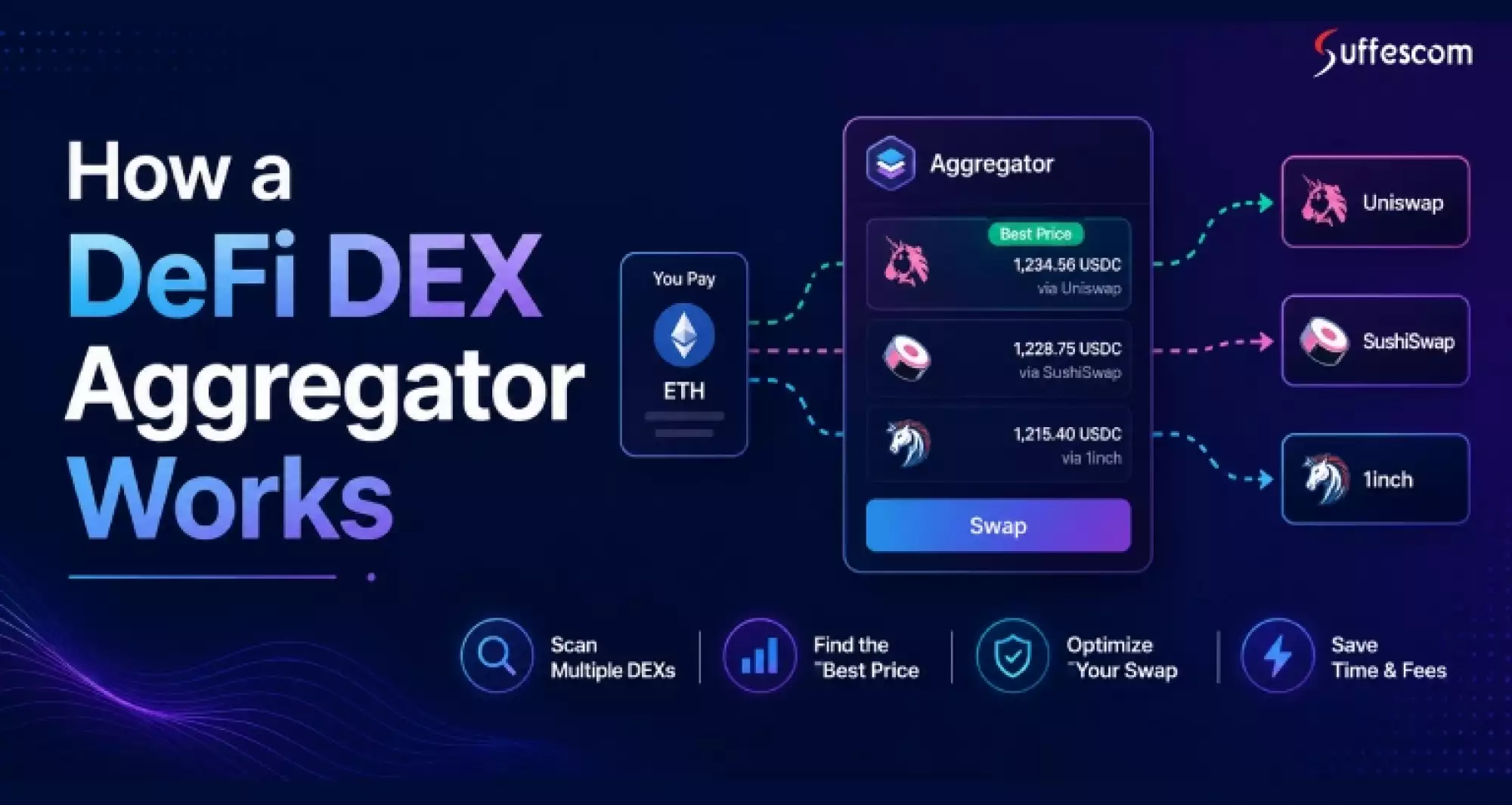
The operational architecture of a DEX aggregator is elegantly simple from the user's perspective and technically sophisticated under the hood.
From the user's view: Connect a wallet, select a token pair and amount, receive the best available swap rate across all integrated sources, confirm the transaction, and receive the output token in the same wallet.
From the system's view, here is what happens in milliseconds:
1. Liquidity discovery: The routing engine simultaneously queries all integrated DEXs and liquidity pools for the current available price and depth for the requested token pair
2. Price impact modeling: For each potential route, the engine calculates the price impact of the trade size against available liquidity depth, not just the spot price, but the actual execution price accounting for slippage
3. Fee aggregation: Gas costs, bridge fees (for cross-chain routes), and protocol fees are factored into a net-received-value figure for each route allowing genuinely comparable prices
4. Split-route optimization: The engine evaluates whether dividing the order across multiple pools and/or chains produces better net execution than a single-path route
5. MEV risk assessment: Routes are evaluated for front-running exposure; high-risk routes are redirected through MEV-protected channels (private RPC, intent-based execution)
6. Route presentation and execution: The optimal route or the top two or three routes for user comparison is presented with full transparency. On user confirmation, the trade executes through the aggregator's smart contracts
For platform owners, this architecture attracts a larger user base than any single DEX can offer, which translates directly into transaction fee revenue, liquidity incentive participation, and compounding network effects as trading volume grows.
Types of DeFi DEX Aggregators You Can Build
Depending on your target audience, technical requirements, and regulatory environment, a DEX aggregator can be architected across several distinct platform types:
| Aggregator Type | Core Mechanism | Best For |
| Standard DEX Aggregator | Aggregates liquidity from multiple DEXs on one or more chains | General-purpose DeFi trading hub; broadest addressable market |
| Cross-Chain DEX Aggregator | Routes swaps across multiple blockchain networks via bridge integration | Multi-chain users; global DeFi liquidity access |
| Layer-2 DEX Aggregator | Focuses on L2 networks (Arbitrum, Optimism, zkSync) for low gas and fast settlement | Cost-sensitive traders; high-frequency use cases |
| Intent-Based DEX Aggregator | Uses user-defined trade outcomes; solver network fills intents atomically | MEV protection; professional traders; gasless UX |
| Flash Swap Aggregator | Executes high-volume trades atomically using flash liquidity | Large-volume arbitrage; institutional capital efficiency |
| Yield-Aware Aggregator | Routes swaps through yield-generating protocols to maximize returns alongside execution | Passive income-focused users; liquidity providers |
| Privacy-Focused Aggregator | Implements ZK proofs for confidential, non-traceable transaction routing | Privacy-first users; institutional privacy requirements |
| Multi-Protocol Smart Aggregator | Integrates DEXs, lending, staking, and DeFi protocols into composable trading | Power users: advanced DeFi strategy execution |
Base Architecture of a Production-Ready DeFi DEX Aggregator
Every production-ready DEX aggregator is built on five foundational architectural components:
1. User Interface Layer
An intuitive, responsive trading interface enabling seamless navigation, token selection, route visualization, and trade execution. Mobile-first design is increasingly important. It is a growing proportion of DeFi volume that originates from mobile wallets.
2. Smart Routing and Execution Engine
The technical heart of the platform. The routing engine queries liquidity sources, models price impact, aggregates fees, evaluates split routes, applies MEV protection logic, and returns the optimal execution path all within sub-200 milliseconds.
3. Smart Contract Layer
The on-chain execution and settlement layer. Router contracts receive trade instructions from the backend, coordinate token transfers across integrated DEXs and bridges, collect protocol fees, and ensure trustless settlement without custodial intermediaries.
4. Liquidity Source Integrations
Adapters link the platform with the various DEXs integrated on the platform (Uniswap, SushiSwap, Curve, Balancer, PancakeSwap, Raydium, and others), bridge protocol integrations (Wormhole, LayerZero, and Axelar); and liquidity pools. These integrations are designed using an adapter interface to allow flexibility in integrating other sources later.
5. Data, Analytics, and Monitoring Layer
Indexing of on-chain data (The Graph), price oracle services in real time (Chainlink, Band Protocol), performance analytics services, and infrastructure monitoring through Prometheus and Grafana tools.
Core Features of a Production-Ready DeFi DEX Aggregator
User-Facing Features
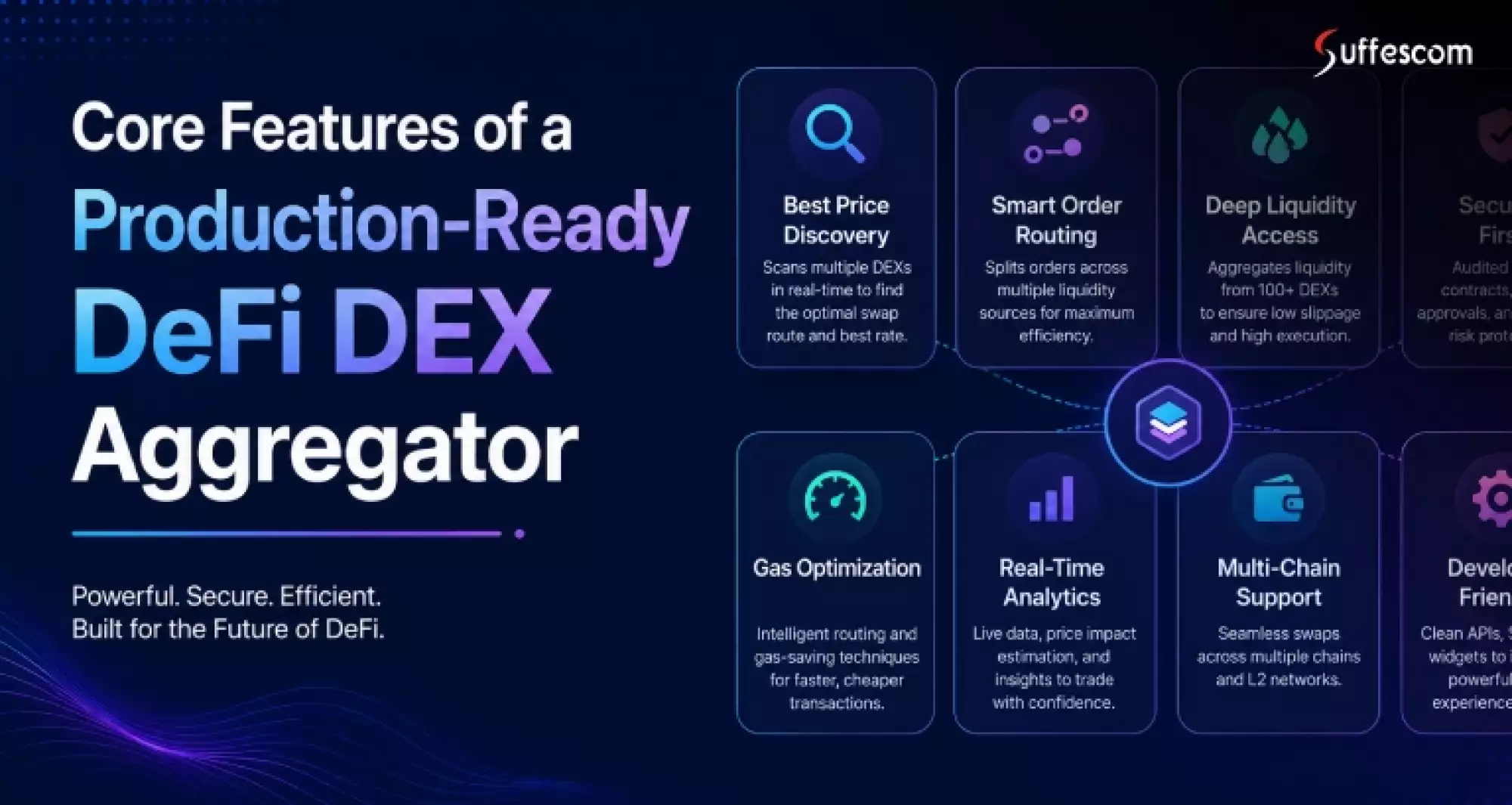
Multi-DEX and Multi-Chain Integration
Seamless connectivity to leading DEXs and liquidity sources across Ethereum, BNB Chain, Polygon, Solana, Avalanche, Arbitrum, Optimism, and more. All accessible from a single wallet connection. Token breadth, chain coverage, and liquidity depth are the primary trading quality metrics users evaluate when choosing a platform.
Smart Order Routing with Split Execution
The routing algorithm automatically analyzes on-chain order books and liquidity across all integrated DEXs, splits large orders across multiple pools to minimize slippage, and presents users with the best available net-received-value across the entire integrated ecosystem. Smart Order Routing splits trades across platforms, reducing slippage and gas fees in every transaction.
MEV Protection
MEV-resistant architecture employs private transaction submission, dynamic gas estimation, and stealth execution logic to safeguard every swap from front-running and sandwich attacks. This is a non-negotiable feature for any platform targeting professional or institutional users in 2026.
Intent-Based Trade Execution
Users specify desired trade outcomes, "receive at least X tokens," and a solver network competes to fill the intent atomically. Solvers pay gas; users receive MEV-protected execution without managing transaction mechanics. This model, pioneered by 1inch Fusion and CoW Swap, is rapidly becoming the standard expectation for high-quality aggregator platforms.
Real-Time Price Discovery
Continuous real-time querying of liquidity pool states, RFQ market maker quotes, and bridge fee data, with prices displayed including all costs — gas, bridge fees, and protocol fees, so users see the true net-received value, not just the spot rate.
Gas and Fee Optimization
Intelligent route selection minimizing total transaction cost across all hops. For cross-chain trades, bridge fee minimization is as important as gas optimization. Gas abstraction — allowing users to pay fees in their input token eliminates the need to hold native chain tokens on every integrated network.
Yield Farming and Staking Integration
Reward mechanisms for liquidity providers and active traders, including staking module integration that allows users to earn additional returns alongside trade execution. Yield-aware routing optimizes for capital efficiency — routing swaps through yield-generating paths where execution quality is comparable.
Portfolio Management and Transaction History
A unified portfolio dashboard showing cross-chain token holdings, historical swap records with performance metrics, profit-and-loss tracking, and downloadable transaction history for tax reporting. Institutional users specifically require comprehensive audit trails.
Token Safety Alerts
Integrated risk engine scanning for honeypot contracts, hidden transfer taxes, low liquidity warnings, and suspicious token logic before any trade executes — protecting users from common DeFi scams without requiring them to conduct manual due diligence.
Admin Dashboard Capabilities
Market and Protocol Management
Admins control which DEXs, bridges, and liquidity sources are active, monitor integration health, and manage the rollout of new chain support, all from a centralized control panel without code deployment.
Fee Configuration and Revenue Management
Real-time adjustment of protocol fee rates by token pair, trade size, and user tier. Premium liquidity service configuration, token listing fee management, and promotional incentive controls are all managed from the admin console.
Risk Monitoring and Anomaly Detection
Real-time dashboards monitoring abnormal trading patterns, bridge failure rates, routing engine performance metrics, and smart contract interaction anomalies. Automated alerts trigger on-call response for security events.
Essential Features List: DeFi DEX Aggregator Platform Capabilities
| Category | Feature | Strategic Value |
| Architecture | Fully configurable modular design | Add chains and DEXs without core rework |
| Liquidity | Access to deep multi-DEX liquidity | Core trading quality proposition |
| Performance | High transaction throughput | Supports thousands of swaps per minute under peak load |
| Cost | Gas optimization mechanisms | Lower user cost = higher volume = higher fee revenue |
| Integration | Multi-DEX connectivity | Breadth of routing coverage |
| Standards | ERC-20, BEP-20, SPL token support | Cross-chain token compatibility |
| Transparency | Immutable on-chain transaction ledger | Auditability and user trust |
| Intelligence | AI-powered swap optimization | Predictive routing beyond static algorithms |
| Security | Multi-layer security framework | Automated vulnerability detection |
| Governance | Role-based admin console | Protocol management and oversight |
| Monitoring | Real-time performance dashboard | Operational visibility and incident response |
| Privacy | ZK-proof transaction routing | Confidential swaps for privacy-sensitive users |
| Interoperability | Cross-chain swap orchestration | Multi-blockchain liquidity access |
| Execution | Flash liquidity for atomic large trades | High-volume capital efficiency |
| Yield | Yield-aware routing | Capital optimization alongside trade execution |
| Governance | On-chain DAO governance modules | Community-driven protocol evolution |
DeFi DEX Aggregator Platform Development
DeFi aggregator platform development represents a comprehensive roadmap for building a DeFi-based DEX aggregator. It involves a sequential set of technical and strategic steps designed to bring high-performing decentralized exchanges under one unified interface.
Most businesses entering the DeFi industry share one primary goal: providing users with efficient, intuitive trading experiences despite users' varying levels of blockchain knowledge. A DEX aggregator plays an essential role in simplifying the trading process through intelligent routing algorithms that automatically direct users to the best available trading routes across multiple liquidity sources.
Suffescom is a leading DeFi development company specializing in secure, scalable, and customizable aggregator platforms. The team develops platforms from scratch and also delivers white-label and clone-based solutions tailored to specific business requirements.
White-label DEX aggregator scripts provide ready-to-deploy foundational infrastructure while allowing extensive customization, feature expansion, and branding beyond the original reference platform.
DeFi DEX Aggregator Development Process: 5 Structured Phases
Developing a DeFi aggregator requires adherence to rigorous security protocols and industry best practices. Building a platform where users can identify the most suitable trading options across multiple DEXs is technically complex and demands expert blockchain developers.
1. Analyze the Project
In the development process of the DeFi DEX aggregator, the development team first analyzes the project, its goals, competitors, requirements, etc. Further, they build a roadmap accordingly to perform all the operations smoothly and to develop a product that fulfills the expectations of clients and end-users. In this phase, the development team works collaboratively with the project owner to clearly define the scope of the work, timeliness, and budget and build a plan to carry out the development.
2. UI/UX Design
When everything gets planned and a roadmap is built, the team of designers comes into play. It is translucent that aggregators are built to improve the customer experience by offering a single interface for interaction with multiple protocols. So, it becomes necessary to build a platform that is easy to use and engage with customers. Hiring a skillful UX/UI design team can help you in incorporating incredible features into a user-friendly interface that the end users will enjoy.
3. Smart Contract Development
Then begins the development phase. The backend development of DEX aggregators requires the building of smart contracts. Smart contracts are the backbone of the platform; thus, hiring eminent developers with experience in creating smart contracts would do wonders. They will construct the platform according to your requirements and make sure that the dex aggregator development is integrated with security protocols.
4. Front-End Development
The front-end development is highly imperative since this is the main part of the DEX development with which users interact directly. Developers need to ensure that all the interfacing elements are rightly positioned and users are eligible to interact with the platform more successfully. While doing front-end development, suitable frameworks and libraries are selected.
5. Testing and Auditing
The final part is the testing phase where the newly built platform is thoroughly tested. It ensures that the platform is working properly and all its features are also functioning in the exact manner they are supposed to be. Testing helps in finding any bugs or errors so that they can be resolved as soon as possible before deploying and making it public. As these involve the development of smart contracts, testing and auditing become essential.
By following these systematically structured steps, you can build a fully functional, secure, and market-ready decentralized exchange aggregator.
Technology Stack for DeFi DEX Aggregator Development
| Layer | Technology | Purpose |
| Frontend | React.js, Next.js, Vue.js | Responsive, real-time trading interfaces with server-side rendering |
| Mobile | React Native / Flutter | Cross-platform iOS and Android trading apps |
| Backend | Node.js, Go, Python | Routing logic, API orchestration, trade execution workflows |
| Smart Contracts (EVM) | Solidity + OpenZeppelin | Secure, gas-optimized router and integration contracts |
| Smart Contracts (Solana) | Rust + Anchor | Solana program development with memory-safe guarantees |
| Web3 Libraries | Ethers.js, Viem, Web3.js | Type-safe blockchain interaction and wallet connectivity |
| Price Oracles | Chainlink, Band Protocol | Real-time, tamper-resistant price feeds for accurate routing |
| Liquidity Protocols | Uniswap, SushiSwap, Curve, Balancer, Raydium | Direct liquidity source integration |
| Cross-Chain Infrastructure | LayerZero, Wormhole, Axelar, deBridge | Secure cross-chain asset transfers and message passing |
| Data Indexing | The Graph, Subgraphs | On-chain data indexing for analytics and historical queries |
| Wallet Integration | MetaMask SDK, WalletConnect, Phantom, Coinbase Wallet | Non-custodial authentication across ecosystems |
| Blockchain Networks | Ethereum, BNB Chain, Polygon, Arbitrum, Optimism, Solana | Multi-chain and Layer-2 compatibility |
| Security and Auditing | OpenZeppelin, Slither, Certora, MythX | Smart contract safety, static analysis, formal verification |
| MEV Protection | Flashbots Protect, MEV Blocker | Private mempool submission; front-running prevention |
| Database | PostgreSQL + Redis | Persistent storage and high-speed caching for routing state |
| DevOps and Infrastructure | Docker, Kubernetes, AWS/GCP | Scalable deployment, load balancing, multi-region reliability |
| Monitoring | Prometheus, Grafana | Real-time platform monitoring and anomaly alert systems |
| CI/CD | GitHub Actions | Automated testing and deployment pipelines |
Advanced Security Practices for DeFi DEX Aggregators
Protect digital assets, investor data, and transactions with advanced encryption, smart contract audits, multi-layer authentication, and compliance-ready security protocols.
Multi-Signature Wallets
Need several cryptographic authentications for essential tasks to avoid failures and unauthorized access.
Smart Contract Audits
Identify vulnerabilities and logic flaws through comprehensive code reviews and automated security analysis tools from leading audit firms.
Anti-Front-Running and MEV Protection
Prevents transaction manipulation by optimizing order routing and mitigating miner-extractable value (MEV) risks through advanced techniques.
Penetration Testing
Simulates real-world attack scenarios to uncover infrastructure and application-level security weaknesses before deployment.
Gas Optimization for Cost-Efficiency
Implements efficient contract logic and intelligent routing strategies to minimize transaction fees for users without compromising security.
Wallets Supported by a Production DEX Aggregator
Our DeFi DEX aggregator supports leading non-custodial wallets to ensure secure authentication, seamless asset management, and frictionless swap execution across multiple blockchain networks.
| Wallet | Chain Ecosystem | Key Capability |
| MetaMask | EVM chains | Standard browser and mobile EVM connectivity |
| WalletConnect | Multi-chain | QR-based connection with broad mobile and desktop wallet support |
| Coinbase Wallet | EVM + multi-chain | Self-custodial with seamless dApp integration |
| Trust Wallet | Multi-chain | Mobile-first with broad chain compatibility |
| OKX Wallet | Multi-chain | Advanced DeFi access with built-in cross-chain support |
| Phantom | Solana, EVM | High-speed Solana ecosystem connectivity |
| Ledger | Multi-chain | Hardware-level security for high-value holdings |
| Trezor | Multi-chain | Offline key storage for long-term asset protection |
| Backpack | Solana, xNFT | Next-generation Solana wallet with app store |
Top DEX Aggregator Platforms in the Market (2026)
Understanding the competitive landscape informs what your platform must match and where differentiation is achievable:
| Platform | Description | Key Differentiator |
| 1inch | Leading EVM aggregator; Pathfinder routing + Fusion intent mode | $700B+ lifetime volume; 350+ liquidity sources across 12 chains |
| Uniswap | Dominant AMM-based DEX; serves as core liquidity source for all aggregators | Deepest EVM single-DEX liquidity; v4 hook architecture |
| CoW Swap | Intent-based batch auction protocol | Structural MEV protection; peer-to-peer settlement |
| deBridge | 0-TVL cross-chain aggregator | Native asset delivery; no pooled liquidity risk; 30+ audits |
| OpenOcean | Cross-chain aggregator integrating DeFi and CeFi liquidity | Broadest market coverage, including centralized liquidity |
| Matcha (0x) | DEX aggregator backed by 0x RFQ network | Professional-grade routing; MEV-aware execution |
| Odos | Multi-chain aggregator with 16+ chain support | Clear route visualization; competitive large-trade pricing |
| AirSwap | Peer-to-peer RFQ-based protocol | Gas-efficient; minimal slippage for professional traders |
| SimpleSwap | Non-custodial swap aggregator | No registration required; instant exchange model |
| AtlasDEX | Cross-chain aggregator with Layer-2 scaling | Fast, low-cost decentralized trading across ecosystems |
How Much Does DeFi DEX Aggregator Development Cost in 2026?
Development costs of DeFi DEX aggregators in 2026 usually stand between $20,000 and $150,000 for a full-fledged business-grade DeFi DEX aggregator with all required customization features, such as advanced liquidity aggregating algorithms, multi-chain support, smart contract implementation, robust security infrastructure, and an easy-to-use interface.
In case you need a quick and cost-effective way to launch your project, consider a white-label solution of the DEX aggregator.
| Build Approach | Cost Range | Timeline | Best For |
| White-Label / MVP | $20,000 – $40,000 | 6 – 10 weeks | Market validation, early-stage operators, regional launches |
| Semi-Custom Platform | $40,000 – $75,000 | 2 – 4 months | Startups needing differentiated routing on proven infrastructure |
| Full Custom Aggregator | $75,000 – $120,000 | 4 – 7 months | Enterprises building a proprietary, long-term trading brand |
| Institutional-Grade Platform | $120,000 – $150,000+ | 7 – 12+ months | High-frequency routing, RFQ networks, 15+ chain integrations |
Not Sure Which Build Tier Fits Your Budget?
Benefits of a DeFi DEX Aggregator
DEX aggregator development offers substantial advantages for users, platform owners, and the broader DeFi ecosystem. It delivers improved usability, security, and financial efficiency. Let's examine the key benefits in detail:
1. Increased security
The DEX outperforms CEX in terms of confidentiality and privacy. Additionally, DEX is also responsible for maintaining total control over possessions and avoiding the possibility of losing everything as a result of a hacker attack. Thus, the user doesn't keep any assets in the on-site wallet.
2. Better Liquidity
The extreme control and lack of decentralization seen at CEXs led to the development of DEXs. The DEX is decentralized; however, since it was only recently introduced to the blockchain industry, its liquidity pool is limited. Therefore, someone who wishes to purchase a large number of coins or tokens can easily or significantly change the price. It won't be capable of finishing the transaction. Therefore, consolidating multiple DEXs into a single aggregator enhances the liquidity situation.
3. Better Prices
Slippage is a problem with limited liquidity that can cause the price to fluctuate either upwards or downwards. It performs several substantial operations. Therefore, you purchase and sell assets at a price that is not what you had predicted. Price slippage is less for large-scale orders with improved liquidity.
4. Better Trading Conditions
The operations that traders carry out within a single platform are limited. They, therefore, need current price assurance instead of overcoming the challenge of registering on other platforms. As a result, the decentralized exchange aggregator gives you access to the best price offer on numerous DEXs.
Why Building a DeFi DEX Aggregator Makes Strategic Sense in 2026
Build a highly scalable and profitable system of trading on decentralized exchanges with DeFi DEX aggregator software focused on maximum capital efficiency and minimum slippage.
Growing User Base for DEXs
In Q2 of 2025, weekly trading volume through decentralized exchanges was about $18.6 billion, while the number of unique DeFi wallets grew from ~6.8 million to ~9.7 million.
High Route Volumes with Aggregators
Such top DEX aggregators as 1inch and Matcha route more than $3.9 billion weekly volume, which proves that people definitely like services with better performance, liquidity, and optimized price discovery.
Better Execution Quality and Minimized Slippage
Aggregators divide their trades on several liquidity pools, improving execution quality and significantly minimizing slippage in swaps.
Multichain Support
The majority of modern aggregators provide multi-chain routing options, allowing users to route their trades across several blockchains. It's one of the key features in a fragmented yet interoperable DeFi environment.
Efficient Pricing and Lower Fees
By finding the best swap path and optimizing transaction execution, aggregators make the trading process cheaper and more efficient.
Business Models and Monetization for DEX Aggregator Platforms
1. Transaction Fees
Generate sustainable revenue by charging a small percentage (typically 0.1–0.5%) on each completed swap transaction.
2. Premium Liquidity Services
Offer advanced routing capabilities, faster execution speeds, or priority liquidity access through subscription-based models.
3. Yield Farming Incentives
Encourage user retention and platform loyalty by integrating reward mechanisms tied to liquidity provision and active trading.
4. Token Listing Fees
Allow projects to pay for enhanced visibility, priority routing support, and featured placement within the aggregator ecosystem.
Future Outlook: Where DeFi DEX Aggregators Are Heading
Expanding Cross-Blockchain Liquidity
The aggregation of liquidity from a diverse range of blockchains will allow users to swap assets freely without the need to manually bridge or utilize wrapped tokens.
Machine Learning-Based Swap Optimization
Sophisticated machine learning systems will evaluate market dynamics on a constant basis in order to ensure optimized trades through reduced slippage and efficient execution.
Increased Use of Layer-2 Solutions
More extensive use of Layer-2 scaling solutions such as Optimism, Arbitrum, and zkSync will lead to substantial reductions in fees while ensuring decentralization.
Price Prediction and On-Chain Signals
The use of predictive analytics to anticipate changes in liquidity and pricing before trade execution will further enhance decision-making capabilities.
Professional Traders' Infrastructure Needs
Future aggregators will feature robust MEV prevention systems and other features necessary to appeal to institutional-grade traders.
Why Choose Suffescom for DeFi DEX Aggregator Development
When entering the blockchain-based aggregator business, Suffescom represents the optimal choice for comprehensive development services. As a renowned leader in DeFi smart contract development, we maintain a talented team of blockchain developers, UI/UX designers, QA testers, and business analysts. All business needs of your project will be fully addressed, with expert recommendations to improve every aspect of development.
Upon partnering with us, you'll work directly with our team of analysts who will carefully listen to your requirements and build a robust development plan to deliver exceptional results. We have a professional team of experts with extensive experience and deep technical knowledge of DEX aggregator architecture. To date, we have successfully delivered numerous high-quality solutions to clients worldwide.
What You'll Get With Suffescom:
- Top-quality services
- 24/7 technical support
- Team of blockchain developers
- Multiple token standards
- Improved security
Your Competitors Are Already Building. Let's Talk This Week.
Conclusion
DEX aggregators remain the key driver behind changing the face of decentralized trading through streamlining access to liquidity pools, optimization of swap paths, and minimizing inefficiencies associated with trade execution on more than one DEX. The following article outlines some essential factors that you should consider when developing a DEX aggregator.
With a reliable DeFi aggregator solution, businesses can provide their users with the ability to make optimized trades, enjoy deep liquidity pools, and apply advanced trading techniques regardless of their knowledge about the intricacies of the DeFi world.
Contacting Suffescom for decentralized application development services will pave the way for sustainable success in the rapidly evolving DeFi landscape. We will leverage our proven experience and technical expertise to deliver top-quality products using cutting-edge blockchain technology.
FAQs
1. Why choose a DEX development company for aggregator projects?
A professional DEX development company brings specialized expertise in smart contract development, blockchain integration, liquidity routing algorithms, and user-friendly UI/UX design, ensuring your aggregator is secure, efficient, scalable, and competitive in the market.
2. How long does it take to build a DEX aggregator?
The timeline depends on project complexity, feature requirements, and customization scope. A typical DEX aggregator takes 3–6 months from initial planning through design, development, testing, security audits, and deployment.
3. What are the costs of DEX aggregator development?
Development costs vary based on features, blockchain integrations, security requirements, and customization level. Contact Suffescom for a tailored quote based on your specific project requirements.
4. How does Suffescom ensure security in DEX aggregator development?
Suffescom employs rigorous smart contract audits, penetration testing, and industry-standard security protocols to protect your platform from vulnerabilities.
5. Which blockchain is best for building a DEX aggregator?
The choice of blockchain depends on factors like scalability, transaction fees, and liquidity. Ethereum offers high security and ecosystem support, while Binance Smart Chain and Polygon provide faster, low-cost transactions suitable for high-frequency trading and smaller swaps.
6. Can DEX aggregators support cross-chain swaps?
Yes, modern DEX aggregators can integrate multiple blockchains to enable seamless cross-chain swaps. This allows users to trade assets across different networks without needing multiple wallets or manual bridging.
7. How do DEX aggregators ensure price accuracy?
Aggregators scan multiple liquidity pools in real time and use advanced routing algorithms combined with oracle feeds. This ensures users receive the best swap rates while minimizing slippage and avoiding failed transactions.
8. What is gas optimization in DEX aggregators, and why is it important?
Gas optimization reduces transaction costs for users by batching swaps, leveraging Layer-2 solutions, or employing smart contract efficiency techniques. It enhances user experience and encourages higher trading volumes on the platform.
9. How does a DeFi DEX aggregator development company ensure platform security?
A professional DeFi DEX aggregator development company implements smart contract audits, MEV protection, encrypted API gateways, and penetration testing to safeguard transactions and user assets.
10. Can a DEX aggregator integrate yield farming and staking?
Absolutely, DEX aggregators can incorporate yield farming and staking modules. This allows users to earn additional rewards while trading, increasing engagement and creating multiple revenue streams for the platform owner.