+971-8000321216



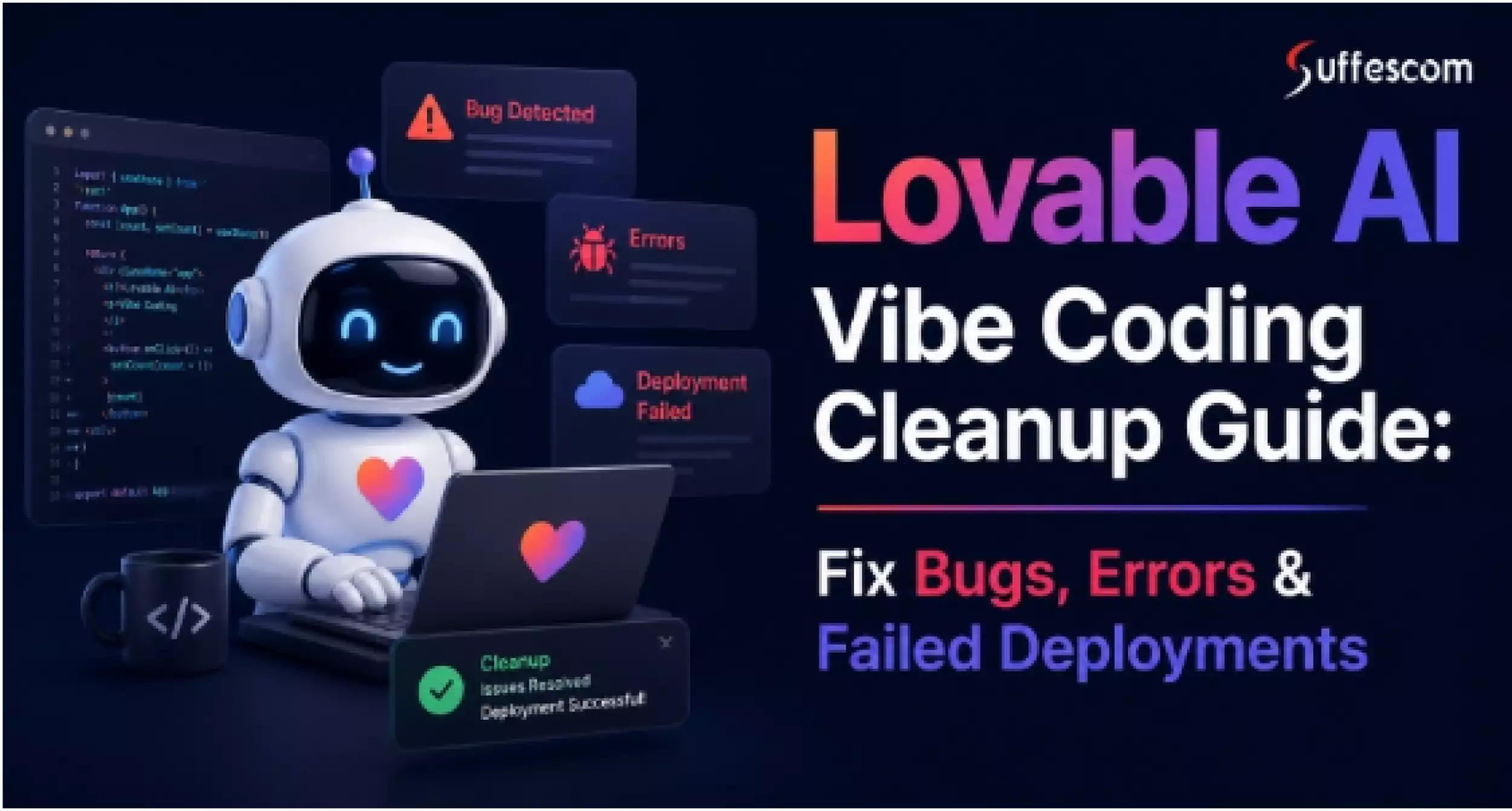
Lovable has changed how startups and founders build software by enabling rapid application development through natural-language prompts to AI. While the platform accelerates MVP creation and product validation, many businesses encounter challenges when their applications move beyond the prototype stage.
Issues such as deployment failures, broken functionality, scalability limitations, security vulnerabilities, and inconsistent code structures often emerge after launch. As a result, founders find themselves searching for solutions when a Lovable app is not working as expected.
Lovable AI vibe coding cleanup services help startups identify, fix, and optimize problematic applications without having to start from scratch. Through detailed code audits, architectural reviews, and performance enhancements, it helps businesses transform unstable AI-generated Lovable applications into production-ready products.
Ideal Use Cases and Real-World Limitations of Lovable Applications
Lovable is highly effective for rapid product development, especially in early-stage builds where speed and iteration matter more than long-term architectural complexity. However, its limitations become more visible as application requirements grow in scale, security, and system complexity.
Best Use Cases of Lovable:
- MVP development
- Internal tools
- Startup validation
- Rapid prototyping
Where Lovable Starts Breaking Down:
- Complex workflows
- Enterprise applications
- Compliance-heavy platforms
- Payment systems
- Large-scale SaaS applications
Struggling with Lovable Vibe Coding Implementation?
Get expert guidance to fix errors, stabilize your application, and move it to production-ready. Consult with Experts!
Reasons to Identify When Your Project Needs Lovable Vibe Coding Restructuring
Most of these issues can be resolved through structured Cleanup Lovable Code, which addresses technical debt, integration failures, and architectural inconsistencies at the root level.
Incomplete Business Logic Implementation
Central processes can be poorly implemented and break in edge cases, leading to issues with user journey consistency and application behavior in production.
Poor Code Maintainability
The lack of modularity and separation of concerns makes it hard to maintain, debug, and add new functionality without breaking something else.
Security Vulnerabilities
Lack of validation for inputs, weak authentication mechanisms, and exposed APIs become potential security holes that can cause real problems in production.
Database and Back-end Problems
Inefficient schema implementation, poor optimization of queries, and unresponsive back-end services result in latencies and data inconsistency.
Third-Party Integration Failures
Failing to manage errors and exceptions in third-party services integration leads to errors that impact production environment stability.
System Failures Untraceable
Runtime exceptions and silent failures make problems undetectable and cause issues in terms of application behavior in production.
Technical Debt from Inconsistent Coding Increases
Code generation causes inconsistency and duplicated business logic, which becomes harder to maintain and support in long term.
Difficulties Adding Features
Inefficiencies of the existing solution architecture can cause serious difficulties when implementing even simple features.
Compliance Gaps
Problems with managing consent, data governance, and audit logging make an application.
Lovable App Failure Analysis: 6 Root Causes Every Founder Should Know
Vision of Product Roadmap Lacking
Without any defined product roadmap, applications will feature misaligned capabilities and inconsistencies, leading to a poorly scalable system in the long term.
Third-Party Breakages and Workflow Failures
Incorrect API coordination, insufficient error management mechanisms, and faulty webhook configurations will cause service breakages and workflow disruptions.
Lack of Enterprise Architecture
Applications generated by Lovable lack proper enterprise architecture optimization, which leads to the development of monolithic and loosely coupled services.
Code Generated with Technical Debt
Fast-paced code generation will introduce code duplication, inconsistent styles, and unorganized modules, leading to technical debt accumulation.
Insecure Architecture Flaws
Flaws in terms of insecure authentication/authorization protocols and exposed environmental variables will introduce security loopholes for exploitation.
Poor Scaling Capabilities
Improper database management and caching policies, as well as poor API handling, will cause performance problems under high load conditions.
Many production issues like crashes, broken deployments, and API failures are resolved through Vibe code cleanup for Lovable, which stabilizes AI-generated code and improves system reliability.
Trusted Lovable Cleanup Services Across Multiple Industries: From Broken to Scalable
Delivering end-to-end lovable project rescue solutions that help transform unstable, AI-generated applications into scalable and production-ready systems across diverse industry domains.
Transportation & Taxi
Transportation systems may experience issues with tracking locations in real time, optimizing routes, pairing drivers with passengers, and handling payments. Lovable code cleanup will help to provide stability to mission-critical workflows of your transportation applications.
Real Estate
Property listing synchronization, document management, investor portals, and CRM integration are some of the challenges that most real estate platforms face when scaling. Cleanup and optimization will lead to improvements in performance and data consistency.
Delivery
In the context of delivery applications, workflow disruptions caused by delays can be a common problem due to their reliance on real-time order tracking, dispatching, payments, and user interaction. It's important to fix those.
Healthcare
Healthcare applications need to have secure data handling features, appointment scheduling tools, telemedicine capabilities, and be ready for HIPAA compliance. Cleanup services help achieve this by making the app more stable and secure.
E-Commerce
As user traffic and transactions increase, e-commerce platforms often encounter checkout failures, inventory synchronization issues, and performance bottlenecks. Code optimization ensures stable shopping experiences and scalable transaction processing.
SaaS Platforms
Many SaaS products start as MVPs but later struggle with user management, subscription workflows, integrations, and scalability. A structured Lovable AI vibe coding cleanup helps transform these early-stage products into maintainable and production-ready SaaS solutions.
FinTech Applications
FinTech products require secure authentication, transaction integrity, regulatory compliance, and high availability. Cleanup services help strengthen security controls, stabilize financial workflows, and improve system performance under growing user demand.
Need Cleanup for Your Lovable Generated Code?
Fix structural issues, remove technical debt, and optimize your app for scalability and performance.
Rescue Your Lovable Project: How Suffescom Gets Your App Back on Track and Scale
Our experienced lovable experts follow a structured, repeatable rescue methodology specifically for Lovable-generated applications. Our process is transparent, milestone-based, and designed to give founders confidence at every stage.
Phase 1: Comprehensive Half-Backed Code Auditing
The process begins with a detailed application assessment under Auditing Services for Lovable Code Cleanup to identify architectural issues, code inconsistencies, and performance bottlenecks across workflows, APIs, database structure, and frontend behavior.
Phase 2: Structural Cleanup
During this phase , the focus shifts to Cleanup Lovable Code, where redundant logic, duplicated modules, and inconsistent patterns are removed to create a modular and scalable architecture. It helps get rid of unnecessary logic, duplicate components, and coding inefficiencies. This leads to more organized code, which will help add features in the future.
Phase 3: Integration Repair & Security Hardening
A large number of applications built using Lovable face problems with connectivity to outside systems like payment gateways, authentication providers, CRM systems, or other APIs. The main objective of this phase is to solve connectivity issues while making improvements related to authentication, access control, APIs, and other application resilience aspects.
Phase 4: Compliance-Focused Remediation
Due to the increase in size, it becomes necessary that the application should be compliant, and in this phase, we ensure that the application complies with GDPR, HIPAA, SOC 2, ISO 27001, SEC, FINRA, MiFID, and industry standards, which include data security management, consent management, encryption of sensitive data, access control, and audit trails.
Phase 5: Testing, Deployment & Knowledge Transfer
Validation of the application takes place before its implementation to ensure that all necessary corrections, improvements, and enhancements function properly. Testing for functionality and performance, along with deployment reviews, helps mitigate any risk in production, whereas technical documentation and knowledge transfer assist teams in supporting the application going forward.
Want a Clear Estimate for Your Lovable Project Rescue Cost?
Get a detailed cost breakdown based on your application complexity, integrations, and code health to plan your cleanup effectively.
Tech Stack Used for Lovable Code Cleanup
A structured tech stack is used to audit, refactor, and stabilize Lovable-generated applications across frontend, backend, database, and DevOps layers.
| Layer | Technologies | Purpose |
| Frontend | React.js, Next.js, TypeScript | UI stabilization, state management fixes, rendering optimization |
| Backend | Node.js, Express.js, Python (FastAPI) | API restructuring, business logic correction, workflow optimization |
| Database | PostgreSQL, MongoDB, Redis | Schema optimization, query tuning, caching improvements |
| API Layer | REST APIs, GraphQL | Integration repair, request/response standardization |
| Authentication | JWT, OAuth 2.0 | Secure login flows, RBAC implementation |
| DevOps & Deployment | Docker, Kubernetes, CI/CD pipelines | Deployment stability, environment consistency |
| Monitoring | Sentry, Prometheus, Grafana | Error tracking, performance monitoring, observability |
Common Lovable Issues and How We Resolve Them
| Issue | Diagnosis Approach | Resolution Steps |
| Lovable app shows blank page | Check console errors, routing issues, missing env variables, and failed API responses | Fix imports, correct env config, add null checks, and resolve routing/render issues |
| Lovable app not working | Trace full flow from API call → state → UI render to find breakdown point | Repair API integration, add async handling, and implement proper loading/error states |
| Lovable project has bugs (intermittent) | Reproduce edge cases, inspect async behavior, and check lifecycle issues | Fix race conditions, improve state handling, and add cleanup in effect |
| Lovable website broken after deployment | Compare local vs production builds, env configs, and API base URLs | Fix deployment settings, update env variables, and resolve CORS/build issues |
| Lovable app crashing (runtime) | Analyze logs, memory usage, and infinite re-renders or dependency loops | Add error boundaries, fix re-render triggers, and clean up subscriptions |
| Lovable generated code errors (console) | Classify errors: type, null, network, or logic failures | Add strict typing, null safety checks, and proper error handling for promises |
| Why is my Lovable app failing? | Full-stack audit: architecture, backend, security, and integrations | Apply structured refactor, fix core architecture issues, and stabilize production readiness |
What Deliverables Do You Receive After a Lovable Cleanup?
After completing a Lovable AI vibe coding cleanup, structured technical deliverables are provided to ensure full visibility into application health, security risks, and optimization opportunities. These outputs help evaluate system stability and support future scalability.
Technical Audit Report
A report on the technical audit detailing architecture structure, module-level dependencies, technical debt analysis, API flow map, and state management issues. The report provides insights on how to optimize the Lovable-generated codebase by eliminating inefficiencies.
Security Findings Report
The security findings report analyzes various issues concerning the application security. It focuses on vulnerabilities in the authentication flows, API endpoints, environment variables management, and data protection practices. These vulnerabilities have been classified depending on the level of risk associated with each one of them.
Refactored Codebase
Refactoring the codebase results in a well-organized version of the current code. In refactoring, all redundant logic and unnecessary code will be removed.
Performance Optimization Report
A structured analysis of frontend and backend performance bottlenecks, including API latency issues, inefficient database queries, rendering delays, and scalability constraints. Recommendations are provided for system-level optimization.
Deployment & Infrastructure Documentation
The documentation provides information on the infrastructure needed for proper deployment of the application. Information includes the deployment configuration, environment setup, and CI/CD pipeline structure.
Compliance & Data Protection Checklist
A structured checklist evaluating GDPR compliance, data privacy controls, consent mechanisms, and secure data handling practices, ensuring alignment with standard regulatory requirements for production systems.
Is Your Lovable App Facing Critical Issues in Production?
Get expert analysis to identify failures in payments, integrations, security, and performance before they impact your users.
Recover, Refactor, and Scale: Why Choose Suffescom Solutions
Payment Gateway Risks
We help startups fix fragile and incomplete payment workflows in Lovable-generated applications. Our team strengthens transaction validation, webhook handling, and payment state synchronization to eliminate risks like failed or duplicate transactions in production environments.
GDPR & Compliance Gaps
We help make sure that your Lovable application complies with international data privacy rules by incorporating proper consent, data retention policy, and data lifecycle management. This will keep you safe legally and compliant with the rules.
Auth & Access Problems
We enhance the security of identity and access management by ensuring that there are no problems with authentication processes, session management, and role-based access control (RBAC).
Performance Problems
We help enhance the performance of your back and frontend through better database query optimizations, implementation of caching, and more efficient API flow execution.
Technical Debt & Code Quality
We improve the code quality of your fragmented Lovable codebase by eliminating redundant code, improving coding structure, and restructuring into modular architecture.
Integration Failures
We fix issues associated with broken integrations between other systems and yours, for example, payment gateways, authentication processes, and external webhooks to improve system interactions.
FAQs Related to Lovable Crashed Code Cleanup Service
Q1: What is Lovable AI vibe coding cleanup, and why do I need it?
Lovable AI vibe coding cleanup is the process of auditing, fixing, and optimizing AI-generated Lovable applications. It helps resolve hidden bugs, performance issues, and deployment failures. It ensures your app becomes stable, scalable, and production-ready.
Q2: Why is my Lovable app showing a blank page?
A blank page usually occurs due to frontend rendering failures, broken imports, or missing environment variables. It can also result from routing issues or failed API responses. A structured debug process is needed to identify the exact breakdown point.
Q3: How do I fix a Lovable website that is broken after deployment?
Deployment issues often happen due to mismatched environment configs, build errors, or incorrect API base URLs. Fixing them requires comparing local vs production settings and validating deployment pipelines. Proper configuration alignment restores functionality.
Q4: What are the biggest loopholes in Lovable-generated apps?
Common loopholes include weak authentication, payment gateway issues, and missing GDPR compliance layers. Many apps also suffer from poor scalability and insecure API handling. These gaps create risks in production environments.
Q5: Can I do Lovable code cleanup myself, or do I need a professional?
However, deeper problems like architecture flaws, security gaps, or integration failures require expert intervention. Work with a dedicated vibe coding cleanup specialist to ensure stability and prevent recurring issues.
Q6: What is the difference between vibe code cleanup for Lovable and a full rewrite?
Cleanup improves and stabilizes existing code without rebuilding the application from scratch. A full rewrite involves redesigning architecture, logic, and infrastructure entirely. Cleanup is faster and cost-effective, while rewrites are used for severely broken systems.
Q7: How long does a Lovable project rescue take?
Timelines depend on complexity, code quality, and severity of issues. Small cleanup tasks may take a few days, while full project rescue can take several weeks. A detailed audit is required to estimate an accurate delivery time.