Key Takeaways:
- RAG connects healthcare AI models to external medical knowledge, including clinical guidelines, hospital protocols, and authorised patient records.
- Fine-tuning adapts a model's behaviour to specialised healthcare tasks, response formats, and domain-specific examples.
- RAG is often suitable for applications that require access to changing medical information, while fine-tuning can help standardise outputs for well-defined tasks.
- A hybrid approach combines retrieved medical evidence with a model adapted to a specific healthcare workflow.
- Both approaches require rigorous evaluation, privacy safeguards, and clinical oversight before being used in high-risk healthcare settings.
Healthcare organisations are exploring large language models (LLMs) to streamline clinical documentation, make medical information easier to access, and support healthcare professionals with information-intensive tasks. However, general-purpose AI models may lack access to an organisation's latest clinical protocols, struggle with specialised documentation requirements, or generate responses that do not match established healthcare workflows.
Two common approaches to adapting these models are retrieval-augmented generation (RAG) and fine-tuning. Although both can improve the usefulness of AI applications, they solve different problems.
RAG retrieves relevant information from external knowledge sources when a user submits a query. Fine-tuning, on the other hand, uses carefully prepared training examples to adjust a model's parameters so it performs more consistently on particular tasks.
For example, a hospital developing an AI assistant to answer questions about its latest treatment protocols may benefit from RAG. An organisation building a system to classify clinical notes into predefined categories may find fine-tuning more suitable. Some applications may need both approaches.
Choosing between RAG and fine-tuning LLMs for healthcare depends on the information the system must access, the behaviour it needs to produce, the available data, and the consequences of an incorrect response. This guide compares the two approaches, explores their healthcare use cases, and explains how to select and implement the right strategy.
Why Healthcare Needs More Than a General-Purpose LLM
Healthcare AI applications operate in an environment where information accuracy, patient context, privacy, and consistency matter. A model that performs well on general questions may still struggle when applied to clinical terminology, complex patient records, institutional policies, or specialised documentation tasks.
Several challenges make model adaptation particularly important in healthcare.
- Specialised medical knowledge: Healthcare applications may need to work with clinical terminology, medical literature, diagnostic information, and organisation-specific protocols.
- Frequently changing information: Treatment guidelines, formularies, institutional procedures, and patient records can change. A model's existing training knowledge does not automatically reflect these updates.
- Task-specific requirements: Clinical summarisation, medical coding assistance, patient communication, and document extraction require different output formats and levels of detail.
- Data privacy and access controls: Healthcare systems must manage sensitive patient information and ensure that AI applications access only authorised data.
- Clinical reliability: Plausible-sounding answers are not necessarily correct. Outputs must be evaluated against appropriate evidence and intended-use requirements.
Before selecting an approach, healthcare organisations can assess their data, workflows, integration requirements, and technical capabilities through an AI readiness assessment for healthcare. This helps establish whether the main requirement is access to reliable information, adaptation to a specialised task, or a combination of both.
What is RAG in Healthcare AI? Connecting Models to Medical Knowledge
Retrieval-augmented generation (RAG) is an AI architecture that retrieves relevant information from an external knowledge source and supplies it to a language model when generating a response.
Rather than relying entirely on information encoded during training, a RAG-based healthcare application can search approved medical resources, retrieve relevant passages, and use them as context for an answer.
For example, a hospital's clinical assistant could retrieve the latest approved institutional protocol when a clinician asks about a specific procedure. The model can then summarise the relevant guidance and provide references for the clinician to review.
How Retrieval-Augmented Generation Works
A typical RAG pipeline includes the following steps:
- Prepare the knowledge sources: Collect approved clinical guidelines, hospital protocols, medical reference documents, or other authorised information.
- Index the content: Divide documents into searchable sections and create representations that help the system retrieve relevant information.
- Retrieve relevant evidence: When a user submits a query, the retrieval system identifies passages that may answer the question.
- Generate a contextual response: The retrieved passages are supplied to the language model, which generates an answer based on the available context and instructions.
- Present supporting sources: Where supported by the implementation, the application displays source references so users can verify the information.
The retrieval process may use keyword search, vector search, metadata filtering, or a combination of techniques. The right design depends on the content, search requirements, and sensitivity of the information.
RAG can improve access to relevant knowledge, but it does not guarantee that the retrieved evidence is complete, current, or correctly interpreted. The knowledge repository must be maintained, and generated responses still require appropriate validation.
For a deeper explanation of the architecture and its healthcare applications, read RAG in Healthcare Applications.
Healthcare Use Cases for RAG
1. Clinical guideline and medical literature retrieval
Healthcare professionals may need to consult lengthy guidelines, institutional protocols, or research publications. RAG can retrieve relevant passages and summarise them for review, reducing the need to search multiple documents manually.
2. EHR summarisation and patient record queries
A properly authorised application can retrieve relevant information from electronic health records (EHRs), such as previous encounters, documented allergies, medication histories, and test results. The model can organise this information into a summary or answer a question about the available record.
Patient-specific applications require careful handling of permissions, data freshness, conflicting entries, and missing information. A summary must not be treated as a complete substitute for reviewing clinically significant records.
3. Healthcare chatbots and patient education
RAG can help healthcare chatbots answer common questions using approved patient education materials, service information, and organisational guidance. Responses can be grounded in reviewed content rather than relying solely on the model's pretrained knowledge.
Patient-facing systems should be designed to recognise questions outside their intended scope and direct users to appropriate professional care when necessary.
4. Clinical decision support grounded in approved evidence
An AI-powered clinical decision support application can retrieve relevant institutional protocols or medical references and present them alongside information supplied by the clinician. This may help clinicians locate evidence relevant to a clinical question.
RAG alone does not establish a diagnosis, verify a treatment's suitability, or demonstrate improved clinical outcomes. Those capabilities require appropriate system design and clinical evaluation.
What Is Fine-Tuning in Healthcare AI? Adapting Models for Medical Tasks
Fine-tuning is the process of training an existing model further on a curated dataset to adapt its parameters to a particular task, domain, or response style.
In healthcare AI, fine-tuning may help a model recognise specialised language patterns, follow a consistent documentation format, classify clinical text, or produce outputs that align with a defined workflow.
For example, a healthcare organisation may fine-tune a model using reviewed examples of clinical notes paired with the appropriate categories. The resulting model can then be evaluated on its ability to classify new notes consistently.
Fine-tuning does not automatically give a model access to current clinical guidelines or private patient records. It also does not guarantee medical accuracy simply because the training data contains healthcare terminology.
How Fine-Tuning Works
A typical fine-tuning workflow involves these stages:
- Define the target task: Specify the expected input, output, and performance requirements.
- Prepare training examples: Collect representative, appropriately authorised examples with reliable labels or target responses.
- Clean and review the dataset: Remove duplicates, address inconsistencies, and assess whether the data represents the intended use case.
- Train the model: Apply an appropriate fine-tuning method to adapt the model to the target task.
- Evaluate on separate data: Test the model on examples that were not used for training, including difficult and edge cases.
- Deploy and monitor: Integrate the model into the intended workflow and monitor its performance as requirements and data change.
Depending on the model and project, teams may use parameter-efficient methods such as low-rank adaptation (LoRA) rather than updating all model parameters. This can reduce the number of trainable parameters, although actual infrastructure and training costs depend on the implementation.
Healthcare Use Cases for Fine-Tuned Models
1. Clinical note classification
Fine-tuned models can classify clinical text into predefined categories, such as document type, encounter type, or administrative routing category. They can support triage of documentation tasks when the categories are clearly defined and performance is validated.
2. Medical entity extraction and coding assistance
A model can be adapted to identify information such as medication names, symptoms, procedures, and diagnoses within clinical documents. These outputs may support coding and data processing workflows, but medical coding decisions and clinically significant extracted information require appropriate verification.
3. Consistent healthcare-specific responses
Healthcare organisations may need AI assistants to follow a particular tone, terminology, structure, or response format. Fine-tuning can help a model produce more consistent outputs for a well-defined task, such as drafting structured administrative responses or generating summaries in a standard template.
4. Structured clinical documentation
Fine-tuning may help models convert source text into a predefined structure, such as sections for presenting concerns, documented history, and follow-up actions. The system must preserve the meaning of the original information and avoid introducing unsupported clinical details.
Fine-tuning is most useful when the desired behaviour can be demonstrated through reliable examples and measured against a defined evaluation standard. It should not be used as a substitute for access to authoritative medical information when the application depends on current evidence.
RAG vs. LLM Fine-Tuning for Healthcare: Key Differences
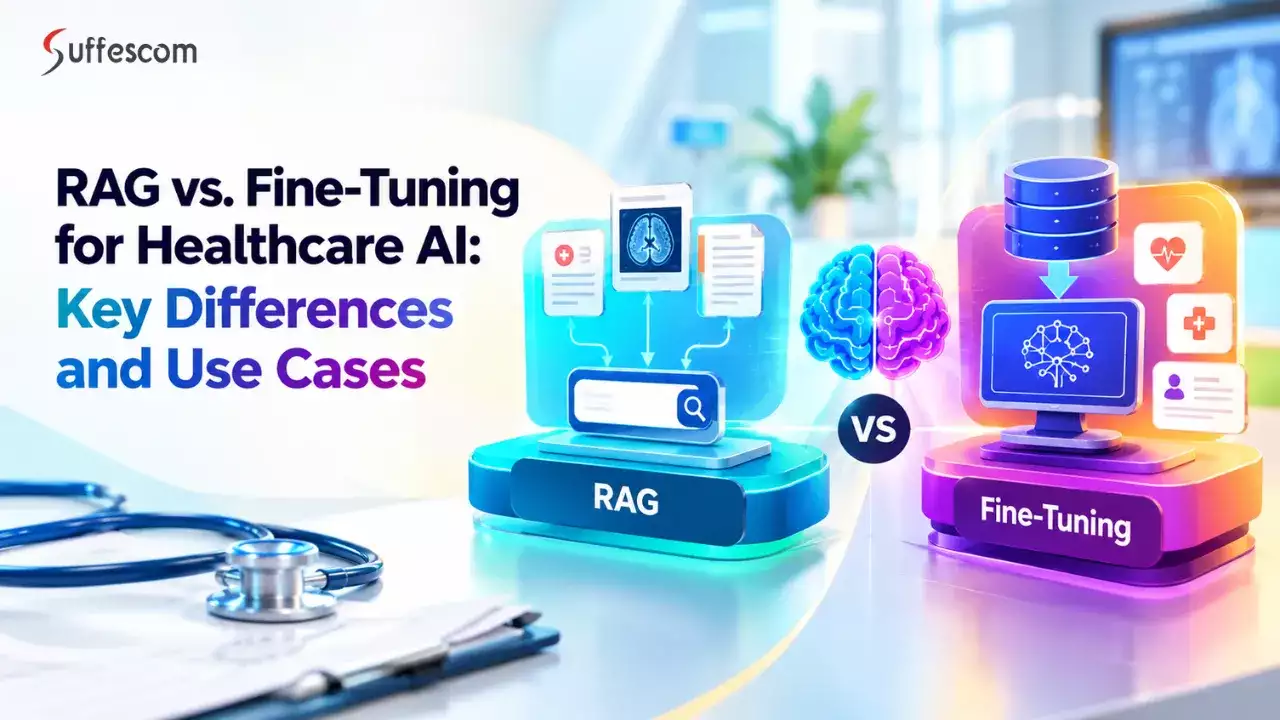
RAG and fine-tuning are not interchangeable techniques. RAG changes the information available to the model at response time, while fine-tuning changes the model's learned parameters to influence how it performs a task.
The comparison below highlights the main differences healthcare organisations should consider.
| Comparison factor | RAG | Fine-tuning |
| Primary purpose | Provides relevant external information at query time | Adapts model behaviour for a specific task |
| Medical knowledge | Retrieves information from connected sources | Learns patterns from training examples |
| Updating information | Update or re-index the knowledge source as needed | New training may be required to change learned behaviour or knowledge patterns |
| Data requirements | Searchable, relevant, authorised knowledge sources | Curated, representative training examples |
| Customisation | Customises retrieved context and instructions | Can customise response style, task behaviour, and output patterns |
| Traceability | Can expose retrieved source passages and references | Model outputs do not inherently provide traceable source evidence |
| Maintenance | Requires knowledge-source, retrieval, and index maintenance | Requires model evaluation, version management, and potentially retraining |
| Typical use cases | Guideline retrieval, record queries, evidence-grounded assistance | Classification, structured extraction, specialised response formats |
| Main risks | Poor retrieval, outdated sources, incorrect synthesis | Overfitting, biased examples, inconsistent generalisation, unsupported outputs |
Knowledge Access vs. Model Behaviour
RAG is generally useful when an application needs to consult information that exists outside the model, such as hospital policies, approved medical references, or patient-specific records.
Fine-tuning is useful when a model needs to learn a repeatable task or follow a specialised output pattern. It may help standardise how clinical text is processed, but it does not guarantee that the model will apply medical knowledge correctly.
For example, a hospital assistant that answers questions about changing institutional protocols may need RAG. A model that categorises incoming clinical documents into a fixed set of administrative categories may benefit from fine-tuning.
Updating Medical Information and Clinical Guidelines
Medical information changes over time, so teams need a reliable process for updating the knowledge used by an AI application.
With RAG, approved documents can be revised and re-indexed without necessarily retraining the language model. However, the system must still manage document versions, publication dates, source authority, and retrieval quality.
With fine-tuning, changing the model's learned behaviour or incorporating new examples may require another training cycle. Fine-tuning should not be treated as the preferred way to keep frequently changing clinical guidelines current.
Data Requirements and Preparation
RAG depends on the quality of the knowledge repository and the retrieval pipeline. Documents must be organised, indexed, permissioned, and retrievable in ways that preserve their meaning and context.
Fine-tuning depends on the quality and representativeness of training examples. Incorrect labels, inconsistent responses, or narrow datasets can teach the model undesirable patterns.
Both approaches require data governance. Healthcare organisations must establish appropriate rights and permissions for the data they use and ensure that sensitive patient information is handled according to applicable requirements.
Development Cost, Infrastructure, and Maintenance
RAG costs may include document processing, indexing, search infrastructure, model inference, source maintenance, and integration with healthcare systems.
Fine-tuning costs may include data preparation, expert annotation, training infrastructure, evaluation, model hosting, and future retraining. Parameter-efficient techniques may reduce training requirements for some projects.
The total cost depends on the model, dataset size, data complexity, infrastructure, usage volume, integration requirements, and validation effort. Neither approach is universally cheaper; the more cost-effective choice is the one that meets the requirements with acceptable reliability and ongoing operating costs.
Accuracy, Explainability, and Clinical Risk
RAG can make it easier to inspect the evidence used to generate an answer, but retrieved sources may be irrelevant, incomplete, outdated, or misinterpreted. A citation does not prove that the generated response accurately represents the source.
Fine-tuned models may perform consistently on a specialised task, but their outputs do not automatically reveal the evidence or reasoning behind a prediction or response. They may also fail when presented with data that differs from their training examples.
Healthcare teams should evaluate the actual task, including clinically significant errors, omissions, robustness, and performance across relevant patient populations. High-risk applications require safeguards proportionate to their intended use.
RAG vs. Fine-Tuning: Which Approach Fits Your Healthcare Use Case?
The right approach depends on what the system needs to accomplish. Start with the underlying requirement rather than choosing a technique simply because it is popular.
When to Choose RAG
Consider RAG when the application needs to retrieve and use relevant information from external sources at response time.
It may be suitable when:
- Medical guidelines, protocols, or organisational policies change regularly.
- Answers need to reference approved documents or knowledge repositories.
- The system needs authorised access to patient-specific records.
- Users need to inspect the source material supporting a generated answer.
- Updating the knowledge base independently of model training is important.
Example: A hospital wants to develop an AI assistant that answers staff questions using its approved clinical protocols. RAG allows the assistant to retrieve relevant sections from the current document repository and present them for staff review.
When to Choose Fine-Tuning
Consider fine-tuning when the main requirement is to improve performance on a defined task or make outputs more consistent.
It may be suitable when:
- The system needs to classify specialised clinical or administrative text.
- A consistent output schema is important.
- The task involves repeated transformations of similar document types.
- Representative, high-quality training examples are available.
- Performance can be evaluated against clearly defined acceptance criteria.
Example: A healthcare organisation wants to classify incoming clinical documents into predefined categories for administrative routing. A fine-tuned model can be trained on reviewed examples and tested for classification performance before deployment.
When to Combine RAG and Fine-Tuning
A hybrid approach may be useful when an application needs both reliable access to external knowledge and specialised model behaviour.
RAG can supply relevant clinical evidence, while fine-tuning can help the model follow a particular response format or perform a defined task more consistently. These capabilities can be combined within the same application.
Example: A clinical support assistant retrieves approved hospital protocols and then generates a structured summary using a model adapted to the organisation's preferred format. Clinicians can review the cited source material alongside the summary.
However, combining both approaches increases architectural complexity and introduces more components to evaluate and maintain. A hybrid system is justified when its measurable benefits outweigh that additional complexity—not simply because it uses more advanced technology.
Benefits of RAG and Fine-Tuning for Healthcare AI
RAG and fine-tuning improve healthcare AI in different ways. RAG strengthens how a system accesses and uses relevant information, while fine-tuning adapts a model to perform specific tasks more consistently. Understanding these benefits helps healthcare enterprises evaluate which approach aligns with their technical and operational requirements.
| Benefit | RAG | Fine-Tuning |
| Knowledge freshness | Incorporates updated information from connected sources without retraining the underlying model. | Requires additional training or adaptation when changes to model behaviour or learned patterns are needed; factual updates alone do not automatically require fine-tuning. |
| Source traceability | Can link generated responses to retrieved documents, making it easier to check supporting evidence. | Does not inherently provide document-level citations for information reflected in the model's learned parameters. |
| Task consistency | Improves responses by supplying relevant context, but output consistency still depends on the model and prompt design. | Can improve adherence to specialised task patterns, response structures, and output conventions when training data is representative. |
| Knowledge maintenance | Allows teams to update or remove information in the connected knowledge base without retraining the model, subject to indexing and caching processes. | Embeds learned patterns in model parameters, so changing those patterns may require another training cycle. |
| Adaptability to new information | Can make newly approved information available once it is added, indexed, and accessible to the retrieval system. | Is better suited to adapting model behaviour than serving as a live repository for frequently changing facts. |
| Control over information access | Can work with retrieval permissions and source-level access controls to limit which information is returned to each user. | Does not itself enforce access to individual records; separate application-level security controls are necessary. |
| Task-specific performance | Helps the model respond using relevant evidence but may not resolve weaknesses in the model's underlying task performance. | May improve performance on a defined task when high-quality examples and suitable evaluation results support the investment. |
Real-World Healthcare AI Scenarios: RAG vs. Fine-Tuning in Practice
The following scenarios illustrate how healthcare teams might select an architecture for different needs. They are implementation examples, not claims about named healthcare deployments or proven clinical outcomes.
Scenario 1: A Clinical Assistant That Answers Questions Using Hospital Protocols
Requirement: Clinicians need a convenient way to locate approved hospital guidance without manually searching lengthy documents.
Recommended approach: RAG.
The application indexes authorised protocols, retrieves relevant passages for each query, and generates a response that references the source documents. The knowledge repository must be maintained so superseded guidance is not inadvertently presented as current.
Why it fits: The main requirement is access to changing, organisation-specific information rather than teaching a model to memorise every protocol.
Scenario 2: An AI System That Extracts Information From Clinical Notes
Requirement: A healthcare organisation wants to identify specific information in clinical documents and return it in a consistent structured format.
Recommended approach: Fine-tuning may be appropriate if a suitable base model struggles with the task and reliable labelled examples are available.
The model can be trained to identify target fields and produce the required output structure. Evaluation should measure extraction accuracy, omissions, incorrect values, and performance on different document types.
Why it fits: The primary challenge is consistent task execution rather than retrieving changing medical knowledge. Depending on the task, a conventional extraction model or a well-prompted LLM may also be sufficient without fine-tuning.
Scenario 3: A Healthcare Support Assistant That Needs Reliable Knowledge and Consistent Responses
Requirement: A healthcare organisation wants an assistant that answers operational questions using approved information while following a standard response structure.
Recommended approach: Start with RAG and evaluate whether fine-tuning adds measurable value.
The retrieval system supplies relevant policy documents or approved reference material. If the model continues to struggle with the required output format or specialised task behaviour, fine-tuning may help address that limitation.
Why it fits: The application has two distinct requirements: access to the right information and consistent processing of that information. The architecture should address each requirement with the simplest effective method.
How to Implement RAG or Fine-Tuning in Healthcare
Successful implementation starts with the clinical or operational problem, not the choice of model adaptation technique. The following process helps healthcare organisations evaluate the options systematically.
Step 1: Define the Clinical or Operational Objective
Identify the task the application must perform, its intended users, and the consequences of an incorrect output. Define measurable success criteria, such as retrieval relevance, extraction accuracy, time required to complete a task, or clinician acceptance.
The evaluation criteria should reflect the actual use case rather than general language-model performance alone.
Step 2: Assess Data Quality, Access, and Readiness
Determine which clinical documents, patient records, training examples, or reference sources are needed. Assess completeness, consistency, permissions, data quality, and the effort required to prepare the information.
For RAG, evaluate whether the knowledge sources can be indexed and kept current. For fine-tuning, determine whether sufficient representative examples and reliable labels are available.
Step 3: Select the Model and Adaptation Approach
Compare RAG, fine-tuning, prompt engineering, conventional machine-learning approaches, and hybrid architectures as appropriate.
Use RAG when the main need is access to external knowledge. Consider fine-tuning when the task requires specialised behaviour that prompting alone does not deliver reliably. Combine methods only when the requirements justify the additional complexity.
Step 4: Build the Retrieval Pipeline or Prepare Fine-Tuning Data
For RAG, prepare and index approved documents, configure retrieval, apply access controls, and test whether the system returns the right evidence for representative queries.
For fine-tuning, prepare training examples, review labels, remove inappropriate or duplicated data, and establish separate evaluation datasets. Maintain clear dataset versions and document the training process.
Step 5: Integrate With Healthcare Systems and Workflows
Connect the application to authorised systems and present outputs in a way that suits the intended users. Integration may involve EHRs, document repositories, internal knowledge platforms, or other healthcare applications.
Apply access controls, audit logging, and appropriate safeguards. For patient-specific systems, verify that data retrieval respects permissions and that the application handles missing or conflicting information safely.
Step 6: Evaluate Performance, Safety, and Clinical Relevance
Test the system against representative scenarios, including difficult queries, ambiguous records, incomplete inputs, and cases where the correct response is to acknowledge uncertainty.
For RAG, assess retrieval relevance, source accuracy, and whether generated responses faithfully represent retrieved evidence. For fine-tuning, evaluate task accuracy, generalisation, output consistency, and performance on data not used during training.
Involve relevant healthcare professionals in reviewing clinically significant outputs. The scope of validation should match the system's intended use and potential risk.
Step 7: Deploy, Monitor, and Improve the System
Begin with a controlled rollout appropriate to the use case. Train users, collect feedback, and monitor errors, system reliability, and workflow impact.
RAG systems need ongoing checks for source freshness, retrieval quality, and access permissions. Fine-tuned systems need model-version management, performance monitoring, and reassessment when tasks or input data change. Both require a documented process for investigating failures and approving updates.
Challenges of Using RAG and Fine-Tuning in Healthcare—and How to Address Them
Both approaches can improve the usefulness of healthcare AI, but neither eliminates the risks associated with language models or sensitive clinical information.
1. Outdated, Incomplete, or Conflicting Medical Information
Challenge: A RAG system may retrieve outdated documents or fail to identify the most relevant source. Fine-tuning data may also contain outdated recommendations or inconsistent examples.
How to address it: Establish approved source lists, document version controls, regular reviews, and clear ownership of clinical content. Use appropriate metadata and retrieval filters, and evaluate whether the system selects authoritative information when sources conflict.
2. Hallucinations and Unsupported Responses
Challenge: A model may add details that are absent from the retrieved material or generate incorrect information despite receiving relevant context.
How to address it: Test outputs against trusted references, require source-grounded responses where appropriate, and define how the application handles insufficient evidence. Do not assume that RAG citations guarantee correctness or that fine-tuning eliminates hallucinations.
3. Patient Data Privacy and Security
Challenge: Both architectures may involve sensitive clinical data. Risks can arise through retrieval permissions, training datasets, logs, model providers, or poorly configured integrations.
How to address it: Apply data minimisation, appropriate encryption and access controls, secure logging, and clear retention policies. Review how any third-party model provider processes data and ensure that data use complies with applicable requirements. Fine-tuning datasets require particular care because sensitive information may be incorporated into training data.
4. Bias, Reliability, and Clinical Validation
Challenge: Models may perform inconsistently across patient populations, clinical settings, document types, or unfamiliar scenarios. Fine-tuning can reinforce patterns in unrepresentative data, while RAG can retrieve evidence that is not appropriate for the patient or question.
How to address it: Evaluate representative cases, measure important errors and omissions, and test performance across relevant groups. Include clinical review, document known limitations, and monitor deployed systems for unexpected changes.
5. Ongoing Model and Knowledge Maintenance
Challenge: A system that performs well during initial testing may become less reliable as clinical protocols, data sources, workflows, or user needs change.
How to address it: Assign ownership for source updates, model changes, evaluation, and approval. Maintain version histories, repeat testing after significant changes, and establish a rollback process if performance deteriorates.
Healthcare organisations should also assess applicable privacy, security, and regulatory requirements according to the system's location, intended purpose, and functionality. The appropriate controls depend on the specific application rather than the use of RAG or fine-tuning alone.
How Much Does It Cost to Implement RAG vs. Fine-Tuning for Healthcare?
The cost of implementing RAG or fine-tuning for healthcare AI depends on the application's complexity, data readiness, model requirements, integration scope, and validation needs. A RAG solution may require more investment in document processing and retrieval infrastructure, while fine-tuning may require additional spending on training data, model experimentation, and evaluation.
Actual costs vary significantly based on the scope of the project, the sensitivity of the data, and the intended clinical use.
| Cost factor | RAG implementation | Fine-tuning implementation |
| Initial development | $15,000–$40,000 for a focused implementation | $20,000–$50,000 for a focused implementation |
| Mid-complexity solution | $40,000–$100,000 | $50,000–$120,000 |
| Complex healthcare platform | $100,000–$250,000+ | $120,000–$300,000+ |
| Primary cost drivers | Document ingestion, retrieval, indexing, integrations, and source maintenance | Training data, annotation, model adaptation, experimentation, and evaluation |
| Ongoing expenses | Model inference, retrieval infrastructure, document updates, and monitoring | Model hosting, inference, performance monitoring, and potential retraining |
These ranges are broad budgeting guides for custom development. They are not directly comparable without defining the same scope, integrations, security controls, and evaluation requirements for both approaches.
The Hidden Costs
The initial development budget does not represent the full cost of ownership. Healthcare AI projects can incur additional expenses during data preparation, integration, validation, deployment, and ongoing maintenance.
1. Healthcare Data Preparation and Expert Review
Clinical documents may contain inconsistent terminology, outdated protocols, duplicate records, or incomplete information. RAG projects may require document cleaning, metadata tagging, indexing, and source verification. Fine-tuning projects may require clinical experts to annotate examples and review training labels.
2. EHR Integration and Interoperability
Connecting the AI application to EHRs, laboratory systems, hospital knowledge repositories, or other clinical platforms can increase development costs. The effort depends on available APIs, interoperability standards, legacy infrastructure, and access-control requirements.
3. Clinical Validation and Safety Testing
Testing must go beyond whether an answer sounds convincing. RAG systems need evaluation of retrieval relevance and source-grounded responses, while fine-tuned models require task-specific performance testing. Both may need clinical expert review, error analysis, and additional testing for high-risk scenarios.
4. Privacy, Security, and Compliance
Healthcare organisations may need additional investment in encryption, access management, audit logging, secure deployment, data-retention controls, and regulatory assessments. Requirements depend on the deployment market, the data being processed, and the system's intended purpose.
5. Infrastructure and Model Usage
Ongoing expenses may include model API usage, GPU infrastructure, storage, vector databases, search services, monitoring, and backup systems. Costs depend on request volume, response length, model selection, and whether the solution uses managed services or self-hosted infrastructure.
6. Maintenance and Updates
RAG systems need their knowledge sources reviewed and updated, with retrieval quality checked as content changes. Fine-tuned models may require additional training and evaluation when task requirements, data patterns, or performance expectations change. Both approaches need version management and a process for investigating failures.
7. User Training and Workflow Changes
Clinician training, workflow redesign, support, and user feedback can add costs that are easy to overlook during initial planning. These activities matter because a technically functional system may deliver limited value if users cannot incorporate it effectively into their work.
Making the Right Decision for Enterprises
Choosing between RAG and fine-tuning starts with identifying what the healthcare AI application needs to achieve. Enterprise decision-makers should evaluate information requirements, expected outputs, available data, integration needs, and operational constraints before selecting an architecture.
Choose RAG When Access to Reliable, Up-to-Date Information Is Essential
RAG is a strong candidate when an application needs to retrieve information from approved sources that change over time.
Consider RAG if your healthcare AI solution needs to:
- Answer questions using current clinical guidelines, hospital protocols, or internal policies.
- Retrieve authorised information from electronic health records (EHRs) and clinical documents.
- Provide source references so users can verify generated answers.
- Update its knowledge base without retraining the language model whenever source information changes.
- Search across multiple approved document repositories while respecting access permissions.
Choose Fine-Tuning When Specialised Task Performance Is the Priority
Fine-tuning may be appropriate when an application needs to perform a specialised, repeatable task and suitable training examples are available.
Consider fine-tuning if your healthcare AI solution needs to:
- Classify clinical documents into predefined categories.
- Extract specific fields or medical entities from clinical notes.
- Generate structured summaries or follow a consistent response format.
- Handle healthcare-specific terminology and task patterns more reliably.
- Improve performance on a well-defined task when prompting alone does not meet the required standard.
Consider a Hybrid Architecture When Both Requirements Matter
Some enterprise healthcare applications need access to reliable medical information and consistent task-specific outputs. In these cases, combining RAG with fine-tuning may be worth evaluating.
For example, an AI-powered clinical documentation assistant might retrieve relevant information from authorised records and generate summaries in a standard format. RAG can supply the relevant context, while fine-tuning may help standardise the output if testing demonstrates a meaningful improvement.
A hybrid architecture is not automatically the best option. Enterprises should begin with the simplest approach that meets their requirements, establish measurable performance benchmarks, and add further components only when they address a demonstrated limitation.
Questions to Answer Before Making the Investment
Before finalising the architecture, healthcare decision-makers should ask:
- Does the application need access to current information, specialised task behaviour, or both?
- Are the required medical documents and training examples accurate, available, and authorised for use?
- How will the system's accuracy, reliability, and outputs be evaluated for the intended use case?
- What data privacy, security, EHR integration, and clinical oversight requirements apply?
- What are the expected development, infrastructure, validation, monitoring, and maintenance costs?
- Can the selected architecture scale as data volumes, users, and healthcare workflows expand?
Answering these questions helps enterprises define a realistic project scope, manage implementation risks, and avoid unnecessary model complexity. The final choice should be based on the application's requirements, validation results, and total cost of ownership—not on the assumption that a more complex AI architecture will always deliver better results.
How Suffescom Uses a Hybrid Approach for AI Healthcare Solutions
At Suffescom, healthcare solutions can be designed around the specific information requirements, workflows, and performance goals of each project. When an application needs both access to trusted medical knowledge and consistent task-specific outputs, a hybrid architecture combining RAG development services and fine-tuning may be worth evaluating.
RAG enables an AI application to retrieve relevant information from approved sources, such as clinical guidelines, institutional protocols, and authorised healthcare documents. Fine-tuning can adapt the model to specialised tasks, including structured summarisation, consistent response formatting, or healthcare-specific text processing.
For example, a healthcare organisation planning an AI-powered clinical assistant may need to retrieve relevant information from approved medical resources and present it in a standardised format for clinician review. RAG can provide the supporting context, while fine-tuning may help improve output consistency if testing shows that the base model does not meet the required standard.
A hybrid implementation may include:
- Healthcare knowledge integration: Connecting the application to authorised and maintained medical information sources.
- Context-aware retrieval: Finding relevant information for each query while respecting data-access permissions.
- Task-specific response generation: Structuring outputs to match the intended healthcare workflow.
- Validation and clinician review: Evaluating generated responses against trusted sources and enabling appropriate human oversight.
- Performance monitoring: Tracking output quality, retrieval relevance, reliability, and maintenance requirements after deployment.
Suffescom's generative AI development approach for healthcare should begin with the project's actual requirements rather than assuming that every application needs both techniques. Where RAG alone or fine-tuning alone meets the requirements, a simpler architecture may be more practical. A hybrid solution is worth considering when it offers measurable benefits that justify its additional development and maintenance costs.
Frequently Asked Questions
Is RAG better than fine-tuning for healthcare AI?
Neither approach is universally better. RAG is generally useful when an application needs access to external, frequently updated medical information. Fine-tuning may be more suitable when the goal is to adapt a model to a specific task, output format, or domain-specific behaviour. The best choice depends on the application's requirements and evaluation results.
Can RAG and fine-tuning be used together?
Yes. A healthcare AI application can use a fine-tuned model to improve task-specific behaviour while using RAG to retrieve relevant medical information at response time. A hybrid approach is useful when both requirements are important, provided the added complexity is justified.
Does fine-tuning make an LLM more medically accurate?
Not automatically. Fine-tuning may improve performance on a particular task when the training examples are suitable, but it can also reinforce errors or reduce performance on unfamiliar inputs. Medical accuracy must be evaluated using appropriate test cases and expert review.
Is RAG more suitable for healthcare data that changes frequently?
RAG can be advantageous when information needs to be updated independently of model training. Approved documents can be revised and re-indexed, although the system must still retrieve and interpret them correctly. Updates should be governed and tested, especially when the content affects clinical decisions.
Which approach is more cost-effective for healthcare AI?
Cost-effectiveness depends on data preparation, infrastructure, integration, evaluation, usage volume, and ongoing maintenance. RAG may be more economical when the main requirement is access to changing information. Fine-tuning may be worthwhile when it measurably improves a specialised task. Compare the total lifecycle cost rather than training cost alone.
Are RAG and fine-tuning enough to make healthcare AI clinically safe?
No. Neither technique guarantees clinical safety. Healthcare AI requires appropriate validation, data governance, privacy and security controls, human oversight, and ongoing monitoring. The safeguards must reflect the intended use and the potential consequences of incorrect outputs.