Modern Patient Portal Development With EHR Integration for a Multi-Specialty Healthcare Provider

This case study outlines how a leading healthcare provider replaced its low-adoption, limited-functionality portal with a modern, mobile-first digital experience. By implementing FHIR-based APIs, bi-directional EHR synchronization, and a patient-centric interface, we enabled real-time data exchange, automated administrative workflows, and secure patient-provider communication to improve clinical efficiency and patient satisfaction.

Project Overview

The client is a multi-specialty outpatient provider group operating multiple clinic locations. Their existing patient portal was an add-on module from their EHR vendor—rigid, poorly adopted, and unable to handle the group's growing patient volume. Patients couldn't self-schedule, update demographics, or complete forms digitally. Clinicians lacked visibility into patient-reported data until the encounter began. Administrative teams manually processed pre-visit documentation, leading to bottlenecks and delays.

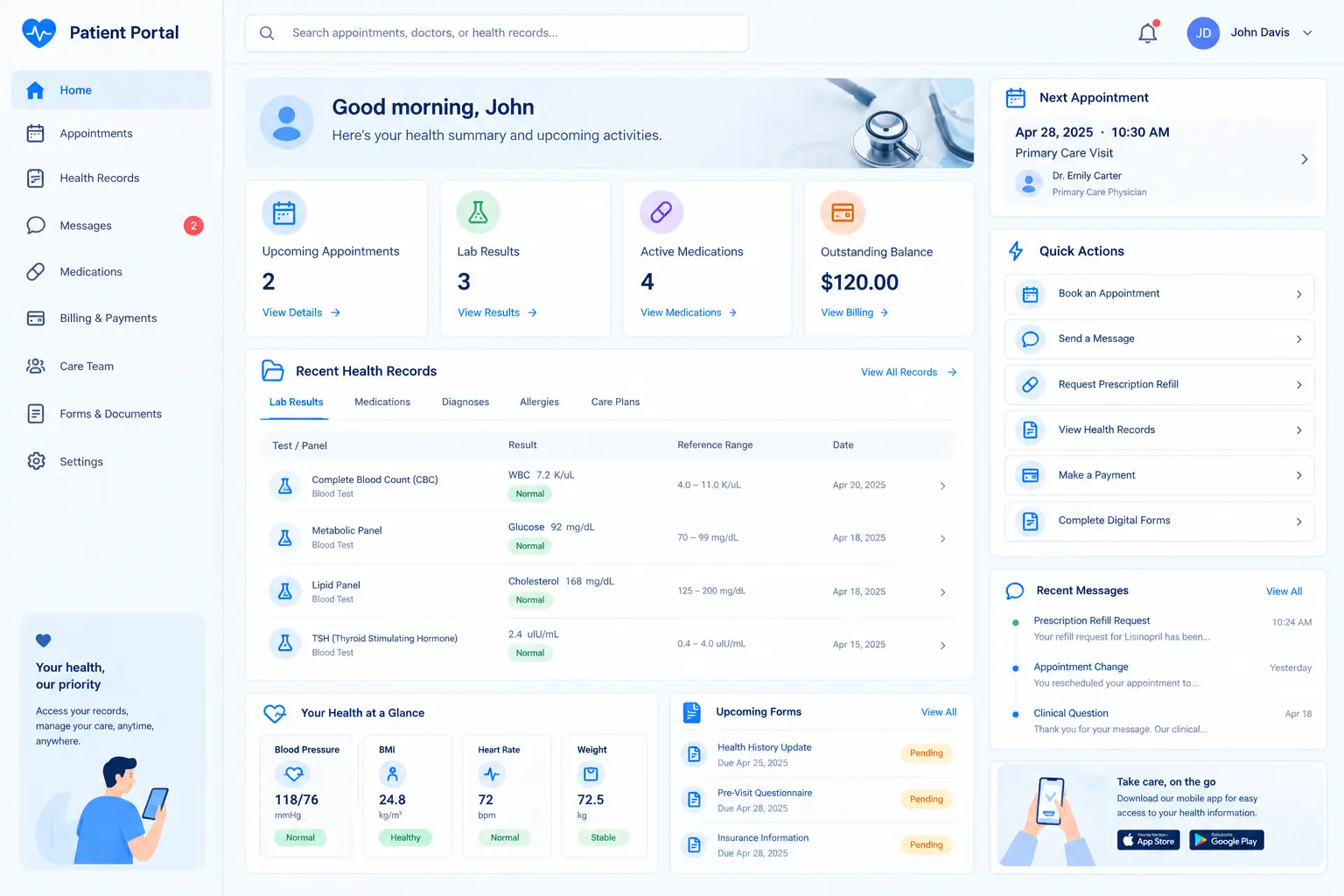
To address this, we decoupled the patient experience from the EHR and built a dedicated engagement layer. Using FHIR R4 APIs and HL7 v2.x, we connected the new portal directly to the existing EHR system, enabling real-time, bi-directional synchronization. The solution unified scheduling, secure messaging, digital intake, records access, and online payments into a single mobile-first experience, while ensuring all patient actions flowed back to the EHR without manual intervention.
Challenges -Modern Patient Portal Development With EHR Integration

Challenges

Challenges - Multi-Specialty Healthcare Provider
  • Low Patient Portal Adoption

    The portal offered basic functionality, leading to continued reliance on phone-based support for scheduling, messaging, and billing. Adoption remained below 20%.

  • Fragmented Patient Identity

    Patient data existed across disconnected systems. Duplicate records were common, requiring hours of manual reconciliation by staff.

  • Incomplete Clinical Data Display

    The portal displayed only a fraction of EHR data. Lab results, historical diagnoses, and care plan details were missing, causing patient confusion and clarification calls.

  • Limited Mobile Accessibility

    The portal was not mobile-optimized, making it difficult for patients to access information or manage appointments on the go. Rural patients with limited connectivity could not use it effectively.

  • No Bi-Directional Synchronization

    Patient actions like appointment bookings and form submissions did not flow back to the EHR. Staff manually entered patient-reported data, increasing administrative burden and error risk.

  • EHR-Disconnected Messaging

    Messages arrived in generic inboxes without context, requiring manual triage. Staff switched between systems to respond, with no structured routing for prescription refills or clinical questions, increasing response times and errors.

Solution Delivered

Unified Patient Self-Service Portal

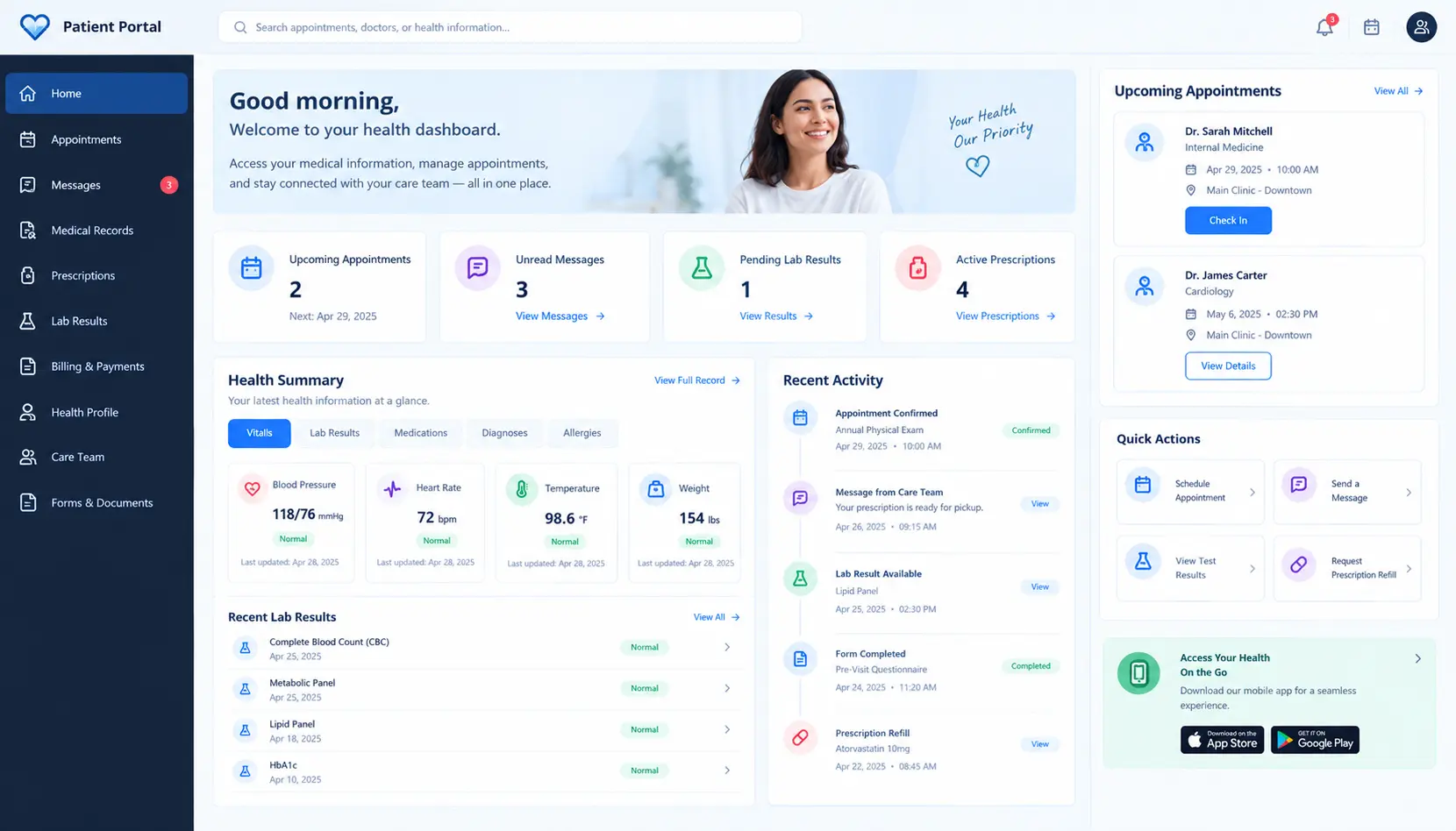
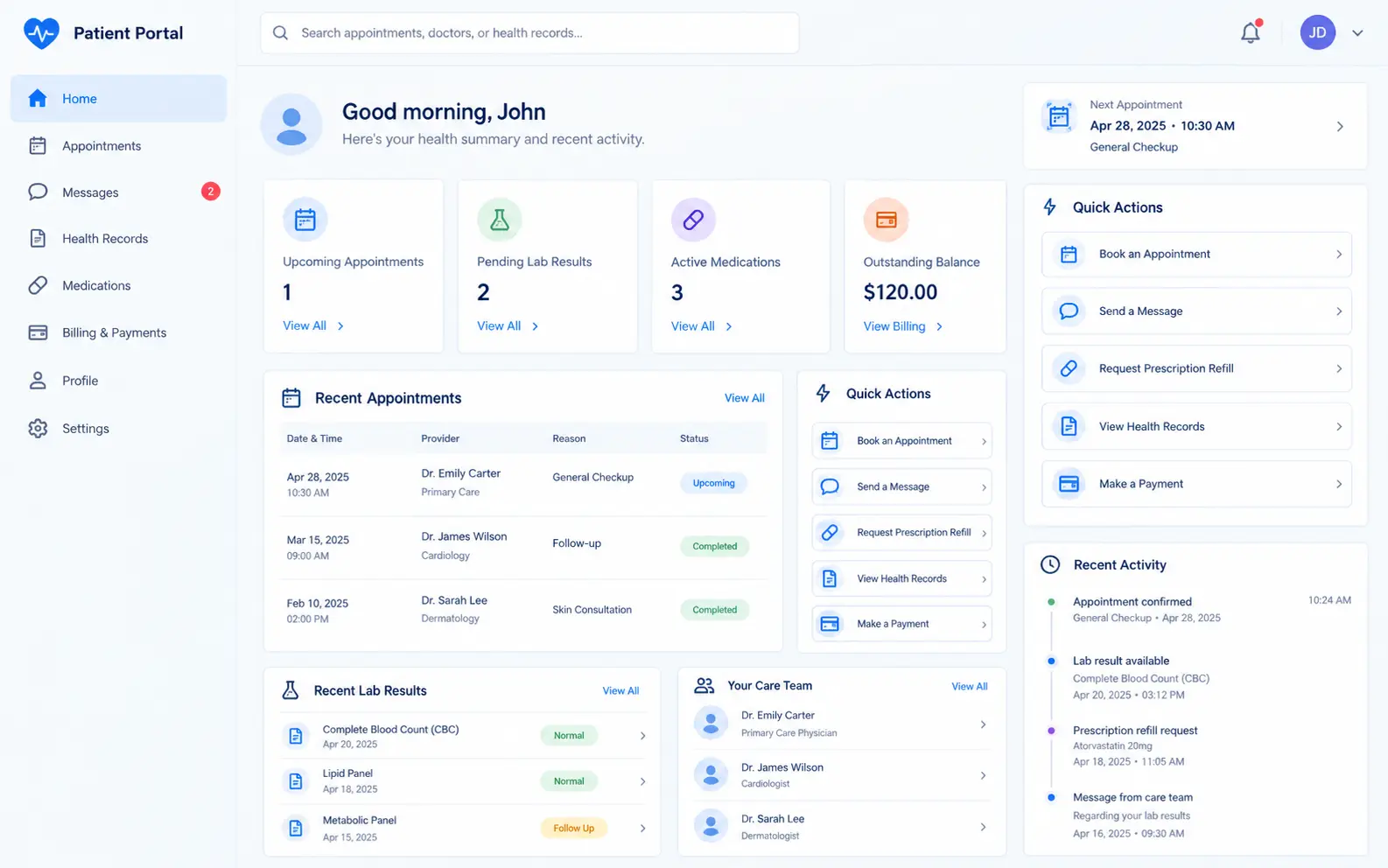
Consolidated scheduling, messaging, records, digital intake, and payments into one interface, reducing reliance on phone-based support.

FHIR-Based EHR Integration

Implemented FHIR R4 APIs and HL7 v2.x for bi-directional data exchange, ensuring real-time, accurate patient-facing information.

Real-Time Data Synchronization

Patient actions (appointments, forms, symptom updates) automatically flow back to the EHR, This eliminated duplicate data entry, reduced errors, and freed staff for higher-value tasks.

Mobile-First Accessibility

We delivered responsive web and native mobile applications for iOS and Android, providing a consistent experience across smartphones, tablets, and desktops. Patients can now manage appointments and complete pre-visit tasks from anywhere.

EHR-Integrated Messaging

Structured message types (prescription refill, appointment change, clinical question) auto-route to care teams with patient context, reducing response times. We integrated the messaging system with the EHR's clinical modules via HL7 v2.x and REST APIs

Unified Patient Identity Resolution

Implemented demographic matching to eliminate duplicate records, ensuring accurate health information.

Comprehensive Clinical Data Aggregation

Integrated EHR and external lab systems via FHIR APIs to display complete records (lab results, diagnoses, medications, allergies, care plans) in a unified view..

Solution Delivered

Outcomes

The patient engagement platform delivered measurable improvements across adoption, efficiency, and data accuracy:

85% patient adoption

within the first month after go-live.

32% reduction in routine

administrative call volume

25% improvement in

patient portal engagement

Manual data entry reduced with

real-time EHR sync, cutting administrative burden

Secure messaging response times

improved with automated routing to care teams.

HIPAA-compliant architecture with

OAuth 2.0, RBAC, SSO, and encrypted data transmission

Technology Stack

  • Frontend:React.js for web, React Native for iOS/Android
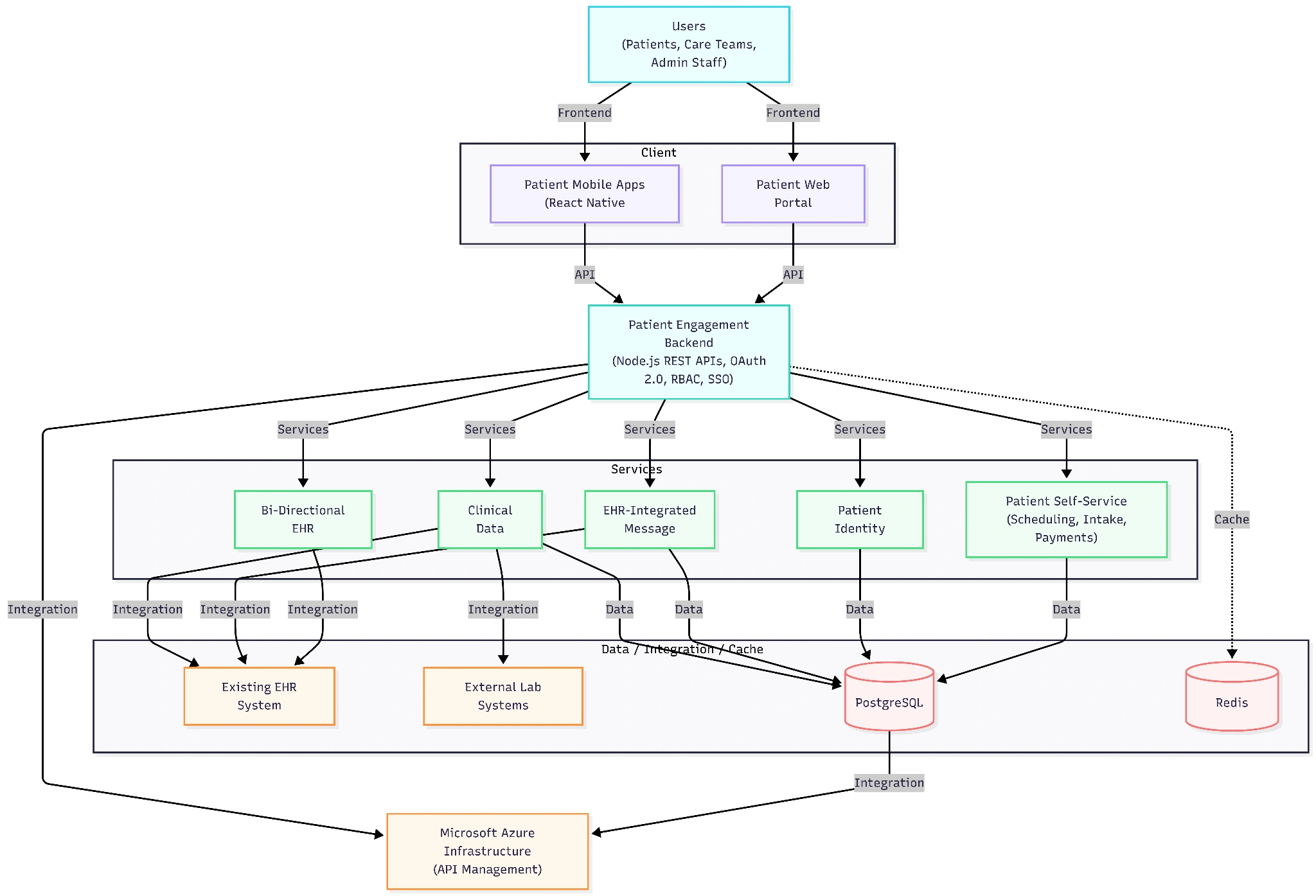
  • Backend:Node.js with RESTful APIs
  • Integration: FHIR R4 APIs, HL7 v2.x messaging, SMART on FHIR
  • Cloud Infrastructure: Microsoft Azure with API Management
  • Data Management: PostgreSQL, Redis caching
  • Security:OAuth 2.0, Role-Based Access Control (RBAC), Single Sign-On (SSO)
  • Compliance:HIPAA, GDPR
Legacy Patient Portal Modernization Architecture
×

Key Capabilities of Delivered Solution

  • Unified Patient Self-Service

    Unified Patient Self-Service

    Consolidated appointment scheduling, secure messaging, medical records, intake forms, and online payments into a single intuitive interface.

  • Real-Time EHR Synchronization

    Real-Time EHR Synchronization

    Bi-directional data exchange via FHIR APIs ensures patient actions are automatically reflected in the EHR, reducing manual data entry and errors.

  • Mobile-First Accessibility

    Mobile-First Accessibility

    Responsive web and native mobile applications provide a consistent experience across all devices, driving patient adoption.

  • Automated Clinical Workflows

    Automated Clinical Workflows

    AI-driven intake, automated appointment reminders, and intelligent message routing reduce administrative workload and improve care coordination.

  • Unified Patient Identity Management

    Unified Patient Identity Management

    Demographic matching eliminates duplicate patient records and keeps patient information consistent across connected systems.

  • Intelligent Message Routing

    Intelligent Message Routing

    Demographic matching eliminates duplicate patient records and keeps patient information consistent across connected systems.

Conclusion

The Patient Portal with EHR Integration project demonstrates how a modern, API-first patient engagement platform can transform the patient experience while reducing administrative workload. By implementing FHIR-based integration, bi-directional data synchronization, and a mobile-first interface, we helped the healthcare provider achieve 85% patient adoption, reduce administrative calls by 32%, and improve clinical efficiency. The solution achieved HIPAA compliance while creating a connected digital healthcare experience that patients trust and use.

Beware of Scams

Don't Get Lost in a Crowd by Clicking X

Your App is Just a Click Away!

Fret Not! We have Something to Offer.