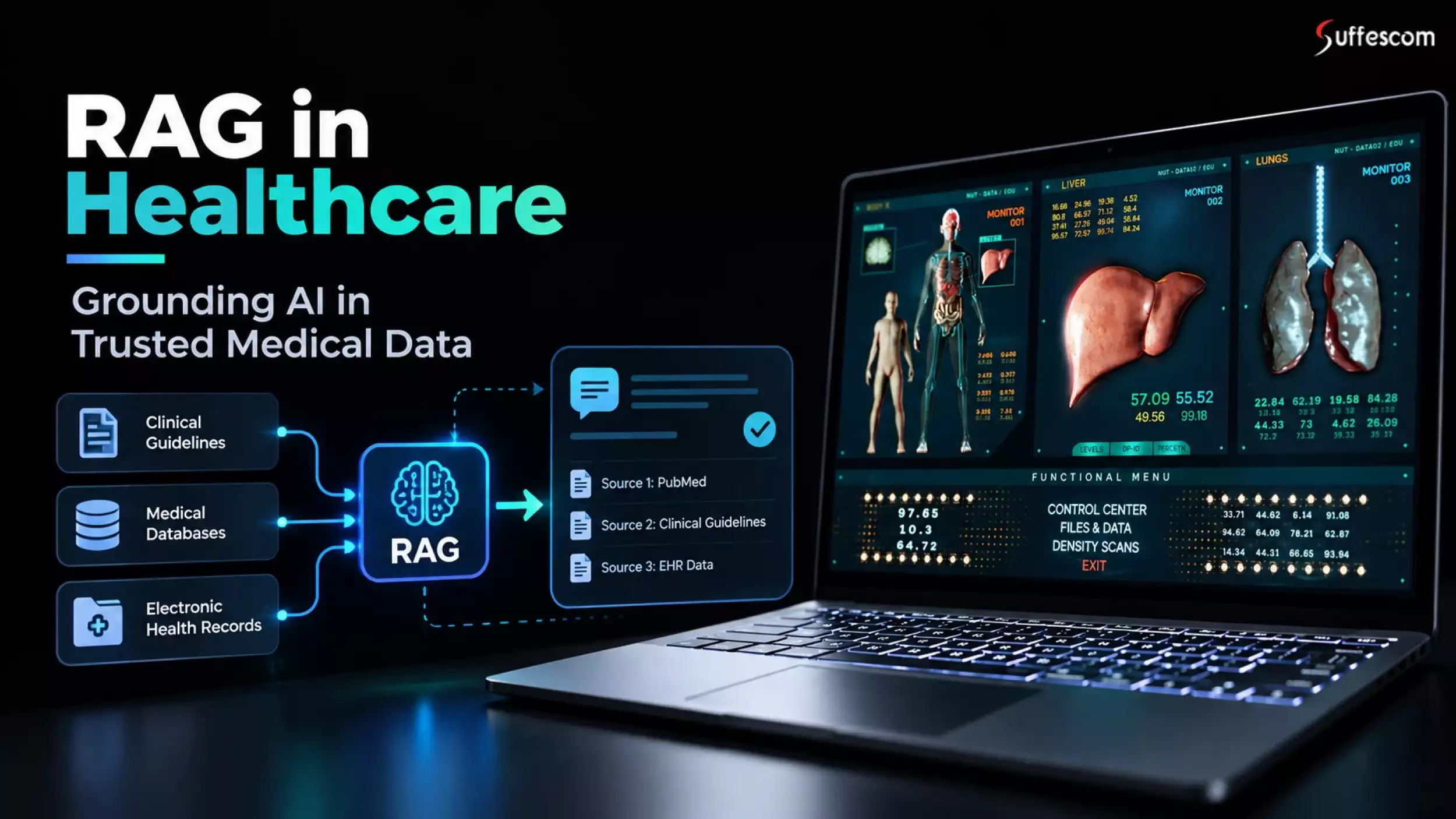
A large volume of data is generated from health care organizations like EHRs, discharge sheets, clinical practice guidelines, health care literature, and insurance claims. However, obtaining this type of data is not an easy task due to different sources of data, outdated data, and less connectivity, which may impair decision-making and add more administrative burden.
Thus, the retrieval-augmented generation (RAG) method could prove itself as a solution to the problem mentioned above, as it connects the LLM to the right sources of data. Therefore, besides the knowledge acquired during training, RAG will look for evidence before producing the response.
Still, effective healthcare RAG involves not just LLMs and vector databases but also reliable information search, up-to-date data, consideration of the context, access management, citation of the sources used, and clinical control.
This article covers all important aspects of using RAG in the field of healthcare: when and where it might be useful, the structure of RAG, and other issues organizations should be aware of prior to implementation.
What Is RAG in Healthcare?
RAG is a combination of information retrieval and an LLM for producing outputs that are informed by external sources. In health care, those sources may be approved clinical guidelines, internal protocols of the hospital, literature, and even authorized patient records.
For instance, a health care worker who is going to conduct a follow-up consultation could rely on a RAG assistant that will find diagnoses, lab tests, drugs, and discharge letters from the previous consultation. All of these pieces of information could be compiled into a summary with references to the documents.
In contrast to the independent LLM, a RAG assistant has access to information that was updated after the training of the LLM. This assistant could refer to information that is unique to the particular organization.
How Does RAG Make Healthcare AI More Useful?
RAG (Retrieval-Augmented Generation) gives access to relevant data for AI assistants as necessary. As an example, in medicine, RAG will assist healthcare professionals in looking up treatment guidelines, summarizing patient charts, and conducting a literature review.
The main advantages are:
- Relevant Data Access: The AI pulls the relevant guidelines and documents rather than utilizing pre-trained knowledge.
- Contextual Information: The AI integrates general medical information along with personal data of a patient when permitted.
- Data Verification: It is easier to verify information because the AI's response may be accompanied by sources.
However, there is no assurance that RAG will be able to give accurate information if the extracted documentation turns out to be inaccurate or incomplete. In this case, it is advisable to have accurate data, authorization, and verification by humans before making any crucial decision.
How Does RAG Work in Healthcare?
We can illustrate the process by taking an example; a doctor wants to know about the recent laboratory results of the patient and his medication history.
- Understanding the Query: Find out if the query involves patient records, clinical guidelines, research, or policy.
- Information Retrieval: Obtain information from the official source through semantic or keyword search.
- Rank and Filter the Information: Rank relevant, updated, and authoritative documents, taking into account access control and patients' conditions.
- Response Generation: Generate a response based on the chosen document.
- Validation and Citation: Associate the claim with the sources, and find out if there are missing, contradictory, or incomplete sources.
This is not about doing everything for the AI. On the contrary, it is about assisting health care providers to access and make use of relevant information effectively, at the same time ensuring that all decisions are based on evidence and proper clinical judgment.
RAG vs. Traditional Healthcare Chatbots vs. Standalone LLMs
Not every healthcare AI application needs RAG. While an ordinary chatbot is enough to address FAQs, a separate LLM would be able to answer more generalized queries, offer summaries of data, and create content. However, when the responses need to incorporate contemporary medical advice, hospital guidelines, or even patient history, the type of technology used matters more.
The following is a comparison of the three technologies.
| Capability | Traditional healthcare chatbot | Standalone LLM | Healthcare RAG system |
| How it responds | Generates answers using its learned knowledge and the supplied prompt | Generates answers using its learned knowledge and the supplied prompt | Retrieves relevant information before generating an answer |
| Access to updated information | Requires manually updated rules or content | Depends on the model and any connected tools | Can use updated source material when the knowledge base is refreshed |
| Patient-specific context | Limited to configured workflows and integrations | Only if relevant data is supplied through an authorized workflow | Can retrieve authorized patient information when integrated with clinical systems |
| Patient-specific context | Can link to predefined resources | May not provide verifiable supporting sources | Can provide citations to retrieved documents when properly implemented |
| Best suited for | Appointment FAQs, reminders, and structured intake | Drafting, summarization, and general-purpose assistance | Clinical knowledge retrieval, internal policy search, and evidence-based summaries |
| Main limitation | Struggles with unexpected or complex questions | May produce unsupported claims or outdated information | Can retrieve irrelevant or incomplete evidence and still generate incorrect answers |
RAG vs. Fine-Tuning: Which Approach Is Better for Healthcare?
RAG and fine-tuning address different needs in AI. RAG helps the model have access to fresh information, whereas fine-tuning uses certain examples to tune the model’s output. In the context of healthcare, RAG can be useful for companies that often change their guidelines, as it will update the information base without further training. Fine-tuning would be more effective for creating clinical summaries in a specific format by training on representative examples.
Here's how they differ.
| Consideration | RAG | Fine-tuning |
| Primary purpose | Ground responses in retrieved information | Adapt model behavior to a particular task, style, or domain |
| Updating medical knowledge | Update the connected knowledge sources and retrieval index | Usually requires another training or adaptation cycle to incorporate newly learned patterns |
| Source traceability | Does not inherently provide source citations | Does not inherently provide source citations |
| Domain-specific output | Uses retrieved context and instructions to guide responses | Can learn preferred terminology, formats, and task-specific patterns |
| Data requirements | A well-organized, permission-controlled knowledge base | Suitable training examples and a carefully designed training process |
| Ongoing effort | Maintain sources, retrieval quality, and indexing | Manage training data, model versions, retraining, and evaluation |
| Common healthcare applications | Guideline retrieval, medical literature search, internal knowledge assistants | Structured report generation, narrow classification, and consistent task-specific outputs |
How Does RAG Architecture Work in Healthcare Systems?
A healthcare RAG system does more than connect an AI model to medical documents. It should be in a position to collect data from various sources, analyze it, get the information needed, and finally use the collected information to create a response.
For instance, when a physician requires a summary of the patient's medical history, the information retrieval will require extracting the information from the clinical notes, laboratory reports, medications, and other guidelines. Various components of the RAG framework will help in making sure that the information collected is relevant.
Data Ingestion and Preprocessing
The data will be harvested from the right places, such as EHR systems, laboratories, guidelines, research repositories, and hospital policies. The structured data shall be collected through the APIs, while the unstructured data will be collected from the PDF files.
Preprocessing will involve the normalization of the data format, preserving its clinical significance, and at the same time attaching metadata such as the source, date, specialty, version, and access rights.
Chunking and indexing
Documents are broken down into searchable pieces or chunks. When it comes to healthcare, the chunking process has to maintain context; a laboratory finding has to stay attached to its date and unit, and a drug needs its dosing and status information.
Text embeddings turn text data into numerical representations for conducting semantic search. These numerical representations are kept in a vector index or database.
Hybrid retrieval and reranking
Semantic search is effective at finding relevant text that has similar meaning, whereas keyword search will be effective for accurate medication names and codes. A hybrid of both approaches may be used where necessary.
Re-ranking of results becomes possible at this point to ensure the top results are retrieved. Re-ranking needs to consider factors such as source, authority, and recency.
LLM-based response generation
The system supplies the selected evidence and the user's question to the LLM. The model generates a summary or answer based on that context and the application's instructions.
The system should avoid treating absent information as fact and should not present an inference as a confirmed clinical finding.
Citations, validation, and abstention
Responses should identify their supporting sources and, where possible, link to the relevant passage or document version. Validation should check whether citations actually support the claims being made.
In cases where there is no evidence, disputable evidence, or evidence that falls outside the domain of the system, then the application of integration must seek clarification, stay silent, or bring the issue up for human review.
Integration, monitoring, and updates
Many healthcare RAG systems will need to integrate with EHRs and other clinical systems. The use of APIs and standards such as HL7 FHIR could be helpful here.
After deployment, retrieval quality, accuracy of answers, security measures, delays, and costs need to be monitored. Source updates and index updates need to be controlled so that old information isn’t viewed as current information.
12 High-Value Use Cases of RAG in Healthcare
Healthcare organizations have to work with a significant amount of clinical, administrative, and research data. The use of RAG will make the processing of the data more efficient regardless of whether it is necessary to assist clinicians, facilitate the documentation, or streamline processes internally.
There is now a growing trend towards the usage of AI-based solutions. Based on the findings of the Doximity 2026 State of AI in Medicine survey, 35% of the respondents have utilized AI for literature searches, 29% for voice documentation, and 17% for patient record summaries. The numbers above show the adoption rate of AI in general, not RAG in particular, but they demonstrate areas of work where retrieval-grounded AI can be helpful.
RAG can facilitate both clinical and administrative workflows by providing easy access and analysis of information that is approved. The use cases below may become the application areas, but not a guarantee of clinical or economic outcomes.
Clinical Decision Support and Evidence Retrieval
The RAG can find appropriate data regarding clinical guidelines, licensed drugs, and medical literature that can be used by clinicians to evaluate the evidence. Such a system is capable of generating summaries of relevant documents and providing links to their sources as proof.
One can ask questions regarding the recently released guidelines that concern the patient's condition and review the data along with the officially recorded patient data. It is up to the clinician to interpret the information and make the decisions.
Patient Record Summarization
A patient history may include decades of information regarding diagnoses, tests, medication changes, and discharge information. RAG can extract this information and summarize it to create a summary ahead of the appointment or transfer of care.
The system should save dates, differentiate between historical and current data, detect missing information, and include references to the actual records. Clinicians need to check these summaries whenever an error or an omission may impact patient care.
Medical Knowledge Assistants for Clinicians
There are a lot of protocols, SOPs, instructions, and policies within a hospital. A medical knowledge assistant built on RAG technology can be employed by the hospital’s employees to find the required information using natural language queries.
Rather than consulting various sources in search of information, the physician might simply ask about the proper procedure and get a brief answer along with citations of the pertinent policies. The versioning and control of documents will contribute to providing appropriate information to the users.
Clinical Documentation Support
With the help of RAG technology, a physician can be provided with the required information related to historical facts and terminology when working on the clinical notes, referral letters, or discharge summary.
The system may collect the relevant information from the approved documents of the patient for the physician to edit them. The system shouldn’t make up facts, fill in any gaps, or include new information in the medical record.
Medical Research and Literature Review
It is often necessary to go through huge amounts of articles and summaries of studies. RAG for legacy systems will help identify relevant snippets, organize information, and generate references for future review.
It can be used for literature searches and synthesizing evidence; however, there should be an ability to identify study results and general conclusions. Quality of sources, publication dates, limitations of studies, and contradicting evidence are still significant.
Patient Engagement and Education
Patient assistants powered by RAG can be created to use available educational materials, clinical guidance, and organizational policies to answer patients' questions.
For instance, they can be used to deliver preparation instructions prior to a visit or summarize an approved document after a visit. Patient-facing systems need clear boundaries, accessible language, privacy protections, and escalation pathways for urgent or individualized medical concerns.
Medical Coding and Billing Assistance
Coders and billers have to handle clinical documentation, coding guidelines, payer guidelines, and reimbursement guidelines. RAG can pull up relevant guidelines that would help in the process of clinical documentation review and coding.
The tool might show the supporting text or lack of documentation for manual analysis. The coding suggestions are always made based on relevant guidelines and processes of the organization and must not be taken into account until proven.
Insurance Claims and Prior Authorization
RAG would assist teams in policy requirement retrieval, documentation summary, and information identification for prior authorization or claim review.
A system could analyze the submitted documentation and compare it with the policy in order to find any possible omissions. The system is supposed to distinguish policy text from its conclusions, preserve the sources of policy text, and allow the concerned persons to make relevant decisions.
Hospital Operations and Administrative Support
There are policies in healthcare institutions on scheduling, procurement, staffing, facilities, and operations. RAG can help employees retrieve the right internal guidance without searching across disconnected repositories.
Knowledge assistants for administrative purposes are good examples to start with since they do not carry the same clinical risks as those that affect the diagnostic or treatment process. Still, they must have proper permission access and be maintained by credible sources and evaluated.
Trial Matching and Patient Recruitment
RAG can assist in finding out eligibility criteria for clinical trials and extracting information from authorized patient databases.
They can be used for initial screening purposes but cannot be used alone to determine the eligibility of the patients. Taking into account criteria, clinical evaluation, as well as problems regarding the privacy and validation of the data, should be done prior to employing such data in recruitment.
Drug Safety Monitoring and Drug Safety Research
Information on products, adverse event reports, literature, and safety communication needs to be screened by drug safety personnel. RAG can be used in obtaining and arranging the information for further investigation.
While it could be used for literature review and signal detection, it should retain the context and distinguish between the recorded data and the interpreted data. Formal safety assessments and reports should be conducted using validated procedures of the organization.
Medical Imaging and Multimodal Information Retrieval
Multimodal RAG could be helpful in retrieving information from radiology reports, clinical reports, and medical images when the right imaging models and integration have been established.
For instance, an algorithm would be able to retrieve reports and necessary information for the radiologist’s assessment. The interpretation of the image as well as the clinical conclusion would need to be validated and supervised. It should not be expected that ordinary text-based RAG would be able to interpret the medical images.
Key Benefits of Retrieval-Augmented Generation (RAG) in Healthcare
By connecting language models to all the required medical documentation, such as guidelines, research, and other internal documents, RAG will enhance the functionality and usefulness of healthcare AI applications. Rather than relying on what the system has been trained to know, RAG will retrieve the necessary information for creating the context-aware response.
In the case of proper implementation, RAG will be able to assist healthcare organizations in quicker discovery of information, minimizing the need for repetitive tasks, increasing access to organizational knowledge, and increasing verifiability of the generated responses.
Faster Access to Relevant Medical Information
Healthcare professionals are mandated to obtain their information from various sources such as clinical guidelines, patient medical records, and research information. In RAG, the relevant information that is needed is sourced from interconnected sources and provided in one response.
For instance, a practitioner can obtain a relevant guideline using a conversational question rather than manually searching different sources. The effort involved in searching for information is minimized, although the efficiency of the search depends on the system's design and data quality.
More Evidence-Grounded AI Responses
Language models produce responses that are convincing without having the exact evidence for the medical questions. RAG helps in solving this problem through information retrieval prior to generating responses.
The AI assistant could summarize an approved protocol for hospitals and provide a link to the source so that employees can check the data. The RAG system cannot prevent hallucinations; thus, trustworthy sources, proper retrieval, and adequate validation are always required.
More Efficient Use of Organizational Knowledge
There is valuable knowledge available within healthcare organizations in the form of organizational policies, clinical guidelines, research papers, and learning materials. However, when such knowledge is dispersed among various departments of an organization, employees may have problems with finding and applying it.
RAG allows the employee to ask questions in their language and receive answers in relation to information coming from the approved sources. This makes sure that the information available is more accessible and does not depend on obsolete versions of documents and advice.
Lesser Administrative Hassles
The preparation of summaries and going through documentation and records can take up considerable time for the employees. However, with the help of RAG, it becomes possible to use relevant information in preparing documents and checklists.
For example, it can assist in the preparation of a discharge summary using documented information about the treatment. While staff members can continue to review the prepared draft, the manual collection of information may be reduced.
Better Access to Information Authorized
Though there may be various versions of policies and guidelines among different departments, RAG could assist in obtaining the information from a valid knowledge base.
For instance, the infection prevention policy could be obtained by the staff of all hospital locations using an internal AI assistant. Consistency depends on the documents being updated and retrieving the right version.
Traceability and Auditability of Sources
For healthcare applications, the user must be aware of the source of the answer generated using the AI. The user can use RAG to get a reference to the documents and passages used to create a response, making it easier to check the underlying information.
It is also possible for organizations to monitor the queries, sources, and responses made by the system when necessary. This is helpful during the process of review and audit, but citations alone do not guarantee correctness.
Use in Healthcare Research and Knowledge Exploration
It is common for researchers to need to review scientific literature and clinical trials as well as regulatory documents in order to be aware of the current evidence. Using RAG, researchers can pull up publications and summarize their findings for further research.
A group of researchers working in the area of pharmaceutical research could use RAG to review the results from different studies about a specific drug target. Nevertheless, it is important for researchers to verify the credibility of the original work and the quality of the study because RAG provides evidence exploration but not alternative research.
A Foundation for Broader Healthcare AI Applications
A well-thought-out RAG system will be able to facilitate the implementation of several healthcare AI applications based on the following common features: document processing, retrieval, and source management.
The same infrastructure can be used for the development of an internal policy assistant, research search engine, and documentation assistant. However, in order to create each application, it is necessary to develop individual permissions and requirements, especially when there is a risk that patients may be involved.
Overall, RAG proves to be highly valuable only in case there is a certain information problem that it solves. Accurate data, safe retrieval of information, proper human involvement, and measurable performance are some of the factors that will make the tool useful in the process.
Key Challenges That Businesses Will Have to Overcome When Implementing RAG in Healthcare
The implementation of RAG in healthcare will enhance the usefulness of artificial intelligence used in the sector, but it is not an easy task since there are some challenges organizations will have to overcome for them to implement RAG effectively. Healthcare data is fragmented, there is constant change in medical knowledge, and mistakes could be disastrous.
Healthcare Data Fragmentation and Interoperability Issues
Information on patients can be fragmented in the form of electronic health records, lab management systems, imaging systems, and document management systems. It may prove difficult to connect the information because of different formats used.
RAG requires information retrieval from all these sources. A low level of interoperability will make sure that particular piece of information does not get retrieved even if it exists elsewhere within the organization.
Incomplete, Outdated, or Conflicting Information
A RAG system can be accurate only if the information it provides is accurate. In the case of out-of-date clinical guidelines, incomplete documentation, redundant data, or conflicting policies, false responses may be provided.
It is important that the health care institution create mechanisms to ensure its sources are current, document versioning, and establish authoritative information. Otherwise, the system can get older recommendations rather than the actual ones.
Problems with Retrieval and Missing Clinical Context
The system will be able to retrieve the documents that contain relevant keywords and will ignore the information required to answer the question accurately. The clinical facts may be influenced by numerous factors such as dates, doses, medical history, connections between different facts, etc.
For instance, using an outdated prescription that has already been changed, the user may receive the wrong answer. The correct retrieval process should consider the context and distinguish all the necessary information correctly and distinguish current details from historical records.
Hallucinations and Unjustified Medical Statements
While RAG provides helpful evidence, the language model may misinterpret it, combine unconnected facts, or produce false claims that are not supported by any source.
In particular, it is important when the response includes diagnoses, treatments, or prescriptions. The system should be developed in such a way that it would detect inadequate evidence, use relevant sources, and abstain from giving unreliable answers. Clinical review remains important for high-risk applications.
Patient Privacy and Unauthorized Data Exposure
Healthcare RAG systems may process sensitive patient records, making privacy and access control essential. If permissions are not enforced during retrieval, a response could expose information to someone who is not authorized to see it.
Organizations need role-based access, secure data storage and transmission, appropriate retention policies, and careful handling of prompts and logs. Access permissions must apply to retrieved content as well as the final generated response.
Prompt Injection and Retrieval-Layer Security Threats
Retrieved documents can contain malicious or misleading instructions designed to influence the language model. This is known as indirect prompt injection and can affect RAG systems that treat retrieved content as trustworthy instructions.
Healthcare organizations should treat retrieved documents as data rather than commands, validate source content, restrict tool permissions, and test the system against adversarial inputs. Security controls must cover the full retrieval and generation pipeline, not just the user-facing chatbot.
Integration With Existing Clinical Workflows
A technically capable RAG system may still struggle if it does not fit how clinicians and healthcare staff work. Switching between applications, repeating queries, or reviewing poorly formatted responses can create extra work rather than reduce it.
Integration with existing systems, clear source links, and familiar interfaces can improve usability. The system should support established workflows without introducing unnecessary steps or obscuring professional accountability.
Latency, Scalability, and Infrastructure Costs
RAG systems may need to search large document collections, rerank results, and generate responses within a short time. As usage grows, retrieval speed, model costs, infrastructure requirements, and data processing overhead can become significant.
Organizations must balance response quality with performance and cost. Techniques such as efficient indexing, caching, and model selection can help, but optimization should not compromise retrieval accuracy or access controls.
Regulatory Requirements and Accountability
Healthcare AI may be subject to privacy laws, medical-device regulations, clinical governance requirements, and rules governing the handling of health information. Applicable obligations depend on the system's purpose, deployment location, and how it influences clinical decisions.
Organizations should establish clear responsibilities for system oversight, data governance, documentation, and incident management. Using RAG does not automatically make an AI application compliant; requirements must be assessed for the specific use case and jurisdiction.
Clinical Validation and User Adoption
Before deployment, a healthcare RAG system needs to be tested against realistic questions, representative data, and the consequences of incorrect or incomplete answers. Useful measures include retrieval relevance, factual accuracy, citation quality, privacy protection, response time, and performance across different user groups.
Healthcare professionals should also be involved in testing and ongoing evaluation. Clear training, transparent limitations, and feedback mechanisms can build trust while helping organizations identify problems before they affect routine operations.
How to Choose the Right RAG Architecture for Healthcare
Not every healthcare application needs a complex RAG architecture. An internal policy assistant may work well with basic retrieval, while clinical research or patient record analysis may require hybrid search, reranking, or more advanced retrieval methods.
The right choice depends on the type of data, the complexity of user queries, response-time requirements, security needs, and the consequences of an incorrect answer.
Basic RAG for Focused Knowledge Assistants
Basic RAG is a practical starting point for applications that answer questions using a defined collection of documents, such as hospital policies, clinical guidelines, or staff training materials.
The system retrieves relevant passages and provides them to the language model to generate an answer. This approach is relatively straightforward to build, evaluate, and maintain, making it suitable for focused knowledge assistants.
Hybrid RAG for Complex Medical Terminology
Medical searches often involve exact terms, abbreviations, drug names, diagnostic codes, and clinical concepts. Semantic search can understand meaning, while keyword search helps identify precise terms.
Hybrid RAG combines these retrieval methods to improve coverage. For example, a query containing a specific medication name or diagnostic code may benefit from exact keyword matching alongside semantic retrieval that identifies related clinical information.
Reranking for Improved Retrieval Relevance
Initial retrieval can return documents that are broadly related to a query but do not contain the most useful evidence. Reranking adds another step: a reranker evaluates the retrieved passages against the query and reorders them by relevance before they reach the language model.
In healthcare, this can help prioritize the right guideline, relevant section of a medical record, or specific research finding. It adds processing overhead, so its value should be measured against improvements in retrieval quality and response accuracy.
Graph RAG for Complex Relationships
Graph RAG organizes information around entities and their relationships rather than treating documents as isolated text. Depending on the design, a graph may connect diseases, medications, clinical findings, research studies, and related concepts.
This can be useful when a question requires exploring relationships across multiple sources. For example, researchers could investigate connections between a disease, a drug target, and published studies. Graph construction and maintenance require additional effort, so this approach is most useful when relationships are central to the task.
Agentic RAG for Multi-Step Healthcare Workflows
Agentic RAG uses an AI agent to coordinate multiple retrieval or processing steps instead of following one fixed retrieval-and-generation sequence. Depending on its permissions and design, it may break down a query, search different sources, compare results, and request additional information.
For example, an administrative assistant might retrieve an insurer's authorization policy, check a documentation checklist, and identify missing information in an authorized record. Such workflows need strict tool permissions, clear action limits, audit trails, and human approval for consequential decisions.
Multimodal RAG for Text, Images, and Other Data Types
Healthcare information extends beyond text to include medical images, charts, scanned documents, and other data types. Multimodal RAG can retrieve or process supported combinations of these sources, depending on the models and indexing methods used.
For example, a research assistant might search scientific papers alongside figures and tables, while a document-processing system could retrieve information from scanned reports. Medical imaging applications require specialized models and clinical validation; a general-purpose multimodal system should not be assumed to interpret diagnostic images reliably.
How to Build a Healthcare RAG System: Step-by-Step
Building a healthcare RAG system requires more than connecting a language model to a vector database. The solution must retrieve reliable information, protect sensitive data, fit existing workflows, and produce responses that can be evaluated and verified.
A practical implementation starts with a clearly defined use case, followed by data preparation, architecture selection, security controls, testing, and ongoing monitoring.
Step 1: Define the Business Problem and Intended Use
Start by identifying the specific problem the system should solve. This could be helping clinicians find approved guidelines, summarizing patient records, supporting medical research, or answering staff questions about hospital policies.
Define what a successful outcome looks like, such as faster information retrieval, fewer manual searches, or more accurate responses. Keep the initial scope focused rather than trying to build one assistant for every healthcare workflow.
Step 2: Identify Users, Workflows, and Risk Levels
Determine who will use the system and how its responses will influence their work. A hospital administrator searching internal policies has different needs from a clinician reviewing patient-specific information.
Map the workflow, identify who reviews the output, and establish when the system should escalate a question or decline to answer. Applications that could influence clinical decisions generally require more rigorous validation and oversight than lower-risk internal knowledge assistants.
Step 3: Assess Data Readiness and Access Permissions
Identify the information sources the system needs, including EHRs, clinical guidelines, research publications, and internal documents. Assess their completeness, accuracy, format, update frequency, and accessibility.
Set permissions before indexing the data. The system must retrieve only information the requesting user is authorized to access, including when data from several departments or systems is combined.
Step 4: Select the Appropriate RAG Architecture
Choose the architecture based on the use case and the complexity of the information. Basic RAG may be sufficient for a focused policy assistant, while hybrid search and reranking may improve retrieval for complex medical terminology.
More advanced approaches, such as Graph RAG, agentic RAG, or multimodal RAG, should be considered when the application genuinely needs them. Begin with the simplest viable design and add complexity when evaluation shows a clear benefit.
Step 5: Build Secure Data Ingestion and Indexing Pipelines
Create a pipeline that collects information from approved sources, extracts usable content, removes unnecessary duplication, and preserves important metadata such as document type, publication date, version, and department.
Split documents into meaningful chunks without losing important clinical context. Generate embeddings and index the content for retrieval, using keyword indexes or other search mechanisms where needed. Establish update and deletion processes so the index reflects changes in the sources.
Step 6: Integrate Retrieval, LLMs, and Source Citations
Connect the retrieval system to the language model so relevant passages are supplied with each query. Use appropriate ranking methods to prioritize useful evidence and instruct the model to answer from the retrieved material.
Where possible, include source links or citations that allow users to verify the response. The system should also recognize when the retrieved information is insufficient or conflicting instead of generating an unsupported answer.
Step 7: Implement Healthcare-Specific Security Controls
Apply security throughout the pipeline, from data ingestion to response generation and logging. Important controls include encryption, role-based access, secure API connections, audit trails, and appropriate retention policies.
Also test for risks such as prompt injection, unauthorized retrieval, and sensitive information appearing in responses or logs. Requirements vary by jurisdiction and use case, so privacy and regulatory obligations should be assessed before deployment.
Step 8: Evaluate Using Representative Healthcare Queries
Test the system with realistic questions, including ambiguous requests, uncommon terminology, conflicting documents, missing information, and questions that should not be answered.
Measure whether retrieval finds the right evidence, whether responses accurately reflect the sources, and whether citations support the claims being made. Also evaluate latency, cost, access-control enforcement, and the system's ability to abstain when evidence is insufficient. Clinical applications should include review by qualified healthcare professionals.
Step 9: Launch a Controlled Pilot With Human Oversight
Start with a limited group of users and a clearly defined workflow. A pilot can reveal problems that may not appear in offline testing, such as confusing answers, missing context, workflow interruptions, or unexpected usage patterns.
Keep human review in place where appropriate, provide a way to report incorrect responses, and document issues before expanding access. Avoid using an early pilot as the sole basis for making high-stakes clinical decisions.
Step 10: Monitor, Optimize, and Scale the Solution
After deployment, monitor retrieval quality, response accuracy, citation reliability, latency, infrastructure costs, and user feedback. Track whether changes to documents, models, prompts, or indexes affect performance.
Update the knowledge base regularly, investigate failures, and rerun evaluation tests after significant changes. Scale to additional departments or workflows only when the system demonstrates reliable performance and the required security and governance controls remain effective.
Security, Privacy, and Regulatory Considerations for Healthcare RAG
Healthcare RAG systems may process patient records, clinical notes, and sensitive research data. Protecting this information requires security controls across data ingestion, retrieval, generation, and ongoing monitoring.
Protecting PHI and Sensitive Data
Identify and minimize protected health information (PHI) throughout the RAG pipeline. De-identification can reduce exposure when patient identifiers are unnecessary, but it does not always eliminate re-identification risks.
Role-Based and Attribute-Based Access Control
Role-based access control (RBAC) assigns permissions by job role, while attribute-based access control (ABAC) considers factors such as department, treatment relationship, and data sensitivity. Enforce permissions before retrieving information or generating responses.
Encryption, Audit Trails, and Data Retention
Encrypt sensitive data in transit and at rest. Define retention policies for prompts, retrieved passages, responses, and logs. Maintain audit trails for data access, permission changes, and system activity.
Securing Vector Databases and Retrieval
Protect vector databases with authentication, encryption, network controls, and tenant isolation. Embeddings should not be assumed risk-free. Enforce access permissions during retrieval to prevent unauthorized exposure of patient or organizational data.
Preventing Prompt Injection and Data Leakage
Treat retrieved documents as untrusted content, not system instructions. Use input and output checks, restricted tool permissions, and adversarial testing to reduce prompt-injection risks. Model instructions must never override access controls.
HIPAA, HITECH, and U.S. Healthcare Privacy Requirements
Organizations subject to HIPAA must assess applicable Privacy, Security, and Breach Notification Rule requirements. The HITECH Act strengthens certain protections and obligations. Also review business associate agreements, vendor data handling, incident response, and applicable state privacy laws.
FDA Regulations and Clinical Oversight
RAG used for administrative support may face different requirements from software that influences diagnosis or treatment. Depending on its intended use and functionality, a healthcare AI application may fall under FDA medical device oversight. Assess applicable requirements and establish clinical validation, monitoring, and human oversight appropriate to the system’s risk.
Responsible AI Governance and Risk Management
Assign clear ownership for data quality, system performance, access reviews, and incident response. Document testing, monitor failures, and review system changes throughout its lifecycle.
How to Evaluate and Measure Healthcare RAG Performance
Healthcare RAG systems should be evaluated on more than response quality. They must retrieve relevant evidence, generate grounded answers, protect patient data, and perform reliably in real clinical and administrative workflows.
Retrieval Precision, Recall, and Ranking Quality
Measure whether the system retrieves the right information and ranks the most relevant sources highly. Precision tracks how much retrieved content is relevant, while recall measures how much relevant content was found. Poor retrieval can undermine even a capable language model.
Evidence Coverage and Source Relevance
Check whether retrieved evidence adequately covers each part of a question. Sources should be relevant, authoritative, current, and appropriate to the clinical context—not simply semantically similar to the query.
Answer Correctness and Groundedness
Evaluate whether answers are factually correct and supported by retrieved evidence. Test for unsupported claims, missing details, contradictions, and misleading summaries using expert-reviewed test cases where clinical accuracy matters.
Citation Accuracy and Source Traceability
Verify that citations point to the correct source and actually support the associated claims. Measure whether users can trace answers to relevant passages, documents, or approved clinical guidance.
Clinical Safety and Error Analysis
Review high-risk errors, including incorrect clinical recommendations, omitted contraindications, outdated guidance, and misleading patient summaries. Categorize failures by severity and cause to identify whether problems originate in retrieval, source quality, or generation.
Abstention and Escalation Performance
A safe system should recognize when evidence is insufficient or a question falls outside its scope. Measure whether it appropriately declines to answer, requests clarification, or escalates cases for clinician review, without unnecessarily refusing answerable questions.
Privacy and Security Testing
Test whether the system prevents unauthorized record access, cross-user data leakage, and exposure of sensitive information. Include access-control checks, prompt-injection tests, and reviews of prompts, logs, and generated responses.
Latency, Availability, and Cost per Interaction
Track response time, system availability, throughput, and cost per query. These measures help determine whether the system can support real-world workloads without compromising response quality or reliability.
Human Review, User Adoption, and Workflow Outcomes
Gather feedback from clinicians and administrative users to assess usefulness, trust, and ease of use. Measure relevant outcomes such as time saved, reduced manual searching, documentation efficiency, and correction rates.
How Much Does Healthcare RAG Implementation Cost?
Healthcare RAG implementation can cost anywhere from tens of thousands of dollars for a focused pilot to several hundred thousand dollars for an enterprise deployment. The final price depends on data complexity, EHR integrations, security requirements, clinical validation, and expected usage.
Based on our published RAG development & integration cost and healthcare software estimates, these ranges provide a practical starting point:
| Implementation level | Estimated development cost | Typical scope |
| Proof of concept or pilot | $20,000–$50,000 | One use case, limited documents, basic retrieval, initial evaluation |
| Production healthcare RAG | $60,000–$150,000 | Multiple data sources, access controls, integrations, monitoring, and testing |
| Enterprise or higher-assurance deployment | $200,000–$300,000+ | Complex integrations, advanced security, extensive evaluation, and stricter operational requirements |
Key Factors Affecting Development Costs
The main cost drivers include:
- Data sources and preparation: Cleaning, organizing, and indexing clinical records, medical literature, and internal policies.
- EHR and system integration: Connecting platforms through APIs, HL7, or FHIR, depending on the systems involved.
- Retrieval architecture: Implementing hybrid search, reranking, metadata filters, and permission-aware retrieval where needed.
- Model and usage requirements: Selecting models based on answer quality, latency, and expected query volume.
- Security and clinical validation: Implementing HIPAA-related safeguards where applicable, testing access controls, and validating clinical workflows.
- Maintenance and support: Updating data pipelines, monitoring quality, managing model changes, and resolving production issues.
Initial Development Costs vs. Ongoing Operating Costs
Development is only part of the budget. After launch, organizations must pay for infrastructure, model usage, monitoring, maintenance, and ongoing security work.
Published general RAG estimates put infrastructure at approximately 300–2,500 per month, with larger deployments potentially costing more.
| Implementation level | What it covers |
| Initial development | Architecture, application development, data pipelines, integrations, and testing |
| Model and retrieval services | LLM inference, embeddings, vector search, and reranking |
| Infrastructure | Cloud compute, storage, networking, and backups |
| Security and oversight | Access reviews, security testing, clinical evaluation, and audit requirements |
| Ongoing maintenance | Bug fixes, data refreshes, monitoring, upgrades, and support |
For ongoing support, an estimate is 15%–25% of the original healthcare software build cost annually after the warranty period. Actual support budgets depend on the service level, system complexity, and regulatory obligations.
How to Estimate Total Cost of Ownership
Calculate total cost of ownership (TCO) over three to five years to capture both the initial investment and recurring expenses.
Include:
- Development and integration costs.
- Cloud infrastructure, model usage, and storage.
- Security, compliance-related work, and clinical validation.
- Maintenance, monitoring, and technical support.
- Staff time for evaluation, governance, and workflow changes.
Use actual or forecast query volumes, document sizes, model prices, and integration requirements rather than relying on a single generic estimate. Also distinguish one-time implementation costs from recurring expenses to avoid double-counting.
Strategies to Optimize Healthcare RAG Costs
Organizations can reduce unnecessary spending without compromising safety or answer quality:
- Start with a focused use case and a limited set of trusted data sources.
- Reuse existing infrastructure and managed services where appropriate.
- Use hybrid retrieval or reranking when evaluations demonstrate clear value.
- Route simpler queries to less expensive models and reserve stronger models for complex tasks.
- Retrieve only the relevant passages instead of sending excessive context to the model.
- Update indexes incrementally rather than rebuilding them unnecessarily.
- Monitor cost per successful, grounded response, not just cost per model call.
How to Calculate ROI for a Healthcare RAG System
Measure return on investment (ROI) using verifiable workflow improvements, not assumed AI productivity gains.
ROI (%) = [(Annual benefits − Annual costs) ÷ Annual costs] × 100
Potential benefits include reduced time spent searching clinical information, lower administrative effort, faster access to approved policies, and improved information retrieval.
For example, estimate the staff hours saved each month, multiply them by the relevant labor cost, and add other measurable financial benefits. Then subtract annual operating costs and the annualized portion of the initial investment.
Track nonfinancial outcomes as well, including answer quality, user adoption, correction rates, and safety incidents. A system that saves time but produces unreliable or unsafe answers may not deliver meaningful value.
What Is the Future of RAG in Healthcare?
Healthcare RAG is evolving beyond text-based question answering toward systems that can retrieve information across different data types, connect medical knowledge, and support complex workflows. Research reviews highlight multimodal retrieval, knowledge graphs, and agentic approaches as important directions, while clinical validation and safety remain major challenges.
Multimodal Retrieval Across Clinical Information
Future RAG systems will increasingly combine clinical notes, medical images, lab results, and other structured and unstructured data. This could help clinicians access relevant evidence across different information sources. Reliable multimodal retrieval will require careful validation to ensure that findings are interpreted in the correct clinical context.
Graph-Enhanced Retrieval and Knowledge Discovery
Knowledge graphs connect medical concepts such as diseases, symptoms, medications, and treatments through defined relationships. Combined with RAG, they can help retrieve connected evidence and support more complex questions that ordinary similarity search may miss.
Agentic RAG and Controlled Workflow Automation
Agentic RAG can break complex tasks into steps, retrieve additional evidence, use approved tools, and check results before responding. In healthcare, it supports workflows like assembling patient summaries or locating relevant clinical guidelines. Actions involving patient care or sensitive records should remain subject to strict permissions and appropriate human review.
Continuous Evaluation and Evidence Provenance
Healthcare knowledge changes as research findings and clinical guidelines are updated. Future systems will need reliable content refreshes, checks for conflicting or outdated sources, and traceable links between answers and supporting evidence. Continuous evaluation can help identify performance changes before they affect users.
Integration With EHRs and Healthcare Software Ecosystems
RAG systems will increasingly connect with electronic health records (EHRs), clinical decision-support tools, and other healthcare applications. Standards such as HL7 FHIR can support data exchange where compatible, while secure APIs and permission controls help ensure that information reaches the right users and workflows.
More Reliable, Governed, and Context-Aware Healthcare AI
The long-term direction is not simply more autonomous AI but systems that better understand context, retrieve appropriate evidence, acknowledge uncertainty, and operate within defined clinical and organizational boundaries. Progress will depend on robust evaluation, privacy protections, bias monitoring, and evidence of real-world value, not model capability alone.
How to Choose a Healthcare RAG Development Partner
Hiring a RAG development partner should understand both AI engineering and the realities of healthcare data and workflows. Evaluate potential partners on five factors:
- Healthcare integration experience: Familiarity with EHRs, APIs, and HL7 FHIR where appropriate.
- RAG engineering and evaluation: A clear approach to retrieval quality, grounded responses, citations, and failure handling.
- Security and privacy: Practical controls for sensitive data, access permissions, audit logs, and vendor risk.
- Clinical workflow understanding: Experience involving domain experts and designing appropriate human review.
- Long-term support: Defined responsibilities for monitoring, updates, maintenance, incident response, and scaling.
Ask prospective partners to explain how they would evaluate a specific use case and demonstrate performance against agreed criteria. Claims of accuracy or compliance should be supported by evidence relevant to the proposed system.
Conclusion
Retrieval-Augmented Generation (RAG) offers healthcare organizations a practical way to make clinical knowledge, patient information, and medical research more accessible through AI. From clinical decision support to administrative automation, its value depends on retrieving reliable evidence and generating answers grounded in relevant sources.
Successful implementation requires the right architecture, secure healthcare data integration, continuous evaluation, and appropriate clinical oversight. Organizations should start with a clearly defined use case, measure performance through a focused pilot, and scale based on demonstrated results.
For healthcare providers and technology companies, the opportunity lies in developing a custom RAG software that is accurate, secure, and aligned with real-world workflows.
Looking to implement RAG in healthcare? Suffescom Solutions can help you explore healthcare software development services tailored to your data, workflows, and business goals.
Frequently Asked Questions
Which RAG architecture is best for healthcare applications?
The best architecture depends on the use case. Hybrid RAG can improve retrieval across structured and unstructured data, Graph RAG can support relationship-based medical knowledge discovery, and multimodal RAG can retrieve information from text, images, and other clinical data types. Architecture selection should be guided by evaluation results, data complexity, and clinical risk.
How can healthcare RAG prevent hallucinations in clinical responses?
Healthcare RAG can reduce hallucinations by retrieving authoritative evidence, reranking relevant passages, grounding responses in retrieved content, and validating citations. Systems should also detect insufficient evidence and abstain when necessary. These controls reduce risk but cannot guarantee error-free responses.
How can RAG securely retrieve patient-specific information from EHRs?
Use authenticated integrations, role- or attribute-based access controls, and permission checks before retrieval. Apply patient-level and organizational boundaries, minimize sensitive data exposure, and maintain audit trails. Standards such as HL7 FHIR can support integration where compatible with the EHR.
What are the biggest challenges in deploying RAG across healthcare organizations?
Common challenges include fragmented data, inconsistent documentation, outdated sources, complex EHR integrations, privacy requirements, and unreliable retrieval. Organizations must also address clinical validation, workflow adoption, monitoring, and accountability before scaling deployment.
How should healthcare organizations evaluate RAG before production deployment?
Build a representative test set that includes routine questions, ambiguous requests, conflicting sources, and high-risk scenarios. Evaluate retrieval quality, answer groundedness, citation accuracy, privacy, and appropriate abstention. Involve clinical experts and define measurable acceptance criteria before deployment.
Can healthcare RAG work with proprietary clinical guidelines and internal protocols?
Yes. RAG can index approved internal guidelines, care protocols, standard operating procedures, and organizational policies. Metadata, version tracking, access controls, and scheduled updates help ensure that responses reflect the correct source and its current status.
What is the difference between healthcare RAG and an AI medical chatbot?
An AI medical chatbot is a user-facing application, while RAG is a technique that can power its information retrieval and responses. A chatbot may use RAG to access approved clinical information, but the overall system still needs suitable safeguards, evaluation, and oversight.
How can healthcare RAG remain accurate as medical evidence changes?
Implement controlled source updates, incremental re-indexing, version tracking, and recurring evaluations. Monitor changes in retrieval quality and answer accuracy, and ensure outdated or superseded guidelines are handled appropriately.
What determines the scalability of a healthcare RAG system?
Scalability depends on query volume, document size, retrieval latency, model capacity, integration architecture, and infrastructure costs. Caching, efficient indexing, model routing, and performance monitoring can help scale usage without unnecessarily increasing costs or reducing answer quality.
When should a healthcare organization choose RAG over fine-tuning?
RAG is generally suitable when responses must use current, source-specific, or frequently updated information. Fine-tuning is more useful for adapting model behavior, format, or task performance. Some applications combine both, depending on their data, evaluation results, and operational requirements.