Key Takeaways:
- Platform architecture: A reliable predictive analytics platform combines data pipelines, machine learning models, prediction APIs, and monitoring to deliver actionable forecasts.
- Essential features: Data integration, automated preprocessing, model evaluation, explainable predictions, and drift monitoring support dependable production use.
- Industry applications: Businesses use AI for predictive analytics to forecast demand, identify fraud risks, predict customer churn, and anticipate equipment failures.
- Development approach: Successful implementation starts with a measurable business problem and progresses through data assessment, model validation, integration, and deployment.
- Technology selection: The right stack depends on data volume, prediction latency, model complexity, existing infrastructure, and governance requirements.
- Development cost: Investment varies with data readiness, model complexity, integrations, security requirements, and ongoing maintenance.
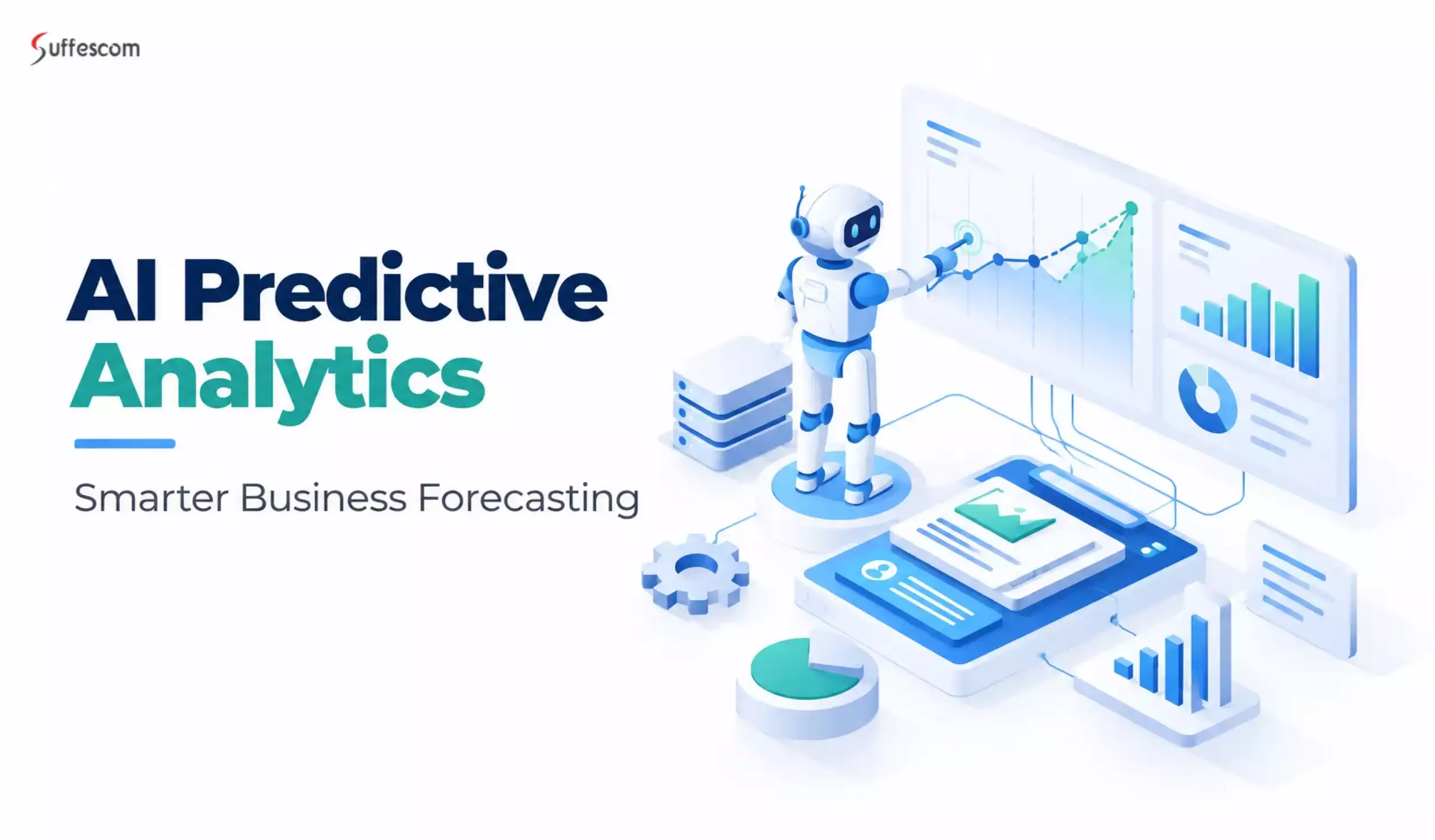
Businesses need more than historical reports to make informed decisions. They need to anticipate customer behavior, forecast demand, identify emerging risks, and understand how operational changes may affect future performance. AI predictive analytics platform development helps organizations turn historical and real-time data into actionable forecasts using machine learning, statistical modeling, and automated data processing.
A well-designed predictive analytics platform combines data pipelines, machine learning models, prediction APIs, interactive dashboards, and continuous monitoring within a unified software environment. It can support individual business functions or multiple prediction use cases across an enterprise. The right architecture depends on data availability, prediction requirements, integration needs, and the speed at which decisions must be made.
This guide explains how predictive analytics platforms work, which features and technologies matter, how to approach development, and what businesses should consider before investing in a custom solution.
What Is an AI Predictive Analytics Platform?
An AI predictive analytics platform is a software system that analyzes historical and current data to estimate future outcomes. It uses machine learning algorithms and statistical techniques to identify patterns, calculate probabilities, and generate forecasts that help businesses make decisions before problems or opportunities become apparent.
Unlike conventional business intelligence tools, which primarily explain past performance, predictive analytics estimates what may happen next. For example, a retailer can forecast product demand, a SaaS company can identify customers at risk of leaving, and a manufacturer can estimate when equipment may require maintenance.
Predictive analytics is also different from prescriptive analytics. Predictive models estimate likely outcomes, while prescriptive systems evaluate possible actions based on predictions, constraints, and business objectives. Combining these capabilities can help organizations move from reviewing reports toward proactive, data-informed operations.
Planning Your Predictive Analytics Platform?
How Does an AI Predictive Analytics Platform Work?
A predictive analytics platform processes data through a connected workflow, from ingestion and preparation to model inference and production monitoring. Each stage influences the reliability of the final predictions, so the architecture must account for data quality, model performance, and how results reach business users.
1. Data collection and ingestion: The platform collects information from CRM and ERP systems, transactional databases, application logs, IoT devices, APIs, and external datasets. Batch ingestion works well for periodic forecasting, while streaming pipelines support use cases that require frequently updated information.
2. Data preparation and feature engineering: Incoming records are validated, cleaned, standardized, and transformed into model-ready features. Engineers address missing values, duplicate records, inconsistent formats, and data leakage before selecting variables that can help models learn meaningful relationships.
3. Model training and validation: Machine learning models learn from historical examples and are evaluated against data they have not previously seen. Regression, classification, time-series forecasting, and other techniques are selected according to the prediction objective and the characteristics of the available dataset.
4. Prediction generation and delivery: Trained models generate forecasts, probabilities, or risk scores. The platform delivers these outputs through dashboards, APIs, notifications, or connected business applications so teams can incorporate predictions into existing operational workflows.
5. Monitoring and improvement: Production monitoring tracks data quality, prediction performance, latency, and changes in incoming data. When performance deteriorates or business conditions change, teams can investigate the cause, validate updated models, and deploy improvements through controlled release processes.
Key Features to Include in a Predictive Analytics Platform
The features of an AI predictive analytics platform should reflect how users consume forecasts and how the business acts on them. Instead of adding every available AI capability, prioritize functions that support reliable predictions, accessible insights, operational integration, and long-term model maintenance.
Unified Data Integration
The platform should connect relevant business applications, databases, cloud data warehouses, APIs, and external information sources. Reusable connectors, scheduled synchronization, schema validation, and error handling help maintain consistent data flows as systems change. A well-planned foundation also reduces the need for teams to repeatedly export and reconcile information manually.
Automated Data Preparation and Feature Engineering
Automated preprocessing can standardize incoming data, identify missing values, flag anomalies, and prepare features for model training. Data validation rules should remain configurable because different use cases require different treatments. This capability makes pipelines more repeatable, while data lineage and versioning help engineers investigate unexpected changes in model behavior.
Multi-Model Prediction Engine
A flexible prediction engine supports different model types rather than relying on one algorithm for every business problem. Time-series models can forecast demand, classification models can estimate churn risk, and anomaly detection can flag unusual activity. Model selection should be driven by validation results, interpretability needs, operational constraints, and the cost of incorrect predictions.
Real-Time and Batch Prediction
Real-time inference generates predictions when new events arrive, making it useful for transaction screening, alerts, and time-sensitive decisions. Batch inference processes larger datasets on a schedule, supporting inventory planning, monthly revenue forecasts, and portfolio reviews. The platform should support the execution pattern each use case requires without introducing unnecessary infrastructure complexity.
Explainable Predictions and Confidence Scoring
Users need context to understand how a model reached an output, especially when predictions influence financial, operational, or customer-related decisions. Feature attribution methods such as SHAP or LIME can help explain individual predictions, while suitable uncertainty estimates communicate limitations. Confidence scores should be calibrated and validated rather than treated as guarantees of accuracy.
Analytics Dashboards and Natural-Language Access
Role-based dashboards can present forecasts, historical comparisons, risk indicators, and model performance to executives, analysts, and operational teams. NLP-powered analytics can extend access by allowing users to ask questions in natural language, such as which customer segment faces the greatest churn risk. The system must validate queries and communicate uncertainty instead of presenting unsupported answers as facts.
Model Monitoring and Governance
Production systems need model versioning, access controls, audit logs, data drift detection, and performance monitoring. Automated alerts can help teams investigate changes before they affect business decisions. Retraining should follow validated triggers and release checks, ensuring that updated models are tested against appropriate benchmarks before replacing existing production versions.
AI Predictive Analytics Use Cases Across Industries
AI for predictive analytics can support different business functions, but the value depends on selecting a measurable problem and having suitable data to address it. Common applications include the following:
- Banking and financial services: Predictive models can assess credit risk, identify potentially fraudulent transactions, estimate default probabilities, and flag unusual account behavior. Financial institutions must validate model performance, protect sensitive information, and maintain appropriate explanations and review processes for consequential decisions.
- Healthcare: Predictive analytics can support patient readmission risk assessment, resource planning, and demand forecasting. Clinical applications require careful validation against relevant populations, secure handling of patient information, and appropriate clinical oversight because model outputs should inform professional judgment rather than replace it.
- Retail and e-commerce: Demand forecasting helps retailers estimate product requirements, plan inventory, and anticipate seasonal changes. Customer propensity models can also help prioritize relevant offers, while churn analysis can identify customer segments that may benefit from improved service or targeted retention efforts.
- Manufacturing and logistics: Sensor readings, maintenance records, production data, and shipment histories can support equipment failure prediction, quality monitoring, and delivery forecasting. These models can help operations teams prioritize inspections, plan resources, and investigate disruptions before they create wider operational problems.
- SaaS and technology: Product usage, subscription history, support interactions, and account activity can help estimate churn risk, forecast recurring revenue, and identify promising leads. Teams can use these insights to prioritize customer success activities and improve planning, provided that predictions are evaluated against actual business outcomes.
Technology Stack for AI Predictive Analytics Platform Development
The technology stack should support the platform's data volume, prediction frequency, model complexity, deployment environment, and security requirements. A practical architecture typically combines data processing, machine learning, model serving, monitoring, and application development technologies rather than depending on a single framework.
| Architecture layer | Suitable technologies | Primary purpose |
| Data ingestion | Apache Kafka, APIs, cloud connectors | Collect batch and streaming data from business systems. |
| Processing and storage | Python, SQL, Apache Spark, Snowflake, BigQuery | Clean, transform, and organize data for analytics workloads. |
| Machine learning | Scikit-learn, XGBoost, LightGBM, TensorFlow, PyTorch | Train and evaluate models for different prediction tasks. |
| Model serving | FastAPI, ONNX Runtime | Expose predictions through services and application interfaces. |
| MLOps and deployment | MLflow, Docker, Kubernetes | Track models, manage releases, and support repeatable deployments. |
| Cloud infrastructure | AWS, Microsoft Azure, Google Cloud | Provide computing, storage, security, and scaling capabilities. |
| Visualization | React, Power BI, custom dashboards | Present forecasts, model outputs, and performance indicators. |
Technology selection should also account for integration with existing infrastructure and the team's ability to maintain the solution. Organizations building complex data foundations may benefit from data engineering services to establish reliable ingestion, transformation, and storage workflows before introducing production machine learning models.
AI Predictive Analytics Platform Development Process
A structured development process connects business objectives with the engineering decisions required to deliver a dependable predictive product. Each stage should produce a reviewable outcome, helping stakeholders validate assumptions early and avoid investing in complex models before confirming that the data and use case justify them.
1. Define the Business Problem and Assess Data
Start by identifying the decision the platform should improve, the outcome it must predict, and the metric that will demonstrate business value. Review available datasets, data ownership, historical coverage, missing information, and access restrictions. This assessment establishes feasibility and helps prioritize an initial use case with measurable results.
2. Design the Data Architecture
Define how information will move from source systems into storage, processing, feature engineering, and model training environments. Establish data validation, lineage, access permissions, and refresh schedules. The architecture should accommodate expected workloads while leaving room for additional prediction models and integrations as business requirements expand.
3. Develop and Validate Predictive Models
Select algorithms according to the prediction objective, dataset characteristics, interpretability requirements, and acceptable error levels. Establish a baseline, train candidate models, and compare their results using appropriate evaluation metrics. Validation should reflect real deployment conditions, including time-based splits for forecasting and careful prevention of data leakage.
4. Build the Platform and Integrations
Develop the backend services, prediction APIs, dashboards, user permissions, and connections to business applications. Integrate models into workflows where their outputs can support actual decisions rather than leaving predictions isolated in an analytics interface. Teams providing machine learning development services can help align model engineering with the requirements of the surrounding software platform.
5. Implement Testing, MLOps, and Governance
Test data pipelines, API behavior, system performance, model quality, access controls, and failure recovery before production release. Establish model registries, monitoring dashboards, audit trails, and documented retraining procedures. For AI risk assessment and governance, the NIST AI Risk Management Framework provides guidance for identifying, assessing, and managing risks throughout the AI lifecycle. Security and compliance controls should reflect the sensitivity of the data and the requirements applicable to the specific industry and deployment environment.
6. Deploy, Monitor, and Optimize
Release the platform through a controlled deployment process and monitor its behavior under actual workloads. Compare predictions with subsequently observed outcomes, investigate drift, and review infrastructure costs. Updates should be validated before release, while feedback from users and business stakeholders helps determine whether the system continues to solve the intended problem.
Custom Predictive Analytics Platform vs. Off-the-Shelf Tools
Off-the-shelf platforms can be suitable when a business needs standard forecasting capabilities, established integrations, and a relatively quick implementation. A custom predictive analytics platform is worth considering when the business requires specialized models, proprietary workflows, deeper integration, or control over how predictions are generated and consumed.
Custom development also introduces responsibility for architecture, security, maintenance, and model governance. Before choosing either approach, compare licensing and infrastructure costs, data portability, customization limits, vendor dependency, and the effort required to integrate the tool with existing systems. A hybrid approach may be practical when managed machine learning services can support selected workloads within a custom application.
How Much Does It Cost to Build an AI Predictive Analytics Platform?
The cost of predictive analytics platform development depends on the number of use cases, condition of available data, complexity of the models, required integrations, and deployment environment. A focused MVP with one prediction workflow will generally require a different investment from an enterprise platform supporting multiple business units, real-time inference, and formal governance.
Key cost drivers include data pipeline development, data labeling or preparation, model experimentation, dashboard design, cloud computing, security controls, API integrations, testing, and ongoing MLOps. Real-time processing and stringent availability requirements can add infrastructure and engineering work. A reliable estimate should follow a scope assessment that defines deliverables, acceptance criteria, assumptions, and post-launch support needs.
Get a Development Plan for Your Use Case
Challenges to Consider When Building Predictive Analytics Software
Predictive analytics development involves more than selecting an algorithm. Poor data quality can weaken model performance, while changing customer behavior, market conditions, or operational processes can make previously useful patterns less reliable. Data drift and concept drift therefore require ongoing monitoring, suitable evaluation methods, and a clear process for reviewing model updates.
Explainability, privacy, bias, and system integration also need attention from the beginning. A model may perform well in testing yet deliver limited value if predictions arrive too late or cannot be used within existing workflows. Businesses should define acceptable error thresholds, protect sensitive data, document important model decisions, and retain human review where the consequences of incorrect predictions are significant.
Why Choose Suffescom for AI Predictive Analytics Platform Development?
Building a useful predictive analytics platform requires coordinated work across data engineering, machine learning, application development, integration, and production operations. Suffescom's AI development services cover areas including data pipelines, model development, system integration, testing, and continuous MLOps, providing a foundation for solutions tailored to specific business requirements.
The engagement should begin with the business problem, available data, and expected outcomes rather than a predetermined technology stack. From there, the team can define the architecture, select suitable modeling approaches, and plan the platform's integration and monitoring requirements. For organizations evaluating a practical implementation, the healthcare AI analytics platform case study illustrates how predictive analytics, data processing pipelines, and existing healthcare data sources can be brought together in one solution.
The objective is to develop a platform that fits real operational needs and can be maintained as data, workloads, and business priorities change. A clear development scope, measurable validation criteria, and production monitoring help keep the solution focused on useful predictions rather than technology for its own sake.
Build an AI Predictive Analytics Platform for Your Business
FAQs
What is AI predictive analytics platform development?
AI predictive analytics platform development involves building software that processes business data, trains or integrates machine learning models, and delivers forecasts or risk estimates through applications, dashboards, or APIs. The platform also requires data quality controls, model validation, monitoring, and integration with the systems where decisions are made.
How long does it take to build a predictive analytics platform?
The timeline depends on data readiness, the number of prediction use cases, integration complexity, and production requirements. A focused MVP may take several weeks to a few months, while a larger enterprise implementation with multiple models, extensive integrations, and governance requirements can take considerably longer.
What data is required for predictive analytics?
The required data depends on the business outcome being predicted. Common sources include transaction histories, customer activity, operational records, product usage, maintenance logs, and external market information. Data should be relevant, sufficiently representative, and available under appropriate permissions to support reliable training and evaluation.
Which industries can use AI predictive analytics?
Banking, healthcare, retail, manufacturing, logistics, and SaaS businesses commonly use predictive analytics for forecasting, risk assessment, customer behavior analysis, and operational planning. The most suitable application depends on the available data, the decision being improved, and the measurable value of producing a reliable prediction.
Can predictive analytics integrate with existing CRM and ERP systems?
Yes. Predictive analytics platforms can connect with CRM, ERP, data warehouses, databases, and custom applications through APIs, connectors, and data pipelines. Integration planning should define synchronization frequency, permissions, data validation, error handling, and how predictions will be delivered to the users or workflows that need them.
How do you maintain prediction accuracy after deployment?
Teams monitor model performance against observed outcomes, check incoming data for drift, and investigate changes in business conditions. Retraining may be required when performance deteriorates, but updated models should be validated against appropriate baselines before release. Regular monitoring helps maintain reliability without assuming that every new model will perform better.
Build an AI Predictive Analytics Platform Around Your Business Goals
The right predictive analytics platform starts with a clear business problem, reliable data, and a realistic plan for using forecasts in day-to-day decisions. By combining suitable machine learning models with robust data pipelines, explainable outputs, and continuous monitoring, businesses can build predictive capabilities that evolve with their operational needs.