Key Takeaways:
- VAPT helps enterprises understand which weaknesses attackers could exploit and what damage they could cause.
- Vulnerability assessment and penetration testing serve different purposes. One identifies potential weaknesses. The other tests whether selected weaknesses can be exploited.
- CVSS scores alone cannot set priorities. Teams must also consider active threats, system exposure, and business impact.
- Retesting confirms whether fixes work. Never close a finding without checking that the weakness has been resolved.
- Effective VAPT fits into engineering workflows. Connect security findings to development tasks and routine system updates.
- Choose a VAPT partner that understands your business. Look for technical depth, clear reports, transparent testing methods, and practical remediation support.
Are you sure that there are no vulnerabilities in your business applications, APIs, and IT infrastructure that may be exploited by hackers? A system may appear to be impeccable; however, outdated software, additional user rights, and incorrect configuration of cloud resources may make it vulnerable. Appropriate testing is needed in order to identify which vulnerabilities are the most dangerous ones and how to cope with them.
Vulnerability assessment is a key part of cybersecurity services. It will evaluate the possible impact of their exploitation and set the priorities concerning which vulnerabilities should be tackled first. Vulnerability assessment gives your team information about the security situation now, before the launch of a new product, infrastructure change, or security assessment.
Identifying your weak spots is the first step. The next important part is knowing which ones require urgent action, how to address them, and when to run a more detailed security test. Let us look at the process of vulnerability testing, its types, tools, and more.
Vulnerability Assessment: Scope, Business Value, and Timing
The importance of a vulnerability assessment is found in the capacity of giving the leadership a clear view of where the vulnerabilities exist, the risks involved, and what would be needed to implement fixes. The importance is seen in drawing the link between the technical analysis and the critical business assets.
What Does a Vulnerability Assessment Include?
Scope needs to be determined by the organization's attack surface, technology stack, and risk exposure. In the specific environment, the assessment could entail:
- Discovery and coverage of assets: Discovery of systems, applications, APIs, cloud, and infrastructure to be tested.
- Identification and validation of vulnerabilities: Identification of known vulnerabilities and their verification to minimize false positives.
- Analysis of risk and impact: Evaluation of severity of vulnerabilities, exploitability, exposure, criticality of assets, and possible business impact.
- Remediation: Assignment of priority, remediation recommendations, and ownership assignment.
Verification: Verifying that any fixes applied have indeed corrected the flaws and recording any residual risks.
The document must be more than just an output of the scan. Management requires a prioritized list of risks, whereas technical people require enough detail to reproduce the findings and implement the fix. This method is consistent with the NIST recommendations on security testing and mitigation. Cybersecurity consulting and advisory services can help translate these findings into practical remediation priorities aligned with business risks and security goals.
Why Do Businesses Need Vulnerability Assessments?
Reducing exposure prior to exploiting any vulnerabilities resulting in an event is the main goal. Three key accomplishments for the decision-maker from the assessment include:
- Improved allocation of security resources. Vulnerabilities that pose danger to crucial systems could be given priority over other findings.
- Lower risk from current attacks. Findings can be assessed based on current attacks, including those in the CISA Known Exploited Vulnerabilities Catalog. A CVSS score is not enough to dictate which vulnerabilities have to be addressed first.
- Increased visibility for existing risks. It becomes clear to senior management what vulnerabilities exist and how long it has been since their resolution.
However, an assessment cannot ensure the security of a system. It only highlights those aspects that have been tested.
When Should You Conduct a Vulnerability Assessment?
Schedules are not sufficient. Evaluations must adapt according to environmental changes and the degree of risk.
- On a periodic basis: Plan periodic assessments based on the criticality of the asset, exposure, requirements, and remediation capabilities of the organization.
- Prior to any major release or any infrastructure changes: Perform the assessment of any major release or changes made to the infrastructure.
- After any critical vulnerability is disclosed: Determine the existence of any vulnerable software or system in your environment and assess the threat.
- After any security event occurs: Determine if the vulnerability was exploited and conduct a reassessment to determine if remediation is performed.
- As part of any requirement imposed through regulation or contract: Test as per the scope and frequency required by the respective standard or contract.
Businesses operating in a dynamic environment may require continuous monitoring of assets and regular scanning through automation with occasional deep evaluations on an interval basis depending on the risk involved. The vulnerability management guidelines developed by CISA stress asset visibility and prioritization of known exploits.
An effective frequency should be the one that allows the business to recognize a change in risk at an early stage.
See Your Security Through an Attacker's Eyes
With 500+ security assessments completed, our experts know where critical weaknesses hide and how to help you address them.
Types of Vulnerability Assessments
The appropriate evaluation will vary based on the attack surface of the organization. A web3 testing service will employ different techniques than those used to test cloud permissions or the internal network. In fact, most organizations require a hybrid assessment to protect the entire attack surface.
1. Network Vulnerability Assessment
Analyzes the internal and external infrastructure network for exposed services, out-of-date software, insecure settings, and flaws in network controls. Can aid organizations in finding out whether attackers can take advantage of accessible systems or operate in the internal environment.
Ideal for: Organizations with dispersed infrastructure, remote access systems, internal networks, or internet-facing applications.
2. Web Application and API Vulnerability Assessment
Evaluates application logic, authentication, authorization, session management, input validation, and exposure of data. An API assessment will also analyze object-level authorization, data access issues, and request handling vulnerabilities.
Best used for: Organizations running customer portals, finance websites, e-commerce portals, SaaS applications, or applications using APIs to share sensitive information.
3. Cloud Vulnerability Assessment
The review will cover workloads, storage, identity permissions, network exposure, and security postures on AWS, Azure, and Google Cloud. Besides the analysis mentioned above, the cloud security review will assess cloud-specific risks, including risks associated with over-privileges and outwardly accessible assets.
Perfect fit for: Migration to cloud, multi-cloud operations, and infrastructure deployments for scaling purposes.
4. Mobile Application Vulnerability Assessment
Examines the data storage methods, authentication processes, encryption techniques, and permissions requested from the device by the mobile application. As well as how the application communicates and connects with centralized services. Should be conducted in the mobile app client as well as in the APIs used by the client.
Best for: Organizations that provide banking, healthcare, retail, logistics, and other applications that utilize personal data from a mobile device.
5. Infrastructure and Software Dependency Assessment
Identifies potential vulnerabilities in the following: operating systems, container images, open source libraries, and third-party software components. Scanning infrastructure as code and configurations identifies security risks even before deployment.
Suitable for: Organizations dealing with complex software supply chains, containerized workloads, or releasing frequently to production environments.
How Should You Choose the Right Assessment?
Start with assets whose compromise could have the most significant impact on your business. In one case, the company might choose to prioritize application and API testing due to the size of its customer-facing application, while in another, it might require identity, permission, workload, and configuration coverage.
The assessments are cumulative. The universe of each should reflect an evolution of your architectural, threat, and risk profiles, not an independent set of assessments.
Vulnerability Assessment vs. Penetration Testing
Both are useful for determining security weaknesses; however, they ask very different questions. Vulnerability Assessment is the process of identifying and prioritizing the vulnerabilities of a scope. Penetration Testing is more advanced because it attempts to leverage vulnerabilities and determine what an attacker could do.
Knowing the difference between the following when considering testing requirements.
| Evaluation factor | Vulnerability assessment | Penetration testing |
| Primary objective | Identify and prioritize weaknesses | Validate exploitability and attack paths |
| Testing approach | Automated scanning, analysis, and validation | Manual testing supported by specialized tools |
| Coverage | Can assess large numbers of assets | Usually concentrates on a defined target and attack scenarios |
| Main deliverable | Risk-ranked findings and remediation guidance | Evidence of exploitable weaknesses and potential attack impact |
| Best suited for | Ongoing visibility into security exposure | Deeper assurance of security controls and attack resistance |
When Is a Vulnerability Assessment Enough?
Vulnerability scans may be appropriate in instances where there is a requirement for awareness of known vulnerabilities, a backlog of work prioritized for remedial work, and there is a requirement for scanning of a large asset base.
But it will not be able to identify all the findings that can be exploited or identify all the multi-layered attack vectors. The depth of validation through the manual testing is also on a case-by-case basis.
When Should You Choose Penetration Testing?
It is applicable when you need to determine whether vulnerabilities can be chained together to attack an account, retrieve sensitive data, or bypass some other security control.
It is used when testing needs to be conducted on machines, APIs, major releases, and risk.
Do Enterprises Need Both?
Quite often, yes. Vulnerability assessment provides knowledge of the most common and reliable vulnerabilities. Penetration testing will then provide information about what is actually likely to be exploitable for a given selected group of vulnerabilities.
Another way is to do vulnerability discovery and risk-oriented penetration testing on a periodic basis. The amount and frequency of each activity are determined by the company's exposure and needs.
Neither method guarantees complete security. It is intended to discover significant flaws, minimize exposure, and demonstrate the value of mitigation.
How Does the VAPT Cycle Work for an Enterprise?
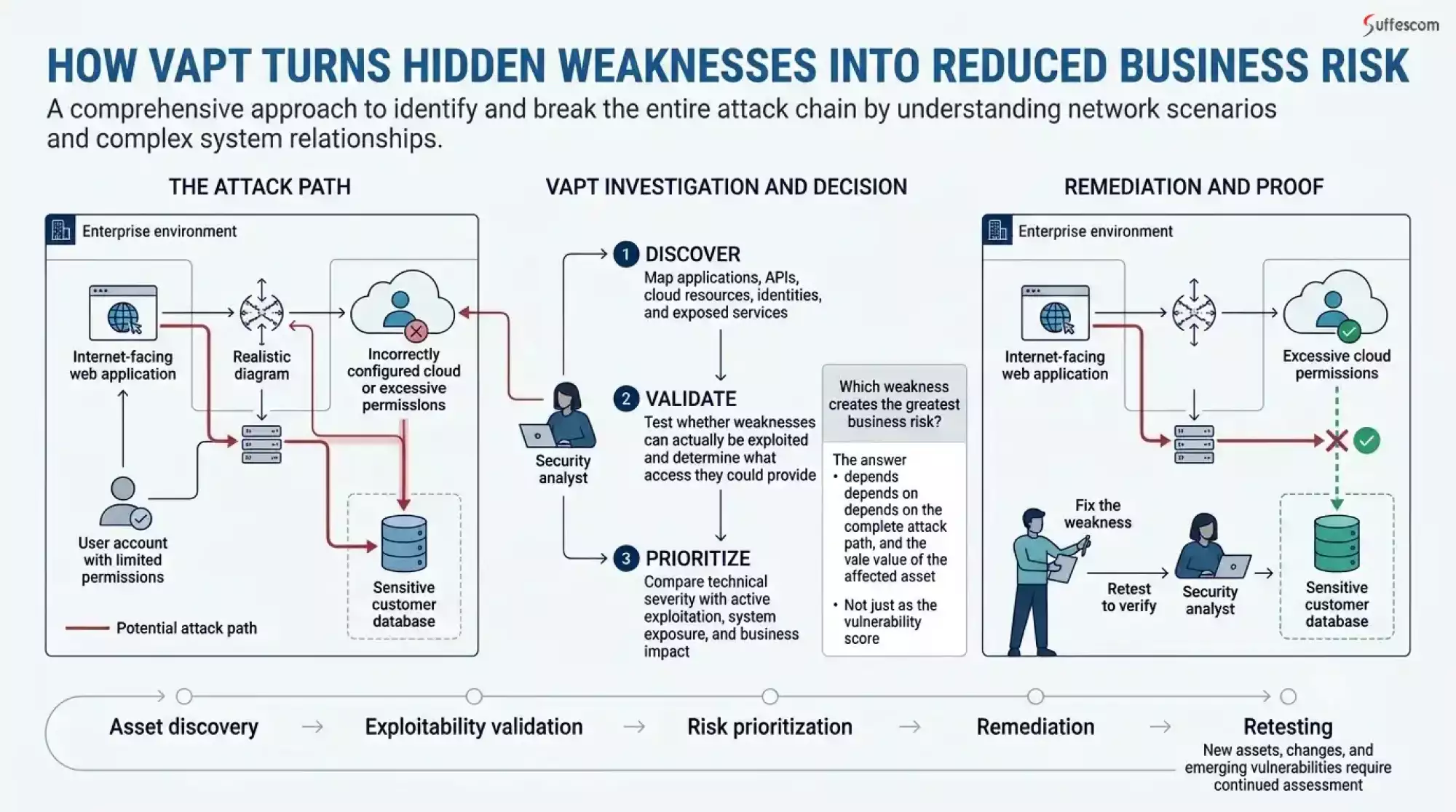
In well-established enterprises, the process of VAPT should become an integral security life cycle that involves performing the same procedures over and over again. All the mentioned stages from asset discovery through risk management and verification should be merged in one cycle. With each iteration, security professionals will better understand their vulnerabilities and risks.
1. Identify What Needs to Be Tested
Before scanning, you need to be aware of what you own, where your system exists, and what computer system your critical business operations run on.
What you can see is your attack surface, however, there is more than you think. Shadow SaaS accounts, unknown stage servers, obsolete APIs, unused cloud assets, unmonitored third-party systems, etc. What you scan is what you are aware of, and that may not be enough.
A comprehensive vulnerability assessment process should include an inventory of your assets and the following three activities:
Asset inventory validation
Develop a centralized repository for application, domain, IP, API, cloud resources, endpoints, database, and software inventory. Use cross-referencing from cloud providers, CMDBs, endpoints, and software inventory to identify any gaps or outdated information.
Exposure mapping
Figure out how you are accessible and who is able to access you. Find out about: services on the Internet, externally exposed APIs, remote access points, access to assets in your network, access through third parties. This will allow you to figure out if any of your assets are exposed to unauthorized parties.
Configuration and identity review
Review the cloud configuration, access policies, service accounts, privileged accounts, and controls for authentication. Look for excessive access, public resources, unmanaged identities, and configuration weaknesses that might expose privileged assets.
Once you have established what exists and how it is all exposed, the security team will be able to establish an appropriate test scope based on criticality and exposure of assets and risks to business. This would give the vulnerability assessment and penetration testing team a basis to work from, rather than an inadequate list of assets.
2. Validate Where the Real Exploitability Lies
The vulnerability assessment scans the attack surface for vulnerabilities, and penetration tests verify whether vulnerabilities can be exploited and what the impact is.
Validation for a business generally consists of:
- Chaining together low-privileged access, IAM misconfigurations, and lateral movement to access systems that contain sensitive PII.
- Privilege escalation analysis: Routes from an accessed user account to a higher level of privilege.
- Lateral movement test: Establishing if compromised resources can access other assets.
- Token theft/session hijacking: Verifying if shared tokens or hijacked sessions enable access.
- Business logic attack: Taking advantage of flaws in your workflows, authorization rules, or transaction logic so that people can get access or privileges they're not supposed to have.
- Simulation of cloud attack paths: Path analysis of how inadvertent access to cloud resources, overlapping permissions, and misconfigurations could work together to put valuable cloud assets at risk.
For example, testers might discover that an attacker with a compromised low-privilege account could exploit excessive cloud permissions to access a sensitive database. This reveals the attack path and the business assets at risk. Business intelligence and consulting can help organizations interpret such findings in the context of operational priorities and business risks, supporting more informed security decisions.
3. Prioritize Risks Beyond the CVSS Score
CVSS scores measure technical severity but don't advise an enterprise which bug to fix first. It may need to fix a moderate-severity vulnerability on an internet-facing payment system more quickly than a critical bug found on an internally sandboxed test server.
A mature VAPT program considers all signals when prioritizing for remediation:
- Active exploitation: Is it being exploited?
- Is there a public exploit code that would facilitate exploitation?
- Exposure: Is the compromised asset accessible over the internet, inward, or secured behind a login?
- Business impact: Will the exploit lead to exposure of customer information, disruption of essential business processes, or impact on financial transactions?
- Is the system providing housing critical business applications or intellectual property?
- Compensating controls: Will network segmentation, access restrictions, endpoint security, or other controls mitigate the attacker's ability or ability to cause harm?
In other words, it sets up the team to understand the vulnerabilities that need to be addressed right now and the ones that can be paid later through remediation. CVSS still informs this decision, but the business context is ultimately what helps prioritize.
4. Turn Findings Into Remediation Actions
Any VAPT program is only as good as the insights it turns into action. Finding vulnerabilities that sit in backlogs and on watch lists can leave the door open.
A successful enterprise program will embed remediation into the engineering workflow via:
- Guided remediation intake: Turn validated issues into tickets with evidence, impacted assets, risk, and recommended actions.
- Remediation driven by SLA: Prioritize and set dates based on risk and business impact; escalate for overdue high-risk issues.
- Align on engineering: Associate the results with the teams responsible for the impacted applications, infrastructure, or cloud modernization services (and security teams guide in fixing it).
- The acceptance of risk: Specify in the defect report the name of the individual who approved any unmitigated risk, as well as the reasons for accepting it and the intervals at which it will be reviewed.
5. Retest and Verify the Fixes
Placing a patch, or modifying a configuration, does not necessarily mean the vulnerability is now fixed. Reverification helps to verify that the problem has been fixed and no new issues are present.
- Verify fix: Re-run the original test to make sure the problem is still fixed.
- Regression testing: Verify that the fix hasn't compromised existing functionality or introduced a new security vulnerability.
- Residual risk review: Review residual risk, and if it is still present, whether this must be mitigated further.
- Evidence and closure: Make a note of the retest outcome, prior to the finding being closed.
This completes the circle from test to repair, so security teams now know you have reduced the risk, not just checked the box that it's been marked as fixed.
Common Mistakes That Reduce VAPT Effectiveness
An enterprise's VAPT report may include numerous findings, some of which point to critical infrastructure, while others are just edge cases that may be hard to exploit. This way, without any priorities and action taken, the security team ends up fixing low-hanging fruit and ignoring the critical vulnerabilities.
The task here isn't finding vulnerabilities but mitigating them. These are the things companies should avoid doing when performing VAPTs.
1. Running VAPT for Audits rather than Risk Minimization
Dealing with VAPT as a compliance checkbox can result in a periodic testing with no real follow-up. A report can meet an audit requirement but exploitable risks are still in production.
How to avoid it: Map every assessment to business risks, remediation ownership, and retesting. Compliant evidence should be part of security enhancement instead of being a substitute for it.
2. Confusing Tool Results with Understanding Risks
A scanner will be able to detect known vulnerabilities, but it may not be able to prove if they are exploitable or how various lesser vulnerabilities can be used to create an exploit chain.
Preventive steps: Verify results manually and through targeted penetration testing. Use business risk and exploitability, not just scanner results, to determine priorities.
3. Keeping the Ownership of Remediation Ambiguous
While infrastructure teams view the finding as an application issue and development teams attribute remediation to DevOps solutions team, there is risk that remediation will not be completed. The vulnerable system will continue to remain vulnerable.
How to prevent it: Clearly identify the owners of the system, remediation deadlines, and escalation processes.
4. Failing to Account for Identity and Privilege Vulnerabilities
When performing vulnerability assessments, there may be a heavy emphasis placed on infrastructure vulnerabilities without considering vulnerabilities such as cloud permissions, stale admin accounts, and poor authentication mechanisms. This would allow an attacker to gain access into a secure system even if there is no infrastructure vulnerability present.
How to avoid this: Ensure that identity and privilege reviews are conducted during the assessment process.
5. Closing Tickets Without Confirming the Fix
Just because the ticket is completed, it doesn't mean the vulnerability is patched. The patch can be incomplete, the configuration might not be applied everywhere, and the same vulnerability can be present somewhere else.
How to avoid it: Test the initial finding and document the results. Close the vulnerability when you confirm it was fixed or document the residual risk.
6. Segregation of VAPT from Engineering Processes
Where security findings remain disconnected from engineering processes like Jira, sprint backlog, and CI/CD pipeline, teams find it difficult to track the fixing of these findings and to stop the vulnerabilities from creeping in again.
How to avoid it: Incorporate the findings into the existing engineering processes. Fixing of these findings should be assigned to the responsible teams.
7. Measuring Activity versus Risk Mitigation
Measuring the number of identified vulnerabilities or scans performed tells you how much testing has been done rather than whether or not the organization has become more secure.
How to avoid it: Measure progress through metrics such as reduced attack surface, reduced vulnerability exposure periods, improved critical finding mitigation, and reduced recurring vulnerabilities.
We Don't Just Report Vulnerabilities. We Help You Prioritize Them.
A vulnerability's severity depends on more than its technical score. We assess how it affects your critical systems, sensitive data, and business operations so your team knows what to fix first.
Key Metrics for Measuring VAPT Risk Reduction
An effective VAPT program will be able to tell you if exploitable risks are decreasing, not just the number of vulnerabilities that testing finds.
- Mean time to remediate (MTTR): How rapidly teams are addressing vulnerabilities, with a particular focus on critical and high-risk issues.
- The time window that an attack vector is available before it is patched.
- Remediation rate verified: Percentage of confirmed closed findings upon retesting.
- Repeat Vulnerability rate: How often the same CVEs recur.
- The count of critical unresolved vulnerabilities that impact critical business systems.
- Attack path reduction: Whether testing discovers fewer attackable routes to data, power, and sensitive infrastructure.
All these measures indicate if the company is actually reducing exposure and improving security posture over time.
How to Choose the Right VAPT Partner
A good VAPT service provider does more than just detect vulnerabilities. They should help you determine real exposure, prioritize remediation efforts, and verify that security risks have been addressed.
When choosing a service provider, consider the following:
- Distinctiveness of VA vs. penetration testing: Do they provide guidance on when automated vulnerability assessment is enough and when exploitation testing is required?
- Technical coverage: Can they perform tests on applications, APIs, cloud, identity, and sophisticated attack vectors?
- Quality of reports: Do they cover exploitability, business impact, remediation actions, and risk prioritization in the reports, or simply mention the findings?
- Integration with processes: Can they coordinate the testing and remediation with your engineering team and ticketing processes?
- Transparency of testing process: Do they specify the scope, approach, limitations, and rules of engagement for testing?
- Continuous improvement process: Can they retest vulnerabilities and identify recurring problems?
- Alignment with business risk: Can they prioritize vulnerabilities according to your critical assets and risk profile?
Choose an expert partner whose approach fits your security maturity and business priorities, not simply the provider offering the most tests at the lowest price.
Build a VAPT Program That Keeps Up With Your Business
We help you find new risks, fix weaknesses, and keep your systems secure as your business grows.
Conclusion
The most valuable thing about vulnerability assessment and penetration testing is that they must result in reduced risk. The process starts with identifying weaknesses but must go beyond that and include determining which vulnerabilities can be exploited, prioritizing remediations and ensuring that remediations have actually helped.
Such an organized process will allow the security team and other experts to make informed choices. As technologies develop and change, regular tests will keep the security team's focus on the right issues.
If your company requires assessing security and validating defenses, Suffescom's cybersecurity consulting team is ready to help you assess your attack surface and define an appropriate testing strategy.
FAQs
1. How should enterprises prepare for a VAPT assessment?
Start by confirming the testing scope. You also need to identify the system owners, document critical assets and securing the necessary approvals alongside. After this, share relevant architecture diagrams and test accounts where needed. Also, define testing restrictions for production systems to avoid disrupting business operations.
2. Can VAPT testing disrupt production systems?
Yes. Aggressive scanning or exploitation attempts can affect application performance. They can trigger security controls or disrupt vulnerable services. That's why you need to agree on testing windows, rate limits, emergency contacts, and rollback procedures before testing begins.
3. Should enterprises test production or staging environments?
Both can be necessary. Staging environments help teams test safely, but they may not reflect production configurations, access controls, or integrations. Production testing can reveal real-world exposure, provided it is carefully scoped and authorized.
4. How should enterprises handle vulnerabilities that cannot be fixed immediately?
Here is how enterprises should handle vulnerabilities that are too complex to fix immediately:
Document the risk:
- Assign an owner
- Establish a remediation deadline
- Apply compensating controls where possible, such as restricting network access or disabling vulnerable functionality.
- Then, high-risk exceptions should receive formal approval and regular review until the issue is resolved
5. How can enterprises manage vulnerabilities discovered between scheduled VAPT assessments?
Use continuous vulnerability monitoring. Run software dependency scanning and cloud configuration checks. Threat intelligence is also important to identify emerging risks. Trigger targeted reassessments when major changes occur, such as new application releases affecting your technology stack.
6. Does VAPT cover third-party software and vendor integrations?
It can, depending on the agreed scope and testing permissions. Enterprises should assess exposed APIs, integration configurations, authentication mechanisms, and dependencies. Testing third-party-owned systems requires explicit authorization, so coordinate with vendors before attempting to assess their environments.
7. What should enterprises do if a VAPT assessment discovers an actively exploited vulnerability?
Treat it as a potential incident rather than an ordinary remediation ticket. Confirm exposure, notify the incident response team, and apply available mitigations or patches according to the risk. Investigate relevant logs for signs of exploitation and follow incident response procedures if compromise is suspected.
8. How can enterprises demonstrate VAPT effectiveness to executives and auditors?
Provide information beyond the aggregate number of vulnerabilities discovered. Include timelines for remediation, outstanding critical issues, percentage of verified fixes, repeating problems, and shifting attack vectors. Relate these findings to the critical systems within the organization that are necessary for compliance to help management see the evolving nature of their security risks.