-
● Publicly listed on BSE • ISO 27001 & SOC 2 Type II compliant



● Publicly listed on BSE • ISO 27001 & SOC 2 Type II compliant
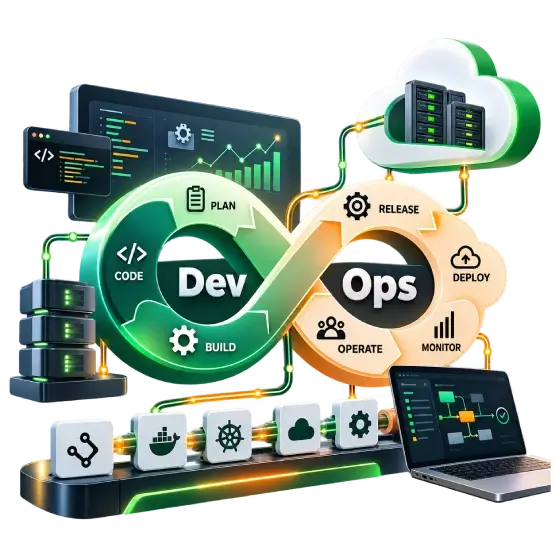
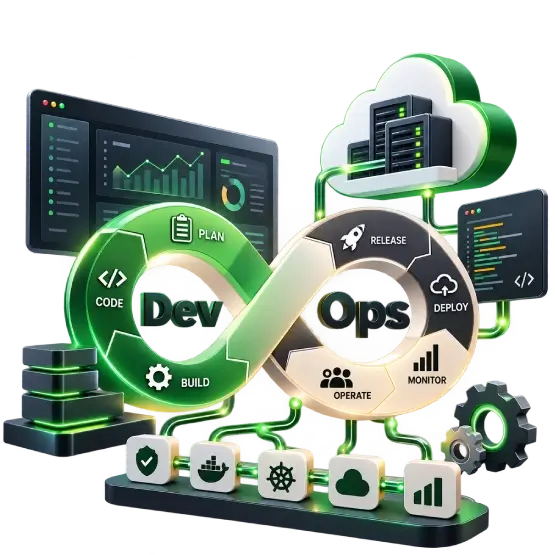
Suffescom is an IT and software development company providing DevOps engineering services for those who want to go fast and stay safe. We will work with your developers, infrastructure, and security teams in order to design real-life, scalable automated processes that do not break down after a few weeks or months of usage but work as intended from day one until the end.
We have a team of engineers experienced in such disciplines as CI/CD pipelines, cloud-native infrastructure, container orchestration, and security automation, so you will not have to piece together the information given by five specialists. We will integrate into your environment and build automation based on the reality of how things work.
Whether your requirement is modernizing an existing legacy release process, scaling up your Kubernetes environment, or building an entire DevSecOps pipeline from scratch, we have the know-how to get this job done and done right, as well as the diligence to make sure it stays that way.
Our DevOps development solutions integrate app delivery into infrastructure, testing, security, and production operations. We operate within your architecture and toolchain or develop new delivery processes if there are any necessary modifications to your engineering environment.

Before you make any alterations to your current tooling, processes, and infrastructure, assess your current development and operations environment. Our DevOps consultants assess your delivery, infrastructure, deployments, toolchain, and issues to create a realistic roadmap.
Implement recommended DevOps practices into your engineering setup. We bring together source control, CI/CD pipeline, infrastructure management, testing, deployments, security, and operations into a process for your application architecture and organization’s structure.

Automate the process from code commit to production deployment using validation, artifacts, environment promotion, and deployment processes. We build our pipelines on your branching process, testing needs, artifact flows, deployment destinations, and release policies.

Manage infrastructure using repeatable and version-controlled configurations instead of manual provisioning. The use of Infrastructure as Code and cloud automation principles is implemented by our team throughout the development, staging, and production phases.

Package your applications consistently and manage containers in the application development and production environments. We deal with Docker, Kubernetes, Helm, registry management, and deployment processes based on the needs of the applications and infrastructure.
Embed security measures within development and deployment processes instead of having it as an independent process during release time. We implement automated testing across source code, dependencies, containerization, configuration, secrets, and deployment processes.

Connect application and infrastructure metrics into your deployment and incident handling processes for visibility once your release is complete. We instrument our monitoring, logging, tracing, alerts, and processes based on what’s required in production.

Modernize fragmented or legacy delivery environments without requiring an unnecessary replacement of the underlying stack. We refactor pipelines, introduce automation, support cloud transitions, and provide ongoing assistance across delivery and production operations.
Business Requirements
A London-based fintech company operating a transaction-processing platform needed to move from VM-based deployments to a containerized delivery model. Releases involved manual infrastructure changes, inconsistent environments, and extended coordination between teams.
DevOps Implementation
We containerized application services and introduced Kubernetes-based deployment workflows with Helm, environment-specific configurations, centralized secrets handling, and automated CI/CD pipelines. Git-based deployment definitions controlled application promotion across development, staging, and production environments.
Outcomes
68%
reduction in manual deployment steps54%
shorter production release cycle41%
fewer environment-related deployment issuesBusiness Requirements
An IT company specializing in software for health care required repeatable infrastructure deployment to develop, stage, and produce. There was manual management of infrastructure, which made replicating environments and infrastructure auditing difficult.
DevOps Implementation
Our Infrastructure as Code approach for Terraform was leveraged to implement our cloud network, computing, database, IAM policy, and environment configuration. Our infrastructure code was always maintained in source control, and all updates were made via pull request before application by our automated processes.
Outcomes
72%
reduction in manual infrastructure provisioning work63%
faster environment setup47%
reduction in configuration inconsistencies between environmentsBusiness Requirements
A Berlin-based software company specialized in enterprise applications had to implement security validation early in the release cycle. The dependencies, source code, container images, and infrastructure descriptions were evaluated by our software engineers and security experts.
DevOps Implementation
We used these DevSecOps practices within our CI/CD pipeline: static code analysis (SAST), dependency scanning, container image analysis, secrets scanning, and infrastructure as code security policies. Builds that failed security evaluation were not able to proceed, while the approved builds remained traceable throughout the pipeline and repository records.
Outcomes
57%
more security findings identified before production36%
faster security validation during release cycles100%
of production releases passed through automated security gatesDevOps solutions provided by us transcend not only the level of specific engineering work but also include consideration of diverse application architectures, infrastructure, organizational structure, and operational requirements.
Implement the DevOps methodology for application development when it is developed using cloud-native architecture, infrastructure, containerization, and application platforms. Align all the practices, infrastructure, deliveries, and operations in order to suit the lifecycle of the cloud-native application.
Consistently implement engineering practices across many teams, applications, environments, and IT infrastructure. Enterprise-level DevOps practices include organization management, standardizing engineering, reusable delivery practices, and collaboration within complex development environments.
DevOps practices for implementing distributed architecture-based applications where services are independently developed, tested, delivered, and managed. Take into account engineering practices on the basis of dependencies, independent deployment, versions, and distributed systems behavior.
Build internal engineering platforms for development teams to enable reusable processes, standardization, templates, and self-service capabilities. This will let us help organizations reduce the overall engineering efforts and standardize their engineering practices among product teams.
Support engineering environments spanning multiple cloud providers, private infrastructure, and on-premises systems. Our DevOps engineering solutions address differences between environments while establishing consistent approaches to application delivery and infrastructure operations.
Adapt DevOps practices for engineering environments where governance, auditability, approvals, traceability, and security requirements influence how software is developed and released. Delivery workflows incorporate appropriate controls without separating governance from engineering processes.
Help organizations transition older application and delivery environments toward modern DevOps practices without requiring an immediate replacement of the existing application estate. Modernization is implemented gradually in pipelines, infrastructure, environments, and release workflows.
Support SaaS, web, mobile, and other continuously evolving digital products where development and production operations need to remain closely connected. We align delivery workflows with product release cycles, multiple environments, application dependencies, and ongoing operational requirements.
Apply DevOps principles to engineering environments that support data platforms, AI applications, model-serving systems, and data-intensive workloads. The focus is on repeatable environments, controlled delivery, infrastructure management, and operational visibility across the supporting technology stack.
DevOps is applied at different points across the software delivery and operations lifecycle, from automating releases and standardizing environments to managing cloud infrastructure and securing the software supply chain.

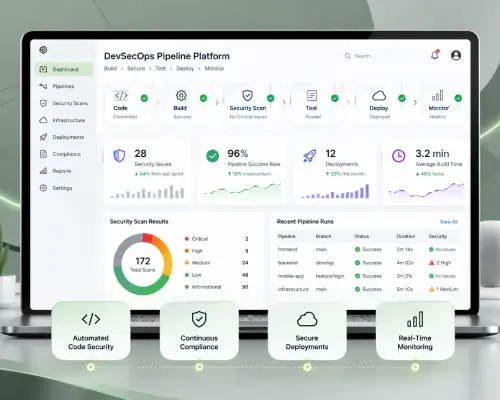
Automate the path from code commit to production through system testing, security checks, and artifact management. DevOps development services help make releases repeatable across multiple environments.

Use Infrastructure as Code, configuration management, and containers to maintain consistent environments across development, staging, and production. This reduces configuration drift and deployment inconsistencies.

Automate provisioning and configuration of cloud resources through version-controlled IaC workflows. DevOps implementation services manage networks, compute, databases, IAM, and other infrastructure components.
Automate container builds, image management, Kubernetes deployments, configuration, and health checks. This supports controlled delivery of containerized workloads across cloud and hybrid environments.

Create independent workflows for building, testing, versioning, and deploying individual microservices. Shared templates and policies maintain consistency across distributed application environments.

Modernize manual or fragmented delivery processes around existing applications without requiring an immediate rewrite. DevOps engineering services introduce automated builds, testing, IaC, and deployment workflows.

Integrate metrics, logs, traces, and deployment events across applications and infrastructure. Centralized observability helps engineering teams identify production issues and correlate them with recent changes.

Automate deployment, health checks, failover, recovery, and infrastructure provisioning for systems requiring high availability. These DevOps solutions help make operational recovery more repeatable and controlled.

Embed dependency scanning, secret detection, code analysis, container scanning, and policy checks into CI/CD pipelines. DevSecOps practices help identify security issues before software reaches production.

Provide developers with approved IaC modules, pipeline templates, and environment provisioning workflows. Platform engineering enables self-service delivery while maintaining centralized security and governance controls.
Our DevOps development services apply to industry-specific applications, platforms, cloud environments, and operational systems while integrating with existing engineering and infrastructure practices.


Enterprise DevOps environments rarely have a single delivery problem. Development workflows, infrastructure, testing, security, and operations often evolve independently, creating gaps that become visible during releases or incidents, and this is how we solve them.
Challenge: Development, QA, security, and operations teams may use separate workflows, tools, and deployment procedures, making ownership and handoffs difficult to manage.
Solution: Establish shared source-controlled configurations, automated quality gates, and centralized operational visibility. This creates a common delivery path while retaining appropriate team-level responsibilities.
Challenge: Release procedures relying on manual builds, environment configuration, approvals, or production commands increase operational effort and make releases difficult to reproduce.
Solution: Implement pipelines that automate builds, testing, artifact promotion, deployment, and release verification. Approval gates remain in place for production environments where organizational controls require them.
Challenge: Development, staging, and production environments diverge through manual infrastructure or configuration changes.
Solution: Use Infrastructure as Code, configuration management, version control, and drift detection to define environments as controlled, reviewable configurations rather than relying on undocumented changes.
Challenge: Pipelines become difficult to maintain when they contain fragile scripts, inconsistent dependencies, flaky tests, or poorly defined failure conditions.
Solution: Structure pipelines into stages for build, test, security validation, artifact management, and deployment. Version dependencies, isolate reusable pipeline components, capture failure diagnostics, and establish clear quality gates before promotion.
Challenge: Older applications may rely on manual deployments, tightly coupled infrastructure, outdated build processes, or limited automated testing, making direct modernization risky.
Solution: Modernize incrementally. DevOps engineering begins with source control integration and repeatable builds, followed by automated testing, deployment automation, IaC, containerization, or cloud migration for components where the architecture supports it.
Challenge: Security checks performed only before production identify vulnerabilities late in the delivery lifecycle, introducing risks around dependencies, secrets, and identities.
Solution: Integrate DevSecOps controls into CI/CD, SAST, dependency and software analysis, secret detection, container scanning, infrastructure checks, and policy enforcement. Security controls should extend beyond the build pipeline to relevant runtime environments.
Challenge: Logs, metrics, traces, infrastructure signals, and deployment information may exist across separate systems, making incident investigation dependent on manual correlation.
Solution: Implement centralized monitoring, logging, tracing, and observability with deployment and infrastructure context. This allows teams to correlate application behavior with infrastructure changes and release events rather than investigating each signal independently.
Challenge: Multiple cloud accounts, regions, providers, on-premises infrastructure, and application environments create inconsistent provisioning and operational processes.
Solution: Standardize infrastructure through reusable IaC modules, environment definitions, identity policies, system templates, and centralized observability. Provider-specific capabilities remain where required instead of forcing different environments into an identical architecture.
Challenge: When deployments fail, recovery becomes slow if teams lack versioned artifacts, known-good configurations, health checks, or automated rollback procedures.
Solution: Maintain versioned application artifacts and infrastructure definitions, validate deployments through health checks, and roll back or recover the application. For critical environments, recovery procedures should be tested rather than only documented.
Challenge: Enterprise teams need approvals, access controls, auditability, and policy enforcement, but excessive manual gates become bottlenecks in delivery.
Solution: Use policy-as-code, role-based access controls, automated compliance checks, approval workflows, and audit trails to encode governance into DevOps pipelines. This allows controls to be applied consistently while keeping routine delivery automated.
We follow a structured engineering process that starts with the existing application and infrastructure landscape to introduce automation, delivery controls, and operational practices without disrupting critical workloads or forcing unnecessary changes.

We review the current application architecture, source repositories, infrastructure, deployment workflows, environments, testing practices, cloud resources, and operational processes. This establishes the delivery flow and identifies manual dependencies, environment inconsistencies, and opportunities where DevOps services and solutions improve the delivery lifecycle.

We evaluate automation across source control, testing, Infrastructure as Code, security, release management, monitoring, and incident response. The assessment helps define priorities for DevOps transformation, based on application criticality, team structure, release frequency, infrastructure complexity, and operational requirements.

We design the target DevOps architecture and select tools that fit the existing engineering ecosystem. Our DevOps consulting services include architecture, branching and promotion strategies, IaC workflows, container orchestration, artifact management, secrets handling, observability, and integration with existing cloud or on-premises infrastructure.

We implement the delivery workflows, connecting source control with build, testing, artifact management, security checks, and deployment stages. Infrastructure is provisioned and managed through IaC, while environment-specific configuration, access controls, and deployment dependencies are incorporated into the workflow.

We validate pipelines, infrastructure changes, application deployments, and recovery procedures before production rollout. Automated unit, integration, API, regression, performance, or end-to-end tests are integrated according to application requirements, with deployment gates preventing unsuitable releases from progressing.

Security controls are integrated into the delivery lifecycle rather than treated as a separate final-stage activity. Our DevSecOps practices include dependency and vulnerability scanning, secret detection, code analysis, container security, infrastructure checks, IAM controls, and policy enforcement within infrastructure workflows.

Validated artifacts are promoted through the required environments using controlled release workflows. Depending on the application architecture, DevOps engineering services incorporate rolling, blue-green, or canary deployments, approval gates, health checks, deployment verification, feature controls, and automated rollback procedures.

After deployment, we connect application and infrastructure telemetry to centralized monitoring and observability workflows. Metrics, logs, traces, alerts, and deployment events are reviewed to identify operational issues and opportunities to improve pipeline reliability, infrastructure utilization, release processes, and recovery procedures.
DevOps development typically costs $30,000–$250,000+, depending on infrastructure complexity, automation scope, cloud environment, security requirements, and the number of applications and environments involved. The following pricing ranges provide an indicative view of what different DevOps implementation scopes may cost.
USD $30,000 – $60,000
USD $60,000 – $120,000
USD $120,000 – $250,000+
These specific security standards applied depend on the application's architecture, infrastructure, data sensitivity, industry, and compliance requirements.






DevOps connects development, infrastructure, testing, security, and operations through standardized engineering workflows. The result is that teams get greater control over how software is tested, released, operated, and recovered across environments.
Automated CI/CD pipelines reduce manual handoffs between development, testing, and operations. DevOps engineering services help establish repeatable delivery workflows so validated application changes progress through environments without relying on manual deployment steps.
Infrastructure provisioning, configuration, testing, and deployment are automated through Infrastructure as Code workflows. This reduces repetitive operational tasks and allows engineering teams to spend more time on application improvements and infrastructure architecture.
Version-controlled infrastructure and configuration management reduce differences between development, staging, and production. DevOps implementation services standardize environment creation and configuration so applications are deployed against predictable infrastructure conditions.
Automated checks for unit, integration, regression, dependency, and security are seamlessly integrated into the delivery pipelines to ensure comprehensive validation at every stage. Issues are identified closer to the point where changes are introduced, reducing the number of undetected defects reaching production.
Release engineering practices provide greater control over how application changes reach users. Blue-green deployments, canary releases, approval gates, phased rollouts, and environment-based promotion are selected according to application and operational requirements.
Versioned application artifacts, infrastructure definitions, deployment records, and rollback procedures make recovery more structured. Teams identify the affected release and restore a previously validated application or infrastructure state rather than rebuilding the environment manually.
Centralized monitoring, logging, metrics, tracing, and deployment information provide a connected view of application and infrastructure behavior. This helps engineering and operations teams correlate releases with production issues and investigate incidents using consistent operational data.
DevOps solutions bring development, infrastructure, QA, security, and operations activities into shared delivery workflows. Clearer ownership, automated checks, and common deployment processes reduce dependencies between teams and make operational responsibilities easier to manage.
Standardized CI/CD pipelines, infrastructure workflows, configuration practices, and release procedures reduce dependence on undocumented steps or individual operational knowledge. This gives enterprises a repeatable foundation for delivering applications across multiple environments.
Automated infrastructure and deployment workflows provide a structured way to manage applications across cloud, hybrid-cloud, and multi-environment architectures. DevOps solutions coordinate infrastructure changes, application releases, configuration, and operational controls without treating each environment as an isolated setup.
By automating recurring delivery and infrastructure tasks, DevOps engineering teams reduce time spent on environment preparation, deployment coordination, and routine operational work. Engineering capacity is instead directed toward application development, platform improvements, and modernization initiatives.
Source-controlled pipelines, infrastructure definitions, configuration, and deployment records create a history of what changed, when it changed, and how it was introduced. This facilitates effective troubleshooting, comprehensive release reviews, enhanced operational accountability, and thorough enterprise audit requirements.
Organizations require different levels of DevOps involvement, from architecture guidance to end-to-end implementation and continuous production support. Our engagement models are structured around the scope, ownership, and duration of your DevOps requirements.

End-to-end DevOps implementation for defined projects such as cloud migration, Kubernetes, IaC, or pipeline modernization.

A dedicated team handling ongoing DevOps engineering across CI/CD, cloud infrastructure, Kubernetes, automation, and observability.

Expert guidance for DevOps architecture, maturity assessment, toolchain selection, cloud strategy, and implementation planning.

Add DevOps engineers to your existing teams for specific requirements such as pipeline engineering, IaC, cloud automation, or container operations.

Continuous support for pipelines, infrastructure, deployments, monitoring, incident response, and production operations.

Improve a DevOps environment by addressing pipeline bottlenecks, infrastructure workflows, release processes, observability, and automation gaps.


The move from VM-based deployments to Kubernetes gave our engineering teams a much more consistent release process. The automated delivery workflow reduced the coordination required for production releases and gave us better control across our environments.

Terraform gave our teams a repeatable way to provision infrastructure across development, staging, and production. Version-controlled infrastructure changes also made reviews and configuration auditing much easier for our engineering teams.

Integrating security validation directly into our delivery pipeline helped us identify issues earlier and establish a clearer process between engineering and security teams. The automated gates also gave us better traceability across releases.

Suffescom is an IT and software engineering company offering DevOps services and solutions across application delivery, cloud infrastructure, automation, security, and production operations. Our approach combines software engineering knowledge with DevOps engineering services to fit delivery workflows into your existing technology environment.
Our teams understand application architecture, APIs, databases, integrations, testing, cloud infrastructure, and production environments. This broader experience helps us design DevOps development services around actual application dependencies and release requirements.
We assess your architecture, environments, existing toolchain, and deployment model before defining the appropriate approach. Depending on requirements, our DevOps implementation services involve infrastructure as code, containers, Kubernetes, GitOps, or related practices.
We connect delivery automation with the infrastructure that runs your applications. Our teams work across cloud environments, IaC, configuration management, container platforms, and environment automation as part of broader enterprise DevOps solutions.
Existing systems often include legacy applications, multiple environments, manual release processes, and third-party integrations. Our DevOps engineering solutions introduce automation and modernization while accounting for existing application and infrastructure dependencies.
Security checks, access controls, secrets management, monitoring, logging, and operational workflows are incorporated directly into the delivery architecture. This allows DevSecOps and observability practices to work alongside application and infrastructure automation.
Our DevOps support services continue after implementation with pipeline maintenance, infrastructure changes, deployment troubleshooting, monitoring, and workflow improvements as your applications and environments evolve.
Suffescom’s recognition across software engineering and technology services reflects its broader capabilities as an IT and software engineering company.

Business Awards 2025
Recognized for app excellence in Mobile Technology

Appfutura
Top App Development Company

GoodFirms
Top AI Development Company

Clutch
Top 100 Companies 2025
ITFirms
World’s Top Mobile App Development Companies 2025

Clutch
Top Developers in India 2025

Global 100 - 2026
Best Information Technology & Services Firm of the Year - US
We select our DevOps technology stack based on the application architecture, cloud environment, delivery workflow, security requirements, and operational model.




























DevOps development services include DevOps consulting, CI/CD and release automation, Infrastructure as Code, cloud and infrastructure automation, containerization and Kubernetes, DevSecOps, continuous testing, observability, modernization, and ongoing support. The scope is adapted to your application architecture, infrastructure, delivery workflow, and operational requirements.
DevOps connects source control, testing, artifact management, infrastructure, security, deployment, and production operations through standardized workflows. This helps reduce manual delivery work, maintain consistent environments, introduce controlled releases, and give teams better visibility into application and infrastructure changes.
Traditional development and operations rely on separate processes and manual handoffs. DevOps brings these activities into shared workflows using CI/CD, Infrastructure as Code, automated testing, deployment automation, security controls, and observability across the software lifecycle.
Yes. DevOps implementation services will be introduced around existing applications without requiring an immediate rewrite. Depending on the environment, the work may begin with source-control integration and repeatable builds before progressing to automated testing, IaC, containerization, or cloud migration.
The existing source repositories, branching strategy, build process, testing requirements, artifacts, environments, and deployment methods are first evaluated. The CI/CD workflow then connects code commits with automated builds, testing, artifact management, security validation, environment promotion, deployment, and rollback.
Yes. DevOps implementation integrates source control, testing, deployment, security, and operational tools already used by your engineering teams. Where changes are required, the toolchain and architecture should be evaluated before introducing new technologies or workflows.
IaC is useful when infrastructure needs to be provisioned consistently, reproduced across environments, and managed through version-controlled workflows. It is used to manage resources such as networking, compute, databases, IAM policies, and environment configuration.
Kubernetes is appropriate for applications that require container orchestration and structured management of containerized workloads. The implementation may include Kubernetes workload configuration, Helm deployments, registries, ingress, services, configuration management, and application delivery workflows. Kubernetes is not required for every application; its suitability depends on the application and infrastructure requirements.
DevSecOps integrates security checks into development and delivery workflows. Depending on requirements, this includes SAST, dependency scanning, container image checks, IaC validation, secrets management, access controls, and security gates that prevent affected artifacts from progressing through the pipeline.
Yes. DevOps engineering solutions support environments spanning multiple cloud providers, private infrastructure, and on-premises systems. IaC, standardized delivery workflows, configuration management, and centralized observability help coordinate application and infrastructure operations across these environments.
Yes. Legacy DevOps modernization starts by replacing manual or fragmented delivery processes with repeatable builds, automated testing, and infrastructure automation. Containerization or cloud migration is then introduced for components where the existing application architecture supports those changes.
Security and governance controls are incorporated into infrastructure workflows through access controls, secrets management, vulnerability scanning, IaC checks, policy enforcement, deployment approvals, and audit records. The specific controls depend on the application's architecture, data sensitivity, industry, and compliance requirements.
The page currently estimates DevOps development at $30,000–$250,000+, depending on infrastructure complexity, automation scope, cloud environment, security requirements, and the number of applications and environments. Focused implementations generally cover a narrower scope, while enterprise engagements include Kubernetes, multi-cloud or hybrid infrastructure, platform engineering, GitOps, and advanced security controls.
The timeline depends on the existing architecture, number of applications and environments, infrastructure complexity, testing coverage, security requirements, and modernization scope. A focused CI/CD or infrastructure automation initiative will generally involve less implementation work than a broader enterprise DevOps transformation covering cloud, Kubernetes, IaC, security, and observability.
Yes. DevOps support services continue after implementation through pipeline and infrastructure maintenance, deployment troubleshooting, monitoring, incident assistance, production support, and continuous environment optimization.
Yes, hire a dedicated DevOps team when you need end-to-end DevOps ownership; extend your existing engineering team when you have DevOps leadership in place but need additional expertise or implementation capacity.
• SUFFESCOM SOLUTIONS
Build Smarter. Scale Faster. Grow More.
Have a Vision? Let’s Turn It Into a Digital Reality.
Get a quick response from our best experts in under 10 minutes.
Suffescom easily understood our main goal and delivered the best digital solution. Their team was very cooperative, and it was a very good experience working with them. I would highly recommend them.

Working with Suffescom was a really great experience. Their developers demonstrated technical knowledge and delivered our mobile app solution with all required functionalities on time.

Suffescom helped us build a logistics software solution that completely improved our fleet operations. Their professionalism and transparency are what make them a reliable technology partner.

Share Your Requirements. Our Experts Will Shape the Solution.
• SUFFESCOM SOLUTIONS
Build Smarter. Scale Faster. Grow More.
Have a Vision? Let’s Turn It Into a Digital Reality.
Get a quick response from our best experts in under 10 minutes.
Suffescom easily understood our main goal and delivered the best digital solution. Their team was very cooperative, and it was a very good experience working with them. I would highly recommend them.
Working with Suffescom was a really great experience. Their developers demonstrated technical knowledge and delivered our mobile app solution with all required functionalities on time.
Suffescom helped us build a logistics software solution that completely improved our fleet operations. Their professionalism and transparency are what make them a reliable technology partner.
Share Your Requirements. Our Experts Will Shape the Solution.
• SUFFESCOM SOLUTIONS
Build Smarter. Scale Faster. Grow More.
Have a Vision? Let’s Turn It Into a Digital Reality.
Get a quick response from our best experts in under 10 minutes.
Suffescom easily understood our main goal and delivered the best digital solution. Their team was very cooperative, and it was a very good experience working with them. I would highly recommend them.
Working with Suffescom was a really great experience. Their developers demonstrated technical knowledge and delivered our mobile app solution with all required functionalities on time.
Suffescom helped us build a logistics software solution that completely improved our fleet operations. Their professionalism and transparency are what make them a reliable technology partner.
Share Your Requirements. Our Experts Will Shape the Solution.
Fret Not! We have Something to Offer.