Fleet Management Software Development For Fleet Owners and Service Providers

Get full control of your fleet with intelligent fleet management software aimed at increasing efficiency, optimizing the route, decreasing fuel usage, and saving on costs. We offer custom software development services for fleet management systems allowing companies to have full control of their fleets through automation and analytics.
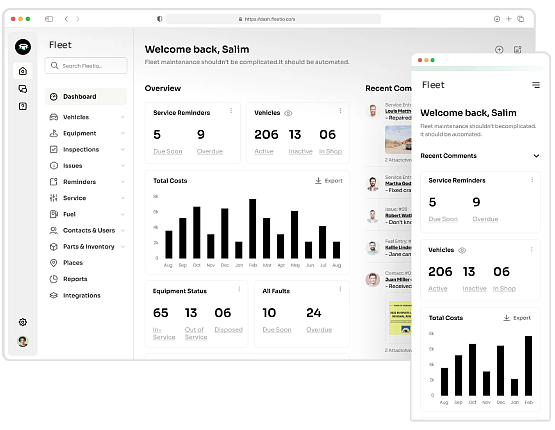

Fleet Management Software Development

Excellence and Expertise Trusted by Global Industry Leaders

  • Years of Technical Brilliance

    13+

    Years of Technical Brilliance

  • Fleet Solutions Delivered

    500+

    Fleet Solutions Delivered

  • Platform Uptime

    99.9%

    Platform Uptime

  • Real-Time Monitoring

    24/7

    Real-Time Monitoring

Fleet Management Software Development

Fleet Management Software Development for Every Vehicle Type

  • Commercial trucks & heavy-duty freighters
  • Passenger fleets
  • Aviation and marine vessels
  • Service & utility vehicles
  • Public transit & emergency response vehicles
  • Construction & Heavy Machinery
  • Reefers & waste management trucks
  • Non-motorized equipment (generators or containers)

Gain Control Over Your Fleets With a Feature-Rich Fleet Management App

Specialized Software Development Solutions for Fleet Management

  • Fleet Tracking Software

    Fleet Tracking Software

    The benefits of fleet tracking software include real-time tracking of vehicles like trucks, movements, and operational activity within the entire fleet. The features involved include GPS tracking, real-time vehicle tracking, tracking of routes taken by the vehicle, trips review, geofencing, location-based alerts, and dashboard of fleet management. Drawing from our experience developing Arriver Driver, businesses improve fleet efficiency and productivity through real-time tracking, intelligent route optimization, and enhanced vehicle utilization.

  • Maintenance Management Software

    Maintenance Management Software

    Proactive vehicle maintenance is made possible with maintenance management software by automatic scheduling and health check of the vehicles. Some of the features included are preventive maintenance management, management of services history, inspections, repairs history, management of warranties, and maintenance notifications. Proactive maintenance management assists in avoiding unforeseen mechanical failures, extending the life of the vehicle, reducing idle time and ensuring efficiency of the fleet.

  • Route Planning & Geofencing Software

    Route Planning & Geofencing Software

    The route planning & geofencing software development involves developing software which is useful for fleet optimization through reduction of driving time and fuel cost. This includes automatic route optimization, traffic navigation, multiple routes planning, dynamic scheduling, setting up virtual fences, and sending location-based alerts.

  • Fuel Management Software

    Fuel Management Software

    Fuel management software offers visibility of all aspects concerning the use of fuel. These features include fuel transactions, fuel cards, mileage, refuels, efficiency and fuel anomalies among others. Reports are offered in order to analyze any inefficiencies and prevent fuel wastage.

  • Driver Management Software

    Driver Management Software

    The driver management software integrates all employee monitoring activities into one software package. Its basic functions encompass driver profiles maintenance, licenses management, certifications management, attendance monitoring, scheduling shifts, allocating trips, assigning scores based on safety measures, and analyzing behavior. Insights gained from the driver’s performance in real-time enable safe driving habits, responsibility, and efficiency.

  • Compliance Management Software

    Compliance Management Software

    Compliance management software makes managing compliance related activities easier for the companies. Common modules include permits management, registration of vehicles, tracking insurance details, inspections recording, certification management, document management, and automatic renewal notifications.

  • Telematics Software

    Telematics Software

    Telematics solutions make use of multiple connected car solutions, IoT devices, and OBD systems to make sure that intelligent information on the fleet is generated. Vehicle data including engine performance, diagnostics, fuel economy, utilization rates, and even driver data is gathered and analyzed. The use of powerful analytical capabilities allows for better decision-making and helps optimize the performance of your fleet.

  • AI-Powered Fleet Monitoring Software

    AI-Powered Fleet Monitoring Software

    By utilizing artificial intelligence, predictive analysis, and machine learning, an AI-powered fleet monitoring software solution helps to gain operational intelligence. It provides the user with information about possible issues that may emerge in the course of operations. Predictive capabilities allow the software to analyze performance trends, diagnose potential problems with the car, predict risks associated with the driver, and estimate fuel efficiency.

Key Features to Integrate into Fleet Management Software Development

  • Real-Time Fleet Tracking
    Real-Time Fleet Tracking

    Keep track of the location and movements of your fleet vehicles via GPS tracking technology. Live tracking enables you to gain greater control over your fleet operations as well as allocate resources accordingly.

  • Intelligent Routing
    Intelligent Routing

    Apply automation to your route planning process by making use of live traffic updates, distance, timing of deliveries and availability of your vehicles. Efficient routing will save time and money and make managing fleets like buses, trucks, trailers, etc., smoother.

  • Geofencing and Location Alerts
    Geofencing and Location Alerts

    Draw virtual geofences around the selected locations and set up alerts for any entering, exiting, and straying from the assigned location. This function can really improve your safety and compliance within your fleet.

  • Vehicle Maintenance Management
    Vehicle Maintenance Management

    Control all aspects of your car's service records, schedules, and warranty issues using an easy-to-use fleet management tool. You will always be warned on time to prevent any sudden mechanical failures.

  • Fuel Management
    Fuel Management

    Track fuel consumption, mileage, fueling events, and other things related to fuel consumption and its efficiency. You will know how to optimize and cut expenses.

  • Driver Behavior Monitoring
    Driver Behavior Monitoring

    Evaluate the performance of drivers through their driving speeds, rough breaking, acceleration, idling, and adherence to route instructions. This will lead to efficient drivers.

  • Dispatch & Scheduling Automation
    Dispatch & Scheduling Automation

    Make the coordination of tasks within the fleet more efficient with the aid of automation in assigning jobs, dispatching vehicles like ambulances, allocating drivers, and distributing workloads.

  • Compliance & Documentation Management
    Compliance & Documentation Management

    Permits, registrations, insurance policies, certifications, inspections, and other regulatory compliance details need to be centralized. Automation will assist in ensuring that your vehicle(s) remain up to code and reduce some of your paperwork.

  • Telematics and IoT Connectivity
    Telematics and IoT Connectivity

    Connect all the systems of the vehicle(s) in question, as well as sensors and other onboard equipment, to generate live information about the operation of your vehicle(s). Telematics will enable you to get the status of the operation of your car, engine, fuel consumption, asset tracking, and much more.

  • Reporting and Analytics
    Reporting and Analytics

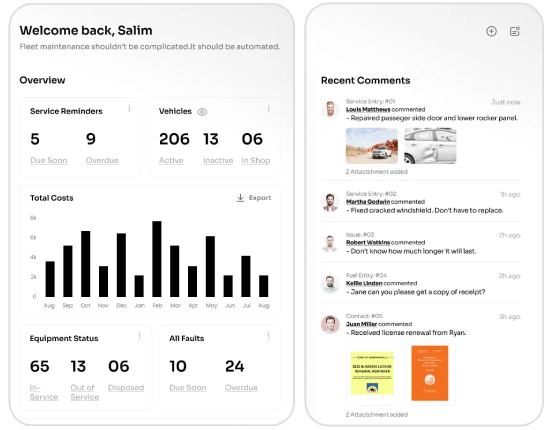
    Benefit from various insights provided by fleet analytics via customizable reports and dashboards. Fleet analytics provide you with an opportunity to perform a fleet performance analysis and evaluate how much you spend on fuel.

  • Predictive Insights Based on AI Technology
    Predictive Insights Based on AI Technology

    Take advantage of predictive analytics capabilities that use machine learning technology to forecast vehicle maintenance, fuel efficiency, routing, and more.

  • Vehicle and Asset Management
    Vehicle and Asset Management

    Build fleet management software to track your assets, including vehicles, trailers, containers, generators, tanks, and other heavy machinery.

  • Mobile Fleet Management
    Mobile Fleet Management

    Enable managers, drivers, and field personnel to access fleet information through mobile applications. Features such as real-time tracking, task updates, route information, and instant notifications improve operational flexibility.

  • Alerts & Notification System
    Alerts & Notification System

    Get notifications about the need for maintenance of the vehicles, deviations from the route, any unauthorized usage of vehicles, cases of speeding, abnormal fuel consumption, and other issues in time.

  • Multi-Fleet and Multi-Location Management
    Multi-Fleet and Multi-Location Management

    Organize vehicle management in one or several locations through a single administration panel that is responsible for overseeing all vehicles, employees, and assets.

Future-Proof Your Fleet Operations with a Centralized Fleet Management Ecosystem!

Common Fleet Management Challenges Suffescom Helps Overcome

G2 logo Design Rush 2025 Clutch 2025 Top App Development Companies
  • Lack of Real-Time Fleet Visibility

    Lack of Real-Time Fleet Visibility

    The handling of several vehicles from various sites may cause difficulties in controlling them. The use of fleet management tools makes it easier to track, monitor, and gain real-time access to information on how the fleet is performing at any given time.

  • Fuel Cost Increases

    Fuel Cost Increases

    Fuel prices contribute greatly to the running expenses of the fleets. Fuel monitoring allows the identification of fuel wastage and reduces unnecessary expenses.

  • Vehicle Breakdowns and Unexpected Failures

    Vehicle Breakdowns and Unexpected Failures

    A vehicle may experience mechanical failure, which would cause delays and affect efficiency. Maintenance services ensure timely checks to prevent failures.

  • Inefficient Route Planning

    Inefficient Route Planning

    Manual route planning typically leads to inefficiencies and hence causes delays, unneeded mileage gain, and high costs.

  • Safety Issues and Poor Driver Performance

    Safety Issues and Poor Driver Performance

    Reckless driving can lead to many problems for the company, including operational issues and increased maintenance costs. Tracking the performance of drivers enables firms to avoid accidents.

  • Management of Compliance Documents

    Management of Compliance Documents

    Manually recording permits, licenses, certifications, and other documents required to prove compliance may lead to inaccuracies and errors. A compliance manager will eliminate all difficulties associated with keeping track of relevant documents.

  • Low-Fleet Utilization Rate

    Low-Fleet Utilization Rate

    Inefficient operation makes it difficult for fleet operators to make optimal use of their assets. Utilization reports offer detailed data that is crucial for maximizing the benefits of one's fleet.

  • Manual Dispatch and Scheduling Processes

    Manual Dispatch and Scheduling Processes

    Manual coordination of drivers, vehicles, and routing can be time-consuming and add to the burden of administrative tasks. Automated fleet dispatching and scheduling improve productivity through better allocation of resources.

  • Fleet Theft and Unauthorized Access

    Fleet Theft and Unauthorized Access

    Fleet management would be very difficult without the means of tracking their movement constantly, thus leaving them vulnerable to any form of theft or misuse. GPS technology can provide better awareness and immediate intervention towards potential threats.

  • Lack of Business Intelligence

    Lack of Business Intelligence

    Dispersed information sources make it challenging for companies to make sound decisions based on accurate information. Analytics-based dashboard reporting tools compile relevant business intelligence into insightful reports.

  • Increasing Fleet Size and Complexity

    Increasing Fleet Size and Complexity

    Expanding a company's operations can lead to more complexities within its fleet. A scalable system for managing a fleet allows companies to manage a larger fleet with ease even as things get complicated.

Who Stands to Gain from Fleet Management Software?

Fleet management software adds value at all levels of fleet management by allowing decision makers to work faster, increase efficiency, and have full control over everything.

Role How Fleet Management Software Helps
Fleet Owners
  • Gain complete business visibility
  • Track operational costs and profitability
  • Monitor fleet utilization and asset performance
  • Access real-time business intelligence
  • Make data-driven investment decisions
Fleet Managers
Dispatchers
  • Coordinate operations with precision
  • Assign vehicles and drivers efficiently
  • Optimize routes and schedules
  • Monitor trip progress in real time
  • Respond quickly to operational changes
Drivers
  • Stay connected on the move
  • Receive trip assignments instantly
  • Access optimized routes and schedules
  • Report issues through mobile apps
  • Improve productivity and communication
Logistics Operators
  • Optimize transportation workflows
  • Improve delivery performance
  • Reduce delays and operational bottlenecks
  • Enhance resource allocation
  • Scale fleet operations efficiently
Maintenance Teams
  • Keep fleets road-ready
  • Monitor vehicle health and diagnostics
  • Manage preventive maintenance schedules
  • Track repairs and service records
  • Reduce unexpected downtime
Compliance Teams
  • Simplify regulatory management
  • Track permits and certifications
  • Manage inspections and documentation
  • Receive automated renewal reminders
  • Maintain audit-ready compliance records

The Framework Behind Successful Fleet Management App Development

Every high-performing fleet management platform is built on a proven framework that aligns business objectives with advanced technologies. Each stage contributes to creating a scalable and future-ready solution.

  • 1

    Discovery & Requirement Analysis

    Every successful fleet management solution begins with a thorough understanding of operational workflows, business objectives, fleet size, vehicle categories, compliance requirements, and integration needs. This phase establishes a clear development roadmap aligned with organizational goals.

  • 2

    Fleet Workflow Assessment & Solution Planning

    Existing fleet operations, dispatch processes, maintenance workflows, fuel management practices, and reporting requirements are analyzed to define system architecture, feature priorities, and scalability requirements.

  • 3

    UI/UX Design & Prototyping

    User-centric interfaces are designed to ensure seamless navigation across web and mobile platforms. Interactive prototypes and wireframes help visualize dashboards, fleet monitoring tools, reporting modules, and operational workflows before development begins.

  • 4

    Custom Software Development

    Core modules such as vehicle tracking, route optimization, maintenance management, telematics integration, compliance monitoring, analytics dashboards, and AI-powered capabilities are developed using scalable and secure technologies.

  • 5

    Integration & Connectivity

    The software is integrated with GPS devices, telematics systems, IoT sensors, mapping services, ERP platforms, fuel management systems, and third-party business applications to create a connected fleet ecosystem.

  • 6

    Testing & Quality Assurance

    Comprehensive testing validates system performance, security, functionality, scalability, and reliability across multiple devices and operating environments to ensure a seamless user experience.

  • 7

    Deployment & Implementation

    The solution is deployed within the desired infrastructure environment, followed by system configuration, user onboarding, data migration, and operational setup to ensure a smooth transition.

  • 8

    Continuous Support & Optimization

    Ongoing monitoring, feature enhancements, performance optimization, security updates, and technical support help ensure long-term system reliability and evolving business requirements are continuously addressed.

Technologies Powering Fleet Management Software Development Solutions

The following technologies enable seamless connectivity, high availability, and data-driven fleet management.

Enterprise-Grade Security Integrations for Fleet Management Software Development

Fleet management software handles large volumes of operational, vehicle, driver, and asset data, making security a critical component of every deployment. Enterprise-grade security measures help safeguard sensitive information, prevent unauthorized access, and ensure uninterrupted fleet operations across distributed environments.

Role-Based Access Control (RBAC)

Role-Based Access Control (RBAC)

Define user permissions based on roles and responsibilities, ensuring stakeholders can only access the data, modules, and functionalities relevant to their operational needs.

Data Encryption

Data Encryption

Protect fleet data during transmission and storage through advanced encryption protocols that help maintain confidentiality and prevent unauthorized data exposure.

Multi-Factor Authentication (MFA)

Multi-Factor Authentication (MFA)

Strengthen user authentication with additional verification layers that reduce the risk of account compromise and unauthorized system access.

Secure Cloud Infrastructure

Secure Cloud Infrastructure

Leverage enterprise-grade cloud environments designed to provide high availability, disaster recovery capabilities, secure data storage, and scalable performance.

Real-Time Threat Monitoring

Real-Time Threat Monitoring

Continuously monitor system activities, user actions, and network events to detect suspicious behavior and respond proactively to potential security threats.

Audit Trails & Activity Logs

Audit Trails & Activity Logs

Maintain detailed records of user activities, system changes, and operational events to support accountability, compliance requirements, and incident investigations.

Compliance & Regulatory Support

Compliance & Regulatory Support

Facilitate adherence to industry-specific regulations and internal governance policies through centralized documentation, record management, and compliance monitoring tools.

API & Integration Security

API & Integration Security

Secure communication between fleet management software and other platforms such as GPS devices, telematics systems, ERP solutions, and IoT networks through protected third-party API integrations and authentication mechanisms.

Automated Data Backups & Disaster Recovery

Automated Data Backups & Disaster Recovery

Ensure business continuity through scheduled backups, data redundancy, and disaster recovery strategies that minimize downtime and data loss risks.

Secure Mobile Access

Secure Mobile Access

Enable fleet managers, drivers, and field personnel to securely access critical fleet information through protected mobile applications with authentication and access-control safeguards.

Continuous Security Updates

Continuous Security Updates

Maintain a resilient security posture through regular vulnerability assessments, security patches, software updates, and proactive automated risk assessment solutions.

Why Businesses Trust Suffescom for Fleet Management Software Development

Building a high-performing fleet management solution requires more than technical expertise, it demands a deep understanding of fleet operations, connected technologies, and evolving industry requirements. Suffescom combines innovation, industry knowledge, and scalable development practices to deliver fleet management software that drives measurable operational outcomes.

  • 13+ Years of Development Excellence

    Since 2013, delivering scalable AI-powered software development solutions that help businesses streamline operations, automate workflows, and improve operational efficiency. Extensive development expertise enables the creation of reliable fleet management platforms tailored to evolving business requirements.

  • 220+ Technology Experts

    Backed by a multidisciplinary team of developers, solution architects, UI/UX designers, QA engineers, and technology consultants focused on building high-performance, user-centric fleet management applications.

  • AI, IoT & Telematics Expertise

    Leveraging intelligent technologies to enable real-time vehicle tracking, predictive maintenance, route optimization, driver performance monitoring, and connected fleet ecosystems powered by actionable data.

  • Built for Real-Time Fleet Operations

    Developing solutions that support every aspect of fleet management, including vehicle tracking, dispatching, route planning, fuel monitoring, maintenance scheduling, compliance management, and fleet analytics.

  • Seamless Third-Party Integrations

    Enabling smooth connectivity with GPS devices, telematics platforms, fuel management systems, mapping services, ERP software, accounting tools, and other business-critical applications to create a unified operational environment.

  • Scalable, Secure & Future-Ready Solutions

    Building cloud-native platforms with enterprise-grade security, flexible architecture, and high-performance infrastructure capable of supporting evolving technology like EV fleets, automated dispatch management, and increasing operational demands.

Transform Fleet Operations with Custom Fleet Management Software Development!

Ready to modernize your fleet operations? Connect with an expert fleet management software development company like us to discuss your requirements today.
Frequently Asked Questions

  • What is fleet management software?

    Fleet management software is a centralized platform that helps organizations monitor, manage, and optimize vehicles, drivers, assets, maintenance schedules, fuel consumption, compliance activities, and overall fleet operations through real-time insights and automation.

    How much does fleet management software development cost?

    The cost of developing a fleet management software depends on several factors, including feature complexity, fleet size, mobile application requirements, AI capabilities, telematics integrations, third-party connectivity, and deployment infrastructure. A basic MVP application typically ranges between $35,000 and $90,000 and varies as the project complexity rises.

    How long does it take to develop fleet management software?

    Development timelines vary based on project requirements and customization levels. A basic fleet management solution may take 3-6 months, while enterprise-grade platforms with advanced analytics, AI features, telematics integration, and mobile applications can require 9-12 months.

    What features should a fleet management software solution include?

    Core features typically include real-time vehicle tracking, route optimization, geofencing, maintenance management, fuel monitoring, driver performance tracking, dispatch management, compliance management, analytics dashboards, and mobile accessibility.

  • Can fleet management software integrate with GPS and telematics systems?

    Yes. Modern fleet management software can integrate with GPS tracking devices, telematics systems, IoT sensors, onboard diagnostics (OBD) devices, fuel monitoring systems, and third-party fleet technologies to provide comprehensive operational visibility.

    Which industries can benefit from fleet management software?

    Fleet management software is widely used across logistics and transportation, delivery services, construction, mining, utilities, public transportation, healthcare, waste management, field services, agriculture, and enterprise fleet operations.

    Can fleet management software track non-powered assets?

    Yes. In addition to vehicles, fleet management solutions can monitor and manage non-powered assets such as trailers, containers, generators, tanks, heavy equipment, and other operational assets through asset tracking capabilities.

    Why choose custom fleet management software over off-the-shelf solutions?

    Custom fleet management software offers greater flexibility, scalability, AI integration capabilities, and feature customization tailored to specific business processes. Unlike off-the-shelf products, custom solutions can be designed to address unique operational requirements and support long-term business growth.

x

Beware of Scams

Don't Get Lost in a Crowd by Clicking X

Your App is Just a Click Away!

Fret Not! We have Something to Offer.