+971-8000321216



Key Takeaways
- AI is highly beneficial for automating repetitive claims processes and reducing manual labor.
- Claims platforms can use AI for document processing, fraud detection, damage estimation, claim routing, and decision-making.
- Implementing AI in claims processing does not necessarily mean a zero-touch claims process; humans still play an integral role in handling complex claims.
- AI insurance claims software development costs depend on the platform's scope and the complexity of the AI, and range from $30K to $400K+.
- Enterprise-grade platforms require 6-12 months+ of development, with the phases overlapping.
- Security, compliance, AI governance, and auditability must be core components of the platform.
- Successful AI claims transformation is dependent on data quality, legacy integration, human interaction, and model monitoring.
- Insurers can build an MVP first, then increase automation, AI, and integration over time.
Processing insurance claims becomes a challenge to do at scale. Processors have to deal with numerous documents, images, policy information, fraud checks, adjusters' decisions, and communication with customers, usually across several systems. This leads to manual review and disconnected processes, increasing the risk of slower claim processing, higher operating costs, and claim leakage.
Research conducted by McKinsey in 2025 shows how insurers apply AI to manage claims, detect fraud, analyze documents, route, and make decisions. For instance, Aviva used more than 80 AI models in its claims process, reducing complex liability assessment time by 23 days, increasing accuracy in claims routing by 30%, and saving more than £60 million due to its motor claims transformation in 2024.
In this guide, you will learn about the design and deployment of the AI Insurance Claims Processing Platform, including its features, AI technologies, architecture, integration, security and governance, development cost, timeline, implementation process, and future trends.
What Is an AI Insurance Claims Processing Platform?
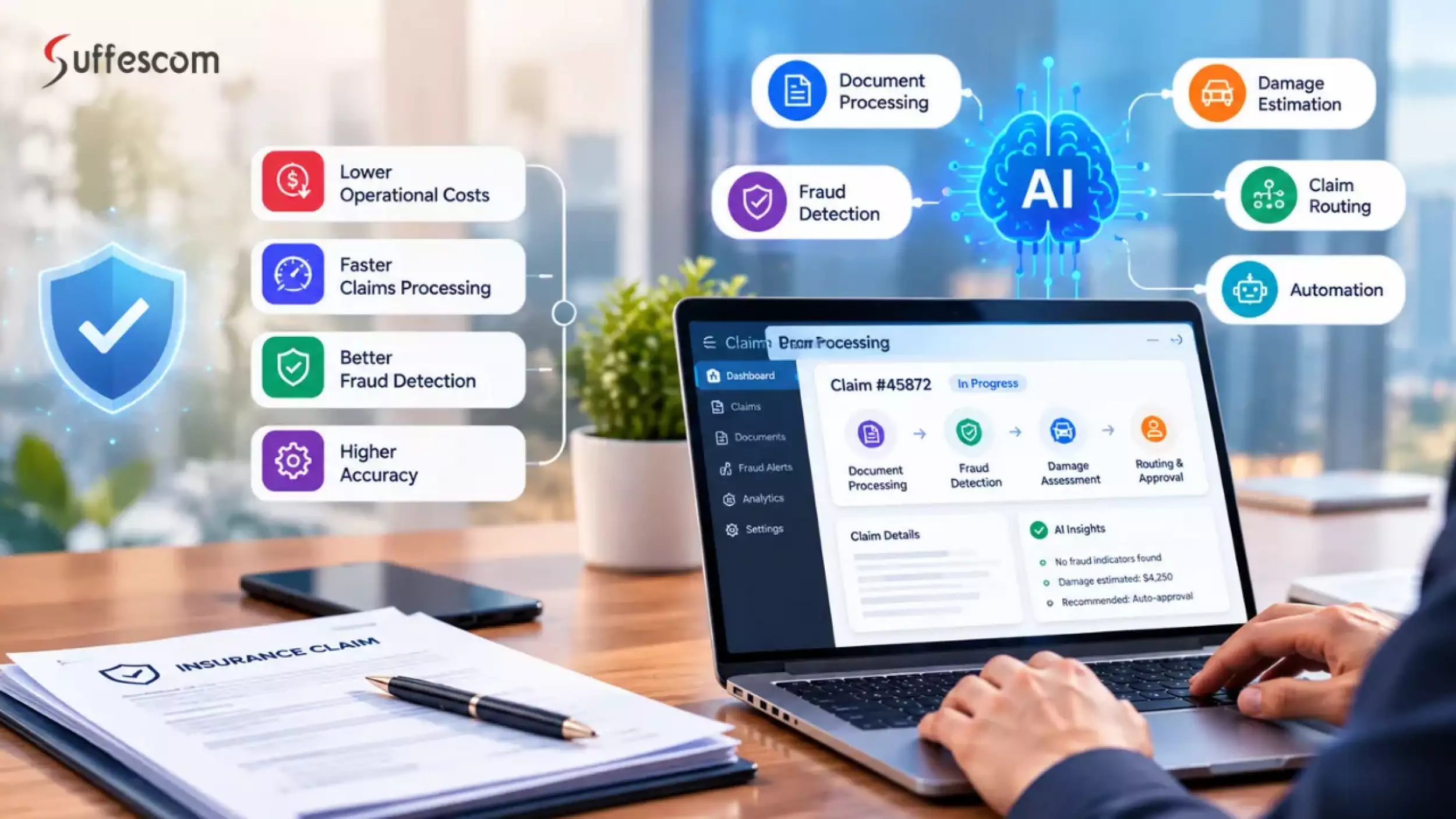
An AI insurance claims process automation tool is software that uses artificial intelligence to support and automate various processes across the claims lifecycle. Such a platform may perform functions such as gathering information about the claim, extracting data from documentation, verifying the insured's coverage, classifying claims, detecting any possibility of fraud, assessing damages, and assisting adjusters with faster decision-making.
How AI Insurance Claims Processing Works
The platform integrates all claim processes under a single, coherent process flow. The claim flow begins with the report of a loss from the policyholder using First Notice of Loss (FNOL), and it proceeds through claim intake, document processing, policy validation, claim classification, risk analysis, damage assessment, claim adjudication, approval, settlement, and claim closure.
The AI technology helps to complete the claim processes through information extraction from the claim documents, validation of the policies and coverages, detection of any unusual patterns, image damage assessment, and creation of claim summaries. Depending on the risk and complexity of the claim, the process flow can either be automatic or manual.
AI Claims Processing vs. Traditional Claims Processing
Here is how AI claim processing enables smarter claim processing in comparison to traditional processing:
| Factor | Traditional Processing | AI-Powered Processing |
| Data entry | Manual | Automated |
| Document review | Manual | AI + assisted |
| Claim routing | Rule-based/manual | AI + rules |
| Fraud detection | Investigator-led | ML-assisted |
| Damage assessment | Manual | Computer vision |
| Claim summarization | Manual | Generative AI |
| Decision support | Limited | Predictive analytics |
| Human involvement | High | Risk-based |
Key Stakeholders
An AI claims platform connects the teams and parties involved in the claims lifecycle, including:
Policyholders — Submit claims and track their status.
Claims adjusters — Review claims, assess losses, and handle exceptions.
Claims examiners — Validate claims and support approval decisions.
Underwriters — Use claims insights to understand risk and policy performance.
Agents and brokers — Support policyholders and claims communication.
Fraud investigators — Review claims flagged as potentially suspicious.
Repair and service providers — Receive assignments and share estimates or service updates.
TPAs — Process claims on behalf of insurers.
Finance and payment teams — Manage approved settlements and payments.
Make Claims Processing Faster With AI
Automate repetitive claims tasks, support adjusters, and improve processing efficiency with a platform built around your workflows.
Why Insurance Companies Are Adopting AI for Claims Processing
The McKinsey study on insurance in 2025 revealed that top-performing companies applying AI-enabled platform development managed to improve claims accuracy by 3–5%. The report also brings into focus actual claims transformations through AI technology.
Increase in Number of Claims
An increase in the number of claims translates to an increase in the number of forms, documents, images, assessments, and interactions that the claims team has to handle. The use of AI will enable the insurer to handle high volumes of information without having to expand manual labor.
Customer Expectation for Fast Claim Handling
There is a growing customer expectation where there is a need to have their claim be submitted digitally and handled without unnecessary delays. AI can automate processes and ensure that responses are fast throughout the claim handling process.
Decreasing Manual Claim Processes
The claims team spends a lot of time on manual processing of data input, reviewing documents, requesting additional information, and doing routine administrative actions. AI will enable automation of such manual actions.
Increasing Adjuster Efficiency
Adjusters require a lot of information regarding the policies, the claims, risks involved, and damage analysis, among other things. With AI, all such information can be presented in one interface.
Faster Claims Processing
AI can help expedite many aspects of the claims management process, including intake, sorting, coverage, damage evaluation, and routing. Low-complexity claims can proceed through automated processes, while high-complexity claims get routed to humans for assessment.
Earlier Detection of Fraud
Through machine learning, claims and policy history, documentation, and behavioral analysis can flag anomalous behavior without having to wait until manual review uncovers any problems with the claim.
Avoiding Claims Leakage
Leakage can take place through improper payment, missed policy requirements, inconsistencies in damage assessments, and inefficiencies within the claims handling process. AI can compare claims information to policy terms and historical patterns to try to reduce leakage.
Better Claims Decisions
AI can use predictive analytics and computer vision technology to evaluate large amounts of structured and unstructured data to make better claims decisions.
Enabling Real-Time Visibility of Claims
The AI-enabled platform will allow real-time claim visibility in terms of claim status, workflow process, documents, risks, and processing metrics. The result is enhanced claim visibility for adjusters, managers, and other teams who have access to the platform.
How to Develop an AI Insurance Claims Processing Platform
Creating an AI-based platform for insurance claims processing entails more than integrating the AI models into the existing insurance claims processing system. The platform should tie together several elements into one cohesive system while still allowing human decision-making in places that demand such expertise. Modular design will help make reusability of AI functionality possible.
Step 1: Analyze Existing Claims Processes
- Map out the claim handling process as it is done now, from FNOL (First Notice of Loss) to settlement and closeout.
- Look for manual steps, delayed approvals, duplication of data entry, claims leakage, system transfers, and time spent by adjusters on various activities.
- Assess existing policy administration, claims, CRM, billing, document management, and payments systems. This will give an idea of the amount of data and integration that will be involved.
- Talk to claims managers, adjusters, examiners, fraud groups, IT people, and other interested parties to see where AI can be applied.
- Compare KPIs, such as claims cycle time, time spent manually, accuracy of settlements, leakage, degree of automation, and escalations.
These serve as the basis for measuring results of implementing the new system.
Step 2: Define AI Claims Processing Requirements
Translate the insights of the process into functional, AI, integration, security, and reporting requirements. Identify those capabilities that will provide value in the initial release.
| Requirement | Priority | Example |
| Digital FNOL | Must-have | Online claim submission |
| Automated intake | Must-have | AI-powered data extraction |
| Policy verification | Must-have | Automated coverage checks |
| Claims routing | Must-have | Intelligent assignment |
| Document processing | Must-have | OCR + NLP |
| Fraud detection | High | ML risk scoring |
| Damage assessment | High | Computer vision |
| Claims summarization | High | GenAI |
| Predictive analytics | High | Severity prediction |
| Customer portal | High | Claim status |
| Adjuster copilot | High | AI recommendations |
| Mobile claims | Medium | Field adjusters |
| IoT/telematics | Optional | Connected vehicle data |
Step 3: Design the AI Claims Platform Architecture
Design the architecture to fit within the existing insurance ecosystem, rather than developing yet another standalone application. A middle application and integration layer can help integrate legacy claims systems with customer applications and AI services.
The architecture usually involves:
| Layer / Module | Primary Functions & Components |
| Frontend | Customer portal, mobile app, adjuster dashboard, and admin interfaces |
| Claims Application Layer | Claim creation, case management, policy checks, settlement, and user management |
| Workflow Engine | Manages claim stages, routing, approvals, escalations, and notifications |
| AI/ML Services | Document intelligence, fraud detection, prediction, computer vision, and GenAI |
| Rules Engine | Applies coverage rules, business policies, thresholds, and approval conditions |
| API Layer | Connects internal insurance systems and third-party services |
| Data Layer | Stores claims, policy, customer, document, model, and audit data |
| Analytics | Provides operational dashboards, KPI tracking, and predictive insights |
| Security | Identity management, encryption, access controls, monitoring, and audit trails |
| Cloud app development | Provides scalable compute, storage, AI workloads, backups, and disaster recovery |
Step 4: Build the MVP
The MVP needs to concentrate on the core claims journey process and not attempt to automate all claim types simultaneously. An achievable MVP may involve:
- FNOL
- Claims submission
- Documents processing
- Policy validation
- Claim process
- Adjuster dashboard
- Basic AI functionalities
- Notifications
- Reporting
Initial AI functionalities may involve high-volume and repetitive processes like document extraction, claim categorization, summarization, and basic risk scoring.
Step 5: Integrate Core Insurance Systems
Data from policy, client, payments, and claims will be needed for AI-based claims processing. Integrate the AI solution with the current systems utilized by the insurance company rather than expecting people to operate different systems.
Some important integrations might include:
| External System / Integration | Primary Functions & Data Exchanged |
| Policy Administration Systems | Manages coverage details and core policy information |
| CRM Platforms | Tracks customer profiles, history, and interactions |
| Billing Systems | Handles premium details, account status, and financial records |
| Payment Gateway Integration | Executes disbursements for claim settlements and payouts |
| Document Management Systems | Stores and organizes policy documents and claim files |
| Identity Providers | Manages user authentication, single sign-on, and access control |
| Fraud Databases | Cross-references risk indicators and investigation signals |
| Third-Party Data Providers | Supplies external valuation, weather, and claim context data |
| Repair / Vendor Networks | Coordinates estimates, work assignments, and service updates |
| Telematics Platforms | Collects connected vehicle data, crash metrics, and driving insights |
Step 6: Implement Claims Workflow Automation
Combine the use of business rules and AI to automate repetitive workflow decisions. A rules-based system can handle deterministic constraints, while AI assists with classification, predictions, extraction, and suggestions.
The platform can automate:
- Claim assignment
- Priority classification
- Document requests
- Missing information identification
- Escalation
- Adjuster routing
- Approvals workflows
- Settlement workflows
A claim with all documents in place, appropriate coverage, low severity, and a low risk of fraud can be handled automatically. Claims with uncertainties, high value, or other abnormalities can be assigned to an experienced adjuster.
Step 7: Integrate AI Models
Select AI technologies based on specific claims problems rather than using one model for the entire workflow.
| Capability / AI Technology | Primary Functions & Use Cases |
| NLP | Extracts information from claim descriptions, notes, emails, and unstructured text |
| OCR & Intelligent Document Processing | Converts forms, invoices, reports, and scanned documents into structured data |
| Machine Learning | Classifies claims, predicts severity, identifies patterns, and supports routing |
| Computer Vision | Analyzes vehicle, property, or physical damage images and videos |
| Predictive Analytics | Estimates claim severity, settlement risk, processing duration, and escalation needs |
| Generative AI | Summarizes claim histories, drafts customer responses, assists adjusters, and explains contextual information |
| Fraud Detection Software | Identifies anomalous patterns, red flags, and calculates fraud risk scores |
| Recommendation Models | Suggests optimal next actions, adjuster assignments, vendor routing, and resolution paths |
Step 8: Implement Human-in-the-Loop Workflows
AI should not decide on its own regarding every claims decision. Clearly defined thresholds will enable you to define when a claim needs to be decided through an automatic process and when it must be reviewed by a human.
Low-risk claims can be processed automatically; on the other hand, high-risk, valuable, complex, or fraud-related claims need to be sent to an adjuster or examiner. Humans must be allowed to override AI and justify their decision.
It is this combination of machine and human that enables insurance companies to leverage automation advantages without stripping expert decision-making out of claims decisions.
Step 9: Test AI, Security and Compliance
Testing should cover both conventional software quality and AI-specific risks before the platform handles production claims.
Test for:
| Evaluation Focus / Metric | Primary Testing & Validation Scope |
| AI Accuracy | Checks extraction, classification, prediction, and recommendation quality |
| Bias | Evaluates whether model outcomes differ unfairly across relevant customer or claim groups |
| Model Performance | Monitors precision, recall, confidence scores, and other model-specific measures |
| Data Security | Tests encryption protocols, access controls, data handling, and storage safety |
| API Security | Validates authentication, authorization, input validation, and rate controls |
| Workflow Accuracy | Verifies that claims consistently follow the correct automated business paths |
| Claims Decision Consistency | Compares AI-assisted decisions against approved business rules and expert human outcomes |
| Auditability | Maintains traceable records of inputs, model outputs, human decisions, overrides, and key workflow events |
Step 10: Run a Controlled Pilot
Before implementing the tool across the organization, implement it in a limited scope. Possible implementation scope includes:
- One type of insurance policy
- One geographic area
- Limited types of claims
- Limited adjusters
- Key performance indicators (KPIs)
Compare implementation results against the baseline identified through process analysis. These will include processing time, automation percentage, AI accuracy, escalation rate, claims leakage, adjuster efficiency, and customer satisfaction.
Step 11: Deploy and Scale
Once the pilot passes the set KPIs, gradually roll out the platform to other products, regions, claims, AI models, and integrations.
Adopt a modular approach where the platform can be expanded to incorporate new features without having to rebuild the whole thing. AI services, APIs, workflows, and data pipelines that can be reused as adoption grows can minimize duplication.
Step 12: Continuously Monitor and Optimize
Monitor model and claims performance to identify when models need retraining or replacement, adjust confidence thresholds, improve processes, and identify additional automation opportunities. McKinsey states that successful AI implementations involve feedback and monitoring to improve models and spot performance deterioration over time.
- Model drift
- AI accuracy
- False positives
- False negatives
- Claims cycle time
- Automation ratio
- Human escalation ratio
- Customer satisfaction
Plan Your AI Claims Platform With Clarity
Get expert guidance on the right features, AI capabilities, integrations, development timeline, and investment for your platform.
AI Technologies Used in Insurance Claims Processing
A process automation system for handling insurance claims using AI can use several different types of AI in order to automate tasks that involve repetition, make decisions on claims, and increase the productivity of the adjusters. Every type of AI is designed to perform a certain function.
AI-Assisted FNOL
The use of AI can streamline the FNOL process by collecting claim information through online forms, chat, voice, or mobile apps. This will involve identifying missing information, structuring the information provided by the claimant, and creating an initial claim file without manual data entry.
Intelligent Document Processing
This involves the extraction and organization of information from various types of documents like claim forms, invoices, repair estimates, medical information, police reports, etc. This can help the system classify documents, identify fields of interest, validate the information collected, and feed the extracted data to the relevant claims workflow.
OCR and NLP
OCR technology scans paper and image documents and converts them to machine-readable text, whereas NLP helps the platform make sense of the text information and provide relevant meanings.
Damage Assessment Using Computer Vision
Computer vision technology can be used to analyze images and video files provided along with claims to identify damages visible in the media. In the case of vehicle insurance and property insurance, computer vision can be used to detect damaged components and assess the severity of the damages.
Fraud Detection Using Machine Learning Algorithms
Machine learning algorithms can be used to analyze the claims history of customers, documents, transactions, and other data to detect abnormal behavior. Instead of conducting the whole process manually, the system can automatically assign a probability score to every claim that is likely to be fraudulent.
Severity Prediction for Claims
Predictive models can be developed to predict the cost or complexity of a certain claim or the amount of time required to process it. Such predictions can be used by the insurance company to handle the claims process more efficiently.
Claims Triage and Routing by AI
AI is capable of categorizing claims based on their severity, complexity, urgency, potential fraud, and needed expertise. This way, the platform decides the proper workflow and sends the claim to an automated procedure, claims adjuster, expert, or investigation.
AI for Generative Claims Summarization
Generative AI can combine various pieces of information from different claims sources into a unified picture that will be available to the adjuster and the examiner. It can unite all the FNOL data, policy data, documents, correspondence, notes, and evaluation results without forcing a user to read every source separately.
Coverage Analysis by AI
AI is capable of analyzing policy wording, endorsements, exclusions, deductibles, and claim data to find out which coverage provisions can be used. It is able to show what policy provisions apply and provide additional information about them but keeps the final decision under the human’s control.
Conversational AI for Policy Holders
Conversational AI can assist policyholders in submitting data, checking the status of their claims, knowing what documents are necessary, and receiving updates through web and mobile portals. The technology can answer routine inquiries on its own, while more complicated requests will be forwarded to a claims representative.
Generative AI Copilots for Claims Adjusters
The AI copilot can give claims adjusters claim summaries, information about the policy, document insights, actions to take, and customer correspondence suggestions. It will save time spent by adjusters on searching for relevant information in various systems.
Agentic AI for Insurance Claims
An agentic AI platform is capable of performing a series of interconnected tasks under certain permissions and business rules. In addition to giving the response, an AI agent will be able to collect missing data, access certain systems, analyze claim data, make recommendations, and launch an approved process.
As an illustration, the agentic claims process may be as follows:
- Receive the claim.
- Determine whether all the necessary data are present.
- Obtain the missing data from the customer or other systems.
- Gather policy and coverage data.
- Perform the analysis of the documentation and claim information.
- Evaluate the risks and complexity of the claim.
- Make recommendations on further actions.
- Forward the claim for human evaluation if necessary.
Human-in-the-loop AI
The human-in-the-loop concept integrates AI-based automation with an expert review. Low-risk and simple claims can be processed via an automated workflow, whereas high-risk, high-value, complicated, or potentially fraudulent claims can be passed to adjusters or examiners.
The platform will also allow authorized users to review AI-generated results, override the recommendations, give feedback, and document important decisions.
Explainable AI for Claim Decisions
Explainable AI assists claim teams in understanding why an AI model generated a specific prediction, classification, or recommendation. The platform will present relevant information, factors, probabilities, and details of AI-driven decisions so that users can evaluate them.
Monitoring and Governance of AI Models
AI models require monitoring during their life cycle. Insurers must monitor the model accuracy, drift, false positives, false negatives, data quality, bias, human overrides, and changes in business outcomes.
Governance of AI models should also define which people have approval authority to use a model, adjust thresholds, access AI results, override recommendations, and decommission inefficient models.
Key Features of an AI Insurance Claims Processing Platform
Key functionalities must support the entire claims life cycle while enabling insurance companies to automate certain tasks and manually review others.
| Feature | Purpose |
| Digital FNOL | Capture claims digitally |
| AI claims intake | Automate data extraction |
| Policy verification | Check coverage |
| Intelligent routing | Assign claims automatically |
| Document processing | Extract information from documents |
| Adjuster dashboard | Manage workloads |
| Fraud detection | Identify suspicious claims |
| Computer vision | Assess visual damage |
| AI claims summarization | Reduce review time |
| Claims workflow automation | Automate repetitive tasks |
| Customer portal | Track claim status |
| Notifications | Provide updates |
| Payment management | Manage settlements |
| Analytics | Track claims KPIs |
| Audit trails | Support compliance |
| RBAC | Control access |
Role of Each AI Feature in Claim Processing
- Digital FNOL – Enables digital claim filing and the recording of loss information, client information, and other evidence.
- Claim Intake Automation – Enables faster claim creation through the gathering, validation, and structuring of information from various sources such as forms, documents, images, and connected systems.
- Intelligent Claim Routing – Enables automatic routing of claims based on claim features and complexity.
- AI Claims Adjuster Dashboard – Provides the adjuster with a dedicated workspace to view claim information, documents, alerts, and other information provided by AI.
- Automated Policy and Coverage Verification – Helps in quicker verification of coverage information through comparison of claim information with policy limits, deductibles, and exclusions.
- Intelligent Document Management — Supports document management, document extraction, searching, and tracking of documents relevant to claims.
- Fraud Detection and Investigation — Helps identify and investigate suspicious claims with the help of identifying patterns and risk factors.
- AI Damage Assessment — Helps claims adjusters assess physical damage using submitted photos and videos along with other claim data.
- Claims Analytics — Helps keep track of claim numbers, time taken to process claims, value of settlements, workload, degree of automation, etc.
- Payment and Settlement Management — Helps manage payments and settlements through financial system integrations.
- Customer Self-Service — Enables policyholders to provide documentation, respond to inquiries, track claim status, and receive updates without interacting with the agent for every action.
- Audit Trail & Compliance Reporting — Enables accountability through keeping audit trails for significant claim activity, approval of claims, AI recommendations, user activity, overrides, and settlements.
- Role-Based Access Control — Enables access security by providing adjusters, examiners, investigators, managers, finance department personnel, and administrative users with role-based permissions.
Advanced AI Features for Insurance Claims Processing
Advanced AI functionalities build on the existing claims platform by providing enhanced automation, prediction, and decision-making support. These features work best when the insurer has claims data, system integration, and review processes in place.
| AI Capability | Claims Use Case | Business Impact |
| Machine Learning | Fraud scoring | Better investigations |
| Intelligent Document Processing | Complex claim documents | Faster processing |
| Computer Vision | Damage assessment | Faster estimates |
| Predictive Analytics | Severity prediction | Better reserves |
| Generative AI | Adjuster assistance | Higher productivity |
| Agentic AI | Multi-step workflows | Lower manual effort |
How These Advanced Features Add Value to the Platform
Fraud Scoring Using Machine Learning
Fraud scoring using machine learning helps detect claims that may require further investigation by using models to analyze claim history, customer information, transactions, and other risk factors to generate a risk score for review.
Document Processing Using Intelligent Systems
Document processing using intelligent systems is helpful for claims where there are many different documents to be handled. These systems can help in classifying the documents, extracting information from them, comparing details, and finding inconsistencies.
Damage Assessment Using Computer Vision
Computer vision is useful in providing better analysis of the images and videos related to damage. This can help in identifying the damage, classifying the damaged parts, and assessing the damage information.
Predictive Claims Analytics
Predictive analytics helps in making future-oriented decisions for claims with respect to estimating possible risks, severity, cost, processability, or any other parameter. This information helps the claims team prepare for reserves and prioritize claims. Predictive analytics is a mature AI application in the insurance industry, including fraud detection and risk modeling.
Claims Copilot
The generative AI claims copilot helps the claims adjuster make sense of information related to the claims being handled. This can be used to get answers to questions, look for information, generate correspondence, determine next actions, and manage information from different sources of claims.
Claims Summary Automation
Claims summary automation enables rapid analysis of claims file information. This can be done by creating summaries of claims notes, claims documents, claim correspondence, insurance policy details, and assessment outcomes.
Coverage Analysis through AI
The coverage analysis through AI allows the review of policy language and claims circumstances. The technology is capable of identifying any potentially relevant coverage language, exclusions, limits, deductibles, and conditions, which can be further analyzed by authorized claims specialists.
Intelligent Claims Triage
The intelligent claims triage will allow more effective claims segmentation according to complexity, severity, risk, and other characteristics. The platform will identify those claims that require straight-through or low-touch handling while sending the rest to the appropriate claims specialists.
Agentic AI Claims Automation
Agentic AI will enable multi-step claims workflows by allowing an AI agent to complete predefined tasks on multiple connected platforms. The agent will gather information, obtain authorized data, analyze the claim, make recommendations, and start the next approved workflow step.
It is different from an AI assistant since the agent performs a series of tasks in a predefined permission and control environment. Agentic AI is still a developing concept in insurance, with insurers researching its application to handle workflow execution autonomously.
AI Explainability and Bias Monitoring
AI explainability and bias monitoring allow for the responsible use of sophisticated models in claims management. The system is capable of providing reasons behind the decisions made by models, monitoring their performance with respect to different groups, detecting any instances of bias, and alerting about suspicious model behavior.
AI Insurance Claims Processing Platform Architecture
Modern insurance claims software development should unify claims processing, AI services, insurance systems, the data platform, and security. A modular design would make integrating AI into existing insurance systems simpler and enable scaling modules based on claims volume.
| Architecture Layer | What It Supports | Key Components |
| Frontend Layer | Customer and employee interactions | Web portal, mobile app, adjuster dashboard, admin portal |
| Claims Application Layer | Core claims operations | Claim creation, claim records, assessments, approvals, settlements |
| Workflow and Rules Engine | Claims process automation | Business rules, routing, approvals, escalations, task management |
| AI/ML Layer | AI-powered claims intelligence | ML models, NLP, computer vision, GenAI, fraud models, prediction |
| API and Integration Layer | Connectivity with insurance systems | API gateway, REST APIs, integration services, authentication |
| Data and Analytics Layer | Claims data management and insights | Data lake, databases, data pipelines, BI, real-time analytics |
| Security Layer | Protection of claims and customer data | IAM, RBAC, encryption, API security, audit logs, monitoring |
| Cloud Infrastructure | Scalability and system availability | Cloud services, containers, Kubernetes, serverless, storage, backups |
| MLOps and Monitoring | AI model lifecycle management | Model deployment, versioning, monitoring, drift detection, retraining |
Technology Stack for AI Insurance Claims Processing Software
It is not possible to identify a single best set of technologies for developing AI-based insurance claims processing software. Selection must be based on the insurer's legacy system, integration needs, security architecture, team capabilities, data environment, and scale expectations. The objective is to select technologies that work well within the insurer's ecosystem, not just popular ones.
| Layer | Possible Technologies |
| Frontend | React, Angular, Vue |
| Mobile | Swift, Kotlin, React Native, Flutter |
| Backend | Java, .NET, Node.js, Python |
| Database | PostgreSQL, MySQL, MongoDB |
| AI/ML | Python, TensorFlow, PyTorch |
| NLP | Python NLP frameworks, LLM APIs |
| Computer Vision | OpenCV, deep learning frameworks |
| APIs | REST, GraphQL |
| Messaging | Kafka, RabbitMQ |
| Cloud | AWS, Azure, Google Cloud |
| Analytics | Power BI, Tableau |
| Security | OAuth 2.0, OIDC, encryption, RBAC |
| DevOps | Docker, Kubernetes, CI/CD |
| MLOps | Model versioning, monitoring, drift detection |
How Much Does It Cost to Develop an AI Insurance Claims Processing Platform?
Developing an AI insurance claim processing system will require costs that depend on the size of the claims process and some other variables as described below. An MVP for a claims process system will be much cheaper to develop than an enterprise-level system with AI models and legacy systems.
AI Insurance Claims Platform Development Cost Overview
| Platform Type | Indicative Development Cost |
| Basic claims MVP | $30K–$90K |
| Mid-level claims platform | $90K–$200K |
| Enterprise claims platform | $200K–$400K+ |
Factors Affecting Development Cost
- Platform Complexity: The platform to support simple FNOL and claims ingestion will be cheaper compared to a more complicated platform that supports full adjudication, fraud investigations, settlement, analytics, and AI-based decision-making.
- Claim types: Motor, property, health, travel, commercial, or other claim types may involve different business logic and processes.
- AI complexity: Simple document extraction and classification is easier to develop compared to more sophisticated tools such as fraud models, computer vision, analytics, GenAI copilots, and agentic AI.
- Number of integrations: Each integration with policy administration, customer relationship management, billing, payments, document management, fraud database, repair network, or external data providers will add to development and testing needs.
- Legacy system intricacy: Legacy systems might need custom APIs, middleware, data conversion, batch integrations, or other modernizations before supporting real-time AI-driven claim processing.
- Regulatory compliance needs: Compliance issues around data security, auditing, access control, model governance, storage retention, and regional regulations might raise architecture, development, and testing needs.
- Scope of Geography: It is easier to support one market than multiple markets in different countries with different currencies, policies, languages, procedures, etc.
- Data volume: A huge dataset of claims would require more storage capacity, infrastructure for processing, pipelines for data, data quality efforts, and model training facilities.
- Cloud Infrastructure: Costs would increase due to more claims, higher AI workloads, data storage, real-time processing, disaster recovery, and high availability needs. There would also be usage-based costs in case of AI workloads.
- Location of the development team: The speed of development varies with regions and development team composition. The price may differ based on whether the insurer uses its own development team, an offshore development team, AI experts, or both.
- Testing needs: AI accuracy test, security test, integration test, performance test, model validation, bias testing, and user acceptance testing may be required in an enterprise deployment.
What Drives the Difference Between the Cost Tiers?
The cost range increases as the platform moves from a focused claims MVP solution to a full enterprise solution with more workflows, integrations, automation, governance, and advanced AI capabilities.
- $30K-$90K: Narrow MVP including only core claims intake, workflow, some integrations, and selected AI features.
- $90K-$200K: Expanded claims workflow with customer and adjuster portals, many integrations, analytics, and additional automation.
- $200K-$400K+: Full enterprise claims platform with various claim types, complex workflows, extensive integrations, governance, and scalable architecture.
For an insurer embarking on a major transformation program, the early-stage development budget should also include costs for the cloud, AI models, data, maintenance, monitoring, security, and support. Enterprise AI costs may vary depending on usage and the number of production AI flows.
How Long Does It Take to Build an AI Claims Processing Platform?
The stages might overlap each other rather than follow one by one. For instance, UX/UI Design could begin when requirements are still being defined, integrations could start while the MVP is being built, and AI development could go along with core platform development. In any case, the total time taken would not just be the sum of all stages.
In general, for an average enterprise AI claims platform, the whole development process will take somewhere between 6–12+ months.
| Development Stage | Approximate Timeline |
| Discovery & requirements | 2–4 weeks |
| UX/UI design | 3–6 weeks |
| MVP development | 3–5 months |
| Core integrations | 1–3 months |
| AI development | 2–5 months |
| Testing & compliance | 4–8 weeks |
| Pilot deployment | 4–8 weeks |
Insurance Claims AI Compliance and Governance
The platform design should be guided by insurance, privacy, AI governance, and consumer protection considerations. The NAIC requires insurers to ensure governance of the AI throughout its lifecycle, including its usage in the claims process, through fairness, accountability, transparency, risk management, and documentation.
NAIC AI Governance
Ensure that AI governance complies with the NAIC Model Bulletin, including risk management, documentation, testing, validation, monitoring, and accountability.
State Insurance Regulations
There is variation by state. The platform should facilitate compliance with the insurance, consumer protection, anti-unfair discrimination, and examination regulations.
Data Privacy in Insurance
Control access, encrypt, and retain data appropriately, obtain consent, and handle the data securely.
CCPA and State Privacy Regulations
Design data handling and privacy flows for CCPA and other states’ privacy regulations if applicable, depending on the insurance company’s operations and compliance.
AI Bias and Unfairness
Identify unfair bias, wrong outputs, and discrimination in your AI model testing, especially when AI impacts claim decisions.
Explanation of AI Output
Have enough information on input, output, confidence, and other factors behind the decision-making process of the AI model.
Governance of Third-Party AI Models
Evaluate external AI models, data sources, and suppliers for security, performance, transparency, controls, and regulatory risks.
AI Audit Trails
Ensure there are audit trails that document the output of AI systems, versions of the models used, data sources, human overrides, approvals, and significant claims decisions.
Human Oversight of Automated Claims Decisions
Ensure human intervention remains possible in cases where claim decisions are complex, valuable, uncertain, or potentially adverse to the claims professional.
Build a Scalable AI Claims Infrastructure
Connect your existing insurance systems with secure AI, automation, analytics, and human-in-the-loop workflows.
Security Requirements for AI Insurance Claims Software
Encryption at Rest and in Transit
Ensure encryption for claims, customer, policy, and payment data when stored and in transit between systems.
Role-Based Access Control
Limit access according to users’ roles and responsibilities and claims-related permissions.
Identity and Authentication
Implement authentication, multi-factor authentication, identity management, and session controls for employees, customers, administrators, and connected systems.
API Security
Use authentication, authorization, rate limiting, input validation, encryption, and monitoring to secure APIs.
Audit Logging
Log important actions performed by users, system events, claim modification events, output of AI systems, approvals, and overrides.
Data Loss Prevention
Manage access to, transfer of, downloading, sharing, and use of sensitive claims information by connected AI systems.
Vulnerability Management
Scan applications, infrastructure, APIs, dependencies, and containers for vulnerabilities and fix critical vulnerabilities on an ongoing basis.
Disaster Recovery
Backup, recovery procedures, redundancy, and testing of restoration methods to minimize the effects of system failure or cyberattacks.
Business Continuity
Build the platform such that essential claim handling systems will function even in case of disruptions.
AI and Model Governance for Security
Ensure the protection of the AI models, training data, prompts, outputs, and endpoints of models, along with the monitoring of models’ behavior, access, modification, and performance.
Benefits of AI Insurance Claims Processing
AI can assist insurance companies in reducing manual labor, making claims decision-making easier, and providing fast, transparent service through the claims cycle.
- Fast Claims Processing: Reviews documents, routes claims, and performs other tedious processes in order to save time on claims processing.
- Low Cost per Claim: Minimizes manual labor and operational costs involved in processing routine claims.
- Increased Adjuster Productivity: Provides adjusters with claim summaries, pertinent data, and AI-generated information to help them concentrate on difficult claims.
- Fraud Detection: Detects unusual claims and risk indicators for further analysis.
- Claims Accuracy: Employing AI to process claims information, documentation, images, and past trends to enable consistent decision-making.
- Better Claimant Experiences: Making it possible to update and self-serve digitally and resolve claims quickly.
- Reduction of Claims Leakage: Assisting in identifying inaccuracies in payment, policy terms, and other factors that may cause leakage.
- Operational Visibility in Real Time: Giving an understanding of current claims numbers, processes, workloads, escalations, and outcomes.
- Scale of Claims Operations: Enabling insurance companies to manage increased claims while minimizing manual labor proportionally.
- Regulatory Traceability: Creating a history of claims processing, decision-making, AI output, approval, and overrides.
Custom AI Claims Platform vs. Off-the-Shelf Software
It depends on how specialized the insurance company's processes are, how much control is required over AI and data use, the company's current technology setup, and the required deployment speed. Customization would offer more control and flexibility, while using software products would mean faster deployment.
| Factor | Custom Platform | Off-the-Shelf |
| Workflow flexibility | High | Limited |
| Integrations | Tailored | Vendor-dependent |
| Scalability | Needs-based | Product-dependent |
| AI customization | High | Varies |
| Initial cost | Higher | Lower |
| Long-term control | High | Lower |
| Maintenance | Insurer/partner | Vendor |
| Differentiation | High | Limited |
When Should an Insurer Build a Custom AI Claims Platform?
A customized system is more suitable when there are unique claims management processes involved, legacy system complexities, data or AI dependencies, and a need for high levels of control and distinction. A customized solution will be appropriate when there are vital business processes that cannot be supported by off-the-shelf software solutions.
When Is Off-the-Shelf Software Better?
When the insurer requires faster implementation, robust claims features, reduced capital costs, and managed software updates by the vendor, off-the-shelf solutions are superior. This type of software solution is well-suited to the insurer whose processes are mostly aligned with industry-standard business processes and does not require customized AI/claims.
Challenges in AI Insurance Claims Platform Development
Integrating AI into claims processes entails more than just building a model. It is essential for insurers to consider their legacy system issues, data quality problems, regulations, security, and adoption within the organization.
Integration of Legacy Systems
Integration of artificial intelligence functions with legacy systems, such as policy administration, claims management, billing, customer relationship management, and others, may be complicated.
Poor Quality of Claims Data
Incompleteness, inconsistency, or fragmentation of claims data may decrease the accuracy of AI applications.
Complex Claims Processes
Variety of claims, claim approval processes, exceptions, and human reviews make it hard to standardize and automate the process.
Accuracy of Artificial Intelligence
It is important to test AI outputs against real claims data to minimize errors, false flags, or misclassification.
Model Drift
There can be shifts in the nature of claims patterns and data that can affect model performance, necessitating monitoring and regular retraining of the model.
Regulatory Complexities
There could be different regulatory requirements governing insurance and the application of AI depending on the jurisdiction.
Data Privacy
The claims management system deals with personal and financial information, demanding strict controls for collection, access, processing, storage, and disclosure.
Cybersecurity
Using an AI platform increases the attack surface through APIs, data pipelines, cloud architecture, models, and third-party software systems.
Employee Adoption
Adjusters and claims teams require training, an understanding of the limits of AI decision-making, and the assurance that the system assists, not overrides, their decisions.
Scaling from MVP to Enterprise
While an MVP may function with fewer claims and less data, enterprise-scale implementation will require robust architecture, performance, monitoring, integration, and governance capabilities.
Third-Party AI Dependency
Third-party AI services or models may expose insurers to availability, pricing, data management, model change, vendor lock-in, and single-supplier risks.
Human Oversight
Insurers should have rules for escalation in order for complex and difficult claims to be reviewed by humans.
Insurance Claims KPIs to Track
Tracking the right KPIs helps insurers measure whether AI is improving claims speed, cost, service quality, automation, and model performance.
| KPI | What It Measures |
| Average claim cycle time | Processing speed |
| FNOL-to-assignment time | Routing efficiency |
| Average settlement time | Resolution speed |
| Cost per claim | Operational efficiency |
| Claims leakage | Financial loss |
| Fraud detection rate | Fraud performance |
| Straight-through processing rate | Automation |
| First-contact resolution | Service efficiency |
| Customer satisfaction | Experience |
| Adjuster productivity | Workforce efficiency |
| AI precision/recall | Model performance |
| AI escalation rate | Human-review dependency |
| Model drift | AI stability |
How to Measure ROI From AI Claims Automation
AI claims automation can deliver financial benefits through lower processing costs, improved employee productivity, reduced fraud loss, and an enhanced customer experience. Insurers should set a benchmark before implementation and track KPI changes afterward.
Decrease Cost Per Claim
Compare the cost per claim process before and after automation, which includes manpower, documentation, administrative, and other operational costs.
Increase Straight Through Processing
Calculate the proportion of claims processed with no human touch. A higher figure shows that the automation system is taking care of more claims that way.
Increase Adjuster Productivity
Count the number of claims handled by an adjuster, the average handling time, and administrative time before and after using AI.
Reduce Frauds
Compare frauds detected, fraudulent payouts prevented, investigations, and loss recoveries against the base before AI.
Customer Retention Enhancement
Measure customer satisfaction levels, complaint levels, renewal rates, and claims resolution time to see whether faster, more efficient claims processing improves retention.
Calculating ROI for AI Claims Processing
Determine the financial return based on the comparison of savings achieved and productivity increase versus the overall cost of technology:
ROI = (Savings from Operations + Savings from Fraud Prevention + Productivity Increase − Cost of Technology) / Cost of Technology × 100
The cost of technology should cover all expenses related to developing and implementing the technology.
Real-World AI Insurance Claims Transformation
Aviva's AI claims transformation, documented by McKinsey, provides a useful evidence-based example.
Business Problem
Aviva aimed to improve claims speed, accuracy, efficiency, and customer experience.
Existing Claims Workflow
The transformation covered the claims journey from FNOL through assessment and settlement.
Technology Strategy
Aviva worked across six dimensions — strategy, talent, agile operating model, technology, data, and adoption/scaling — combining AI with changes to its operating model and employee capabilities.
AI and Automation Implementation
The insurer deployed 80+ AI models across its claims function, built with a team of 50+ data scientists, engineers, and "translators" who worked directly with claims teams to shape each model.
Integration Architecture
AI capabilities were embedded into the broader claims workflow rather than operated as standalone tools, using a "double helix" model that lets a claim switch between digital and human handling as needed.
Security and Governance
Aviva retained human involvement for cases where human judgment was more appropriate — personal-injury claims default to human interaction under this model.
Measurable Results
- 23 days less time for complex liability assessment
- 30% improvement in routing accuracy
- 65% reduction in customer complaints
- 7×+ improvement in Net Promoter Score
- Employee engagement scores more than doubled, reaching an all-time high
- Use of recycled parts tripled, cutting costs and environmental impact
- £60M+ ($82M) in savings from its motor claims transformation in 2024, per Aviva's disclosure to investors, cited in McKinsey's industry report
Lessons for Other Insurers
The case shows that AI claims transformation works best when technology, data, workflows, employees, and measurable business outcomes are addressed together — not as isolated pilots.
Future Trends in AI Insurance Claims Processing
AI claims technology is moving toward more automated workflows, stronger decision support, real-time data, and greater human-AI collaboration.
Agentic AI for Claims Automation
AI agents can manage multi-step claims tasks, use connected systems, and coordinate actions within defined permissions and controls.
Generative AI Claims Copilots
GenAI copilots can help adjusters summarize claims, retrieve relevant information, draft communications, and identify next actions.
Straight-Through Processing
More routine and low-risk claims can move through automated workflows with limited manual intervention.
Zero-Touch Claims
Zero-touch processing aims to complete eligible claims without human handling. AI-powered claims processing is not the same as zero-touch claims; AI may automate individual tasks while the overall claim still requires human review.
Predictive Fraud Detection
AI models can analyze claims patterns, historical data, and risk signals to identify potentially fraudulent claims earlier.
Computer Vision Claims Assessment
Computer vision can increasingly support damage identification and assessment from claim images and videos.
IoT and Telematics-Based Claims
Connected vehicles and devices can provide real-time event and loss data to support faster, more evidence-based claims assessment.
Real-Time Claims Analytics
Insurers can use live operational data to monitor claim volumes, workloads, processing times, fraud signals, and service performance.
Embedded Insurance Claims
Claims functionality can increasingly be integrated directly into digital products, platforms, and customer journeys.
Hyper-Personalized Claims Communication
AI can tailor claim updates, explanations, and support based on the customer's claim status, communication preferences, and needs.
AI Governance and Model Risk Management
According to the NIST framework,https://www.nist.gov/itl/ai-risk-management-framework as AI becomes more deeply embedded in claims, insurers will need stronger controls for model monitoring, explainability, human oversight, security, and accountability.
Why Choose Suffescom for AI Insurance Claims Platform Development?
Suffescom offers insurance software development services and artificial intelligence engineering expertise to build secure, scalable claims management platforms that align with insurer workflows. Suffescom's insurance domain focuses on claims management, AI-driven claims automation, integrations, and legacy platform modernization.
Insurance Domain Expertise
13+ years of experience across 150+ insurance and FinTech projects, including claims management and insurance automation.
Custom Claims Platform Development
Build claims platforms according to your processes, claim types, business logic, roles, and growth strategy.
AI-Powered Claims Automation
Introduce AI technologies into document processing, claims validation, damage assessment, fraud detection, summarization, and decision-making.
Enterprise System Integrations
Integrate claims software with policy administration, CRM, billing, payment, document management, and other enterprise systems.
Security-First Development
Employ access control, encryption, secure APIs, auditing, and security testing throughout the platform development.
AI Model Governance
Provide monitoring of AI models, their performance evaluation, access control, auditability, and responsible AI.
Post-Launch Optimization
Continuously optimize platform performance, AI models, processes, integrations, and scalability after launch.
Create a custom AI-powered insurance claims processing platform for your workflows.
Ready to Modernize Your Claims Operations?
Build an AI-powered insurance claims processing platform designed to automate suitable workflows while keeping your teams in control.
Conclusion
AI insurance development software can simplify the claims process by automating tedious tasks, speeding document processing, supporting adjusters, detecting fraud, and improving claims visibility.
This would be especially useful for insurance companies, TPAs, and insurance holding companies. Brokers, claims management services, and insurtechs can also take advantage of claims processing via artificial intelligence technology.
Are you considering creating an AI-based insurance claims processing platform? Our specialists will gladly help you get on the right track. A free, no-obligation strategy call will enable you to talk about the technology, cost of software development, time frame, and other critical aspects of the project. Schedule your free strategy call now.
FAQs
1. What is an AI insurance claims processing platform?
An AI-based claims management system is software that uses AI to facilitate and automate various processes throughout the entire claims-handling cycle. Some functions that it can perform include FNOL, document processing, policy validation, claim routing, fraud detection, damage assessment, claim summary, and decision support. This system could also include adjuster dashboards, a customer portal, analytics, and workflow automation while maintaining human intervention for complicated cases.
2. How does AI insurance claims processing work?
The process of claims processing using AI begins with data capture and continues through document review, policy validation, classification, fraud detection, damage assessment, claims routing, adjudication, and settlement. AI technology used in claims processing includes NLP, machine learning, computer vision, predictive analytics, and generative AI. Claims can be automated based on the fulfillment of specific criteria or escalated to adjusters for human decision-making.
3. How much does it cost to build an AI claims processing platform?
Costs generally range from $30,000 to $400,000, depending on the platform's scale and the AI's sophistication. An MVP, if developed with a particular focus, may cost anywhere between $30K and $90K, whereas a mid-tier platform may cost between $90K and $200K. Enterprise-grade platforms can cost between $200K and $400K, and above.
4. How long does it take to develop AI claims software?
Typically, an AI claims platform would take up to 6-12+ months to implement for an enterprise solution. An MVP with a clear focus would be quicker to achieve its first version. More elaborate solutions would need further time for integrations, AI building, testing, compliance, and piloting. The phases may be concurrent, meaning that time taken is not additive.
5. What are the key features of an AI claims processing platform?
The main functionalities include FNOL digitization, claim intake automation, policy and coverage validation, intelligent routing, document management, fraud detection, damage assessment, adjuster dashboard, claim analytics, payment management, customer self-service, notifications, audit trail, and role-based access controls. Some sophisticated solutions may even provide AI copilot functionalities, predictive analytics, generative AI, and automated claims processes.
6. How can AI improve insurance claims processing?
With AI, claims processing can be enhanced through the reduction of routine activities, document analysis, classification of claims according to complexity, detection of fraud, damage assessment, and assisting adjusters in providing summary reports. Through this approach, insurance companies can process valid claims quickly while giving the workers time to attend to complicated cases.
7. How is AI used for insurance fraud detection?
AI identifies the possibility of insurance fraud through the analysis of claim history, client data, transaction patterns, documents, among others. Machine learning can detect unusual patterns and assign scores to the claims that need to be investigated. AI does not need to establish that fraud has occurred; it can flag claims for further investigation by human fraud specialists.
8. Can AI automate the entire insurance claims process?
AI can automate several aspects of the claims process, but that does not necessarily imply that all claims need to be completely automated. Claims that are routine and low-risk may be appropriate candidates for greater degrees of automation, whereas those which are complicated or high-value or contested can benefit from human oversight.
9. What is zero-touch claims processing?
Zero-touch claims processing refers to handling eligible claims from start to finish without human intervention. It generally applies to simple, low-risk, and clearly defined claims that meet predetermined criteria. AI claims processing does not necessarily mean zero-touch processing because AI can automate individual tasks while human professionals continue to review or make decisions on complex claims.
10. What is the role of generative AI in claims processing?
Generative AI can support claims teams by summarizing claim files, extracting information from documents, drafting customer communications, answering queries about claim information, and guiding adjusters on next steps.
11. How does computer vision help with insurance claims?
Computer vision can be used to evaluate images and video claims to assess visible damage, damaged parts, and damage indicators. It can be used to offer evaluation information to the adjusters. For instance, insurers can use computer vision AI to support automobile damage evaluation and repairs.
12. Can AI claims software integrate with legacy insurance systems?
Yes. AI claims software can integrate with legacy systems, including policy administration, claims, billing, customer relationship management, documentation, and payments, through APIs and integration layers. This enables insurance companies to incorporate AI-based claims handling functionality without upgrading their core systems.
13. What security features should an AI claims platform have?
A platform for AI claims will need to have encryption, role-based access control, authentication, API security, audit logging, data loss prevention, vulnerability management, backups, disaster recovery, and continuous monitoring. Additional controls specific to AI would also need to be put in place to safeguard models, training data, prompts, outputs, and model endpoints.
14. How should insurers govern AI used in claims processing?
Insurance companies need to have governance around model development, validation, deployment, monitoring, access, explainability, bias testing, human involvement, and changes to models. Models need to be monitored post-deployment to determine accuracy and unanticipated results. Insurance companies will also need to define situations where automation decisions need to be checked by humans.
15. What technologies are used to build AI claims processing software?
Technology options are Python, TensorFlow, PyTorch, NLP libraries, OCR, computer vision tools, LLMs, Java, .NET, Node.js, React, PostgreSQL, MongoDB, RESTful APIs, Kafka, AWS, Azure, Google Cloud, Docker, and Kubernetes. Choose the technology stack based on the existing insurance system, integration needs, security requirements, AI computing tasks, scalability, and the team's technical expertise.
16. How do I choose an AI insurance claims software development company?
Select a partner who has a proven track record in implementing insurance workflow processes, AI development, enterprise integrations, cloud infrastructure, security, and AI model governance. Review past projects, case studies, technical capabilities, development approach, communication style, post-deployment support, and experience working with legacy systems. The partner should also have knowledge of integrating AI automation with human oversight.