Key Takeaways:
- Ad exchange development connects publishers and advertisers through auction engines, DSP/SSP integrations, and OpenRTB protocols.
- Businesses can build open, private, PMP-enabled, white-label, format-specific, or custom enterprise exchanges.
- Scalable architecture separates real-time bidding, analytics, event streaming, administration, and financial reconciliation.
- Development covers requirement analysis, MVP planning, auction engine development, integrations, reporting, security, testing, and deployment.
- Security relies on API authentication, access controls, ad fraud detection, privacy compliance, inventory transparency, and performance monitoring.
Every time a digital ad impression becomes available, multiple systems may need to evaluate the opportunity, exchange bid requests and responses, apply auction rules, and return a decision within a strict time limit. Building an ad exchange means engineering this entire transaction flow, not simply creating a marketplace where advertisers and publishers connect.
The business opportunity is significant. According to the IAB/PwC Internet Advertising Revenue Report, US programmatic advertising revenue reached $162.4 billion in 2025, growing 20.5% year over year. This growth highlights the scale of automated advertising and the infrastructure needed to support it.
However, a production-ready ad exchange must do more than run auctions. It needs reliable DSP and SSP integrations, OpenRTB-compatible communication where applicable, low-latency bid processing, inventory controls, ad fraud detection, and accurate transaction reporting and financial reconciliation. Each component must work together without compromising auction speed or data integrity.
This guide explores how to build an ad exchange platform, from selecting the right trading model and designing its technical architecture to choosing a technology stack, implementing security controls, and estimating development costs.
What Is Ad Exchange Development?
Ad exchange development is the process of software development that facilitates programmatic advertising transactions between publishers and advertisers. The platform receives eligible advertising opportunities, routes bid requests to connected demand sources, validates bid responses, and selects a winner according to configured auction rules.
An ad exchange typically connects publishers or supply-side platforms (SSPs) with advertisers or demand-side platforms (DSPs). Its core components include:
- Supply-side integrations that connect publishers, SSPs, and other inventory sources.
- Demand-side integrations that enable compatible DSPs and buying systems to evaluate opportunities and submit bids.
- Auction engine that validates bids and applies pricing, eligibility, and deal rules.
- Inventory management that controls placements, formats, availability, and selling restrictions.
- Reporting and analytics that track requests, bids, auction outcomes, impressions, spend, and publisher revenue.
- Financial reconciliation that compares auction, delivery, billing, and payment records to identify discrepancies.
Ad Exchange Platform Anatomy: Supply, Demand, and Reconciliation Subsystems
These programmatic advertising transactions are handled by software known as an ad exchange platform. It is composed primarily of:
- Supply-side integrations: Integration of publishers, SSPs, and other sources of supply to make available eligible ad placements.
- Demand-side integrations: Integrations with DPNs (Decentralized Private Network) and other buying systems to accept bid requests and make bids.
- Auction engine: Sustains bids, implements the auction rules, and calculates the winning bid by price and other rules that were set up.
- Inventory Management: Plans Ad placements, formats, availability, targeting parameters, and selling restrictions.
- Reporting and analytics: Measures bid requests, bid responses, auction wins, impressions, spend, publisher revenue, and more.
- Financial reconciliation: Coordinates auction results, delivery and billing information, and payment receipts with discrepancies that are raised.
These parts must operate in concert and be reliable, as auction decisions may have to be made in strict time-limit constraints.
Ad Exchange vs. DSP vs. SSP: Functional Roles Across the Programmatic Ecosystem
Theoretically, they can be used together in programmatic advertising, but each of them comes with a particular function.
| Platform | Primary role | Main users | Core function |
| Ad Exchange | Facilitates transactions between advertising supply and demand | Publishers, SSPs, DSPs, and advertising partners | Routes eligible opportunities, facilitates auctions, and returns auction outcomes |
| Demand-Side Platform (DSP) | Helps buyers purchase advertising inventory | Advertisers and agencies | Evaluates bid requests, applies campaign targeting and budget rules, and submits bids |
| Supply-Side Platform (SSP) | Helps publishers monetize advertising inventory | Publishers and media owners | Manages supply, applies selling rules, and connects inventory with buying sources |
| Ad Server | Manages advertisement selection, delivery, and measurement | Publishers, advertisers, and ad operations teams | Selects or delivers ads and records delivery and performance events according to its configuration |
They may share the same functions but can be combined into a unified advertising process. For instance, some platforms offer exchange and SSP functionality, and an ad server can take delivery following auction results that are returned.
Custom Ad Exchange Development: Business Requirements and Technical Considerations
For businesses that require control of their marketplace engine, integrations with partners, marketplace logic, inventory, or transaction data, custom ad exchange development might be a suitable solution. Common customers are:
- AdTech startups launching their own programmatic advertising marketplace.
- Publishers looking for more control of inventory monetization and auction mechanics.
- Advertising firms linking numerous advertisement suppliers and viewers on a single platform.
- Businesses that need custom rules or access and inventory policies.
- Custom reporting, financial reconciliation, and data platform needs in growing platforms.
However, building an exchange from scratch is not always an easy and practical solution. For smaller companies or companies with more straightforward needs, it is possible that these conventional exchanges, white-label platforms, or integrations with the mainstream AdTech platforms might be a superior choice. The desired level of control, integration, scalability requirements, and operating cost are key factors in determining the solution that is right for you.
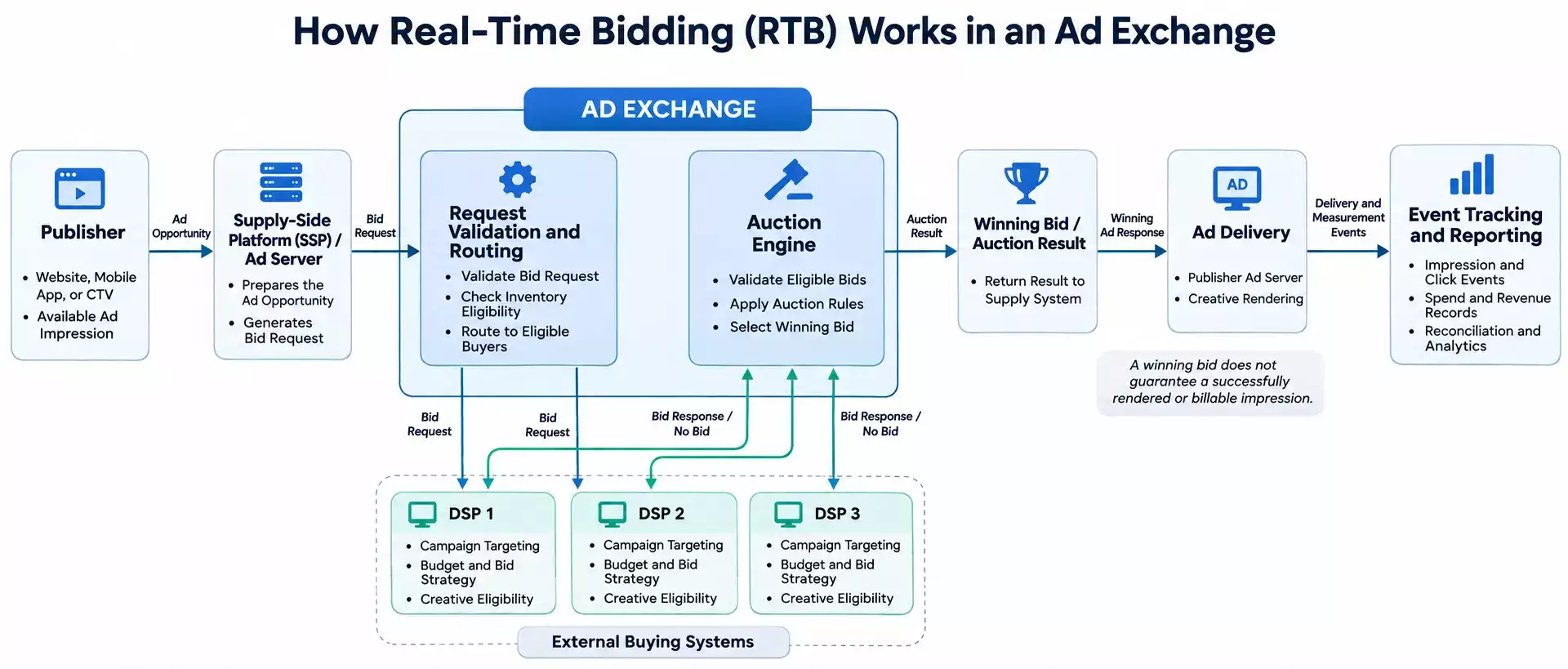
End-to-End Transaction Flow: How Does an Ad Exchange Platform Work?
Real-time bidding (RTB) is one of the programmatic ad exchanges that automate the transaction of individual advertising impressions. A bid is requested by the exchange or demand-side system when an impression becomes available. When opportunity and return meet campaign needs, the bid is evaluated via demand-side platforms (DSPs). The exchange verifies the answers, follows the rules of the auction, and delivers the outcome to the appropriate advertising system.
Not all transactions are like the one posted above. Private marketplace (PMP) deals or programmatic direct deals could also be applied to transactions, on platforms where available, or other buying methods.
Step-by-Step Real-Time Bidding Process
Step 1: A Publisher Makes Advertising Inventory Available
A web advertiser or mobile app, connected TV (CTV) service, or other digital property has an ad placement they wish to sell to a publisher. The placement can contain its format, size, inventory ID, page or app context, device specifications, types of media supported, and privacy or consent signals that apply.
Initializing the advertising request handles the process; this could be from the publisher's ad server, supply-side platform (SSP), or other component of the supply-side. The SSP or exchange might add additional inventory details, placement info, and identity info to the request needed by demand partners to assess the opportunity depending on integration.
Step 2: The Exchange Receives and Validates the Bid Request
The request is sent directly to the exchange via an SSP. The request fails validation tests for the request structure, required fields, ad formats supported by the inventory, inventory eligibility, partner configuration, and applicable privacy and consent signals.
OpenRTB validation also involves verifying that the request adheres to the supported OpenRTB specification and includes any necessary OpenRTB callout objects, such as, in the case of OpenRTB, the user, site, app, device, or impression (imp) object as relevant and permitted in the specification. The exchange will also need to ensure that both the desired format and transaction type are supported by the exchange's "demand" trading partners.
The exchange will reject malformed or unsupported requests before beginning the auction. This prevents over-processing and eliminates incompatible or invalid requests being passed to demand systems.
Step 3: The Exchange Routes the Opportunity to Demand Sources
Once validated, the exchange will determine which connected demand-side platforms (DSPs) or buying systems can be involved. Eligibility for routing may include supported formats, geographic criteria, device criteria, publisher criteria, commercial restrictions, private marketplace (PMP) criteria, and partner connectivity.
The exchange then passes on matched bid requests via protocols it supports, including the IAB Tech Lab's OpenRTB. Depending on the integration, it could map the fields of a request to ones required by partners but maintain the original meaning of the advertising opportunity.
Because RTB operates under strict response deadlines, the exchange must manage concurrent requests, partner-specific timeouts, connection failures, and demand-source health. Slow or unavailable DSPs should not cause the entire auction to exceed its latency budget.
Step 4: DSPs Evaluate the Advertising Opportunity
Each DSP assesses the request for a bid based on the advertisers' requirements of the campaign. Some of the factors it looks at for its decision-making engine are targeting, budget, bidding strategy, frequency limitations, audience data, placement appropriateness, creative compatibility, and deal suitability.
If an eligible campaign qualifies for this opportunity, then the DSP will send a bid response that includes specifics about the creative or deal, including the bid price. In OpenRTB integrations, the response typically contains a bid object with the following elements: the bid price, the creative identifier, and the markup or creative reference depending on the implementer.
If no campaign is found, the DSP will respond with no bid response. It may also fail to answer on time. The exchange should identify valid offers from the non-offers, invalid responses from offered responses, and timeouts.
Step 5: The Exchange Runs the Auction
The auction engine verifies "qualified" bid responses and runs the configured auction rules. They can include deal eligibility, bid floors, other publisher requirements, permitted decision criteria, creative restrictions, and more.
Next, the engine follows the auction logic of the exchange to choose which bid is the winning bid. A simple highest-eligible-bid auction is one in which the winning bid is the one by the highest qualified bidder. The more complex the implementation, the more it could include other constraints, such as deal priority, contractual rules, or other configuration constraints.
The ultimate market price of the winning bid and the revenues to the publishers are not the same. Other commercial considerations such as platform fees, contractual revenue sharing, and other obligations can impact publisher net revenue. The exchange must have separate records of anything submitted for bid, the end result of the auction, the handling of the fees applied, and amounts collected.
Step 6: The Winning Bid Is Returned for Ad Delivery
The exchange signals a result of the auction to the appropriate supply-side system. The "winning" creative or ad response then goes to the relevant delivery elements, such as the SSP, publisher ad server, exchange, or other ad server.
The components that will be responsible for delivering this creative must validate the ad, verify format compatibility, and set publisher serving rules prior to delivery. It will also have to cope with situations like timeouts, invalid creatives, missed responses, and auctions that have no bid.
If an ad is rendered even though it's not the top bidder, it may not be a billable impression. Both the delivery and measurement systems will need to determine if an advertisement was actually delivered and if the considered impression-counting conditions applied.
Step 7: Impression and Transaction Events Are Recorded
The exchange and the related systems log transaction and delivery events in order to measure, monitor, and bill for those transactions. These can vary depending on integration and measurement setup and may include:
Auction events: Bid requests, bid responses, no-bids, an auction outcome, and notification of a win.
- Delivery events: Ad responses, impression events, and clicks (where applicable).
- Financial events: Advertiser spend, publisher revenue, transaction adjustments, and fees.
- Quality events: Invalid traffic signals, rejected creatives, timeouts, and measurement discrepancies.
Consistent transaction identifiers, timestamps, event definitions, and deduplication rules are important for these events, as they can come from varying systems. A new parallel, scalable event-processing pipeline can process this data without adding undue latency to the real-time auction path.
Step 8: Reporting and Financial Reconciliation Take Place
The platform receives the transaction and delivery information, which is then used to create operational and financial reporting information. Publishers can track the performance of their inventory, fills, and revenues, while advertisers can monitor their impressions, spending, and campaign delivery through their connected reporting systems.
Financial reconciliation compares auction results and delivery to billing data and contractual and payment records. The platform needs to have rules for counting and settling that can be clearly stated, as both the wins and impression events, as well as billable events, may not be the same.
Reconciliations should show areas of missing events, duplicate records, price differences, and discrepancies between buyer spend versus earnings generated by the publisher. Keeping all transactions documented in an auditable format helps to ensure precise reporting, dispute resolution, and financial accountability.
Publisher-Side Integration Path: Inventory Configuration and Revenue Attribution
An exchange is what publishers can use to offer advertising inventory to connected buyers and oversee the transactions.
- Inventory configuration: Publishers add or link placements, formats, and inventory sources.
- Supply integration: Inventory is supplied via another supported integration or SSP.
- Bid request generation: If the impression is eligible, then the supply system is used to create the bid request.
- Demand access: The exchange passes the opportunity to qualified buyers subject to the rules of the inventory, partner access, and deal configuration.
- Auction and delivery: The exchange receives bids and returns the changed value of the auction for the relevant delivery process.
- Revenue tracking: Reporting and reconciliation encompass revenue allocation, impressions, fees, and auction revenue.
- Optimization of Performance: Publishers use their analysis, which includes fill rate, inventory quality, revenue and participation, and traffic, to guide optimization decisions.
The ability to configure floor pricing, control user access to inventory, monitor "Ad traffic quality" and revenue visibility, and existing SSP and ad server integration are key technical requirements.
Demand-Side Integration Path: Ad Exchange Work for Advertisers
Typically, advertisers access ad exchange inventories through direct systems such as DSPs or other preferred systems. The DSP takes care of campaign targeting and bidding; the exchange makes the transaction happen.
- Campaign setup: Advertisers set their budgets, targeting needs, creative needs, and campaign goals in the advertiser's buying system.
- Opportunity evaluation: The DSP takes in eligible bid requests from the exchange.
- Bid decision: The DSP makes its bid based on the rules of the campaign and the available budget and bidding strategy.
- Bid submission: A bid response is returned by the DSP and will include the proposed price and information required for qualifying opportunities.
- Auction outcome: The exchange reaches an agreement on which bid to accept as winner based on the rules that it was set to follow.
- Ad delivery and measurement: The events that apply are recorded, and the relevant systems deliver the ad that won.
- Performance analysis: Advertisers inspect impressions, spend, delivery, and campaign results via existing reporting systems.
DSP and OpenRTB compatibility, creative validation, inventory eligibility controls, reporting of auctions and transactions, invalid traffic identification, and delivery measurement are all key technical requirements.
Ad Exchange Platform Models: Trading Mechanisms, Access Controls, and Supported Formats
Ad exchange platforms can fall into one of three classifications based on access methodology, trading system, and supported advertising formats and delivery environments. The right way to go will depend on the target audiences, inventory providers, demand partners, commercial model, and level of control desired. Using these requirements, Suffescom can provide custom-built ad exchange solutions complete with appropriate integrations, auction logic, inventory controls, and reporting.
Open Ad Exchange Platforms
With an open ad exchange, participating buyers can submit bids for inventory available to them according to their purchase rules and bid criteria. Usually, such broad demand integrations include automatic auctions, bid validation, inventory eligibility checks, traffic quality checks, and preferred data analytics for auctions.
Best for: Companies developing a marketplace to connect a wide variety of publishers and advertising buyers.
Private Ad Exchange Platforms
A private ad exchange restricts usage to selected publishers, buyers, or selected partners. Offers more control over inventory availability, user permissions, deal specifics, pricing parameters, and customized partner reporting.
Best for: premium publishers, media companies, and businesses that require better control over who can access their inventory.
Private Marketplace Platforms (PMP)
A private marketplace platform provides a way for a group of users who are under a special agreement to buy designated inventory based on negotiated programmatic deal terms. PMPs do not need to be a dedicated exchange; they can be built right into an existing exchange or programmatic advertising platform.
All of this is possible with key capabilities such as deal ID management, buyer eligibility rules, inventory packages, deal-specific pricing, bid request filtering, and deal-level performance reporting.
Best for: Publishers and advertising companies that help to manage programmatic deals with chosen advertising buyers.
Real-Time Bidding (RTB) Ad Exchange Platforms
An RTB-enabled exchange conducts auctions based on impressions to which connected buying systems bid on an impression-by-impression basis, with specific time limits. Most of the development features include high-throughput request processing, low-latency auction processing, OpenRTB integration, bid validation, directive handling for timeouts, event-level analytics, and more.
RTB is not an access model but a trading model. RTB is a feature that can work on open exchanges, private exchanges, or on RTB platforms that are PMP-enabled (Private Marketplace).
Best for: Companies looking to develop an automated programmatic advertising platform.
Ad Exchange Platforms for Multiple Digital Advertising Channels
Specific types of delivery and advertising formats can be designed into an ad exchange. They each need to be fed with the same type of inventory data, validated differently in creative ways, integrated for delivery, and measured.
| Platform Type | Core Technical Requirements |
| Display Ad Exchange | Banner inventory, placement dimensions, creative validation, and impression tracking |
| Video Ad Exchange | Video inventory, compatible creative formats, and video event measurement |
| Mobile Ad Exchange | App inventory, device context, supported mobile formats, and applicable privacy signals |
| Connected TV (CTV) Ad Exchange | CTV inventory, video ad support, device and content context, and compatible measurement integrations |
| Audio Ad Exchange | Audio inventory, supported audio formats, playback events, and campaign measurement |
The specific services required to include a format are dependent on the protocols that are selected, the integration via the partners, and the delivery environment. Therefore, having support for one format does not equal making an exchange applicable to all advertising channels.
White-Label Ad Exchange Platforms
A white-label ad exchange offers a set of configurable components on which a business can brand and deploy its own ad exchange. The features have the potential to be interactive interfaces, platform options, partner control, reporting dashboards, specific integrations with ads, and custom business rules.
Consider the extent of customization, data access, source code ownership, integration flexibility, ongoing reliance on the vendor, and licensing terms before choosing a white-label solution.
Best for: Companies that want to potentially attain the marketplace quicker than creating each component from the ground up.
Custom Enterprise Ad Exchange Platforms
Enterprise ad exchanges will be bespoke to complex commercial, technical, and operational needs. These can involve custom auction logic and deal logic, multi-tenant solutions, fine-grained partner permissions, real-time event processing, financial reconciliation, advanced analytics, high-availability infrastructure, and integration with other enterprise systems.
Best for: Established adtech businesses, large publisher platforms, and businesses with unique advertising requirements and workflows or who want to take greater control over their advertising platform.
The architecture should focus on the expected number of requests, latency times, availability expectations, data governance, and cost considerations, and avoid being based on technology choices that assume that every enterprise platform requires the same tech stack.
Platform Type Selection Matrix
When choosing between business solutions, the following comparison should help businesses narrow down their choices. There may be a combination of models in these categories; a single model may apply to more than one category, or a model may not apply to any category.
| Platform Type | Access Model | Technical Complexity | Customization Needs | Suitable Use Case |
| Open Exchange | Broad access for eligible participants | High | Medium to high | Marketplace connecting multiple publishers and buyers |
| Private Exchange | Restricted to approved participants | Medium to high | Medium to high | Controlled access to premium inventory |
| PMP Platform | Selected buyers and agreed deals | Medium to high | Medium to high | Negotiated programmatic transactions |
| RTB-Enabled Exchange | Can be open or restricted | High | Depends on auction and integration requirements | Automated, impression-level bidding |
| Format-Specific Exchange | Varies by implementation | Medium to high | Depends on format and delivery environment | Display, video, mobile, CTV, or audio advertising |
| White-Label Exchange | Depends on the underlying solution | Low to high | Limited to extensive, depending on the provider | Faster deployment using a configurable foundation |
| Custom Enterprise Exchange | Configurable | Very high | Extensive | Complex integrations, specialized auction rules, and high-volume operations |
Which Type of Ad Exchange Platform Fits Your Business Model?
Explore the right architecture, trading model, and essential features for your advertising marketplace with a development approach tailored to your goals.
Ad Exchange Platform Implementation Across Advertising Business Models
Ad exchange platforms support different advertising business models by automating inventory discovery, bid evaluation, and transactions between buyers and sellers. Their applications vary depending on the type of inventory, target audience, advertising formats, and level of control required.
1. Publisher and Media Network Monetization
Digital publishers and media networks can use an ad exchange to make their advertising inventory available to multiple demand partners. Instead of relying on a single advertising source, publishers can connect eligible inventory to multiple buyers and evaluate competing bids.
For example, a digital news network can offer display and video ad placements across its websites. The exchange evaluates incoming bids according to its auction rules, eligibility criteria, and floor prices before selecting a winning bid.
Key requirements include: Inventory management, publisher onboarding, floor-price configuration, demand partner integrations, and revenue reporting.
2. Retail Media Networks
Retailers can use ad exchange technology to support advertising across their websites, mobile applications, and other digital properties. A retail media exchange can connect advertisers with available placements while applying campaign eligibility rules and inventory controls.
For example, an online marketplace could allow approved brands to bid for sponsored placements on product listing pages. The platform would need to manage available inventory, campaign requirements, auction rules, and performance data.
Key requirements include: Inventory categorization, campaign targeting, advertiser access controls, reporting, and appropriate governance of customer data.
3. Mobile App Advertising
Mobile publishers and app monetization businesses can use ad exchanges to connect mobile advertising inventory with demand partners. Depending on the implementation, the platform may support in-app display, video, rewarded video, and other mobile advertising formats.
For example, a gaming publisher could make rewarded video placements available to eligible advertisers through connected demand platforms. The exchange evaluates bids for each impression and returns a winning response within the available auction time.
Key requirements include: Mobile inventory identification, device and placement signals where permitted, bid-response validation, latency controls, and invalid traffic detection.
4. Video, Connected TV, and Digital Audio Advertising
Businesses working with video streaming services, connected TV publishers, and digital audio platforms can build exchanges tailored to their advertising inventory. These platforms may need to process format-specific information, content restrictions, creative requirements, and deal conditions.
For example, a connected TV publisher could make eligible video ad slots available to buyers through programmatic auctions. The exchange must validate incoming bids against supported formats and publisher-defined restrictions before selecting a winner.
Key requirements include: Format compatibility, creative validation, deal management, content suitability controls, and reliable auction processing.
5. Private Advertising Marketplaces
Large publishers, media groups, and advertising networks may require more control over which buyers can access their inventory. A private exchange or private marketplace-enabled platform can support restricted access, approved buyer relationships, and negotiated deal terms.
For example, a premium publisher could provide selected advertisers with access to specific inventory under agreed pricing and eligibility conditions. The platform would enforce buyer permissions and deal rules during the auction process.
Key requirements include: Buyer approval workflows, access controls, deal configuration, pricing rules, inventory restrictions, and transaction reporting.
6. Niche and Industry-Specific Advertising Networks
Businesses can develop specialized ad exchanges for particular industries, audience categories, or groups of publishers. These platforms can implement inventory rules, buyer eligibility requirements, and advertising policies suited to their market.
For example, a network of specialist publications could create a shared exchange that allows relevant advertisers to access inventory across participating publishers. The exchange would need to standardize inventory information while respecting each publisher's permissions and commercial terms.
Key requirements include: Flexible inventory classification, partner onboarding, configurable auction rules, reporting, and integration support.
Operational and Commercial Capabilities: Benefits of Ad Exchange Development
Ad exchange development provides ad tech companies with a degree of control over advertising deals, partner integration, regulatory terms, and operational information. The pay-off, however, hinges on having the right products and customers, the right infrastructure, and adding value to publishers and advertisers.
Greater Control Over Advertising Transactions
A custom ad exchange lets companies determine who gets access to their inventory, who can buy ads, auction rules, bid validation, and deal terms. Unique marketplace needs, beyond what are currently supported by available marketplace platforms, can be met by the custom logic.
Improved Automation and Operational Efficiency
An ad exchange can automate bid request validation, demand routing, auction execution, event processing, and reporting. Well-designed workflows reduce manual intervention while improving transaction consistency and operational visibility. However, efficiency depends on the quality of the implementation and its ability to meet auction deadlines.
Flexible Business Models and Revenue Opportunities
An exchange can operate any number of monetization formats for a variety of reasons depending on its architecture and commercial model.
- Transaction-based fee: Any fee that is applied to transactions that qualify for the transaction fee.
- Platform or technology fees: Costs to use platform functionalities.
- Deal-based arrangements: Business terms established with regard to certain stock or customers.
- Premium inventory access: Pricing structure relating to the access of certain inventory items or the purchase opportunity.
- White-label or managed services: A revenue model that involves providing outsourced access to a platform or continuous platform services.
They have the potential to be business models, but you won't count on every one of those as a revenue stream. Profitability relies on the demand, volume of transactions, operating costs, price, and partnership agreements.
Better Access to Inventory and Demand
Adopting an integration of a compatible Supply Side Platform (SSP), Demand Side Platform (DSP), publishers, and advertising buyers can help to increase advertising opportunities. The actual value depends on how good the stocks are, how good the buyer is, how compatible the target is, how well commercial relations are developed, and how competitive the available demand is.
Data-Driven Optimization
If an exchange is well designed, it would be able to record the auction events and transaction events to measure the success of an exchange. With analytics, one can find partner performance, inventory quality, participation in bidding, auction latency, fill rate, win rate, revenue trends, and financial discrepancies.
Access and use of this data must respect privacy rules, partner "rules," and permissions as appropriate. The reliable reporting and reconciling of transactions are also helped by consistent event definitions and transaction identifiers.
Scalability and Customization
A custom exchange can be designed based on a number of different parameters, such as expected traffic, latency goals, partner integrations, ad format, and availability. Future expansion will be facilitated by modular parts and the appropriate data processing infrastructure.
But just because software is custom does not mean that it will be more scalable or cheaper than any platform. The results will be great based on architecture, implementation, selection of infrastructure, and maintenance status.
Publisher-Side Capabilities: Inventory Control, Demand Access, and Revenue Optimization
An ad exchange can also be beneficial for publishers and media owners in terms of being able to better control their inventory and gain better access to programmatic demand.
- More demand sources: Integrate with multiple buyers and find purchasable inventory.
- Increased Inventory Control: Set up eligibility for placement, format support, and rules that control selling, and applicable price conditions.
- Revenue visibility: Check the monetization status, fees, auction results, and transactions.
- Automated monetization: Process eligible impressions programmatically instead of negotiating every transaction individually.
- Flexible commercial arrangements: Support open auctions and selected-buyer deals where available.
- Performance insights: Analyze fill rate, demand participation, inventory quality, and revenue trends.
Advertiser-Side Capabilities: Programmatic Buying, Campaign Control, and Measurement
An exchange can offer access to eligible exchange inventory via connected buying systems for advertisers and agencies.
- Eligible Inventory: Advertising opportunities that are available through the exchange's supply connections.
- Automated buying: Take advantage of DSP integration to bid programmatically and assess opportunities.
- Campaign control: Targeting, budget, and frequency; bidding rules applied during campaign control via the supported buying system.
- Bidding flexibility: Join in the open auction events or private marketplace deals, depending on the platform’s ability.
- Measurement: Take advantage of auction, delivery, and impression events to enhance campaign reporting.
- Inventory and traffic controls: Use the available eligibility controls, creative restrictions, and invalid traffic controls to facilitate buying risk management.
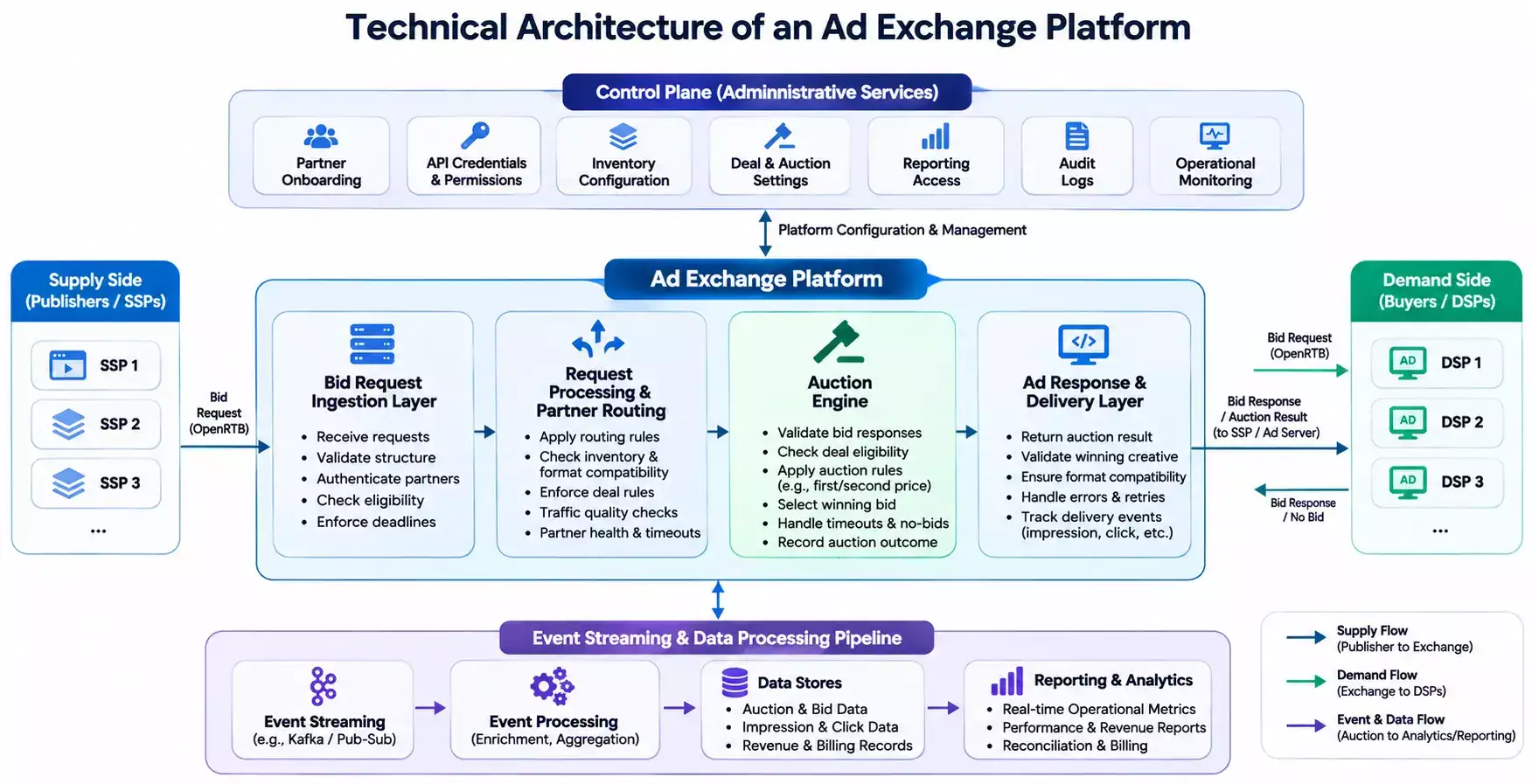
Reference Architecture for an Ad Exchange Platform:
There are several key aspects of a technical architecture that will determine how successfully an ad exchange can receive bid requests, integrate other advertising systems, conduct auctions, process events, and keep accurate records of all transactions. It needs to perform low-latency auctions while supporting data assurance, security, and total visibility.
The architecture should take into consideration the number of expected requests, latency requirements, advertisements that can be served, partner integrations, budget, and the team's ability to operate the architecture. A usable design keeps the auction processing related to time and away from time-consuming analytics and billing and administration tasks.
Bid Request Ingestion Layer
The layer receives these ad opportunities from connected supply-side platforms (SSPs), ad servers, or other approved sources of supply. Displays configured endpoints and ensures that incoming requests comply with supported protocols, field requirements, partner identity, and inventory rules.
These are key functions that include well-defined authentication, request validation, partner identification, deadline verification, and rejection of malformed and unsupported traffic. For OpenRTB integrations, it is recommended to validate the request objects and format requirements that are relevant during processing.
Request Processing and Partner Routing
Once validated, the exchange decides which demand-side platforms (DSPs) or buying systems can be included in the auction. Some of the factors to be taken into account when making routing decisions include inventory eligibility, format compatibility, geographic and device context, private marketplace (PMP) deal, partner permissions, and traffic quality signals.
The decision of the route can be assisted with the partner's health, connection status, and past latency. The exchange should not make offers to any incompatible or undeliverable parties who are requesting offers, and the exchange should impose partner-specific timeouts to preserve and honor the auction time limit.
Auction Engine
The auction engine checks for the eligibility of the bids and chooses the winning bid based on the auction rules. It's tasked with validating bids, eligibility rules for deals and inventory, restrictions on creativity, pricing restrictions, handling timeouts, processing no bids, determining the winner, and keeping track of the outcome of the auction.
The process used in an auction should be deterministic and testable. Implementations should clarify what to do if bids are invalid or late, if a response is repeated, if duplicate responses occur, if a bid floor is breached, and if the deal priority rules are violated. Decision records are also helpful in clarifying the decisions made in an auction and settling disputes.
Ad Response and Delivery Layer
The outcome of the auction is brought back to the appropriate supply-side element after the auction. The winning response can be passed through an SSP, or an SSP can submit the winning response to the publisher or ad server before the creative is rendered. Alternatively, it can be passed through another delivery system or returned directly to the publisher or ad server.
The job of this layer is to deal with response formatting, create compatibility, and deal with invalid responses, delivery failures, and timeouts. This should also ensure that the signals for appropriate measurement are supported to differentiate between an auction and a billable advertisement and aid in successful advertisements.
Event Streaming, Analytics, Financial Reconciliation
Data from the auction is loaded into an event processing pipeline for operational monitoring, analytics, and financial processing. Elements can consist of message brokers, analytical databases, reporting APIs, and reconciliation services.
You can track the pipeline for bid requests, bid responses, auction results, impressions, clicks, spend, publisher revenue, and fees. The asynchronous processing helps to keep the analytics workloads off of the latency-critical auction path. Billing and reconciliation should adhere to contract specifications and measurement applicable to the contract, not assume that all winning bids are billable transactions.
Control Plane and Administrative Services
The control plane configures the platform but does not put any real-time auctions to sleep. It can offer partner onboarding, API access and credentials, role-based access to key data and processes, deal configuration, auction parameters, reporting access, audit tracking, and operational monitoring.
Dividing administrative from auction processing also facilitates the control of access and prevents the configuration and reporting loads from affecting auctions.
Monolithic vs. Microservices Architecture
Modular monoliths or microservices will be chosen depending on the workload complexity, experience of the development team, deployment needs, or workload scalability needs.
| Factor | Modular Monolith | Microservices |
| Initial development | Often simpler and faster | Requires service boundaries and additional infrastructure |
| Deployment | Usually managed as one application | Services can be deployed independently |
| Scaling | Often scales the application as a whole | Individual services can scale independently |
| Operational overhead | Generally lower | Higher due to service communication and distributed operations |
| Best suited for | MVPs and focused products | Complex platforms with justified independent scaling needs |
Can Your Ad Exchange Handle Real-Time Bidding at Scale?
Build a technical foundation around low-latency auctions, DSP and SSP integrations, scalable infrastructure, and reliable transaction processing.
Technology Stack and AdTech Protocols Selection for Ad Exchange Development
Ad exchange development should include a technology stack that facilitates low-latency transactions, reliable partner integrations, data processing efficiency, and long-term maintainability. Which one to select depends on the traffic, response times, the advertisement types it supports, and the complexity of integration, along with the developer experience.
OpenRTB for Programmatic Advertising
OpenRTB is an industry protocol that creates a unified communication standard between programmatic advertising systems using bid requests and bid responses. It sets up structured fields to describe opportunities to advertise, such as impression details, site or app context, device information, bid prices, creative information, and comparative deal identifiers.
From an ad exchange perspective, the OpenRTB helps all the DSP and SSP partners to integrate with each other. Implementations need to be able to operate with the version of the protocol supported by each partner, the extension that each partner expects, required fields, and supported formats.
DSP, SSP, and Ad Server Integrations
Integrations allow the exchange to integrate with advertising inventory, buying systems, and delivery infrastructure. The exchange will provide supply opportunities, pass 'qualifying' requests to the DSPs, review replies, and be able to report the auction outcome to the relevant supply-side system.
Endpoint configuration, authentication, protocol version compatibility, request and response validation, partner-specific testing and validation, timeout management, and error monitoring are just a few of the possibilities for each integration. Differences in creative delivery, measurement, and transaction reporting must also be taken into account with ad server and SSP integrations.
Other Relevant Advertising Standards
Other standards provide specific advertising, verification, supply-chain, and privacy requirements.
| Standard or Mechanism | Purpose |
| VAST | Defines communication and tracking conventions for video ad delivery. |
| Open Measurement SDK (OM SDK) | Supports standardized measurement and verification of eligible in-app advertising experiences. |
| ads.txt and app-ads.txt | Allow publishers to declare sellers authorized to sell their website or app inventory. |
| sellers.json | Helps buyers identify entities involved in selling advertising inventory. |
| SupplyChain Object | Communicates information about the entities participating in the sale of an impression. |
| Privacy and consent frameworks | Help communicate applicable consent choices and privacy signals to participating systems. |
Latency, Connectivity, and Integration Requirements
RTB environments have very tight response times and require the proper handling of the network and requests. Some data engineering principles to be considered are:
- Persistent connection: Reuse the connection if supported to minimize the overhead of the connection.
- Efficient processing: Avoid over-parsing the requests, serializing requests, and synchronous operations.
- Bounded queues and backpressure: Stop services from becoming overwhelmed when traffic spikes in the system and the downstream system.
- Gated timeouts: Set specific time limits for your partners and deal with late responses and missed messages without hassle.
- Latency monitoring: Monitor response times, timeouts, errors, and partner availability.
The Google Authorized Buyers RTB Documentation is a great resource for the needs of an ecosystem of major buyers for integration. Actual deadlines and protocol constraints will vary depending on the partner, and the auction should be confirmed prior to implementation.
Candidate Technology Stack: Backend, Data Infrastructure, and Cloud Components
There is no universal technology stack for every ad exchange. It will depend on the desired request volume, the expected latency needs, integrations with partners, analytics load, security requirements, and the team's technical knowledge.
| Layer | Potential Technologies | Purpose |
| Backend and auction services | Go, Java, or Rust | Bid processing, auction execution, and latency-sensitive services |
| API and integration services | Go, Java, or Node.js | Partner APIs, configuration, and integration workflows |
| Frontend | React and TypeScript | Administrative dashboards, reporting, and partner interfaces |
| Primary database | PostgreSQL | Partner configuration, users, deal metadata, and transactional records |
| In-memory data | Redis | Caching, low-latency lookups, and selected temporary state |
| Event streaming | Apache Kafka or a managed equivalent | Auction event processing and downstream data pipelines |
| Analytics database | ClickHouse or an analytical warehouse | Aggregated metrics, reporting, and event analysis |
| Object storage | Amazon S3 or equivalent | Logs, exports, and selected data archives |
| Cloud infrastructure | AWS, Azure, or Google Cloud | Compute, networking, storage, and managed services |
| Containerisation | Docker | Packaging and distributing application services |
| Orchestration | Kubernetes or managed alternatives | Deployment and independent scaling where justified |
| Observability | OpenTelemetry with compatible monitoring tools | Metrics, distributed tracing, and diagnostics |
How to Choose the Right Technology Stack
Before deciding on the architecture, finalize the following factors:
- Latency requirement: Identify technologies that can meet the response time requirements, both with and without load.
- Expected traffic volume and concurrency: Consider peak speeds, auctions, concurrent requests, and loads for partners.
- Data requirements: Select optimal data stores for transactional, event, analytical, and reconciliation data.
- Integration compatibility: Check that necessary interfaces, authentication, and protocols are available in the stack.
- Operational maturity: Evaluate the readiness of the team to deploy, monitor, secure, troubleshoot, and maintain the chosen technologies.
- Total cost of ownership (TCO): Consider all components of the cloud infrastructure, from data transfer to monitoring to licensing, support, upgrades, and continued maintenance.
Ad Exchange Development Lifecycle: Phased Build Sequence with Acceptance Criteria
Ad exchange development should be done in stages to test the trading model, the main auction functionality, and the integrations with partners, and only then start developing advanced features and scaling up to an infrastructure of considerable size. Phases should include specific deliverables and criteria for their acceptance.
Step 1: Define Business Requirements and the Trading Model
Define target publishers and advertisers, inventory sources, the exchange access model, revenue strategy, supported advertising formats, and necessary DSP/SSP integrations. Project normal traffic levels and establish reporting, billing, and financial reconciliation requirements.
Outcome: preparation of a business model, product scope, integration requirements, and initial technical specification in a documented way.
Step 2: Define the MVP and Technical Architecture
Prioritize the essential features required to validate the trading model before investing in advanced functionality. An MVP may include partner onboarding, a functional auction engine, at least one supply integration, one or more demand integrations, basic reporting, and administrative security controls.
Define the architecture, API contracts, data flows, expected request volume, latency targets, and failure-handling requirements. Establish measurable acceptance criteria before development begins so the team can evaluate functionality, performance, and integration quality.
Step 3: Develop the Auction Engine and APIs
Implement the components of a bid request ingestion process, validation, routing to partners, bid processing, auction logic, and handling bid responses. Establish criteria to determine eligibility to run, pricing, tiebreakers, and deal preference.
The engine should be capable of dealing with malformed requests, no-bids, late and duplicate responses, invalid bids, incompatible creatives, timeouts, and even a partner failing without disrupting the auction process.
Step 4: Connect Publishers, DSPs & SSPs
Enforce the chosen supply and demand integrations, as applicable, through the appropriate protocol (including integrations with OpenRTB where applicable). Set up endpoints, authentication, partner-specific fields, supported formats, and response time.
Validate integrations using realistic bid requests and responses. Test the protocol compatibility and the way you handle errors, timeouts, and failure scenarios before turning on production traffic.
Step 5: Build Reporting and Financial Reconciliation
Introduce event processing and reporting of publishers, advertisers, and platform operators. Keep monitoring the number of bids received, bid responses, auction results, impressions, clicks, spend, fees, and the revenue earned by the publishers, where applicable.
Match auction and delivery events with bills by agreed measurement and contractual stipulations. Maintain and update duplicate event detection, discrepancy reporting, and an audit trail of financial transactions for improved financial accuracy.
Step 6: Apply Security, Privacy, and Quality Controls
Use role-based access control, secure API credential tracking, an encryption system, request validation, traffic quality controls, and audit logging. Apply relevant privacy and consent signals and verification processes like ads.txt, app-ads.txt, and supply-chain information.
Verify the security and privacy controls on the platform based on the data flows handled by the platform, partner agreements, platform operating model, and governing legislation. Don't claim to be compliant unless you know that you are.
Step 7: Test, Deploy, and Optimize
Perform functional, integration, load, stress, security, and financial reconciliation tests. Collect metrics for latency, throughput, timeouts, errors, and accurate reporting of auctions to defined metrics.
Install and run monitoring, alerting, rollback, and incident response processes. Once launched, improve partner connectivity, optimize infrastructure costs, identify production metrics, and have timely transaction reporting.
Ad Exchange Engineering Challenges: Performance, Integration, Data Integrity, and Reliability
Building an ad exchange involves coordinating real-time auctions, external integrations, advertising inventory, transaction records, and traffic quality controls. These systems must work together under strict timing requirements while maintaining reliable data processing.
Understanding the common challenges early helps businesses establish realistic development priorities and reduce operational risks.
1. Maintaining Low-Latency Auction Processing
An ad exchange must process bid requests, evaluate responses, and select winners within the available auction time. Slow request handling, inefficient data processing, or delays from external partners can cause bids to time out and reduce the number of eligible responses.
How to address it: Optimize request parsing and auction execution, use efficient data structures, set appropriate partner timeouts, and monitor latency across individual processing stages. Performance testing should use realistic traffic patterns rather than relying only on average response times.
2. Integrating Multiple DSPs and SSPs
Each demand or supply partner may support different protocol versions, fields, authentication methods, creative requirements, and operational rules. A technically valid integration may still fail if the exchange interprets partner data incorrectly or handles errors inconsistently.
How to address it: Build a consistent integration layer, validate supported OpenRTB fields, maintain partner-specific configurations, and test each integration independently before enabling production traffic. Monitoring should identify repeated errors, timeouts, and changes in partner behavior.
3. Handling Traffic Spikes and Scaling Infrastructure
Advertising traffic can fluctuate considerably depending on publisher activity, audience behavior, campaigns, and seasonal demand. A system that performs well under normal conditions may experience queue buildup, resource exhaustion, or increased latency during traffic spikes.
How to address it: Design for horizontal scaling, establish capacity limits, apply backpressure where appropriate, and monitor CPU, memory, network usage, queue depth, and auction latency. Load and stress tests should help identify bottlenecks before the platform handles production traffic.
4. Detecting Invalid Traffic and Advertising Fraud
Fraudulent or low-quality traffic can affect advertiser spending, publisher revenue, reporting accuracy, and partner relationships. Detection is difficult because suspicious activity may resemble legitimate traffic or emerge gradually across multiple sources.
How to address it: Combine request validation, traffic anomaly monitoring, partner verification, rate limiting, and suitable third-party AI fraud detection capabilities. Establish procedures for investigating suspicious activity and documenting how invalid traffic affects billing or reporting.
5. Maintaining Accurate Reporting and Reconciliation
Auction events and financial records may differ across the exchange, DSPs, SSPs, and publishers because of reporting delays, event definitions, filtering rules, or invalid traffic adjustments. Unresolved discrepancies can undermine trust and create billing disputes.
How to address it: Define consistent event schemas, use reliable event processing, retain auditable transaction records, and establish reconciliation rules for each partner. Reporting should distinguish between metrics such as bid requests, bids, wins, and measured impressions rather than treating them as interchangeable.
6. Managing Privacy and Consent Requirements
An exchange may process information used for advertising decisions and share bid-request data with external partners. Requirements can vary by jurisdiction, data type, advertising use case, and partner agreement, making privacy management a design consideration rather than a single compliance task.
How to address it: Map data flows before implementation, minimize the information transmitted, validate relevant consent and privacy signals, restrict access, and establish retention and deletion policies. Have applicable legal and privacy requirements reviewed for the markets in which the exchange will operate.
7. Maintaining Integration Reliability and Platform Availability
An exchange depends on its own services and external systems. Partner outages, configuration changes, network failures, and software updates can interrupt transaction processing or affect auction quality.
How to address it: Implement health checks, alerts, circuit breakers where appropriate, controlled retries, and clear failure-handling rules. Monitor individual integrations and define how the platform should behave when a partner becomes unavailable, without allowing retries to create additional load or violate auction deadlines.
Ad Exchange Security Architecture: Security, Privacy, and Ad Fraud Prevention in Ad Exchange Development
Commercial data is sent to and received by various advertising systems through an ad exchange. Its security system should safeguard the API, partner credentials, inventory, and finances, as well as issues unique to ad security like bad traffic, fake ad sources, and suspicious bidding activity.
Platform and API Security
The exchange should enforce strong authentication and least-privilege access for users, internal services, and external partners. Other controls include API credential management and secure API credentials, encryption in transit, input validation, rate limiting, audit logging, and, in multi-tenant environments, tenant isolation.
Each API endpoint needs to be validated to prevent other parties from accessing their resources and to counteract harmful use and resource consumption. The OWASP API Security Top 10 is a helpful list of risks like broken object-level authorization, broken authentication, and unrestricted resource consumption.
Ad Fraud and Invalid Traffic Controls
Traffic analysis, inventory validation, and event monitoring can all be merged into an exchange to detect traffic that may be suspicious. Relevant controls include:
- Request analysis: Identify anomalous request trends, unusual traffic surges, and strange devices or network indications.
- Event validation: Find duplicate impressions, inconsistent timestamps, and odd click or conversion activity.
- Inventory and partner checks: Ensure that supply sources, sellers, and setup are correct and that supply permissions are set up correctly.
- Creative validation: Ensure the creative is “compatible,” and restrict the content and security as appropriate.
- Monitoring and investigation: Identify suspicious activity, and keep audit trails and audit paths for investigation and reporting.
Inventory Transparency and Supply-Chain Verification
There are some good advertising standards that help buyers gauge the parties that will be dealing with inventory:
- ads.txt and app-ads.txt: Declare the sellers authorized to sell their inventory.
- sellers. json: Helps buyers identify sellers and intermediaries participating in programmatic transactions.
- SupplyChain Object: Articulate and deliver messages about the parties' interaction to the sale of an impression.
If applicable, an exchange should verify the decisive documents and sellers involved. These processes help to increase transparency but don't necessarily confirm authenticity and safety against fraud by themselves.
Privacy and Consent Management
The platform should help process applicable privacy and consent signals, minimize the collection of unnecessary data, limit access to sensitive data, and establish proper retention and deletion policies. Data handling should align with the jurisdictions that come into play, the nature of the data processed, and the party's legal standing and relationships with publishers and demand partners.
Consent framework should be propagated and interpreted according to the applicable integration requirements. Implementing a particular consent framework does not automatically make an exchange compliant with every privacy law. Compliance requires appropriate technical controls, documented processes, and ongoing review.
Ready to Turn Your Ad Exchange Concept Into a Working Platform?
Get support with MVP planning, auction engine development, partner integrations, testing, and deployment based on your business requirements.
Ad Exchange Performance Engineering: Performance, Scalability, and Reliability in Ad Exchange Development
An ad exchange should respond to the bids and return them to the partners within the defined deadlines. Too many delays, non-compliance with deadlines, and service failures can have an impact on buyer engagement and on the auction results. The architecture should thus focus on defined response time targets, limited resource consumption, and highly fault-tolerant processing of variable loads of resources.
Design for Latency-Sensitive Auction Processing
Preserve the fundamentally efficient auction path through the use of fast request parsing, optimized serialization, partner routing (where applicable), and low overhead. For frequently-accessed configuration and eligibility information, or other data that causes many database queries, in-memory lookups can prove valuable.
Let them have clear request time deadlines and set time-out periods with partners. Don't perform any other activities during the auction beyond the report, analytics, and the auction itself. Send events to asynchronous processing pipelines if possible so that the processing of downstream workloads does not cause delay in auction response.
Scale Infrastructure According to Traffic
For services that can be run independently, scale horizontally; for distributing requests, scale load balancing; and for scaling for expected requests per second, load balance, peak traffic, and concurrency. If demand fluctuates, autoscaling could be used to cope, but take into consideration the resources needed and the startup time.
Set queue limits, resource quotas, and backpressure to decrease the risk that traffic spikes burden the services downstream. In addition to scaling application instances, there might be other bottlenecks, such as network capacity, database, partner endpoint, or event-processing systems.
Monitor the Right Performance Metrics
Standardly defined metrics allow operators to detect when their system isn't performing well and how to assess the success of auctions.
| Metric | What It Measures |
| Bid requests received | Volume of incoming advertising opportunities |
| Bid responses returned | Number of valid bid responses received from demand partners |
| Bid response rate | Responses received relative to eligible requests sent, using a defined denominator |
| No-bid rate | Requests or opportunities receiving no bid, based on a consistent counting method |
| Win rate | Auctions won relative to the defined set of bids or opportunities |
| Fill rate | Eligible inventory opportunities resulting in a served ad, divided by the defined eligible inventory denominator |
| Auction latency | Median, 95th-percentile, and 99th-percentile auction response times |
| Timeout and error rates | Frequency of missed deadlines and failed processing |
| Partner availability | Connectivity and responsiveness of individual integrations |
| Event-processing lag | Delay between event production and downstream processing |
| Reconciliation discrepancies | Differences between auction, delivery, and financial records |
Build for Fault Tolerance
Plan for exchange availability in case of partner outages and downstream failures, without impacting unrelated transactions. Circuit breakers and controlled fallback behavior can prevent repeat calls to unavailable services. Auction deadlines should be respected; avoid duplication of transactions or events as part of a retry policy.
Monitoring and alerting, tested backups and recovery processes, deployment rollback, and documented incident-response procedures are also necessary for production readiness. The combined effect of these controls is instrumental in promoting availability, mitigating the effects of other single component failures, and facilitating reliable auction processing.
Pre-Launch Test Strategy for Ad Exchange Platforms
It's necessary to test the behavior of an ad exchange, as well as software correctness. The goal is to make sure auctions are performed correctly, to ensure all integrations with partners are stable, and to ensure that financial data is correct and that the platform performs, is secure, and has appropriate availability.
Functional Testing
Verify essential workflows, including partner onboarding, permissions, and auction execution. Try extreme conditions like tied bids, invalid bids, no-bids, and auctions with no eligible buyers.
Protocol and Integration Testing
Confirm OpenRTB request-response interactions, required fields, supported extensions, and authentication, and connectivity with every DSP, SSP, and applicable ad server. Check partner-specific timeouts, incorrect responses, unsupported formats, invalid creative, and connection issues. Test with realistic test payloads and verify that failures are dealt with whilst not disrupting auctions that have nothing to do with the failure.
Load and Stress Testing
Simulate normal and peak request volumes, abnormal and quick traffic spikes, and high request load conditions. Monitor throughput, resource usage, queue counts, and error rates, and track recovery response.
Consider not only average response time but also p50, p95, and p99 latency. Stratified requests may be considered slow if their latency is above a certain threshold, even if the average seems good. Validate performance and timing in relation to set targets.
Security and Privacy Testing
Review authentication, role-based access controls, API authentication, authorization, rate limiting, abuse prevention, encryption, audit logs, and isolating tenants, as applicable. Check that privacy and consent signals are not misinterpreted and sensitive information does not end up in the hands of unauthorized parties or users. Vulnerability testing must be performed to analyze how security weaknesses can be assessed and verified after remediation
Billing and Reconciliation Testing
Ensure auction results, impression events, fees, advertiser spend, and publisher revenue are following well-established contractual and measurement protocols. Test for delayed events and missing records, adjustments, rounding differences, and discrepancies among systems connected to each other. The financial transaction records should be traceable and be subject to audit.
Production Readiness Checklist
Before launch, confirm that:
- All required DSP, SSP, and other partner integrations have passed testing.
- Latency, throughput, and peak-load targets have been evaluated.
- Monitoring, alerts, and partner health checks are configured.
- Security and privacy controls have been reviewed.
- Reporting, billing, and reconciliation results have been validated.
- Backup, recovery, and data restoration procedures have been tested.
- Deployment, rollback, and incident-response procedures are documented.
How Much Does Ad Exchange Development Cost?
The development of an ad exchange will be influenced by several factors, such as the level of complexity of the auction, the number of different integrations with the various DSPs and SSPs, the amount of traffic, various ad formats being supported, security requirements, and various reporting capabilities. The investment needed for a simple platform with an auction workflow is quite different from a business platform that will handle large volumes of transactions with various inventory sources.
Estimated Cost of Building an Ad Exchange Platform
The figures below are assumed planning figures and are no reflection of the average of the industry. Specific costs vary with project scope, engineering rates, project team, and project delivery.
| Development Scope | Indicative Cost | Estimated Timeline | Approximate Engineering Effort |
| Proof of Concept | $20,000–$50,000 | 6–10 weeks | 800–1,200 hours |
| MVP Ad Exchange | $60,000–$120,000 | 3–5 months | 2,000–3,000 hours |
| Production-Ready Custom Platform | $150,000–$350,000 | 5–9 months | 4,000–7,000 hours |
| Enterprise Ad Exchange | $350,000–$800,000+ | 9–15+ months | 8,000–16,000+ hours |
What Affects the Cost of Ad Exchange Development?
There are six key determinants of the development budget:
- Auction engine complexity: Basic auction logic is less of a burden than advanced deal prioritization, multiple different types of auctions, partner-specific rules, and complex bid validation.
- DSP and SSP integration: Each integration includes various requirements such as protocol compatibility, authentication, request mapping, timeout management, test coverage, and continual maintenance.
- Traffic and performance requirements: More requests and more stringent requirements for latency put greater demands on architecture, capacity planning, performance tuning, and reliability testing.
- Supported ad formats: Display, video, mobile, audio, and CTV ads each have their own compatibility and measurement needs, which may be less developed than supported display inventory within a platform.
- Reporting and financial reconciliation: Advanced analytics, reporting APIs, fee calculations, billing workflows, and reconciliation for auction and delivery records further complicate the issue.
- Development and Operating Costs: Security, privacy, access controls, fraud detection, handling of signals of consent, audit logging, monitoring, backup, and recovery.
Development Cost vs. Ongoing Infrastructure Cost
Initial development is only one part of the total cost of ownership. Ongoing expenses may include:
- Cloud computing, networking, and data transfer.
- Database storage, event streaming, and data retention.
- Logging, infrastructure monitoring, and observability tools.
- Third-party software, APIs, and other services.
- Security testing, maintenance, and infrastructure upgrades.
- Partner integration updates and ongoing engineering support.
Actual operating costs depend on request volume, compute requirements, event throughput, data retention, geographic deployment, availability targets, and the services selected. Businesses should therefore estimate infrastructure expenses separately from the initial development budget.
Custom-Built vs. White-Label Ad Exchange
| Factor | Custom Development | White-Label Solution |
| Initial investment | Typically higher | May be lower, depending on licensing and customization |
| Time to market | Usually longer | Potentially shorter if existing capabilities meet requirements |
| Customisation | Greater control over architecture and business logic | Depends on provider capabilities |
| Source-code ownership | Defined by the development contract | Often restricted or provider-dependent |
| Integrations | Can be tailored to project requirements | Limited by available connectors and extension options |
| Ongoing costs | Infrastructure, maintenance, and upgrades | Licensing, support, infrastructure, and customization |
| Vendor dependency | Depends on ownership and architecture | Potentially higher with proprietary platforms |
The decision between right and wrong depends on the level of control desired, the deployment timeline, integration requirements, and the long-term operating model. Evaluate the total cost of ownership (TCO), not just the initial price; take into account development or licensing, infrastructure, maintenance, upgrades, and dependency on the vendor.
Ad Exchange Development Partner Evaluation: Technical Expertise and Delivery Capabilities
Ad exchange development requires expertise in real-time transaction processing, APIs, distributed systems, advertising protocols, and financial workflows. Businesses should evaluate development partners based on their technical capabilities, security practices, and long-term support, rather than relying solely on a general software development portfolio.
Evaluate AdTech and Programmatic Advertising Knowledge
Look for AdTech development experience with real-time bidding (RTB), OpenRTB integrations, DSP and SSP connectivity, auction engines, advertising formats, and financial reconciliation. Ask how the team would implement your trading model, handle bid eligibility, manage auction deadlines, and support your target inventory sources.
Review Architecture and Performance Capabilities
Assess the provider's approach to bid request ingestion, partner routing, auction execution, event processing, and monitoring. The team should explain how it will meet latency targets, handle traffic spikes, scale services, manage partner outages, and test performance under realistic workloads.
Assess Security and Privacy Practices
Review the provider's approach to API authentication, role-based access control, credential management, encryption, audit logging, fraud prevention, and privacy-signal handling. Independently verify relevant security certifications and compliance claims, including their scope and validity, rather than relying solely on marketing materials.
Examine Testing and Post-Launch Support
Confirm that the delivery plan includes functional, protocol, integration, load, stress, security, and financial reconciliation testing. Discuss production monitoring, incident response, maintenance, software updates, service-level expectations, and the process for introducing new integrations or features.
Clarify Ownership and Commercial Terms
Before signing the agreement, establish clear terms covering:
- Intellectual property: Ownership of source code, custom components, and project deliverables.
- Third-party licensing: Costs and restrictions associated with external software, APIs, and services.
- Integration responsibilities: Ownership of partner onboarding, testing, and ongoing compatibility updates.
- Documentation: Delivery of architecture diagrams, API specifications, deployment instructions, and operational documentation.
- Maintenance and support: Support scope, response expectations, upgrades, and incident handling.
- Data access and portability: Access to transaction records, reporting data, and export mechanisms.
- Project governance: Milestones, deliverables, acceptance criteria, payment schedules, and change-request procedures.
Why Consider Suffescom for Ad Exchange Development?
Building an ad exchange requires more than developing a marketplace interface. Businesses need a structured approach to technical architecture, API integrations, auction workflows, transaction processing, security, performance testing, and ongoing optimization. At Suffescom, we provide software engineering, application integration, cloud, and data-related capabilities that businesses can explore for custom platform development.
1. Custom Platform Planning and Technical Architecture
A successful ad exchange begins with a clear understanding of the business model, target users, inventory types, trading mechanisms, expected traffic, and revenue structure.
We can help define the technical scope, architecture, integration requirements, and implementation roadmap for a custom platform. Depending on the agreed requirements, this may include bid request ingestion, partner routing, auction processing, inventory management, reporting, and administrative controls.
2. Backend Development, API Integrations, and Auction Workflows
An ad exchange must validate bid requests and responses, apply auction rules, communicate with connected platforms, and process transaction events reliably. Integrations and reporting workflows must also support accurate performance measurement and financial reconciliation.
Our Crypto Card Platform case study describes related capabilities, including transaction monitoring, financial service integrations, multi-currency support, and administrative dashboards. These provide useful reference points for backend architecture and transaction workflow discussions.
An ad exchange would require additional advertising-specific implementation, including OpenRTB integration where applicable, bid validation, auction logic, partner timeouts, and creative eligibility checks.
3. Cloud Infrastructure, Scalability, and Performance
Ad exchanges must handle fluctuating request volumes while meeting strict auction deadlines. Their performance depends on efficient request processing, infrastructure design, partner response times, and event-processing workloads.
Our AWS Cloud Operations Competency announcement highlights relevant cloud operations capabilities. For an ad exchange project, we would need to establish measurable requirements for throughput, p95 and p99 latency, timeout rates, availability, and recovery, then validate the architecture through realistic load testing and production monitoring.
4. Security, Testing, and Data Governance
Ad exchanges process partner credentials, bid data, inventory information, and campaign activity. Security should therefore be built into the platform from the beginning.
Depending on project requirements, the development scope may include API authentication, role-based access control, encryption, secrets management, audit logging, request validation, vulnerability testing, and privacy-signal handling. Testing should also cover invalid bids, auction timeouts, duplicate events, partner failures, and reporting discrepancies.
5. Relevant Project Experience, Awards, and Certifications
Evaluating a development partner involves reviewing comparable technical projects alongside its professional recognitions and credentials. Suffescom's published resources offer several starting points for this assessment.
Awards and credentials include:
- AWS Cloud Operations Competency
- Clutch Global Award, Summer 2026
- ISO 9001
- SOC 2 Type II
Planning to Build Your Own Ad Exchange Platform?
Discuss your trading model, integration requirements, platform features, and performance expectations with the Suffescom team to determine a practical development approach.
Ad Exchange Platform Development Aligned with Your Business and Technical Requirements
At Suffescom, we understand that successful ad exchange development requires the right combination of auction processing, DSP and SSP integrations, inventory management, transaction reporting, financial reconciliation, security, and scalable infrastructure. Before choosing an architecture or estimating costs, we recommend defining your trading model, target users, integration requirements, and performance expectations.
Whether you need an open exchange, private exchange, PMP-enabled solution, format-specific platform, white-label product, or custom enterprise solution, we can help you evaluate the development approach that aligns with your business goals. Start by defining your MVP, prioritizing essential features, and establishing measurable technical requirements. Explore our custom software development services to discuss your platform requirements and plan your development roadmap with our team.
FAQs
What Is Ad Exchange Development?
Ad exchange development is the process of building software that connects advertising supply and demand for programmatic transactions. It includes auction processing, inventory management, DSP and SSP integrations, reporting, security, and financial reconciliation.
How Do You Build an Ad Exchange Platform?
Start by defining your trading model, target users, inventory sources, demand partners, and MVP requirements. Next, design the architecture, develop the auction engine and APIs, integrate DSPs and SSPs, implement reporting and reconciliation, and test the platform for performance, security, and reliability.
How Much Does It Cost to Build an Ad Exchange Platform?
The cost depends on platform complexity, integrations, traffic expectations, advertising formats, and security requirements. A proof of concept costs less than a production-ready or enterprise platform. A reliable estimate requires a defined feature scope, delivery timeline, infrastructure plan, and development budget.
How Long Does Ad Exchange Development Take?
A proof of concept may take several weeks, while a production-ready exchange can require several months or longer. The timeline depends on the number of integrations, auction complexity, testing requirements, security controls, and infrastructure readiness.
What Technology Stack Is Best for Ad Exchange Development?
The right stack depends on latency targets, traffic volume, data workloads, and team expertise. Go, Java, and Rust are suitable backend options, while PostgreSQL can manage structured data, Redis can support fast lookups, and event-streaming and analytical databases can handle high-volume events and reporting.
What Is the Role of OpenRTB in Ad Exchange Development?
OpenRTB standardizes bid request and response structures used in programmatic advertising. It simplifies communication between compatible systems, but developers must account for protocol versions, supported advertising formats, extensions, and partner-specific requirements.
What Is the Difference Between an Open Ad Exchange and a Private Ad Exchange?
An open exchange allows a broader pool of eligible buyers to access available inventory, subject to participation rules. A private exchange restricts access to selected participants. Both require appropriate buyer eligibility checks, auction rules, and inventory controls.
Can an Ad Exchange Integrate with Multiple DSPs and SSPs?
Yes. An ad exchange can connect with multiple DSPs and SSPs through compatible protocols and APIs. Each integration must account for authentication, supported formats, request and response structures, timeouts, and partner-specific requirements, followed by compatibility testing and ongoing monitoring.
How Can an Ad Exchange Handle High Traffic Volumes?
High-traffic exchanges require efficient request processing, scalable services, low-latency routing, and strict auction deadlines. Load balancing, controlled queues, asynchronous event processing, and performance monitoring help manage demand, while realistic load testing validates capacity and reliability.
How Does an Ad Exchange Prevent Ad Fraud?
An exchange can combine traffic validation, anomaly detection, partner verification, creative checks, and inventory transparency mechanisms. Continuous monitoring helps identify suspicious activity, but no single control eliminates all fraud. Prevention measures should reflect the platform's risk profile.
Should a Business Build a Custom Ad Exchange or Use a White-Label Solution?
Custom development offers greater control over auction logic, architecture, integrations, and platform functionality. A white-label solution may reduce time to market when its existing features meet business requirements. Compare total cost, customization, licensing, data ownership, vendor dependency, and long-term scalability before deciding.