Key Takeaways:
- Finance AI chatbots streamline customer support and financial workflows across banking, fintech, and accounting.
- Secure chatbots use authorized financial data, identity verification, and controlled API integrations to deliver reliable responses.
- Common use cases include transaction tracking, payment assistance, loan queries, invoice management, and financial reporting.
- AI chatbot architecture combines LLMs, data retrieval, backend systems, access controls, and audit logging.
- PCI DSS requirements depend on how the chatbot handles payment card data and connects to the cardholder data environment.
Financial institutions handle conversations that can involve account details, payment issues, personal information, lending questions, and sensitive business records. A general-purpose chatbot may respond fluently, but a production finance chatbot must also retrieve reliable information, respect permissions, protect customer data, and recognize when a request needs a human specialist.
The opportunity is already substantial. The Consumer Financial Protection Bureau’s report on chatbots in consumer finance estimated that approximately 37% of the U.S. population had interacted with a bank chatbot in 2022. The report also highlighted problems with inaccurate answers and customers being unable to resolve complex issues. For developers, the lesson is that availability and conversational quality are not enough; a chatbot must also provide dependable answers and a clear route to human support.
The wider business case for AI is significant, although it should not be confused with a chatbot-specific return on investment. McKinsey’s analysis of generative AI in banking estimated a potential annual value of $200 billion to $340 billion across banking from generative AI use cases. Realizing value from an individual chatbot depends on the tasks it handles, integration quality, adoption, risk controls, and measurable operational outcomes.
Types of Finance AI Chatbots
Finance AI chatbots vary according to their users, data access, and the actions they are permitted to perform. Choosing the right type helps define the architecture, integration scope, and compliance requirements.
1. Banking Customer Service Chatbots
Banking chatbots answer questions about account services, branch information, card support, transaction status, fees, and common banking procedures. They can also collect information for a service request or route a customer to the right department.
For account-specific questions, the chatbot should retrieve information through authenticated banking APIs. It should not infer a balance, payment status, or account restriction from previous conversation text.
2. Fintech and Digital Payment Chatbots
Fintech chatbots support digital wallets, payment platforms, lending products, remittance services, and other financial applications. Typical workflows include checking payment status, explaining transaction fees, helping users navigate a payment flow, and collecting details about a failed transaction. These chatbots can also be integrated into financial applications through fintech software development to help users access financial services and resolve routine payment-related queries.
A chatbot that initiates or modifies a payment requires stronger controls than one that only explains payment policies. Transaction confirmation, authorization, limits, and fraud checks should remain within the relevant payment systems.
3. Personal Finance and Budgeting Chatbots
Personal finance assistants help users understand spending categories, recurring expenses, savings progress, and budget variances. With permission, they can summarize transactions and answer questions such as, “How much did I spend on subscriptions last month?”
Recommendations should be based on current, authorized data and clearly stated assumptions. The chatbot should distinguish general educational information from regulated financial advice or recommendations requiring additional suitability checks.
4. Investment and Wealth Management Chatbots
These chatbots help users retrieve approved product information, understand portfolio reports, find research, and prepare questions for a financial adviser. Internal assistants may also summarize research documents or support advisers with meeting preparation.
Investment recommendations and trading actions require additional safeguards. The system should apply applicable suitability, disclosure, approval, and authorization processes rather than allowing generated text to make unreviewed decisions.
5. AI Chatbots for Accounting
Accounting chatbots support finance teams with invoice searches, expense explanations, reconciliation queries, payment-term lookups, and financial report summaries. They can connect to accounting platforms, enterprise resource planning (ERP) systems, document repositories, and approved financial databases.
For example, a finance employee could ask which supplier invoices remain unpaid. The chatbot can retrieve records from the accounting system, summarize due dates, and link to the underlying entries. Posting journal entries, changing vendor details, or approving payments should require explicit permissions and the appropriate workflow.
6. Internal Finance and Employee Support Chatbots
Internal chatbots help employees find expense policies, procurement rules, reimbursement procedures, approved financial templates, and internal control documentation.
Retrieval-augmented generation (RAG) can ground answers in the organization’s approved documents.
Access controls must reflect the user’s role. An employee should not gain access to payroll, customer account records, or confidential finance documents simply because the chatbot can retrieve them.
Finance Chatbot Development Steps
AI chatbot development for finance should begin with a defined business workflow and its risk boundaries, not with selecting a large language model (LLM). The following process helps teams build a system that is useful, testable, and secure.
Step 1: Define Use Cases and Risk Boundaries
Identify the users, questions, systems, and actions the chatbot will support. Separate informational tasks from workflows that read sensitive data or change financial records.
For example, an initial banking release might answer product FAQs, retrieve authenticated transaction status, and create a support ticket. Initiating transfers or making credit decisions could remain outside the first release until the relevant authorization and risk controls are validated.
Document the expected response for unsupported requests, ambiguous instructions, suspected fraud, complaints, and urgent cases. Define success metrics such as task completion, answer accuracy, escalation rate, resolution time, and customer satisfaction.
Step 2: Map Data Sources and Integrations
List the systems required to answer each supported question. These may include core banking systems, customer relationship management (CRM) platforms, payment gateways, loan servicing systems, accounting software, knowledge bases, and customer support tools.
Determine which data each workflow needs, how fresh that data must be, and which service is authoritative. Use read-only access wherever possible for the initial release. Integration planning should also account for API limits, service failures, reconciliation, and inconsistent identifiers.
For payment-related workflows, payment gateway integration for mobile and web applications is a useful related consideration. The chatbot should normally interact with a controlled payment service rather than collecting and processing raw card details inside the language model.
Step 3: Design the Conversation and Escalation Flows
Map how users enter a workflow, verify their identity, provide required information, review the result, and exit or escalate. Design clear recovery paths for incomplete requests, authentication failures, unavailable APIs, and conflicting records.
A chatbot should explain what it can and cannot do. For instance, if a payment cannot be located, it should ask for an approved reference or offer a support handoff rather than inventing a transaction status.
Step 4: Select the AI Approach
Use rule-based logic for deterministic steps such as consent, identity verification, transaction confirmation, and approval requirements. Use an LLM for natural-language understanding, summarization, and generating explanations from approved information.
RAG can retrieve relevant passages from approved policy documents and product information before generating a response. Tool or function calling can route supported requests to specific backend APIs. Neither approach makes an output inherently correct: retrieved information, tool permissions, response grounding, and failure handling still need testing.
Choose the model based on language coverage, latency, deployment requirements, data-handling terms, evaluation results, and cost. A smaller or specialized model may be sufficient for straightforward classification and routing tasks.
Step 5: Build Secure API and Identity Controls
Place an API gateway or equivalent service between the chatbot and financial systems. Enforce authentication, authorization, rate limits, input validation, and service-to-service credentials. Use role-based or attribute-based access controls to restrict each operation to the appropriate user and context.
Authentication and authorization are separate. A user may successfully sign in but still lack permission to view a particular account or perform a transaction. For sensitive actions, apply step-up authentication and explicit confirmation as required by the institution’s risk policies.
Do not rely on the conversation history as proof of identity or permission. The backend must verify access on each protected request.
Step 6: Test Accuracy, Security, and Financial Workflows
Create a test set based on real business questions, approved responses, edge cases, and failure scenarios. Test whether the chatbot retrieves the correct records, explains them accurately, refuses unauthorized requests, and escalates cases that exceed its capabilities.
Security testing should include prompt injection, attempts to extract other users’ data, malicious documents, tool misuse, session confusion, and accidental exposure through logs. Test API timeouts, duplicate requests, stale data, and partial failures as well.
Measure more than response fluency. Relevant metrics include grounded answer accuracy, successful task completion, incorrect action rate, unauthorized access attempts blocked, escalation quality, latency, and cost per completed task.
Step 7: Deploy Gradually and Monitor
Begin with a controlled pilot, limited user group, and clearly defined scope. Review failed conversations, escalation patterns, user feedback, integration errors, and security alerts before expanding access.
Maintain version control for prompts, models, retrieval settings, tools, and policies. Monitor model or data changes for their effect on accuracy and risk. Financial workflows should have a documented rollback path and a way to disable individual tools without necessarily shutting down all chatbot functionality.
For a broader financial product, the chatbot may need to integrate with an existing financial software development environment. This makes API contracts, data ownership, testing, and operational support part of the development plan rather than afterthoughts.
Finance Chatbot Use Cases with Examples in Banking, Fintech, and Accounting
The most useful finance chatbots connect natural-language conversations to controlled business workflows. The examples below illustrate how a chatbot can work; they are implementation examples, not claims about a particular institution’s deployed system.
Banking: Transaction Queries and Card Support
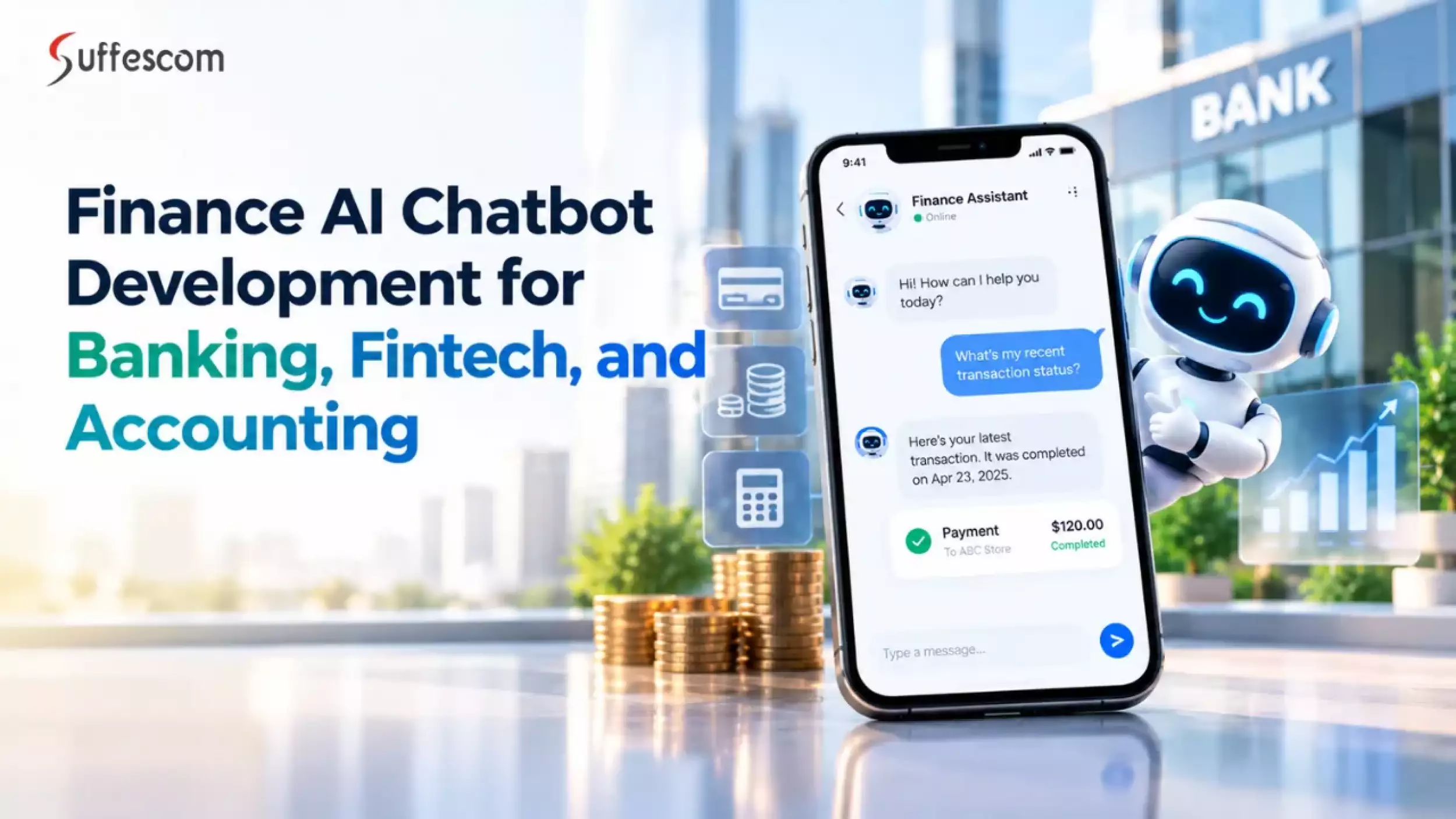
A customer asks, “Why is my card payment still pending?” After authentication, the chatbot calls a transaction-status API and retrieves the payment state, timestamp, and any available status description. It explains what the source system reports and offers the appropriate next step.
If the transaction is disputed, the chatbot can collect the relevant details and open a case. It should not promise a refund or describe a payment as reversed unless the authoritative system confirms that status.
Banking: Loan and Product Information
A prospective borrower asks about eligibility documents, repayment schedules, or the steps in a loan application. The chatbot retrieves approved product information and explains the process in plain language.
If a user asks whether their specific application will be approved, the chatbot should not invent a decision. It can retrieve an authorized application status or route the user to the lender’s official decision process.
Fintech: Payment Status and Failed Transactions
A digital payment user asks why a transfer has not reached the recipient. The chatbot verifies the user’s identity, checks the transaction reference through a payment API, and explains the recorded state.
If the payment provider is unavailable, the response should say that the status cannot currently be confirmed. Retry logic should be designed carefully: repeating a payment request without idempotency controls can create duplicate transactions.
Related workflows may require fintech software integration services to connect payment providers, transaction services, customer support, and internal systems consistently.
Fintech: Budgeting and Spending Insights
A user asks, “What were my three largest expense categories last month?” The chatbot retrieves authorized transaction records, applies the approved categorization rules, and returns a summary with the reporting period and any exclusions.
The interface should allow users to inspect the underlying transactions. If some transactions are uncategorized or pending, the response should state that limitation rather than presenting an incomplete result as a complete financial picture.
Accounting: Invoice and Reconciliation Queries
An employee asks, “Which supplier invoices are overdue and still unpaid?” The chatbot queries the accounting system, applies the agreed definition of overdue, and returns invoice references, amounts, due dates, and status.
For reconciliation, it may identify entries that appear to differ by amount, date, or reference. It should present these as potential matches for review rather than silently changing ledger entries or declaring a discrepancy resolved without confirmation.
An accounting software development workflow can support this type of integration when the chatbot needs access to structured records, reporting logic, and finance-team permissions.
Internal Finance: Policy and Document Retrieval
A finance employee asks which expenses require manager approval. The chatbot retrieves the relevant policy section and explains the rule, including applicable thresholds and exceptions if the source contains them.
Answers should include a link to the source policy and identify its version or effective date where available. If policies conflict or are out of date, the chatbot should surface the uncertainty and route the question to the policy owner.
Benefits of AI Chatbots in Finance
The value of a finance chatbot depends on whether it improves a real workflow without creating unacceptable financial, operational, or customer risk.
Faster Access to Financial Information
A chatbot can let users ask questions in natural language instead of navigating several screens or searching lengthy documents. When integrated with authorized systems, it can retrieve relevant account, payment, invoice, or policy information and summarize it in context.
Reduced Repetitive Support Work
Routine requests such as finding a payment status, locating a policy, or explaining a standard process can be handled through self-service. This may give human support teams more time for complex disputes and cases that require judgment. Integrating AI capabilities with existing financial applications can help automate repetitive queries, streamline workflows, and improve access to relevant financial information.
More Accessible Financial Workflows
Conversational interfaces can help users who are unfamiliar with financial terminology or complex software screens. Multilingual support and plain-language explanations can make information easier to understand, provided the translations and financial terms are tested for accuracy.
Better Support for Finance Teams
Internal assistants can summarize reports, retrieve approved procedures, and help employees locate relevant records. These capabilities may reduce time spent searching across disconnected systems, although the chatbot must respect the same permissions and confidentiality requirements as the underlying tools.
Consistent Service Across Channels
A shared chatbot service can support web applications, mobile apps, and internal portals while using a common set of policies and controlled integrations. Channel-specific authentication, session management, and privacy requirements still need to be handled separately.
Technology Stack and Architecture of a Secure Finance AI Chatbot
A secure finance chatbot is not simply a chat interface connected to an LLM. It is a controlled application that combines conversation handling, AI orchestration, authorized data access, financial business rules, and monitoring.
Core Architecture Components
1. User interface and channel layer
The interface may be embedded in a banking website, mobile app, fintech dashboard, or internal employee portal. It should display authentication status, relevant disclaimers, confirmations for sensitive actions, and options to contact a human agent.
2. Identity and access management
This layer validates user sessions, identity claims, roles, and permissions. It may integrate with an institution’s identity provider, multi-factor authentication (MFA), and session-management controls. Protected API calls must still enforce authorization server-side.
3. API gateway and integration services
The gateway controls traffic between the chatbot and backend systems. Integration services normalize responses from banking, payment, CRM, accounting, and support APIs. They should apply input validation, rate limits, timeouts, error handling, and operation-specific permissions.
4. AI orchestration layer
The AI orchestration service classifies the request, selects an approved workflow, manages tool calls, and assembles the response. It should enforce a clear distinction between informational requests and actions that can affect financial records or move money.
5. LLM and retrieval layer
The LLM interprets natural-language requests and generates explanations. A RAG component can retrieve approved policy documents, product information, and internal knowledge. Retrieval should be filtered by the user’s access rights, and the model should be instructed to acknowledge missing or conflicting evidence.
6. Financial systems and data stores
Core banking, payment processing, accounting, CRM, and case-management systems remain authoritative for their respective records. The chatbot should use approved APIs and controlled read models rather than treating model memory, conversation history, or a vector database as the source of truth for live financial data.
7. Security, audit, and monitoring layer
This layer records relevant security events, tool calls, authorization decisions, errors, and workflow outcomes. Logs should be designed to avoid unnecessary sensitive data and support incident investigation. Monitoring should cover availability, latency, retrieval quality, model behavior, cost, and suspicious activity.
Illustrative Technology Choices
| Layer | Possible technologies | Selection considerations |
| Front end | React, Next.js, Flutter, native mobile | Existing application, accessibility, channel requirements |
| Backend and APIs | Python, Java, Node.js, REST, event-driven services | Existing systems, transaction requirements, team expertise |
| AI and orchestration | Approved LLM APIs or hosted models, tool calling, workflow orchestration | Accuracy, data handling, latency, model governance |
| Retrieval | Vector search, keyword search, hybrid retrieval | Document types, freshness, permissions, traceability |
| Data | Relational databases, approved data warehouses, encrypted object storage | Data classification, retention, reporting needs |
| Infrastructure | Cloud or private deployment, containers, managed services | Availability, regional requirements, resilience, operational model |
| Security and monitoring | IAM, secrets management, SIEM, application monitoring, audit logging | Threat model, compliance scope, incident response |
These are examples rather than a mandatory stack. Financial institutions should select technologies based on their existing architecture, approved vendors, deployment restrictions, support capabilities, and risk assessments.
Example Request Flow
Consider a customer asking for the status of a card payment.
- The interface receives the question and validates the user’s session.
- The orchestration layer identifies the request as a transaction-status query.
- The backend verifies permission to access the specified account and transaction.
- An integration service calls the approved transaction API.
- The response is checked for validity and transformed into a minimal, structured result.
- The AI layer explains the returned status without inventing a reason or changing the underlying transaction.
- The application displays the answer and offers a support path if the result is unclear.
- Security-relevant events are logged according to the institution’s retention and privacy policies.
This separation keeps the LLM from becoming the authority for account access, transaction state, or payment execution.
Security and Compliance Required for Finance AI Chatbot
Security and compliance requirements depend on the organization, jurisdiction, products, data handled, and actions supported by the chatbot. A banking assistant, an accounting copilot, and a payment chatbot may have different obligations. The compliance scope should be assessed before architecture decisions are finalized.
Data Protection and Privacy
Classify the data that may enter the chatbot, including account details, transaction records, personal information, business financials, uploaded documents, and conversation history. Collect only the information needed for the workflow and establish retention and deletion rules for prompts, outputs, logs, caches, and retrieval indexes.
Use encryption in transit and at rest, secure key management, and restricted access to stored data. Review model and hosting providers’ data-processing terms, retention behavior, regional processing options, and use of submitted data for model improvement. Do not assume that an external AI API is suitable for financial data without a documented review.
Authentication and Authorization
Use institution-approved authentication and enforce permissions on every protected operation. MFA or step-up authentication may be required for sensitive account access or transactions. Session expiry, device changes, suspicious behavior, and repeated failed attempts should be handled according to the institution’s security policies.
Never use personal details disclosed in a conversation as a substitute for identity verification. Likewise, a successful sign-in must not automatically grant access to all accounts or financial records.
Secure AI Behavior and Prompt Injection Protection
A chatbot may process user messages, uploaded files, retrieved documents, and tool outputs. Any of these can contain malicious or misleading instructions. Treat retrieved content as data rather than executable instructions, restrict the tools available to the model, and validate all tool arguments in trusted backend code.
Additional controls can include approved-source retrieval, output validation, sensitive-data detection, prompt and response testing, and restrictions on high-risk actions. A system prompt alone is not a sufficient security boundary.
Accuracy, Explainability, and Human Escalation
Ground financial answers in authoritative records or approved documentation. Show the source, reporting period, or relevant transaction reference where useful. If the data is incomplete, stale, or unavailable, the chatbot should say so.
Provide a clear handoff for complaints, disputes, suspected fraud, complex financial problems, and requests that need professional judgment. The CFPB’s analysis of chatbots in consumer finance warns that poorly deployed chatbots can frustrate consumers and may create legal and consumer-protection risks when they provide inaccurate information or prevent customers from getting appropriate assistance.
Regulatory and Governance Review
Depending on the product and market, review applicable privacy and data-protection laws, financial-services rules, consumer-protection obligations, electronic payment requirements, recordkeeping obligations, and third-party risk controls. Organizations operating across regions may need different retention, consent, data residency, and disclosure practices.
Document who owns the chatbot, which business workflows it may perform, how changes are approved, and how incidents are investigated. Where the chatbot supports regulated decisions, the organization should establish the required review, validation, disclosure, and appeal processes rather than treating the output as ordinary customer-service text.
For implementation planning, compliant software development and the relevant compliance resources can help teams identify questions to assess with their legal, risk, security, and compliance stakeholders. These links are not a certification or guarantee that a specific chatbot meets every applicable requirement.
How PCI DSS Controls Map to AI Chatbot Components
The Payment Card Industry Data Security Standard (PCI DSS) provides requirements for protecting payment account data. PCI DSS v4.0.1 is listed in the PCI Security Standards Council’s official document library.
PCI DSS is not a blanket certification for every finance chatbot. Its applicability depends on whether the chatbot environment stores, processes, or transmits cardholder data or sensitive authentication data, or can affect the security of the cardholder data environment (CDE). A payment-related chatbot may still have relevant scope even when it does not directly execute transactions, depending on its architecture and connections.
The following table is an architectural mapping aid, not an official PCI DSS control crosswalk or a substitute for a formal scope assessment.
| Chatbot component | Relevant PCI DSS consideration | Implementation approach |
| Chat interface and message handling | Avoid unnecessary collection and exposure of payment account data | Warn users not to submit card details in free text; use controlled payment components where needed |
| API gateway and integration services | Network protection, access restrictions, secure configuration | Restrict routes, validate inputs, limit service permissions, and separate environments as appropriate |
| Identity and administration | Access control and authentication requirements | Apply least privilege, MFA where required, and controlled administrative access |
| LLM prompts, outputs, and conversation storage | Account data may be exposed through prompts, logs, traces, or stored transcripts | Minimize sensitive data, redact where appropriate, and prevent prohibited data retention |
| Payment service integration | Protect payment data and reduce exposure to the chatbot environment | Use a compliant payment provider or hosted payment page where suitable; return tokens and status references instead of raw card data |
| Logging and monitoring | Auditability, security monitoring, and retention controls | Record relevant events while excluding sensitive authentication data and unnecessary card data |
| Deployment and third-party services | Scope, service-provider responsibilities, and security of connected systems | Review provider responsibilities, contracts, segmentation, and the impact of connected services on the CDE |
| Release and vulnerability management | Secure development, patching, and testing | Test changes, address vulnerabilities, restrict deployment access, and maintain evidence for applicable assessments |
Practical PCI DSS Design Decisions
Keep card data out of the AI conversation where possible. A chatbot should not ask users to paste a full card number, card verification code, PIN, or other sensitive payment information into a general text box. If payment details are required, use a suitable payment component with its own security controls.
Use tokenization and hosted payment flows appropriately. The chatbot can initiate a payment workflow through an approved payment service and receive a token or transaction reference. Tokenization and hosted payment pages can reduce exposure, but they do not automatically remove every connected component from PCI DSS scope. Scope must be confirmed with the organization’s assessor or acquiring/payment stakeholders as applicable.
Prevent prohibited storage. PCI DSS prohibits retaining sensitive authentication data after authorization, even if encrypted, subject to the standard’s specific issuer-related exceptions. The PCI SSC explains this in its FAQ on storage of sensitive authentication data after authorization. Chat transcripts, debug traces, analytics events, and model observability systems must be included in the data-flow review if they could capture such information.
Review the entire data flow, not only the chat widget. Include the front end, backend, model provider, retrieval system, logs, analytics, support platform, payment integrations, and administrative tooling in the scope discussion. Whether a component is in scope depends on how it handles or can affect the security of account data—not merely on its product name.
Validate the design with qualified stakeholders. The applicable requirements and assessment method depend on the payment environment and the organization’s role. A qualified assessor, acquiring bank, payment brand, or other relevant compliance stakeholder should confirm scope and assessment obligations. Technical controls should be mapped to the current standard and the actual environment before a compliance claim is made.
Finance Chatbot Development Cost
Finance chatbot development costs depend on what the system is allowed to do, which systems it must access, how sensitive the data is, and how much validation is needed before launch. A read-only FAQ assistant has a different cost profile from a banking chatbot that retrieves account data, supports disputes, or initiates payment workflows.
The ranges below are indicative planning estimates, not independently verified market averages or a formal quotation. Actual costs can vary by location, team composition, vendor, existing infrastructure, compliance scope, and delivery requirements.
| Project scope | Indicative development cost | Typical scope |
| Focused FAQ or policy assistant | $15,000–$35,000 | Approved knowledge base, basic conversational UI, limited integrations, initial evaluation |
| AI finance assistant with business integrations | $35,000–$80,000 | RAG, authenticated data retrieval, several APIs, access controls, analytics, and escalation |
| Advanced banking or fintech chatbot | $80,000–$180,000 | Multiple financial integrations, complex workflows, detailed audit trails, stronger security testing, and deployment controls |
| Enterprise-grade finance AI platform | $180,000–$350,000+ | Multiple channels, complex legacy integrations, advanced governance, high availability, extensive validation, and enterprise operations |
Factors That Affect Development Cost
AI complexity and scope.
FAQ retrieval and intent classification are generally simpler than multi-step workflows that combine retrieval, API calls, summarization, and conditional actions. Supporting multiple languages or specialized financial terminology may require additional data preparation and evaluation.
Integration requirements.
Each banking, payment, CRM, or accounting system introduces API work, permissions, error handling, testing, and ongoing maintenance. Legacy systems or incomplete API documentation can add significant effort.
Security and compliance.
Identity integration, MFA, sensitive-data controls, auditability, threat modeling, security testing, and payment-data scope assessments require specialist time. The cost depends on the actual obligations and the maturity of existing controls.
Deployment and reliability.
High availability, disaster recovery, private or region-specific deployment, observability, and service-level requirements can increase infrastructure and engineering costs.
Ongoing operating costs.
After launch, budgets may need to cover model usage, hosting, retrieval infrastructure, monitoring, security updates, evaluation, knowledge-base maintenance, and support. These should be estimated separately from the initial build.
Financial Chatbot Development Challenges and Solutions
1. Incorrect or Unsupported Financial Answers
Challenge: An LLM may produce a convincing answer that conflicts with the actual account record, policy, or product terms.
Solution: Retrieve authoritative information at request time, ground responses in approved sources, validate structured data, and make the chatbot acknowledge uncertainty. Test answers against an evaluated set of real and edge-case questions.
2. Sensitive Data Leaking Through Prompts or Logs
Challenge: Customer information can be exposed through conversation transcripts, model traces, analytics tools, retrieval indexes, or third-party services.
Solution: Minimize collected data, classify and redact sensitive fields where appropriate, restrict retention, secure logs, review provider data-handling terms, and test the full data flow. Apply controls to observability and support tools, not only the primary database.
3. Unauthorized Actions or Excessive Tool Access
Challenge: A prompt injection or ambiguous user request may try to trigger an action outside the intended workflow.
Solution: Keep authorization and business rules in trusted backend services. Give each tool narrowly scoped permissions, validate arguments, require confirmation for sensitive actions, and apply transaction limits and approval workflows. Never treat the model’s decision alone as authorization.
4. Legacy Financial System Integration
Challenge: Core banking and accounting systems may have inconsistent identifiers, limited APIs, old data formats, or strict change windows.
Solution: Use an integration layer to normalize data, manage retries and timeouts, handle duplicate requests, and preserve audit references. Begin with read-only integration and expand the workflow after reliability has been demonstrated.
5. Ambiguous Transactions and Partial Failures
Challenge: A payment can remain pending, a provider can time out, or the chatbot may receive an incomplete response.
Solution: Define explicit states such as pending, failed, completed, and unknown. Use idempotency controls for retryable actions, verify final transaction status through the authoritative system, and never tell the user that a transaction succeeded solely because an API request was submitted.
6. Difficult Escalation and Complaint Handling
Challenge: A chatbot may repeatedly offer generic answers when a user needs to dispute a transaction, report suspected fraud, or resolve a complex complaint.
Solution: Detect escalation triggers, preserve the relevant context safely, create a case where appropriate, and provide a direct route to a human agent. Track unresolved conversations and repeated handoffs as quality indicators.
7. Changing Policies and Outdated Knowledge
Challenge: Financial products, fees, eligibility rules, and internal procedures can change, leaving cached answers or indexed documents out of date.
Solution: Assign owners to knowledge sources, track document versions and effective dates, remove obsolete material, and test important answers after updates. For live account data, query the authoritative system rather than relying on a document index.
8. Unclear Return on Investment
Challenge: A high number of chatbot sessions may look successful even when users fail to complete their tasks or contact support afterward.
Solution: Establish a baseline before launch and measure resolution rate, answer accuracy, repeat contacts, escalation quality, time saved, user satisfaction, and cost per successful task. Compare outcomes by use case and expand only where the evidence supports it.
Build a Finance AI Chatbot with Suffescom
Suffescom helps businesses develop AI-powered chatbot solutions tailored to financial products, including digital wallets, payment applications, lending platforms, and customer support systems. The development process can cover conversational AI, intent recognition, backend API integration, transaction-status queries, automated support workflows, and escalation to human agents when a request requires manual review.
For businesses planning to launch a new finance AI chatbot or add conversational AI to an existing financial application, Suffescom’s chatbot development services can support solution planning, feature development, system integration, and implementation based on specific business requirements. The chatbot’s architecture should also account for data privacy, authentication, role-based access, and appropriate safeguards for financial information.
Whether the goal is to reduce repetitive customer support requests, simplify payment-related queries, or improve access to financial services, the chatbot’s features and integrations should align with the intended use case, existing infrastructure, and security requirements.
FAQs
1. What is finance AI chatbot development?
Finance AI chatbot development is the process of building conversational software that helps users retrieve financial information, understand policies, complete supported workflows, or get assistance with banking, fintech, and accounting tasks. A production solution may combine an LLM, approved knowledge retrieval, secure APIs, authentication, authorization, audit logging, and human escalation.
2. How are AI chatbots used in banking?
Banks can use AI chatbots to answer product questions, retrieve authorized transaction information, assist with card support, explain application processes, collect dispute details, and help employees find approved information. Account-specific responses should come from authorized banking systems, and complex or high-risk cases should have an escalation path.
3. How do you implement an AI chatbot in banking?
Start by defining the supported use cases and risk boundaries. Map the required data sources, design the conversation and escalation flows, select the AI and retrieval approach, integrate secure APIs, implement identity and access controls, test accuracy and security, and deploy gradually with monitoring. Payment or account-changing actions require additional authorization and validation.
4. Can a finance chatbot integrate with core banking or accounting software?
Yes. A chatbot can connect through approved APIs, integration services, or other supported interfaces to retrieve balances, transaction statuses, invoice records, financial reports, and other permitted information. Access should be restricted by user role and workflow, and the source system should remain authoritative for financial records.
5. How can an AI chatbot help accounting teams?
An accounting chatbot can retrieve invoices, explain expense categories, summarize financial reports, find policy guidance, and identify potential reconciliation discrepancies. Any action that posts entries, changes supplier records, approves expenses, or initiates payments should follow the organization’s existing authorization and review controls.
6. Is PCI DSS compliance required for every finance AI chatbot?
No. PCI DSS applicability depends on whether the chatbot environment stores, processes, or transmits payment card data or sensitive authentication data, or can affect the security of the cardholder data environment. The actual scope and assessment obligations should be confirmed with the organization’s qualified compliance stakeholders.
7. How much does finance chatbot development cost?
A focused FAQ assistant may cost around $15,000–$35,000 as an indicative planning estimate. A more integrated finance assistant may range from $35,000–$80,000, while advanced banking or enterprise platforms can cost $80,000–$350,000 or more. Integrations, security requirements, AI complexity, deployment, and testing all affect the final estimate.
8. How long does it take to develop a finance AI chatbot?
A limited FAQ or policy assistant may take several weeks to a few months. A finance chatbot with authenticated data retrieval and multiple integrations may take several months, while enterprise banking solutions can require longer due to legacy integration, security testing, governance reviews, and rollout requirements. Timelines depend on scope, team capacity, and approval processes.
9. How can finance chatbots protect sensitive financial data?
Use data minimization, encryption, controlled retention, secure identity and access management, restricted API permissions, prompt-injection defenses, and careful logging. Review third-party model and hosting providers, test for data leakage, and avoid placing unnecessary account or card data in prompts and conversation transcripts.
10. Can a finance chatbot provide financial advice?
It can provide approved educational information or help users understand financial documents, depending on the product’s scope. Personalized investment, lending, or other regulated recommendations may trigger additional legal, suitability, disclosure, or oversight requirements. The system should be designed to respect those boundaries and escalate cases when required.