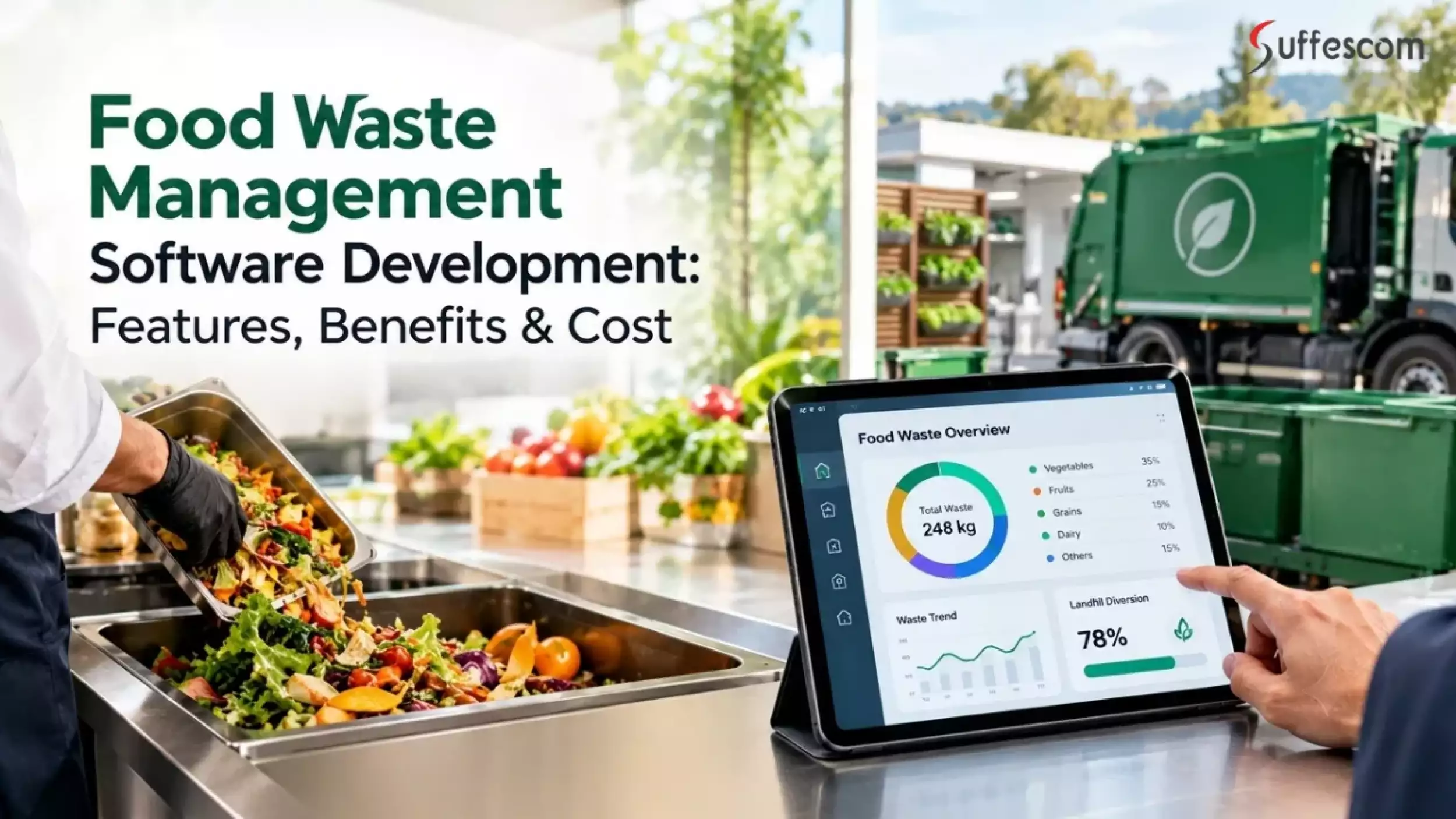
Food waste management software development enables businesses to build digital systems that measure discarded food, identify waste patterns, optimize purchasing decisions, and coordinate surplus food recovery. Modern platforms can combine connected weighing systems, computer vision, inventory data, predictive analytics, and operational workflows to help businesses understand what they purchase, prepare, store, sell, and discard.
The need for these systems is significant. According to the Food Waste Index Report 2024, the United Nations Environment Programme (UNEP) estimated that 1.05 billion tonnes of food were wasted globally in 2022. For restaurants, supermarkets, hotels, and food manufacturers, avoidable waste can increase purchasing costs, reduce margins, and create operational inefficiencies.
Building an effective platform requires more than a digital waste log or a reporting dashboard. The software must capture reliable data, connect it with business operations, and help teams take measurable action. This guide covers the benefits and types of food waste management software, essential features, AI applications, development steps, technology architecture, cost estimates, and security considerations.
Benefits of Food Waste Management Software
The value of food waste software depends on whether the data leads to better operational decisions. Recording discarded food is the first step; preventing avoidable waste requires businesses to understand its causes and change their processes.
Identify Where Food Waste Occurs
Waste can occur during food preparation, production, storage, service, or retail display. A structured system records the quantity, category, location, time, and reason for disposal, helping businesses identify recurring problems.
For example, a commercial kitchen may discover that excess portions of a particular dish are consistently discarded after lunch service. Managers can investigate preparation quantities, serving sizes, and demand patterns before changing production plans.
Consistent categorization is essential. Without standardized records, businesses may know how much food they discard but struggle to compare locations or determine the causes.
Reduce Purchasing and Production Inefficiencies
Food waste data becomes more useful when connected with sales, inventory, procurement, and production records. Comparing these datasets can reveal whether a business is ordering too much stock, preparing excessive quantities, or failing to rotate inventory appropriately.
For instance, a restaurant can compare ingredient consumption with sales and recorded preparation waste to identify mismatches between planned and actual demand. An inventory management software system can complement these workflows by maintaining stock levels, product records, and inventory movements.
Improve Surplus Food Recovery
Food that remains suitable for consumption may be eligible for discounted sale, donation, or redistribution, depending on the food type and applicable requirements.
Recovery software can help businesses publish available surplus, communicate quantities and collection windows, match food with eligible recipients, and record completed handovers. These workflows can make redistribution more organized while reducing the likelihood that recoverable food is discarded.
Strengthen Sustainability Reporting
Businesses can track waste quantities, disposal reasons, recovery volumes, and changes over time. Where suitable data and calculation methods are available, they can also estimate associated costs and environmental impacts.
Reports should distinguish measured data from estimates. For example, recorded waste weight is a direct measurement, while estimated emissions avoided depend on the calculation methodology and assumptions used.
Improve Accountability Across Locations
Businesses operating multiple restaurants, kitchens, stores, or production facilities can compare waste patterns across locations and departments. Managers can investigate unusual changes, assign corrective actions, and assess whether those actions deliver lasting improvements.
These workflows can form part of a broader digital transformation in restaurants, where operational data connects purchasing, kitchen processes, inventory, and performance monitoring.
Types of Food Waste Management Software
Food waste management systems differ in how they collect data, automate measurements, and support business decisions. Some rely on manual input, while others combine connected hardware, computer vision, forecasting, or surplus food recovery workflows.
Manual Logging Apps
Manual logging apps allow staff to record discarded food through a mobile application, tablet, or web interface. Typical records include the food category, quantity, reason for disposal, location, and timestamp.
These applications can be suitable for businesses that need a straightforward starting point or handle waste that automated systems cannot reliably identify. Staff can also record contextual information, such as preparation errors, overproduction, spoilage, or customer plate waste.
However, manual logging depends on consistent staff participation. Busy employees may forget to record waste, estimate quantities inaccurately, or select inconsistent categories.
A well-designed application should minimize data-entry steps, support predefined categories, allow corrections, and identify incomplete records. Offline data capture can also be useful in environments with unreliable connectivity.
Connected Digital Scales and Automated Weighing Systems
Connected digital scales capture the weight of discarded food and transmit measurements to the software platform. Depending on the setup, staff may select the food category or disposal reason while the device records the weight automatically.
A typical workflow involves placing a waste container on the scale, capturing the weight, identifying the food category where necessary, and storing the measurement against the relevant location and time.
Automated weighing can reduce reliance on estimates, but it does not automatically identify every food type. The implementation must account for container tare weights, calibration, device connectivity, and staff interactions.
For businesses with multiple sites, the system should also standardize measurement units and device configurations so that records remain comparable across locations.
Camera-Based and Computer Vision Systems
Camera-based systems use computer vision to help identify food discarded into a designated collection area. Depending on the hardware, the system may combine images with scale measurements to estimate the type and quantity of waste.
A production workflow can capture an image, classify the likely food category, associate the result with a weight measurement, and send uncertain predictions for staff review.
These systems require careful validation. Mixed food, overlapping items, poor lighting, changing menus, and visually similar ingredients can affect classification accuracy. Developers should implement confidence thresholds, human correction workflows, and performance monitoring using representative images from the actual operating environment.
These examples demonstrate how software can combine hardware and operational processes rather than relying exclusively on manual data entry.
Integrated Kitchen and Procurement Management Software
Integrated systems connect waste records with purchasing, inventory, recipes, production schedules, and sales data. Their purpose is to help businesses understand how operational decisions contribute to waste.
A hotel kitchen might compare planned buffet quantities with consumption and recorded leftovers. A supermarket could combine inventory age, sales velocity, and product expiry information to prioritize markdowns or replenishment reviews. A food manufacturer might examine losses associated with specific production batches.
A digital procurement management platform can support more organized purchasing workflows, but effective food waste management also depends on reliable integrations with point-of-sale (POS), enterprise resource planning (ERP), inventory, and supplier systems. Product identifiers, timestamps, measurement units, and synchronization rules must be consistent enough to make the combined data meaningful.
Surplus Food Donation and Recovery Software
Surplus food platforms coordinate businesses with excess food and consumers, charities, or other eligible recipients. Depending on the business model, the platform may support discounted food sales, charitable donations, or internal redistribution.
Typical workflows include surplus listings, quantity and allergen information, collection deadlines, recipient matching, pickup scheduling, and handover confirmation.
When developing a new platform, it is important to define whether it will serve consumers, business-to-charity donations, internal redistribution, or multiple models. Each option has different requirements for user roles, payment handling, collection workflows, and food safety controls.
Predictive and Forecasting Platforms
Predictive and forecasting platforms use historical sales, inventory movements, production quantities, menu changes, seasonality, and other relevant signals to estimate demand and identify potential food waste. Predictive platform development focuses on turning these data patterns into actionable recommendations for purchasing, production planning, and inventory management.
For example, a restaurant may use historical sales and reservation data to inform food preparation quantities. A supermarket could identify products at risk of remaining unsold before their relevant dates and prioritize a review of replenishment or markdown decisions.
Forecasting models must be evaluated against actual outcomes. Demand variability, promotions, holidays, unexpected events, and changing customer behavior can affect predictions. The software should track forecast accuracy alongside business measures such as waste, stockouts, availability, and operating costs.
Essential Features of Food Waste Management Software
Feature requirements should reflect the target users and operating environment. A restaurant waste-tracking tool does not necessarily need every capability required by an enterprise food manufacturer or a multi-sided donation marketplace.
Waste Capture and Categorization
The system should record waste quantity, food category, location, timestamp, and disposal reason. Depending on the product, records can come from staff input, connected scales, barcode scans, or computer vision.
Standardized categories allow businesses to compare results across shifts and locations. The system should also support corrections and record changes where data accuracy matters.
Inventory and Expiry Monitoring
Inventory functionality may include batch or lot identifiers, received dates, relevant expiry or use-by dates, storage locations, quantities, and stock adjustments.
The system can flag products approaching important dates and help staff review stock rotation. However, alerts must reflect the correct rules for the relevant food category and jurisdiction; software should not independently determine that a product is safe to consume.
Demand and Production Planning
The platform should connect waste records with relevant demand signals. Food-service businesses may use menu items, historical sales, customer counts, reservations, and production quantities. Retailers may depend more on sales velocity, promotions, inventory age, and replenishment schedules.
Recommendations should make their assumptions visible so managers can understand why the system suggests changing a purchase or preparation quantity.
Surplus Listing and Recipient Coordination
For recovery-focused products, useful capabilities include listing creation, quantity updates, availability windows, recipient matching, pickup scheduling, status tracking, and collection confirmation.
The system should handle exceptions such as cancelled pickups, unavailable recipients, missed collection windows, and food that no longer meets eligibility requirements.
Analytics and Corrective Actions
Analytics should identify actionable patterns rather than simply display waste totals. Businesses may need reports by food category, reason, menu item, location, production period, or estimated cost. Effective data analytics solutions can help turn these records into insights for operational decision-making.
A corrective-action workflow can assign issues to managers, record interventions, and compare results over subsequent periods. This helps teams assess whether operational changes are reducing avoidable waste.
Roles, Permissions, and Audit Trails
Different users require different access levels. Kitchen staff may record waste, site managers may approve adjustments, and corporate teams may review consolidated performance.
Audit logs should capture important changes to records, inventory adjustments, permissions, and recovery transactions. These controls are particularly valuable when the information supports financial reporting, supplier discussions, or compliance processes.
How AI Can Improve Food Waste Management
AI can support food waste prevention when it addresses a defined operational problem. Adding a generic AI dashboard or chatbot does not automatically reduce waste; the system needs reliable data and a process for acting on its outputs.
The UNEP Food Waste Index Report provides a useful foundation for understanding the scale of the issue, while practical AI implementations must be evaluated using their own data and measurable outcomes.
Computer Vision for Waste Identification
Image-recognition models can help classify discarded food from camera images. A connected scale may supply weight data, while the model predicts the likely food category.
A production-ready system should record uncertain predictions, allow staff to correct classifications, and evaluate performance across actual food types and operating conditions. Predictions should remain distinguishable from verified measurements.
Demand Forecasting
Machine learning can estimate demand using historical sales, calendar patterns, promotions, occupancy, events, and other relevant signals. Businesses can use the results to inform purchasing and preparation decisions.
Forecasts should be compared with suitable baseline methods and evaluated across different operating conditions. Teams should also monitor real business outcomes, including waste levels, stockouts, availability, and labor requirements.
Expiry and Waste-Risk Prioritization
A risk model can rank inventory items according to the likelihood that they will remain unsold or become unusable before the relevant deadline. The platform may then recommend reviewing replenishment quantities, markdowns, or donation eligibility.
The model must account for the reliability of date and inventory records. Risk scores should support staff decisions, not replace food safety checks.
Automated Reporting and Workflow Recommendations
AI can summarize recurring waste patterns, flag unusual changes, and prepare recommendations for staff review. Workflow automation can route alerts to the responsible manager, create follow-up tasks, or request approval for proposed changes.
Custom classification or forecasting requirements may benefit from AI development services, particularly when existing models do not meet the product's accuracy or workflow needs.
How to Develop Food Waste Management Software: Step by Step
Food waste management software development should begin with a defined operational problem and measurable success criteria. Building advanced features before validating the workflow and data quality can increase costs without delivering meaningful improvements.
Step 1: Define the Use Case and Success Metrics
Choose the target environment, such as restaurants, hotels, grocery stores, food manufacturers, or surplus food recovery organizations. Document where waste occurs, who records it, and which decisions the software should support.
Define baseline metrics before implementation. Depending on the use case, these may include waste weight per meal served, avoidable waste cost, unsold inventory, recovery rate, forecast error, or missed collections.
Step 2: Map Data Sources and Operational Workflows
Identify how the system will obtain information from staff, scales, cameras, POS systems, inventory platforms, procurement software, and external partners.
Document data ownership, product identifiers, units of measurement, synchronization frequency, and exception handling. If records from different systems cannot be matched reliably, the resulting analytics may be misleading.
Step 3: Design the MVP
Prioritize the smallest feature set that can validate the business case. A restaurant MVP might include waste logging, predefined categories, cost estimates, location-based reports, and corrective actions. A surplus food marketplace may instead prioritize listings, recipient matching, collection scheduling, and handover confirmation.
A connected hardware or AI-based product may need a working device integration and a human review workflow from the beginning.
Following a structured MVP development approach can help define essential functionality, validate assumptions, and postpone advanced features until the core workflow has been tested.
Step 4: Develop the Core Software and Integrations
Build the user interface, backend services, database, access controls, APIs, and reporting workflows according to the approved requirements.
Test integrations with realistic data and plan for failed synchronization, duplicate events, invalid records, and offline operation where necessary. Hardware-enabled products also need device authentication, connectivity checks, and measurement validation.
Step 5: Validate Data Quality and AI Performance
Before relying on automated recommendations, verify that the data is complete and representative. For computer vision, evaluate classification performance across actual food categories and operating conditions. For forecasting, compare predictions against a baseline and assess performance during busy and unusual periods.
Include human review for uncertain or high-impact decisions, and maintain a clear distinction between predicted values and verified records.
Step 6: Pilot in a Real Operating Environment
Deploy the system in one kitchen, store, facility, or region before expanding across the organization. Observe whether staff can use it consistently and whether the recommendations are practical.
Compare outcomes with the baseline while considering other influences, including menu changes, seasonality, occupancy, and purchasing policies. Avoid attributing every improvement to the software without examining these factors.
Step 7: Deploy, Monitor, and Improve
Expand in stages after validating the pilot. Monitor application reliability, integration errors, data quality, staff adoption, and the operational outcomes the platform is intended to improve.
For an existing legacy system, a phased approach to software modernization may help improve architecture, integrations, or maintainability without requiring every component to be rebuilt at once.
Tech Stack and Architecture for Food Waste Management Software
The technology stack should reflect the product's scale, hardware requirements, integrations, and data-processing needs. There is no single technology combination that is best for every food waste management platform.
Frontend and Backend Technologies
A web administration portal may use React, Angular, or Vue. Mobile data-entry applications can use native iOS or Android development or a cross-platform framework such as Flutter or React Native.
Backend services can be implemented using Node.js, Python, Java, or .NET. The choice should consider team expertise, integration requirements, background processing, and long-term maintenance.
Database and Data Processing
A relational database such as PostgreSQL can store users, inventory, waste events, locations, and donation records. Object storage can hold images from camera-based systems, while analytics infrastructure can support large historical datasets.
Time-series storage or event-stream processing may be useful when connected devices continuously generate measurements. These components should be introduced when justified by actual data volume, processing needs, and latency requirements.
AI and Computer Vision Infrastructure
Python-based tools and machine learning frameworks can support image classification, anomaly detection, and demand forecasting. Production deployments may require image preprocessing, model versioning, confidence thresholds, evaluation pipelines, and monitoring.
The architecture should distinguish raw observations, model predictions, human corrections, and verified business records. This improves auditability and makes model evaluation more reliable.
Hardware, APIs, and Cloud Infrastructure
Connected scales, barcode scanners, cameras, and temperature sensors may communicate through device APIs, local gateways, or cloud endpoints. The platform should handle intermittent connectivity, duplicate messages, device authentication, and delayed synchronization.
Cloud infrastructure can support application hosting, data storage, monitoring, backups, and machine learning workloads. Appropriate cloud solutions depend on existing enterprise systems, regional requirements, expected workloads, and operating costs.
A typical data flow looks like this:
Capture → Validate → Store → Analyze → Recommend → Act → Measure
Data comes from users, devices, and connected systems. The platform validates and stores the records, generates insights or recommendations, routes actions to responsible users, and measures the resulting operational outcomes.
Real-World Examples of Food Waste Management Platforms
Existing platforms demonstrate different approaches to food waste measurement, prevention, and recovery. Their capabilities should be assessed against their published use cases rather than assuming all food waste solutions provide the same functionality.
Winnow: AI-Based Measurement and Forecasting
Winnow offers food waste technology for commercial kitchens, including AI-enabled measurement and forecasting. Its published case studies describe deployments in hospitality and food-service environments.
Winnow has reported that Hilton Frankfurt Airport and Hilton Garden Inn Frankfurt Airport reduced overproduction by 66% using AI-powered food forecasting. This is a vendor-reported result from those specific properties, not a guaranteed outcome for other businesses.
The example illustrates why connecting waste measurement with production planning can be more useful than collecting waste statistics alone.
Leanpath: Tracking and Prevention Workflows
Leanpath focuses on measuring food waste and using the resulting information to support prevention actions. Its approach illustrates the value of standardized waste capture, category analysis, and operational follow-up.
A custom platform could adopt similar principles by identifying recurring waste patterns, assigning corrective actions, and tracking whether changes persist across shifts or locations.
Too Good To Go: Surplus Food Marketplace
Too Good To Go is an example of a surplus food marketplace that connects consumers with businesses offering eligible unsold food. Its model focuses on recovering surplus through a marketplace rather than measuring every instance of kitchen waste.
A new surplus food platform can apply the same broad product concept while designing its own availability rules, pickup confirmation, inventory updates, payment workflows, and communication between businesses and recipients.
For a related development perspective, see the guide on building a food wastage app like Too Good To Go.
These examples represent different product models: measurement and prevention, operational analytics, and surplus recovery. A new product should establish its core purpose first and add other capabilities when they support a validated business need.
Food Waste Management Software Development Cost
Food waste management software development cost depends on the product scope, number of user roles, integrations, hardware, AI requirements, data migration, and security needs.
| Development scope | Indicative cost |
| Basic waste logging and reporting MVP | $15,000–$35,000 |
| Business platform with inventory and integrations | $35,000–$80,000 |
| Multi-location platform with advanced workflows | $80,000–$180,000 |
| AI, connected hardware, or complex enterprise platform | $180,000–$400,000+ |
What Affects the Development Cost?
Core features and user roles: A staff logging application and a multi-location enterprise system require different levels of access control, reporting, administration, and testing.
Third-party integrations: POS, ERP, inventory, procurement, supplier, and donation-partner integrations can increase development and testing effort, particularly when APIs are limited or inconsistent.
Hardware requirements: Connected scales, cameras, sensors, and device gateways may require hardware procurement, protocol integration, calibration, installation, and on-site validation.
AI development: Using an existing model with suitable data is different from collecting training data and developing a custom model. Computer vision and forecasting also require ongoing evaluation, monitoring, and refinement.
Security and deployment: Enterprise access controls, audit logs, data retention, backups, monitoring, and multi-region deployment can affect the architecture and total cost.
How to Plan the Budget
Start by selecting one operational workflow and defining its baseline metrics. Build the MVP around that workflow, validate adoption and data quality, and then expand into predictive analytics, automation, or additional locations when the results justify the investment.
Budget separately for cloud infrastructure, hardware maintenance, third-party subscriptions, support, and AI monitoring. These recurring expenses are not necessarily included in the initial development estimate.
Security, Data Privacy, and Regulatory Considerations
Food waste platforms may store employee information, supplier records, inventory data, commercial performance metrics, images, and donation transactions. Security controls should reflect the sensitivity of the information and the operational consequences of an outage or unauthorized change.
Access Control and Data Protection
Use role-based access controls, secure authentication, encryption in transit and at rest, managed secrets, and appropriate backup and recovery procedures. Camera-based systems should restrict access to stored images and avoid collecting unnecessary personal information.
Audit logs should capture changes to waste records, inventory adjustments, donation status, permissions, and other important events.
Integration and Device Security
Connected scales, cameras, and third-party APIs create additional points that require protection. Systems should authenticate devices, secure API credentials, validate incoming data, and monitor integration failures or suspicious activity.
The architecture should also prevent duplicate or delayed device events from corrupting waste totals and inventory records.
Food Safety and Regulatory Requirements
Software must not treat waste reduction as permission to distribute food that is unsafe or ineligible for donation. Depending on the product and jurisdiction, requirements may involve storage conditions, allergen information, use-by dates, traceability, and collection deadlines.
For example, the U.S. FDA Food Code provides a model for retail and food-service food safety regulation in the United States. Its applicability depends on local adoption and the requirements governing the specific business.
The relevant compliances obligations should be reviewed before launch. A platform's workflows, data retention, permissions, and audit records should reflect the applicable rules. The compliance resources can be reviewed alongside qualified legal and food safety advice when identifying relevant requirements.
Build Food Waste Management Software with Suffescom
Building a food waste management platform involves more than developing a data-entry interface. The solution may need to connect operational systems, validate measurements, manage user permissions, process analytics, and support workflows across purchasing, preparation, storage, and surplus recovery.
The development approach should reflect the product's actual requirements. A waste-tracking MVP may focus on reliable data capture and reporting, while an enterprise platform may require multi-location management, connected hardware, complex integrations, and predictive analytics.
Suffescom provides software development services that can support the implementation of custom platforms based on defined business workflows, technical requirements, and deployment needs.
A practical starting point is to identify the target users, map the waste-management workflow, establish baseline metrics, and determine which systems and devices will supply the data. This creates a foundation for prioritizing the MVP, estimating implementation effort, and evaluating whether the completed platform delivers measurable operational value.
FAQs
1. What is food waste management software?
Food waste management software records, analyzes, prevents, or coordinates the recovery of food waste and surplus. Depending on the product, it may use manual logging, connected scales, computer vision, inventory integrations, forecasting, or donation workflows.
2. What features should food waste management software include?
Core features may include waste capture and categorization, inventory and expiry monitoring, analytics, corrective-action tracking, user permissions, and audit trails. Products focused on AI or food recovery may also need connected hardware, forecasting, recipient matching, pickup scheduling, and POS or ERP integrations.
3. How does AI help reduce food waste?
AI can support food classification, demand forecasting, inventory-risk prioritization, and workflow recommendations. Its effectiveness depends on data quality, model performance, staff adoption, and whether recommendations lead to measurable changes in purchasing or production.
4. How much does food waste management software development cost?
A basic waste logging and reporting MVP may cost approximately $15,000–$35,000, while an enterprise platform with advanced integrations, hardware, or custom AI can cost $180,000–$400,000 or more. These are indicative planning estimates; actual costs depend on requirements and implementation complexity.
5. How long does it take to develop food waste management software?
A basic MVP may take around 8–14 weeks, while a platform with several integrations and multi-location workflows may take 4–8 months. Complex hardware-enabled or AI-heavy products can take longer because they require data preparation, testing, calibration, and real-world validation.
6. Can food waste management software integrate with POS and inventory systems?
Yes. APIs and integration services can connect waste records with sales, purchasing, stock levels, recipes, and supplier data. Integration feasibility depends on the systems involved, API availability, data quality, and synchronization requirements.
7. What is the difference between food waste tracking and food waste prevention software?
Tracking software primarily measures what is discarded and why. Prevention software uses that information, often alongside sales and inventory data, to change purchasing, preparation, storage, or production decisions. Many modern platforms combine both capabilities.
8. Can food waste management software coordinate food donations?
Yes. A donation-focused platform can publish eligible surplus, match it with recipient organizations, manage collection windows, track handovers, and retain relevant records. Food safety, recipient eligibility, and local donation requirements must be built into the workflow.