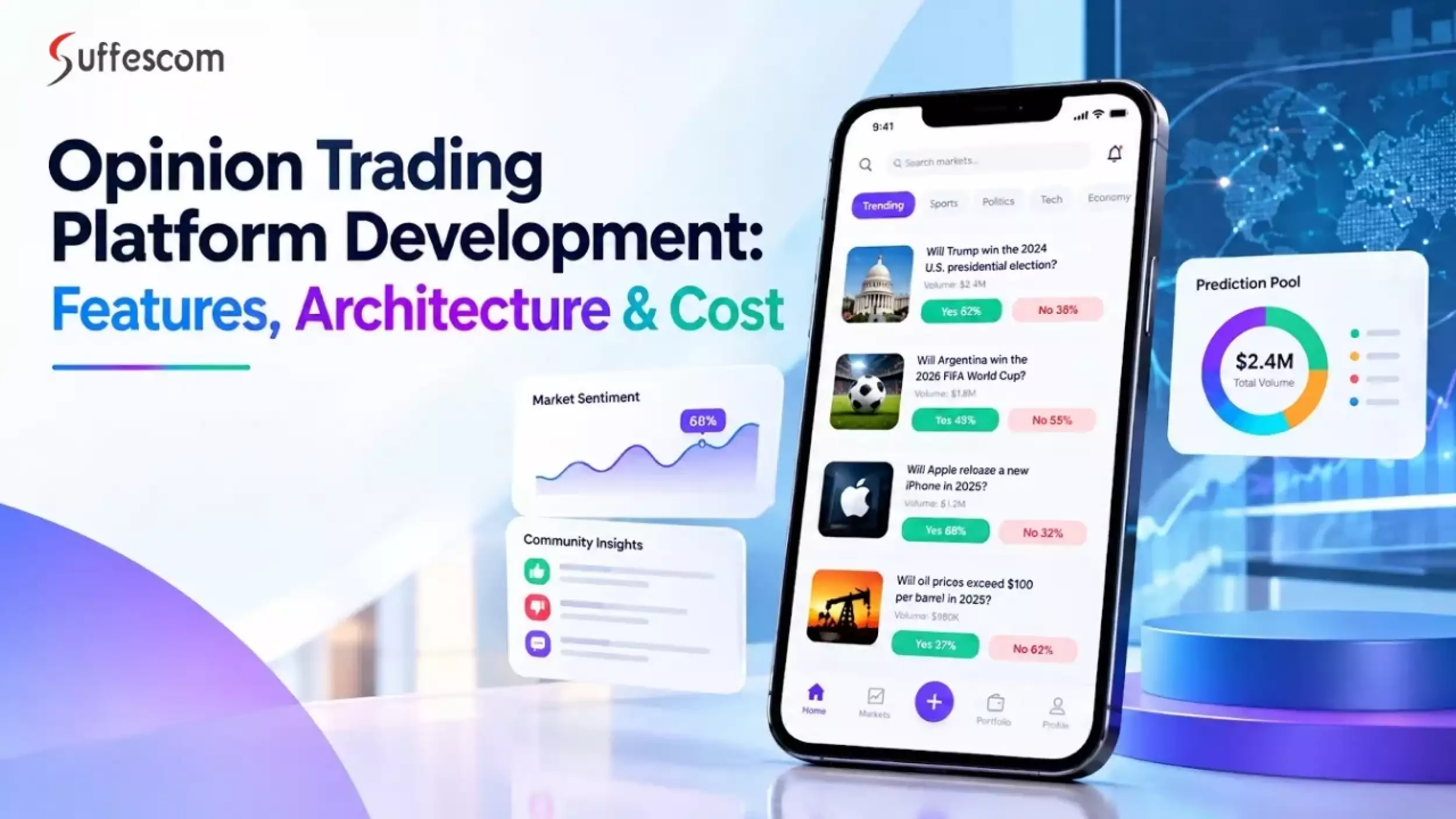
Opinion trading platforms enable users to trade on the possible outcomes of future events, including economic developments, public policy decisions, sports, technology milestones, and other clearly defined events. Depending on the platform model, users may buy and sell outcome-based contracts, with prices reflecting participants' collective expectations about an event's likelihood.
For fintech founders and businesses, opinion trading platform development involves more than building a trading interface. The product needs a market creation system, pricing and order-handling logic, liquidity management, transparent settlement rules, account and transaction records, risk controls, and a reliable infrastructure for real-time activity.
Market activity has expanded rapidly. According to Pew Research Center's September 2026 analysis, combined monthly global trading volume on Kalshi and Polymarket reached approximately $53 billion in July 2026. Sports-related trading drove much of the increase. This is a measure of activity across two platforms, not the total addressable market or revenue of the opinion trading industry.
Businesses considering this category need to evaluate the intended market model, applicable regulations, liquidity strategy, technical requirements, and commercial objectives before development begins. This guide covers the platform features, trading architecture, development process, estimated costs, and key considerations involved in building an opinion trading application.
How Does an Opinion Trading Platform Work?
A typical opinion trading platform follows a defined lifecycle from market creation to final settlement. The precise workflow depends on whether the platform uses an order book, an automated market maker, or another pricing mechanism.
- Market creation: An authorized operator defines the event, available outcomes, trading period, resolution deadline, and settlement criteria.
- User participation: Users review market details, prices, fees, and rules before placing orders.
- Order processing: The trading engine validates orders and matches compatible orders or calculates prices through the selected market-making mechanism.
- Position updates: The platform records executions and updates positions, balances, and relevant risk calculations.
- Event resolution: The system determines the outcome using the market's predefined criteria and approved information sources.
- Settlement: The platform calculates payouts, records balance movements, and updates the market's final status.
- Reporting and monitoring: Users and administrators can review transaction history, market activity, settlement records, and relevant alerts.
The resolution process deserves particular attention. A market should define how it handles delayed announcements, corrected data, cancellations, conflicting sources, and outcomes that cannot be verified conclusively. Clear rules reduce ambiguity and help operators manage disputes consistently.
Types of Opinion Trading Platforms
The appropriate platform model depends on the events being traded, target users, pricing mechanism, liquidity strategy, and applicable regulations.
1. Event-Based Opinion Trading Platforms
These platforms allow users to take positions on defined future events, including economic announcements, technology developments, business milestones, and public policy outcomes.
The software must support precise event descriptions, controlled market creation, reliable data sources, and clear resolution rules. Markets should not be opened when the outcome cannot be determined using an objective and documented process.
2. Prediction Market Platforms
Prediction markets aggregate participants' expectations through prices associated with possible outcomes. They may cover economic indicators, political developments, business forecasts, or other events, depending on their product design and operating permissions.
The market's pricing mechanism influences how participants trade and how prices respond to new information. For a broader technical overview of the planning process, see this guide to building a prediction market platform.
3. Binary-Outcome Trading Platforms
Binary-outcome markets offer two possible results, such as whether a defined event occurs or does not occur. Some contract structures provide a fixed payout when the specified outcome is confirmed.
The platform must implement accurate payout calculations, order validation, trading limits, and reliable settlement logic. Although a binary market may appear simple to users, its execution and risk controls can still require substantial engineering.
4. Multi-Category Opinion Trading Platforms
A multi-category platform may support different types of event markets through a shared account system and trading infrastructure. Categories could include economic data, business events, technology developments, or other permitted subjects.
A modular architecture is particularly useful when adding new categories introduces different data sources, trading rules, market hours, or resolution requirements. Businesses planning a broader product can also review multi-asset trading platform development for relevant platform architecture concepts. However, event contracts and conventional financial assets should not be treated as interchangeable instruments.
Essential Features of an Opinion Trading Platform
An opinion trading app needs capabilities for traders, market operators, administrators, and risk teams. The feature set should reflect the intended market model and the operational requirements of the business.
User Registration and Account Management
The account system should support secure registration, authentication, profile management, account recovery, and identity verification where required.
Depending on the jurisdiction and product model, onboarding may also require age checks, geographic restrictions, eligibility validation, sanctions screening, and controls for suspicious or duplicate accounts.
Market Discovery and Search
Users need to locate relevant markets without navigating an unnecessarily complex interface.
Important capabilities include:
- Search and category filters.
- Trending and recently created markets.
- Market closing and resolution dates.
- Liquidity or activity indicators, where applicable.
- Clear descriptions of outcomes and settlement conditions.
- Access to market rules and source information.
The interface should distinguish open, suspended, closed, disputed, and resolved markets. Popularity alone should not determine which markets users see first.
Real-Time Prices and Market Data
The trading interface should display current prices, available order depth where supported, recent trades, price changes, and market status.
WebSocket connections or other suitable real-time delivery methods can keep the interface updated without requiring repeated page reloads. However, the backend must remain the authoritative source for order acceptance, execution, account balances, and settlement.
Historical charts should use consistent timestamps and documented calculation methods. If a displayed price is interpreted as an implied probability, the platform should explain how that value is calculated and why it may differ from the actual probability of the event occurring.
Order Placement and Trade Management
Depending on the execution model, users may need to place limit orders, execute against available liquidity, cancel open orders, and track completed or partially completed trades.
The trading engine should validate order quantities, enforce applicable limits, check available balances or collateral, and handle repeated submissions safely.
An order-book platform needs matching logic and order-state management. An automated market maker needs pricing calculations and liquidity accounting. The chosen mechanism should be reflected in both the user interface and backend design.
Portfolio and Transaction History
Users should be able to review open positions, completed trades, transaction history, fees, pending settlements, and applicable account movements.
The underlying ledger must link orders, executions, fees, balance changes, and settlements. Records should be traceable, and corrections should use auditable adjustment procedures instead of silently overwriting transaction history.
Notifications and Market Updates
Notifications can inform users about order execution, price thresholds, market closures, resolution announcements, account activity, and service updates.
Users should be able to configure notification preferences. The platform should also distinguish operational updates from promotional messages and avoid presenting predictions as guaranteed outcomes.
Admin Dashboard and Market Operations
The administration panel gives authorized staff control over the platform's markets and operational workflows.
It may include:
- Market creation, approval, suspension, and closure.
- Event descriptions and resolution criteria.
- User and account management.
- Trading activity and liquidity monitoring.
- Dispute and exception handling.
- Transaction reconciliation and settlement records.
- Fee configuration and operational reporting.
- Role-based permissions and administrative audit logs.
High-impact actions, such as changing resolution criteria or processing exceptional settlements, should have strict permissions and an auditable approval process.
Opinion Trading Platform Architecture and Trading Engine
A production-grade opinion trading platform needs an architecture that can process orders reliably, distribute real-time market updates, maintain accurate records, and support controlled settlement. The frontend should remain separate from the backend services responsible for execution and financial records.
1. Frontend and API Layer
The frontend provides web or mobile interfaces for registration, market discovery, order entry, portfolio management, and notifications.
An API layer authenticates requests, enforces permissions, applies rate limits, and routes requests to the appropriate backend services. Client-side calculations should never be the final authority for order acceptance, balances, or settlement.
2. Market Management Service
This service maintains market definitions, available outcomes, trading periods, market status, resolution criteria, and relevant source references.
Market definitions should be versioned and auditable. If an event is corrected or suspended, the platform must record the change and apply the published rules consistently.
3. Order Management and Execution Engine
The execution engine validates and processes trading instructions.
For an order-book model, this can involve order matching, a defined matching policy, cancellations, partial fills, and liquidity management. For an automated market maker, it involves a pricing function, liquidity accounting, trade-impact calculations, and safeguards against invalid states or unexpected price movements.
Both models require concurrency controls, idempotent request handling, clear execution states, and recovery procedures. Repeated requests must not create duplicate trades.
Automated execution also requires careful monitoring. Techniques used in algorithmic trading software development, such as execution monitoring and automated workflow controls, may inform parts of the design, but event-based markets need their own pricing, resolution, and settlement logic.
4. Pricing, Liquidity, and Risk Management
In an order book, displayed prices emerge from submitted orders. In an automated market maker, prices are calculated according to the selected pricing mechanism and the state of its liquidity pool.
The platform should monitor liquidity, price impact, unusual activity, exposure, and concentration risks. Depending on the model, controls may include maximum order sizes, market-specific limits, trading pauses, and alerts for abnormal price movements.
Market prices should not be presented as guaranteed predictions. Thin liquidity, concentrated positions, or unusual trading activity can make prices less informative.
5. Transaction Ledger and Settlement Service
The ledger records orders, executions, fees, applicable collateral movements, transfers, and settlements. Its design should provide traceable records and consistent reconciliation.
The settlement service evaluates the event against the market's documented resolution criteria and calculates the corresponding account changes. It should support exception handling, reconciliation, and a complete audit trail.
Separating event resolution from order execution helps prevent a market from being settled merely because its trading interface displays a final result.
6. Data, Messaging, and Observability
A platform may use relational databases for transactional records, in-memory systems for selected low-latency operations, and messaging infrastructure for asynchronous workflows.
Market data, notifications, analytics, and reporting can be processed through separate services where appropriate. Monitoring should cover execution latency, rejected orders, message delays, ledger discrepancies, error rates, and settlement failures.
The architecture should also define backup procedures, recovery objectives, incident response, and capacity testing before the platform handles significant trading activity.
AI and Data Analytics in Opinion Trading Platforms
AI can support operational monitoring and data analytics, but it should not replace deterministic financial controls or documented event-resolution rules.
Potential applications include:
- Anomaly detection: Flag unusual order patterns, abrupt activity changes, or suspicious account behavior for investigation.
- Market analytics: Summarize price movements, liquidity conditions, participation, and historical activity.
- Support automation: Help users locate platform functions and understand documented market rules.
- Operational forecasting: Estimate traffic, infrastructure demand, or support workload around high-interest events.
- Fraud monitoring: Identify patterns that warrant additional review while preserving appropriate human oversight.
AI systems should be evaluated for false positives, bias, data drift, and performance under unusual market conditions. Model-generated summaries should not change market outcomes or override published settlement rules.
Where AI capabilities need to connect with an existing platform or operational workflow, AI integration services may be relevant to assessing the required integrations and implementation scope.
Security, Compliance, and Market Integrity
Security and compliances should begin before the trading engine is implemented. Requirements depend on the target jurisdiction, contract structure, user eligibility, payment flows, and legal classification of the product.
Account and Transaction Security
Core controls may include multi-factor authentication, secure session management, encryption in transit and at rest, role-based access, secrets management, vulnerability testing, and continuous monitoring.
The platform should also protect administrative functions, payment integrations, API credentials, and sensitive user data. A security incident affecting balances, order execution, or resolution records can have consequences beyond a conventional application outage. Implementing appropriate cybersecurity solutions can help address risks through security assessments, vulnerability management, access controls, and continuous monitoring.
Identity Verification and User Eligibility
Where required, onboarding may need identity verification, age checks, geographic restrictions, sanctions screening, and ongoing account monitoring.
KYC and AML requirements should be determined by qualified legal and compliance professionals for the actual product and jurisdiction. Integrating a verification provider alone does not establish that a platform is legally compliant.
Compliance planning should be built into the product requirements, architecture, and operating procedures. Suffescom's compliant software development services are a relevant resource when evaluating software requirements alongside the applicable compliance framework.
Market Manipulation and Insider Activity
Market-integrity controls may include suspicious-trading detection, account relationship analysis, concentration monitoring, trading limits, audit trails, and investigation workflows.
The U.S. Commodity Futures Trading Commission's prediction market guidance explains how regulated event-contract markets operate and highlights protections relating to market integrity and misconduct. Its rules apply within the relevant U.S. regulatory framework and should not be generalized to every platform or country.
Jurisdiction-Specific Legal Review
The legal treatment of opinion trading differs by market, contract design, and jurisdiction. A product permitted in one country may face restrictions or different licensing requirements elsewhere.
Before launch, businesses should obtain qualified legal advice on product classification, market eligibility, contract structure, marketing, payment flows, user restrictions, and operating jurisdictions. The platform's technical design should reflect the resulting requirements rather than assuming that security or identity verification features alone establish legal permissibility.
How to Develop an Opinion Trading Platform: Step by Step
A phased development process helps validate the product model and technical assumptions before investing in large-scale trading infrastructure.
Step 1: Define the Product and Target Market
Establish the event categories, intended users, market mechanism, revenue model, and launch jurisdictions.
Document the primary user journeys and identify what differentiates the product from existing opinion trading and prediction market platforms.
Step 2: Validate Legal and Commercial Feasibility
Obtain jurisdiction-specific legal advice before finalizing real-money functionality. Determine whether the product requires licensing, registration, restrictions on eligible users, specific disclosures, or other controls.
Evaluate market demand, competition, potential liquidity sources, and the operational resources needed to manage event resolution.
Step 3: Define the Trading and Settlement Model
Choose between an order book, an automated market maker, or another suitable mechanism. Define order types, pricing behavior, fees, liquidity rules, trading limits, and the lifecycle of each market.
Specify how events are resolved, which sources are authoritative, how disputes are handled, and what happens when an event is cancelled or cannot be conclusively verified.
Step 4: Design the Architecture and Data Model
Define the market, order, execution, account, ledger, and settlement data structures. Establish service boundaries, API contracts, event handling, security controls, and observability requirements.
Plan for concurrency, idempotency, transaction consistency, backups, and disaster recovery. These decisions become more difficult to change after the platform accumulates live trading activity.
Step 5: Develop the Core Platform
Build onboarding, market discovery, order placement, portfolio management, transaction history, notifications, and administration capabilities.
Implement the trading engine and ledger as authoritative backend services. The application should be tested against realistic execution, data, and operational scenarios before the launch scope is finalized.
Step 6: Integrate Payments and External Services
Where legally permitted, connect payment providers, identity verification services, market data sources, notification systems, and reporting tools.
Each integration needs error handling, reconciliation, access controls, and a documented fallback process. Resolution sources deserve particular attention because unreliable data can lead to incorrect settlements.
For broader financial product requirements, fintech development services can be evaluated alongside the platform's specific trading, integration, and operational needs.
Step 7: Test Trading, Security, and Operational Scenarios
Testing should cover order execution, partial fills, concurrent requests, rejected orders, duplicate submissions, balance reconciliation, settlement calculations, and recovery after service failures.
Run load tests at realistic traffic levels. Conduct security testing and validate monitoring for suspicious activity, data inconsistencies, and operational exceptions.
Step 8: Launch in Phases and Monitor Results
Start with a controlled rollout appropriate to the approved product model. Track system reliability, order success rates, latency, active markets, liquidity, settlement accuracy, support issues, and security events.
Use the findings to prioritize improvements. Expand market categories and trading capacity only after validating operational readiness and the applicable legal requirements.
Opinion Trading Platform Development Cost
Opinion trading platform development cost depends on the trading mechanism, feature scope, integrations, security requirements, deployment model, and complexity of legal and operational controls.
The following are indicative planning ranges, not independently verified market averages or a Suffescom quotation.
| Development scope | Development scope |
| Clickable prototype and product validation | $15,000–$35,000 |
| Focused MVP with core market and account workflows | $40,000–$80,000 |
| Production-oriented platform with real-time trading and administration | $80,000–$180,000 |
| Advanced platform with complex execution, risk controls, and integrations | $180,000–$400,000+ |
| Large-scale, multi-market platform with extensive infrastructure and operational requirements | $400,000+ |
These ranges are directional and overlap because projects differ substantially in scope. They should not be interpreted as quotes for a legally approved, production-ready real-money trading service.
Factors That Affect Development Cost
- Trading engine complexity: An order book, automated market maker, or advanced execution system involves different engineering requirements.
- Market and liquidity management: Supporting many active markets, varying liquidity conditions, price-impact controls, and automated monitoring increases complexity.
- Security and compliance: Identity verification, access restrictions, audit trails, monitoring, and jurisdiction-specific requirements can add substantial effort.
- External integrations: Payment services, data providers, verification tools, notifications, and reporting systems require implementation and ongoing maintenance.
- Scalability and reliability: Low-latency execution, high availability, monitoring, disaster recovery, and performance testing affect infrastructure and engineering budgets.
- Post-launch operations: Cloud services, security updates, customer support, incident management, third-party fees, and ongoing development contribute to total cost of ownership.
For a realistic estimate, separate discovery and legal assessment, design, core development, integrations, testing, deployment, and ongoing operations. The budget should follow the verified scope rather than an arbitrary feature count.
How to Choose an Opinion Trading Platform Development Company
Choosing a development partner requires evaluating software engineering capability alongside an understanding of trading workflows.
Assess whether the team can explain:
- How it would implement the selected order execution and pricing model.
- How market definitions, resolution criteria, and settlement records will be controlled.
- How the architecture will maintain transaction consistency and prevent duplicate execution.
- How security, identity verification, monitoring, and audit trails will be addressed.
- How integrations, performance testing, and operational recovery will be handled.
- Which responsibilities remain with the product owner, legal advisers, and third-party providers.
Ask prospective partners for a phased implementation plan, architecture documentation, a clear statement of assumptions, and a breakdown of development and ongoing operating costs.
For example, Suffescom's case study can be considered as a reference for stock trading app modernization and integration experience. It should not be treated as proof that every opinion trading requirement has already been implemented.
Review case studies for the actual scope delivered and the capabilities they demonstrate. Ask how the team would adapt its experience to the intended market mechanism, resolution rules, liquidity model, and operating jurisdiction.
Conclusion
Opinion trading platform development combines market design, trading infrastructure, real-time data processing, account and ledger management, security, and reliable event settlement. The most important early decisions concern the market model, liquidity approach, target jurisdiction, resolution methodology, and controls needed to operate the product responsibly.
Market activity across major prediction platforms has grown considerably, but trading volume alone does not establish profitability, sustainable demand, or legal viability. Businesses should validate their intended product, assess the regulatory position, define the trading architecture, and estimate both development and operating costs before committing to a launch.
Suffescom's capabilities across trading software development, fintech applications, AI integration, and custom software engineering can be evaluated against these requirements. A project discussion should begin with the intended market model, target users, jurisdiction, integrations, and operational goals so the proposed scope reflects the actual product.
FAQs
What is opinion trading platform development?
Opinion trading platform development is the process of building software that enables users to participate in markets based on the outcomes of defined future events. It can include market creation, trading interfaces, pricing and execution logic, liquidity management, account records, risk controls, and settlement workflows.
How much does it cost to develop an opinion trading platform?
An initial prototype may cost approximately $15,000–$35,000, while a focused MVP may fall in the $40,000–$80,000 range. More advanced platforms can cost $180,000–$400,000 or more, depending on trading architecture, security, integrations, infrastructure, and scope. These are indicative planning estimates, not verified market averages or project quotes.
How long does it take to develop an opinion trading app?
A prototype can require considerably less time than a production platform with a complete trading engine, payments, risk monitoring, and settlement workflows. The timeline depends on product scope, integrations, testing, and jurisdiction-specific requirements. A project plan should distinguish discovery, development, testing, and launch readiness.
What features should an opinion trading platform include?
Core capabilities commonly include registration and account management, market discovery, real-time prices, order placement, portfolio tracking, transaction history, notifications, administration tools, security controls, and settlement. The exact requirements depend on the market mechanism and intended operating model.
How does an opinion trading platform generate revenue?
Possible revenue models include transaction fees, eligible service fees, subscription-based analytics, or business-to-business licensing, subject to applicable law and platform rules. Each model needs careful evaluation because pricing affects user participation, liquidity, and commercial sustainability. Revenue should not be inferred directly from trading volume.
What technologies are used to build an opinion trading platform?
A platform may use web or mobile frontend frameworks, backend services, relational databases, real-time messaging, APIs, analytics infrastructure, monitoring tools, and security controls. The trading engine, ledger, and settlement services need architecture appropriate to their consistency, latency, and auditability requirements.
What is the difference between opinion trading and prediction markets?
The terms can overlap when users trade contracts linked to event outcomes. Their precise meaning depends on the platform, contract structure, and jurisdiction. Before selecting an architecture or launching a product, businesses should define the market mechanics and confirm the relevant legal classification.
How can an opinion trading platform maintain market integrity?
Useful controls include transparent market rules, verified resolution sources, transaction audit trails, suspicious-activity monitoring, user eligibility checks, access controls, and procedures for handling disputes or unusual market conditions. The controls should match the applicable legal framework and the risks associated with the platform's market model.
What should businesses consider before launching an opinion trading platform?
Businesses should validate the product concept, identify target users and jurisdictions, obtain legal advice, select the market mechanism, define liquidity and resolution rules, and assess the required security and operational controls. They should also budget for ongoing monitoring, support, infrastructure, and maintenance rather than focusing only on the initial development cost.