There is growing demand for integrated digital trading solutions as investors increasingly seek access to multiple financial markets through unified platforms. According to Fortune Business Insights, the global online trading platform market was valued at $10.82 billion in 2025 and is projected to reach $11.57 billion in 2026. The market is expected to reach $18.50 billion by 2034, registering a CAGR of 6.0% from 2026 to 2034.
Building a multi-asset trading platform for businesses is harder than just putting various instruments under one interface. Indeed, each market has its own pricing model, sources of liquidity, order types, margining methods, execution processes, and settlement options. That means that the platform should be built on an architecture that allows integrating market data, order management, liquidity, risk management, portfolio services, compliance, and post-trade activities without loss of asset-specific functions.
This guide focuses on the technical aspects of developing a multi-asset trading platform, covering such points as asset classes, core functions, architecture, trading workflow, APIs and integrations, technology stack, development challenges, security, costs, and future trends. Also, we describe the key factors businesses should take into account when creating a flexible trading platform that can work on multiple markets using a unified infrastructure.
What Is a Multi-Asset Trading Platform?
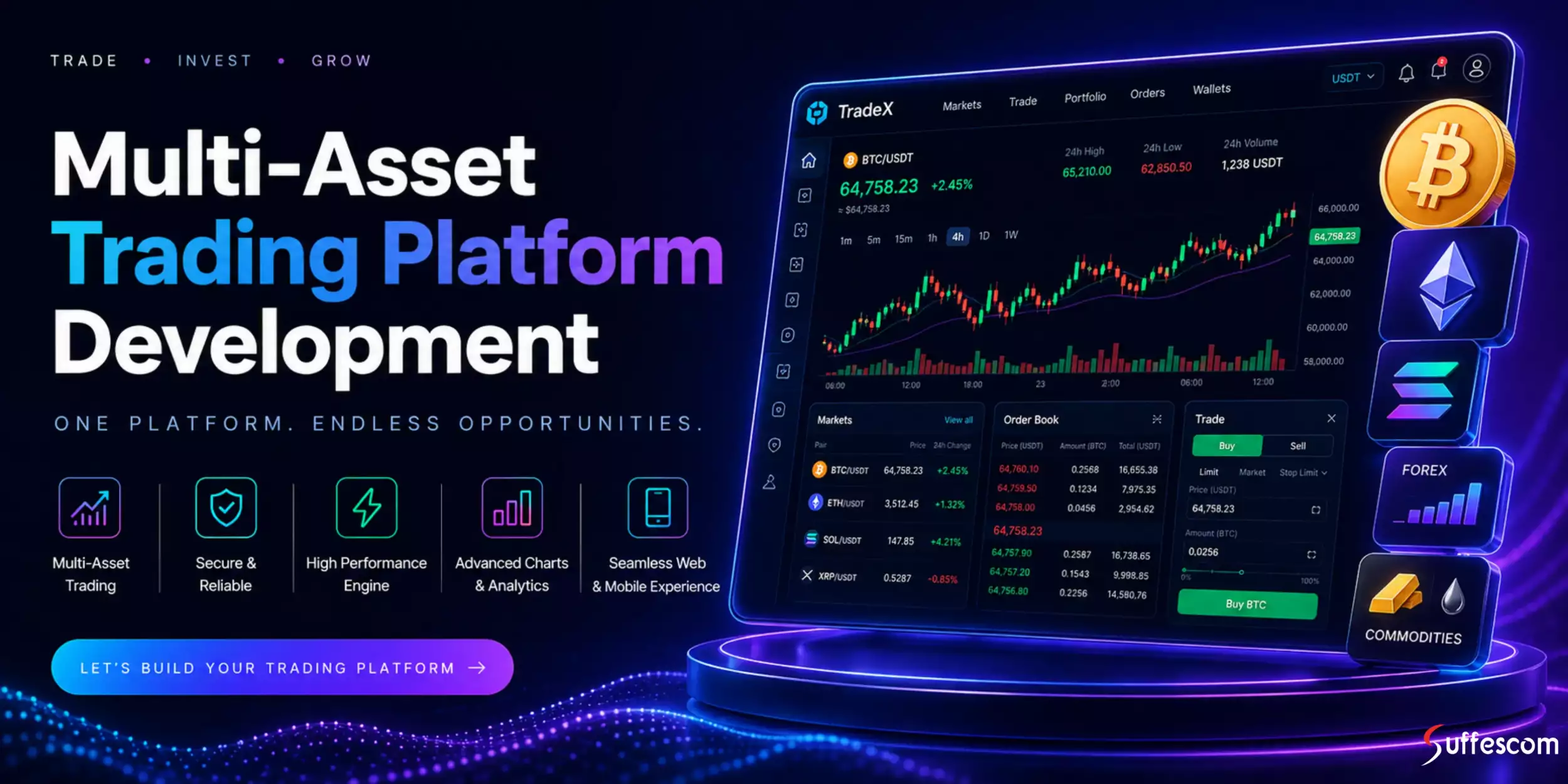
A multi-asset trading platform is a unified trading system that allows users to access and manage multiple financial instruments through a single account, interface, and technology infrastructure. Depending on the business model and regulatory permissions, the platform can support asset classes such as stocks, forex, cryptocurrencies, commodities, futures, options, bonds, and CFDs.
Unlike a single-asset trading application, a multi-asset platform must accommodate different market structures, pricing models, order types, settlement processes, trading sessions, margin requirements, and regulatory obligations.
The primary engineering challenge is therefore not simply adding more asset classes. It is creating a common infrastructure where each asset class can retain its specific trading logic while sharing core services such as account management, risk management, order processing, reporting, and portfolio management.
Modern multi-asset brokerage platforms increasingly use a single-account model, unified portfolio views, real-time market data, and centralized risk management to provide traders with a consistent experience across markets.
Why Build a Multi-Asset Trading Platform?
The traditional approach of operating separate systems for different markets creates fragmented user experiences and increases operational complexity. A trader may need one application for equities, another for forex, and another for crypto, while the broker maintains separate systems for order management, reporting, liquidity, and risk.
A unified multi-asset trading platform addresses this fragmentation by consolidating these workflows into one ecosystem.
Key Benefits of Multi-Asset Trading Platform Development
Unified trading experience: Users can access multiple financial markets through one account and interface.
Portfolio diversification: Traders can monitor stocks, forex, crypto, commodities, and derivatives from a consolidated portfolio.
Centralized risk management: Exposure, margin, P&L, and risk limits can be monitored across asset classes.
Operational efficiency: Brokers can manage accounts, orders, reporting, and compliance through centralized infrastructure.
Scalable market expansion: A modular architecture makes it easier to add new asset classes, exchanges, liquidity providers, and regions.
Improved user retention: Traders do not need to move between multiple platforms to execute different investment strategies.
Cross-asset analytics: Users can compare performance and correlations across different instruments.
Planning Your Multi-Asset Trading Architecture?
Explore the right architecture, integrations, and infrastructure for your target markets and trading model.
Asset Classes Supported by a Multi-Asset Trading Platform
The supported markets depend on the brokerage model, target geography, liquidity relationships, and regulatory permissions.
Stocks and Equities
Stock trading requires exchange connectivity, real-time market data, corporate-action processing, order routing, and settlement workflows.
A platform may support:
- Domestic equities
- International stocks
- Fractional shares
- ETFs
- ADRs
- Exchange-listed securities
- Forex
Forex trading requires connectivity with liquidity providers, price aggregation, spread management, leverage controls, and low-latency order execution.
The infrastructure may include:
- Major and minor currency pairs
- Multiple liquidity providers
- Bid and ask aggregation
- Spread and markup configuration
- A-book and B-book routing
- Real-time exposure monitoring
Cryptocurrency
Crypto trading introduces a different infrastructure model because liquidity is fragmented across centralized exchanges and the market operates continuously.
A crypto-enabled multi-asset platform may support:
- Spot trading
- Crypto derivatives
- Multiple exchanges
- Crypto wallets
- Blockchain settlement
- Custody integrations
- 24/7 trading
- Real-time order book synchronization
Crypto infrastructure must also account for exchange-specific APIs, blockchain confirmations, wallet security, and fragmented liquidity.
Commodities
Commodity trading can include instruments such as gold, silver, crude oil, natural gas, and agricultural commodities.
The platform needs to accommodate contract specifications, expiry schedules, margin requirements, tick sizes, and settlement rules.
Futures and Options
Derivatives introduce additional complexity because contracts have expiration dates, strike prices, contract multipliers, margin requirements, and specific lifecycle events.
An advanced platform may include:
- Futures contracts
- Call and put options
- Options chains
- Greeks
- Strategy builders
- Contract rollover
- Expiration management
- Multi-leg orders
- Hedging functionality
- CFDs
Contracts for Difference require broker-side pricing, leverage controls, exposure management, margin calculation, and risk monitoring.
Core Capabilities of a Modern Multi-Asset Trading Platform
A modern multi-asset trading platform requires a combination of trading, market data, risk, liquidity, and operational capabilities to support multiple financial markets through a unified infrastructure.
1. Unified Trading Dashboard
Provides a consolidated view of balances, positions, margin, P&L, active orders, portfolio allocation, and market activity across asset classes.
2. Multi-Asset Order Management
Manages order creation, validation, modification, cancellation, routing, execution, and trade confirmation while applying asset-specific trading rules.
3. Real-Time Market Data
Aggregates live prices, order-book data, volume, and market information from exchanges, brokers, liquidity providers, and other data sources.
4. Liquidity Aggregation and Smart Order Routing
Combines liquidity from multiple venues and determines suitable execution routes based on price, liquidity, transaction costs, execution speed, and venue availability.
5. Real-Time Risk Management
Monitors margin, leverage, exposure, position limits, P&L, and liquidation thresholds while applying pre-trade and post-trade risk controls.
6. Portfolio and Multi-Currency Management
Provides consolidated portfolio valuation, asset allocation, performance tracking, currency exposure, and multi-currency balance management across different markets.
7. Compliance and Security
Integrates KYC, AML, sanctions screening, transaction monitoring, access controls, encryption, and audit trails to support secure and compliant trading operations.
8. Settlement, Reconciliation, and Reporting
Handles post-trade settlement, balance and position reconciliation, trade confirmations, account statements, P&L reports, fees, and regulatory reporting.
9. API and Third-Party Integrations
Connects the platform with exchanges, liquidity providers, brokers, custodians, banks, payment providers, and external applications through APIs such as REST, WebSocket, and FIX.
How Does a Multi-Asset Trading Platform Work?
A multi-asset trading platform connects traders with multiple financial markets through a unified trading infrastructure. While the exact workflow varies by asset class, the core process typically follows these steps:
1. User Login and Account Validation
- The trader logs into the web or mobile trading application.
- The platform authenticates the user's identity and account.
- It verifies account status, available balance, permissions, and trading eligibility.
- Multi-factor authentication can be applied for additional security.
2. Instrument Selection
- The trader selects an instrument from a supported asset class, such as stocks, forex, crypto, commodities, futures, or CFDs.
- The platform retrieves the instrument's trading specifications, including price, trading hours, lot or contract size, leverage, and margin requirements.
3. Real-Time Market Data
- The market data engine retrieves live prices from exchanges, brokers, liquidity providers, or other market data sources.
- The platform processes and normalizes the incoming data before displaying it to the trader.
- Depending on the asset class, the interface may display bid and ask prices, order-book depth, volume, charts, and other market information.
4. Order Entry
- The trader selects an order type, such as market, limit, stop, or stop-limit.
- The platform captures parameters such as quantity, price, leverage, and time-in-force.
- The order management system creates the order and initiates validation.
5. Pre-Trade Risk Check
- The risk engine evaluates the order before execution.
- It checks available funds, margin requirements, leverage, position limits, and exposure.
- Compliance rules and trading restrictions can also be applied at this stage.
- If the order fails validation, it is rejected or returned for modification.
6. Smart Order Routing
- Once the order passes risk checks, the platform determines the appropriate execution venue.
- The smart order routing engine can evaluate price, liquidity, execution speed, transaction costs, and venue availability.
- The order is then routed to the relevant exchange, broker, liquidity provider, or trading venue.
7. Order Execution
- The selected venue matches or processes the order.
- The platform receives execution confirmations and status updates.
- Partial fills can be processed when the complete order cannot be executed immediately.
- Execution details are recorded for subsequent reconciliation and reporting.
8. Position and Account Update
After execution, the platform updates the trader's position and account balance.
The system calculates relevant changes to:
- Open positions
- Available margin
- Used margin
- Realized P&L
- Unrealized P&L
- Fees and commissions
9. Portfolio Update
- The portfolio management service incorporates the new position into the user's overall portfolio.
- The trader can view asset allocation, portfolio value, exposure, performance, and currency exposure across multiple markets.
10. Settlement and Reconciliation
- The platform initiates or coordinates post-trade settlement according to the asset class and execution venue.
- Trade records, balances, fees, and positions are reconciled with external exchanges, brokers, custodians, or liquidity providers.
- Corporate actions and other instrument lifecycle events can also be processed where applicable.
11. Reporting and Trade History
The completed transaction is stored in the user's trading history.
The platform can generate trade confirmations, account statements, P&L reports, fee reports, and regulatory reports.
Audit logs maintain a traceable record of order creation, validation, routing, execution, and settlement.
Technical Challenges in Multi-Asset Trading Platform Development
Building a multi-asset trading platform is significantly more complex than developing a conventional trading application.
Handling Different Market Structures
Each market operates differently.
Stocks typically rely on centralized exchanges. Forex uses fragmented liquidity networks. Crypto can operate across multiple exchanges continuously. CFDs may use broker-generated pricing and internal risk management.
The platform therefore needs a common abstraction layer without removing the underlying asset-specific logic.
Achieving Low-Latency Trade Execution
Trading systems must process market data and orders with minimal latency.
Performance optimization may require:
- In-memory processing
- WebSocket streaming
- Efficient serialization
- Asynchronous messaging
- Connection pooling
- Load balancing
- Horizontal scaling
- Low-latency networking
Latency becomes especially important for high-frequency market data and time-sensitive order execution.
Building a Unified Risk Engine
A unified risk engine must calculate exposure across different instruments while applying instrument-specific rules.
It should support:
- Initial margin
- Maintenance margin
- Available margin
- Leverage
- Position limits
- Liquidation
- Cross-asset exposure
- Currency conversion
Managing Market Data at Scale
Market data can generate extremely high event volumes during volatile market conditions.
The platform needs a resilient data pipeline that can:
- Receive market data.
- Validate incoming events.
- Normalize different formats.
- Aggregate prices where required.
- Distribute data to trading terminals.
- Store historical information.
- Recover from feed interruptions.
Corporate Actions and Instrument Lifecycle
Equities and derivatives introduce lifecycle events that cannot be ignored.
The system may need to process:
- Stock splits
- Dividends
- Bonus issues
- Rights issues
- Spin-offs
- Contract expiry
- Futures rollover
- Options expiry
- Instrument delisting
Modern multi-asset back ends can use dedicated lifecycle and corporate-action engines to process these events while keeping account and position records synchronized.
Regulatory Compliance Across Markets
A multi-asset platform operating across jurisdictions may need to support multiple regulatory frameworks simultaneously.
Depending on the market, this can involve:
- KYC and AML
- MiFID II
- EMIR
- DORA
- SEC requirements
- FINRA requirements
- FCA requirements
- MAS requirements
- FATF recommendations
- Local securities regulations
The applicable requirements depend on the platform's business model, target markets, licensing structure, and asset classes.
APIs and Integrations Required for a Multi-Asset Trading Platform
API connectivity is fundamental to multi-asset trading infrastructure.
Exchange APIs
Exchange connectivity provides:
- Market data
- Order submission
- Order status
- Trade confirmations
- Instrument information
Liquidity Provider APIs
Liquidity APIs allow the platform to receive prices and route orders to external liquidity sources.
FIX API
FIX is commonly used for institutional trading connectivity between brokers, exchanges, banks, and other financial institutions.
REST APIs
REST APIs can support:
- Account services
- User management
- Portfolio data
- Trading history
- Reporting
- Administrative functions
WebSocket APIs
WebSocket connections are useful for real-time:
- Price updates
- Order status
- Position updates
- Notifications
- Portfolio changes
Banking and Payment APIs
Payment integrations allow users to fund and withdraw from their trading accounts.
These can include:
- Bank transfers
- Payment gateways
- Cards
- Digital wallets
- Open banking services
- Crypto payment infrastructure
Technology Stack for Multi-Asset Trading Platform Development
The technology stack should be selected according to expected trading volume, latency requirements, supported markets, compliance requirements, and deployment model. A representative stack can include:
| Layer | Recommended Technologies |
| Frontend | React.js, Next.js, TypeScript |
| Mobile | Flutter, React Native, Swift, Kotlin |
| Backend | Java, Go, Node.js, Python |
| APIs | REST, WebSocket, FIX |
| Database | PostgreSQL, MySQL |
| Cache | Redis |
| Messaging | Apache Kafka, RabbitMQ |
| Cloud | AWS, Microsoft Azure, Google Cloud |
| Containerization | Docker, Kubernetes |
| Market data | Exchange APIs, FIX feeds, WebSocket feeds |
| Blockchain | Ethereum, Solana, other supported networks |
| Monitoring | Prometheus, Grafana, ELK Stack |
Multi-Asset Trading Platform Development Process
A structured development process helps align the platform's architecture, trading workflows, integrations, security, and regulatory requirements from the beginning. The process can be divided into the following stages:
1. Define the Trading Model
Start by identifying the type of platform and target users. The model may include:
- Retail brokerage platform
- Institutional trading platform
- Cryptocurrency brokerage
- Forex trading platform
- CFD trading platform
- Investment platform
- Proprietary trading platform
- Multi-market investment application
This decision influences the required asset classes, liquidity model, risk controls, compliance requirements, and overall architecture.
2. Select the Asset Classes
Define the markets the platform will support initially and those planned for future expansion, such as stocks, forex, crypto, commodities, futures, options, or CFDs.
Starting with a focused set of asset classes allows the architecture to be validated before introducing additional pricing, execution, margin, and settlement models.
3. Map Regulatory Requirements
Identify the regulatory requirements associated with the target markets and jurisdictions, including:
- Licensing requirements
- KYC and AML procedures
- Transaction monitoring
- Data protection
- Reporting obligations
- Recordkeeping
- Market-specific compliance requirements
Regulatory requirements should influence the architecture from the early design stage rather than being added after development.
4. Design the Trading Architecture
Define the technical architecture and core trading workflows, including:
- Order lifecycle
- Order Management System
- Execution Management System
- Risk architecture
- Market data architecture
- Liquidity connectivity
- Account and ledger model
- Position management
- Settlement workflow
- API architecture
- Compliance architecture
The architecture should keep asset-specific trading logic modular while maintaining shared services for accounts, risk, reporting, and portfolio management.
5. Develop the MVP
Build the initial version around the most important trading and operational capabilities, such as:
- User onboarding
- KYC
- Account management
- Market data
- Watchlists
- Trading charts
- Order management
- Portfolio management
- Deposits and withdrawals
- Basic reporting
The MVP should establish the core infrastructure while leaving room for additional asset classes and advanced trading capabilities.
6. Integrate Liquidity and Execution Providers
Connect the platform with the required financial-market infrastructure, including:
- Stock exchanges
- Forex liquidity providers
- Crypto exchanges
- Brokers
- Prime brokers
- Custodians
- Payment providers
- Other execution venues
APIs, FIX connectivity, and WebSocket streams can be used according to the requirements of each integration.
7. Implement Risk and Compliance Controls
Deploy the systems required to manage trading and operational risks, including:
- Pre-trade risk checks
- Margin calculation
- Leverage controls
- Position limits
- Exposure monitoring
- Liquidation rules
- KYC and AML
- Transaction monitoring
- Audit trails
- Regulatory reporting
Risk rules should be configurable for individual asset classes because margin, leverage, and exposure requirements can vary significantly between markets.
8. Test and Validate the Platform
Before production deployment, validate the platform across functional, technical, security, and performance dimensions.
Testing should include:
- Functional testing
- API and integration testing
- Performance testing
- Load and stress testing
- Security testing
- Order execution testing
- Market-data testing
- Failover testing
- Reconciliation testing
- User acceptance testing
This helps identify issues such as order-processing failures, market-data interruptions, integration errors, performance bottlenecks, and system failures before the platform handles live trading activity.
Multi-Asset Trading Platform vs Single-Asset Trading Platform
| Parameter | Single-Asset Platform | Multi-Asset Platform |
| Market access | One primary asset class | Multiple asset classes |
| Account model | Asset-specific | Unified account |
| Portfolio | Limited | Cross-asset |
| Risk engine | Narrow rules | Cross-asset risk |
| Market data | Single-feed ecosystem | Multiple feed types |
| Liquidity | Usually specialized | Multiple liquidity sources |
| Order routing | Limited venues | Multiple venues |
| Compliance | Asset-specific | Multi-market compliance |
| Architecture | Less complex | Modular and highly scalable |
| Expansion | Requires major changes | New assets can be added through modular services |
The Future of Multi-Asset Trading Platforms
The future of multi-asset trading platforms will be shaped by technologies that improve automation, connectivity, scalability, and decision-making. Key trends are expected to include:
AI for Trading Analytics
AI-powered trading analytics for market summaries, pattern recognition, sentiment analysis, portfolio insights, risk monitoring, and personalized recommendations.
Algorithms & Automations in Trading
Increasingly, platforms will have rule- and algorithm-based trading capabilities for traders and institutions.
Trading APIs
Financial firms will be able to expose trading capabilities via APIs, enabling third-party apps to plug into market access and execution.
Portfolio Intelligence for Cross-Asset Portfolios
Portfolios will go from basic P&L tracking to exposure management, correlation analysis, risk attribution, and automatic portfolio analytics.
Open Front-End Platform
A modern infrastructure for brokerage will allow separating frontend from the trading platform, thus giving businesses the option of offering web, mobile, third-party, or customized trading frontends while keeping the trading backend centralized.
Need Help Defining Your Trading Platform Requirements?
Get technical guidance on architecture, liquidity, risk management, and integrations from Suffescom Solutions.
Build a Scalable Multi-Asset Trading Platform
The success of the multi-asset trading platform involves much more than just a trading platform which supports various financial instruments. Instead, the multi-asset trading platform is a financial ecosystem that links market data, liquidity, order processing, risk management, portfolio services, compliance, settlement, and reporting via one architecture.
Suffescom Solutions assists businesses in developing scalable multi-asset trading platforms with a modular architecture built based on their trading strategy, supported asset classes, required liquidity, and regulations. The architecture ensures that the asset-specific logic remains modular while providing a consistent foundation for account management, order processing, risk management, reporting, and API integration.
Having the right architecture, a business can gradually add new markets to its platform without changing the entire structure of the platform.
FAQs
1. What is a multi-asset trading platform?
A multi-asset trading platform is a unified system that enables users to trade and manage multiple financial instruments such as stocks, forex, crypto, commodities, futures, options, and CFDs through one account and interface.
2. How does a multi-asset trading platform work?
The platform receives market data, validates trading requests, performs risk checks, routes orders to the appropriate exchange or liquidity provider, processes execution updates, and synchronizes positions, balances, P&L, reporting, and settlement.
3. What features should a multi-asset trading platform have?
Core features include a unified dashboard, multi-asset order management, real-time market data, liquidity aggregation, smart order routing, risk management, portfolio management, charting, watchlists, alerts, KYC, AML, payments, reporting, and back-office administration.
4. What is the biggest technical challenge in multi-asset trading platform development?
The main challenge is creating a unified architecture that supports different asset-specific trading, pricing, risk, settlement, and lifecycle rules without creating fragmented systems.
5. Can a multi-asset trading platform support crypto and traditional assets?
Yes. A platform can support crypto alongside stocks, forex, commodities, and derivatives if its architecture supports the different market structures, liquidity models, custody requirements, trading sessions, and settlement mechanisms.
6. Should I choose a white-label or custom trading platform?
A white-label platform can be suitable for businesses prioritizing faster deployment and standardized functionality. Custom development is better when the business requires proprietary workflows, unique risk models, specialized integrations, or extensive control over the technology architecture.
7. What APIs are required for a multi-asset trading platform?
Depending on the business model, integrations can include REST APIs, WebSocket APIs, FIX APIs, exchange APIs, liquidity-provider APIs, broker APIs, banking APIs, payment APIs, custody APIs, and blockchain APIs.
8. How long does it take to develop a multi-asset trading platform?
The timeline depends on the number of asset classes, integrations, regulatory requirements, trading functionality, security requirements, and whether the platform is being built from scratch or extended from an existing system. A proper estimate should be provided after technical and regulatory requirements are defined.
9. What technology is used to build a multi-asset trading platform?
Common technologies include React.js and Next.js for web interfaces, Flutter or React Native for mobile applications, Java, Go, Node.js, or Python for back-end services, PostgreSQL for transactional data, Redis for caching, Kafka for event streaming, and Docker and Kubernetes for deployment and orchestration.