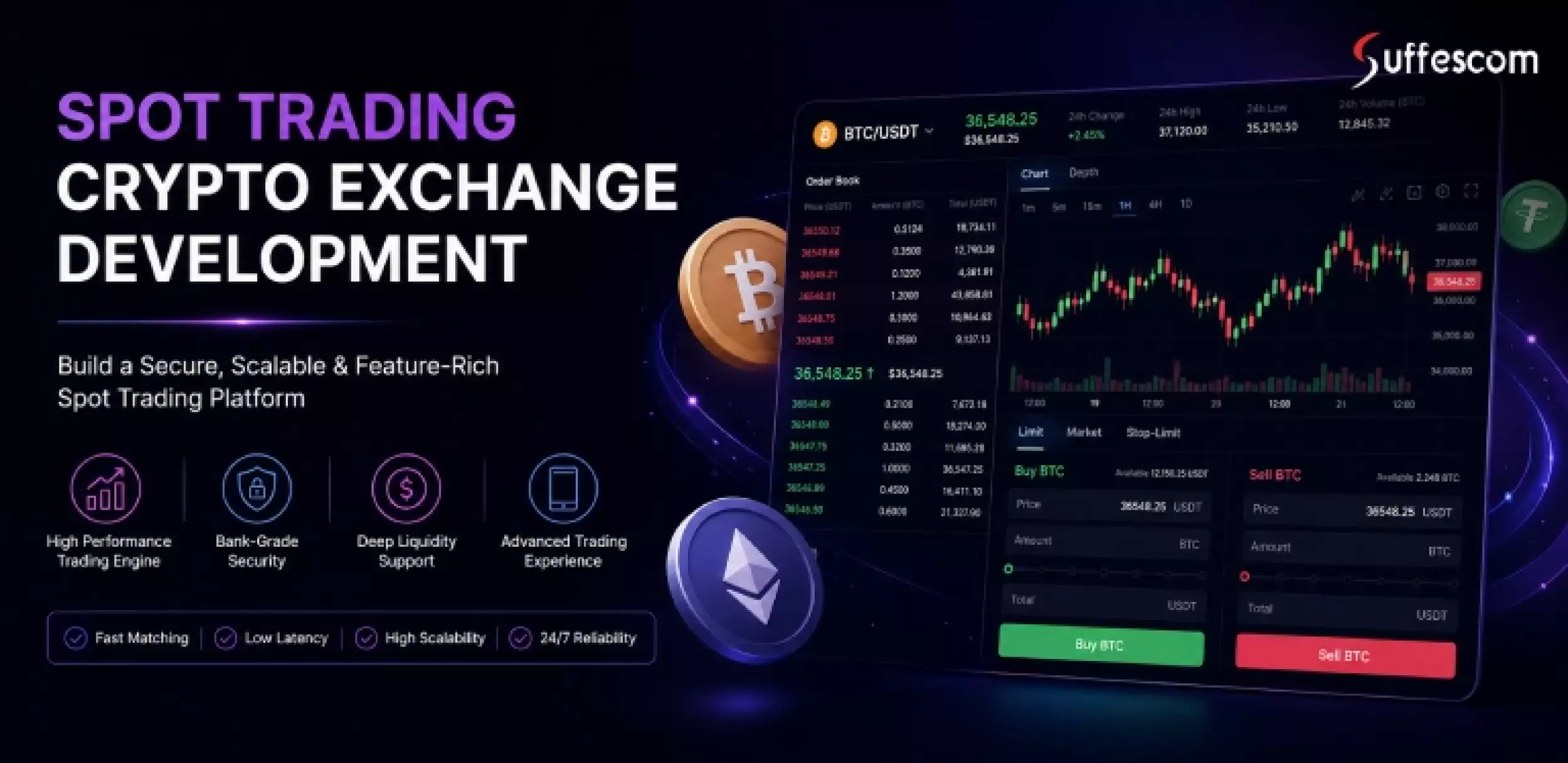
Quick Answer
Spot trading crypto exchange development is the process of building a platform where users buy and sell cryptocurrencies at real-time market prices, with the asset landing in their wallet immediately after the trade settles. A modern spot exchange is built on five core components: a matching engine, an order book, wallet integration with hot and cold storage, KYC/AML compliance, and enterprise-grade security. Development cost ranges from $15,000 for a white-label launch to $300,000+ for a custom, multi-chain, institutional-grade platform.
There are more than 650 million crypto owners globally as of 2025, and spot trading remains the entry point for nearly all of them: it's the only trading model with no leverage, no expiry, and no contract, just an asset changing hands at the price shown on screen. This guide covers what a spot exchange actually needs, what it costs, how it's built, and, just as importantly, when it's the wrong move.
What Is Spot Trading, and How Is It Different From Margin or Futures?
Spot trading is the immediate purchase or sale of a cryptocurrency at its current market price, settled within seconds and with no leverage by default. You pay the market price, you own the asset, it lands in your wallet.
Margin, futures, and perpetual swaps trade contracts based on an asset's price rather than the asset itself, usually with leverage and a future settlement date. That's a materially different regulatory and technical build, covered in our margin and derivatives trading development guide.
Key Features of a Spot Trading Exchange
Matching Engine: Pairs buy and sell orders in real time using price-time priority, the core determinant of how fair and fast the exchange feels to traders.
Order Book: Displays live bids and asks so traders can see market depth before placing an order.
Multi-Currency Wallet: Stores, deposits, and withdraws multiple cryptocurrencies, split across hot wallets for liquidity and cold storage for security (industry practice holds 90 to 95 percent of funds in cold storage).
KYC/AML Module: Verifies user identity and monitors transactions to meet regulatory requirements in each supported jurisdiction.
Advanced Order Types: Supports market, limit, and stop-loss orders so traders can execute with precision rather than only at the current price.
Admin Dashboard: Gives operators control over fees, liquidity, user activity, and compliance workflows from one panel.
Security Layer: Combines encryption, multi-factor authentication, multi-signature or MPC wallet approval, and continuous monitoring against DDoS and phishing attempts.
Feature Breakdown: For Traders
| Feature | Purpose |
| Multi-Currency Wallet | Store, deposit, and withdraw multiple cryptocurrencies securely |
| Real-Time Charts | Analyze price movements using live market data and indicators |
| Advanced Order Types | Execute market, limit, and stop-loss orders with precision |
| Live Order Book | View market depth, order history, and real-time trade execution |
| Push Notifications | Receive instant alerts for executed trades, deposits, and withdrawals |
Feature Breakdown: For Administrators
| Feature | Purpose |
| User Management | Monitor accounts, transactions, and user activity |
| KYC & Compliance Dashboard | Verify users and manage compliance workflows efficiently |
| Trading & Revenue Analytics | Track trading volume, fees, and platform performance |
| Fee & Risk Management | Configure trading fees, withdrawal limits, and platform settings |
| Customer Support Panel | Resolve support requests and manage user queries centrally |
Our position: teams that cut the admin-side feature set to save budget almost always regret it within the first six months of live trading, once volume, disputes, and compliance requests exceed what a lean dashboard can handle. Build the admin layer at full scope from day one, even on a white-label launch.
Planning to Launch Your Own Spot Trading Platform?
Discuss your business model with our blockchain experts to identify the right development approach before investing in infrastructure.
When Should a Business Invest in Spot Trading Crypto Exchange Development?
Businesses looking to launch a platform where users can buy and sell cryptocurrencies should evaluate whether a spot trading platform aligns with their operational goals, target audience, and long-term growth strategy.
Market Entry Strategy
Startups and entrepreneurs establishing a digital asset marketplace with faster deployment than derivatives platforms require.
Expansion of Product Portfolio
Fintech, brokerage, and payment companies adding crypto trading to an existing product line.
Token Liquidity
Web3 businesses launching a proprietary token that needs an immediate trading venue.
Revenue Streams
Trading commissions, listing fees, withdrawal fees, API access, and staking, layered onto one platform.
Staged Scalability
A spot exchange as the foundation, with margin, futures, or copy trading added later once liquidity is established.
Regulatory Compliance
For businesses working in regulated markets, they can first have a spot trading platform up and running with KYC/AML flows, transaction monitoring, and governance, and then move on to other financial products.
When Spot Trading Exchange Development Is the Wrong Move
No Realistic Day-one Liquidity Plan
An exchange with a thin order book produces wide spreads and slippage, and word travels fast in crypto communities. If you don't have a liquidity provider or market maker relationship lined up before launch, fix that first, not after.
Underestimating Custody Infrastructure Cost
Cold storage, key management, and multi-sig or MPC wallet setup are not a line item you add later. Businesses that treat custody as a post-launch upgrade tend to either rebuild it under pressure after a scare or absorb a loss event first.
Regulatory Mismatch With Target Market
Launching in a jurisdiction without confirming licensing requirements is the most common reason exchanges get shut down or frozen mid-operation, not hacking. Confirm licensing before writing a line of code, not after the platform is built.
Treating Compliance as a Checkbox
KYC/AML implemented as a form field rather than an ongoing transaction-monitoring system will pass an initial audit and fail the first real regulatory review.
How Spot Trading Executes: Order to Settlement
Spot trading in crypto exchange platforms follows a structured workflow, where every order passes through the matching engine, order book, wallet infrastructure, and settlement system before the transaction is completed.
Order Placement
The user submits a market order (execute immediately at the best available price) or a limit order (execute only at a specified price or better).
Order Book Matching
The matching engine pairs the buy order with a compatible sell order using price-time priority.
Trade Execution
Both parties' balances update in real time once matched.
Settlement
The asset lands in the buyer's wallet and proceeds land in the seller's wallet, typically within milliseconds on a centralized exchange.
Comparison of Spot, Margin, Futures, and P2P Crypto Trading Models
| Trading Model | Leverage | Development Complexity | Regulatory Complexity | Best For |
| Spot Trading | No | Low | Low | First-time exchange launches, startups, and users looking to buy and sell cryptocurrencies at market prices |
| Margin Trading | Yes | Medium | Medium–High | Exchanges with established spot liquidity and active traders seeking leveraged positions |
| Futures Trading | Yes (High) | High | High | Mature exchanges offering derivatives trading with the required regulatory approvals |
| P2P Trading | No | Medium | Varies by jurisdiction | Businesses targeting regions with limited fiat-to-crypto banking infrastructure |
Spot Trading Crypto Exchange Architecture That Powers Modern Trading Platforms
A powerful spot trading crypto exchange architecture consists of various integrated layers that help deliver fast trade execution, asset management, real-time data processing, and compliance requirements. Every layer has its own function aimed at providing a smooth trading experience along with scalability and a high volume of transactions.
User Interface Layer
Offers users an intuitive trading dashboard across web platforms and a spot trading crypto app, enabling them to view live market data, place buy and sell orders, manage portfolios, and monitor trades in real time.
Trading Engine Layer
Serves as the heart of the spot trading exchange software that matches buy and sell orders, maintains the order book and executes transactions with high performance.
Wallet Management Layer
Helps deposit and withdraw cryptocurrency funds, manage balances, and work with hot and cold wallets, ensuring protection of the digital assets using enterprise-level security measures.
Blockchain Integration Layer
Enables the platform to connect with blockchain networks to perform transactions, operate various cryptocurrencies, communicate with smart contracts, and synchronize blockchain data.
Security and Compliance Layer
Secures the platform using various methods such as encryption, multi-factor authentication, KYC/AML checks, and transaction monitoring.
How to Build a Spot Trading Exchange: The Process
To develop a spot trading crypto exchange, businesses need a structured development roadmap that covers platform architecture, trading engine implementation, wallet integration, compliance, security, and post-launch monitoring.
Stage 1: Determine the Scope, Jurisdiction, and Supported Trading Pairs
You should understand in advance what fiat and crypto pairs you want to provide and where you will work because that defines your KYC depth, custody approach, and even technical stack.
Stage 2: Select an Approach to Development
White-Label Development: Start with a pre-configured spot trading exchange solution with low initial expenses and limited customizability.
Custom Development: Develop a fully custom trading exchange with full control over the product and its future development, extra functionalities, and scalability that requires high expenses and longer development time.
Hybrid Development: Merge a ready-made core of the trading exchange with custom functionality to have the opportunity to deploy a product quicker than in the case of custom development.
Stage 3: Build the Trading Engine
The matching engine needs to be capable of simultaneous order matching without race conditions and must be built in a low-latency programming language (Go, C++, or Rust) and use an in-memory order book with a persistent database for recovery.
Step 4: Create Wallet and Custody System Architecture
Create a wallet hot and cold split (industry practice is about 90%-95% cold) along with blockchain node integration for all supported chains and settlement automation.
Step 5: Integrate Compliance Processes
Implement KYC/AML vendors' services, create several tiers of verification, and set up transaction monitoring rules according to target jurisdictions.
Step 6: Develop Trading Interface
The trading interface should deliver a seamless experience across both web platforms and the spot trading crypto app, with responsive charting, intuitive order placement, portfolio tracking, and real-time market updates. The lag or confusion between "buy" and "sell" positions is how the trading interface loses its credibility most quickly.
Step 7: Security Audit and Penetration Testing
There is no way an exchange should go into production mode without being tested by independent security firms doing smart contract audits (where relevant) and pen-testing.
Step 8: Testing of the System under High Load Conditions
Test the system under high load conditions to check the efficiency of the matching engine, APIs, wallets, and general stability. Ensure that the performance bottlenecks and security issues are fixed before going into the production environment.
Step 9: Deployment and Monitoring
Implement the exchange and deploy monitoring systems. Keep monitoring all aspects of the exchange to make sure there is continuous operation.
Tech Stack for Spot Trading Crypto Exchange Development
Building a high-performance spot trading cryptocurrency exchange requires a modern technology stack that supports low-latency trading, secure asset management, real-time data synchronization, and horizontal scalability. The table below outlines the core technologies:
| Technology Layer | Recommended Technologies |
| Frontend Development | React.js, Next.js, Vue.js, TypeScript |
| Backend Development | Node.js (NestJS), Go (Golang), Python (FastAPI), Java (Spring Boot) |
| Mobile App Development | Flutter, React Native, Swift, Kotlin |
| Trading Engine | Go, Rust, C++, Java (low-latency order matching) |
| Blockchain Networks | Ethereum, BNB Chain, Polygon, Solana, Avalanche, Arbitrum, Base |
| Smart Contract Development | Solidity, Rust (Solana), Hardhat, Foundry |
| Wallet Integration | WalletConnect, MetaMask SDK, MPC Wallets, Fireblocks, BitGo |
| Databases | PostgreSQL, MongoDB, Redis, TimescaleDB |
| Real-Time Communication | WebSockets, Socket.IO, Apache Kafka, RabbitMQ |
| Liquidity Integration | FIX API, REST APIs, WebSocket APIs, Liquidity Aggregators |
| Payment Integration | Stripe, MoonPay, Transak, Banxa, Banking APIs |
| Cloud & Infrastructure | AWS, Google Cloud, Microsoft Azure, Kubernetes, Docker |
| DevOps & CI/CD | GitHub Actions, GitLab CI/CD, Jenkins, Terraform |
| Security | HSM, AWS KMS, HashiCorp Vault, TLS Encryption, OAuth 2.0, JWT |
| Identity & Compliance | Sumsub, Onfido, Trulioo, Chainalysis, TRM Labs |
| Monitoring & Analytics | Prometheus, Grafana, ELK Stack, Datadog, New Relic |
How Much Does Spot Trading Exchange Development Cost?
Development cost ranges from $15,000 to $300,000+, depending on development approach, feature scope, blockchain integrations, and compliance requirements across target jurisdictions. See the development approach comparison above for a full breakdown by tier.
Working with an experienced cryptocurrency exchange development company helps businesses accurately estimate development costs and select the right architecture based on their growth objectives.
| Development Approach | Estimated Cost | Development Timeline | Best For |
| White-Label Spot Trading Exchange Software | $15,000 – $50,000 | 2–6 weeks | Startups and businesses looking for a quick launch with essential trading features and branding customization. |
| Custom Mid-Scale Spot Trading Crypto Exchange | $50,000 – $150,000 | 4–7 months | Businesses requiring custom UI/UX, advanced trading functionality, wallet integrations, and full source code ownership. |
| Enterprise-Grade Multi-Chain Exchange Platform | $150,000 – $300,000+ | 7–12+ months | Large enterprises building a high-performance platform with multi-chain support, institutional-grade security, deep liquidity integration, and global compliance capabilities. |
Not sure whether white-label or custom development fits your budget?
Our consultants can help estimate the right architecture and investment based on your business goals.
Security and Compliance Requirements
A secure exchange is built on a multi-layered security architecture that safeguards digital assets, protects sensitive user data, and ensures compliance with evolving regulatory frameworks. The following security controls are fundamental to developing a reliable trading platform.
- Cold storage for the large majority of user funds (90 to 95 percent, industry standard)
- Multi-signature or MPC wallet approval for large withdrawals
- Independently published, named security audits, not just an internal claim of testing
- Jurisdiction-specific KYC/AML integration
- A documented incident response plan
Exchanges that treat compliance as an afterthought face regulatory shutdowns, user fund losses, or both. This is where experience matters more than almost anything else in this space, and where cost-cutting shortcuts tend to surface publicly, often after it's too late to fix quietly.
Challenges in Spot Trading Cryptocurrency Exchange
Developing a spot trading crypto exchange presents several challenges from a technical, operational, and regulatory standpoint. It is important to consider these early on as a means of improving the performance, security, and reliability of the platform.
Guaranteeing High Liquidity
Challenge: Low liquidity translates into increased spreads, slippage, and delayed orders, resulting in a poor user experience.
Solution: Integrate liquidity providers, work with market makers, and bring together liquidity from different sources to guarantee an active order book from day one.
Maintaining High Trading Speeds
Challenge: Increased trading volumes cause latency and slow order execution if the platform is not scalable.
Solution: Implement a high-speed matching engine, microservices, and market data feeds based on WebSockets to guarantee high speeds in trade execution.
Compliance
Challenge: Different jurisdictions have their own requirements when it comes to licensing, KYC/AML, and reporting, adding more complexity to the compliance process.
Solution: Automate the KYC/AML verification process, transaction monitoring, and comply with other compliance requirements based on your target market regulations.
Securing User Assets
Challenge: Exchanges are prime targets for cyber-attacks, wallet thefts, and malicious activities related to account hacking.
Solution: Secure your platform with MFA, cold storage, encryption, multi-sig/MPC wallets, and regular security audits to guarantee
Future Trends in Spot Trading Crypto Exchange Development
Order Matching using Artificial Intelligence
The implementation of artificial intelligence in order-matching engines helps achieve efficient order routing, effective utilization of liquidity, minimized slippage, and trade execution at faster speeds during high volatility.
Fraud Detection and AML Compliance using Machine Learning
Modern exchanges are making use of AI and ML to discover fraudulent transactions, spot market manipulation, automate AML compliance checks, and strengthen real-time risk management without affecting users' experience.
Trading Across Various Blockchain Networks
Exchanges of the future are integrating various blockchain networks and are offering users the ability to trade tokens across various blockchain networks, including Ethereum, Solana, BNB Chain, Polygon, and more.
Decentralized and Centralized Liquidity Aggregation
CEXs are increasingly looking to integrate decentralized liquidity and aggregate liquidity pools across DeFi protocols for improved order matching, narrower spreads, and better access to liquidity.
Tokenized RWA (Real-World Asset) Trading
Spot exchanges are increasingly venturing out of the crypto space and listing tokenized real-world assets such as government bonds, commodities, real estate, and private equity funds.
Institutional Custodial Solutions Based on MPC
As the involvement of institutions in the exchange grows, exchanges are implementing Multi-Party Computation (MPC) wallets and other custodial solutions for enhanced private key security.
Build Spot Trading Crypto Exchange With Suffescom Solutions
Choosing the right spot-trading crypto exchange development company is crucial for building a secure, scalable, and future-ready trading platform. At Suffescom Solutions, we develop high-performance spot trading cryptocurrency exchanges featuring low-latency matching engines, multi-chain wallet integration, enterprise-grade security, robust liquidity infrastructure, and compliance-ready architecture tailored to your business objectives.
From strategy and UI/UX design to development, testing, and deployment, Suffescom blockchain specialists will assist businesses in speeding up time to market through the creation of scalable, secure, and compliance-oriented platforms.
FAQs
1. What is spot trading in a crypto exchange?
Spot trading is buying or selling cryptocurrency at the current market price, with ownership transferring immediately after the trade executes. Unlike derivatives, it involves no leverage and no future contract.
2. How long does it take to build a spot trading crypto exchange?
A white-label launch typically takes 2 to 6 weeks. A custom platform typically takes 4 to 7 months, depending on feature complexity, blockchain integrations, and compliance scope.
3. How much does it cost to build a spot trading crypto exchange?
Cost ranges from $15,000 to over $300,000, depending on development approach, feature scope, and compliance requirements.
4. Is white-label spot trading exchange software a good starting point?
Yes, for speed to market, provided source code ownership and exit terms are confirmed in writing before signing. It's the wrong choice if long-term differentiation and full platform control matter more than launch speed.
5. What's the difference between spot trading and margin or futures trading?
Spot trading involves immediate settlement of the actual asset with no leverage. Margin and futures trade contracts based on the asset's price, usually with leverage, and carry higher technical and regulatory complexity.
6. Do I need a license to launch a spot trading crypto exchange?
Licensing requirements vary by jurisdiction and depend on custody model, fiat support, and local financial regulation. Confirm licensing requirements before development begins, not after the platform is built.
7. What are the essential features of a spot trading crypto exchange?
A matching engine, multi-currency wallet with hot and cold storage, live order book, KYC/AML compliance, advanced order types, an admin dashboard, and independently audited security controls.
8. How do I choose a spot trading exchange development company?
Prioritize a verifiable track record with still-operating exchanges, named security audit partners, written source code ownership terms, and jurisdiction-specific compliance experience. Treat price as the last filter, not the first.